Overview
Agreement with intervening phrases represents one of the most frequently tested grammar concepts on the ACT English section. This topic examines a student's ability to maintain proper subject-verb agreement even when modifying phrases, clauses, or prepositional phrases separate the subject from its verb. The ACT test writers deliberately insert these intervening elements to distract students from identifying the true subject of a sentence, making this a high-yield area for point gains when mastered.
Understanding this concept is essential because subject-verb agreement questions appear in approximately 10-15% of all ACT English questions, making them among the most common grammar items tested. The challenge lies not in the rule itself—subjects and verbs must agree in number—but in the test's strategic placement of distracting phrases between these elements. Students who can mentally "cross out" or ignore intervening phrases to identify the core subject-verb relationship will consistently answer these questions correctly.
This topic connects fundamentally to broader grammar and usage principles tested throughout the ACT English section. Mastery of ACT agreement with intervening phrases builds upon basic subject-verb agreement knowledge while preparing students for more complex sentence structure questions. It also relates closely to pronoun-antecedent agreement, modification, and sentence structure analysis—all critical skills for achieving a top English subscore.
Learning Objectives
- [ ] Identify when Agreement with intervening phrases is being tested
- [ ] Explain the core rule or strategy behind Agreement with intervening phrases
- [ ] Apply Agreement with intervening phrases to ACT-style questions accurately
- [ ] Distinguish between the true subject and objects within intervening phrases
- [ ] Recognize common intervening phrase patterns that appear on the ACT
- [ ] Eliminate incorrect answer choices by isolating subject-verb pairs
- [ ] Apply agreement rules to compound subjects separated by intervening phrases
Prerequisites
- Basic subject-verb agreement: Understanding that singular subjects take singular verbs and plural subjects take plural verbs is foundational to recognizing when intervening phrases create agreement errors
- Parts of speech identification: Recognizing nouns, verbs, and prepositions enables students to identify which words form the core sentence structure versus which words serve as modifiers
- Prepositional phrase recognition: Since prepositional phrases are the most common type of intervening phrase, students must identify them to avoid mistaking their objects for the sentence subject
- Singular vs. plural noun forms: Distinguishing between singular and plural nouns allows students to determine correct verb forms even when multiple nouns appear in a sentence
Why This Topic Matters
In real-world writing and communication, maintaining subject-verb agreement ensures clarity and professionalism. Readers expect grammatical consistency, and agreement errors can undermine a writer's credibility or create confusion about meaning. Academic writing, business correspondence, and professional communication all demand mastery of this fundamental grammar principle.
On the ACT English section, subject-verb agreement questions with intervening phrases appear with remarkable frequency—typically 3-5 questions per test. These questions often appear in the first 40 questions of the 75-question English section, making them critical for establishing momentum and confidence. The ACT consistently tests this concept because it effectively distinguishes students who understand sentence structure from those who rely on "what sounds right," which can be misleading when complex phrases intervene.
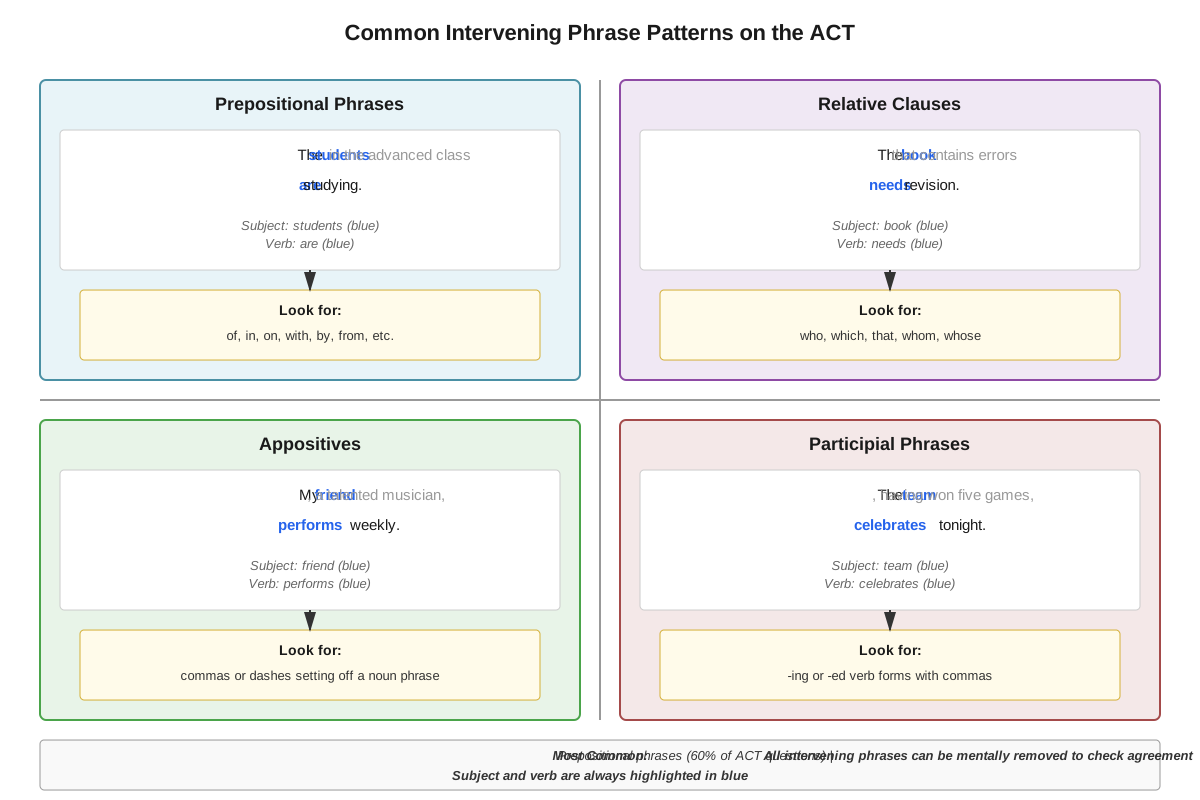
Common ACT presentations include: sentences with prepositional phrases between subject and verb ("The collection of stamps is valuable"), relative clauses that separate elements ("The student who takes advanced classes performs well"), appositive phrases that add information ("My friend, along with her siblings, visits often"), and participial phrases that modify the subject ("The athletes training for the championship need rest"). Each pattern requires students to mentally strip away the intervening material to identify the true subject-verb relationship.
Core Concepts
The Fundamental Agreement Rule
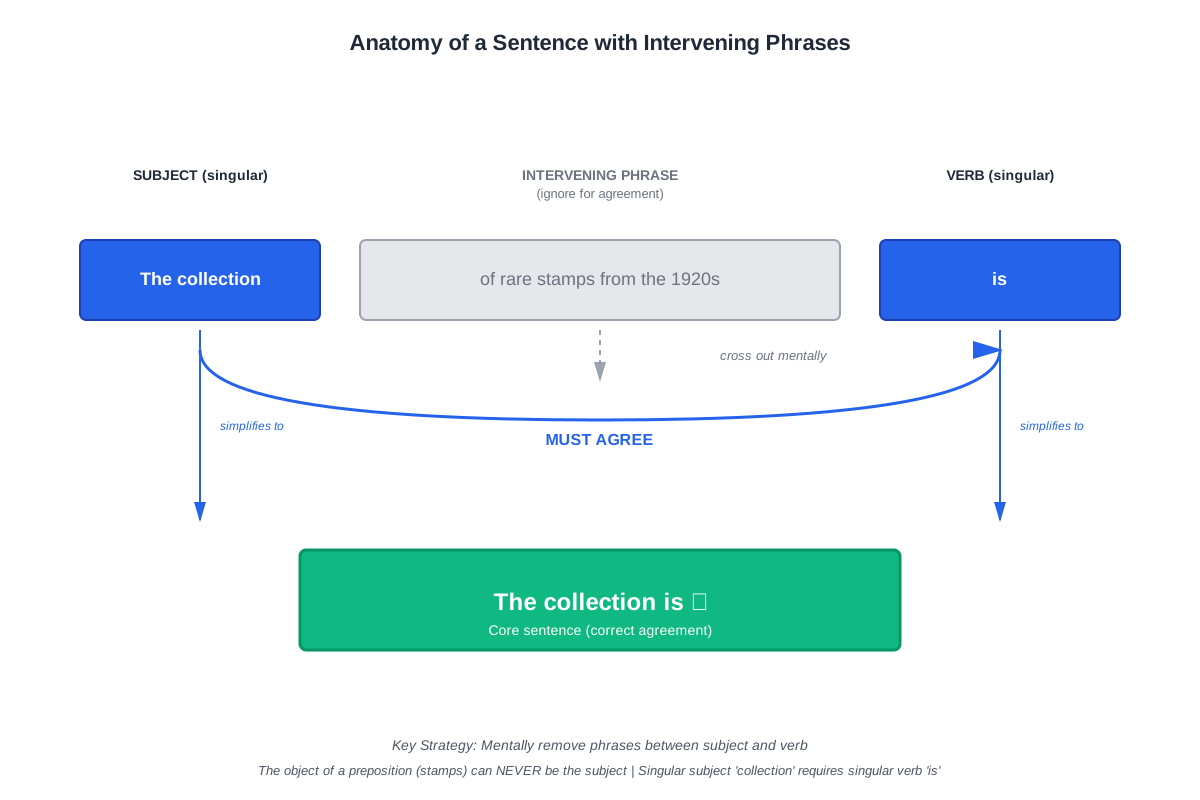
The core principle of agreement with intervening phrases states that the verb must agree with the actual subject of the sentence, not with any nouns that appear in modifying phrases between the subject and verb. This rule remains constant regardless of how many words, phrases, or clauses separate the subject from its verb. The challenge on the ACT lies in identifying which noun serves as the true subject when multiple nouns appear in close proximity.
To apply this rule effectively, students must locate the simple subject (the main noun or pronoun performing the action) and match it with the appropriate verb form. All intervening material—no matter how lengthy or complex—should be temporarily ignored when determining agreement. This mental "bracketing" technique allows students to see the core sentence structure clearly.
Prepositional Phrases as Intervening Elements
Prepositional phrases represent the most common type of intervening phrase on the ACT. These phrases begin with prepositions (of, in, on, with, for, to, by, from, etc.) and end with a noun or pronoun called the object of the preposition. The critical rule: the object of a preposition can never be the subject of a sentence.
Consider this example: "The box of chocolates [is/are] on the table." Students might be tempted to match "are" with "chocolates" because "chocolates" appears immediately before the verb. However, "chocolates" is the object of the preposition "of," making "box" the true subject. Since "box" is singular, the correct verb is "is."
Common prepositional phrases that create agreement challenges include:
- of + plural noun (e.g., "group of students," "collection of books")
- with + noun (e.g., "teacher with assistants")
- along with + noun (e.g., "manager along with employees")
- in addition to + noun (e.g., "report in addition to charts")
- as well as + noun (e.g., "director as well as actors")
Relative Clauses as Intervening Elements
Relative clauses (also called adjective clauses) begin with relative pronouns such as who, which, that, whom, or whose. These clauses modify nouns and can create substantial distance between a subject and its verb. The verb following the relative clause must still agree with the main subject, not with any noun within the clause.
Example: "The scientist who conducts experiments in multiple laboratories [has/have] published groundbreaking research." The relative clause "who conducts experiments in multiple laboratories" modifies "scientist," but the main verb must agree with "scientist" (singular), making "has" correct.
Appositive and Parenthetical Phrases
Appositives are noun phrases that rename or provide additional information about another noun. They often appear between commas, dashes, or parentheses. These phrases can be lengthy and contain plural nouns, but they do not affect subject-verb agreement.
Example: "The CEO, together with the board members and senior executives, [makes/make] the final decision." Despite the plural nouns in the appositive phrase, "CEO" remains the singular subject, requiring "makes."
Parenthetical expressions introduced by phrases like "along with," "together with," "as well as," "in addition to," and "accompanied by" function similarly—they add information but do not change the number of the subject.
Compound Subjects vs. Intervening Phrases
Students must distinguish between true compound subjects (connected by "and," which typically create plural subjects) and subjects with intervening phrases. This distinction is crucial for ACT success.
| Structure | Example | Verb Form | Explanation |
|---|---|---|---|
| Compound subject | The teacher and the student are present | Plural | Two subjects joined by "and" |
| Subject with intervening phrase | The teacher, along with the student, is present | Singular | One subject with additional information |
| Compound subject | Books and magazines fill the shelf | Plural | Two subjects performing the action |
| Subject with intervening phrase | The shelf of books and magazines is full | Singular | One subject ("shelf") with prepositional phrase |
Inverted Sentence Structures
Occasionally, the ACT presents sentences where the verb precedes the subject, particularly in sentences beginning with "there" or "here" or in questions. Intervening phrases in these structures can be especially tricky.
Example: "There [is/are] in the laboratory several microscopes for student use." The phrase "in the laboratory" intervenes, but the true subject is "microscopes" (plural), requiring "are."
Concept Relationships
The concepts within agreement with intervening phrases build upon each other hierarchically. The fundamental agreement rule serves as the foundation, establishing that subjects and verbs must match in number regardless of intervening material. This principle → leads to → the identification strategy of locating the true subject by eliminating intervening phrases.
Prepositional phrase recognition → connects to → the broader concept because these phrases represent the most frequent type of intervening element. Mastering prepositional phrase identification → enables → quick recognition of objects that cannot serve as subjects. This skill → combines with → relative clause recognition to handle more complex sentence structures.
The distinction between compound subjects and subjects with intervening phrases → relates back to → the fundamental rule while → extending to → more nuanced applications. Understanding parenthetical expressions → builds upon → appositive recognition and → reinforces → the principle that additional information does not change the core subject-verb relationship.
All these concepts → connect to → prerequisite knowledge of basic subject-verb agreement while → preparing students for → related topics such as pronoun-antecedent agreement and modification. The mental bracketing technique used here → transfers to → analyzing sentence structure questions and → supports → overall reading comprehension on the ACT.
High-Yield Facts
⭐ The verb must agree with the subject of the sentence, never with the object of a preposition in an intervening phrase
⭐ Prepositional phrases beginning with "of" are the most common intervening elements on the ACT
⭐ Phrases introduced by "along with," "together with," "as well as," and "in addition to" do not change the number of the subject
⭐ When a relative clause (who, which, that) intervenes, the main verb still agrees with the main subject
⭐ Compound subjects joined by "and" are plural, but a singular subject with an intervening phrase remains singular
- Appositive phrases set off by commas, dashes, or parentheses do not affect subject-verb agreement
- The word "each" is always singular, even when followed by a prepositional phrase with plural objects
- Collective nouns (group, team, committee) are typically singular in American English, regardless of intervening phrases
- Inverted sentences (beginning with "there" or "here") still follow standard agreement rules once the subject is identified
- The ACT will never test agreement with subjects more than 15-20 words away from their verbs, but will use that space strategically
Quick check — test yourself on Agreement with intervening phrases so far.
Try Flashcards →Common Misconceptions
Misconception: The verb should agree with the noun closest to it in the sentence. → Correction: The verb must agree with the actual subject of the sentence, which may be several words away. Proximity does not determine agreement; grammatical function does. The ACT deliberately places plural nouns near verbs to test whether students can identify the true subject.
Misconception: Phrases like "along with" and "together with" create compound subjects that require plural verbs. → Correction: These phrases are parenthetical expressions that add information but do not create compound subjects. Only "and" creates a true compound subject. A sentence like "The teacher, along with students, is here" has a singular subject ("teacher") despite the additional people mentioned.
Misconception: If a sentence contains multiple nouns, the verb should be plural. → Correction: The number of nouns in a sentence is irrelevant; only the number of the specific subject matters. A sentence can contain five plural nouns but still require a singular verb if the subject is singular.
Misconception: Long sentences with complex structures follow different agreement rules. → Correction: Subject-verb agreement rules remain constant regardless of sentence length or complexity. The strategy changes (requiring more careful analysis), but the fundamental rule does not.
Misconception: Collective nouns with plural-sounding meanings (like "team" or "group") should take plural verbs. → Correction: In American English (which the ACT follows), collective nouns are treated as singular when the group acts as a single unit. "The team of players is ready" is correct because the team acts as one entity.
Misconception: Relative pronouns (who, which, that) change the subject of the sentence. → Correction: Relative pronouns introduce dependent clauses that modify nouns but do not change the main subject. The main verb must still agree with the main subject, not with anything in the relative clause.
Worked Examples
Example 1: Prepositional Phrase Intervention
Question: The collection of rare coins from various countries (A) are (B) is (C) were (D) have been displayed in the museum.
Step 1 - Identify the verb: The underlined portion contains the verb that must agree with the subject.
Step 2 - Locate the subject: Find the main noun performing the action. "Collection" is the subject. "Coins" and "countries" are objects of prepositions ("of rare coins" and "from various countries").
Step 3 - Eliminate intervening phrases: Mentally bracket the prepositional phrases: "The collection [of rare coins from various countries] ___ displayed in the museum."
Step 4 - Determine subject number: "Collection" is singular (one collection, even though it contains multiple coins).
Step 5 - Match verb to subject: A singular subject requires a singular verb. The sentence appears to be in present tense based on context.
Step 6 - Evaluate answer choices:
- (A) "are" - plural verb, incorrect
- (B) "is" - singular verb, correct match
- (C) "were" - plural verb, incorrect
- (D) "have been" - plural verb, incorrect
Answer: (B) is
Connection to learning objectives: This example demonstrates identifying when agreement is tested (objective 1), applying the core rule of ignoring intervening phrases (objective 2), and accurately selecting the correct answer (objective 3).
Example 2: Multiple Intervening Elements
Question: The director of the film, along with the lead actors and the production crew, (F) have arrived (G) has arrived (H) are arriving (J) were arriving at the premiere.
Step 1 - Identify the subject: "Director" is the main subject. This sentence contains multiple nouns that could confuse students.
Step 2 - Recognize intervening structures: Two types of intervening elements appear here:
- Prepositional phrase: "of the film"
- Parenthetical phrase: "along with the lead actors and the production crew"
Step 3 - Apply the parenthetical phrase rule: Phrases beginning with "along with" do not create compound subjects. They add information but do not change the subject's number.
Step 4 - Simplify the sentence: "The director [of the film, along with the lead actors and the production crew] ___ at the premiere."
Step 5 - Determine agreement: "Director" is singular, requiring a singular verb.
Step 6 - Consider tense: The sentence describes a completed action (arriving at the premiere), suggesting present perfect or simple past. However, we must focus on number agreement first.
Step 7 - Evaluate choices:
- (F) "have arrived" - plural verb, incorrect
- (G) "has arrived" - singular verb, correct
- (H) "are arriving" - plural verb, incorrect
- (J) "were arriving" - plural verb, incorrect
Answer: (G) has arrived
Connection to learning objectives: This example shows how to distinguish the true subject from objects in intervening phrases (objective 4), recognize common ACT patterns (objective 5), and eliminate incorrect choices systematically (objective 6).
Exam Strategy
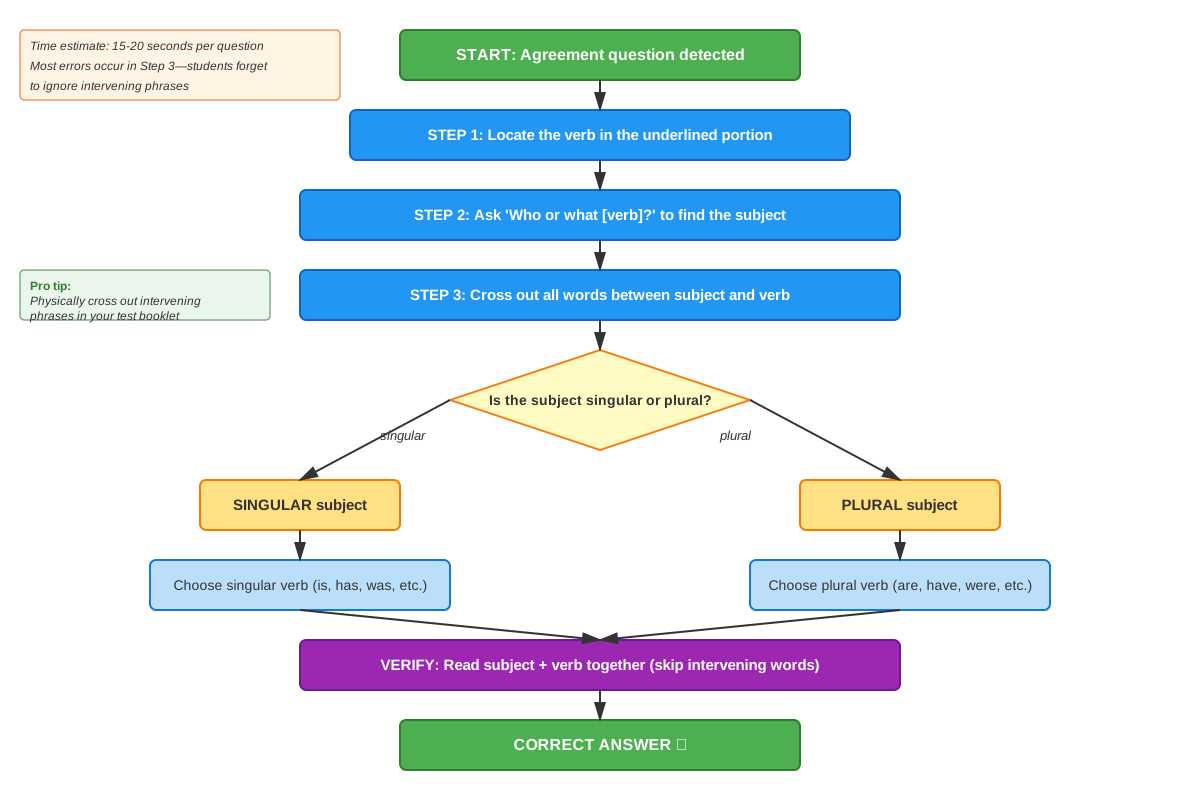
When approaching ACT questions testing agreement with intervening phrases, follow this systematic process:
Step 1 - Identify that agreement is being tested: Look for underlined verbs with multiple answer choices showing different verb forms (singular vs. plural, or different tenses). If the choices differ in number, agreement is likely being tested.
Step 2 - Locate the subject: Work backward from the verb to find the noun or pronoun performing the action. Ask "Who or what is doing this action?"
Step 3 - Bracket intervening material: Mentally place brackets around prepositional phrases, relative clauses, and parenthetical expressions. These elements provide information but do not affect agreement.
Step 4 - Verify subject number: Determine whether the subject is singular or plural. Watch for tricky singular subjects like "each," "every," "either," and collective nouns.
Step 5 - Match verb to subject: Select the verb form that agrees with the subject in number.
Exam Tip: On the ACT, if you see a prepositional phrase beginning with "of" between the subject and verb, the subject is almost always the noun BEFORE "of," not after it.
Trigger words and phrases to watch for:
- Prepositions: of, in, with, for, to, by, from, among, between
- Parenthetical introducers: along with, together with, as well as, in addition to, accompanied by
- Relative pronouns: who, which, that, whom, whose
- Punctuation: commas, dashes, or parentheses setting off phrases
Process-of-elimination strategy: Immediately eliminate answer choices with verbs that don't match the subject's number. If two choices remain with correct agreement, consider tense and voice as secondary factors.
Time allocation: These questions should take 15-20 seconds once you've mastered the technique. Spend 5 seconds identifying the subject, 5 seconds eliminating intervening phrases, and 5-10 seconds selecting and confirming your answer.
Memory Techniques
The "Bracket Method" Mnemonic: B.R.A.C.K.E.T.
- Backtrack to find the subject
- Remove prepositional phrases
- Assess subject number (singular or plural)
- Check for parenthetical phrases
- Keep only subject and verb
- Eliminate mismatched verbs
- Test your answer by reading the simplified sentence
Visualization Strategy: Picture the sentence as a bridge. The subject and verb are the two support pillars that must match in size (number). All the intervening phrases are decorative elements hanging from the bridge—they add beauty and information but don't support the structure. If the pillars don't match, the bridge collapses.
The "OF" Rule Acronym: O.F.F. - "Object Follows, Forget it!" When you see "of," remember that what follows is an object, not the subject, so forget it when determining agreement.
Parenthetical Phrase Memory Device: "A.T.A.I. phrases don't add subjects" - Along with, Together with, As well as, In addition to. These phrases add information but never create compound subjects.
Summary
Agreement with intervening phrases tests a student's ability to maintain correct subject-verb agreement when modifying phrases, clauses, or parenthetical expressions separate the subject from its verb. The fundamental rule remains constant: verbs must agree with their subjects in number, regardless of intervening material. The ACT strategically places prepositional phrases (especially those beginning with "of"), relative clauses, and parenthetical expressions between subjects and verbs to test whether students can identify the true grammatical subject. Success requires mentally bracketing or eliminating intervening elements to isolate the core subject-verb relationship. Students must distinguish between true compound subjects (joined by "and") and singular subjects with additional information (introduced by phrases like "along with" or "together with"). Mastering this high-yield topic—which appears in 10-15% of ACT English questions—provides a reliable path to points through systematic application of the bracketing technique and recognition of common ACT patterns.
Key Takeaways
- The verb must always agree with the actual subject, never with nouns in intervening phrases, regardless of proximity
- Prepositional phrases are the most common intervening elements; their objects can never be the sentence subject
- Phrases like "along with," "together with," and "as well as" add information but do not create compound subjects
- The mental bracketing technique—temporarily removing intervening material—reveals the core subject-verb relationship
- Compound subjects joined by "and" require plural verbs, but singular subjects with intervening phrases remain singular
- This topic appears frequently on the ACT (3-5 questions per test) and provides reliable points when mastered
- Systematic identification of the subject before evaluating verb choices prevents common errors and saves time
Related Topics
Pronoun-Antecedent Agreement: Just as verbs must agree with subjects, pronouns must agree with their antecedents in number, gender, and person. Intervening phrases can similarly obscure the true antecedent, making the skills learned here directly transferable.
Compound Subject Agreement: Understanding when multiple subjects joined by conjunctions (and, or, nor) require singular or plural verbs builds upon the distinction between true compound subjects and subjects with intervening phrases.
Verb Tense Consistency: Once agreement in number is mastered, students can focus on maintaining consistent verb tense throughout passages, another high-yield ACT English topic.
Modification and Misplaced Modifiers: The ability to identify which words modify which other words—essential for agreement questions—transfers directly to questions about modifier placement and clarity.
Sentence Structure and Fragments: Understanding the core subject-verb relationship enables students to identify complete sentences versus fragments, a related grammar concept tested on the ACT.
Practice CTA
Now that you've mastered the concepts behind agreement with intervening phrases, it's time to cement your understanding through active practice. The practice questions and flashcards designed for this topic will challenge you with ACT-style items that mirror actual test conditions. Each practice opportunity reinforces the bracketing technique and pattern recognition skills you've learned here. Remember: understanding the concept is the first step, but consistent practice transforms knowledge into automatic, test-day performance. Approach each practice question systematically, and you'll find these once-challenging items becoming reliable points on test day. You've got this!
Sign up free to keep reading
Create a free AnvayaPrep account to finish this ACT guide on Agreement with intervening phrases — plus flashcards and practice questions.