Overview
The distinction between its versus it's represents one of the most frequently tested grammar concepts on the ACT English section. This seemingly simple topic trips up countless students because it involves both apostrophe usage and pronoun understanding—two areas where common speech patterns often conflict with formal written English rules. Mastering this distinction is not merely about memorizing which form has an apostrophe; it requires understanding the fundamental difference between possessive pronouns and contractions.
On the ACT, ACT its versus it's questions appear regularly in the grammar and usage subsection, often embedded within longer passages where context clues become essential. The test makers deliberately place these questions in positions where students might rely on "what sounds right" rather than applying grammatical rules. Because many students have internalized incorrect patterns from casual writing (texts, social media, and informal emails), this topic demands conscious attention and systematic practice. A single its/it's error can cost valuable points on an exam where every question matters.
Understanding its versus it's connects directly to broader English concepts including apostrophe usage, possessive forms, contractions, and pronoun-antecedent relationships. This topic serves as a gateway to mastering other possessive pronoun distinctions (your/you're, their/they're/there, whose/who's) and reinforces the critical principle that possessive pronouns never use apostrophes. The skills developed here transfer directly to identifying and correcting similar errors throughout the ACT English section, making this a high-leverage topic for score improvement.
Learning Objectives
- [ ] Identify when its versus it's is being tested in ACT passages
- [ ] Explain the core rule or strategy behind its versus it's
- [ ] Apply its versus it's to ACT-style questions accurately
- [ ] Distinguish between possessive pronouns and contractions in context
- [ ] Recognize common trap answers that exploit its/it's confusion
- [ ] Correct its/it's errors in complex sentences with multiple clauses
- [ ] Apply the substitution test to verify correct usage in under 10 seconds
Prerequisites
- Basic apostrophe rules: Understanding that apostrophes typically indicate possession or contraction is essential for recognizing why "it's" follows contraction patterns rather than possessive patterns.
- Pronoun fundamentals: Knowing that pronouns replace nouns and must agree with their antecedents helps identify what "it" refers to in context.
- Contraction formation: Familiarity with how contractions combine two words (cannot → can't, do not → don't) provides the framework for understanding "it's" as "it is" or "it has."
- Possessive noun formation: Recognizing that most nouns form possessives with apostrophes (dog's bone, Sarah's book) creates the contrast that makes "its" exceptional.
Why This Topic Matters
In real-world writing, the its/it's distinction signals attention to detail and grammatical competence. Professional documents, academic papers, and formal correspondence all require correct usage, and errors in this area immediately undermine credibility. Employers and educators consistently cite apostrophe errors—particularly its/it's confusion—as markers of careless or inadequate writing skills. Mastering this distinction demonstrates linguistic precision that extends far beyond test-taking.
On the ACT English section, its versus it's questions appear in approximately 2-4% of all grammar questions, which translates to roughly 1-3 questions per test administration. While this might seem modest, these questions are considered "high-yield" because they're among the most predictable and quickly solvable grammar items when students know the rule. The ACT typically embeds these questions within passages about science, social studies, or narrative topics, requiring students to maintain grammatical focus while processing content. Questions appear in three primary formats: identifying errors in underlined portions, selecting the correct form from multiple choices, and determining whether a sentence contains an error.
The test makers favor contexts where both forms could seem plausible to the untrained ear, such as sentences with complex antecedents or multiple clauses. Common passage scenarios include descriptions of animals ("The bird built its nest" vs. "It's a remarkable bird"), organizations ("The company announced its merger" vs. "It's been a successful company"), or abstract concepts ("The theory has its limitations" vs. "It's a complex theory"). Understanding how to navigate these contexts efficiently can save precious seconds while ensuring accuracy.
Core Concepts
The Fundamental Rule
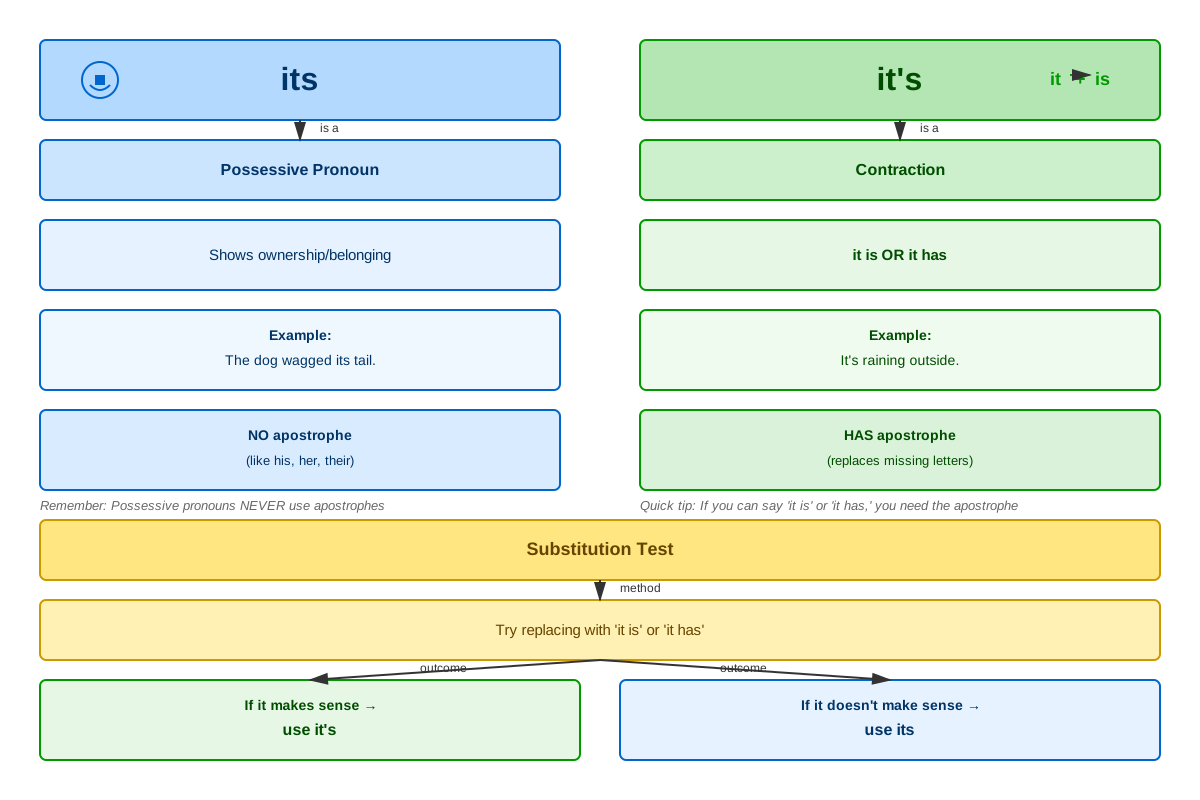
The core principle governing its versus it's is straightforward but counterintuitive: its (without an apostrophe) is the possessive form, while it's (with an apostrophe) is always a contraction meaning "it is" or "it has." This rule contradicts the pattern students learn for possessive nouns, where apostrophes typically indicate possession (the cat's toy, James's book). However, possessive pronouns—including its, his, hers, yours, theirs, whose—never use apostrophes. This exception exists because pronouns already have distinct possessive forms built into their structure.
The confusion arises because English uses apostrophes for two distinct purposes: forming contractions and indicating possession. With the pronoun "it," the apostrophe exclusively signals contraction, never possession. This distinction must be memorized as an exception to the general apostrophe-for-possession pattern.
Its: The Possessive Pronoun
Its functions as a possessive determiner or possessive pronoun, indicating that something belongs to or is associated with the antecedent "it." The word "its" always modifies a noun, showing ownership or relationship without any apostrophe. Consider these examples:
- The dog wagged its tail. (The tail belongs to the dog)
- The company released its quarterly report. (The report belongs to the company)
- The tree lost its leaves. (The leaves belong to the tree)
In each case, "its" could be replaced with "his," "her," or "their" depending on the antecedent, demonstrating its function as a possessive pronoun. The absence of an apostrophe aligns "its" with other possessive pronouns: just as we write "his book" (not "hi's book") and "her car" (not "he'r car"), we write "its purpose" without an apostrophe.
It's: The Contraction
It's serves exclusively as a contraction, combining either "it is" or "it has" into a single word. The apostrophe replaces the missing letter(s) from the second word. This form never indicates possession and always represents a verb phrase that can be expanded:
- It's raining outside. (It is raining outside)
- It's been three years since we met. (It has been three years since we met)
- It's important to study regularly. (It is important to study regularly)
The contraction "it's" functions as a subject-verb combination, where "it" serves as the subject and "is" or "has" serves as the verb. This grammatical structure differs fundamentally from the possessive "its," which modifies a noun rather than forming a verb phrase.
The Substitution Test
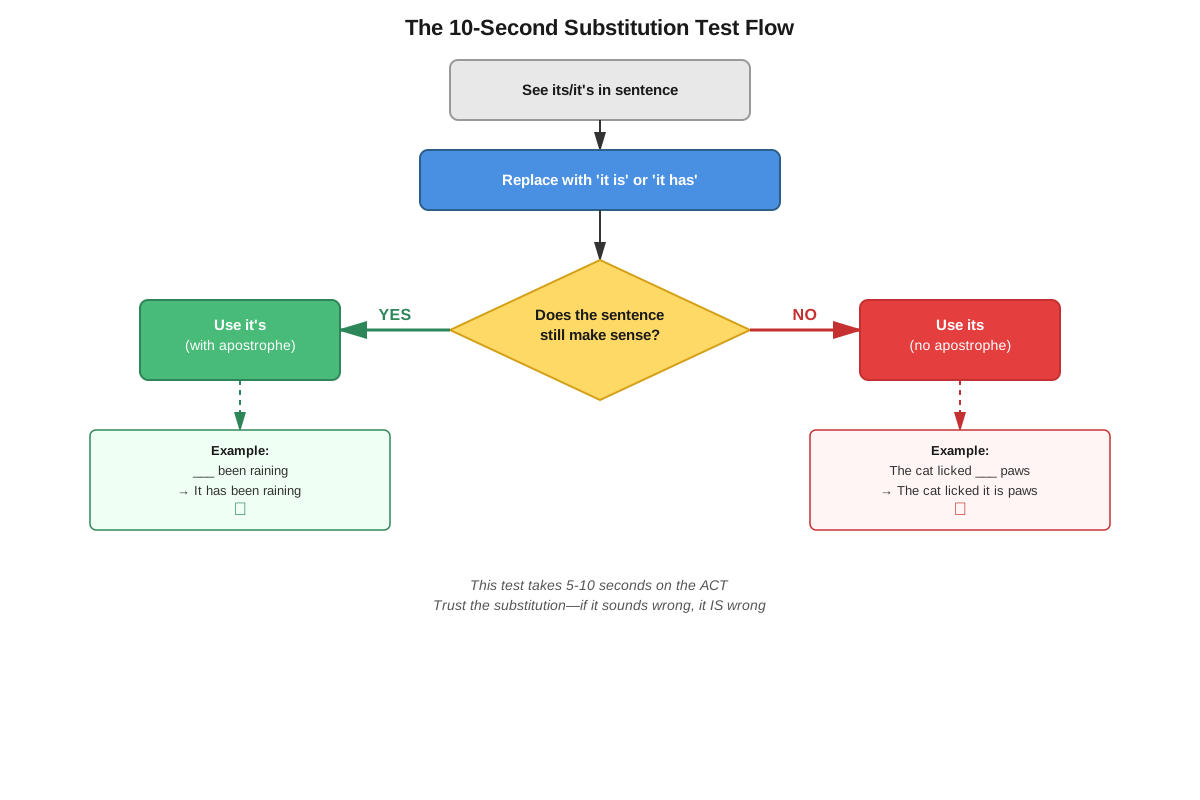
The most reliable strategy for distinguishing its from it's involves the substitution test: attempt to replace the word with "it is" or "it has." If the sentence remains grammatically correct and maintains its meaning, use "it's" (with the apostrophe). If the substitution creates nonsense, use "its" (without the apostrophe).
| Original Sentence | Substitution Test | Correct Form | Explanation |
|---|---|---|---|
| The cat licked ___ paws. | "The cat licked it is paws." ✗ | its | Substitution fails; possessive needed |
| ___ a beautiful day. | "It is a beautiful day." ✓ | It's | Substitution works; contraction correct |
| The phone lost ___ charge. | "The phone lost it is charge." ✗ | its | Substitution fails; possessive needed |
| ___ been raining all week. | "It has been raining all week." ✓ | It's | Substitution works; contraction correct |
This test works in 100% of cases and can be performed mentally in seconds, making it the gold standard for ACT questions.
Context Clues and Antecedents
Understanding what "it" refers to (its antecedent) helps determine correct usage. When "it" represents a specific noun mentioned earlier in the passage, and the sentence describes something belonging to that noun, "its" (possessive) is required. When "it" functions as an expletive subject (a placeholder with no specific antecedent) or introduces a clause, "it's" (contraction) typically appears.
Possessive context: "The museum expanded its collection after receiving the donation." (The collection belongs to the museum)
Contraction context: "It's essential that the museum expand its collection." (It is essential; "it" is an expletive subject)
Concept Relationships
The its/it's distinction connects directly to the broader category of possessive pronouns, which includes his, hers, yours, theirs, whose, and ours—none of which use apostrophes. Mastering its/it's reinforces the principle that possessive pronouns are distinct from possessive nouns, preventing errors across multiple pronoun types. This understanding leads to → correct usage of your/you're (possessive pronoun vs. contraction of "you are") and their/they're (possessive pronoun vs. contraction of "they are").
The concept also relates to apostrophe usage rules, where students learn that apostrophes serve two primary functions: forming contractions and creating possessive nouns. The its/it's distinction represents the critical exception where these two functions diverge for pronouns. This relationship connects to → understanding why "who's" (contraction) differs from "whose" (possessive pronoun).
Within sentence structure, its/it's usage connects to subject-verb agreement and pronoun-antecedent agreement. When using "it's" as a contraction, the verb form must agree with the subject "it" (singular), leading to → proper verb conjugation. When using "its" as a possessive, the pronoun must clearly refer to a singular antecedent, leading to → clarity in pronoun reference.
The substitution test strategy employed for its/it's extends to → other contraction/possessive distinctions, creating a transferable problem-solving approach. This metacognitive skill of testing grammatical choices through substitution applies broadly across ACT English questions, particularly in verb tense and pronoun case decisions.
High-Yield Facts
⭐ Its (no apostrophe) is always possessive, meaning "belonging to it"
⭐ It's (with apostrophe) is always a contraction meaning "it is" or "it has"
⭐ The substitution test (replacing with "it is" or "it has") works 100% of the time to determine correct usage
⭐ Possessive pronouns (its, his, hers, yours, theirs, whose) never use apostrophes
⭐ If you can expand the word to two words ("it is" or "it has"), you must use the apostrophe
- The word "its" always appears before a noun that it modifies (its purpose, its color, its function)
- The contraction "it's" can begin a sentence or clause ("It's raining" or "I know it's true")
- ACT questions often place its/it's in complex sentences to distract from the simple rule
- Reading the sentence aloud with "it is" or "it has" substituted reveals the correct answer immediately
- The possessive "its" never appears at the end of a sentence; it always modifies a following noun
- Historical note: "it's" was once used as a possessive in Early Modern English, but this usage has been incorrect since the 19th century
- The error rate for its/it's in student writing exceeds 30%, making it a reliable ACT testing point
Quick check — test yourself on Its versus it's so far.
Try Flashcards →Common Misconceptions
Misconception: "Its" needs an apostrophe because it shows possession, and possessive forms use apostrophes.
Correction: While possessive nouns use apostrophes (dog's bone, Sarah's car), possessive pronouns never do. The words his, hers, yours, theirs, whose, and its all show possession without apostrophes. Pronouns have distinct possessive forms that don't require apostrophes to signal ownership.
Misconception: You can use "its'" with an apostrophe after the 's' for possessive, similar to plural possessives.
Correction: The form "its'" does not exist in standard English. Because "it" is already singular and "its" is already possessive, no additional apostrophe is needed or correct. Unlike plural nouns that form possessives with apostrophes after the 's' (the dogs' bowls), pronouns don't follow this pattern.
Misconception: "It's" can be possessive if the sentence sounds right when you read it.
Correction: "It's" is exclusively a contraction and can never indicate possession, regardless of how the sentence sounds. Casual speech patterns and informal writing have normalized incorrect usage, but formal written English maintains the strict distinction. Trust the substitution test, not your ear.
Misconception: In phrases like "it's own," the apostrophe shows that "own" belongs to "it."
Correction: The correct phrase is always "its own" (no apostrophe). The word "own" is an intensifier that emphasizes the possessive relationship, but "its" remains the possessive pronoun. "It's own" would mean "it is own," which is grammatically nonsensical.
Misconception: If the sentence already has an apostrophe elsewhere, you shouldn't use "it's" to avoid having too many apostrophes.
Correction: Apostrophe usage depends solely on grammatical function, not on how many apostrophes appear in a sentence. If the sentence requires the contraction "it is" or "it has," use "it's" regardless of other punctuation. Each word must be correct independently.
Misconception: "Its" and "it's" are interchangeable in informal writing, and only formal writing requires the distinction.
Correction: While informal contexts may tolerate errors, the ACT tests standard written English, where the distinction is absolute. Additionally, maintaining correct usage in all writing contexts prevents errors from becoming habitual. Professional and academic writing always require correct its/it's usage.
Worked Examples
Example 1: Identifying the Correct Form in Context
ACT-Style Question: The research team published its findings after it's rigorous peer-review process concluded.
Step 1 - Identify the its/it's instances: The sentence contains two instances: "its findings" and "it's rigorous."
Step 2 - Apply the substitution test to the first instance: "The research team published it is findings" or "The research team published it has findings." Both substitutions create nonsense, indicating that "its" (possessive) is correct. The findings belong to the research team.
Step 3 - Apply the substitution test to the second instance: "after it is rigorous peer-review process" or "after it has rigorous peer-review process." Both substitutions are grammatically incorrect. The sentence needs a possessive form to show that the peer-review process belongs to something (likely the team or the research).
Step 4 - Determine the correct form: The second instance should be "its" (possessive), not "it's" (contraction). The corrected sentence reads: "The research team published its findings after its rigorous peer-review process concluded."
Step 5 - Verify by checking antecedents: Both instances of "its" refer back to "the research team," showing possession of both the findings and the peer-review process. This confirms the possessive form is appropriate.
Connection to Learning Objectives: This example demonstrates how to identify when its versus it's is being tested (Learning Objective 1), apply the substitution test strategy (Learning Objective 2), and correct errors in complex sentences (Learning Objective 6).
Example 2: Choosing Among Multiple Options
ACT-Style Question: The ancient tree, which had stood for centuries, finally lost _____ battle against the storm.
A) its
B) it's
C) its'
D) it is
Step 1 - Eliminate impossible options: Option C ("its'") is not a valid form in English and can be eliminated immediately. This is a common distractor on the ACT.
Step 2 - Apply the substitution test: Replace the blank with "it is" (option D): "The ancient tree finally lost it is battle against the storm." This is grammatically incorrect, eliminating option D.
Step 3 - Test the contraction: Option B ("it's") expands to "it is" or "it has": "The ancient tree finally lost it is battle" or "The ancient tree finally lost it has battle." Both are nonsensical, eliminating option B.
Step 4 - Confirm the possessive: Option A ("its") indicates possession: "The ancient tree finally lost its battle." This makes logical and grammatical sense—the battle belongs to the tree. The possessive pronoun correctly modifies the noun "battle."
Step 5 - Verify context: The sentence describes something (the battle) that belongs to the antecedent (the tree). This possessive relationship confirms that "its" without an apostrophe is correct.
Answer: A (its)
Connection to Learning Objectives: This example shows how to apply its versus it's to ACT-style questions accurately (Learning Objective 3), recognize common trap answers (Learning Objective 5), and use the substitution test efficiently (Learning Objective 7).
Exam Strategy
When approaching ACT its versus it's questions, implement a systematic three-step process: (1) identify the its/it's instance, (2) apply the substitution test, (3) verify by checking the surrounding context. This approach takes 5-10 seconds and ensures accuracy even under time pressure.
Exam Tip: The moment you see "its" or "it's" underlined or in answer choices, immediately perform the substitution test mentally. Don't rely on how the sentence "sounds"—trust the grammatical test.
Trigger words and phrases that signal its/it's questions include: possessive relationships (belonging, ownership, characteristics), time expressions with "it's been," and descriptive phrases about singular entities. Watch for sentences describing organizations, animals, objects, or abstract concepts, as these frequently test its/it's usage.
Process-of-elimination strategies specific to this topic:
- Immediately eliminate "its'" if it appears—this form never exists in standard English
- If you can expand the word to "it is" or "it has" and the sentence works, eliminate any option without an apostrophe
- If the word appears before a noun (its purpose, its color), eliminate contraction options
- If the word begins a clause with a verb following (It's raining, It's been), eliminate possessive options
Time allocation: These questions should take no more than 10-15 seconds once you've mastered the substitution test. If you find yourself spending more time, you're likely overthinking. Apply the test, select the answer, and move forward confidently.
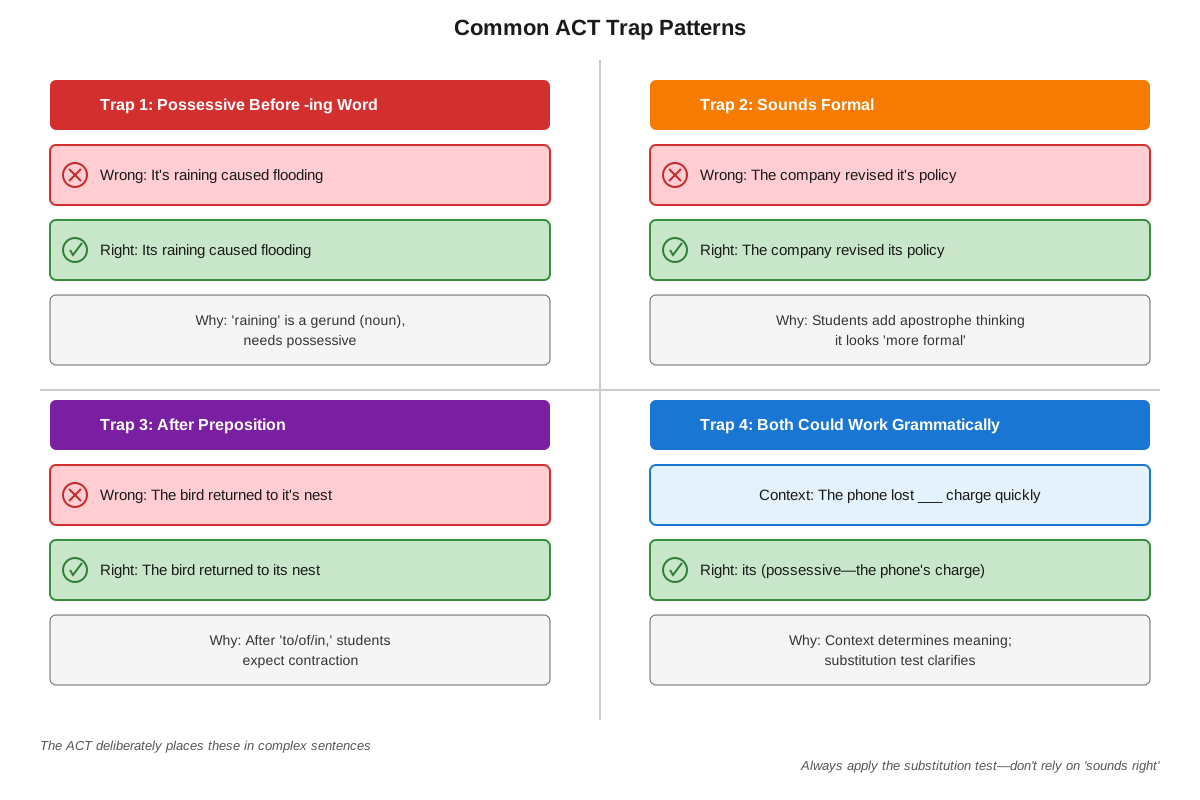
Common trap patterns on the ACT include:
- Placing "it's" before a noun in a possessive context (incorrect: "it's purpose")
- Using "its" where a contraction is needed (incorrect: "its raining")
- Creating complex sentences where the antecedent is distant from the pronoun
- Embedding the its/it's choice within a sentence that has other grammatical issues to distract you
Strategic approach for uncertain situations: If you're unsure, write out "it is" or "it has" in the margin or mentally insert it into the sentence. If this substitution creates an awkward or nonsensical sentence, the answer must be "its" (possessive). This test is foolproof and should resolve any uncertainty immediately.
Memory Techniques
Primary Mnemonic: "It's = It Is (Same number of letters)"
Both "it's" and "it is" contain an apostrophe or space between letters, and both have the same total character count. This visual parallel helps remember that "it's" always expands to "it is" or "it has."
Possessive Pronoun Pattern: Remember the phrase "His, Hers, Its—No Apostrophes for Possessive Pronouns"
This groups "its" with other possessive pronouns that students typically use correctly, reinforcing that possessive pronouns never use apostrophes.
Substitution Mantra: Create a mental habit by repeating: "Can I say 'it is'? Then it's. Can't say 'it is'? Then its."
This simple question-and-answer format becomes automatic with practice.
Visual Memory Aid: Picture the apostrophe in "it's" as a tiny person standing between "it" and "s" saying "is" or "has." The apostrophe literally represents the missing letters, making the contraction function visible.
Contrast Pairs: Memorize these parallel examples:
- The dog wagged its tail (possessive, like "his tail")
- It's a friendly dog (contraction, means "It is a friendly dog")
Practicing these pairs together reinforces the distinction through direct comparison.
Acronym for Testing: SITS = Substitution Immediately Tests Sentences
This reminds you to apply the substitution test as your first and primary strategy.
Summary
The distinction between its and it's represents a fundamental grammar rule that appears consistently on the ACT English section. The core principle is counterintuitive but absolute: "its" (without an apostrophe) functions as a possessive pronoun meaning "belonging to it," while "it's" (with an apostrophe) serves exclusively as a contraction meaning "it is" or "it has." This rule contradicts the pattern for possessive nouns but aligns with other possessive pronouns (his, hers, yours, theirs), none of which use apostrophes. The substitution test—replacing the word with "it is" or "it has"—provides a foolproof method for determining correct usage in every context. ACT questions typically embed this distinction within complex passages where context clues and antecedent identification become essential. Mastering this topic requires overcoming ingrained habits from informal writing and trusting grammatical rules over auditory intuition. Students who internalize the substitution test and recognize that possessive pronouns never use apostrophes can answer these questions accurately in under 10 seconds, making this a high-yield topic for score improvement.
Key Takeaways
- Its (no apostrophe) = possessive pronoun, always modifies a noun, means "belonging to it"
- It's (with apostrophe) = contraction only, always means "it is" or "it has," never possessive
- The substitution test (replacing with "it is"/"it has") works 100% of the time and should be your primary strategy
- Possessive pronouns (its, his, hers, yours, theirs, whose) never use apostrophes—this is a fundamental exception to apostrophe rules
- ACT questions test this distinction 1-3 times per exam, making it a predictable and high-yield topic
- Trust the grammatical rule over how the sentence sounds—informal speech patterns often normalize incorrect usage
- The form "its'" does not exist in standard English and should always be eliminated as an answer choice
Related Topics
Your versus You're: This parallel distinction between possessive pronoun and contraction follows identical rules to its/it's, and mastering one reinforces understanding of the other. The substitution test ("you are") works the same way.
Their, There, and They're: While more complex due to three options, this topic extends the possessive pronoun versus contraction principle and adds the location adverb "there." Understanding its/it's provides the foundation for this more challenging distinction.
Whose versus Who's: Another possessive pronoun/contraction pair that follows the same pattern. "Whose" shows possession (like "its"), while "who's" contracts "who is" or "who has" (like "it's").
Apostrophe Usage in Possessive Nouns: Understanding how regular nouns form possessives (dog's, James's, students') clarifies why pronouns are exceptional. This broader apostrophe knowledge contextualizes the its/it's rule.
Pronoun-Antecedent Agreement: Correctly using "its" requires identifying what "it" refers to in the passage, connecting to broader pronoun reference skills tested throughout the ACT English section.
Practice CTA
Now that you've mastered the core concepts and strategies for its versus it's, it's time to reinforce your learning through active practice. Complete the practice questions to test your ability to identify and correct its/it's errors under timed conditions, simulating actual ACT pressure. Use the flashcards to drill the substitution test until it becomes automatic—your goal is to answer these questions in under 10 seconds with complete confidence. Remember, this is one of the most predictable grammar topics on the ACT, and consistent practice transforms it from a potential error into guaranteed points. Every practice question you complete strengthens the neural pathways that make correct usage instinctive. You've got this!
Sign up free to keep reading
Create a free AnvayaPrep account to finish this ACT guide on Its versus it's — plus flashcards and practice questions.