Overview
Coherence is one of the most frequently tested rhetorical skills on the ACT English section, appearing in approximately 15-20% of all questions. At its core, coherence refers to the logical flow and clarity of ideas within a passage, ensuring that sentences and paragraphs connect smoothly and that the overall message remains clear and unified. When a passage demonstrates strong coherence, readers can easily follow the writer's train of thought without confusion or unnecessary mental effort.
On the ACT, ACT coherence questions assess whether students can identify and fix problems related to logical organization, sentence placement, paragraph structure, and the overall flow of ideas. These questions often ask students to determine the best placement for a sentence, decide whether a sentence should be added or deleted, or evaluate whether a transition effectively connects ideas. Unlike grammar questions that focus on mechanical correctness, coherence questions require students to understand the passage's meaning and purpose at a broader level.
Mastering coherence is essential not only for achieving a high ACT English score but also for developing strong writing and critical reading skills. Coherence connects closely to other rhetorical skills such as organization, transitions, and purpose, while also requiring a solid understanding of sentence structure and paragraph development. Students who excel at coherence questions demonstrate the ability to think holistically about a text rather than focusing solely on individual sentences in isolation.
Learning Objectives
- [ ] Identify when Coherence is being tested on the ACT English section
- [ ] Explain the core rule or strategy behind Coherence in written passages
- [ ] Apply Coherence principles to ACT-style questions accurately
- [ ] Distinguish between coherence issues and other rhetorical or grammatical problems
- [ ] Evaluate whether sentences logically connect within paragraphs and across the passage
- [ ] Determine the most effective placement for sentences to maintain logical flow
- [ ] Assess whether adding or deleting information enhances or disrupts coherence
Prerequisites
- Basic paragraph structure: Understanding topic sentences, supporting details, and concluding sentences is essential because coherence questions often require identifying how sentences function within a paragraph's organizational framework.
- Transition words and phrases: Familiarity with coordinating conjunctions, subordinating conjunctions, and transitional expressions helps students recognize how ideas connect and flow from one sentence to another.
- Reading comprehension skills: The ability to understand main ideas, supporting details, and authorial purpose is necessary because coherence questions require grasping the passage's overall meaning and intent.
- Sentence structure fundamentals: Knowledge of independent and dependent clauses helps students understand how sentences can be combined or separated to improve logical flow.
Why This Topic Matters
Coherence represents a critical skill that extends far beyond standardized testing. In academic writing, professional communication, and everyday expression, the ability to organize ideas logically and connect them smoothly determines whether a message is understood or ignored. Writers who master coherence produce work that readers can follow effortlessly, while those who neglect it create confusing, disjointed texts that frustrate their audience.
On the ACT English section, coherence questions typically appear 8-12 times per test, making them one of the highest-yield rhetorical skills to master. These questions often carry significant weight because they assess higher-order thinking skills rather than simple rule memorization. Students who struggle with coherence questions frequently miss points not because they lack knowledge but because they fail to read the passage holistically or consider the logical relationships between ideas.
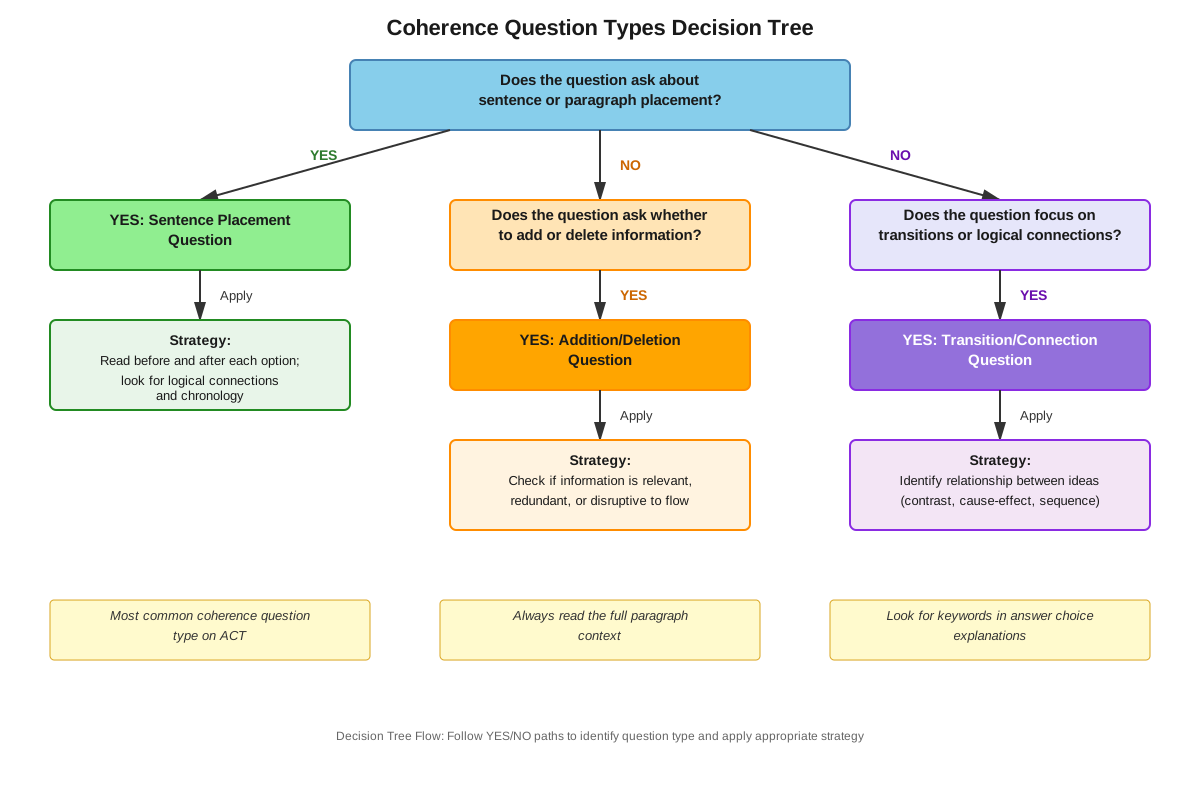
Coherence appears on the ACT in several distinct formats: sentence placement questions that ask where a sentence should be added or moved, addition/deletion questions that require evaluating whether information should be included, transition questions that test logical connections between ideas, and paragraph organization questions that assess the overall structure of the passage. Each format requires students to think beyond individual sentences and consider how pieces of information work together to create a unified, logical whole.
Core Concepts
What Is Coherence?
Coherence refers to the quality of logical flow and clarity in writing, where ideas connect smoothly and readers can easily follow the progression of thought. A coherent passage demonstrates clear relationships between sentences, maintains consistent focus on the topic, and organizes information in a way that makes sense. When coherence is strong, readers never feel lost or confused about how one idea relates to another.
Coherence operates at multiple levels within a text. At the sentence level, coherence means that each sentence logically follows from the previous one and leads naturally to the next. At the paragraph level, coherence requires that all sentences support the paragraph's main idea and appear in a logical sequence. At the passage level, coherence demands that paragraphs connect to form a unified whole that accomplishes the writer's purpose.
Elements That Create Coherence
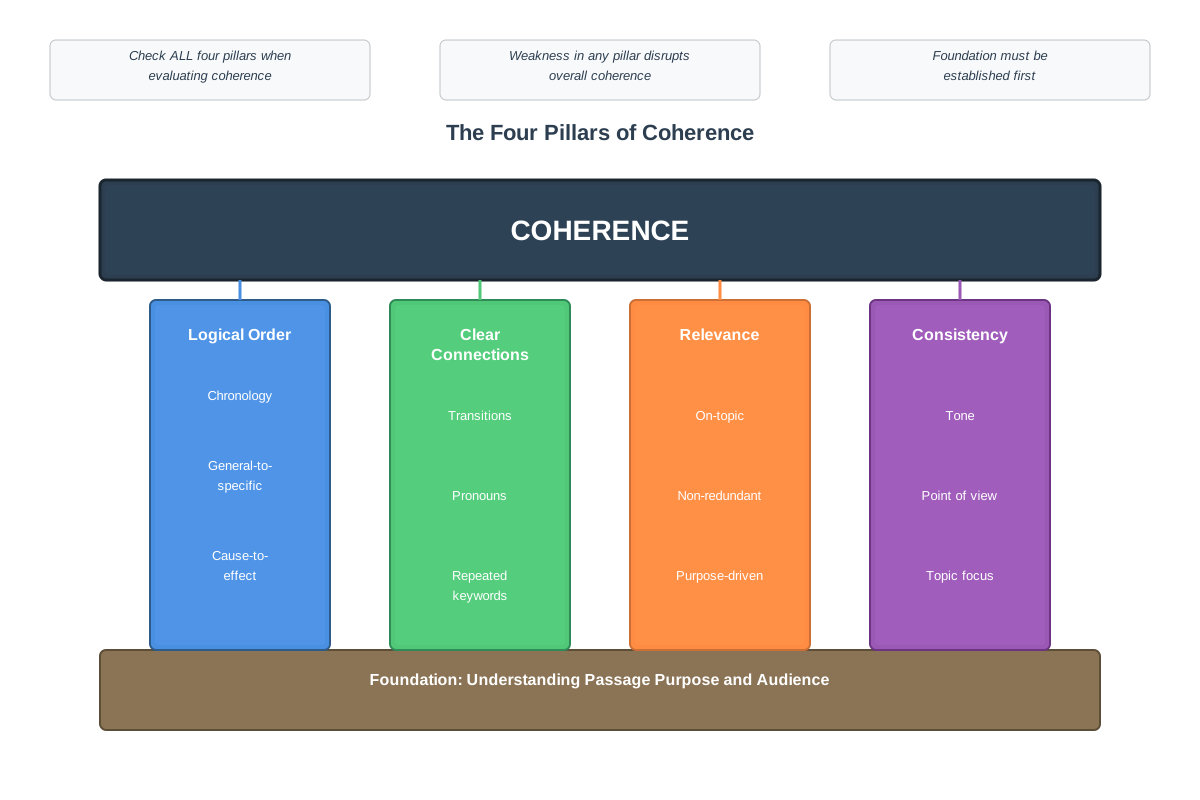
Several key elements work together to establish coherence in writing:
Logical order ensures that ideas appear in a sequence that makes sense to readers. This might be chronological order (events in time sequence), spatial order (descriptions moving through space), order of importance (most to least significant or vice versa), or cause-and-effect order (showing how one thing leads to another).
Consistent focus maintains attention on the main topic without introducing irrelevant tangents or shifting unexpectedly to unrelated subjects. Each sentence should clearly relate to the paragraph's central idea, and each paragraph should connect to the passage's overall purpose.
Clear pronoun reference helps readers track which nouns pronouns refer to, preventing confusion about who or what is being discussed. Ambiguous pronouns disrupt coherence by forcing readers to guess at meaning.
Appropriate transitions signal relationships between ideas, showing readers whether the next sentence will continue the same thought, contrast with the previous idea, provide an example, or introduce a result. Without transitions, even logically ordered ideas can feel choppy and disconnected.
Parallel structure creates coherence by presenting similar ideas in similar grammatical forms, helping readers recognize patterns and relationships.
Types of Coherence Questions on the ACT
The ACT tests coherence through several distinct question formats, each requiring specific strategies:
| Question Type | What It Tests | Common Phrasing |
|---|---|---|
| Sentence Placement | Whether a sentence belongs in a specific location | "The best placement for the underlined sentence would be..." |
| Addition | Whether adding information improves the passage | "Should the writer add this sentence here?" |
| Deletion | Whether removing information improves the passage | "Should the writer delete this sentence?" |
| Transition Selection | Which transition word best connects ideas | "Which choice best connects this sentence to the previous paragraph?" |
| Paragraph Order | The most logical sequence for paragraphs | "For the sake of logic and coherence, Paragraph 3 should be placed..." |
Identifying Coherence Questions
Recognizing when the ACT is testing coherence rather than grammar or other rhetorical skills is crucial for applying the correct strategy. Coherence questions typically include phrases like "for the sake of logic and coherence," "most logical placement," "best connects," "should be added," or "should be deleted." These questions require reading beyond the immediate sentence to understand the surrounding context.
Unlike grammar questions that can often be answered by examining a single sentence, coherence questions demand that students read at least the paragraph containing the question and often the preceding or following paragraph as well. The correct answer will be the choice that creates the smoothest logical flow and clearest connection between ideas.
The Coherence Decision-Making Process
When approaching coherence questions, successful students follow a systematic process:
- Read the entire paragraph (and sometimes adjacent paragraphs) to understand the context and main idea
- Identify the topic and focus of each sentence to understand what each contributes
- Look for logical connections between ideas, noting chronology, cause-and-effect, or other relationships
- Consider the passage's purpose and whether each option supports or distracts from that purpose
- Test each answer choice by reading the passage with that option in place
- Select the choice that creates the smoothest, most logical flow
Coherence vs. Other Rhetorical Skills
While coherence overlaps with other rhetorical skills, it has distinct characteristics. Organization refers to the overall structure and arrangement of a passage, while coherence focuses more specifically on the logical flow and connections between ideas. Transitions are tools that help create coherence, but coherence encompasses more than just transition words—it includes the logical relationships themselves.
Relevance questions ask whether information relates to the topic, while coherence questions ask whether information fits logically at a specific location. A sentence might be relevant to the passage's topic but still disrupt coherence if placed in the wrong location or if it interrupts the logical flow of ideas.
Concept Relationships
Coherence serves as the foundation for effective communication and connects intimately with multiple aspects of writing. The relationship begins with sentence structure, which provides the building blocks that coherence arranges into meaningful patterns. Well-constructed sentences enable clear expression of ideas, which coherence then organizes into logical sequences.
Transitions function as the explicit signals of coherence, marking the relationships that coherence establishes. While coherence represents the underlying logical flow, transitions make that flow visible to readers. A passage can have strong inherent coherence but still feel choppy without appropriate transitions, just as a passage with many transitions can still lack coherence if the underlying logic is flawed.
The relationship flows as follows: Sentence Structure → Logical Relationships → Coherence → Transitions → Organization → Purpose. Each element builds on the previous one, with coherence serving as the central organizing principle that transforms individual sentences into unified paragraphs and complete passages.
Coherence also connects to paragraph development by determining how supporting details relate to topic sentences and how paragraphs connect to form larger arguments. The prerequisite knowledge of paragraph structure enables students to recognize when sentences appear out of place or when information disrupts the logical progression of ideas.
High-Yield Facts
⭐ Coherence questions require reading at least the full paragraph, not just the sentence in question, to understand context and logical flow.
⭐ The correct answer to a sentence placement question is usually near a sentence that contains a clear connection word, pronoun reference, or related concept.
⭐ When deciding whether to add or delete a sentence, consider whether it maintains focus on the paragraph's main idea and supports the passage's purpose.
⭐ Chronological markers (dates, time words, sequence indicators) are strong clues for determining logical sentence order.
⭐ Pronouns and demonstrative adjectives (this, that, these, those) often indicate that a sentence must follow another sentence that establishes what the pronoun refers to.
- Coherence questions typically include phrases like "for the sake of logic and coherence," "most logical," or "best placement."
- A sentence that introduces a new concept should generally come before sentences that elaborate on or provide examples of that concept.
- Transition words at the beginning of sentences provide clues about logical relationships and can help determine correct placement.
- Sentences containing specific examples should follow sentences that make general statements they illustrate.
- When all answer choices seem grammatically correct, the question is likely testing coherence or another rhetorical skill.
- Coherence questions often appear with a boxed number in brackets [1], [2], [3], or [4] indicating possible placement locations.
- The most coherent choice creates smooth flow without requiring readers to reread or pause to understand connections.
- Deleting a sentence is correct when it introduces irrelevant information, repeats what has already been stated, or disrupts the logical flow.
- Adding a sentence is correct when it provides necessary information, clarifies a connection, or supports the paragraph's main idea without redundancy.
- Paragraph-level coherence requires that all sentences support a unified main idea and appear in logical sequence.
Quick check — test yourself on Coherence so far.
Try Flashcards →Common Misconceptions
Misconception: Coherence questions can be answered by reading only the sentence in question. → Correction: Coherence questions require understanding the context of surrounding sentences and often the entire paragraph. The logical flow depends on how ideas connect, which cannot be determined from a single sentence in isolation.
Misconception: The longest or most detailed answer choice is usually correct for addition questions. → Correction: The correct answer for addition questions is the one that best maintains focus and supports the paragraph's purpose, regardless of length. Longer answers often introduce irrelevant details that disrupt coherence.
Misconception: A sentence should be deleted if it contains any information already mentioned elsewhere in the passage. → Correction: A sentence should be deleted only if it adds no new value, disrupts logical flow, or introduces irrelevant information. Some repetition or reinforcement of key ideas can enhance coherence when it serves a clear purpose.
Misconception: Transition words alone create coherence. → Correction: While transitions help signal relationships between ideas, true coherence requires that the underlying logical connections make sense. Adding transition words to illogically ordered sentences does not create coherence.
Misconception: Coherence questions always have obvious right answers. → Correction: Coherence questions often require careful analysis of subtle logical relationships. The difference between answer choices may be nuanced, requiring students to consider which option creates the smoothest flow and clearest connections.
Misconception: Sentences should always be placed as early as possible in a paragraph. → Correction: Sentence placement depends on logical relationships, not position. A sentence introducing a concept should come before sentences that elaborate on it, but a sentence providing a specific example should follow the general statement it illustrates.
Worked Examples
Example 1: Sentence Placement
Passage Context:
[1] The monarch butterfly's migration is one of nature's most remarkable phenomena. [2] These delicate insects travel up to 3,000 miles from Canada to Mexico each fall. [3] Scientists have discovered that monarchs use the sun's position to navigate during their journey. [4] The butterflies that make the return trip in spring are actually the great-great-grandchildren of those that flew south.
Question: For the sake of logic and coherence, the sentence "No single butterfly completes the entire round-trip migration" should be placed at:
A. Point 1
B. Point 2
C. Point 3
D. Point 4
Solution Process:
First, read the entire paragraph to understand the flow of ideas. The paragraph discusses monarch migration, starting with a general statement, then providing distance details, explaining navigation, and ending with information about generational changes.
Next, analyze what the sentence to be placed communicates: it tells us that individual butterflies don't complete both directions of the migration. This information relates most closely to the concept of generational changes.
Look for logical connections. Sentence 4 mentions that different generations make different parts of the journey. The sentence about no single butterfly completing the round trip would logically come just before this explanation of why—because multiple generations are involved.
Test the placement at Point 4: "Scientists have discovered that monarchs use the sun's position to navigate during their journey. No single butterfly completes the entire round-trip migration. The butterflies that make the return trip in spring are actually the great-great-grandchildren of those that flew south."
This creates perfect logical flow: navigation information → statement that individuals don't complete the full trip → explanation that multiple generations are involved.
Answer: D (Point 4)
This question demonstrates how coherence requires understanding logical relationships between ideas. The sentence about individual butterflies not completing the journey serves as a transition between the navigation information and the generational explanation.
Example 2: Addition/Deletion
Passage Context:
The invention of the printing press in the 15th century revolutionized the spread of information. Before this innovation, books were copied by hand, making them expensive and rare. Johannes Gutenberg's press could produce hundreds of copies in the time it took a scribe to copy one book. [The printing press used movable metal type, which could be rearranged to print different pages.] This democratization of knowledge contributed to the Renaissance, the Reformation, and the Scientific Revolution.
Question: Should the writer delete the underlined sentence?
A. Yes, because it distracts from the paragraph's focus on the printing press's historical impact.
B. Yes, because it contradicts information provided earlier in the paragraph.
C. No, because it provides important technical details about how the printing press worked.
D. No, because it explains why the printing press could produce books more quickly.
Solution Process:
First, identify the paragraph's main focus. The topic sentence states that the printing press "revolutionized the spread of information," and the concluding sentence discusses its impact on major historical movements. The paragraph focuses on the press's historical significance, not its technical operation.
Next, evaluate what the underlined sentence contributes. It provides a technical detail about movable type but doesn't explain why this mattered or how it contributed to the historical impact.
Consider coherence: Does this sentence maintain the logical flow from "could produce hundreds of copies" to "democratization of knowledge"? The sentence interrupts the cause-and-effect relationship between increased production and social impact.
Evaluate the answer choices. Choice A correctly identifies that the sentence distracts from the historical impact focus. Choice C incorrectly suggests technical details are important when the paragraph emphasizes consequences. Choice D is incorrect because the sentence doesn't explain the speed advantage—that was already stated in the previous sentence.
Answer: A
This example illustrates how coherence requires maintaining consistent focus. Even factually accurate, relevant information can disrupt coherence if it doesn't support the paragraph's specific purpose or interrupts the logical flow of ideas.
Exam Strategy
When approaching ACT coherence questions, begin by identifying the question type through key phrases. Questions containing "logic and coherence," "best placement," "should add," or "should delete" signal coherence testing. Once identified, resist the temptation to answer immediately—coherence questions require broader context than grammar questions.
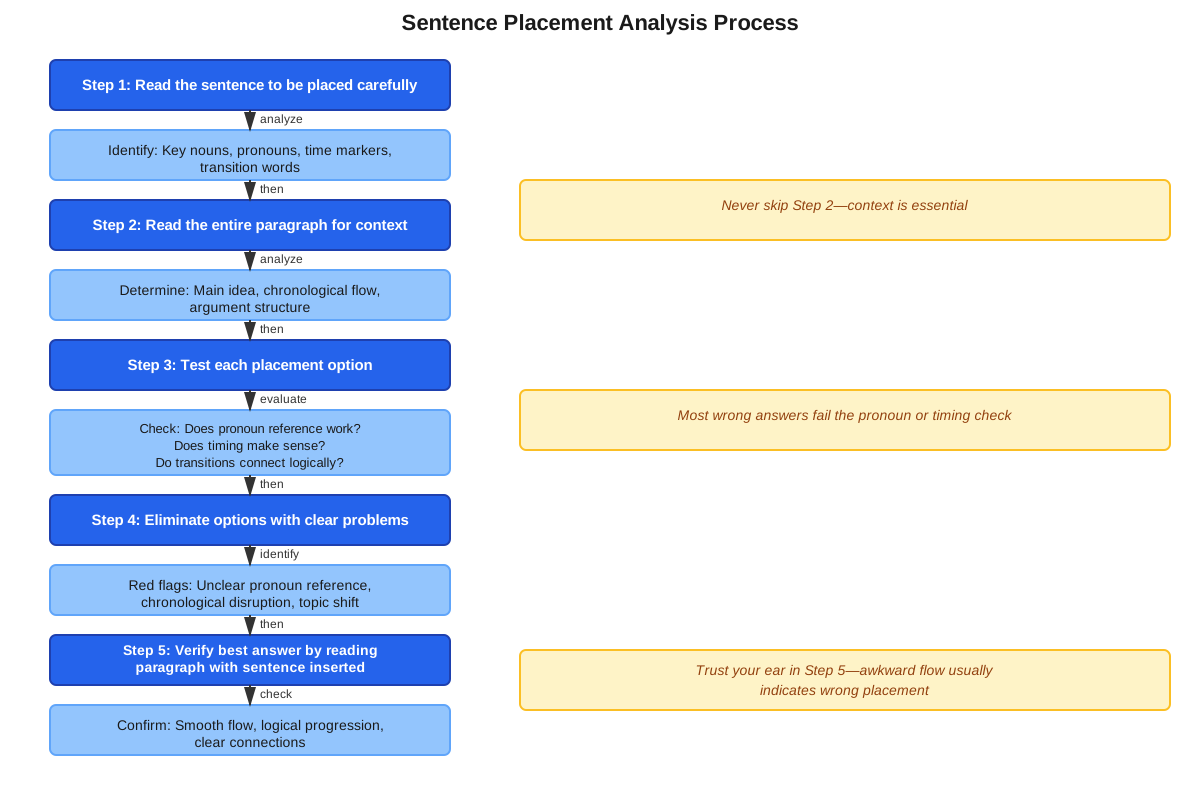
For sentence placement questions, follow this systematic approach:
- Read the entire paragraph containing the placement options
- Identify what the sentence to be placed discusses and what information it requires as context
- Look for connecting words, pronouns, or concepts in both the sentence and the paragraph
- Test each placement option by reading the paragraph with the sentence in that location
- Select the placement that creates the smoothest logical flow without gaps or confusion
Exam Tip: Pronouns and demonstrative adjectives (this, that, these, those) are powerful clues. A sentence beginning with "This discovery" must follow a sentence that describes the discovery being referenced.
For addition questions, evaluate whether the proposed sentence:
- Maintains focus on the paragraph's main idea
- Provides new, relevant information rather than repeating what's already stated
- Supports the passage's overall purpose
- Fits logically at the proposed location without disrupting flow
For deletion questions, choose to delete when the sentence:
- Introduces information irrelevant to the paragraph's focus
- Repeats information already clearly stated
- Disrupts the logical progression of ideas
- Contradicts the passage's purpose or tone
Time allocation strategy: Spend 30-45 seconds on coherence questions, slightly more than grammar questions, because they require reading more context. However, avoid getting stuck—if you cannot determine the answer after reading the relevant paragraph twice, make your best guess and move forward.
Trigger words to watch for: "first," "then," "finally" (sequence), "however," "although" (contrast), "therefore," "as a result" (cause-effect), "for example," "specifically" (illustration), "this," "these," "such" (reference to previous information).
Process of elimination tips: Eliminate answer choices that create awkward repetition, introduce information that requires context not yet provided, or place specific examples before the general statements they illustrate. The correct answer will feel natural when you read the passage with that option in place.
Memory Techniques
PLACE mnemonic for sentence placement questions:
- Pronoun references (what does "this" or "it" refer to?)
- Logical order (chronology, cause-effect, general to specific)
- Adjacent sentences (what comes immediately before and after?)
- Connecting words (transitions, time markers, sequence indicators)
- Examples follow statements (specific after general)
ADD/DELETE decision framework - Remember "FRS":
- Focus: Does it maintain the paragraph's main idea?
- Relevance: Does it support the passage's purpose?
- Smoothness: Does it fit logically without disrupting flow?
Visualization technique: Picture the paragraph as a chain where each sentence is a link. When considering placement or addition, visualize where the new link connects most naturally. Gaps or awkward connections indicate incorrect placement.
Chronology clue: Remember "TIME TELLS" - when you see time markers (dates, "first," "then," "later," "before," "after"), they almost always indicate the correct chronological sequence for sentence placement.
The "Read Aloud" mental technique: Mentally "hear" the paragraph with each answer choice in place. The correct answer will sound smooth and natural, while incorrect answers will feel choppy or confusing.
Summary
Coherence represents the logical flow and clarity of ideas in writing, ensuring that sentences and paragraphs connect smoothly to create a unified, understandable passage. On the ACT English section, coherence questions test whether students can identify appropriate sentence placement, evaluate whether information should be added or deleted, and recognize logical connections between ideas. Success requires reading beyond individual sentences to understand context, identifying logical relationships such as chronology and cause-effect, and selecting options that maintain consistent focus while creating smooth transitions between ideas. The key to mastering coherence questions lies in understanding that grammatical correctness alone is insufficient—the correct answer must also create the most logical flow and clearest connections within the passage's overall purpose and structure.
Key Takeaways
- Coherence questions require reading the full paragraph or more to understand context and logical relationships, not just the sentence in question
- Pronouns, demonstrative adjectives, and transition words provide crucial clues about where sentences logically belong
- Sentence placement follows logical patterns: general statements before specific examples, causes before effects, and chronological sequence for time-based information
- Addition is correct when information maintains focus, provides new value, and supports the passage's purpose without redundancy
- Deletion is correct when information is irrelevant, repetitive, or disrupts the logical flow of ideas
- The correct answer creates smooth, natural flow that readers can follow without confusion or rereading
- Coherence connects to organization, transitions, and purpose, serving as the foundation for effective written communication
Related Topics
Transitions and Connecting Words: Building on coherence principles, this topic explores the specific words and phrases that signal relationships between ideas, including coordinating conjunctions, subordinating conjunctions, and transitional expressions. Mastering transitions enables students to both recognize and create explicit connections that enhance coherence.
Organization and Structure: This broader topic examines how entire passages are arranged, including paragraph order, introduction and conclusion effectiveness, and overall structural patterns. Strong coherence skills provide the foundation for understanding effective organization.
Purpose and Audience: Understanding why a passage was written and who it addresses helps students evaluate whether information contributes to coherence or distracts from the author's goals. This topic builds on coherence by adding the dimension of rhetorical effectiveness.
Relevance and Focus: This closely related skill involves determining whether information belongs in a passage at all, while coherence determines where it should be placed. Together, these skills enable students to evaluate both what information to include and how to arrange it effectively.
Practice CTA
Now that you understand the principles of coherence and how the ACT tests this essential skill, it's time to apply your knowledge through practice. Work through the practice questions to reinforce your ability to identify logical connections, determine appropriate sentence placement, and evaluate addition and deletion decisions. Each question you practice strengthens your pattern recognition and builds the confidence needed to approach coherence questions systematically on test day. Remember that coherence skills improve with deliberate practice—the more passages you analyze with these principles in mind, the more naturally you'll recognize logical flow and make correct decisions. Review the flashcards to cement key concepts and strategies, then challenge yourself with timed practice to simulate test conditions. You've built a strong foundation; now transform that knowledge into consistent performance through focused practice.
Sign up free to keep reading
Create a free AnvayaPrep account to finish this ACT guide on Coherence — plus flashcards and practice questions.