Overview
Logical flow is one of the most frequently tested rhetorical skills on the ACT English section, appearing in approximately 15-20% of all questions. This concept evaluates a student's ability to recognize and create coherent, well-organized writing where ideas progress naturally from one to the next. Unlike grammar questions that focus on mechanical correctness, logical flow questions assess whether sentences, paragraphs, and ideas are arranged in the most effective sequence to communicate meaning clearly.
The ACT tests logical flow through several question types: sentence placement questions (asking where a sentence should be added or moved), transition word selection, paragraph ordering, and questions about whether sentences should be added or deleted based on relevance. These questions require students to understand not just individual sentences, but how those sentences work together to build arguments, tell stories, or explain concepts. Success on these questions depends on recognizing organizational patterns, identifying topic sentences, tracking pronoun references, and understanding how transitional phrases signal relationships between ideas.
Mastering ACT logical flow connects directly to other rhetorical skills including purpose, audience, and style. While grammar questions can often be answered by examining a single sentence in isolation, logical flow questions require reading larger chunks of text—sometimes entire paragraphs or even the full passage. This makes logical flow questions both more time-consuming and more dependent on reading comprehension skills. Students who excel at logical flow questions demonstrate sophisticated understanding of how effective writing is structured, a skill that extends far beyond standardized testing into academic and professional communication.
Learning Objectives
- [ ] Identify when logical flow is being tested in ACT English questions
- [ ] Explain the core rule or strategy behind logical flow organization
- [ ] Apply logical flow principles to ACT-style questions accurately
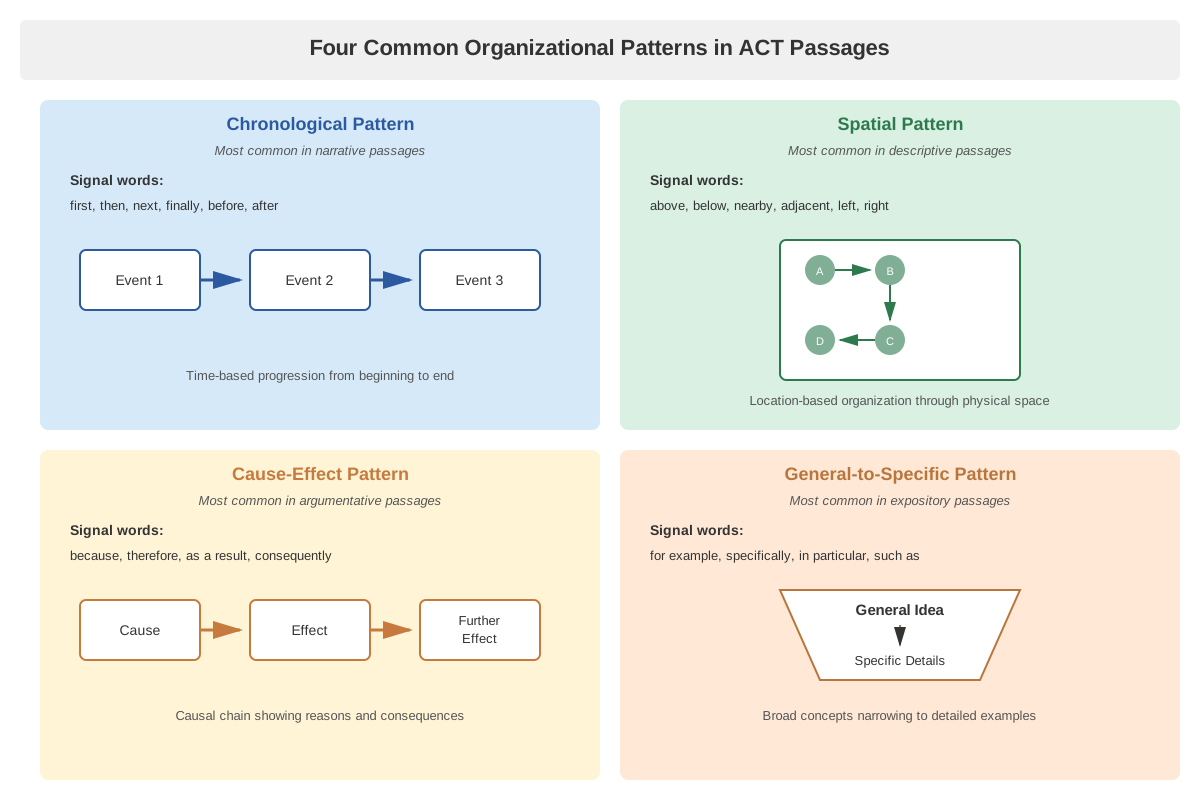
- [ ] Distinguish between chronological, spatial, cause-effect, and general-to-specific organizational patterns
- [ ] Evaluate whether a sentence belongs in a passage based on relevance and coherence
- [ ] Select appropriate transition words that accurately reflect relationships between ideas
- [ ] Determine optimal sentence and paragraph placement by tracking pronouns, repeated keywords, and logical connections
Prerequisites
- Basic paragraph structure: Understanding topic sentences, supporting details, and concluding sentences is essential because logical flow questions require identifying how sentences function within paragraphs
- Pronoun-antecedent relationships: Recognizing what pronouns refer to helps determine whether sentences are in the correct order
- Reading comprehension skills: The ability to understand main ideas and supporting details enables evaluation of whether content fits logically within a passage
- Transition word knowledge: Familiarity with common transitional phrases (however, therefore, additionally) provides the foundation for selecting appropriate connectors between ideas
Why This Topic Matters
In real-world writing, logical flow determines whether readers can follow arguments, understand instructions, or engage with narratives. Professional documents, academic essays, and even everyday emails require clear organization where ideas build upon each other systematically. Writers who master logical flow can guide readers through complex information without confusion, making their communication more persuasive and effective.
On the ACT English section, logical flow questions appear with remarkable consistency. Students can expect 8-12 questions per test focused specifically on organization and flow. These questions typically appear in three formats: (1) sentence placement questions marked with numbered boxes asking where a sentence should be added, (2) questions about whether to add or delete sentences based on relevance, and (3) questions asking for the best transition word or phrase to connect ideas. Additionally, some tests include a question asking students to sequence paragraphs in the most logical order.
Logical flow questions commonly appear in passages discussing processes (how something works or is made), historical narratives (events in sequence), argumentative essays (claims supported by evidence), and descriptive pieces (spatial organization). The ACT deliberately includes passages where sentences are out of order or where irrelevant information disrupts the flow, testing whether students can recognize and correct these organizational problems. Because these questions require reading and understanding larger portions of text, they often take more time than grammar questions, making efficient strategies essential for time management.
Core Concepts
Understanding Logical Flow
Logical flow refers to the smooth, coherent progression of ideas in writing where each sentence connects naturally to what comes before and after it. In well-organized writing, readers can follow the author's train of thought without confusion, backtracking, or wondering why certain information appears where it does. The ACT tests whether students can recognize when flow is disrupted and identify the corrections needed to restore coherence.
Effective logical flow depends on several interconnected elements: coherence (ideas relate clearly to each other), cohesion (sentences connect through transitional devices and repeated keywords), relevance (all content supports the main idea), and appropriate organization (ideas follow a pattern that makes sense for the content type).
Organizational Patterns
Different types of content require different organizational structures. Recognizing these patterns helps students predict where information should appear:
| Pattern | Description | Signal Words | Best Used For |
|---|---|---|---|
| Chronological | Events or steps in time order | first, next, then, finally, before, after, during | Narratives, processes, historical accounts |
| Spatial | Description organized by physical location | above, below, nearby, in the distance, to the left | Descriptions of places or objects |
| Cause-Effect | Reasons and their consequences | because, therefore, as a result, consequently, thus | Explanations, arguments |
| General-to-Specific | Broad statement followed by details | for example, specifically, in particular, such as | Most academic writing |
| Specific-to-General | Details building to a conclusion | therefore, thus, in conclusion, overall | Inductive arguments |
| Compare-Contrast | Similarities and differences | similarly, however, on the other hand, whereas | Analysis of multiple subjects |
| Problem-Solution | Issue followed by resolution | to address this, one solution, this can be solved | Persuasive writing |
Sentence Placement Strategies
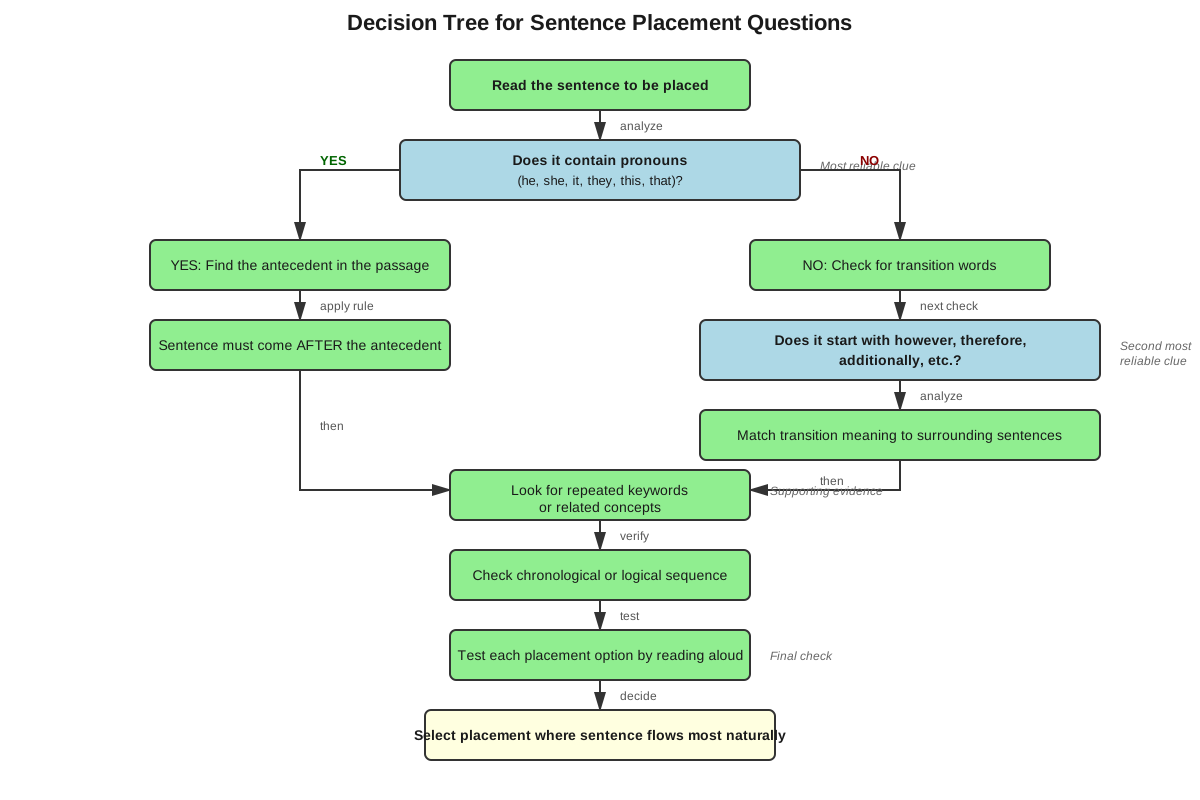
When the ACT presents a sentence in a box and asks where it should be placed, students must analyze several factors:
Pronoun references: If the sentence contains pronouns (he, she, it, they, this, these), it must follow a sentence that establishes what those pronouns refer to. For example, a sentence beginning with "This discovery" must follow a sentence that describes a specific discovery.
Transitional logic: Words like "however," "additionally," or "for example" signal specific relationships. "However" indicates contrast with the previous sentence, while "for example" means the sentence provides an illustration of a preceding general statement.
Keyword repetition: Effective writing often repeats key terms or uses synonyms to connect ideas. A sentence about "the experiment's results" should appear near other sentences discussing that experiment.
Chronological markers: Time-specific phrases ("the next day," "years later," "initially") indicate where sentences fit in a sequence.
Transition Word Selection
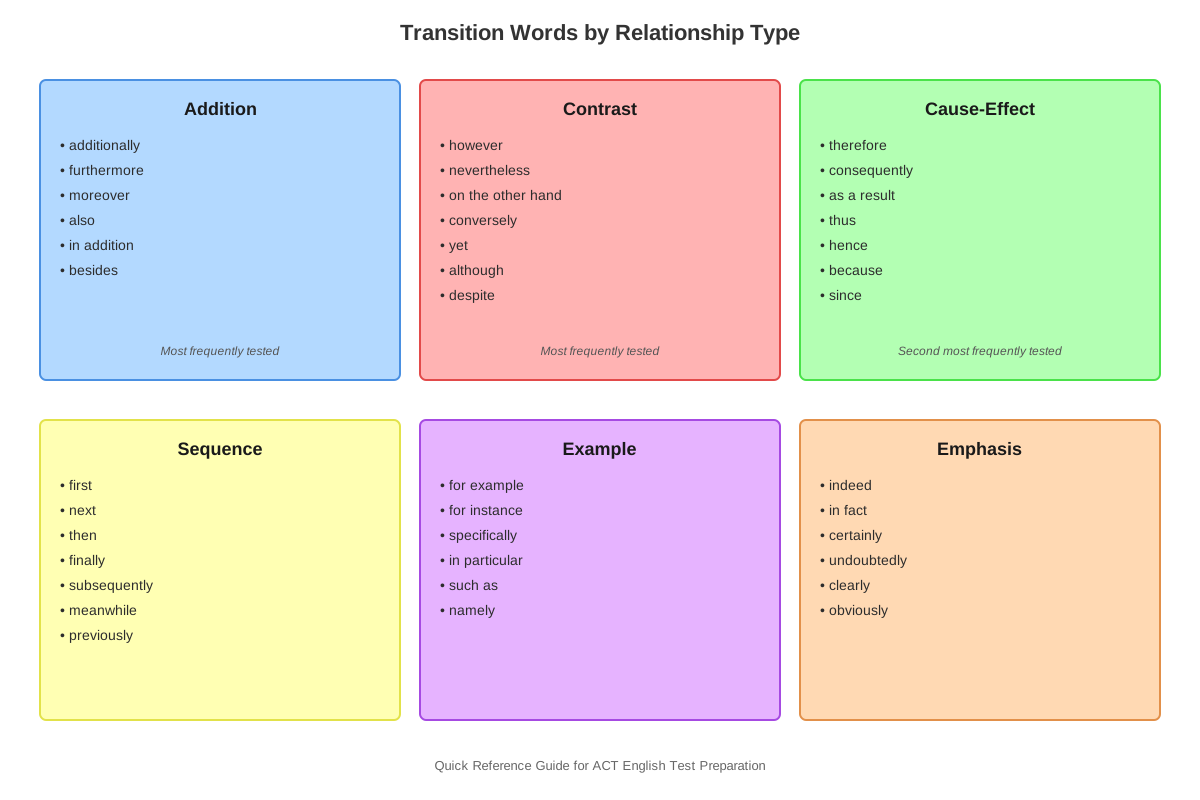
Transition words are the connective tissue of writing, explicitly showing relationships between ideas. The ACT frequently tests whether students can select transitions that accurately reflect these relationships:
Addition/Continuation: furthermore, moreover, additionally, also, in addition
- Use when adding similar or supporting information
Contrast/Opposition: however, nevertheless, on the other hand, conversely, yet
- Use when introducing contradictory or opposing information
Cause/Effect: therefore, thus, consequently, as a result, accordingly
- Use when showing that one idea results from another
Example/Illustration: for example, for instance, specifically, namely
- Use when providing concrete examples of general statements
Emphasis: indeed, in fact, certainly, undoubtedly
- Use when reinforcing or stressing a point
Sequence: first, second, next, then, finally
- Use when ordering steps or events
Relevance and Unity
Every sentence in a well-organized passage should contribute to the main idea. The ACT tests this through questions asking whether sentences should be added or deleted. To evaluate relevance:
- Identify the paragraph's main idea: Usually stated in the topic sentence
- Determine the sentence's content: What information does it provide?
- Assess the connection: Does this information support, explain, or develop the main idea?
- Consider redundancy: Does the sentence repeat information already stated?
- Evaluate specificity: Is the information appropriately detailed for the context?
Sentences should be deleted when they: introduce unrelated topics, repeat information unnecessarily, contradict the passage's purpose, or provide excessive detail that distracts from the main point.
Paragraph-Level Organization
Beyond individual sentences, the ACT occasionally tests whether students can recognize the most logical order for entire paragraphs. Effective paragraph sequencing follows these principles:
Introduction before development: Paragraphs introducing topics or concepts should precede paragraphs that develop or analyze them in detail.
Chronological progression: In narratives or process descriptions, paragraphs should follow time order.
Logical building: Each paragraph should build on information established in previous paragraphs, with later paragraphs assuming knowledge from earlier ones.
Conclusion last: Paragraphs that summarize, conclude, or reflect on the overall topic should appear at the end.
Concept Relationships
The concepts within logical flow are deeply interconnected. Organizational patterns provide the overall structure that determines where content should appear, while transition words make those organizational relationships explicit to readers. Sentence placement depends on understanding both the organizational pattern being used and the specific connections created through pronouns and keyword repetition. Relevance and unity serve as the overarching principle—even if a sentence is grammatically perfect and well-connected through transitions, it should be removed if it doesn't support the main idea.
These logical flow concepts connect to prerequisite knowledge in essential ways: paragraph structure understanding enables identification of topic sentences that signal main ideas, which in turn helps evaluate relevance. Pronoun-antecedent relationships directly inform sentence placement decisions, as sentences must follow their antecedents. Reading comprehension underlies all logical flow questions, since students must understand content before evaluating organization.
Logical flow also connects forward to other rhetorical skills: purpose and audience questions often overlap with relevance decisions (should this sentence be added given the passage's purpose?), while style and tone questions sometimes involve choosing transitions that match the passage's formality level.
The relationship map flows as follows: Reading Comprehension → Understanding Main Ideas → Identifying Organizational Patterns → Evaluating Sentence Relevance → Determining Sentence Placement → Selecting Appropriate Transitions → Achieving Logical Flow
High-Yield Facts
⭐ Sentence placement questions require reading at least one sentence before and after each numbered position to determine the best location
⭐ Pronouns and demonstrative adjectives (this, that, these, those) must have clear antecedents in preceding sentences, making them crucial clues for sentence placement
⭐ Transition words indicating contrast (however, nevertheless, yet) can only be used when the sentence actually contradicts or opposes the previous idea
⭐ When asked whether to add a sentence, the correct answer often depends on whether the sentence is relevant to the paragraph's main idea, not whether it's interesting or well-written
⭐ Chronological order is the most common organizational pattern in ACT passages, especially in narratives and process descriptions
- Topic sentences typically appear at the beginning of paragraphs and signal the main idea that subsequent sentences should support
- Sentences containing specific examples should follow sentences making general statements
- Questions asking where to add a sentence typically have four options: before sentence 1, after sentence 1, after sentence 2, or after sentence 3
- The phrase "for example" signals that the sentence provides a specific illustration of a general concept mentioned previously
- Sentences that introduce new, unrelated topics should be deleted even if they're factually accurate and well-written
- Spatial organization moves systematically in one direction (left to right, top to bottom, near to far) rather than jumping randomly between locations
- Cause-effect relationships require the cause to be stated before the effect for logical flow
- Concluding sentences often contain summary words like "thus," "therefore," or "overall" and should appear at paragraph ends
- Repeated keywords or synonyms create cohesion by linking sentences together thematically
- When two answer choices seem equally logical, the one that creates the smoothest transition through repeated keywords or parallel structure is typically correct
Quick check — test yourself on Logical flow so far.
Try Flashcards →Common Misconceptions
Misconception: Logical flow questions can be answered by reading only the sentence in question.
Correction: Logical flow questions require reading surrounding context—typically the entire paragraph and sometimes adjacent paragraphs—because placement depends on how the sentence connects to other ideas.
Misconception: The longest or most detailed answer choice is always correct for "should this sentence be added" questions.
Correction: The correct answer depends on relevance to the main idea, not length or detail. Detailed sentences should be deleted if they introduce tangential information, even if that information is interesting.
Misconception: Transition words are interchangeable as long as they sound formal.
Correction: Each transition word has a specific meaning that must match the logical relationship between ideas. "However" and "furthermore" cannot be substituted for each other because they signal opposite relationships (contrast vs. addition).
Misconception: Sentences should be placed where they create the most dramatic or interesting effect.
Correction: The ACT tests logical organization, not creative writing. Sentences should be placed where they fit most logically based on pronoun references, chronology, and idea development, regardless of dramatic impact.
Misconception: If a sentence is grammatically correct, it belongs in the passage.
Correction: Grammar and relevance are separate issues. A perfectly grammatical sentence should be deleted if it doesn't support the paragraph's main idea or if it repeats information already stated.
Misconception: Topic sentences can appear anywhere in a paragraph.
Correction: While creative writing sometimes places topic sentences elsewhere, ACT passages follow academic conventions where topic sentences typically appear first, establishing the main idea that subsequent sentences develop.
Misconception: All paragraphs in a passage must follow the same organizational pattern.
Correction: Different paragraphs within a passage can use different organizational patterns. A passage might begin with chronological organization for a narrative introduction, then shift to cause-effect organization for analysis.
Worked Examples
Example 1: Sentence Placement
Passage excerpt with question:
[1] Marie Curie's groundbreaking research on radioactivity transformed modern physics. [2] She became the first woman to win a Nobel Prize and remains the only person to win Nobel Prizes in two different sciences. [3] Her work led to the development of X-ray machines used during World War I. [4] Despite facing discrimination as a woman in science, she persevered in her research.
Question: The writer wants to add the following sentence to the paragraph:
"This achievement demonstrated her exceptional versatility as a scientist."
Where should this sentence be placed?
A. Before sentence 1
B. After sentence 1
C. After sentence 2
D. After sentence 3
Solution Process:
Step 1: Identify what "this achievement" refers to. The demonstrative pronoun "this" must point to a specific achievement mentioned in the preceding sentence.
Step 2: Examine each sentence:
- Sentence 1 discusses her research on radioactivity (general)
- Sentence 2 mentions winning Nobel Prizes in two different sciences (specific achievement)
- Sentence 3 discusses practical applications of her work
- Sentence 4 discusses discrimination she faced
Step 3: Determine which achievement demonstrates "exceptional versatility." Winning Nobel Prizes in two different sciences (physics and chemistry) clearly shows versatility across scientific disciplines.
Step 4: The new sentence must follow sentence 2 because "this achievement" refers to winning Nobel Prizes in two sciences, and the word "versatility" directly connects to working in multiple scientific fields.
Answer: C (After sentence 2)
This question tests the learning objective of applying logical flow principles by requiring students to track pronoun references and identify which sentence the new sentence logically develops.
Example 2: Transition Word Selection and Relevance
Passage excerpt with questions:
The invention of the printing press in 1450 revolutionized information sharing. [1] However, / Therefore, / For example, books became more affordable and accessible to ordinary people. [2] This democratization of knowledge contributed to the Renaissance and Reformation movements. [3] Johannes Gutenberg, the inventor, was also an accomplished goldsmith who enjoyed collecting rare coins. [4] The printing press remained the primary method of mass communication for over 400 years.
Question 1: Which choice provides the most logical transition at [1]?
A. However,
B. Therefore,
C. For example,
D. Nevertheless,
Solution Process:
Step 1: Identify the relationship between the ideas. The first sentence states that the printing press revolutionized information sharing. The second sentence explains that books became more affordable and accessible.
Step 2: Determine the logical connection. Affordable, accessible books are a RESULT of the printing press revolution, not a contrast or example.
Step 3: Evaluate each option:
- "However" signals contrast (incorrect—no opposition)
- "Therefore" signals cause-effect (correct—affordability resulted from the invention)
- "For example" signals illustration (incorrect—this is a result, not an example)
- "Nevertheless" signals contrast despite obstacles (incorrect—no opposition)
Answer: B (Therefore,)
Question 2: The writer is considering deleting sentence 3. Should it be kept or deleted?
Solution Process:
Step 1: Identify the paragraph's main idea: the printing press's impact on information sharing and society.
Step 2: Analyze sentence 3's content: Gutenberg's goldsmith work and coin collecting hobby.
Step 3: Evaluate relevance: While factually accurate, this information about Gutenberg's personal interests doesn't support the main idea about the printing press's societal impact.
Step 4: Check for necessary context: The paragraph works coherently without this sentence, flowing directly from democratization of knowledge (sentence 2) to the printing press's longevity (sentence 4).
Answer: Delete the sentence because it introduces information irrelevant to the paragraph's focus on the printing press's impact.
These questions test multiple learning objectives: selecting appropriate transitions based on logical relationships and evaluating sentence relevance to maintain unity.
Exam Strategy
Approaching Logical Flow Questions
Step 1: Identify the question type immediately. Sentence placement questions have numbered boxes in the passage. Transition questions have underlined words with alternatives. Relevance questions ask "Should the writer add/delete this sentence?"
Step 2: For sentence placement questions, read the entire paragraph first. Don't try to answer by reading only the sentence to be placed. Understanding the paragraph's overall organization and main idea is essential.
Step 3: Look for concrete clues in this order:
- Pronouns and demonstrative adjectives (this, that, these, those)
- Chronological markers (dates, time words, sequence words)
- Repeated keywords or synonyms
- Transition words in the sentence to be placed
Step 4: Use process of elimination systematically. For sentence placement, physically check each position by reading the sentence before, the new sentence, and the sentence after. If pronouns lack antecedents or the chronology is disrupted, eliminate that position.
Trigger Words and Phrases
Watch for these signals in questions:
- "Most logical placement": Requires analyzing pronoun references and idea flow
- "Best transition": Must match the logical relationship (contrast, cause-effect, addition)
- "Relevant to the paragraph": Focus on the topic sentence and main idea
- "Maintain the focus": Signals a relevance question about unity
- "Provide the most specific": Indicates choosing between general and specific information
In passages, these words signal organizational patterns:
- Chronological: first, next, then, finally, before, after, during, when, while
- Cause-effect: because, since, therefore, thus, consequently, as a result
- Contrast: however, nevertheless, despite, although, yet, on the other hand
- Addition: furthermore, moreover, additionally, also, in addition
- Example: for example, for instance, such as, specifically
Time Management
Logical flow questions typically require more time than grammar questions because they demand reading larger text portions. Allocate approximately:
- Sentence placement: 45-60 seconds (must read full paragraph)
- Transition selection: 30-40 seconds (read surrounding sentences)
- Add/delete relevance: 40-50 seconds (must understand main idea)
- Paragraph ordering: 60-90 seconds (must understand entire passage structure)
If a logical flow question seems time-consuming, mark it and return after completing faster grammar questions. However, don't skip reading the passage sections needed for these questions, as that context helps with other questions too.
Process of Elimination Tips
For transition words: Eliminate any option that signals a relationship opposite to what the sentences actually express. If the second sentence doesn't contradict the first, eliminate "however" and "nevertheless."
For sentence placement: Eliminate positions where pronouns would lack clear antecedents or where chronology would be disrupted. Often two positions can be eliminated immediately, leaving a choice between two logical-seeming options.
For relevance questions: Eliminate answers that focus on whether information is interesting, true, or well-written. The correct answer almost always focuses on whether the content is relevant to the main idea or purpose.
Memory Techniques
CRAFT Mnemonic for Sentence Placement
Chronology: Does the sentence fit the time sequence?
References: Do pronouns have clear antecedents?
Antecedents: What must come before this sentence?
Flow: Does it connect smoothly with surrounding sentences?
Topic: Does it relate to the paragraph's main idea?
Transition Word Categories: "CACTEE"
Contrast: however, nevertheless, yet
Addition: furthermore, moreover, also
Cause: because, since, due to
Time: then, next, finally
Effect: therefore, thus, consequently
Example: for instance, such as, specifically
Visualization Strategy
Picture a paragraph as a chain where each sentence is a link. For the chain to work:
- Each link must connect to the links before and after it (coherence)
- The links must be in the right order (organization)
- No link should be from a different chain (relevance)
- The connections between links should be visible (transitions)
When evaluating sentence placement, visualize inserting a new link and checking whether it connects properly at each potential position.
Acronym for Relevance Questions: "MAIN"
Main idea: What is the paragraph about?
Add value: Does this sentence contribute new, relevant information?
Irrelevant: Does it introduce unrelated topics?
Necessary: Is it needed for understanding, or is it redundant?
Summary
Logical flow represents a critical rhetorical skill on the ACT English section, testing whether students can recognize and create well-organized writing where ideas progress coherently. Success requires understanding multiple organizational patterns (chronological, cause-effect, general-to-specific), tracking pronoun references and repeated keywords to determine sentence placement, selecting transition words that accurately reflect relationships between ideas, and evaluating whether sentences are relevant to the paragraph's main idea. Unlike grammar questions that focus on isolated sentences, logical flow questions demand reading and comprehending larger text portions—often entire paragraphs. The most effective approach involves identifying concrete clues (pronouns, chronological markers, transition words) and systematically checking each potential answer against these clues. Students must distinguish between what makes writing interesting versus what makes it logically organized, as the ACT consistently rewards clarity and coherence over creativity. Mastering logical flow requires practice with authentic ACT-style passages where students actively analyze how sentences connect, why certain placements work better than others, and how organizational patterns guide reader understanding.
Key Takeaways
- Logical flow questions require reading surrounding context (usually the full paragraph) rather than analyzing isolated sentences
- Pronouns and demonstrative adjectives (this, that, these, those) are the most reliable clues for sentence placement, as they must have clear antecedents in preceding sentences
- Transition words must accurately reflect the logical relationship between ideas—contrast words for opposing ideas, cause-effect words for results, addition words for similar information
- Relevance to the main idea determines whether sentences should be added or deleted, regardless of whether they're interesting, true, or well-written
- Different organizational patterns (chronological, spatial, cause-effect, general-to-specific) appear in different passage types and determine where information should logically appear
- Sentence placement questions typically offer four positions; systematically eliminate positions where pronouns lack antecedents or chronology is disrupted
- Topic sentences establish the main idea that all other sentences in the paragraph should support, develop, or explain
Related Topics
Transitions and Connecting Words: A deeper exploration of the full range of transitional phrases and their specific uses, including subtle distinctions between similar transitions. Mastering logical flow provides the foundation for understanding when and why specific transitions are needed.
Purpose and Audience: Questions about whether content is appropriate for a passage's intended purpose or audience overlap significantly with logical flow, as relevance depends partly on purpose. Strong logical flow skills enable more sophisticated analysis of purpose-driven writing choices.
Paragraph Structure and Development: Advanced study of how paragraphs are constructed, including different positions for topic sentences and various development patterns. Logical flow mastery is essential before tackling these more complex organizational concepts.
Rhetorical Strategies: Understanding how writers use organization, repetition, and structure to achieve persuasive or explanatory goals. Logical flow provides the organizational foundation that makes rhetorical strategies effective.
Essay Organization: For the ACT Writing section, logical flow principles directly apply to organizing arguments, sequencing paragraphs, and connecting ideas with appropriate transitions.
Practice CTA
Now that you've mastered the core concepts of logical flow, it's time to apply these strategies to authentic ACT-style questions. The practice questions and flashcards will reinforce your ability to identify organizational patterns, track pronoun references, select appropriate transitions, and evaluate sentence relevance under timed conditions. Each practice question you complete strengthens your pattern recognition skills and builds the confidence needed to tackle these questions efficiently on test day. Remember: logical flow questions are highly learnable—unlike some grammar rules that require memorization, these questions reward careful reading and systematic analysis, skills that improve dramatically with focused practice. Start practicing now to transform logical flow questions from time-consuming challenges into reliable scoring opportunities!
Sign up free to keep reading
Create a free AnvayaPrep account to finish this ACT guide on Logical flow — plus flashcards and practice questions.