Overview
Tone consistency is a critical rhetorical skill tested on the ACT English section that evaluates a student's ability to recognize and maintain an appropriate, unified voice throughout a passage. The ACT frequently presents passages where one sentence or phrase clashes with the overall tone, requiring test-takers to identify the inconsistency and select a revision that harmonizes with the surrounding text. This skill goes beyond simple grammar—it assesses whether students can perceive subtle shifts in formality, attitude, and stylistic register that disrupt the coherence of written communication.
Understanding ACT tone consistency is essential because approximately 10-15% of Rhetorical Skills questions directly test this concept, making it one of the highest-yield topics within the English section. These questions typically appear 3-5 times per test and often challenge students who focus exclusively on grammar rules while neglecting the broader context of effective communication. Tone consistency questions require holistic reading comprehension combined with sensitivity to language register, making them particularly challenging for students who rush through passages without considering the author's overall purpose and audience.
Tone consistency connects intimately with other rhetorical skills including style, word choice, and audience awareness. It serves as the unifying principle that ensures all elements of a passage work together harmoniously. While grammar rules govern sentence-level correctness, tone consistency operates at the passage level, requiring students to step back and evaluate whether individual sentences align with the author's established voice. Mastering this topic strengthens overall reading comprehension and prepares students for the sophisticated analytical thinking required in college-level writing.
Learning Objectives
- [ ] Identify when tone consistency is being tested in ACT English passages
- [ ] Explain the core rule or strategy behind tone consistency
- [ ] Apply tone consistency to ACT-style questions accurately
- [ ] Distinguish between formal, informal, technical, and conversational tones in written passages
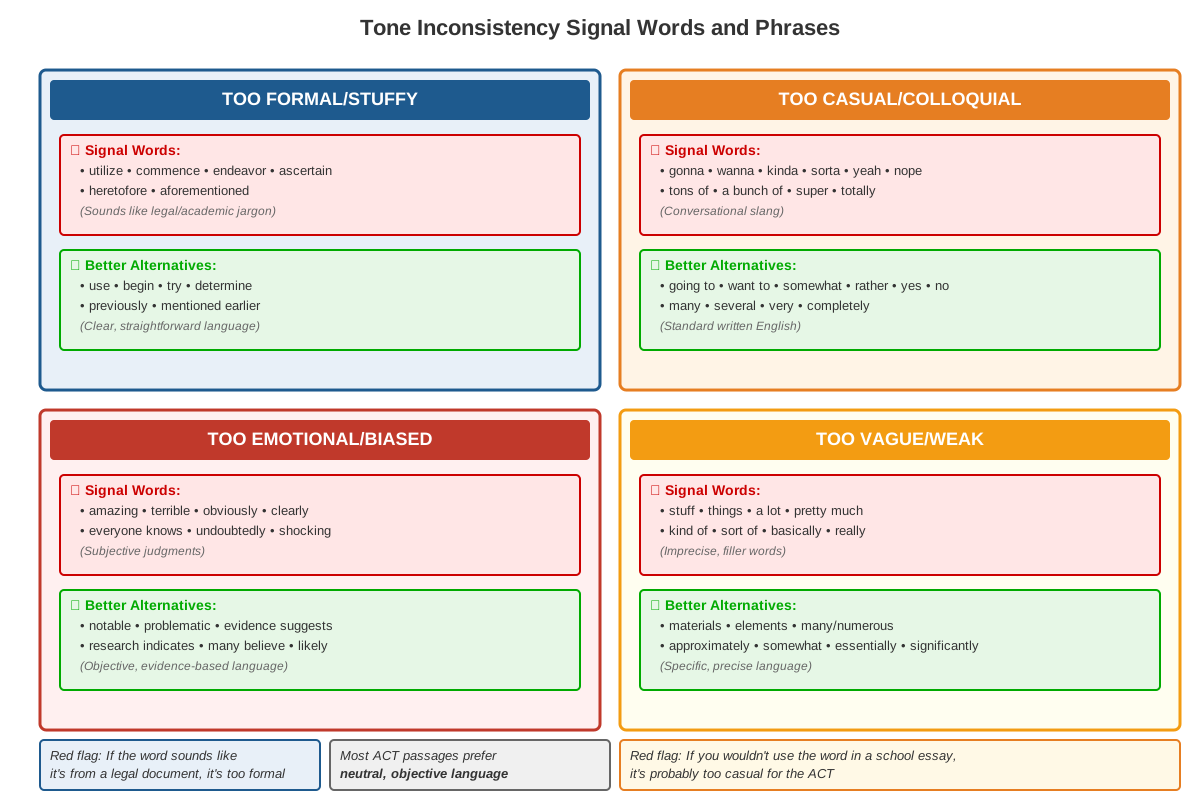
- [ ] Recognize specific words and phrases that signal tone shifts or inconsistencies
- [ ] Evaluate multiple answer choices to determine which option best maintains the established tone
- [ ] Analyze the relationship between tone, audience, and purpose in ACT passages
Prerequisites
- Basic understanding of formal vs. informal language: Necessary to recognize when language register shifts inappropriately within a passage
- Familiarity with context clues and reading comprehension: Essential for determining the overall tone of a passage before identifying inconsistencies
- Knowledge of connotation and denotation: Required to understand how word choice affects tone and emotional impact
- Awareness of audience and purpose in writing: Fundamental to evaluating whether a particular tone is appropriate for the given context
Why This Topic Matters
Tone consistency represents a fundamental principle of effective communication that extends far beyond standardized testing. In professional settings, maintaining appropriate tone in emails, reports, and presentations determines credibility and effectiveness. Academic writing demands consistent scholarly tone, while creative writing requires sustained voice throughout narratives. The ability to recognize and maintain tone consistency demonstrates sophisticated language awareness that colleges value in incoming students.
On the ACT English section, tone consistency questions appear with remarkable frequency—typically 3-5 questions per test, accounting for roughly 6-8% of the entire English section score. These questions carry the same point value as grammar questions but often prove more challenging because they require holistic passage comprehension rather than isolated rule application. Students who master tone consistency gain a significant competitive advantage, as these questions often separate mid-range scorers from those achieving composite scores above 30.
Tone consistency questions most commonly appear in passages about personal narratives, scientific explanations, historical accounts, and persuasive essays. The ACT typically presents a passage with a clearly established tone—perhaps formal and academic, or conversational and personal—then includes one sentence or phrase that jarringly disrupts this tone. The question will ask which revision best maintains consistency with the passage's style, or whether the underlined portion should be kept or deleted based on tone considerations. Recognizing these patterns allows students to approach such questions systematically rather than relying on vague intuition.
Core Concepts
Defining Tone in Writing
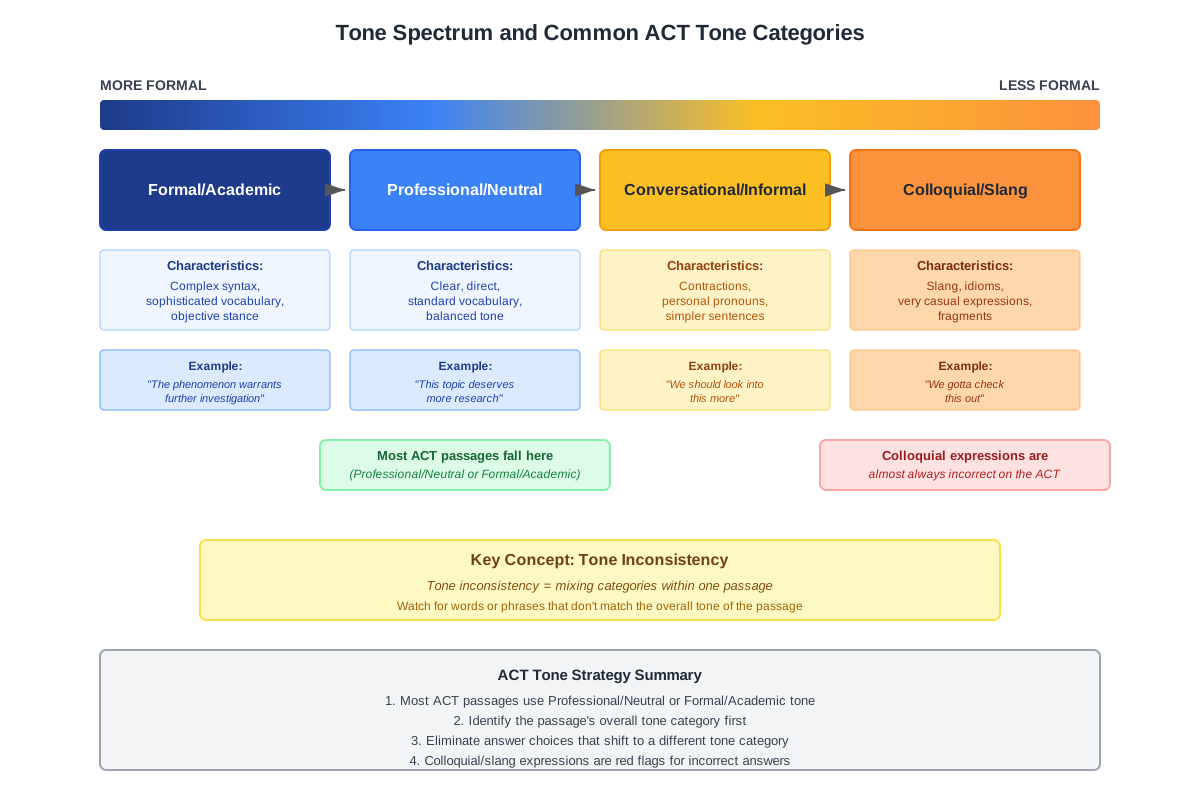
Tone refers to the author's attitude toward the subject matter and audience, conveyed through word choice, sentence structure, and stylistic elements. Unlike mood (which describes the emotional atmosphere created for the reader), tone reflects the writer's stance and relationship with both topic and audience. On the ACT, tone typically falls into several recognizable categories: formal/academic, informal/conversational, technical/scientific, enthusiastic/passionate, objective/neutral, or humorous/lighthearted.
The ACT tests whether students can identify when a sentence disrupts the established tone. For example, a passage discussing archaeological discoveries in formal, academic language would be disrupted by a sentence like "The researchers were totally stoked about finding the ancient pottery." The slang expression "totally stoked" clashes with the scholarly register established throughout the passage. Recognizing such inconsistencies requires reading the entire passage to establish the baseline tone before evaluating individual sentences.
Formal vs. Informal Register
Understanding the distinction between formal and informal language registers is fundamental to tone consistency. Formal register employs sophisticated vocabulary, complete sentence structures, third-person perspective, and objective presentation. It avoids contractions, slang, colloquialisms, and personal anecdotes unless they serve a specific scholarly purpose. Academic essays, scientific reports, and professional communications typically use formal register.
Informal register incorporates conversational elements including contractions, first or second-person perspective, colloquial expressions, and personal observations. It may include sentence fragments for stylistic effect and employs everyday vocabulary accessible to general audiences. Personal narratives, opinion pieces, and casual correspondence often use informal register.
| Formal Register | Informal Register |
|---|---|
| "The experiment yielded significant results" | "The experiment worked out great" |
| "One must consider multiple perspectives" | "You've got to look at it from different angles" |
| "The data demonstrate a clear correlation" | "The numbers show they're definitely connected" |
| "Subsequently, researchers investigated" | "Then, the researchers checked out" |
| "This phenomenon warrants further examination" | "This thing needs more looking into" |
Identifying Tone Markers
Specific linguistic features serve as tone markers—elements that signal the register and attitude of a passage. Recognizing these markers helps students quickly establish the baseline tone:
Formal tone markers include:
- Sophisticated, multi-syllabic vocabulary (utilize, demonstrate, facilitate)
- Passive voice constructions ("The hypothesis was tested")
- Third-person perspective exclusively
- Complete, complex sentence structures
- Absence of contractions
- Technical terminology appropriate to the subject
- Objective, measured language
Informal tone markers include:
- Everyday vocabulary and simple word choices
- Active voice predominance
- First or second-person perspective ("I discovered" or "You might notice")
- Contractions (can't, won't, it's)
- Colloquial expressions and idioms
- Shorter, simpler sentence structures
- Personal opinions and subjective observations
Technical vs. Accessible Language
Some ACT passages employ technical language appropriate for specialized audiences, while others use accessible language for general readers. Technical passages about scientific topics might include discipline-specific terminology and assume reader familiarity with concepts. Accessible passages explain concepts in layman's terms and avoid jargon.
Tone consistency requires matching the level of technicality. A passage explaining photosynthesis to a general audience would be disrupted by suddenly inserting highly technical terminology without explanation: "The Calvin cycle's carbon fixation through RuBisCO catalysis" would clash with surrounding accessible explanations. Conversely, oversimplifying in a technical passage disrupts consistency: "The plant makes food from sunlight" would seem out of place in a biochemistry journal article.
Emotional Tone and Attitude
Beyond formality, tone encompasses the author's emotional attitude toward the subject. Passages may be enthusiastic, critical, neutral, reverent, skeptical, or humorous. Consistency requires maintaining this emotional register throughout.
An enthusiastic passage celebrating a scientific breakthrough would be disrupted by suddenly inserting skeptical or dismissive language. A neutral, objective historical account would be compromised by injecting passionate advocacy. The ACT tests whether students recognize when emotional tone shifts inappropriately, requiring answer choices that restore the established attitude.
Context-Dependent Appropriateness
Tone appropriateness depends entirely on context—the passage's purpose, audience, and subject matter. No tone is inherently "correct"; rather, consistency with the established context matters. A humorous tone might be perfectly appropriate in a personal essay about a comical childhood memory but entirely inappropriate in a passage about a serious historical tragedy.
ACT questions sometimes ask students to evaluate whether a proposed addition or revision is appropriate given the passage's tone. This requires understanding not just what tone exists, but why that tone suits the context. A formal, respectful tone befits a biographical passage about a historical figure, while a casual, conversational tone suits a personal reflection on everyday experiences.
Concept Relationships
Tone consistency serves as the overarching principle that unifies multiple rhetorical elements. Word choice (diction) directly creates tone—selecting "residence" versus "home" versus "crib" establishes different registers. Sentence structure contributes to tone, with complex, varied structures suggesting formality and simple, direct structures suggesting informality. Point of view affects tone, as third-person creates distance and objectivity while first-person creates intimacy and subjectivity.
The relationship flows as follows: Author's Purpose → Intended Audience → Appropriate Tone → Consistent Word Choice + Sentence Structure + Perspective. When any element in this chain breaks, tone consistency suffers. Understanding this relationship helps students recognize that tone consistency questions test holistic awareness rather than isolated skills.
Tone consistency also connects to style questions on the ACT, which evaluate whether additions or revisions match the passage's overall approach. Both question types require reading beyond the immediate sentence to understand broader context. Additionally, tone consistency relates to transitions and organization, as abrupt tone shifts can signal organizational problems or misplaced sentences.
High-Yield Facts
⭐ Tone consistency questions require reading the entire passage or substantial portions to establish the baseline tone before evaluating answer choices.
⭐ Approximately 3-5 tone consistency questions appear on each ACT English section, making this a high-yield topic worth dedicated study.
⭐ The most common tone inconsistencies involve mixing formal and informal language, particularly inserting slang or colloquialisms into academic passages.
⭐ Answer choices that use contractions, slang, or overly casual language almost always violate tone consistency in formal passages.
⭐ Technical passages require maintaining appropriate terminology level—neither oversimplifying nor introducing unexplained jargon.
- Tone consistency questions often appear as "Which choice best maintains the style and tone of the passage?" or "Given that all choices are true, which provides information most consistent with the passage?"
- Emotional tone shifts (from enthusiastic to skeptical, or neutral to passionate) signal inconsistency as clearly as formality shifts.
- First-person pronouns ("I," "we") typically indicate informal or personal tone, while third-person maintains formal distance.
- Humor, sarcasm, or irony must be sustained throughout a passage—a single humorous sentence in an otherwise serious passage creates inconsistency.
- Passive voice constructions ("was discovered," "is believed") typically signal formal, academic tone.
- Exclamation points rarely appear in formal writing and signal enthusiasm or informality.
- Rhetorical questions can suit various tones but must match the established register (formal rhetorical questions differ from casual ones).
- Clichés and idioms typically signal informal tone and disrupt formal passages.
Quick check — test yourself on Tone consistency so far.
Try Flashcards →Common Misconceptions
Misconception: Formal tone is always "better" or more correct than informal tone. → Correction: Tone appropriateness depends entirely on context, audience, and purpose. A personal narrative should use informal, conversational tone, while a scientific report requires formal tone. Neither is inherently superior—consistency with context matters.
Misconception: Using sophisticated vocabulary automatically creates appropriate formal tone. → Correction: Tone consistency requires matching all elements—vocabulary, sentence structure, perspective, and attitude. Simply inserting complex words into an otherwise informal passage creates inconsistency. True formal tone requires sustained register across all linguistic features.
Misconception: Tone consistency only involves avoiding slang and contractions. → Correction: While slang and contractions are common markers of informal tone, consistency encompasses much more: emotional attitude, technicality level, sentence complexity, perspective, and overall stylistic approach. Students must evaluate the complete linguistic package.
Misconception: If a sentence is grammatically correct, it maintains tone consistency. → Correction: Grammar and tone are separate considerations. A sentence can be perfectly grammatical yet completely disrupt tone. For example, "The researchers were totally pumped about the discovery" is grammatically correct but tonally inconsistent in a formal scientific passage.
Misconception: Tone consistency questions are subjective and based on personal preference. → Correction: While tone involves stylistic judgment, ACT questions have objectively correct answers based on clear inconsistencies. The test establishes a definite tone through the passage, and one answer choice will clearly match while others clearly clash. Recognizing the established tone removes subjectivity.
Misconception: Short passages don't establish clear enough tone to test consistency. → Correction: Even brief passages establish tone through word choice, sentence structure, and perspective. The ACT carefully crafts passages to create unmistakable tone, making inconsistencies obvious once students learn to recognize tone markers.
Worked Examples
Example 1: Formal Scientific Passage
Passage Context: A passage discusses recent advances in renewable energy technology using formal, academic language throughout. The passage includes sentences like "Researchers have developed innovative photovoltaic cells that demonstrate significantly improved efficiency" and "These technological advances represent substantial progress toward sustainable energy solutions."
Question: Which of the following alternatives to the underlined portion would be LEAST acceptable?
Original underlined text: "The new solar panels convert sunlight to electricity with remarkable efficiency."
Answer Choices:
- A) NO CHANGE
- B) with awesome efficiency
- C) with unprecedented efficiency
- D) with exceptional efficiency
Analysis:
First, establish the passage's tone by examining surrounding sentences. The passage uses formal, academic language: "innovative photovoltaic cells," "demonstrate significantly improved," "substantial progress," "sustainable energy solutions." This clearly establishes formal, scientific tone.
Next, evaluate each answer choice against this baseline:
- Choice A (NO CHANGE): "remarkable efficiency" uses sophisticated vocabulary appropriate for formal scientific writing. "Remarkable" is a formal adjective commonly used in academic contexts. This maintains consistency.
- Choice B: "awesome efficiency" introduces informal, colloquial language. "Awesome" is slang that belongs in casual conversation, not formal scientific writing. This creates jarring inconsistency with the established academic tone. This is the LEAST acceptable choice.
- Choice C: "unprecedented efficiency" uses formal, sophisticated vocabulary. "Unprecedented" is an academic term meaning "never before achieved," perfectly suited to formal scientific discourse. This maintains consistency.
- Choice D: "exceptional efficiency" employs formal language appropriate for academic writing. "Exceptional" is a sophisticated adjective commonly used in scholarly contexts. This maintains consistency.
Answer: B
Connection to Learning Objectives: This example demonstrates how to identify tone consistency testing (the question asks about acceptability, signaling style/tone evaluation), apply the core strategy (establish baseline tone, then evaluate each choice against it), and accurately select the answer that disrupts consistency.
Example 2: Personal Narrative Passage
Passage Context: A personal essay describes the author's childhood memories of visiting their grandmother's farm. The passage uses informal, conversational tone with first-person perspective: "I remember running through the fields" and "Grandma's kitchen always smelled like fresh-baked bread."
Question: Given that all the choices are true, which one provides the most effective transition while maintaining the tone established in the passage?
Answer Choices:
- A) The agricultural property, comprising approximately forty acres, featured diverse crop cultivation.
- B) The farm had about forty acres with lots of different crops growing.
- C) Grandma's farm stretched across forty acres where she grew all kinds of vegetables.
- D) The farming operation encompassed forty acres dedicated to various agricultural products.
Analysis:
The passage establishes informal, personal, conversational tone through several markers:
- First-person perspective ("I remember")
- Personal references ("Grandma's kitchen")
- Conversational vocabulary and structure
- Emotional, memory-based narrative rather than objective reporting
Now evaluate each choice:
- Choice A: Uses highly formal, technical language: "agricultural property," "comprising," "diverse crop cultivation." This creates stark inconsistency with the warm, personal narrative tone. The formal register clashes with the intimate childhood memory context.
- Choice B: Uses informal, conversational language: "had about," "lots of," "growing." The casual vocabulary and simple structure match the established tone. However, it lacks the personal connection present throughout the passage (no reference to "Grandma").
- Choice C: Maintains informal, conversational tone ("stretched across," "all kinds of") while preserving the personal element ("Grandma's farm"). This choice balances casual language with the intimate, family-centered perspective established throughout. This best maintains consistency.
- Choice D: Uses formal, technical language: "farming operation," "encompassed," "dedicated to," "agricultural products." This formal register completely disrupts the personal, warm narrative tone.
Answer: C
Connection to Learning Objectives: This example shows how tone consistency extends beyond simply avoiding slang—it requires maintaining the emotional register and personal perspective established in the passage. Choice C succeeds because it preserves both the informal language level and the intimate, family-centered focus that defines the passage's tone.
Exam Strategy
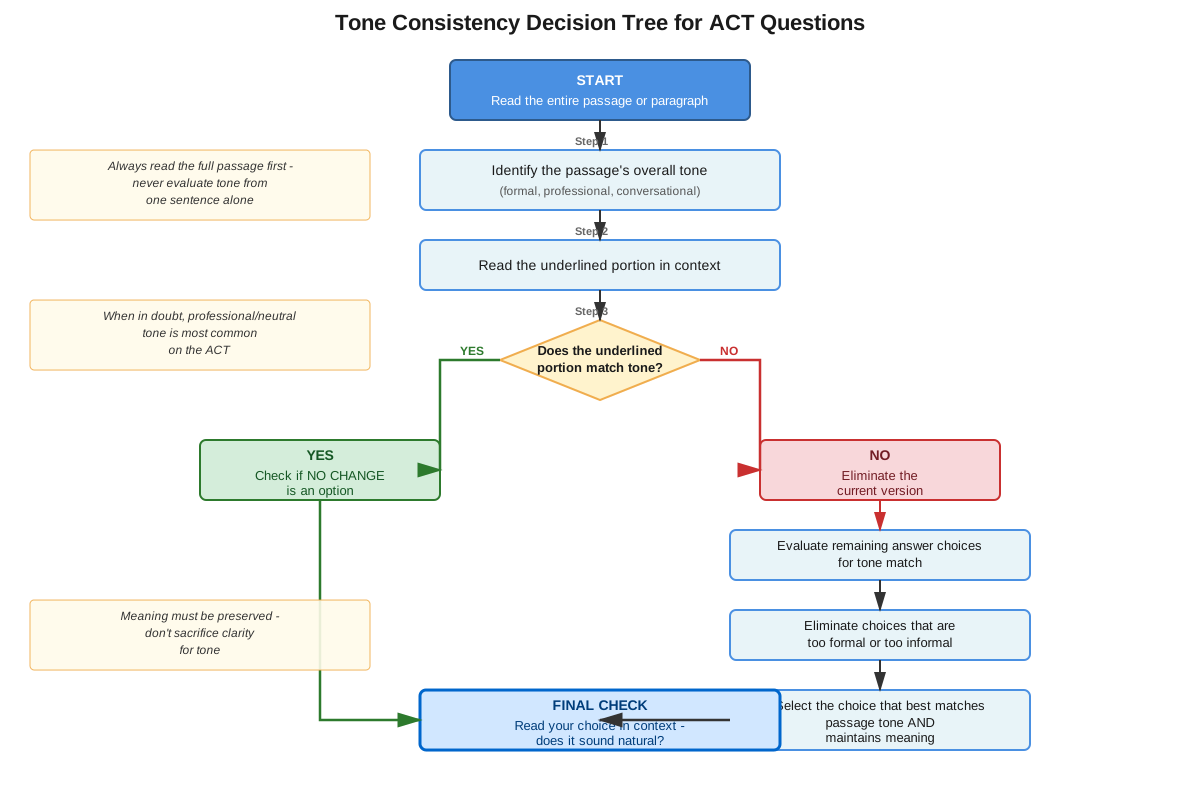
When approaching tone consistency questions on the ACT, follow this systematic process:
Step 1: Identify the Question Type
Recognize tone consistency questions through trigger phrases:
- "Which choice best maintains the style and tone..."
- "LEAST acceptable alternative..."
- "Most consistent with the passage's tone..."
- "Given that all choices are true, which best fits..."
Step 2: Establish Baseline Tone
Before evaluating answer choices, read surrounding sentences (at minimum, the sentence before and after the question). Identify:
- Formality level (formal vs. informal markers)
- Perspective (first, second, or third person)
- Emotional attitude (enthusiastic, neutral, critical, etc.)
- Technical level (specialized vs. accessible language)
- Sentence complexity and structure patterns
Step 3: Predict the Issue
If the question asks for the LEAST acceptable choice, the current text likely maintains consistency, and you're looking for the disruptive option. If it asks for the best choice, the underlined portion likely disrupts tone, and you're seeking the consistent option.
Step 4: Eliminate Systematically
Compare each answer choice against your established baseline:
- Eliminate choices with obvious formality mismatches (slang in formal passages, overly technical language in accessible passages)
- Eliminate choices that shift perspective inappropriately
- Eliminate choices that introduce emotional tones absent from the passage
- Eliminate choices with sentence structures that clash with established patterns
Step 5: Verify Context
Before finalizing your answer, reread the sentence with your selected choice in context. Does it flow naturally with surrounding sentences? Does it maintain the passage's voice?
Time Management Tip: Tone consistency questions require reading more context than grammar questions but shouldn't consume excessive time. Spend 30-45 seconds establishing tone, then 15-20 seconds evaluating choices. If you're uncertain, mark the question and return after completing faster grammar questions.
Process of Elimination Power: Tone consistency questions typically include at least two obviously wrong answers that clearly clash with the established tone. Eliminate these immediately, then carefully distinguish between remaining choices.
Memory Techniques
CRAFT Mnemonic for evaluating tone consistency:
- Context: What is the passage's purpose and audience?
- Register: Is the tone formal or informal?
- Attitude: What emotional stance does the author take?
- Formality markers: Check for contractions, slang, technical terms
- Tone throughout: Does this choice match the entire passage?
The "Voice Test" Visualization: Imagine the passage being read aloud by a specific person (a professor for formal passages, a friend for informal ones). Would the questionable sentence sound natural in that person's voice, or would it sound like someone else suddenly started speaking? This mental audio check helps identify tone shifts.
Formality Spectrum: Visualize a spectrum from 1 (extremely casual) to 10 (extremely formal). Place the passage on this spectrum based on surrounding sentences, then evaluate whether answer choices match that position or shift significantly up or down the scale.
The Consistency Circle: Picture the passage's tone as a circle. Each sentence should fit within this circle. Answer choices that fall outside the circle (too formal, too casual, wrong emotional tone) disrupt consistency. This visual helps maintain focus on the established baseline rather than personal preference.
Summary
Tone consistency represents a crucial rhetorical skill on the ACT English section, testing whether students can recognize and maintain unified voice throughout written passages. Success requires establishing the baseline tone through careful attention to formality markers, emotional attitude, perspective, and technical level, then evaluating whether individual sentences or phrases harmonize with this established register. The ACT typically presents 3-5 tone consistency questions per test, making this a high-yield topic that significantly impacts scores. These questions extend beyond grammar rules to assess holistic reading comprehension and sensitivity to stylistic appropriateness. Students must distinguish between formal and informal registers, recognize when technical language suits the context, and identify emotional tone shifts that disrupt unity. The key strategy involves reading sufficient context to establish tone before evaluating answer choices, then systematically eliminating options that introduce inconsistent formality, perspective, vocabulary, or attitude. Mastering tone consistency requires understanding that no tone is inherently correct—appropriateness depends entirely on matching the passage's purpose, audience, and established voice throughout.
Key Takeaways
- Tone consistency questions require reading substantial context to establish baseline tone before evaluating individual sentences or answer choices
- Approximately 3-5 tone consistency questions appear per ACT English section, making this a high-yield topic worth dedicated preparation
- The most common inconsistencies involve mixing formal and informal language, particularly inserting slang, contractions, or colloquialisms into academic passages
- Successful tone evaluation requires assessing multiple elements simultaneously: formality level, emotional attitude, perspective, technical language, and sentence structure
- No tone is inherently "better"—appropriateness depends on context, audience, and purpose; consistency with the established tone matters most
- Systematic elimination of obviously inconsistent choices (those with clear formality mismatches or inappropriate emotional shifts) quickly narrows options
- Tone consistency connects to broader rhetorical skills including style, audience awareness, and purpose, requiring holistic passage comprehension rather than isolated rule application
Related Topics
Word Choice and Diction: Explores how specific vocabulary selections create and maintain tone, providing deeper understanding of the linguistic tools that establish register and voice.
Style and Effect: Examines broader questions about whether additions or revisions enhance the passage's overall impact, building on tone consistency principles to evaluate rhetorical effectiveness.
Audience and Purpose: Investigates how writers adapt tone to suit specific readers and communicative goals, explaining why certain tones suit particular contexts.
Transitions and Organization: Studies how passages maintain coherence through logical connections, complementing tone consistency's focus on maintaining unified voice.
Sentence Structure and Variety: Analyzes how sentence complexity and patterns contribute to formal or informal tone, deepening understanding of the structural elements that create register.
Mastering tone consistency provides essential foundation for these related topics, as recognizing and maintaining unified voice underlies all effective rhetorical choices in writing.
Practice CTA
Now that you've mastered the core concepts of tone consistency, it's time to apply this knowledge to authentic ACT-style questions. The practice questions and flashcards will reinforce your ability to quickly identify tone markers, establish baseline register, and select answers that maintain consistency. Remember: tone consistency questions reward careful readers who consider context before evaluating choices. Each practice question you complete strengthens your pattern recognition and builds the confidence needed to tackle these high-yield questions efficiently on test day. You've got this—let's put your knowledge into action!
Sign up free to keep reading
Create a free AnvayaPrep account to finish this ACT guide on Tone consistency — plus flashcards and practice questions.