Overview
Function notation is a fundamental algebraic concept that appears consistently throughout the ACT Math test, representing one of the most frequently tested topics in the algebra domain. Rather than writing equations in the traditional y = mx + b format, function notation uses the form f(x) to represent the output of a function when x is the input. This compact, powerful notation allows mathematicians and test-makers to communicate complex relationships between variables with precision and clarity.
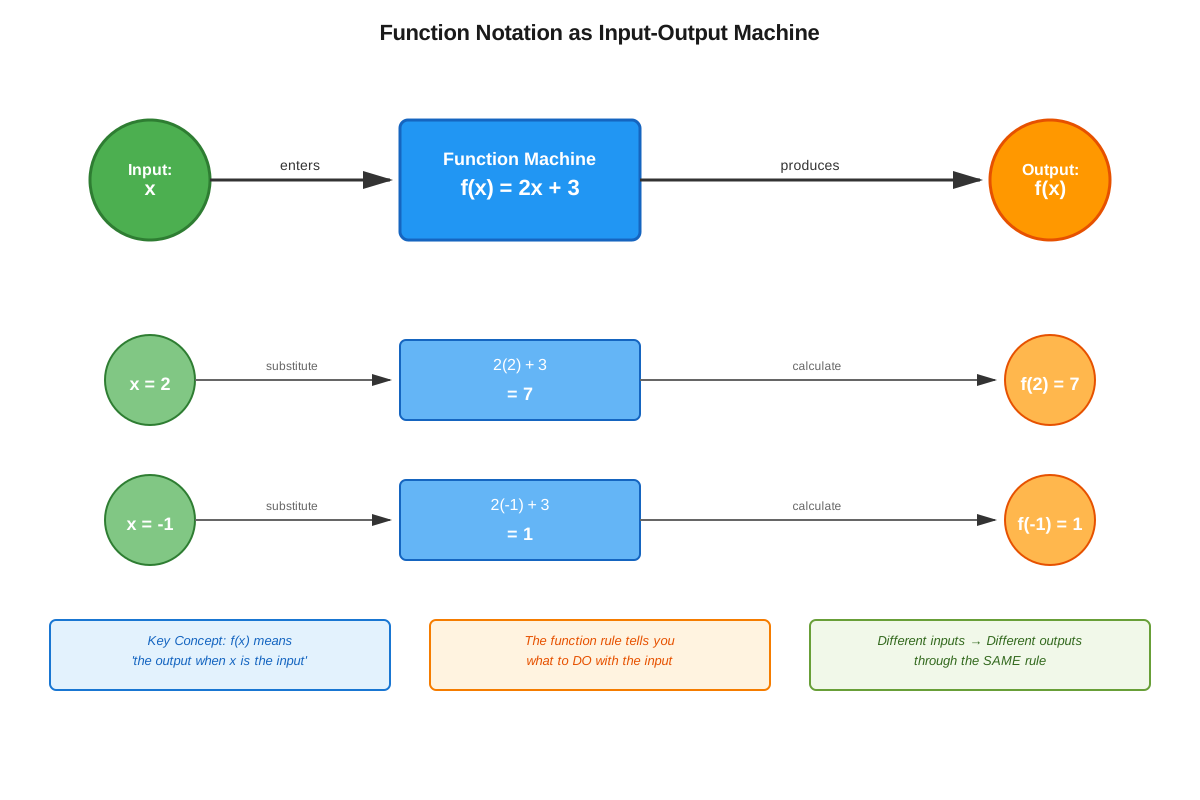
On the ACT, ACT function notation questions test whether students can interpret, evaluate, and manipulate functions written in this specialized format. These questions range from straightforward evaluation problems where students substitute a number for x, to more complex scenarios involving composition of functions, inverse operations, or algebraic manipulation. Understanding function notation is not merely about memorizing a symbol system—it requires recognizing that f(x) represents a process or rule that transforms inputs into outputs, much like a machine that takes raw materials and produces finished products.
Mastery of function notation connects directly to numerous other mathematical concepts tested on the ACT, including coordinate geometry (where functions describe curves on the coordinate plane), systems of equations, polynomial operations, and even trigonometry. Students who struggle with function notation often find themselves unable to access entire categories of ACT problems, making this topic essential for achieving competitive scores. The notation serves as a bridge between basic algebra and more advanced mathematical thinking, preparing students not only for the ACT but for college-level mathematics.
Learning Objectives
- [ ] Identify when Function notation is being tested in ACT questions
- [ ] Explain the core rule or strategy behind Function notation
- [ ] Apply Function notation to ACT-style questions accurately
- [ ] Evaluate functions for numerical inputs, variable expressions, and composite inputs
- [ ] Interpret the meaning of function notation in real-world contexts
- [ ] Manipulate and combine functions using operations and composition
- [ ] Solve equations involving function notation for unknown inputs
Prerequisites
- Basic algebraic substitution: Function notation fundamentally requires substituting values into expressions, making this skill essential for every function evaluation problem.
- Order of operations (PEMDAS): After substitution, students must correctly simplify expressions following the proper sequence of operations.
- Solving linear and quadratic equations: Many ACT function problems require working backward from f(x) to find x, necessitating equation-solving skills.
- Understanding variables: Recognizing that letters represent numbers and can be manipulated according to algebraic rules underpins all function notation work.
- Coordinate plane basics: Functions often connect to graphical representations, requiring familiarity with plotting points and understanding axes.
Why This Topic Matters
Function notation appears in approximately 4-6 questions on every ACT Math test, making it one of the highest-yield topics for focused study. These questions span difficulty levels from straightforward substitution problems that most students can solve in under 30 seconds to complex multi-step problems involving function composition or systems that challenge even top scorers. The versatility of function notation means it can appear in pure algebra questions, word problems involving real-world scenarios, or coordinate geometry contexts.
In real-world applications, functions model countless phenomena: the relationship between time and distance traveled, the connection between price and demand in economics, the trajectory of projectiles in physics, and growth patterns in biology. Scientists, engineers, economists, and data analysts use function notation daily to describe, predict, and analyze patterns. Understanding this notation provides a foundation for calculus, statistics, and virtually every STEM field.
On the ACT specifically, function notation questions typically appear as: direct evaluation problems (find f(3) when f(x) = 2x + 5), composition problems (find f(g(x))), inverse problems (find x when f(x) = 10), algebraic manipulation (find f(x + 2) in terms of x), and application problems where functions model real situations. Recognizing these patterns allows students to quickly categorize problems and apply the appropriate solution strategy.
Core Concepts
Understanding Function Notation Basics
Function notation uses the format f(x) to represent a mathematical relationship where x is the input variable and f(x) is the output. The letter f is simply a name for the function—other common function names include g, h, p, or any letter. The expression f(x) is read as "f of x" and means "the output of function f when the input is x."
The fundamental principle is that f(x) represents a rule or process. When you see f(x) = 3x - 7, this means: "take the input, multiply it by 3, then subtract 7." The parentheses in f(x) do not indicate multiplication; they indicate that x is the input being processed by function f.
Evaluating Functions with Numerical Inputs
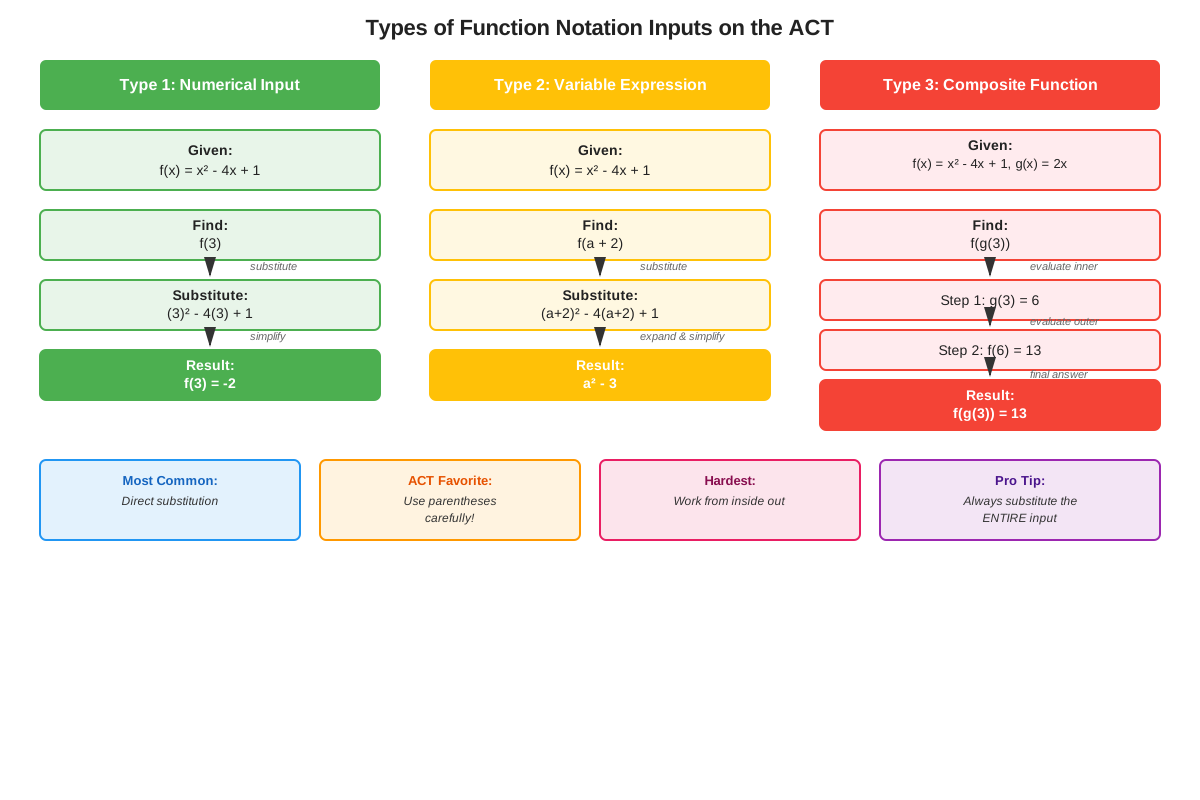
The most common ACT function notation task involves substituting a specific number for x and calculating the result. When asked to find f(5) given f(x) = x² - 4x + 1, follow these steps:
- Replace every instance of x in the function rule with 5
- Simplify using order of operations
- Calculate the final numerical answer
For f(5): f(5) = (5)² - 4(5) + 1 = 25 - 20 + 1 = 6
Critical detail: Use parentheses when substituting to avoid sign errors, especially with negative numbers. Finding f(-3) for f(x) = x² requires writing f(-3) = (-3)² = 9, not -3² = -9.
Evaluating Functions with Variable Expressions
ACT questions frequently ask students to evaluate functions using algebraic expressions rather than numbers. When finding f(2a) given f(x) = x² + 3x, substitute the entire expression 2a for every x:
f(2a) = (2a)² + 3(2a) = 4a² + 6a
Similarly, for f(x + 1), substitute (x + 1) for every x in the original function:
If f(x) = x² - 5x, then f(x + 1) = (x + 1)² - 5(x + 1) = x² + 2x + 1 - 5x - 5 = x² - 3x - 4
This skill tests whether students understand that the input can be any expression, not just a simple variable.
Function Composition
Function composition involves using the output of one function as the input for another function. The notation f(g(x)) means "apply function g first, then apply function f to that result." This is read as "f of g of x" or "f composed with g."
To evaluate f(g(3)) when f(x) = 2x + 1 and g(x) = x² - 4:
- Find g(3) first: g(3) = 3² - 4 = 9 - 4 = 5
- Use that result as input for f: f(5) = 2(5) + 1 = 11
For algebraic composition, find f(g(x)) by substituting the entire g(x) expression into f:
If f(x) = 3x - 2 and g(x) = x + 5, then f(g(x)) = 3(x + 5) - 2 = 3x + 15 - 2 = 3x + 13
Note that f(g(x)) ≠ g(f(x)) in most cases—order matters in composition.
Working Backward: Finding Inputs from Outputs
Some ACT problems provide the output value and ask for the input. If f(x) = 2x - 7 and f(x) = 15, find x by setting up an equation:
2x - 7 = 15
2x = 22
x = 11
This requires recognizing that f(x) is simply another way of writing y, so you're solving a standard equation.
Multiple Function Operations
Functions can be added, subtracted, multiplied, and divided like algebraic expressions:
| Operation | Notation | Meaning |
|---|---|---|
| Addition | (f + g)(x) | f(x) + g(x) |
| Subtraction | (f - g)(x) | f(x) - g(x) |
| Multiplication | (f · g)(x) | f(x) · g(x) |
| Division | (f/g)(x) | f(x)/g(x), where g(x) ≠ 0 |
If f(x) = x² and g(x) = 3x - 1, then:
- (f + g)(x) = x² + 3x - 1
- (f · g)(x) = x²(3x - 1) = 3x³ - x²
Domain and Function Notation
The domain of a function consists of all valid input values. Function notation questions may test whether students recognize restrictions. For f(x) = 1/(x - 3), the domain excludes x = 3 because division by zero is undefined. When evaluating f(3), the answer is "undefined" or "does not exist."
Concept Relationships
Function notation serves as the foundation for understanding how mathematical relationships are expressed and manipulated. The basic concept of evaluating functions with numerical inputs builds directly into evaluating with variable expressions, which simply replaces numbers with algebraic terms while following identical substitution procedures.
Function composition represents a more sophisticated application that combines multiple evaluation steps: f(g(x)) requires first evaluating g(x), then using that result as input for f(x). This concept connects to the idea of working backward from outputs to inputs, which reverses the evaluation process by treating the function equation as a solvable equation.
The relationship map flows as follows:
Basic substitution → Variable substitution → Function composition → Inverse operations
All these concepts connect to prerequisite knowledge of algebraic substitution and equation solving. They also link forward to more advanced topics like inverse functions (where f⁻¹(x) undoes what f(x) does), transformations of functions (where f(x + 2) shifts the graph), and piecewise functions (where different rules apply to different input ranges).
Understanding that f(x) represents both a process and a value bridges the gap between algebraic and graphical thinking. On a coordinate plane, f(x) represents the y-coordinate of points on the function's graph, connecting function notation to coordinate geometry and graphing.
Quick check — test yourself on Function notation so far.
Try Flashcards →High-Yield Facts
⭐ f(x) is read as "f of x" and represents the output when x is the input—the parentheses do not indicate multiplication
⭐ To evaluate f(a), substitute a for every instance of x in the function rule and simplify
⭐ f(g(x)) means evaluate g(x) first, then use that result as the input for f(x)—order matters in composition
⭐ When finding f(x + h) or f(2x), substitute the entire expression for every x, using parentheses to avoid errors
⭐ To find x when given f(x) = k, set the function expression equal to k and solve the resulting equation
- Different letters (f, g, h) represent different functions with potentially different rules
- f(a + b) ≠ f(a) + f(b) in general—you cannot distribute function notation like multiplication
- The domain of a function includes all x-values that produce defined outputs (no division by zero, no negative square roots for real functions)
- (f + g)(x) means f(x) + g(x)—add the outputs of the two functions
- f(3) represents a single number (the output when x = 3), while f(x) represents the entire function rule
- When substituting negative numbers, always use parentheses: f(-2) = (-2)² = 4, not -2² = -4
- Function notation can represent real-world relationships: if C(n) = 5n + 20, then C represents cost as a function of n items
Common Misconceptions
Misconception: f(x) means f times x, so f(3) = 3f
Correction: The parentheses in function notation indicate that 3 is the input to function f, not a multiplication operation. f(3) means "the output of function f when the input is 3."
Misconception: f(a + b) = f(a) + f(b), so you can "distribute" the function
Correction: Functions do not distribute over addition. If f(x) = x², then f(3 + 2) = (3 + 2)² = 25, but f(3) + f(2) = 9 + 4 = 13. You must substitute the entire expression (a + b) into the function.
Misconception: f(g(x)) and g(f(x)) are the same thing
Correction: The order of composition matters. f(g(x)) means apply g first, then f. g(f(x)) means apply f first, then g. These typically produce different results.
Misconception: When finding f(x - 2), you subtract 2 from the function's output
Correction: f(x - 2) means substitute (x - 2) for every x in the function rule. If f(x) = 3x + 1, then f(x - 2) = 3(x - 2) + 1 = 3x - 6 + 1 = 3x - 5. You're changing the input, not the output.
Misconception: f(x) and f always mean the same thing
Correction: f represents the function itself (the rule or process), while f(x) represents the output value for a specific input x. Writing just f is like naming a machine; writing f(x) is like describing what the machine produces.
Misconception: You can cancel the f's in f(x)/f(y) to get x/y
Correction: f is not a factor that can be canceled—it's a function name. f(x)/f(y) means "the output when x is input, divided by the output when y is input." You must evaluate each separately before dividing.
Worked Examples
Example 1: Multi-Step Function Evaluation
Problem: Given f(x) = 2x² - 3x + 1 and g(x) = x - 4, find f(g(5)).
Solution:
Step 1: Identify that this is a composition problem requiring evaluation of g first.
Step 2: Evaluate g(5) by substituting 5 into g(x):
g(5) = 5 - 4 = 1
Step 3: Use this result as the input for f. We need to find f(1):
f(1) = 2(1)² - 3(1) + 1
f(1) = 2(1) - 3 + 1
f(1) = 2 - 3 + 1
f(1) = 0
Answer: f(g(5)) = 0
Connection to learning objectives: This problem tests the ability to identify composition notation, apply the correct strategy (inside function first), and accurately evaluate functions with numerical inputs.
Example 2: Algebraic Function Manipulation
Problem: If h(x) = x² + 2x - 5, find h(x + 3) and simplify completely.
Solution:
Step 1: Recognize that we must substitute (x + 3) for every instance of x in the original function.
Step 2: Write the substitution with parentheses:
h(x + 3) = (x + 3)² + 2(x + 3) - 5
Step 3: Expand (x + 3)² using FOIL or the pattern (a + b)² = a² + 2ab + b²:
(x + 3)² = x² + 6x + 9
Step 4: Distribute the 2 in the second term:
2(x + 3) = 2x + 6
Step 5: Combine all terms:
h(x + 3) = x² + 6x + 9 + 2x + 6 - 5
h(x + 3) = x² + 8x + 10
Answer: h(x + 3) = x² + 8x + 10
Connection to learning objectives: This demonstrates applying function notation with variable expressions, a high-yield ACT skill that tests algebraic manipulation and careful substitution.
Example 3: Working Backward from Output
Problem: If p(x) = 5x - 12 and p(x) = 23, what is the value of x?
Solution:
Step 1: Recognize that p(x) represents the output, so we can set the function expression equal to 23:
5x - 12 = 23
Step 2: Solve for x using standard equation-solving techniques:
5x = 23 + 12
5x = 35
x = 7
Step 3: Verify by checking: p(7) = 5(7) - 12 = 35 - 12 = 23 ✓
Answer: x = 7
Connection to learning objectives: This illustrates the strategy of treating function equations as solvable equations when working backward from outputs to inputs, a common ACT question type.
Exam Strategy
Trigger Words: Watch for phrases like "find f(3)," "evaluate," "f of g of x," "f(g(x))," "when f(x) equals," and "in terms of x." These signal function notation problems.
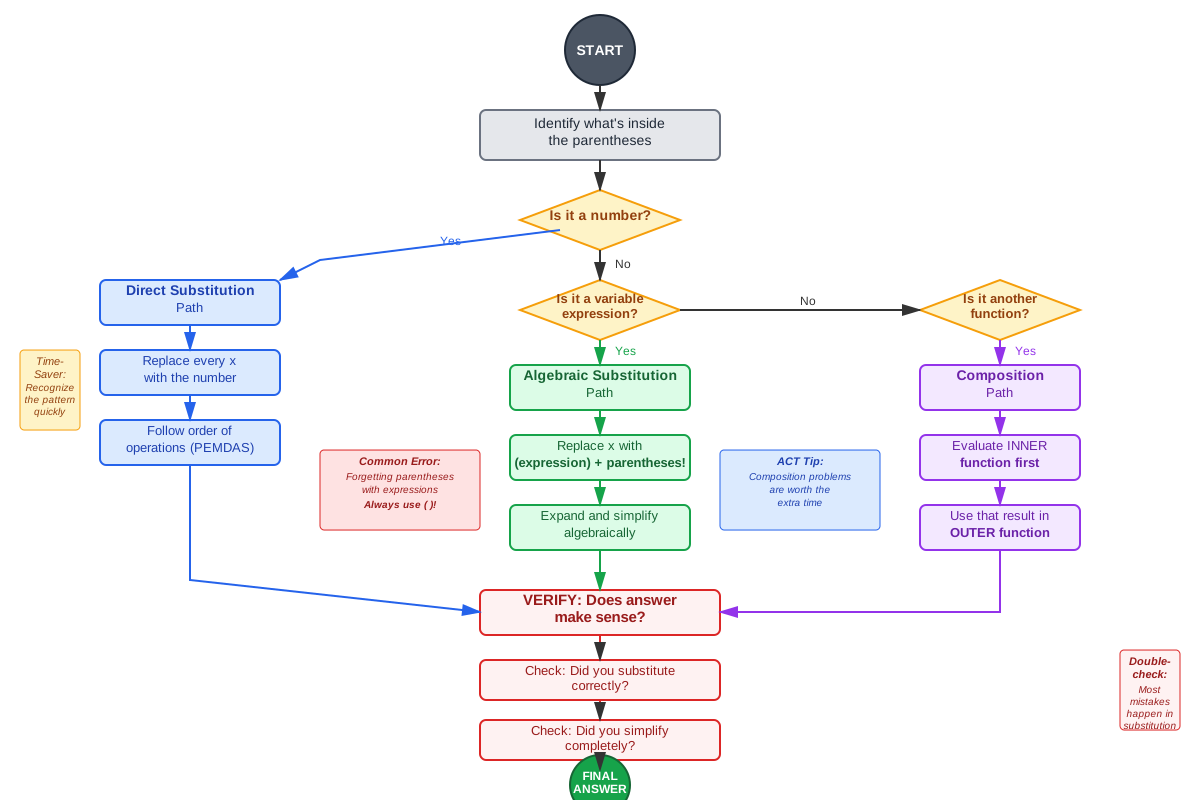
When approaching ACT function notation questions, first identify the question type: direct evaluation (substitute a number), algebraic evaluation (substitute an expression), composition (one function inside another), or inverse (find the input from an output). This categorization determines your solution path.
For direct evaluation problems, use parentheses religiously when substituting, especially with negative numbers or complex expressions. Write f(-3) = (-3)² rather than trying to do it mentally, as this prevents sign errors that cost points.
For composition problems, always work from the inside out. In f(g(3)), evaluate g(3) first and write down that result before moving to the outer function. Many students try to do both steps mentally and make errors. Taking 10 extra seconds to write the intermediate step saves time by preventing mistakes.
For algebraic substitution problems like finding f(x + 2), write the substitution explicitly: f(x + 2) = [original function with (x + 2) in place of every x]. Then expand carefully, watching for distribution errors and sign mistakes.
Time allocation: Simple evaluation problems should take 20-30 seconds. Composition problems typically require 45-60 seconds. Algebraic manipulation problems may take 60-90 seconds. If a function problem is taking longer than 90 seconds, mark it and return later—you may be missing a shortcut or making a repeated error.
Process of elimination: If answer choices are numbers and you're evaluating f(3), you can sometimes eliminate answers that are clearly too large or too small based on the function's structure. For f(x) = x² + 1, f(3) must be greater than 9, eliminating smaller options immediately.
Common traps: ACT test-makers often include wrong answers that result from common errors: forgetting to square negative numbers, distributing functions incorrectly (f(a+b) = f(a) + f(b)), or reversing the order in composition. If your answer matches a choice too easily, double-check these common mistakes.
Memory Techniques
FUNCTION mnemonic for evaluation steps:
- Find the function rule
- Underline what you're substituting
- Nest it in parentheses
- Carefully replace every x
- Tidy up using order of operations
- Inspect for sign errors
- Output your final answer
- Never skip the parentheses step
"Inside Out" for composition: Remember f(g(x)) by visualizing g(x) as being physically inside the parentheses of f—you must evaluate what's inside before you can evaluate the outside function, just like opening nested boxes.
"Same Letter, Same Rule": When you see f(x) = 3x + 2 and later f(7), remember that the same letter f means the same rule applies—just with a different input.
Parentheses = Input Signal: Train yourself to see parentheses in function notation as an input signal, not multiplication. The visual of f(x) should trigger "x is going into function f" rather than "f times x."
PEMDAS After Substitution: Create a mental checkpoint: "Substitute first, PEMDAS second." This prevents the common error of trying to simplify before substituting.
Summary
Function notation provides a powerful, compact way to express mathematical relationships, using f(x) to represent the output when x is the input. Mastering this notation requires understanding that f(x) describes a process or rule, not a multiplication operation. The core skills tested on the ACT include evaluating functions with numerical and algebraic inputs, composing functions by working from the inside out, and solving for inputs when given outputs. Success depends on careful substitution using parentheses, proper application of order of operations, and recognizing that different notation forms (f(g(x)), f(x+2), f(a)) require specific strategies. Function notation connects to virtually every other algebra topic on the ACT and appears in 4-6 questions per test, making it essential for competitive scores. Students who internalize the principle that the input can be any expression—a number, a variable, or a complex algebraic term—and who practice systematic substitution will find these questions among the most reliable point-earners on the exam.
Key Takeaways
- Function notation f(x) represents a rule that transforms inputs into outputs; the parentheses indicate input, not multiplication
- To evaluate any function, substitute the input for every instance of x using parentheses, then simplify with order of operations
- Composition f(g(x)) requires evaluating the inner function g(x) first, then using that result as input for the outer function f
- Algebraic substitution problems like f(x + 2) require replacing every x with the entire expression (x + 2) in parentheses
- Working backward from f(x) = k to find x involves setting the function expression equal to k and solving the equation
- Function notation appears in 4-6 ACT questions per test across multiple difficulty levels, making it a high-yield study topic
- Common errors include treating f(x) as multiplication, incorrectly distributing functions over addition, and making sign mistakes with negative inputs
Related Topics
Inverse Functions: Building on function notation, inverse functions (f⁻¹(x)) reverse the process of the original function. If f(x) takes 3 to 7, then f⁻¹(x) takes 7 back to 3. Mastering basic function notation is essential before tackling inverse function problems.
Piecewise Functions: These functions use different rules for different input ranges, written using function notation with conditions. Understanding how to evaluate f(x) prepares students for determining which piece of a piecewise function applies.
Function Transformations: Topics like f(x + 2), f(x) + 2, and 2f(x) represent shifts and stretches of function graphs. The algebraic manipulation skills developed in function notation directly enable understanding these transformations.
Polynomial Functions: Higher-degree polynomials are typically written in function notation (f(x) = x³ - 2x² + 5x - 1), and all polynomial operations require the evaluation and manipulation skills learned here.
Rational Functions: Functions involving fractions of polynomials build on function notation while adding complexity around domain restrictions and asymptotes.
Practice CTA
Now that you've mastered the core concepts of function notation, it's time to cement your understanding through practice. The ACT rewards students who can quickly and accurately apply these principles under time pressure. Work through the practice questions to test your ability to identify question types, execute the correct strategies, and avoid common traps. Use the flashcards to drill the high-yield facts until they become automatic. Remember: function notation questions are among the most predictable on the ACT—consistent practice transforms them from challenging problems into reliable points. Every function notation question you master is one step closer to your target score!
Sign up free to keep reading
Create a free AnvayaPrep account to finish this ACT guide on Function notation — plus flashcards and practice questions.