Overview
Rational expressions are algebraic fractions where both the numerator and denominator are polynomials. These expressions form a critical component of the ACT Math test, appearing in approximately 2-4 questions per exam across various difficulty levels. Understanding how to manipulate, simplify, and solve problems involving rational expressions is essential for achieving a competitive score, particularly for students targeting scores above 28.
The ACT frequently tests rational expressions through simplification problems, operations (addition, subtraction, multiplication, division), solving rational equations, and identifying restrictions on variables. These questions often appear disguised within word problems, geometric formulas, or complex algebraic scenarios. Mastery of this topic requires both procedural fluency and conceptual understanding of why certain operations work and when expressions are undefined.
Rational expressions connect directly to fundamental algebra skills including factoring polynomials, finding common denominators, and understanding domain restrictions. They also bridge to more advanced topics like function composition, asymptotes in graphing, and rate problems. The ability to work confidently with ACT rational expressions demonstrates algebraic maturity and problem-solving flexibility that the exam consistently rewards.
Learning Objectives
- [ ] Identify when Rational expressions is being tested
- [ ] Explain the core rule or strategy behind Rational expressions
- [ ] Apply Rational expressions to ACT-style questions accurately
- [ ] Determine domain restrictions for rational expressions by identifying values that make denominators zero
- [ ] Simplify complex rational expressions by factoring and canceling common factors
- [ ] Perform all four operations (addition, subtraction, multiplication, division) with rational expressions
- [ ] Solve rational equations and check for extraneous solutions
Prerequisites
- Polynomial operations: Adding, subtracting, multiplying, and dividing polynomials forms the foundation for manipulating rational expressions
- Factoring techniques: Factoring is essential for simplifying rational expressions and finding common denominators
- Fraction arithmetic: Understanding how to add, subtract, multiply, and divide numerical fractions directly translates to rational expressions
- Solving linear and quadratic equations: Many rational expression problems require solving equations after clearing denominators
- Understanding of domain and range: Recognizing when expressions are undefined is crucial for working with rational expressions
Why This Topic Matters
Rational expressions appear throughout mathematics, science, and real-world applications. In physics, they model relationships like resistance in parallel circuits and lens equations. In economics, they represent average cost functions and marginal analysis. In chemistry, they describe reaction rates and concentration relationships. Understanding rational expressions enables students to model and solve complex proportional relationships across disciplines.
On the ACT Math test, rational expressions appear with high frequency, typically in 2-4 questions per exam. These questions span difficulty levels from straightforward simplification (difficulty 3-4 out of 5) to complex multi-step problems involving operations and equation solving (difficulty 4-5 out of 5). The ACT tests rational expressions through direct algebraic manipulation, word problems requiring rational equation setup, and questions about domain restrictions.
Common ACT question formats include: simplifying expressions by factoring and canceling; performing operations that require finding least common denominators; solving equations that involve rational expressions; identifying equivalent forms of expressions; and determining values that make expressions undefined. Questions may appear standalone or embedded within geometry problems (area/perimeter ratios), rate problems (work and distance), or function problems (composition and transformation).
Core Concepts
Definition and Structure
A rational expression is a fraction where both the numerator and denominator are polynomials. The general form is:
f(x)/g(x) where g(x) ≠ 0Examples include: (x + 3)/(x - 2), (x² - 4)/(x² + 5x + 6), and (2x³ - 8x)/(4x² - 16). Just as numerical fractions represent division of integers, rational expressions represent division of polynomials. The critical restriction is that the denominator cannot equal zero, as division by zero is undefined.
Domain Restrictions
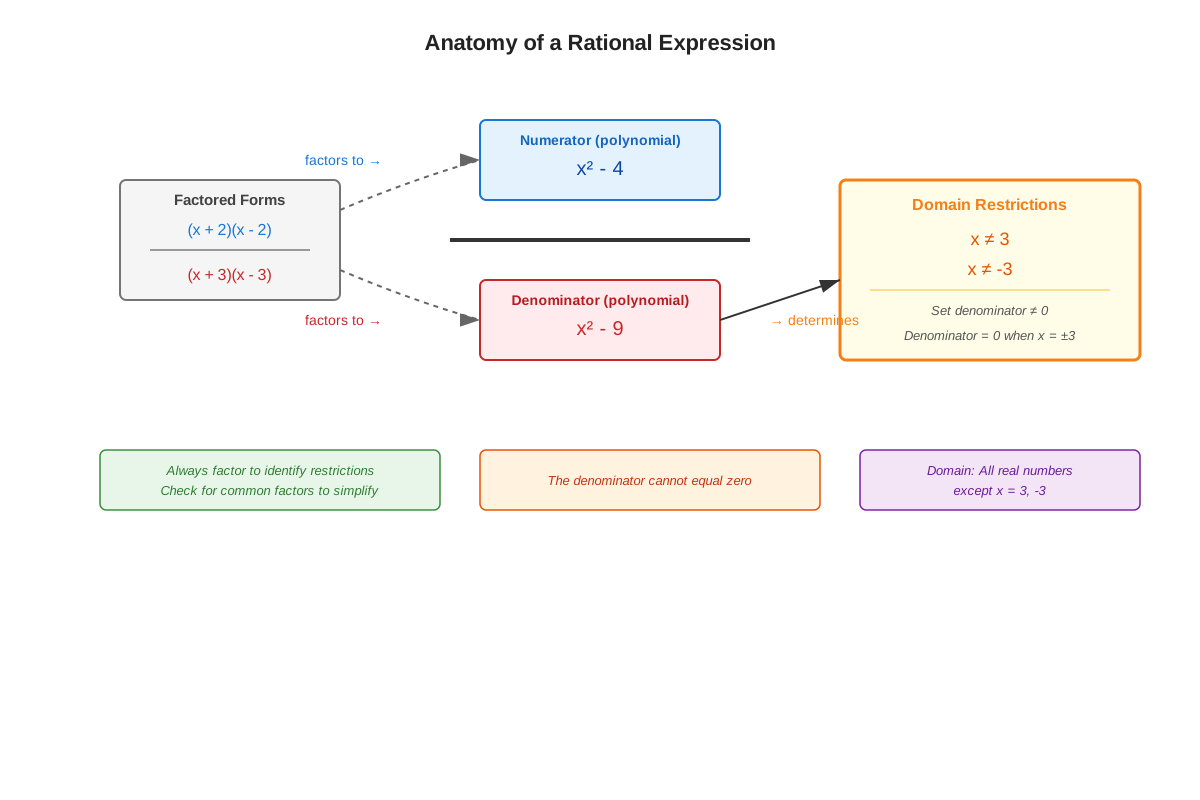
The domain of a rational expression consists of all real numbers except those that make the denominator zero. To find restrictions:
- Set the denominator equal to zero
- Solve for the variable
- Exclude these values from the domain
For example, in (x + 5)/(x² - 9), set x² - 9 = 0, which gives x = ±3. Therefore, the domain is all real numbers except x = 3 and x = -3. The ACT frequently tests whether students recognize these restrictions, especially when simplifying expressions.
Simplifying Rational Expressions
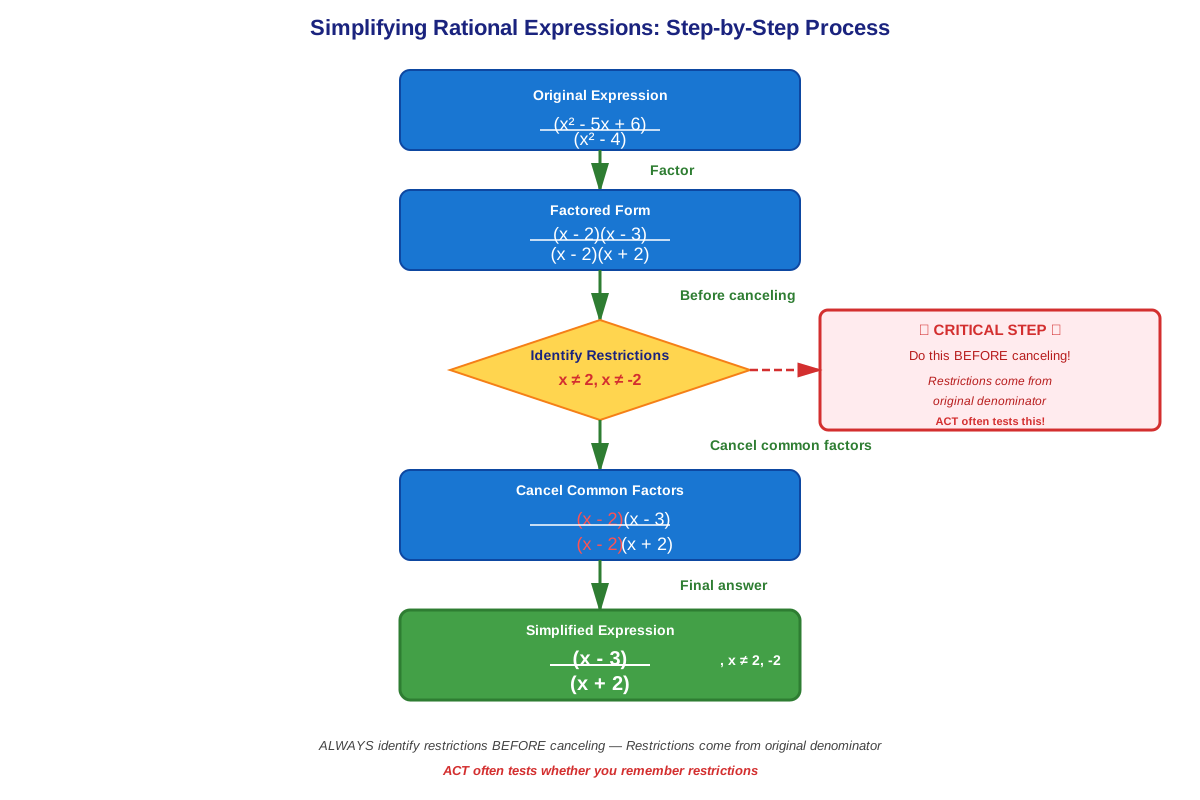
Simplification involves reducing rational expressions to lowest terms by canceling common factors. The process mirrors simplifying numerical fractions:
- Factor both numerator and denominator completely
- Identify common factors in both
- Cancel common factors (divide them out)
- State any domain restrictions from the original denominator
Critical Rule: Only factors can be canceled, never terms that are added or subtracted.
Example: Simplify (x² - 4)/(x² + 5x + 6)
= (x - 2)(x + 2) / (x + 2)(x + 3)
= (x - 2) / (x + 3), where x ≠ -2, -3
The restriction x ≠ -2 remains even though (x + 2) was canceled, because the original expression was undefined at x = -2.
Multiplication of Rational Expressions
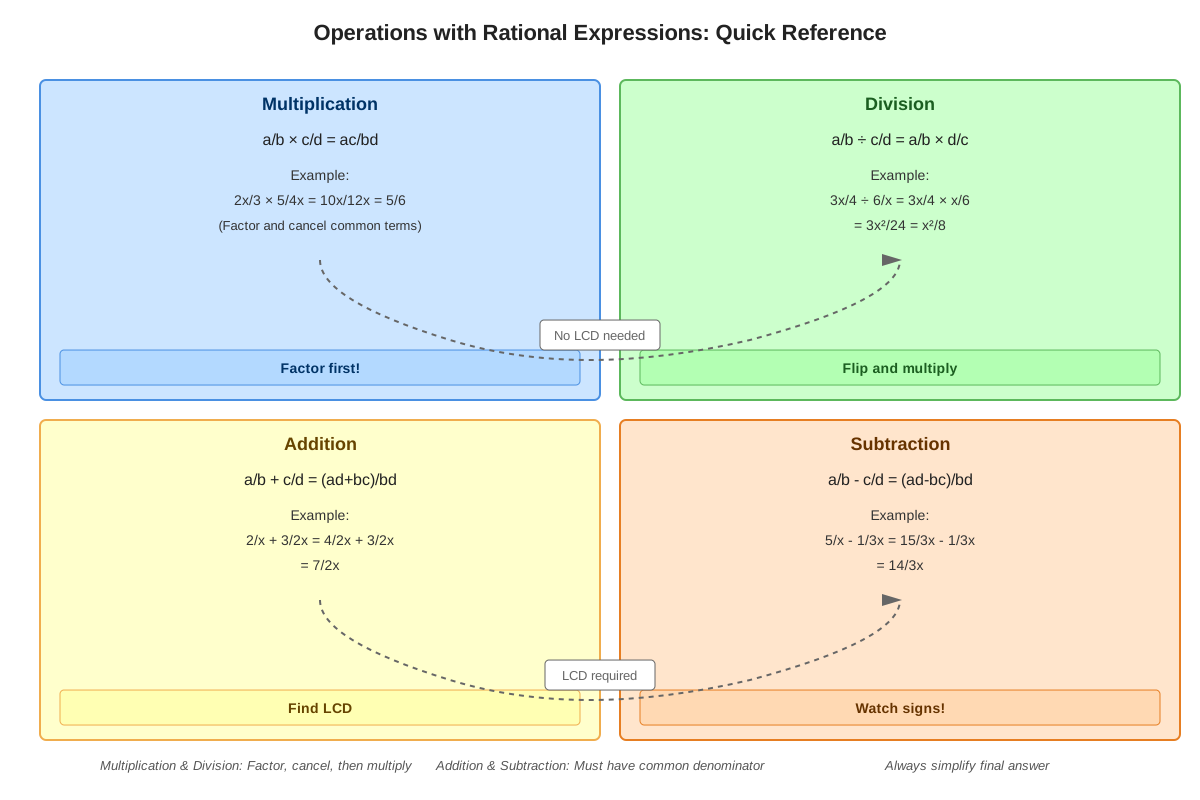
To multiply rational expressions, multiply numerators together and denominators together, then simplify:
- Factor all polynomials first
- Cancel common factors before multiplying
- Multiply remaining factors
- State domain restrictions
Example: (x² - 1)/(x + 2) · (x + 2)/(x - 1)
= (x - 1)(x + 1)/(x + 2) · (x + 2)/(x - 1)
= (x + 1)/1 = x + 1, where x ≠ -2, 1
Division of Rational Expressions
Division follows the "multiply by the reciprocal" rule:
- Change division to multiplication
- Flip (take the reciprocal of) the second fraction
- Follow multiplication rules
Example: (x² - 4)/(x + 3) ÷ (x - 2)/(x² - 9)
= (x² - 4)/(x + 3) · (x² - 9)/(x - 2)
= (x - 2)(x + 2)/(x + 3) · (x - 3)(x + 3)/(x - 2)
= (x + 2)(x - 3), where x ≠ -3, 2, 3
Addition and Subtraction of Rational Expressions
These operations require a common denominator, just like numerical fractions:
- Factor all denominators
- Find the least common denominator (LCD) by taking each unique factor to its highest power
- Convert each fraction to equivalent form with the LCD
- Add or subtract numerators
- Simplify if possible
Example: 3/(x - 2) + 5/(x + 1)
The LCD is (x - 2)(x + 1):
= 3(x + 1)/[(x - 2)(x + 1)] + 5(x - 2)/[(x - 2)(x + 1)]
= [3(x + 1) + 5(x - 2)]/[(x - 2)(x + 1)]
= (3x + 3 + 5x - 10)/[(x - 2)(x + 1)]
= (8x - 7)/[(x - 2)(x + 1)]
Complex Rational Expressions
A complex rational expression contains fractions in its numerator, denominator, or both. Two methods solve these:
Method 1: Combine then simplify
- Simplify numerator and denominator separately
- Divide the results
Method 2: Multiply by LCD
- Find LCD of all fractions involved
- Multiply entire expression by LCD/LCD
- Simplify
Example: (1/x + 1/y)/(1/x - 1/y)
Using Method 2 with LCD = xy:
= [(1/x + 1/y) · xy] / [(1/x - 1/y) · xy]
= (y + x)/(y - x)
Solving Rational Equations
A rational equation contains rational expressions set equal to a value. To solve:
- Identify domain restrictions
- Multiply both sides by the LCD to clear denominators
- Solve the resulting polynomial equation
- Check solutions against domain restrictions (reject extraneous solutions)
Example: Solve 3/(x - 1) = 2/(x + 2)
3(x + 2) = 2(x - 1)
3x + 6 = 2x - 2
x = -8
Check: -8 doesn't violate restrictions (x ≠ 1, -2), so it's valid.
Concept Relationships
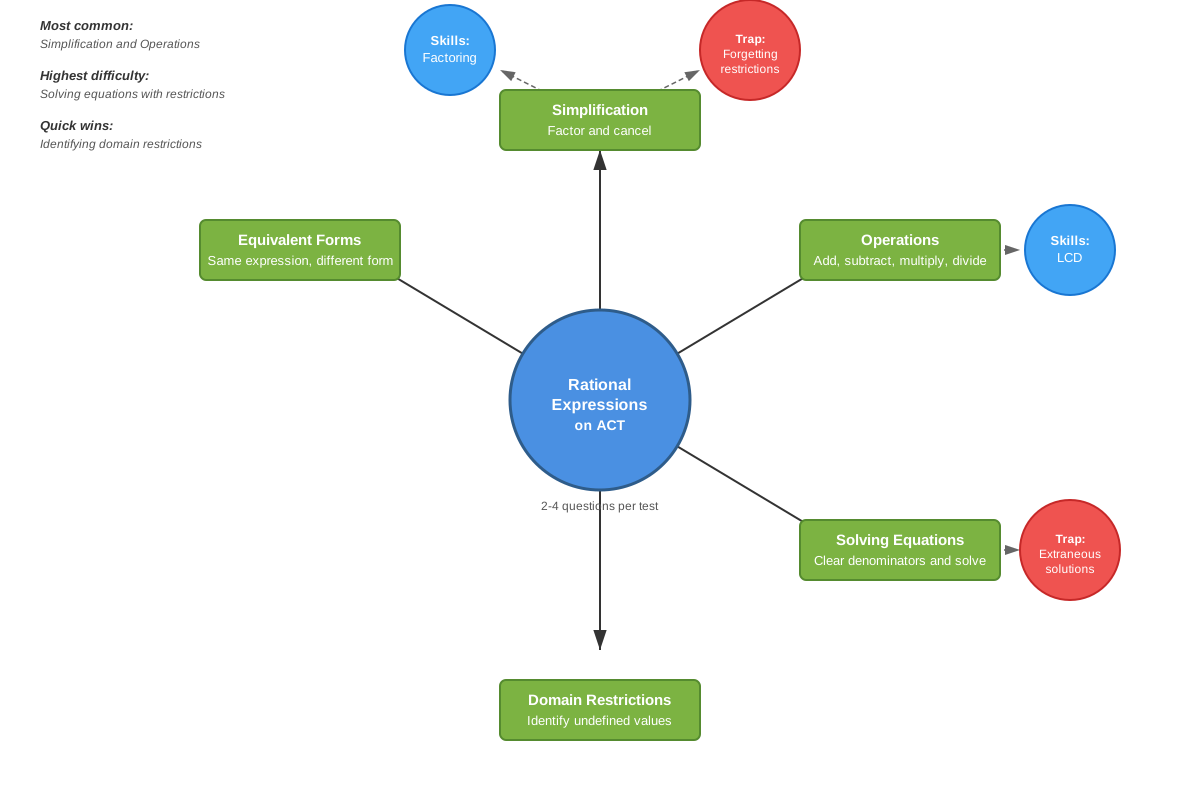
The concepts within rational expressions build hierarchically. Domain restrictions must be identified first, as they apply throughout all operations. Simplification relies on factoring skills and serves as the foundation for all other operations. Multiplication and division are simpler operations that don't require common denominators, making them prerequisite skills for the more complex addition and subtraction operations that demand LCD identification.
Complex rational expressions combine multiple concepts: they require understanding of basic operations, LCD identification, and simplification strategies. Solving rational equations represents the culmination of all skills, requiring domain analysis, LCD application, polynomial equation solving, and solution verification.
The relationship map flows: Domain Restrictions → Simplification → Multiplication/Division → Addition/Subtraction → Complex Expressions → Rational Equations. Each level builds on previous skills while adding new complexity.
Connections to prerequisite topics are direct: polynomial factoring enables simplification; fraction arithmetic provides the operational framework; equation-solving skills apply after clearing denominators. Related topics include function analysis (rational functions have vertical asymptotes at domain restrictions), graphing (understanding behavior near undefined points), and applied problems (rate, work, and mixture problems often generate rational equations).
Quick check — test yourself on Rational expressions so far.
Try Flashcards →High-Yield Facts
⭐ The denominator of a rational expression can never equal zero; always identify and state domain restrictions
⭐ Only factors can be canceled in rational expressions, never terms connected by addition or subtraction
⭐ When simplifying, factor completely before canceling any common factors
⭐ To add or subtract rational expressions, you must have a common denominator
⭐ When solving rational equations, always check solutions against domain restrictions to eliminate extraneous solutions
- The LCD of rational expressions is found by taking each unique factor to its highest power appearing in any denominator
- Multiplying rational expressions: multiply numerators, multiply denominators, then simplify
- Dividing rational expressions: multiply by the reciprocal of the divisor
- Domain restrictions from the original expression remain even after simplification cancels factors
- Complex rational expressions can be simplified by multiplying by the LCD of all internal fractions
- When a rational equation is multiplied by the LCD, the result is a polynomial equation
- Extraneous solutions arise when solving produces values that violate original domain restrictions
Common Misconceptions
Misconception: Terms in the numerator and denominator can be canceled if they appear in both.
Correction: Only common factors can be canceled. In (x + 3)/(x + 5), the x terms cannot cancel because they are terms (connected by addition), not factors. You must factor first: (x² - 9)/(x + 3) = (x - 3)(x + 3)/(x + 3) = x - 3.
Misconception: After canceling a factor during simplification, the domain restriction from that factor disappears.
Correction: Domain restrictions from the original expression always remain. If (x + 2)/(x + 2)(x - 1) simplifies to 1/(x - 1), the restriction x ≠ -2 still applies because the original expression was undefined there.
Misconception: To add rational expressions, simply add the numerators and add the denominators.
Correction: You must find a common denominator first, then add only the numerators. 1/x + 1/y ≠ 2/(x + y). The correct answer is (y + x)/(xy).
Misconception: All solutions to a rational equation are valid.
Correction: Solutions must be checked against domain restrictions. If solving produces a value that makes any original denominator zero, that solution is extraneous and must be rejected.
Misconception: The LCD is always the product of all denominators.
Correction: The LCD is the smallest expression containing all factors. For denominators (x - 2) and (x - 2)², the LCD is (x - 2)², not (x - 2)³.
Worked Examples
Example 1: Simplifying and Operating with Rational Expressions
Problem: Simplify (x² - 5x + 6)/(x² - 4) · (x + 2)/(x - 3) and state domain restrictions.
Solution:
Step 1: Factor all polynomials.
- Numerator of first fraction:
x² - 5x + 6 = (x - 2)(x - 3) - Denominator of first fraction:
x² - 4 = (x - 2)(x + 2) - Second fraction is already factored
Step 2: Rewrite with factored forms.
= [(x - 2)(x - 3)]/[(x - 2)(x + 2)] · (x + 2)/(x - 3)Step 3: Identify domain restrictions before canceling.
- From
(x - 2)in denominator:x ≠ 2 - From
(x + 2)in denominator:x ≠ -2 - From
(x - 3)in denominator:x ≠ 3
Step 4: Cancel common factors.
(x - 2)appears in numerator and denominator: cancel(x + 2)appears in numerator and denominator: cancel(x - 3)appears in numerator and denominator: cancel
Step 5: Write final answer.
= 1, where x ≠ -2, 2, 3Connection to Learning Objectives: This example demonstrates identifying rational expressions, applying simplification strategies, and recognizing domain restrictions—all core ACT skills.
Example 2: Solving a Rational Equation
Problem: Solve 5/(x - 3) - 2/(x + 1) = 1
Solution:
Step 1: Identify domain restrictions.
x ≠ 3(makes first denominator zero)x ≠ -1(makes second denominator zero)
Step 2: Find the LCD.
- LCD =
(x - 3)(x + 1)
Step 3: Multiply every term by the LCD.
(x - 3)(x + 1) · 5/(x - 3) - (x - 3)(x + 1) · 2/(x + 1) = (x - 3)(x + 1) · 1Step 4: Simplify (denominators cancel).
5(x + 1) - 2(x - 3) = (x - 3)(x + 1)Step 5: Expand and simplify.
5x + 5 - 2x + 6 = x² - 2x - 3
3x + 11 = x² - 2x - 3
0 = x² - 5x - 14
Step 6: Factor and solve.
0 = (x - 7)(x + 2)
x = 7 or x = -2
Step 7: Check against domain restrictions.
x = 7: Not restricted (valid solution)x = -2: Not restricted (valid solution)
Answer: x = 7 or x = -2
Connection to Learning Objectives: This example shows the complete process for solving rational equations on the ACT, including the critical step of checking for extraneous solutions.
Exam Strategy
Trigger Words: Watch for "simplify," "solve," "undefined," "domain," "restriction," "equivalent expression," and "for what value(s)" in ACT questions—these signal rational expression problems.
When approaching ACT rational expression questions, follow this systematic process:
- Immediately identify domain restrictions by setting denominators equal to zero. Write these down before doing any algebra—they're easy points and prevent errors.
- Factor first, always. The ACT rewards students who factor before attempting operations. Most simplification and operation problems become straightforward after complete factoring.
- Look for answer choice patterns. If answer choices differ in their factored forms or domain restrictions, use this to guide your approach. Eliminate choices with incorrect restrictions immediately.
- For addition/subtraction problems, identify the LCD before looking at answer choices. The ACT often includes trap answers that result from incorrect LCD identification.
- When solving equations, work efficiently: multiply by LCD, solve the resulting polynomial equation, then check only the solutions you found (not every restricted value). This saves time.
Time Management: Allocate 60-90 seconds for straightforward simplification problems, 90-120 seconds for operations requiring LCD, and up to 2 minutes for solving rational equations. If a problem requires more time, mark it and return later.
Process of Elimination: Eliminate answers that:
- Have incorrect domain restrictions (test by substituting restricted values)
- Don't match the degree of the expected result
- Can't be factored to match the original expression structure
- Produce different numerical values when you substitute a convenient test value like
x = 0orx = 1
Memory Techniques
FACTOR: Remember the simplification process
- Find domain restrictions
- Analyze all polynomials for factoring
- Cancel common factors only
- Test your answer with a value
- Observe restrictions remain
- Rewrite in simplest form
LCD Finder: "Highest Power of Each Factor"
- Take the Highest power
- Of Each unique factor
- That appears in any denominator
Division Mnemonic: "Keep, Change, Flip"
- Keep the first fraction
- Change division to multiplication
- Flip the second fraction (reciprocal)
Visualization for Domain: Picture a number line with "holes" at restricted values. These holes never fill in, even after simplification—they're permanent features of the expression.
Checking Solutions: "Does It Violate Exclusions?" (DIVE)
- After solving, DIVE back to check if your solution violates any domain restrictions
Summary
Rational expressions are algebraic fractions with polynomial numerators and denominators, forming a high-yield ACT Math topic that appears in 2-4 questions per exam. Mastery requires understanding domain restrictions (values making denominators zero), simplification through factoring and canceling common factors, and performing operations using appropriate strategies. Multiplication and division are straightforward (multiply straight across or by the reciprocal), while addition and subtraction require finding the least common denominator. Complex rational expressions and rational equations extend these skills, with equation solving requiring careful attention to extraneous solutions. Success on ACT rational expression questions depends on systematic factoring, consistent identification of domain restrictions, and efficient use of LCD when needed. The key principle underlying all work with rational expressions is that denominators cannot equal zero—this restriction drives domain analysis and solution checking.
Key Takeaways
- Rational expressions are fractions with polynomial numerators and denominators; domain restrictions exclude values making denominators zero
- Always factor completely before simplifying or performing operations; only factors (not terms) can be canceled
- Multiplication and division don't require common denominators; addition and subtraction require the LCD
- Domain restrictions from the original expression persist even after simplification cancels factors
- When solving rational equations, multiply by the LCD to clear denominators, then check all solutions against domain restrictions
- The ACT tests rational expressions through simplification, operations, equation solving, and domain analysis
- Systematic factoring and restriction identification are the foundation for all rational expression work
Related Topics
Rational Functions: Extends rational expressions to function notation, including graphing with vertical and horizontal asymptotes, holes, and end behavior analysis. Mastering rational expressions provides the algebraic foundation for understanding function behavior.
Polynomial Long Division: An alternative method for dividing polynomials that connects to rational expression division and helps identify quotients and remainders, useful for rewriting improper rational expressions.
Partial Fraction Decomposition: An advanced technique for breaking complex rational expressions into simpler components, building directly on LCD and addition skills developed here.
Rate and Work Problems: Applied problems that generate rational equations, requiring the equation-solving skills developed in this topic to model and solve real-world scenarios.
Limits and Continuity: Calculus concepts that rely heavily on understanding rational expression behavior near domain restrictions, making this topic essential preparation for advanced mathematics.
Practice CTA
Now that you've mastered the core concepts of rational expressions, it's time to solidify your understanding through practice! Attempt the practice questions to apply these strategies to ACT-style problems, and use the flashcards to reinforce high-yield facts and common patterns. Remember: rational expressions appear frequently on the ACT, and consistent practice with factoring, domain restrictions, and operations will build the speed and accuracy you need for test day. Every problem you solve strengthens your algebraic foundation and moves you closer to your target score!
Sign up free to keep reading
Create a free AnvayaPrep account to finish this ACT guide on Rational expressions — plus flashcards and practice questions.