Overview
Pattern recognition is a fundamental mathematical skill that involves identifying regularities, sequences, and recurring structures in numbers, shapes, or algebraic expressions. On the ACT Math test, pattern recognition questions assess a student's ability to observe relationships between terms, predict subsequent values, and apply logical reasoning to solve problems efficiently. These questions often appear disguised within various mathematical contexts—from arithmetic sequences to geometric progressions, from number properties to coordinate geometry.
The ACT frequently tests pattern recognition because it evaluates critical thinking and problem-solving abilities that extend beyond rote memorization. Students who master ACT pattern recognition can quickly identify shortcuts, recognize when a problem follows a predictable structure, and avoid time-consuming calculations. This skill becomes particularly valuable when facing complex multi-step problems where recognizing an underlying pattern can reduce a five-minute problem to a thirty-second solution.
Pattern recognition connects deeply to multiple areas of mathematics tested on the ACT. It underlies sequence and series problems, supports understanding of function behavior, aids in solving modular arithmetic questions, and helps identify properties of geometric figures. Students who develop strong pattern recognition skills find themselves better equipped to tackle algebra, coordinate geometry, and even trigonometry questions, as patterns emerge across all mathematical domains. This topic serves as a bridge between computational mathematics and analytical reasoning, making it essential for achieving competitive ACT Math scores.
Learning Objectives
- [ ] Identify when Pattern recognition is being tested
- [ ] Explain the core rule or strategy behind Pattern recognition
- [ ] Apply Pattern recognition to ACT-style questions accurately
- [ ] Distinguish between arithmetic, geometric, and other pattern types within 30 seconds
- [ ] Generate explicit formulas for patterns based on observed terms
- [ ] Recognize cyclical patterns and determine values at specific positions
- [ ] Apply pattern recognition to optimize problem-solving time on multi-step questions
Prerequisites
- Basic arithmetic operations: Addition, subtraction, multiplication, and division form the foundation for identifying how terms in a sequence relate to one another
- Understanding of exponents: Many patterns involve exponential growth or powers, requiring comfort with exponential notation and calculations
- Algebraic manipulation: Translating observed patterns into algebraic expressions and formulas requires facility with variables and equations
- Number properties: Recognizing patterns often depends on understanding divisibility, factors, multiples, and prime numbers
- Coordinate plane basics: Some pattern recognition questions involve identifying patterns in coordinate pairs or graphical representations
Why This Topic Matters
Pattern recognition represents one of the most practical mathematical skills students develop. In real-world applications, professionals use pattern recognition to analyze financial trends, predict scientific phenomena, optimize computer algorithms, and solve engineering problems. Data scientists rely on pattern recognition to identify trends in large datasets, while architects use it to create aesthetically pleasing and structurally sound designs. The ability to spot patterns accelerates problem-solving across virtually every quantitative field.
On the ACT Math test, pattern recognition appears in approximately 3-5 questions per exam, representing roughly 5-8% of the total Math section. These questions typically fall into the medium-to-hard difficulty range and often serve as score differentiators between students aiming for scores in the 28-36 range. Pattern recognition questions appear in multiple formats: explicit sequence problems asking for the nth term, word problems where students must identify an underlying pattern, coordinate geometry questions involving repeating patterns, and number property questions requiring recognition of cyclical behavior.
The ACT strategically places pattern recognition questions throughout the Math section, though they tend to cluster in the latter half where more challenging problems appear. These questions commonly integrate with other topics—a pattern recognition problem might simultaneously test algebraic reasoning, or a coordinate geometry question might require identifying a pattern in plotted points. Students who quickly recognize patterns gain significant time advantages, allowing them to allocate more minutes to genuinely difficult problems rather than grinding through calculations that pattern recognition can shortcut.
Core Concepts
Types of Patterns
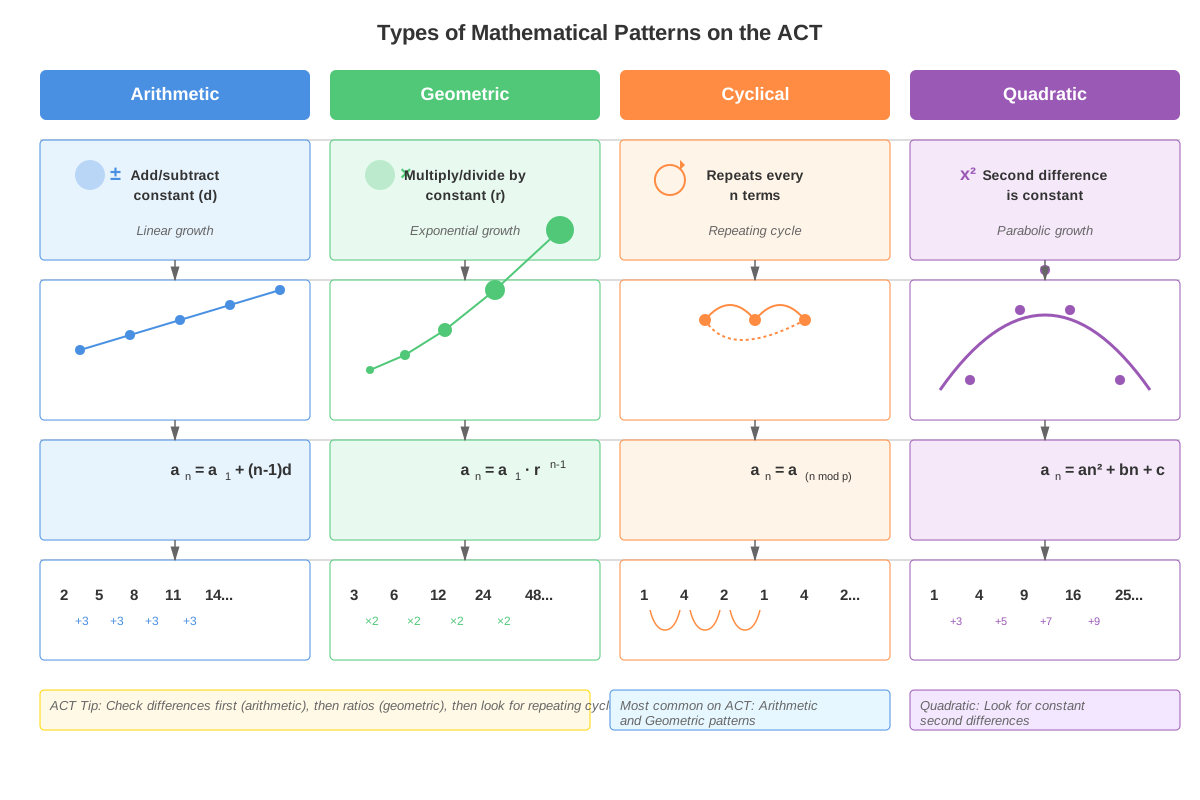
Arithmetic sequences represent the most fundamental pattern type on the ACT. In an arithmetic sequence, each term differs from the previous term by a constant value called the common difference. For example, the sequence 3, 7, 11, 15, 19... has a common difference of 4. The formula for the nth term of an arithmetic sequence is:
a_n = a_1 + (n-1)dwhere a₁ is the first term, n is the position, and d is the common difference.
Geometric sequences involve multiplication rather than addition. Each term is found by multiplying the previous term by a constant called the common ratio. The sequence 2, 6, 18, 54, 162... has a common ratio of 3. The formula for the nth term of a geometric sequence is:
a_n = a_1 × r^(n-1)where r represents the common ratio.
Recursive patterns define each term based on one or more previous terms. The famous Fibonacci sequence (1, 1, 2, 3, 5, 8, 13...) follows the rule that each term equals the sum of the two preceding terms. While complex recursive patterns rarely appear on the ACT, simple recursive relationships do emerge, particularly in word problems involving repeated operations.
Cyclical Patterns
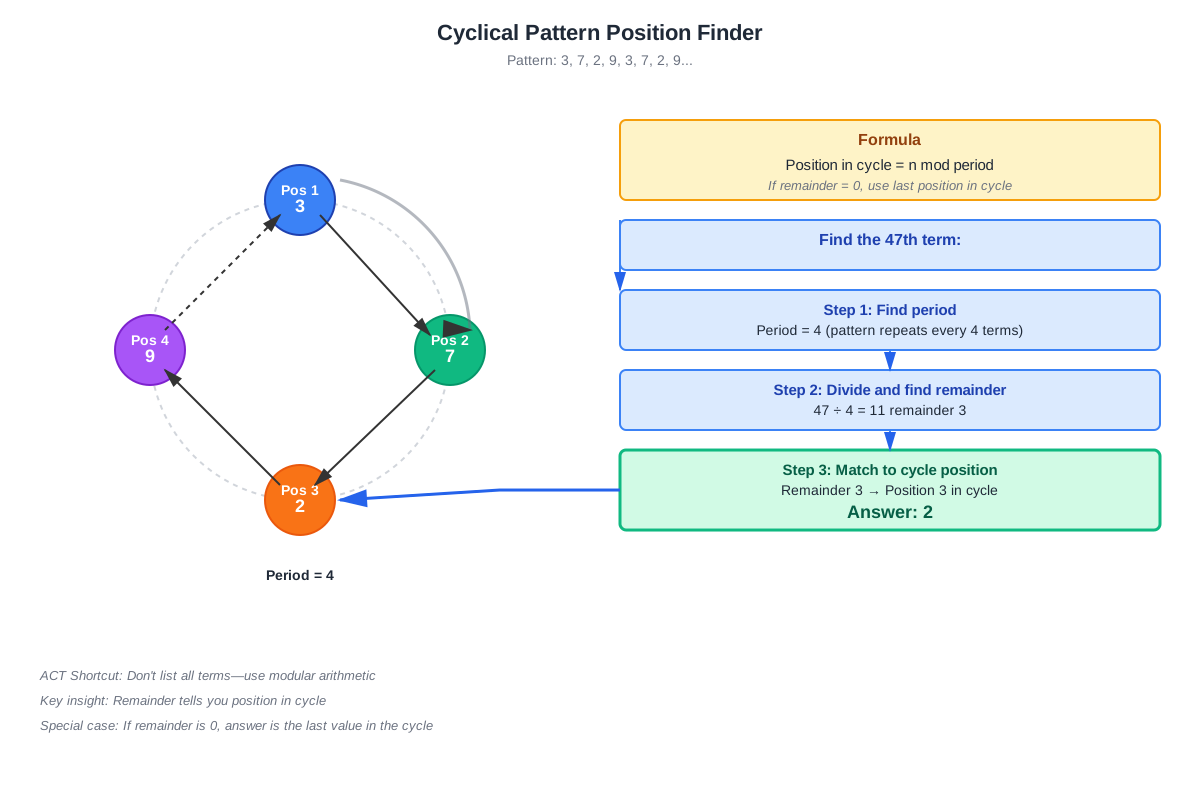
Cyclical patterns repeat after a fixed number of terms, creating a predictable cycle. These patterns are particularly high-yield for the ACT because they allow students to find values at large positions without calculating every intermediate term. For example, if a pattern follows the cycle 2, 5, 8, 2, 5, 8, 2, 5, 8..., the cycle length is 3. To find the 100th term, divide 100 by 3 to get 33 remainder 1, meaning the 100th term matches the 1st term in the cycle: 2.
The modular arithmetic approach provides a systematic method for cyclical patterns. When a pattern has cycle length c, the value at position n equals the value at position (n mod c), where "mod" represents the remainder after division. This technique proves especially valuable for problems asking about the 50th, 100th, or 1000th term in a sequence.
Pattern Recognition in Different Contexts
Numerical patterns extend beyond simple sequences. The ACT tests patterns in:
- Digit patterns: The units digits of powers (3¹=3, 3²=9, 3³=27, 3⁴=81, 3⁵=243...) cycle with period 4: {3, 9, 7, 1}
- Divisibility patterns: Multiples of 9 have digit sums that are multiples of 9
- Prime number patterns: While primes don't follow simple formulas, recognizing prime gaps and distributions helps
Geometric patterns appear in coordinate plane problems. Points might follow a pattern like (1,2), (2,4), (3,6), (4,8)..., where both coordinates follow predictable rules. The ACT also tests patterns in:
- Transformations: Repeated rotations, reflections, or translations
- Polygon properties: Patterns in the number of diagonals, interior angle sums, or vertices
- Area and perimeter relationships: How measurements change when dimensions scale
Algebraic patterns emerge in function behavior, polynomial expansions, and expression simplification. Recognizing that (x-1)(x+1) = x²-1, (x-1)(x²+x+1) = x³-1, and (x-1)(x³+x²+x+1) = x⁴-1 reveals a pattern that can solve complex factoring problems instantly.
Pattern Identification Strategies
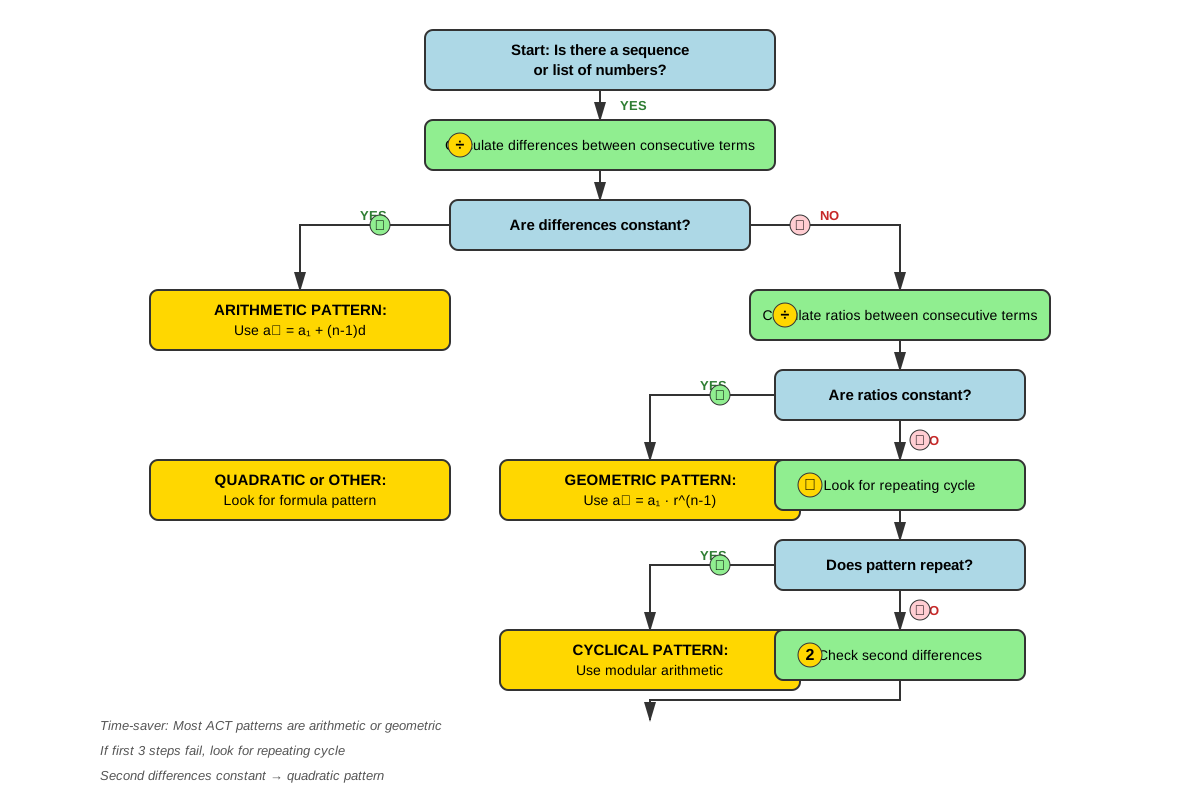
The difference method involves calculating differences between consecutive terms. If first differences are constant, the pattern is arithmetic. If second differences (differences of differences) are constant, the pattern is quadratic. This systematic approach works for polynomial patterns up to degree 3 or 4, which covers all ACT pattern questions.
| Pattern Type | First Differences | Second Differences | Example Sequence |
|---|---|---|---|
| Arithmetic | Constant | Zero | 2, 5, 8, 11, 14 |
| Quadratic | Linear | Constant | 1, 4, 9, 16, 25 |
| Geometric | Increasing/Decreasing | Varies | 3, 6, 12, 24, 48 |
| Cubic | Quadratic | Linear | 1, 8, 27, 64, 125 |
The ratio method checks whether consecutive terms maintain a constant ratio, indicating a geometric sequence. Calculate a₂/a₁, a₃/a₂, and a₄/a₃. If these ratios are equal, the pattern is geometric.
The visual inspection method involves looking for obvious relationships: Are terms perfect squares? Powers of 2? Multiples of a specific number? Do terms alternate signs? Does the pattern involve adding consecutive integers? Quick visual inspection often reveals patterns faster than systematic calculation.
Generating Formulas from Patterns
Once a pattern is identified, generating an explicit formula allows calculation of any term without computing all previous terms. For arithmetic sequences, identify the first term and common difference, then apply the arithmetic formula. For geometric sequences, identify the first term and common ratio, then apply the geometric formula.
For more complex patterns, the pattern matching approach compares the sequence to known formulas. If the sequence is 1, 4, 9, 16, 25..., recognizing these as perfect squares immediately gives the formula n². If the sequence is 2, 6, 12, 20, 30..., calculating differences (4, 6, 8, 10...) reveals a pattern in the differences themselves, suggesting a quadratic formula. Testing n(n+1) confirms this formula works.
Concept Relationships
Pattern recognition serves as a foundational skill that connects to virtually every area of ACT Math. The relationship flows from basic number sense → pattern identification → formula generation → problem solving. Within pattern recognition itself, understanding arithmetic sequences provides the foundation for recognizing geometric sequences, as students learn to look for consistent relationships between terms. Cyclical patterns build on modular arithmetic concepts, while complex patterns require combining multiple pattern types.
Pattern recognition connects backward to prerequisite topics through its reliance on arithmetic operations and algebraic manipulation. Every pattern ultimately reduces to repeated applications of basic operations, and translating patterns into formulas requires algebraic thinking. The connection flows forward to sequences and series, where pattern recognition becomes essential for finding sums and general terms. Function analysis relies heavily on pattern recognition—identifying patterns in function values helps determine function types and predict behavior.
The relationship map for pattern recognition flows as:
Number Properties → Pattern Recognition → Sequences and Series
↓
Algebraic Reasoning → Formula Generation → Function Analysis
↓
Modular Arithmetic → Cyclical Patterns → Advanced Problem Solving
Coordinate geometry problems involving patterns connect pattern recognition to spatial reasoning, while probability questions sometimes require recognizing patterns in outcomes. This interconnectedness makes pattern recognition a high-leverage skill—mastering it improves performance across multiple question types.
High-Yield Facts
⭐ Arithmetic sequences have constant differences between consecutive terms; the nth term formula is a_n = a_1 + (n-1)d
⭐ Geometric sequences have constant ratios between consecutive terms; the nth term formula is a_n = a_1 × r^(n-1)
⭐ For cyclical patterns with cycle length c, the value at position n equals the value at position (n mod c)
⭐ The units digit of powers follows cyclical patterns: powers of 2 cycle every 4, powers of 3 cycle every 4, powers of 4 cycle every 2
⭐ When first differences are constant, the pattern is linear (arithmetic); when second differences are constant, the pattern is quadratic
- Perfect squares follow the pattern n², producing the sequence 1, 4, 9, 16, 25, 36...
- Perfect cubes follow the pattern n³, producing the sequence 1, 8, 27, 64, 125...
- Powers of 2 (2, 4, 8, 16, 32, 64...) appear frequently in ACT pattern questions
- Triangular numbers (1, 3, 6, 10, 15...) follow the formula n(n+1)/2
- The sum of the first n positive integers equals n(n+1)/2
- Alternating signs in sequences often involve (-1)^n or (-1)^(n+1) as a factor
- Fibonacci-type patterns (each term is the sum of the previous two) occasionally appear in word problems
- Patterns involving factorials (n!) grow extremely rapidly: 1, 2, 6, 24, 120, 720...
Quick check — test yourself on Pattern recognition so far.
Try Flashcards →Common Misconceptions
Misconception: All patterns on the ACT are either arithmetic or geometric sequences.
Correction: While arithmetic and geometric sequences are common, the ACT also tests cyclical patterns, quadratic patterns, patterns involving powers and roots, and patterns that combine multiple rules. Always check whether differences or ratios are constant before assuming a pattern type.
Misconception: To find the 100th term in a sequence, you must calculate all 99 previous terms.
Correction: Pattern recognition allows you to find any term directly using a formula or by identifying cycles. For cyclical patterns, use modular arithmetic. For arithmetic/geometric sequences, use the explicit formulas. Never calculate term-by-term unless the pattern is unclear.
Misconception: If the first few terms don't show an obvious pattern, the problem is unsolvable.
Correction: Complex patterns may require calculating differences between terms (first differences, second differences) or ratios. Some patterns only become clear after examining 4-5 terms. Systematic analysis using the difference method or ratio method reveals patterns that aren't immediately obvious.
Misconception: Patterns always continue in the same way indefinitely.
Correction: On the ACT, always read carefully to determine whether a pattern continues or changes. Some problems explicitly state that a pattern continues "in the same way," while others may introduce a rule change. Context clues in word problems are essential.
Misconception: Geometric sequences always involve whole numbers.
Correction: Geometric sequences can have fractional or decimal common ratios. The sequence 64, 32, 16, 8, 4... is geometric with ratio 1/2. The sequence 1, 1.5, 2.25, 3.375... is geometric with ratio 1.5. Don't dismiss geometric patterns just because fractions or decimals appear.
Misconception: Pattern recognition questions always explicitly present sequences of numbers.
Correction: Pattern recognition often appears disguised in word problems, coordinate geometry, or function questions. A problem about a bouncing ball losing height with each bounce tests geometric sequences. A problem about points on a coordinate plane tests pattern recognition in ordered pairs. Develop the skill to recognize when pattern thinking applies even when the problem doesn't look like a traditional sequence question.
Worked Examples
Example 1: Cyclical Pattern with Large Position
Problem: The sequence 3, 7, 2, 5, 3, 7, 2, 5, 3, 7, 2, 5... continues in the same pattern. What is the 87th term?
Solution:
Step 1: Identify the pattern type. The sequence repeats the cycle {3, 7, 2, 5}, so this is a cyclical pattern.
Step 2: Determine the cycle length. The cycle has 4 terms.
Step 3: Use modular arithmetic to find which position in the cycle corresponds to the 87th term overall.
- Divide 87 by 4: 87 ÷ 4 = 21 remainder 3
- The remainder is 3, so the 87th term corresponds to the 3rd position in the cycle
Step 4: Identify the 3rd term in the cycle {3, 7, 2, 5}.
- The 3rd term is 2
Answer: The 87th term is 2.
Connection to learning objectives: This example demonstrates identifying when pattern recognition is being tested (cyclical repetition), explaining the core strategy (modular arithmetic for cycles), and applying it accurately to find a specific term efficiently.
Example 2: Quadratic Pattern with Difference Method
Problem: Consider the sequence 5, 8, 13, 20, 29, 40... What is the 10th term?
Solution:
Step 1: Check if the pattern is arithmetic by calculating first differences.
- 8 - 5 = 3
- 13 - 8 = 5
- 20 - 13 = 7
- 29 - 20 = 9
- 40 - 29 = 11
The first differences are 3, 5, 7, 9, 11... (not constant, so not arithmetic)
Step 2: Calculate second differences.
- 5 - 3 = 2
- 7 - 5 = 2
- 9 - 7 = 2
- 11 - 9 = 2
The second differences are constant (all equal 2), indicating a quadratic pattern.
Step 3: Since this is quadratic and the second difference is 2, the pattern involves n². Testing the formula a_n = n² + n + 3:
- For n=1: 1² + 1 + 3 = 5 ✓
- For n=2: 2² + 2 + 3 = 9... wait, that gives 9, but the second term is 8
Let me try a_n = n² + 2n + 2:
- For n=1: 1² + 2(1) + 2 = 5 ✓
- For n=2: 2² + 2(2) + 2 = 4 + 4 + 2 = 10... that's not right either
Step 4: Alternative approach—continue the pattern using the difference method.
- The 6th term is 40
- The next first difference should be 11 + 2 = 13
- So the 7th term is 40 + 13 = 53
- The next first difference should be 13 + 2 = 15
- So the 8th term is 53 + 15 = 68
- The next first difference should be 15 + 2 = 17
- So the 9th term is 68 + 17 = 85
- The next first difference should be 17 + 2 = 19
- So the 10th term is 85 + 19 = 104
Answer: The 10th term is 104.
Connection to learning objectives: This example shows how to identify a quadratic pattern using the difference method, apply the systematic strategy of continuing the pattern, and accurately solve for a specific term. It also demonstrates that when formula generation is complex, continuing the pattern term-by-term using differences is a reliable ACT strategy.
Exam Strategy
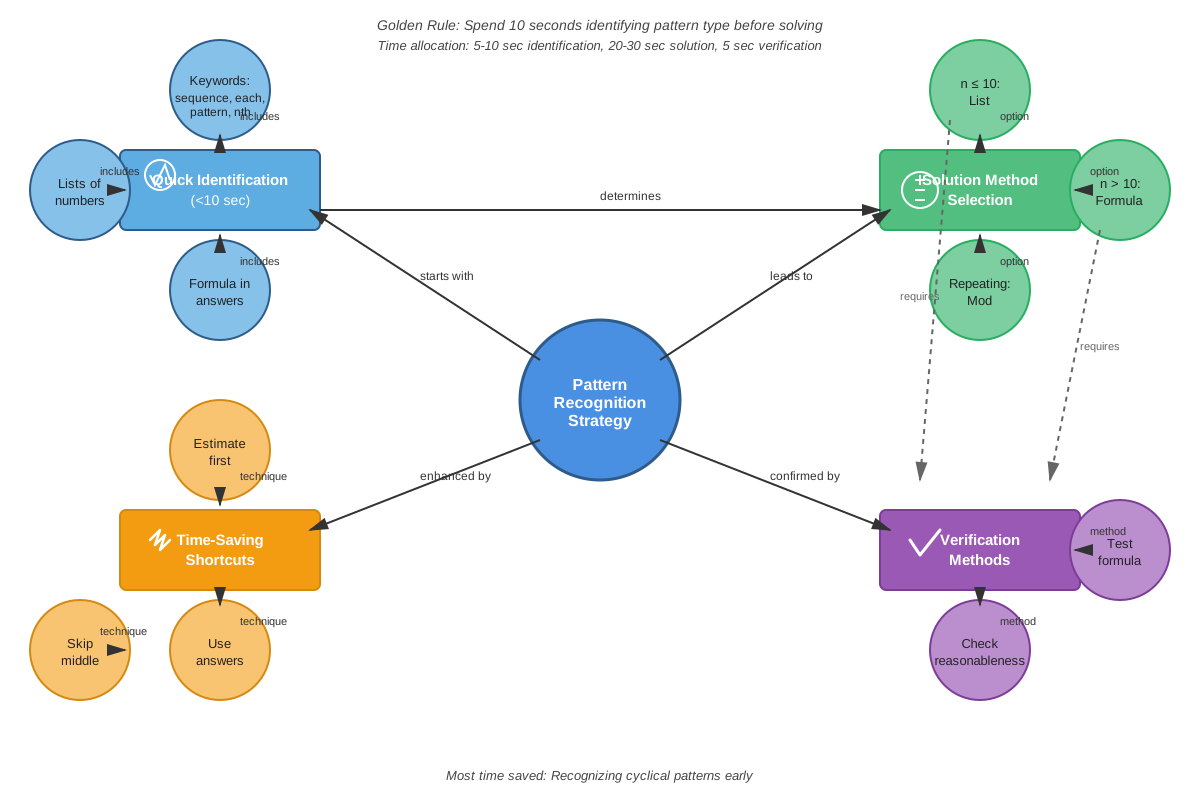
When approaching ACT pattern recognition questions, begin by quickly scanning for the pattern type. Look for explicit sequences of numbers, repeated operations in word problems, or coordinate pairs that might follow a pattern. The first 10-15 seconds should focus on pattern identification rather than calculation.
Trigger words and phrases that signal pattern recognition questions include:
- "continues in the same way"
- "following this pattern"
- "what is the nth term"
- "what is the 50th/100th/1000th term"
- "if this pattern continues"
- "repeats every"
- "cycles through"
For sequence problems, immediately calculate the first few differences or ratios. If differences are constant, apply the arithmetic sequence formula. If ratios are constant, apply the geometric sequence formula. If neither is constant, check second differences for quadratic patterns or look for cyclical repetition.
Time allocation is critical for pattern recognition questions. These problems should take 45-90 seconds maximum. If you spend more than 90 seconds without identifying the pattern, mark the question and return to it later. The ACT rewards efficient problem-solving, and pattern recognition questions are designed to be solved quickly once the pattern is identified.
Process of elimination works effectively on pattern recognition multiple choice questions. If asked for the 100th term and you've identified the pattern type, you can often eliminate answers that don't match the pattern's behavior. For geometric sequences with ratio > 1, later terms must be larger than earlier terms. For cyclical patterns, the answer must match one of the values in the cycle. For arithmetic sequences, check whether the answer is consistent with the common difference.
Exam Tip: When a problem asks for a large position (50th, 100th, 1000th term), it's almost always testing either a formula-based approach or cyclical patterns. Never attempt to calculate term-by-term for large positions.
For word problems involving patterns, translate the situation into mathematical terms first. A ball bouncing to 75% of its previous height is a geometric sequence with ratio 0.75. A savings account growing by $50 per month is an arithmetic sequence with common difference 50. Making this translation explicit helps avoid errors.
Memory Techniques
ARITHMETIC mnemonic for arithmetic sequences:
- Add the same
- Repeat the difference
- Identify first term
- Term formula: a₁ + (n-1)d
- How many? Count carefully
- Minus one from position
- Equal spacing
- Test with examples
- Increase or decrease steadily
- Constant difference
GEOMETRIC mnemonic for geometric sequences:
- Grow by multiplication
- Exponential behavior
- One ratio throughout
- Multiply repeatedly
- Each term times ratio
- Term formula: a₁ × r^(n-1)
- Ratio is key
- Identify the multiplier
- Constant ratio
"Mod Squad" for cyclical patterns: When you see a large position number (50, 100, 1000), think "Mod Squad"—use modular arithmetic to find the remainder when dividing by the cycle length.
Visualization strategy: For sequences, visualize a number line with terms plotted as points. Arithmetic sequences form evenly spaced points. Geometric sequences with ratio > 1 show accelerating spacing. Cyclical patterns show repeating clusters. This mental image helps identify pattern types quickly.
"Difference Detective" approach: When the pattern isn't obvious, become a "Difference Detective"—systematically calculate first differences, then second differences if needed. This methodical approach prevents overlooking quadratic patterns.
Summary
Pattern recognition is a high-yield ACT Math skill that involves identifying regularities in sequences, numbers, and mathematical structures. The two most common pattern types are arithmetic sequences (constant differences) and geometric sequences (constant ratios), each with specific formulas for finding the nth term. Cyclical patterns, which repeat after a fixed number of terms, are solved efficiently using modular arithmetic rather than term-by-term calculation. More complex patterns, including quadratic sequences, can be identified using the difference method—calculating first and second differences to determine pattern type. Success on ACT pattern recognition questions requires quick identification of pattern type, knowledge of relevant formulas, and strategic thinking about when to use formulas versus continuing patterns. The ability to recognize patterns extends beyond explicit sequence questions to word problems, coordinate geometry, and function analysis, making it a foundational skill that improves performance across multiple question types. Students who master pattern recognition gain significant time advantages on the ACT Math section, as these questions are designed to be solved in under 90 seconds once the pattern is identified.
Key Takeaways
- Arithmetic sequences have constant differences between terms; use the formula a_n = a_1 + (n-1)d to find any term
- Geometric sequences have constant ratios between terms; use the formula a_n = a_1 × r^(n-1) to find any term
- For cyclical patterns, use modular arithmetic: divide the position by the cycle length and use the remainder to identify which value in the cycle appears at that position
- The difference method (calculating first and second differences) systematically identifies pattern types and works for all polynomial patterns on the ACT
- Pattern recognition questions should take 45-90 seconds maximum; if you can't identify the pattern quickly, mark and return to the question later
- Pattern recognition appears in multiple contexts beyond explicit sequences—word problems, coordinate geometry, and function questions often require pattern thinking
- Never calculate term-by-term for large positions (50th, 100th, 1000th terms); these questions always have efficient solution methods using formulas or cycles
Related Topics
Sequences and Series: Building directly on pattern recognition, this topic explores arithmetic and geometric series (sums of sequence terms), including formulas for finite and infinite series. Mastering pattern recognition provides the foundation for understanding series convergence and sum calculations.
Function Analysis: Recognizing patterns in function values helps identify function types (linear, quadratic, exponential) and predict behavior. Pattern recognition skills transfer directly to analyzing tables of function values and determining function rules.
Modular Arithmetic: The cyclical pattern techniques used in pattern recognition connect deeply to modular arithmetic, which has applications in number theory, cryptography, and advanced problem-solving. Understanding remainders and congruences extends pattern recognition to more sophisticated mathematical contexts.
Polynomial Functions: Quadratic and higher-degree patterns identified through the difference method relate directly to polynomial functions. Recognizing that constant second differences indicate quadratic relationships helps with polynomial analysis and graphing.
Coordinate Geometry Patterns: Patterns in coordinate pairs lead to understanding linear relationships, transformations, and geometric sequences in the coordinate plane. This connection bridges algebraic pattern recognition and geometric visualization.
Practice CTA
Now that you've mastered the core concepts of pattern recognition, it's time to solidify your understanding through practice. Attempt the practice questions to test your ability to identify pattern types quickly, apply formulas accurately, and solve problems efficiently. Use the flashcards to reinforce key formulas and strategies until they become automatic. Remember, pattern recognition is one of the highest-yield skills for the ACT Math section—investing time in practice now will pay dividends in both accuracy and speed on test day. You've got this!
Sign up free to keep reading
Create a free AnvayaPrep account to finish this ACT guide on Pattern recognition — plus flashcards and practice questions.