Overview
Congruent triangles are one of the most frequently tested topics in the Plane Geometry section of the ACT Math test. Understanding congruence means recognizing when two triangles are identical in shape and size, even if they are positioned differently or oriented in various ways. This concept forms the foundation for solving numerous geometry problems involving angle measures, side lengths, and spatial reasoning.
On the ACT congruent triangles questions appear in multiple contexts: proving relationships between geometric figures, finding missing measurements, analyzing overlapping triangles, and solving real-world application problems. The ACT typically includes 2-4 questions directly testing triangle congruence, making this a high-yield topic that can significantly impact your score. These questions often combine congruence with other geometric concepts like parallel lines, angle relationships, and coordinate geometry.
Mastering congruent triangles provides essential skills for tackling more complex geometry problems on the ACT. The logical reasoning required to identify congruence postulates strengthens your ability to work with proofs, transformations, and similarity. Additionally, understanding congruence helps with coordinate geometry problems where you must determine if figures are identical, and with trigonometry questions where corresponding parts of congruent triangles play crucial roles. This topic connects directly to similarity, transformations, and the properties of special quadrilaterals, making it a cornerstone of geometric reasoning.
Learning Objectives
- [ ] Identify when Congruent triangles is being tested
- [ ] Explain the core rule or strategy behind Congruent triangles
- [ ] Apply Congruent triangles to ACT-style questions accurately
- [ ] Distinguish between the five congruence postulates (SSS, SAS, ASA, AAS, HL) and select the appropriate one for a given problem
- [ ] Use CPCTC (Corresponding Parts of Congruent Triangles are Congruent) to find missing angle measures and side lengths
- [ ] Recognize congruent triangles in complex diagrams with overlapping or embedded figures
- [ ] Apply triangle congruence to prove geometric relationships and solve multi-step problems
Prerequisites
- Basic triangle properties: Understanding that triangles have three sides, three angles, and that angle measures sum to 180° is essential for identifying corresponding parts
- Angle relationships: Knowledge of vertical angles, alternate interior angles, and corresponding angles helps identify equal angles in congruence proofs
- Basic algebraic manipulation: Solving equations and working with variables is necessary when finding unknown measurements in congruent triangles
- Understanding of geometric notation: Familiarity with symbols like ≅ (congruent), ∠ (angle), and △ (triangle) ensures proper interpretation of problems
Why This Topic Matters
Triangle congruence has practical applications in architecture, engineering, construction, and design. Architects use congruent triangles to ensure structural stability and symmetry in buildings. Engineers apply congruence principles when designing bridges and trusses, where identical triangular supports distribute weight evenly. Surveyors use triangle congruence to measure distances indirectly, and computer graphics programmers rely on these concepts for rendering three-dimensional objects.
On the ACT Math test, congruent triangles appear in approximately 5-8% of questions, typically 2-4 questions per exam. These questions fall into several categories: direct identification of congruence postulates, finding missing measurements using CPCTC, proving relationships in complex figures, and application problems involving real-world scenarios. The topic frequently appears in questions numbered 35-50, which are considered medium to difficult difficulty.
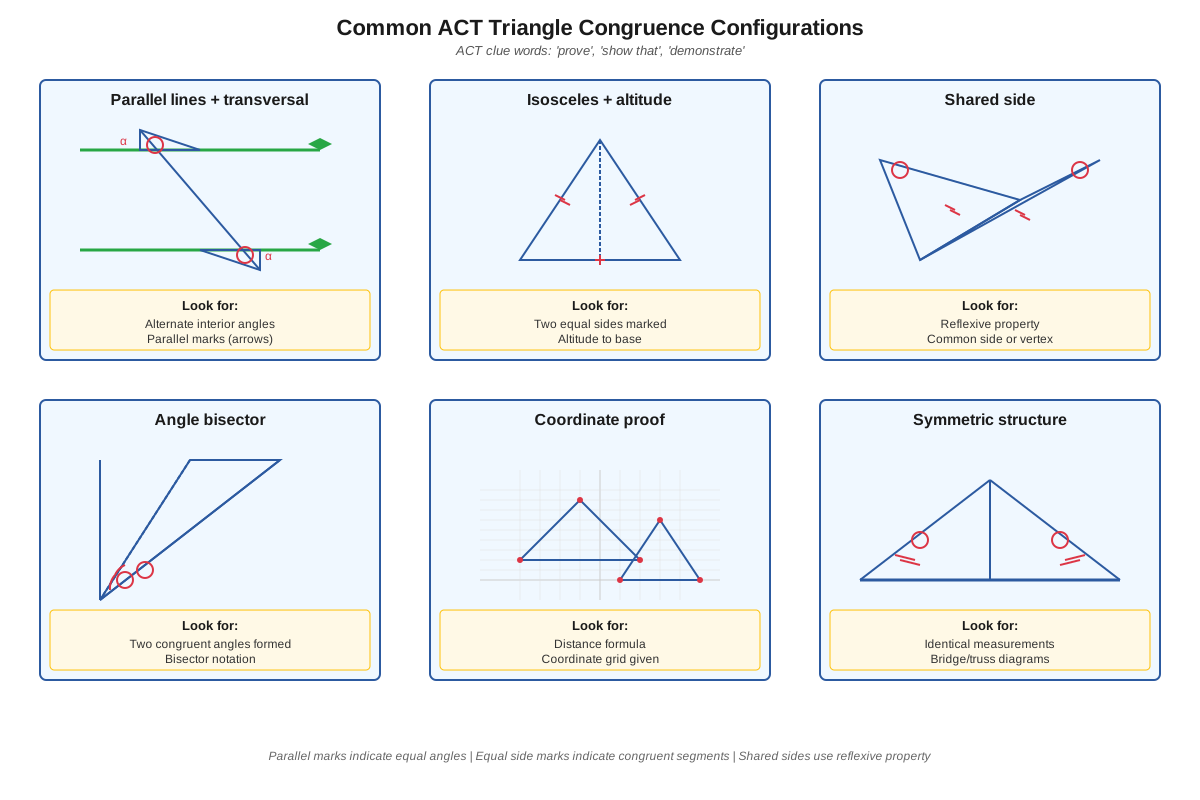
Common question formats include: diagrams showing two triangles with marked congruent parts asking which postulate proves congruence; overlapping triangles where students must identify shared sides or angles; coordinate plane problems requiring distance calculations to prove congruence; and word problems describing construction or design scenarios where congruence ensures proper fit or alignment. The ACT often embeds congruence within larger problems, requiring students to recognize when applying congruence principles will unlock the solution.
Core Concepts
Definition of Congruent Triangles
Two triangles are congruent if and only if all three corresponding sides are equal in length and all three corresponding angles are equal in measure. The symbol ≅ denotes congruence. When writing a congruence statement like △ABC ≅ △DEF, the order of vertices matters because it indicates which parts correspond: A corresponds to D, B corresponds to E, and C corresponds to F. This means AB = DE, BC = EF, AC = DF, ∠A = ∠D, ∠B = ∠E, and ∠C = ∠F.
Congruent triangles are essentially identical copies of each other, though they may be reflected, rotated, or translated in space. The key insight is that if you can prove certain minimum conditions are met, you can conclude the triangles are completely congruent without measuring all six parts.
The Five Congruence Postulates
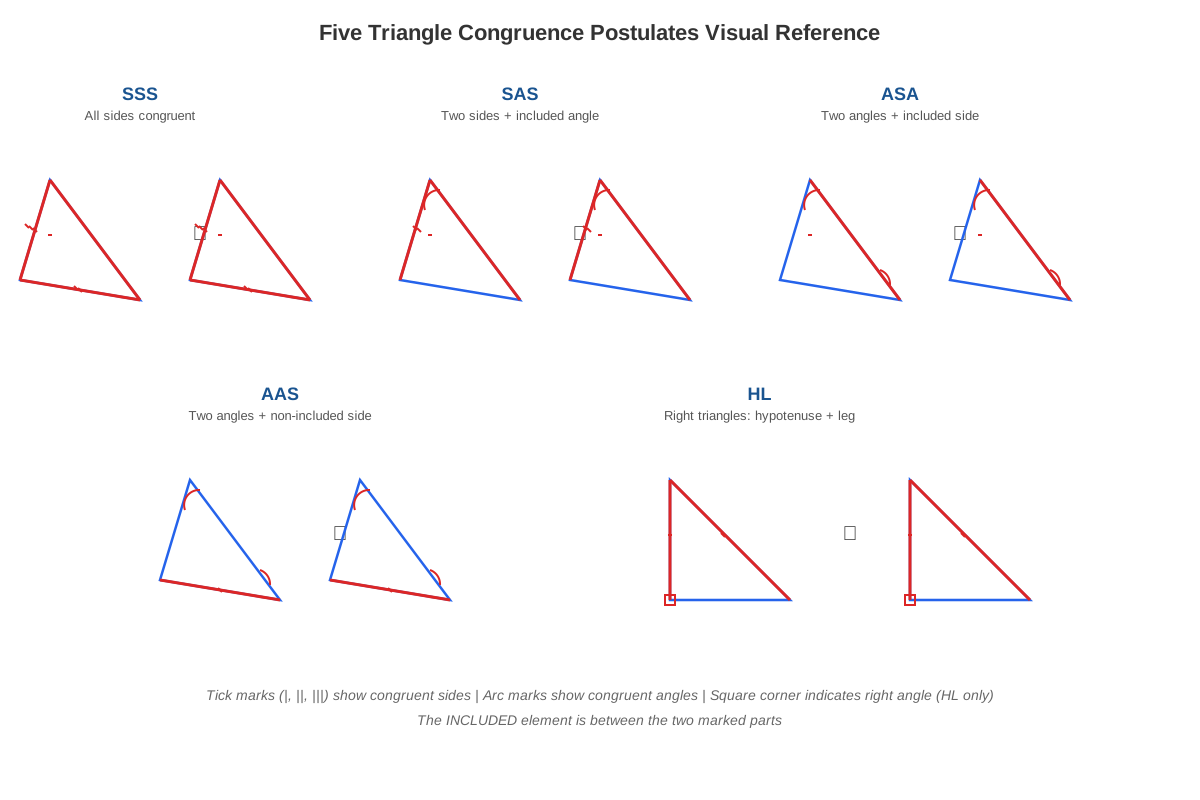
The ACT tests five methods for proving triangle congruence. Understanding when each applies is crucial for efficient problem-solving.
SSS (Side-Side-Side)
If all three sides of one triangle are congruent to the three corresponding sides of another triangle, then the triangles are congruent. This postulate requires knowing or being able to calculate all three side lengths for both triangles. On the ACT, SSS problems often appear in coordinate geometry where you use the distance formula to verify side lengths, or in problems with marked tick marks indicating equal segments.
SAS (Side-Angle-Side)
If two sides and the included angle (the angle between those two sides) of one triangle are congruent to the corresponding parts of another triangle, then the triangles are congruent. The angle must be between the two sides—this is critical. A common ACT trap involves giving two sides and a non-included angle, which does not guarantee congruence.
ASA (Angle-Side-Angle)
If two angles and the included side (the side between those two angles) of one triangle are congruent to the corresponding parts of another triangle, then the triangles are congruent. This postulate is particularly useful when working with parallel lines cut by transversals, as alternate interior angles and corresponding angles provide the angle congruences needed.
AAS (Angle-Angle-Side)
If two angles and a non-included side of one triangle are congruent to the corresponding parts of another triangle, then the triangles are congruent. This differs from ASA because the side is not between the two angles. Since knowing two angles determines the third angle (because angles sum to 180°), AAS essentially gives you all three angles plus one side, which is sufficient for congruence.
HL (Hypotenuse-Leg)
This postulate applies only to right triangles. If the hypotenuse and one leg of a right triangle are congruent to the hypotenuse and corresponding leg of another right triangle, then the triangles are congruent. The ACT often uses this in problems involving rectangles, squares, or other figures containing right triangles.
Comparison of Congruence Postulates
| Postulate | Required Information | Special Conditions | Common ACT Context |
|---|---|---|---|
| SSS | 3 sides | None | Coordinate geometry, marked diagrams |
| SAS | 2 sides + included angle | Angle must be between sides | Overlapping triangles, shared sides |
| ASA | 2 angles + included side | Side must be between angles | Parallel lines, transversals |
| AAS | 2 angles + non-included side | Side not between angles | Complex figures, indirect proofs |
| HL | Hypotenuse + 1 leg | Must be right triangles | Rectangles, squares, altitude problems |
CPCTC: Corresponding Parts of Congruent Triangles are Congruent
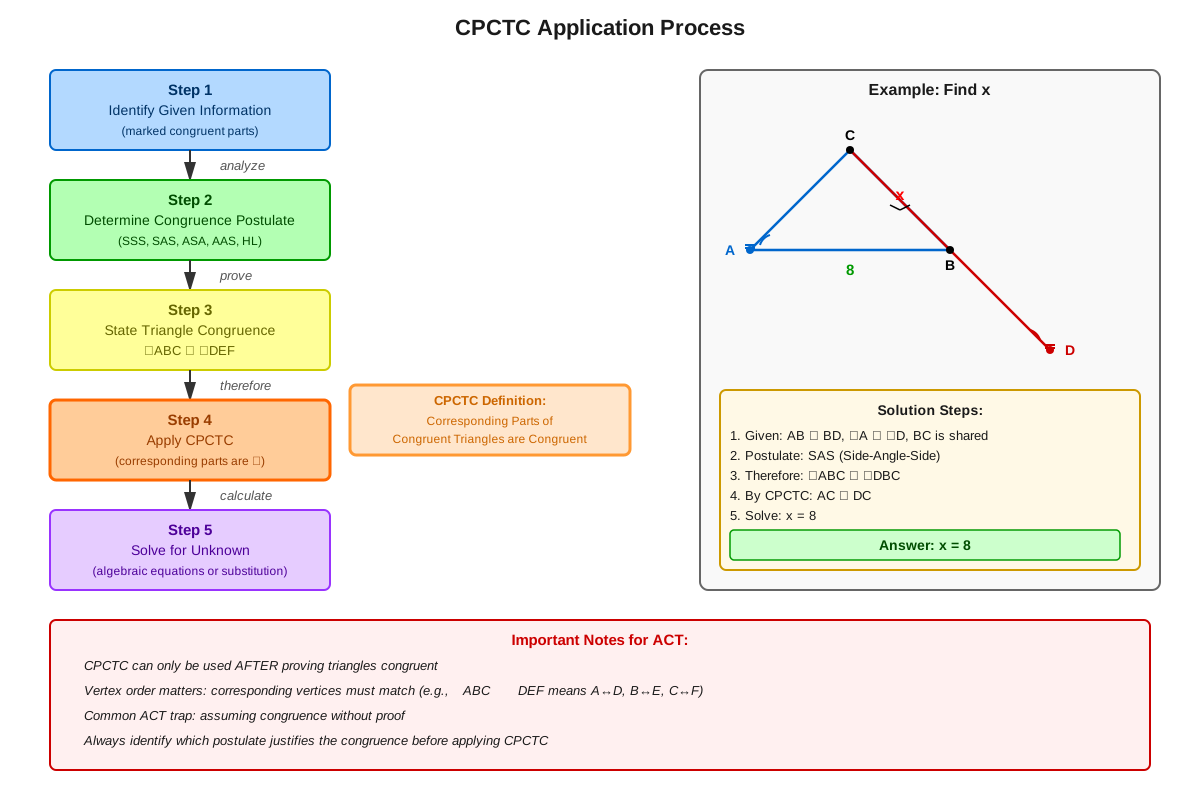
Once you have established that two triangles are congruent using one of the five postulates, you can conclude that all corresponding parts are congruent. This principle, abbreviated as CPCTC, is the key to solving most ACT problems involving congruent triangles. The typical problem structure is: (1) prove triangles are congruent using a postulate, then (2) use CPCTC to find a specific missing measurement.
For example, if you prove △ABC ≅ △DEF using SAS, you can then conclude that ∠C = ∠F even though those angles weren't part of your original proof. This two-step process appears frequently on the ACT.
Identifying Congruent Parts in Complex Diagrams
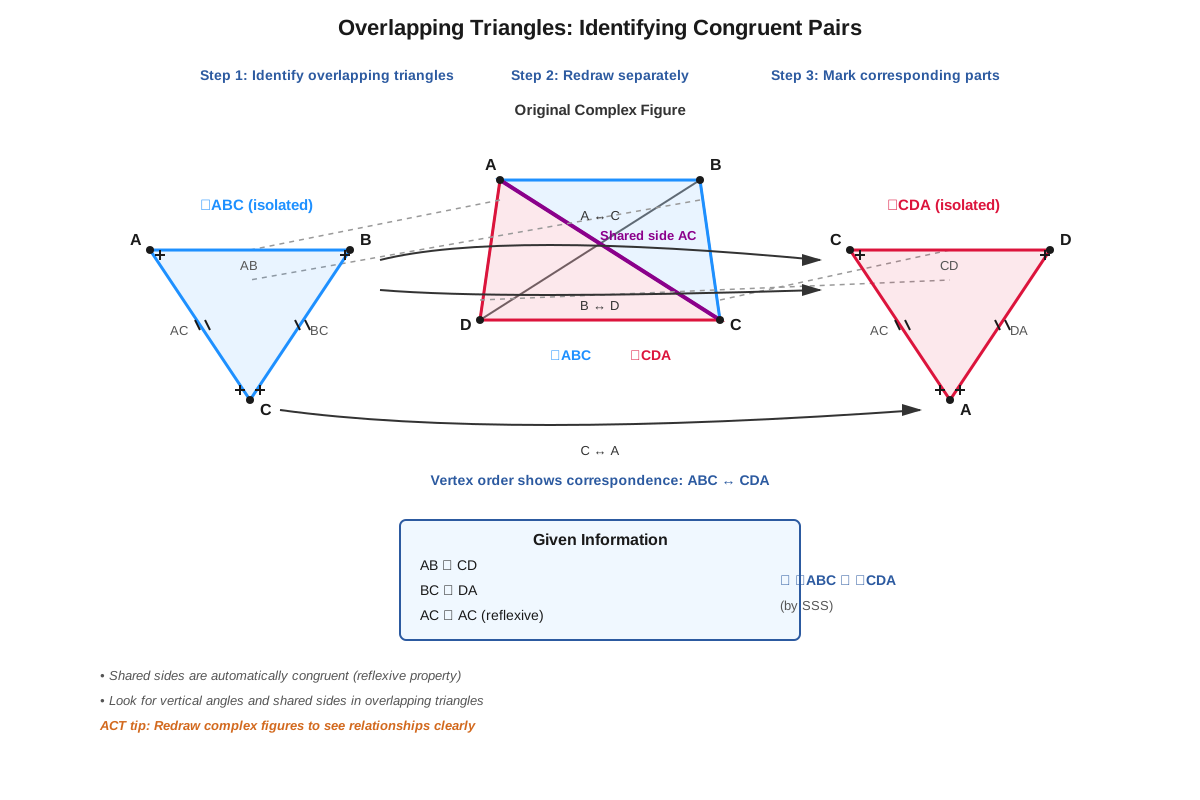
ACT problems often feature overlapping triangles, triangles sharing common sides or angles, or multiple triangles within a single figure. Key strategies include:
- Reflexive Property: A side or angle is congruent to itself. When two triangles share a side or angle, that part is automatically congruent in both triangles.
- Vertical Angles: When two lines intersect, the opposite angles formed are congruent. This often provides angle congruence in overlapping triangle problems.
- Shared Segments: If point B lies on segment AC, and both triangles use portions of AC, identify which segments are shared or equal.
- Redrawing Triangles: Mentally or physically sketch the two triangles separately to clarify which parts correspond.
Concept Relationships
The five congruence postulates (SSS, SAS, ASA, AAS, HL) are the foundation that enables all other work with congruent triangles. These postulates → allow you to prove triangles are congruent → which then enables CPCTC → which provides the specific measurements needed to solve problems.
Triangle congruence connects to prerequisite knowledge of angle relationships: vertical angles and angles formed by parallel lines and transversals provide the angle congruences needed for ASA and AAS proofs. Basic triangle properties (angle sum = 180°) help determine missing angles when applying AAS. Algebraic skills enable solving for variables once congruence relationships are established.
Congruent triangles serve as a stepping stone to more advanced topics. Understanding congruence → leads to understanding similarity (where shapes are the same but sizes differ) → which connects to trigonometry and proportional reasoning. Congruence also → supports transformation geometry (translations, rotations, reflections preserve congruence) → and coordinate geometry (using distance and slope formulas to prove congruence).
Within a single ACT problem, the relationship flow typically follows: analyze diagram → identify potentially congruent triangles → determine which parts are congruent (using given information, angle relationships, or reflexive property) → select appropriate congruence postulate → apply CPCTC to find the requested measurement.
Quick check — test yourself on Congruent triangles so far.
Try Flashcards →High-Yield Facts
⭐ Two triangles are congruent if all three corresponding sides and all three corresponding angles are equal, but you only need to prove specific combinations (SSS, SAS, ASA, AAS, or HL) to establish congruence.
⭐ SAS requires the angle to be between the two sides; if the angle is not included, you cannot conclude congruence.
⭐ CPCTC can only be used after you have proven triangles are congruent; it is not a method for proving congruence itself.
⭐ The order of vertices in a congruence statement indicates which parts correspond: △ABC ≅ △DEF means A↔D, B↔E, C↔F.
⭐ HL (Hypotenuse-Leg) applies only to right triangles and requires the hypotenuse plus one leg to be congruent.
- When two triangles share a common side, that side is congruent to itself by the reflexive property, which often provides the information needed for SAS or SSS.
- Vertical angles formed by intersecting lines are always congruent and frequently provide the angle needed for ASA or AAS proofs.
- If two angles of a triangle are known, the third angle can be calculated using the fact that angles sum to 180°, which is useful for AAS proofs.
- AAA (three angles) is not sufficient to prove congruence; it only proves similarity, meaning the triangles have the same shape but not necessarily the same size.
- SSA (two sides and a non-included angle) is not a valid congruence postulate except in the special case of HL for right triangles.
- Congruent triangles have equal perimeters and equal areas since all corresponding sides are equal.
- In coordinate geometry, the distance formula can be used to calculate side lengths to prove SSS congruence.
Common Misconceptions
Misconception: Any two sides and any angle being congruent proves triangle congruence. → Correction: The angle must be the included angle between the two sides for SAS. If you have two sides and a non-included angle (SSA), this does not guarantee congruence except in the special case of right triangles (HL).
Misconception: Three congruent angles (AAA) prove triangle congruence. → Correction: AAA only proves similarity, not congruence. Triangles with the same three angle measures can be different sizes. You need at least one side measurement to establish congruence.
Misconception: CPCTC is a method for proving triangles are congruent. → Correction: CPCTC is used after proving congruence to conclude that other corresponding parts are equal. You must first establish congruence using SSS, SAS, ASA, AAS, or HL before applying CPCTC.
Misconception: The order of vertices in a congruence statement doesn't matter. → Correction: The order is crucial because it indicates correspondence. △ABC ≅ △DEF is different from △ABC ≅ △EFD. The first statement means A↔D, B↔E, C↔F, while the second means A↔E, B↔F, C↔D.
Misconception: If two triangles look congruent in a diagram, they are congruent. → Correction: Diagrams on the ACT are not drawn to scale unless explicitly stated. You must use given information (marked congruent parts, measurements, or relationships) to prove congruence mathematically, not visual appearance.
Misconception: HL can be used for any triangle. → Correction: HL applies only to right triangles. The presence of a right angle is essential for this postulate to work. For non-right triangles, you must use SSS, SAS, ASA, or AAS.
Misconception: Congruent triangles must have the same orientation. → Correction: Congruent triangles can be rotated, reflected, or translated. They may appear in different positions or orientations but still be congruent if corresponding parts are equal.
Worked Examples
Example 1: Identifying Congruence and Using CPCTC
Problem: In the diagram, line segments AC and BD intersect at point E. It is given that AE = DE and BE = CE. If ∠AEB = 75° and ∠AED = 105°, what is the measure of ∠DEC?
Solution:
Step 1: Identify the two triangles. We have △AEB and △DEC.
Step 2: List what we know:
- AE = DE (given)
- BE = CE (given)
- ∠AEB and ∠DEC are vertical angles
Step 3: Recognize that vertical angles are congruent, so ∠AEB ≅ ∠DEC.
Step 4: We have two sides and the included angle: AE = DE, BE = CE, and ∠AEB ≅ ∠DEC. This is SAS congruence.
Step 5: Therefore, △AEB ≅ △DEC by SAS.
Step 6: Since ∠AEB = 75° and ∠AEB ≅ ∠DEC (vertical angles), we conclude ∠DEC = 75°.
Connection to Learning Objectives: This example demonstrates identifying when congruence is being tested (overlapping triangles with marked equal sides), applying the core strategy (recognizing SAS and vertical angles), and using CPCTC reasoning to find the answer.
Example 2: Coordinate Geometry Application
Problem: Triangle ABC has vertices A(1, 2), B(4, 6), and C(7, 2). Triangle DEF has vertices D(2, 5), E(6, 8), and F(9, 4). Determine if the triangles are congruent.
Solution:
Step 1: Calculate the side lengths of △ABC using the distance formula: d = √[(x₂-x₁)² + (y₂-y₁)²]
AB = √[(4-1)² + (6-2)²] = √[9 + 16] = √25 = 5
BC = √[(7-4)² + (2-6)²] = √[9 + 16] = √25 = 5
AC = √[(7-1)² + (2-2)²] = √[36 + 0] = √36 = 6
Step 2: Calculate the side lengths of △DEF:
DE = √[(6-2)² + (8-5)²] = √[16 + 9] = √25 = 5
EF = √[(9-6)² + (4-8)²] = √[9 + 16] = √25 = 5
DF = √[(9-2)² + (4-5)²] = √[49 + 1] = √50 ≈ 7.07
Step 3: Compare the side lengths:
- △ABC has sides 5, 5, 6
- △DEF has sides 5, 5, √50
Step 4: Since the corresponding sides are not all equal (6 ≠ √50), the triangles are not congruent.
Connection to Learning Objectives: This example shows how to apply congruence concepts to ACT-style coordinate geometry questions, demonstrating the SSS approach and the importance of calculating all measurements rather than assuming congruence from appearance.
Exam Strategy
When approaching ACT congruent triangles questions, follow this systematic process:
Step 1: Identify the triangles. Look for two distinct triangles in the diagram. They may overlap, share sides, or be separated. Circle or mentally note each triangle.
Step 2: Mark known congruent parts. Use the given information to identify which sides and angles are congruent. Look for:
- Tick marks indicating equal segments
- Arc marks indicating equal angles
- Statements in the problem giving measurements
- Vertical angles (always congruent)
- Shared sides or angles (reflexive property)
- Parallel lines creating congruent corresponding or alternate interior angles
Step 3: Determine which postulate applies. Count what you have: three sides (SSS), two sides and included angle (SAS), two angles and included side (ASA), two angles and non-included side (AAS), or right triangle with hypotenuse and leg (HL).
Step 4: Apply CPCTC if needed. Once congruence is established, identify which corresponding part the question asks for and conclude it's congruent to its counterpart.
Trigger words and phrases to watch for:
- "Prove the triangles are congruent" → identify the postulate
- "Find the measure of..." → use CPCTC after proving congruence
- "Given that △ABC ≅ △DEF" → congruence is already established; apply CPCTC directly
- "Corresponding parts" → signals CPCTC application
- "Shared side" or "common side" → reflexive property
Process-of-elimination tips:
- Eliminate answer choices that use invalid postulates (AAA, SSA)
- If the problem involves right triangles, consider HL first
- If two answer choices differ only in vertex order, check correspondence carefully
- Eliminate answers that claim congruence without sufficient information
Time allocation: Spend 45-60 seconds on straightforward congruence identification problems, and up to 90 seconds on complex multi-step problems requiring CPCTC. If a problem requires extensive calculation (like coordinate geometry), budget 90-120 seconds.
Exam Tip: When diagrams show overlapping triangles, redraw them separately on your scratch paper. This clarifies which parts correspond and prevents confusion.
Memory Techniques
Mnemonic for the five postulates: "Some Smart Ants Always Have Legs"
- Some = SSS (Side-Side-Side)
- Smart = SAS (Side-Angle-Side)
- Ants = ASA (Angle-Side-Angle)
- Always = AAS (Angle-Angle-Side)
- Have Legs = HL (Hypotenuse-Leg)
Visualization for SAS vs. SSA: Picture a triangle as a "sandwich." For SAS, the angle is the "filling" between two side "slices of bread"—this makes a stable sandwich (valid congruence). For SSA, the angle is outside, making an unstable sandwich that could fall apart (invalid congruence).
CPCTC acronym: Remember "Corresponding Parts of Congruent Triangles are Congruent" by thinking "Can't Prove Congruence Twice, Compare" — you can't use CPCTC to prove congruence; you use it after proving congruence to compare parts.
Included vs. Non-included: Think of "included" as "hugged by" or "sandwiched between." An included angle is hugged by two sides. An included side is hugged by two angles.
Right triangle HL reminder: "Hypotenuse Leg" sounds like "High Level" — it's a high-level (special) postulate that only works for right triangles.
Summary
Congruent triangles are identical in both shape and size, with all corresponding sides and angles equal. The ACT tests this concept through five congruence postulates: SSS (three sides), SAS (two sides and included angle), ASA (two angles and included side), AAS (two angles and non-included side), and HL (hypotenuse and leg for right triangles only). The key to solving ACT problems is first identifying which postulate proves congruence, then applying CPCTC (Corresponding Parts of Congruent Triangles are Congruent) to find specific measurements. Common problem types include overlapping triangles with shared sides (use reflexive property), figures with parallel lines (use angle relationships), and coordinate geometry (use distance formula for SSS). Critical distinctions include remembering that SAS requires the included angle, AAA only proves similarity not congruence, and CPCTC is used after proving congruence, not for proving it. Success on ACT congruent triangle questions requires systematic analysis: identify the triangles, mark known congruent parts, select the appropriate postulate, and apply CPCTC to answer the question.
Key Takeaways
- Congruent triangles have all corresponding sides and angles equal, but only specific combinations (SSS, SAS, ASA, AAS, HL) need to be proven to establish congruence
- SAS and ASA require the angle or side to be "included" (between the other two parts); non-included arrangements may not prove congruence
- CPCTC is applied after proving congruence to conclude that other corresponding parts are equal; it cannot be used to prove congruence itself
- Shared sides and vertical angles are frequently the key to proving congruence in overlapping triangle problems
- HL applies only to right triangles and requires the hypotenuse plus one leg
- The order of vertices in congruence statements indicates which parts correspond (△ABC ≅ △DEF means A↔D, B↔E, C↔F)
- AAA proves similarity, not congruence; you need at least one side measurement to establish congruence
Related Topics
Triangle Similarity: After mastering congruence, similarity extends these concepts to triangles with the same shape but different sizes, using AA, SAS~, and SSS~ postulates. Understanding congruence provides the foundation for proportional reasoning in similar triangles.
Transformations: Translations, rotations, and reflections preserve congruence, making this topic essential for understanding rigid motions in coordinate geometry and advanced plane geometry.
Coordinate Geometry: Applying congruence concepts to the coordinate plane requires using the distance formula and slope calculations, building on the SSS and SAS postulates.
Trigonometry: Congruent triangles have equal corresponding angles, which connects to trigonometric ratios and solving right triangle problems using sine, cosine, and tangent.
Quadrilateral Properties: Many proofs about parallelograms, rectangles, and rhombuses rely on proving triangles congruent, making this topic foundational for understanding special quadrilaterals.
Practice CTA
Now that you've mastered the core concepts of congruent triangles, it's time to reinforce your learning through active practice. Attempt the practice questions to apply these strategies to ACT-style problems, and use the flashcards to memorize the five congruence postulates and key facts. Remember, recognizing congruence patterns quickly is a skill that improves with repetition—each practice problem strengthens your ability to spot these high-yield questions on test day. You've built a solid foundation; now make it automatic through practice!
Sign up free to keep reading
Create a free AnvayaPrep account to finish this ACT guide on Congruent triangles — plus flashcards and practice questions.