Overview
Inscribed angles represent one of the most frequently tested circle geometry concepts on the ACT Math section. An inscribed angle is formed when two chords of a circle share a common endpoint on the circle's circumference, with the vertex of the angle positioned on the circle itself. Understanding inscribed angles unlocks a powerful set of geometric relationships that appear in multiple question formats throughout the exam, from straightforward angle calculations to complex multi-step problems involving triangles, quadrilaterals, and arc measures.
The ACT consistently includes 2-3 questions per test that directly or indirectly assess knowledge of inscribed angles, making this a high-yield topic that deserves focused attention. These questions often combine inscribed angle properties with other geometric concepts such as central angles, arc measures, triangle properties, and coordinate geometry. Mastering ACT inscribed angles provides students with efficient problem-solving shortcuts that can save valuable time during the exam while ensuring accuracy on questions that many test-takers find challenging.
The beauty of inscribed angles lies in their predictable mathematical relationships, particularly the Inscribed Angle Theorem, which states that an inscribed angle measures exactly half the central angle that subtends the same arc. This fundamental relationship connects to broader mathematical concepts including proportional reasoning, circle properties, and proof-based geometry. Students who thoroughly understand inscribed angles gain confidence in tackling complex geometric diagrams and can quickly identify when this concept is being tested, even when questions are disguised within coordinate plane problems or real-world application scenarios.
Learning Objectives
- [ ] Identify when Inscribed angles is being tested
- [ ] Explain the core rule or strategy behind Inscribed angles
- [ ] Apply Inscribed angles to ACT-style questions accurately
- [ ] Calculate arc measures using inscribed angle relationships
- [ ] Determine angle measures in inscribed polygons, particularly quadrilaterals
- [ ] Recognize and apply the special case of angles inscribed in semicircles
- [ ] Solve multi-step problems combining inscribed angles with other geometric properties
Prerequisites
- Circle terminology: Understanding terms like radius, diameter, chord, arc, and circumference is essential because inscribed angles are defined using these components
- Angle measurement: Familiarity with degrees, angle addition, and complementary/supplementary angles enables calculation of unknown angle measures in inscribed angle problems
- Central angles: Knowledge that central angles equal their intercepted arc measures provides the foundation for understanding the inscribed angle relationship
- Basic triangle properties: Since inscribed angles often form triangles within circles, knowing angle sum properties and special triangle types is necessary
- Arc measure concepts: Understanding that arcs are measured in degrees and that a complete circle contains 360° is fundamental to solving inscribed angle problems
Why This Topic Matters
Inscribed angles appear throughout mathematics, architecture, engineering, and design. Architects use inscribed angle properties when designing circular structures like domes and arches, ensuring that sight lines and structural supports maintain proper angular relationships. Navigation systems rely on inscribed angle calculations when determining positions using circular reference systems. In optics, the behavior of light reflecting through circular lenses follows inscribed angle principles. Even sports field design incorporates these concepts when creating optimal viewing angles in circular or curved stadiums.
On the ACT Math section, inscribed angles appear with remarkable consistency. Statistical analysis of released ACT exams shows that approximately 3-5% of all Math questions involve circle geometry, with inscribed angles representing the most frequently tested circle concept after basic area and circumference calculations. These questions typically appear in positions 35-50 on the 60-question Math test, placing them in the medium-to-difficult range where strategic knowledge can significantly impact scores.
The ACT tests inscribed angles through several distinct question formats: direct angle calculation problems where students must find an inscribed angle given arc information; reverse problems requiring arc determination from angle measures; inscribed polygon questions, especially involving quadrilaterals where opposite angles are supplementary; coordinate geometry problems where circles are graphed and students must identify angle relationships; and complex multi-step problems combining inscribed angles with triangle properties, similar triangles, or trigonometry. Recognizing these patterns enables efficient problem-solving and reduces the likelihood of falling for common distractors.
Core Concepts
The Inscribed Angle Theorem
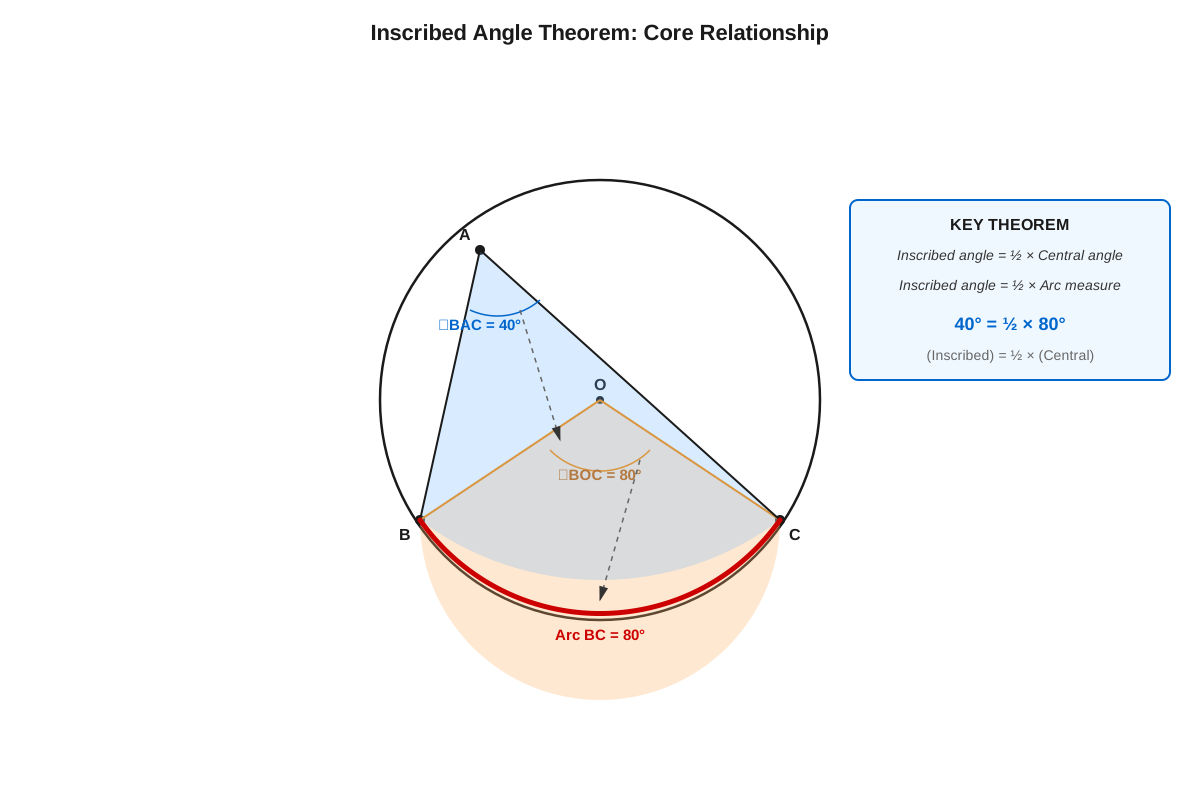
The Inscribed Angle Theorem forms the cornerstone of all inscribed angle problems. This theorem states that an inscribed angle measures exactly one-half the measure of the central angle that subtends (intercepts) the same arc. Alternatively stated, an inscribed angle equals half the measure of its intercepted arc.
Consider a circle with center O. If points A, B, and C lie on the circle's circumference, and we form angle ABC (with vertex B on the circle), this creates an inscribed angle. The arc AC that lies opposite to vertex B is the intercepted arc. If the central angle AOC measures 80°, then the inscribed angle ABC measures exactly 40°. This 2:1 ratio remains constant regardless of where point B is positioned on the circle, as long as it remains on the major arc opposite to AC.
Inscribed Angle = (1/2) × Intercepted Arc
or
Inscribed Angle = (1/2) × Central Angle (for the same arc)
Inscribed Angles Subtending the Same Arc
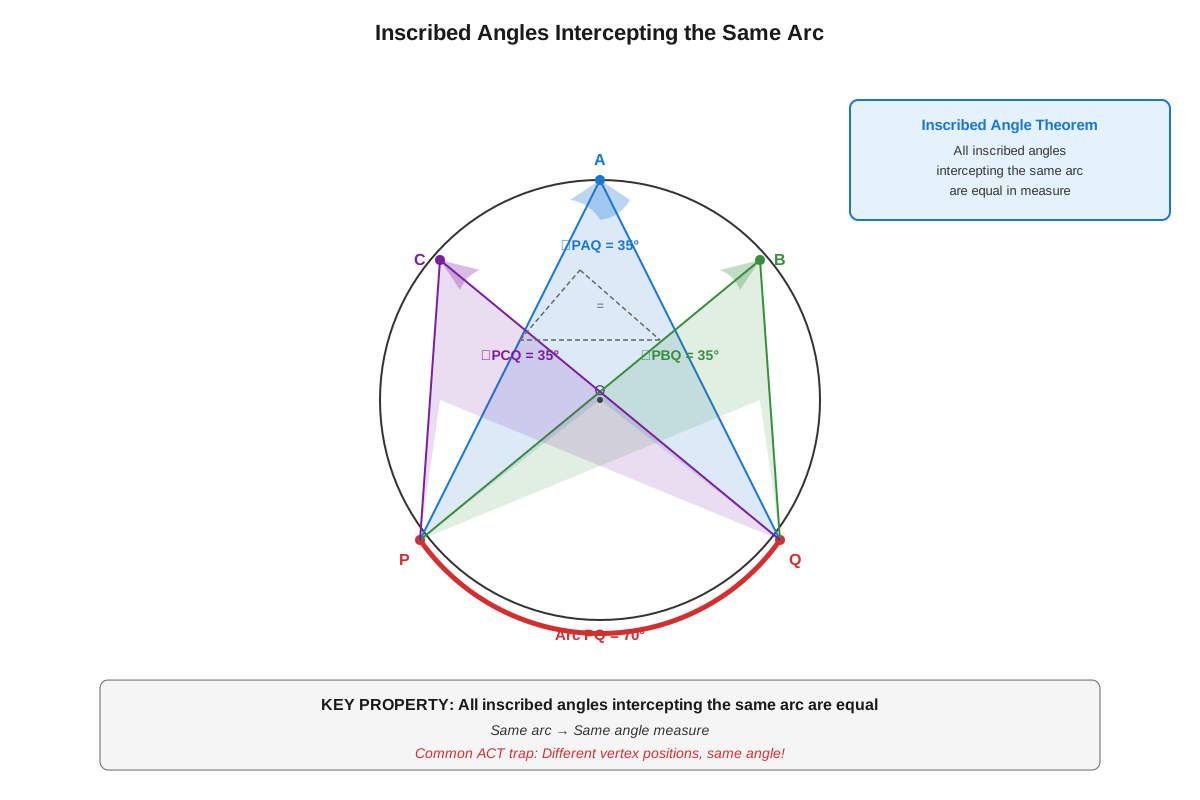
A powerful corollary to the Inscribed Angle Theorem states that all inscribed angles subtending the same arc are congruent (equal in measure). This means that if multiple points on a circle's circumference all form angles that intercept the same arc, those angles must all be equal.
For example, if points B, D, and E all lie on the major arc of a circle, and each forms an angle with endpoints A and C (which define an arc), then angles ABC, ADC, and AEC are all equal. This property frequently appears in ACT problems involving inscribed polygons or when multiple triangles share a common chord.
Angles Inscribed in a Semicircle
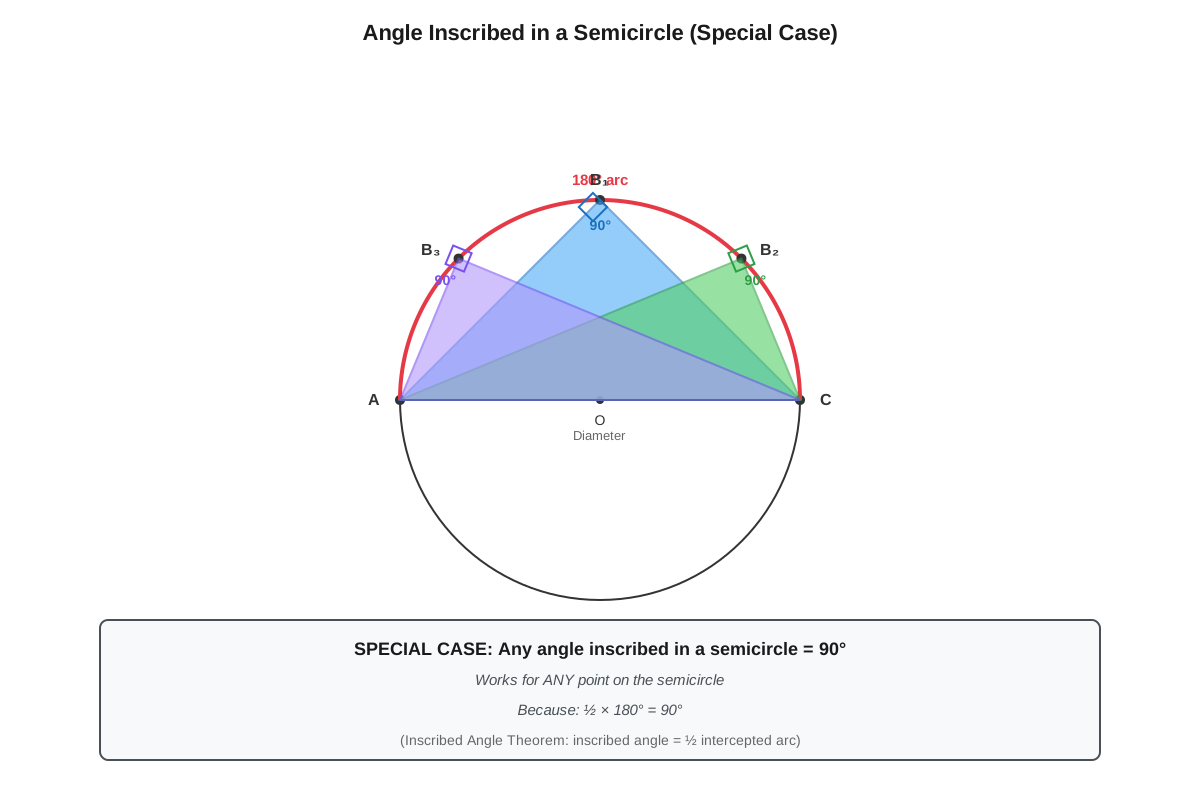
One of the most tested special cases involves angles inscribed in a semicircle. When an inscribed angle's sides pass through the endpoints of a diameter, the angle measures exactly 90°. This occurs because a diameter creates an arc of 180°, and half of 180° equals 90°.
This property provides an immediate right angle identification tool. If an ACT problem shows a triangle inscribed in a circle where one side is a diameter, the angle opposite that diameter must be a right angle. This often connects to Pythagorean Theorem applications and right triangle trigonometry.
Inscribed Quadrilaterals (Cyclic Quadrilaterals)
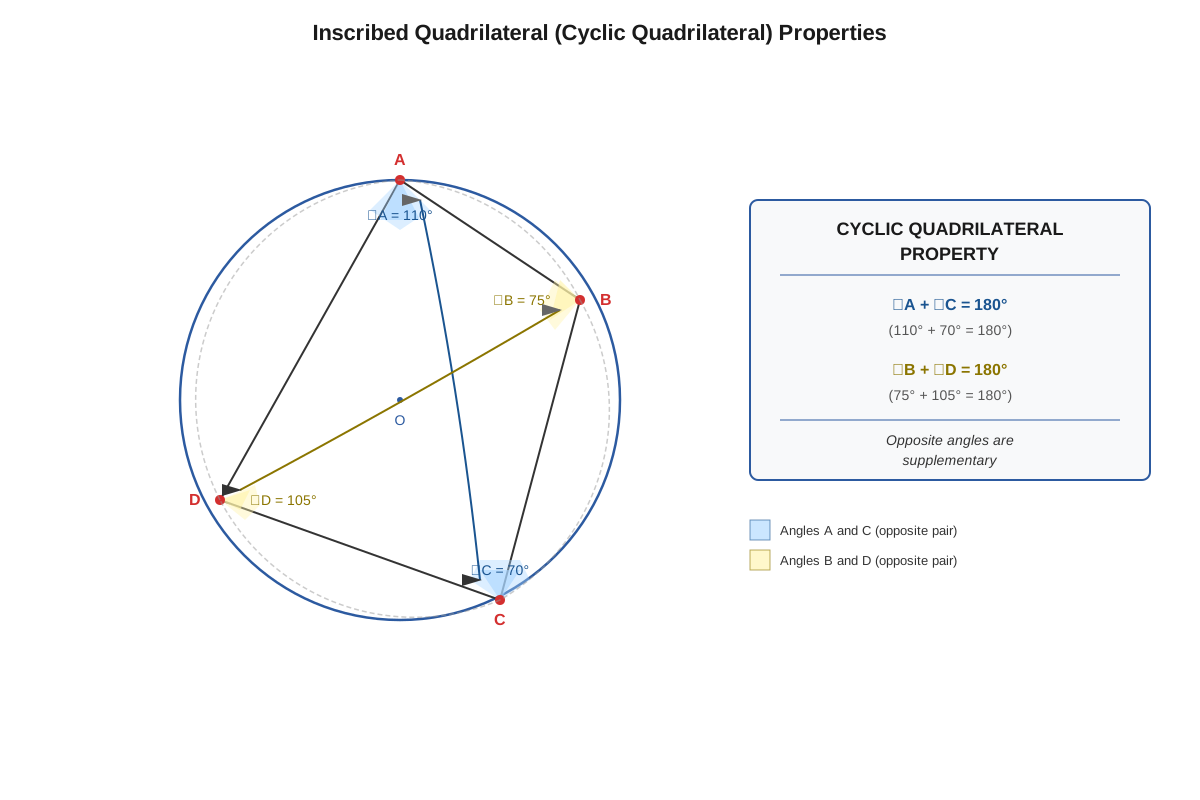
When a quadrilateral has all four vertices on a circle's circumference, it's called an inscribed quadrilateral or cyclic quadrilateral. These figures have a special property: opposite angles are supplementary (they sum to 180°).
If quadrilateral ABCD is inscribed in a circle, then:
- Angle A + Angle C = 180°
- Angle B + Angle D = 180°
This property derives from the fact that opposite angles in an inscribed quadrilateral intercept arcs that together form the complete circle (360°), and since inscribed angles equal half their intercepted arcs, the angles sum to 180°.
| Angle Position | Intercepted Arc | Angle Measure |
|---|---|---|
| Angle A | Arc BCD | (1/2) × Arc BCD |
| Angle C | Arc DAB | (1/2) × Arc DAB |
| Sum | 360° | 180° |
Relationship Between Inscribed and Central Angles
Understanding the distinction between inscribed and central angles is crucial for ACT success. A central angle has its vertex at the circle's center, while an inscribed angle has its vertex on the circle's circumference. For the same intercepted arc:
- Central angle = Arc measure (in degrees)
- Inscribed angle = (1/2) × Arc measure
This relationship allows for quick conversions between angle types. If an ACT problem provides a central angle of 120°, any inscribed angle intercepting the same arc measures 60°. Conversely, if an inscribed angle measures 35°, the corresponding central angle measures 70°, and the intercepted arc also measures 70°.
Arc Addition and Angle Calculation
Complex ACT problems often require combining multiple arc measures or working with arc addition. Since a complete circle contains 360°, if you know some arc measures, you can determine others through subtraction. When calculating inscribed angles, remember to:
- Identify the intercepted arc for the angle in question
- Determine the arc measure (may require adding or subtracting known arcs)
- Apply the inscribed angle formula: angle = (1/2) × arc
- Verify that all angles and arcs create logical relationships
Concept Relationships
The inscribed angle concepts form an interconnected web of geometric relationships. The Inscribed Angle Theorem serves as the foundation, directly leading to the corollary that inscribed angles subtending the same arc are congruent. This corollary, in turn, enables the proof and application of properties for inscribed polygons, particularly the supplementary opposite angles in cyclic quadrilaterals.
The semicircle special case (inscribed angles in semicircles equal 90°) represents a specific application of the Inscribed Angle Theorem where the intercepted arc measures 180°. This connects directly to right triangle properties and the Pythagorean Theorem, creating a bridge between circle geometry and triangle geometry.
Central angles provide the measurement standard for arcs, which then determine inscribed angle measures through the 2:1 ratio. This creates a relationship chain: Central Angle → Arc Measure → Inscribed Angle. Understanding this progression allows students to work bidirectionally, calculating any element when given another.
The connection to prerequisite knowledge is equally important. Circle terminology provides the vocabulary for describing inscribed angles. Angle measurement skills enable the arithmetic calculations required. Triangle properties combine with inscribed angles when triangles are formed within circles, particularly when applying the angle sum property (angles in a triangle sum to 180°) alongside inscribed angle calculations.
Quick check — test yourself on Inscribed angles so far.
Try Flashcards →High-Yield Facts
⭐ An inscribed angle measures exactly half its intercepted arc
⭐ An inscribed angle measures exactly half the central angle that subtends the same arc
⭐ All inscribed angles that intercept the same arc are congruent (equal)
⭐ Any angle inscribed in a semicircle (intercepting a diameter) measures 90°
⭐ In an inscribed quadrilateral, opposite angles are supplementary (sum to 180°)
- The vertex of an inscribed angle must lie on the circle's circumference
- The sides of an inscribed angle are chords of the circle
- A central angle equals the measure of its intercepted arc in degrees
- The sum of all arcs around a circle equals 360°
- If an inscribed angle intercepts a minor arc of 60°, the angle measures 30°
- If two inscribed angles intercept the same arc, they can be located anywhere on the remaining portion of the circle and remain equal
- An inscribed angle can never be larger than 90° unless it intercepts an arc greater than 180° (a major arc)
- When a chord is drawn in a circle, it creates two arcs; inscribed angles can intercept either arc depending on vertex placement
Common Misconceptions
Misconception: An inscribed angle equals its intercepted arc measure → Correction: An inscribed angle equals half the intercepted arc measure. This is the most common error on ACT inscribed angle problems. Always remember to divide the arc measure by 2 when calculating an inscribed angle.
Misconception: Central angles and inscribed angles are the same thing → Correction: Central angles have their vertex at the circle's center, while inscribed angles have their vertex on the circumference. For the same arc, the central angle is twice the inscribed angle.
Misconception: All angles formed by chords are inscribed angles → Correction: An inscribed angle specifically requires the vertex to be on the circle's circumference. If two chords intersect inside the circle (not on the circumference), the angle formed follows different rules (chord-chord angle theorem).
Misconception: In an inscribed quadrilateral, all angles equal 90° → Correction: Opposite angles in an inscribed quadrilateral are supplementary (sum to 180°), but they are not necessarily right angles. Only when one angle is 90° must its opposite angle also be 90°.
Misconception: The inscribed angle theorem only works for minor arcs → Correction: The theorem applies to any arc, whether minor (less than 180°) or major (greater than 180°). An inscribed angle intercepting a major arc will measure more than 90°.
Misconception: If a triangle is inscribed in a circle, all its angles are inscribed angles → Correction: While the three vertices create three inscribed angles within the triangle, each angle intercepts a different arc. The inscribed angle property applies to each angle individually based on its specific intercepted arc.
Worked Examples
Example 1: Basic Inscribed Angle Calculation
Problem: Circle O has points A, B, and C on its circumference. The arc AC (not containing B) measures 124°. What is the measure of inscribed angle ABC?
Solution:
Step 1: Identify the given information
- Arc AC = 124°
- Angle ABC is inscribed (vertex B is on the circle)
- Angle ABC intercepts arc AC
Step 2: Apply the Inscribed Angle Theorem
The inscribed angle equals half the intercepted arc.
Angle ABC = (1/2) × Arc AC
Angle ABC = (1/2) × 124°
Angle ABC = 62°
Step 3: Verify the answer
Since the arc is 124° (less than 180°, so it's a minor arc), the inscribed angle should be less than 90°. Our answer of 62° makes sense.
Answer: 62°
This problem directly tests Learning Objective 2 (explaining the core rule) and Learning Objective 3 (applying to ACT-style questions).
Example 2: Inscribed Quadrilateral with Multiple Steps
Problem: Quadrilateral PQRS is inscribed in a circle. Angle P measures 78°, and angle Q measures 95°. What is the measure of angle S?
Solution:
Step 1: Identify what type of problem this is
This involves an inscribed quadrilateral, so we should recall that opposite angles are supplementary.
Step 2: Identify which angles are opposite
In quadrilateral PQRS (going around in order):
- P is opposite to R
- Q is opposite to S
Step 3: Apply the inscribed quadrilateral property
Since Q and S are opposite angles:
Angle Q + Angle S = 180°
Step 4: Solve for angle S
95° + Angle S = 180°
Angle S = 180° - 95°
Angle S = 85°
Step 5: Verify using the other pair (optional but recommended)
We can check our understanding by finding angle R:
Angle P + Angle R = 180°
78° + Angle R = 180°
Angle R = 102°
Now verify all angles sum to 360° (property of all quadrilaterals):
78° + 95° + 85° + 102° = 360° ✓
Answer: 85°
This problem tests Learning Objective 3 (applying to ACT-style questions) and demonstrates how inscribed angle properties connect to polygon properties.
Exam Strategy
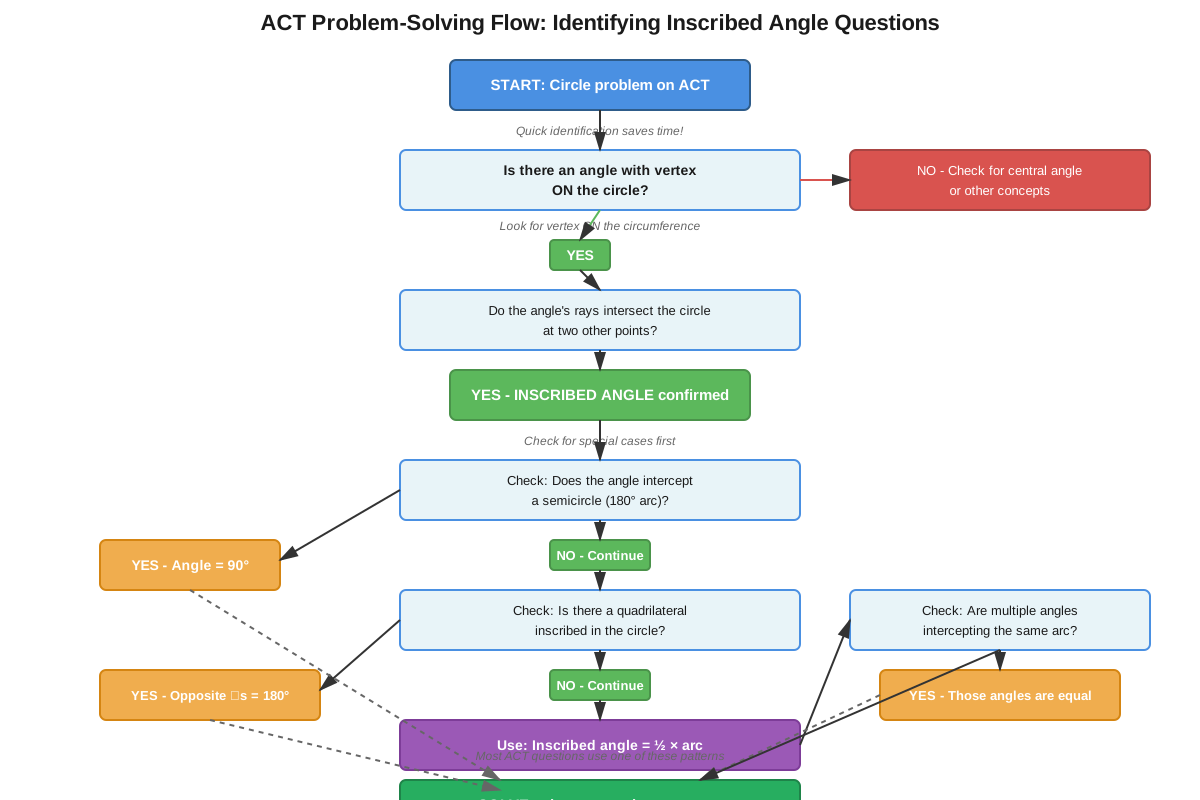
When approaching ACT inscribed angles questions, begin by identifying whether the problem involves inscribed angles at all. Look for these trigger phrases and visual cues: "inscribed in a circle," diagrams showing angles with vertices on a circle's circumference, "points on a circle," or any mention of angles and arcs together. If you see a triangle or quadrilateral inside a circle with vertices touching the circumference, inscribed angles are likely being tested.
Exam Tip: Draw or enhance the diagram. If the ACT provides a circle diagram, mark the center with a clear dot, label all known angle measures directly on the diagram, and write arc measures along the arcs themselves. This visual organization prevents calculation errors.
Follow this systematic approach for inscribed angle problems:
- Identify the angle type: Is it inscribed (vertex on circle) or central (vertex at center)?
- Locate the intercepted arc: Trace from one side of the angle, around the circle, to the other side
- Determine what you're solving for: Angle measure or arc measure?
- Apply the appropriate relationship: Inscribed angle = (1/2) × arc, or rearrange as needed
- Check for special cases: Semicircle (90°), inscribed quadrilateral (supplementary opposites), or congruent inscribed angles
For process-of-elimination strategies, recognize that incorrect answer choices often include these common traps:
- The full arc measure instead of half (forgetting to divide by 2)
- Double the correct answer (multiplying instead of dividing)
- The complementary angle (90° minus the correct answer)
- The supplementary angle (180° minus the correct answer)
If you see these relationships in the answer choices, you can often identify the correct answer by recognizing which trap the other answers represent.
Time allocation: Straightforward inscribed angle problems should take 30-45 seconds once you recognize the pattern. Multi-step problems involving inscribed quadrilaterals or combined concepts may require 60-90 seconds. If a problem requires more than 2 minutes, mark it for review and move on—you may be missing a key insight that will become obvious on a second look.
Memory Techniques
"HALF the arc" - The simplest and most important mnemonic. Whenever you see an inscribed angle, immediately think "HALF the arc." This prevents the most common error of using the full arc measure.
"Semicircle = Right angle" - Memorize this phrase exactly. The word "semicircle" should trigger "right angle" (90°) automatically. Visualize a triangle with one side as a diameter—the opposite angle is always 90°.
"Opposite Angles Add to 180" - For inscribed quadrilaterals, remember this phrase. The word "opposite" should trigger "supplementary" (180°).
The "2:1 Ratio" visualization - Picture a central angle and an inscribed angle intercepting the same arc. Visualize the central angle as twice as large, like a pizza slice that's been doubled. This reinforces that central angle = 2 × inscribed angle.
"Vertex on the circle, divide by two" - This rhyme helps remember that when the vertex is on the circle (inscribed), you divide the arc by two to get the angle.
The "Same Arc, Same Angle" rule - For inscribed angles subtending the same arc, visualize multiple points on a circle all "seeing" the same arc at the same angle, like multiple observers viewing the same scene from different positions along a curved balcony—their viewing angle remains constant.
Summary
Inscribed angles represent a high-yield ACT Math topic centered on a single powerful theorem: an inscribed angle measures exactly half its intercepted arc. This fundamental relationship, combined with key corollaries—inscribed angles subtending the same arc are congruent, angles inscribed in semicircles equal 90°, and opposite angles in inscribed quadrilaterals are supplementary—provides the complete toolkit for solving virtually all ACT inscribed angle problems. Success requires recognizing when inscribed angles are being tested (vertex on the circle, questions involving both angles and arcs), understanding the 2:1 ratio between arcs and inscribed angles, and systematically applying these relationships while avoiding common traps like forgetting to divide by 2 or confusing inscribed and central angles. Mastery of inscribed angles not only secures points on direct circle geometry questions but also enables efficient problem-solving on complex multi-step problems that combine circle properties with triangles, quadrilaterals, and coordinate geometry.
Key Takeaways
- Inscribed angles always equal half their intercepted arc—this is the foundational rule that appears in nearly every inscribed angle problem
- Central angles equal their intercepted arc, creating a 2:1 ratio between central and inscribed angles for the same arc
- Any angle inscribed in a semicircle measures exactly 90°, providing an instant right angle identification tool
- Opposite angles in inscribed quadrilaterals are supplementary (sum to 180°), a frequently tested property
- All inscribed angles intercepting the same arc are congruent, regardless of where the vertex is positioned on the circle
- Always identify whether an angle is inscribed or central before applying formulas—this distinction prevents the most common errors
- Draw and label diagrams clearly, marking the center, known angles, and arc measures to organize information visually
Related Topics
Central Angles and Arc Measures - Understanding how central angles relate to arc measures provides the foundation for inscribed angle calculations and enables quick conversions between angle types.
Chord Properties - Since inscribed angles are formed by chords, studying chord relationships (perpendicular bisectors, chord-chord angles, and chord lengths) extends inscribed angle knowledge to more complex problems.
Circle Equations and Coordinate Geometry - Inscribed angles frequently appear in coordinate plane problems where circles are defined by equations, requiring integration of algebraic and geometric reasoning.
Triangle Properties in Circles - Many inscribed angle problems involve triangles inscribed in circles, connecting to triangle angle sums, special right triangles, and the Law of Sines.
Tangent-Chord Angles - After mastering inscribed angles, studying angles formed by tangent lines and chords provides additional circle geometry tools for comprehensive ACT preparation.
Practice CTA
Now that you've mastered the core concepts of inscribed angles, it's time to cement your understanding through active practice. Work through the practice questions to test your ability to recognize inscribed angle problems, apply the theorems correctly, and avoid common traps. Use the flashcards to reinforce the key relationships and special cases until they become automatic. Remember, inscribed angles appear consistently on every ACT, and the time you invest in mastering this topic will directly translate to points on test day. You've built a strong foundation—now prove your mastery through practice!
Sign up free to keep reading
Create a free AnvayaPrep account to finish this ACT guide on Inscribed angles — plus flashcards and practice questions.