Overview
ACT probability traps represent a category of deceptive question structures that appear regularly on the ACT Math section, designed to test whether students truly understand probability concepts or merely apply formulas mechanically. These traps exploit common reasoning errors, such as confusing independent and dependent events, misidentifying sample spaces, or incorrectly applying the multiplication versus addition rules. Unlike straightforward probability questions that reward formula memorization, trap questions require careful analysis of what the question actually asks and what conditions apply to the scenario.
Understanding these traps is essential for achieving a high ACT Math score because probability questions appear in approximately 3-5 questions per test, and trap questions constitute a significant portion of these. Students who fall for these traps often possess adequate mathematical knowledge but fail to read carefully or recognize subtle distinctions in problem setup. The difference between a score of 28 and 32+ often hinges on avoiding these predictable errors.
Mastering ACT act probability traps connects directly to broader mathematical reasoning skills, including set theory, combinatorics, and logical analysis. The ability to identify what makes a probability question "tricky" strengthens overall test-taking acumen and translates to improved performance across the entire Math section, particularly in questions involving data analysis, statistics, and multi-step problem solving.
Learning Objectives
- [ ] Identify when ACT probability traps is being tested
- [ ] Explain the core rule or strategy behind ACT probability traps
- [ ] Apply ACT probability traps to ACT-style questions accurately
- [ ] Distinguish between independent and dependent probability scenarios in trap contexts
- [ ] Recognize when to use multiplication rule versus addition rule in ambiguous situations
- [ ] Evaluate whether "at least one" questions require complement probability approaches
- [ ] Analyze conditional probability traps involving restricted sample spaces
Prerequisites
- Basic probability concepts: Understanding that probability equals favorable outcomes divided by total outcomes forms the foundation for recognizing when trap questions manipulate either numerator or denominator
- Fraction operations: Multiplying and adding fractions correctly is necessary since probability trap questions often involve multi-step calculations where arithmetic errors compound
- Set notation and Venn diagrams: Recognizing unions, intersections, and complements helps visualize overlapping events that appear in trap scenarios
- Counting principles: Knowing when to multiply versus add when counting outcomes prevents falling for the most common probability traps
Why This Topic Matters
Probability trap questions serve as discriminators on the ACT, separating students who think critically from those who apply procedures blindly. In real-world contexts, probability reasoning appears in medical decision-making (understanding test accuracy), financial planning (evaluating investment risks), and everyday choices (weather forecasts, game strategies). The ability to avoid probability traps translates directly to better decision-making when faced with uncertain outcomes.
On the ACT Math section, probability questions appear with high regularity—typically 3-5 questions per 60-question test, representing 5-8% of the total score. Of these probability questions, approximately 60-70% contain some form of trap element designed to catch careless or conceptually confused students. These questions most commonly appear in positions 40-55 of the test, where difficulty increases and time pressure intensifies.
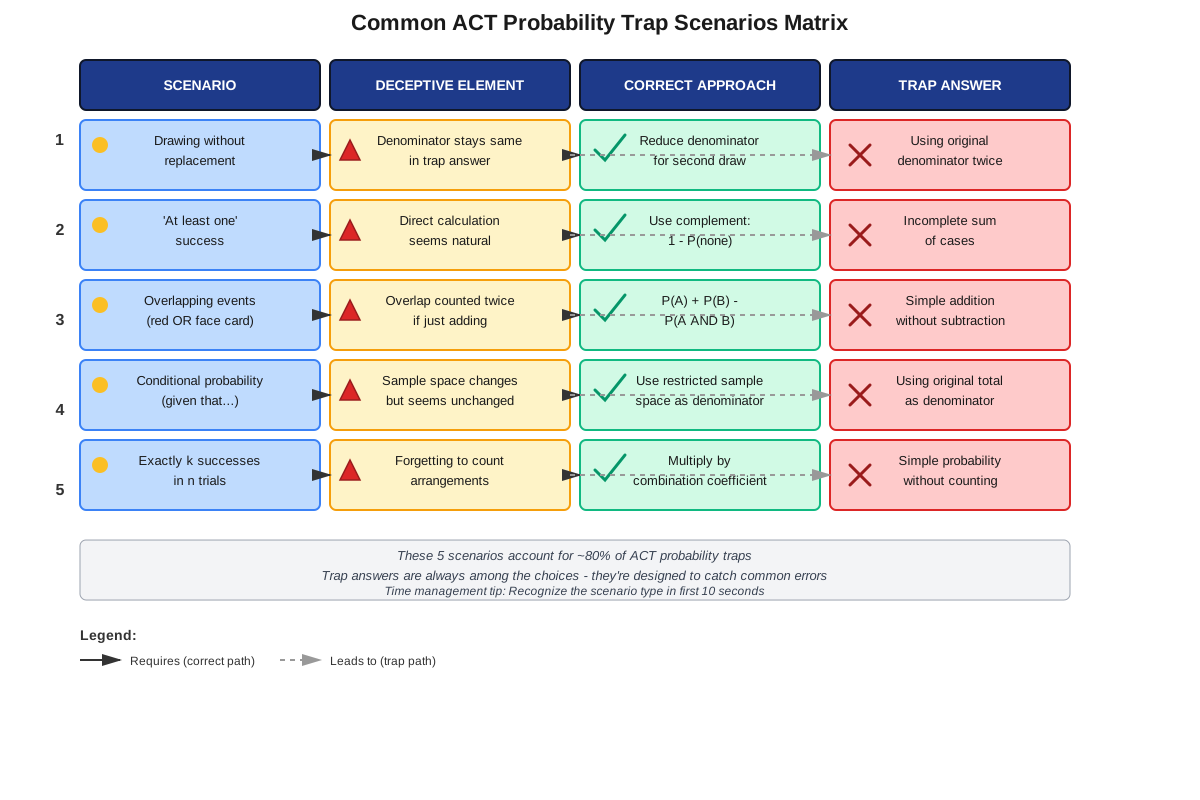
Common trap presentations include: word problems involving card draws or dice rolls with subtle dependencies; "at least one" scenarios where direct calculation is tedious but complement probability is efficient; conditional probability situations where the sample space changes mid-problem; and questions mixing mutually exclusive events with independent events. The ACT deliberately phrases these questions to reward careful reading and conceptual understanding over speed.
Core Concepts
The Independence Trap
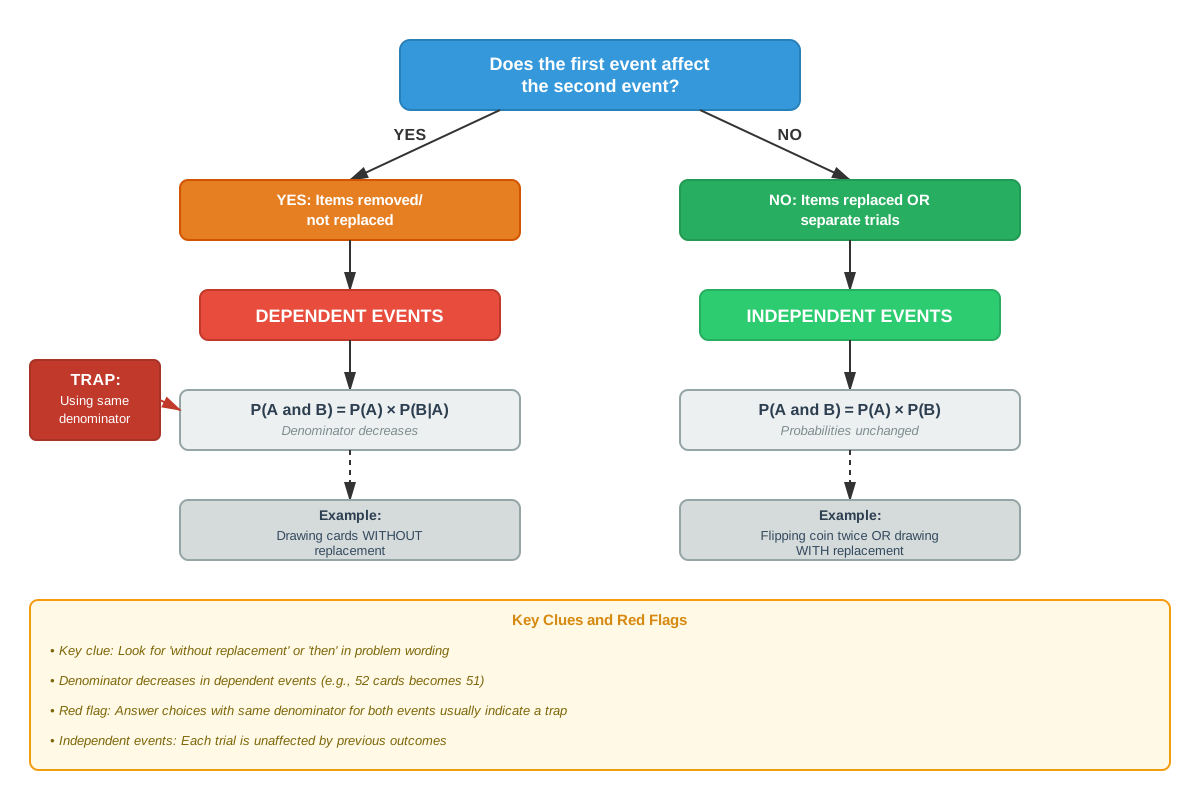
The most prevalent trap involves confusing independent events (where one outcome doesn't affect another) with dependent events (where outcomes are connected). For independent events, probabilities multiply: P(A and B) = P(A) × P(B). For dependent events, the second probability changes based on the first outcome: P(A and B) = P(A) × P(B|A).
The ACT creates traps by using scenarios that appear independent but are actually dependent, or vice versa. For example, "drawing two cards from a deck without replacement" creates dependency because the first draw changes what's available for the second draw. However, "flipping a coin twice" involves independent events because the first flip doesn't affect the second.
Key distinction: Look for phrases like "without replacement," "one after another," or "from the remaining" to signal dependency. Phrases like "each time," "independently," or "with replacement" signal independence.
The "At Least One" Trap
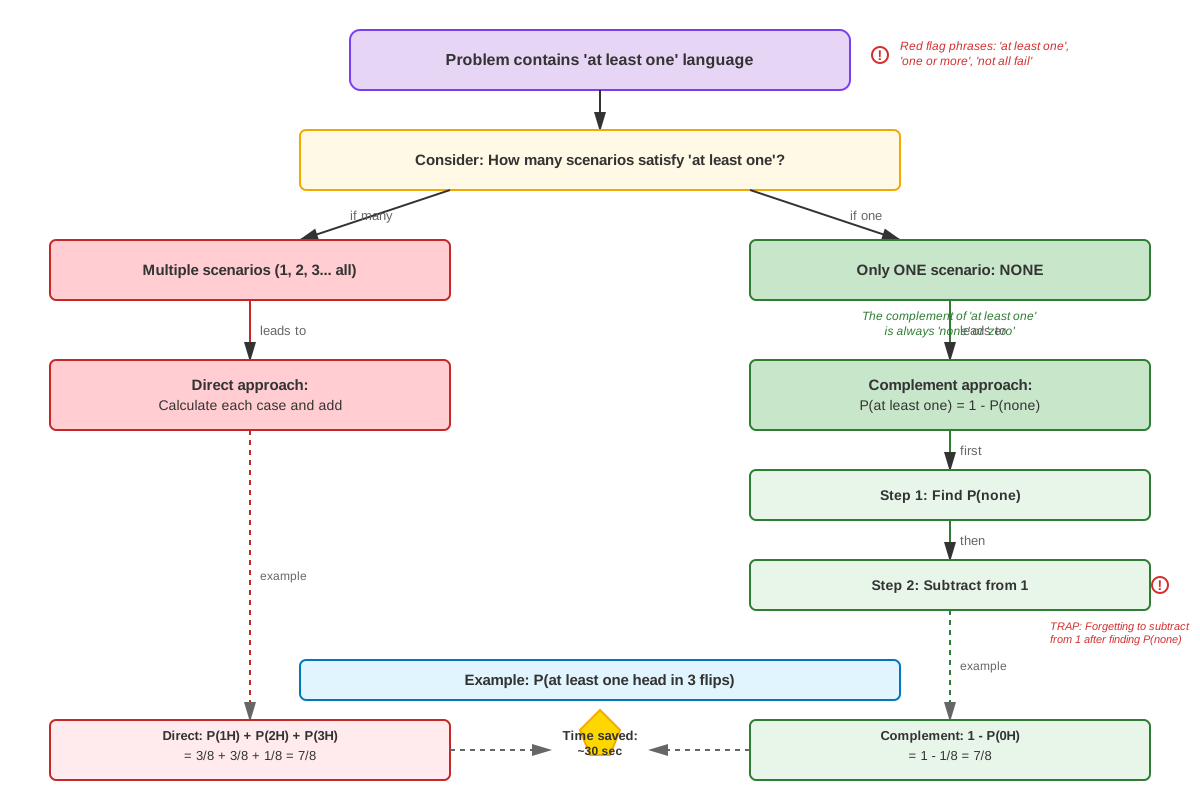
Questions asking for "at least one" success (at least one head in three coin flips, at least one defective item in a sample) trap students who attempt direct calculation. The direct method requires calculating P(exactly 1) + P(exactly 2) + P(exactly 3) + ..., which becomes tedious.
The complement probability approach is far more efficient: P(at least one) = 1 - P(none). This works because "at least one" and "none" are complementary events that together cover all possibilities. The ACT designs these questions knowing most students will waste time on the direct approach or make calculation errors.
The Sample Space Reduction Trap
Conditional probability questions restrict the sample space based on given information, but trap questions disguise this restriction. When a question states "given that event A occurred," the new probability calculation only considers outcomes where A is true, not the entire original sample space.
For example, if asked "What is the probability a student is female given that the student plays soccer?" the denominator becomes "total soccer players," not "total students." The trap occurs when students use the unrestricted sample space, yielding an incorrect probability.
The Multiplication vs. Addition Rule Trap
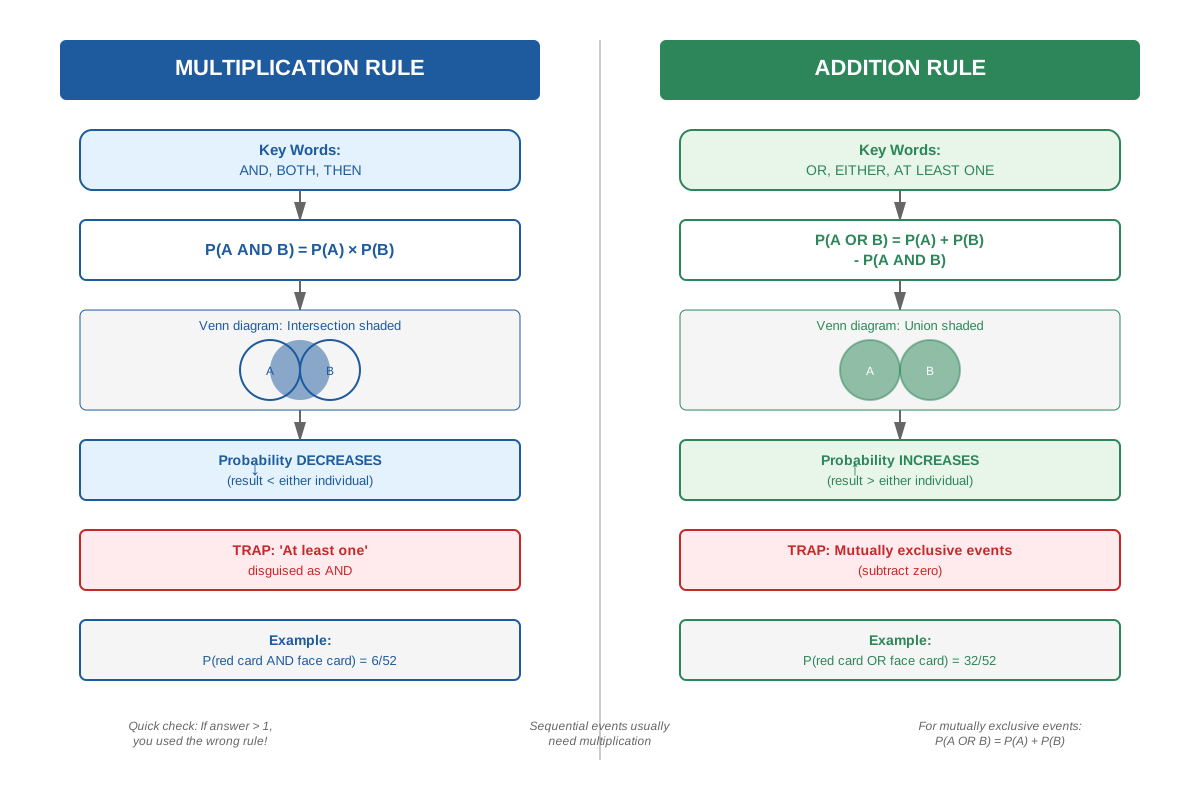
Students must distinguish when to multiply probabilities (for "and" scenarios with sequential events) versus when to add probabilities (for "or" scenarios with mutually exclusive events). The ACT creates ambiguity through careful wording.
| Scenario Type | Rule | Example |
|---|---|---|
| Sequential "and" | Multiply | P(heads AND then tails) = P(heads) × P(tails) |
| Mutually exclusive "or" | Add | P(rolling 2 OR rolling 5) = P(2) + P(5) |
| Non-mutually exclusive "or" | Add then subtract overlap | P(A or B) = P(A) + P(B) - P(A and B) |
The trap emerges when questions use conversational language that obscures whether events are sequential or alternative, or when "or" scenarios involve overlapping possibilities.
The Replacement Confusion Trap
Drawing objects "with replacement" (putting each item back before the next draw) maintains constant probabilities across draws, creating independent events. Drawing "without replacement" changes probabilities with each draw, creating dependent events.
The ACT trap: questions that don't explicitly state "with" or "without" replacement, forcing students to infer from context. Real-world scenarios (drawing cards from a deck, selecting people from a group) typically imply without replacement unless stated otherwise, but students often default to the simpler with-replacement calculation.
The Counting Principle Misapplication Trap
The fundamental counting principle states that if one event can occur in m ways and another in n ways, both events together can occur in m × n ways. Traps occur when students multiply when they should add (for alternative choices) or when they fail to account for restrictions.
For example, "How many ways can you select a president and vice president from 10 people?" requires 10 × 9 = 90 (multiplication, but the second choice has only 9 options remaining). Students who calculate 10 × 10 = 100 fall into the trap by ignoring the dependency.
The Conditional Probability Formula Trap
The formal conditional probability formula P(A|B) = P(A and B) / P(B) appears intimidating, but the ACT traps students who try to apply it when simple reasoning suffices. Often, directly counting favorable outcomes in the restricted sample space is faster and less error-prone than formula manipulation.
The trap works both ways: some students avoid the formula when it's actually needed (complex overlapping events), while others apply it unnecessarily to straightforward problems, wasting time and increasing error risk.
Concept Relationships
The core probability trap concepts form an interconnected web where understanding one illuminates others. Independence versus dependence serves as the foundational distinction that determines whether to use simple multiplication or adjusted conditional probabilities. This concept directly connects to replacement scenarios, which are simply concrete manifestations of independence (with replacement) or dependence (without replacement).
The "at least one" trap relies on understanding complement probability, which itself depends on recognizing that probability spaces must sum to 1. This connects back to sample space concepts from prerequisite knowledge, where identifying all possible outcomes forms the denominator of probability calculations.
Conditional probability represents a specialized case of sample space reduction, where given information eliminates certain outcomes from consideration. This connects to multiplication versus addition rules because conditional scenarios often involve sequential events (multiplication) but can be confused with alternative events (addition).
The relationship map flows: Basic Probability → Independence/Dependence → Replacement Scenarios → Sequential Events (Multiplication) → Conditional Probability → Sample Space Reduction → Complement Probability → "At Least One" Problems.
Quick check — test yourself on ACT probability traps so far.
Try Flashcards →High-Yield Facts
⭐ Independence requires that P(A and B) = P(A) × P(B); if outcomes affect each other, events are dependent and probabilities must adjust
⭐ "At least one" questions are almost always faster using complement: P(at least one) = 1 - P(none)
⭐ Without replacement creates dependent events; with replacement creates independent events
⭐ Conditional probability P(A|B) restricts the sample space to only outcomes where B occurred
⭐ Multiplication rule applies to "and" with sequential events; addition rule applies to "or" with mutually exclusive events
- Drawing cards without replacement changes probabilities: if drawing two aces from a standard deck, P(first ace) = 4/52, but P(second ace | first ace) = 3/51
- Phrases like "given that," "knowing that," or "if we know" signal conditional probability with restricted sample space
- When calculating "or" probabilities for non-mutually exclusive events, subtract the overlap: P(A or B) = P(A) + P(B) - P(A and B)
- Probability values must fall between 0 and 1 (inclusive); answers outside this range indicate calculation errors
- The sum of all probabilities in a complete sample space always equals 1, useful for checking work
- Dependent events require updating probabilities after each outcome; the denominator decreases when sampling without replacement
- "Exactly" questions (exactly 2 heads in 3 flips) require different calculations than "at least" questions (at least 2 heads)
Common Misconceptions
Misconception: All probability questions involving multiple events require multiplying probabilities together. → Correction: Only sequential "and" scenarios require multiplication; "or" scenarios with mutually exclusive events require addition, and conditional probability may require neither simple multiplication nor addition.
Misconception: Drawing two items from a group always uses the same probability for both draws. → Correction: Without replacement (the default assumption for most real-world scenarios), the second probability changes because the sample space has one fewer item and possibly one fewer favorable outcome.
Misconception: "At least one" means "exactly one" and can be calculated directly as a single probability. → Correction: "At least one" includes all scenarios with one or more successes (exactly 1, exactly 2, exactly 3, etc.), making complement probability (1 - P(none)) the efficient approach.
Misconception: Conditional probability P(A|B) equals P(A) × P(B). → Correction: Conditional probability restricts the sample space to outcomes where B occurred, calculated as P(A and B) / P(B), which only equals P(A) when A and B are independent.
Misconception: If two events can't happen simultaneously, they must be independent. → Correction: Mutually exclusive events (can't happen together) are actually dependent because if one occurs, the probability of the other becomes zero; independence means P(A|B) = P(A), which fails for mutually exclusive events.
Misconception: Probability questions always require complex formulas and calculations. → Correction: Many ACT probability traps are best solved through careful reasoning and direct counting of favorable versus total outcomes, avoiding formula misapplication.
Misconception: The order of selection doesn't matter in probability calculations. → Correction: Order matters when calculating probabilities for sequential events; "selecting a president then vice president" differs from "selecting two officers where roles don't matter" (combinations vs. permutations).
Worked Examples
Example 1: The Dependent Events Trap
Question: A bag contains 5 red marbles and 3 blue marbles. If two marbles are drawn one after another without replacement, what is the probability that both marbles are red?
Solution:
Step 1: Identify the trap. The phrase "without replacement" signals dependent events. Many students incorrectly calculate (5/8) × (5/8) = 25/64, treating draws as independent.
Step 2: Calculate the first draw probability. P(first red) = 5 red marbles / 8 total marbles = 5/8.
Step 3: Update the sample space for the second draw. After removing one red marble, 4 red marbles and 3 blue marbles remain, totaling 7 marbles.
Step 4: Calculate the conditional probability. P(second red | first red) = 4/7.
Step 5: Apply the multiplication rule for dependent events. P(both red) = P(first red) × P(second red | first red) = (5/8) × (4/7) = 20/56 = 5/14.
Connection to learning objectives: This example demonstrates identifying the dependency trap (objective 1), applying the correct multiplication rule for dependent events (objective 2), and distinguishing between independent and dependent scenarios (objective 4).
Example 2: The "At Least One" Complement Trap
Question: A fair coin is flipped 4 times. What is the probability of getting at least one head?
Solution:
Step 1: Recognize the "at least one" trap. Direct calculation requires finding P(exactly 1 head) + P(exactly 2 heads) + P(exactly 3 heads) + P(exactly 4 heads), which is time-consuming and error-prone.
Step 2: Identify the complement. The complement of "at least one head" is "no heads" or "all tails."
Step 3: Calculate P(all tails). Each flip has P(tails) = 1/2. Since flips are independent: P(all tails) = (1/2) × (1/2) × (1/2) × (1/2) = 1/16.
Step 4: Apply complement probability. P(at least one head) = 1 - P(all tails) = 1 - 1/16 = 15/16.
Step 5: Verify reasonableness. The probability is high (15/16 ≈ 0.94), which makes sense because getting at least one head in four flips should be very likely.
Connection to learning objectives: This example shows identifying the "at least one" trap structure (objective 1), explaining the complement probability strategy (objective 2), and evaluating when complement approaches are necessary (objective 6).
Exam Strategy
When approaching ACT probability questions, begin by reading the entire question twice before calculating anything. The first read identifies the scenario; the second read catches trap indicators like "without replacement," "at least," or "given that."
Trigger words for specific traps:
- "Without replacement," "one after another," "then" → dependent events, adjust probabilities
- "At least one," "one or more" → use complement probability (1 - P(none))
- "Given that," "knowing that," "if" → conditional probability, restricted sample space
- "And" in sequential context → multiply probabilities
- "Or" with alternatives → add probabilities (check for overlap)
Process-of-elimination strategy: Calculate the probability using your method, then check if the answer appears among choices. If not, immediately reconsider whether events are independent or dependent. Also verify that your answer falls between 0 and 1. Eliminate any answer choices outside this range or that seem unreasonably extreme (very close to 0 or 1 when the scenario suggests moderate probability).
Time allocation: Probability questions typically appear in the latter half of the ACT Math section. Allocate 60-90 seconds per probability question. If a question requires more than 2 minutes, you've likely fallen into a trap—step back and reconsider the approach. The complement probability method for "at least one" questions should save 30-45 seconds compared to direct calculation.
Verification technique: After calculating, ask "Does this answer make intuitive sense?" If drawing two aces from a deck, the probability should be small (there are only 4 aces among 52 cards). If your answer suggests high probability, recheck your work.
Memory Techniques
DRAW mnemonic for probability trap identification:
- Dependency: Check if events affect each other (replacement status)
- Restricted space: Look for conditional probability indicators
- At least one: Use complement (1 - P(none))
- Word choice: "And" multiplies, "or" adds (with adjustments)
Visualization for independence: Picture two separate boxes for independent events (coin flips, dice rolls) versus connected boxes for dependent events (drawing without replacement). If an arrow connects the boxes (first outcome affects second), events are dependent.
The "Replacement Rhyme": "With replacement, stay the same; without replacement, change the game." This reminds students that probabilities remain constant with replacement but must adjust without replacement.
Complement probability shortcut: Visualize a pie chart representing all possibilities. If "at least one" covers most of the pie except a tiny slice (none), it's easier to calculate the tiny slice and subtract from 1.
Conditional probability spatial memory: Imagine physically shrinking the sample space when given information. If told "the student plays soccer," mentally discard all non-soccer students from your mental image before calculating.
Summary
ACT probability traps exploit common reasoning errors and careless reading to differentiate students who truly understand probability from those who mechanically apply formulas. The most prevalent traps involve confusing independent and dependent events (particularly in replacement scenarios), attempting direct calculation for "at least one" questions instead of using complement probability, misidentifying sample spaces in conditional probability situations, and misapplying multiplication versus addition rules. Success requires careful attention to trigger words like "without replacement," "at least," and "given that," combined with strategic thinking about whether complement probability or direct counting offers the most efficient path. Students must distinguish between scenarios requiring probability adjustment (dependent events) and those maintaining constant probabilities (independent events), recognize when conditional information restricts the sample space, and verify that calculated probabilities fall within the valid 0-to-1 range while making intuitive sense for the described scenario.
Key Takeaways
- Independence versus dependence determines whether probabilities remain constant or must adjust; "without replacement" signals dependence
- "At least one" questions are almost always most efficient using complement probability: 1 - P(none)
- Conditional probability restricts the sample space to outcomes where the given condition is true
- Multiplication rule applies to sequential "and" events; addition rule applies to mutually exclusive "or" events
- Careful reading of trap indicators (trigger words) prevents falling for predictable ACT probability traps
- Verification through reasonableness checks (probability between 0 and 1, intuitive magnitude) catches calculation errors
- Strategic approach selection (complement vs. direct, formula vs. counting) saves time and reduces errors
Related Topics
Combinatorics and counting principles: Mastering probability traps provides foundation for understanding permutations and combinations, which frequently appear in ACT questions involving arrangements and selections where order matters or doesn't matter.
Statistics and data analysis: Probability concepts extend to interpreting statistical claims, understanding sampling distributions, and evaluating data-based arguments that appear in ACT Science and Math sections.
Expected value and outcomes: After mastering basic probability traps, students can progress to weighted probability scenarios where different outcomes have different values, common in decision-making contexts.
Set theory and Venn diagrams: The visual and logical framework of sets reinforces probability concepts, particularly for understanding unions, intersections, and complements that underlie "or," "and," and "at least one" scenarios.
Practice CTA
Now that you understand the common probability traps on the ACT and strategies to avoid them, it's time to cement this knowledge through active practice. Attempt the practice questions designed specifically to test these trap scenarios, paying special attention to identifying trigger words before calculating. Use the flashcards to reinforce the distinction between independent and dependent events, multiplication versus addition rules, and when to apply complement probability. Remember: recognizing the trap is half the battle—the other half is executing the correct strategy efficiently. Your ability to avoid these traps will directly translate to points on test day, so practice with purpose and review any mistakes to understand which trap caught you and how to avoid it next time.
Sign up free to keep reading
Create a free AnvayaPrep account to finish this ACT guide on ACT probability traps — plus flashcards and practice questions.