Overview
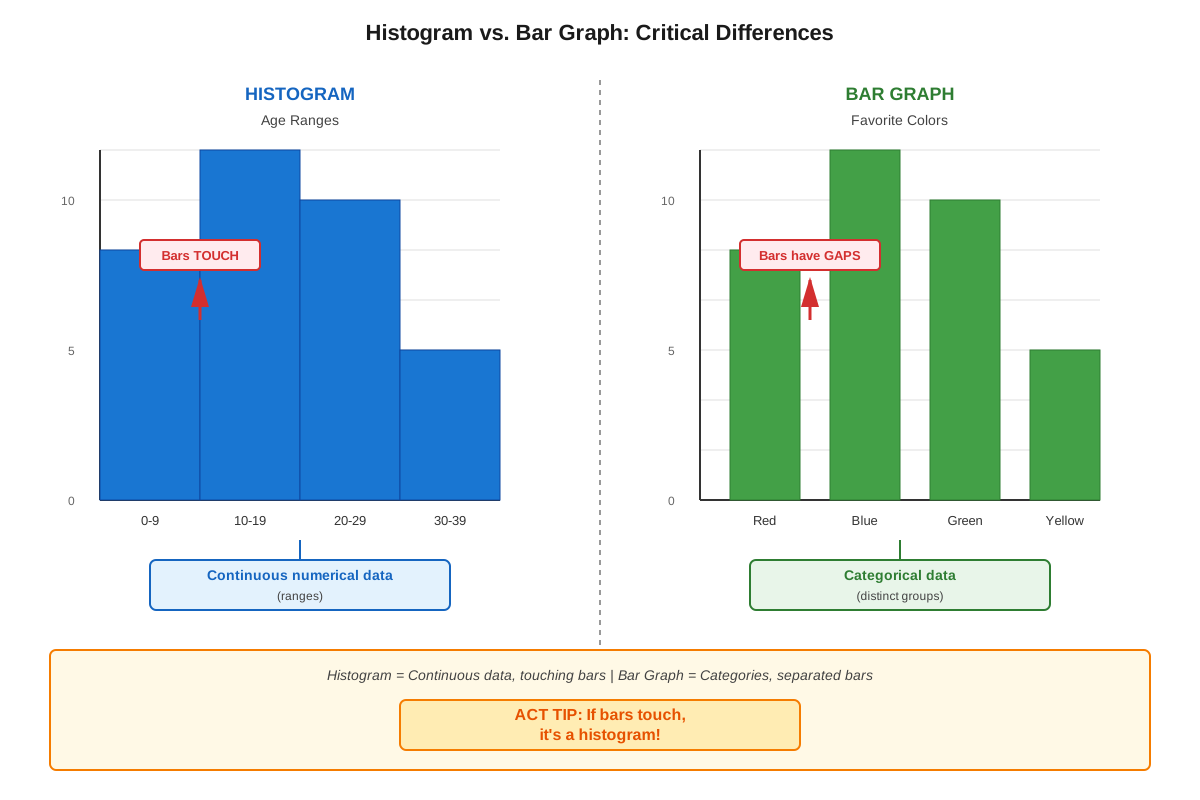
Histograms are one of the most frequently tested data visualization tools on the ACT Math section, appearing in approximately 2-4 questions per exam. A histogram is a specialized type of bar graph that displays the frequency distribution of continuous numerical data by grouping values into intervals called bins or classes. Unlike standard bar graphs that show categorical data with spaces between bars, histograms display quantitative data with bars that touch each other, emphasizing the continuous nature of the data being represented. Understanding how to read, interpret, and analyze histograms is essential for success on the Statistics and Probability portion of the ACT.
The ACT consistently tests students' ability to extract information from histograms, including identifying frequencies, calculating measures of central tendency, determining ranges, and making comparisons between different data sets. Questions may ask students to find the number of data points in specific intervals, calculate percentages, identify the interval with the highest frequency, or determine the total number of observations represented. More challenging questions require students to calculate means, medians, or make inferences about the shape and spread of the distribution.
Mastering histograms connects directly to broader mathematical concepts including data analysis, probability, and statistical reasoning. The skills developed through histogram interpretation—such as understanding frequency distributions, recognizing patterns in data, and making data-driven conclusions—form the foundation for more advanced statistical concepts. Additionally, histogram questions often integrate other mathematical skills such as ratio and proportion, percentage calculations, and algebraic reasoning, making this topic a high-yield area for comprehensive ACT preparation.
Learning Objectives
- [ ] Identify when Histograms is being tested
- [ ] Explain the core rule or strategy behind Histograms
- [ ] Apply Histograms to ACT-style questions accurately
- [ ] Distinguish between histograms and other types of graphs (bar graphs, line plots)
- [ ] Calculate frequencies, totals, and percentages from histogram data
- [ ] Determine measures of central tendency (mean, median, mode) using histogram information
- [ ] Analyze the shape and distribution characteristics of data displayed in histograms
Prerequisites
- Basic arithmetic operations: Essential for calculating frequencies, totals, and percentages from histogram data
- Understanding of mean, median, and mode: Required to calculate and interpret measures of central tendency from grouped data
- Fraction and percentage conversions: Necessary for determining proportions and relative frequencies in histogram analysis
- Number line comprehension: Helps interpret the continuous intervals represented on the horizontal axis
- Basic graphing skills: Provides foundation for understanding how data is visually represented in coordinate systems
Why This Topic Matters
Histograms serve as fundamental tools for understanding how data is distributed across different ranges of values, making them invaluable in fields ranging from scientific research to business analytics. In real-world applications, histograms help professionals visualize patterns in test scores, analyze customer age distributions, examine manufacturing quality control data, study income distributions in economics, and interpret medical test results. The ability to quickly extract meaningful information from histograms is a critical skill for data literacy in the modern world.
On the ACT Math section, histogram questions appear with high frequency, typically comprising 2-4 questions per exam administration. These questions fall primarily within the Statistics and Probability content area, which accounts for approximately 5-10% of the total Math section. Histogram questions range from straightforward frequency identification (difficulty level: easy-medium) to more complex problems requiring multi-step calculations or statistical reasoning (difficulty level: medium-hard). The ACT favors questions that test practical interpretation skills rather than theoretical knowledge, making this a highly predictable and preparable topic area.
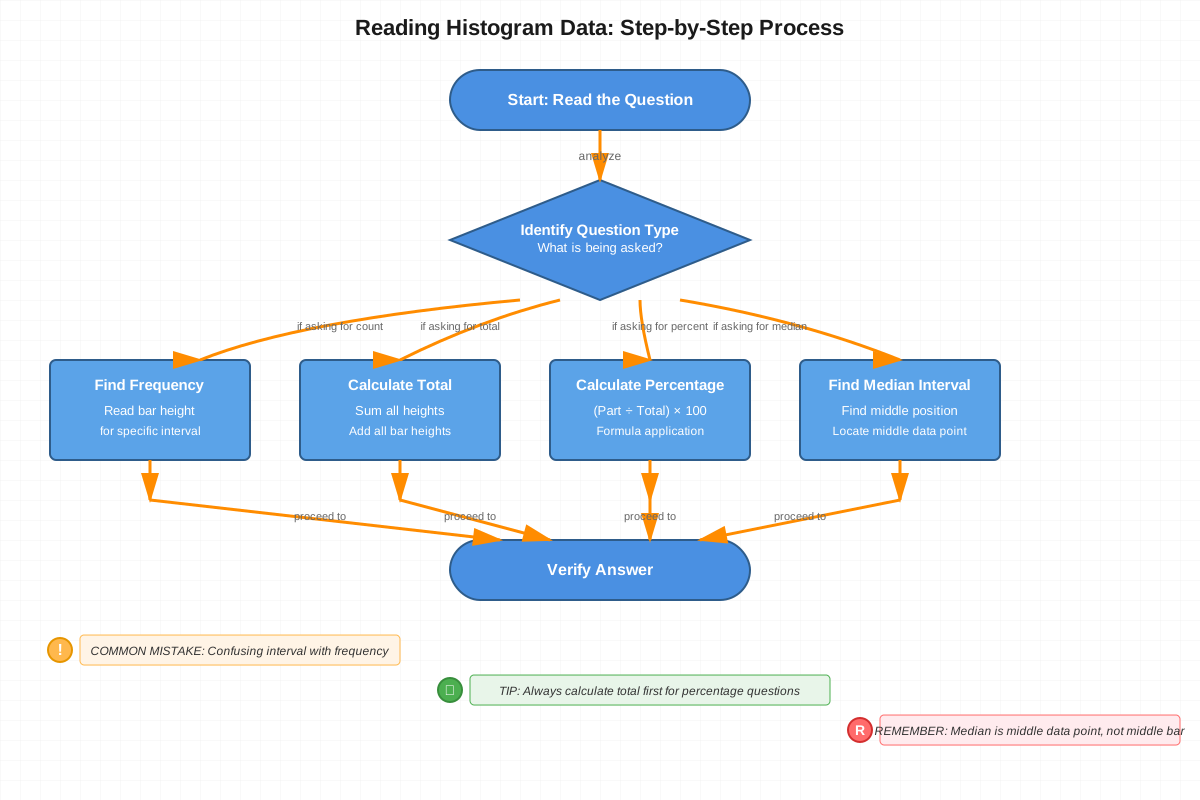
Common question formats include: identifying the number of data points within specific intervals, calculating the total number of observations, determining which interval contains the median value, finding the percentage of data above or below a certain threshold, comparing frequencies between different intervals, and calculating approximate means from grouped data. Questions may also present scenarios where students must interpret the shape of the distribution (symmetric, skewed, uniform) or make predictions based on the displayed data patterns.
Core Concepts
Structure and Components of Histograms
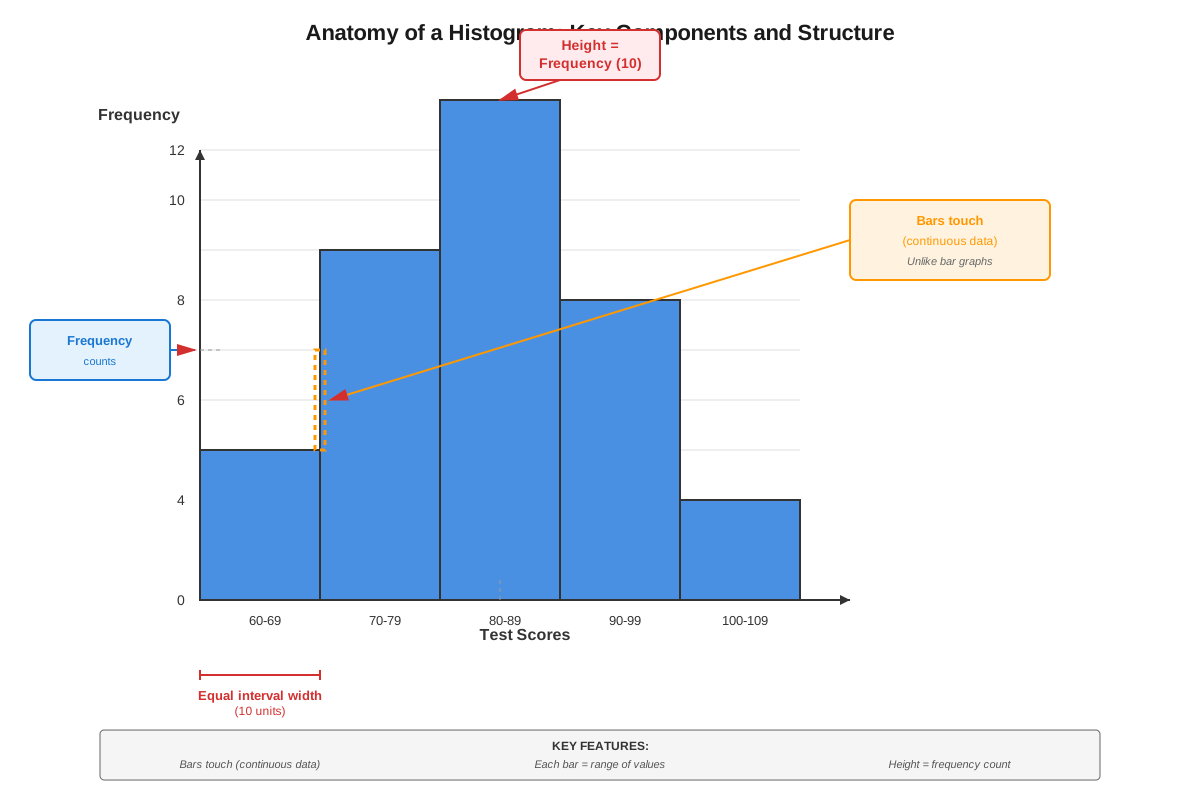
A histogram consists of several key components that students must recognize and understand. The horizontal axis (x-axis) displays the continuous variable being measured, divided into consecutive intervals or bins of equal or varying width. The vertical axis (y-axis) represents the frequency—the count of data points falling within each interval. Each rectangular bar corresponds to one interval, with the bar's height indicating how many observations fall within that range. Critically, the bars in a histogram touch each other, signifying that the data is continuous rather than categorical.
The intervals or bins are the ranges into which data is grouped. For example, if measuring test scores, intervals might be 60-69, 70-79, 80-89, and 90-99. The ACT typically uses clearly defined intervals with consistent width, though students should be prepared to work with varying interval sizes. When intervals have equal width, comparing bar heights directly reveals which ranges contain more data. When interval widths differ, students must pay careful attention to both the width and height to accurately determine frequencies.
Reading and Interpreting Histogram Data
To extract information from a histogram, students must systematically identify the value represented by each bar. The frequency for any interval is read directly from the height of the corresponding bar by checking where the top of the bar aligns with the vertical axis scale. For example, if a bar extends to the "15" mark on the y-axis, then 15 data points fall within that interval.
Calculating the total number of observations requires summing the frequencies of all bars. This fundamental skill appears frequently on the ACT, as many questions ask for totals, percentages, or proportions that depend on knowing the complete data set size. Students should develop the habit of quickly adding all bar heights when first examining a histogram question.
Calculating Percentages and Proportions
Many ACT histogram questions require converting frequencies to percentages or proportions. The formula is straightforward:
Percentage = (Frequency of specific interval / Total frequency) × 100%For example, if 12 students scored in the 80-89 range and there are 50 total students, the percentage is (12/50) × 100% = 24%. Students must be comfortable performing these calculations quickly and accurately, as they often serve as intermediate steps in more complex problems.
Determining Measures of Central Tendency
Finding the median from a histogram requires identifying the middle value(s) of the data set. First, calculate the total number of observations. If the total is odd, the median is the value at position (n+1)/2; if even, it's the average of the values at positions n/2 and (n/2)+1. Students must then count through the intervals from left to right, accumulating frequencies until reaching the position(s) containing the median value(s).
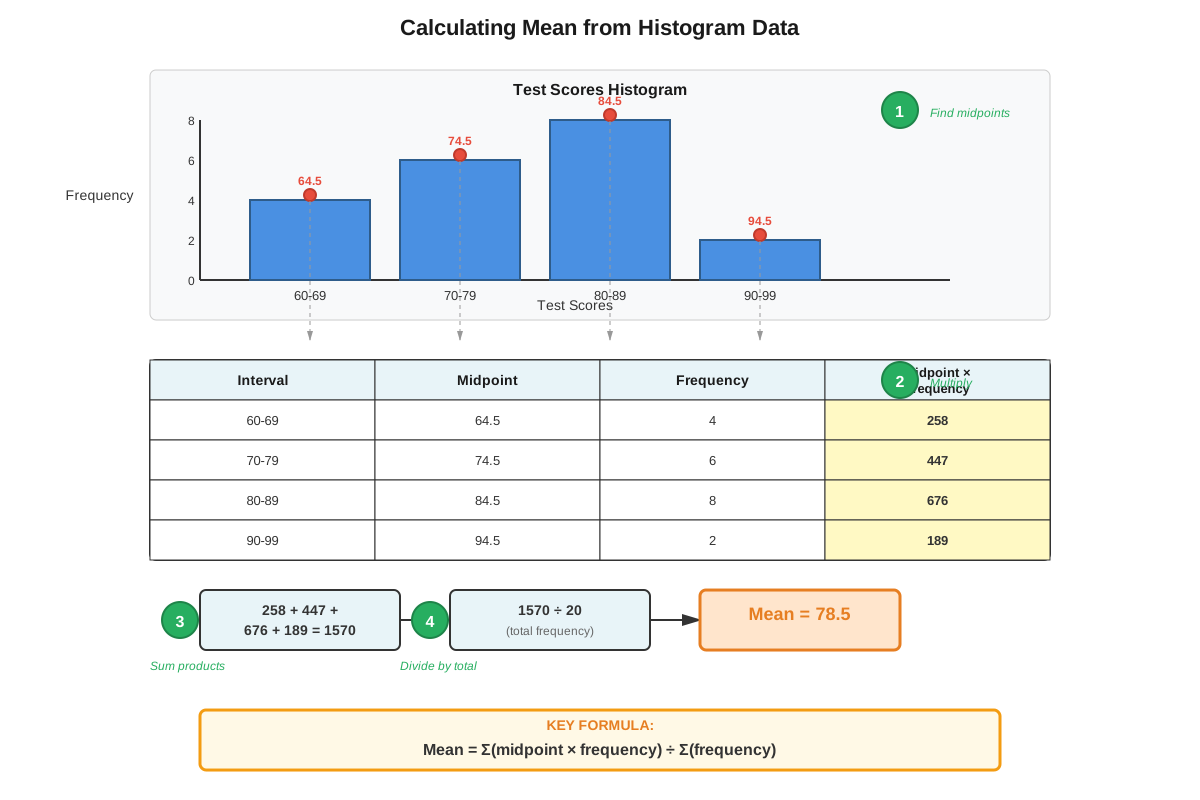
Calculating the mean from a histogram requires using the midpoint of each interval as a representative value. The formula is:
Mean ≈ Σ(midpoint × frequency) / total frequencyFor each interval, multiply the midpoint by the frequency, sum these products across all intervals, then divide by the total number of observations. This yields an approximation since the exact values within each interval are unknown.
The mode corresponds to the interval with the highest frequency—the tallest bar on the histogram. On the ACT, questions may ask which interval is "most common" or contains "the greatest number of observations," both referring to the modal interval.
Analyzing Distribution Shape
Histograms reveal important characteristics about data distribution. A symmetric distribution shows bars that mirror each other around a central peak, with similar frequencies on both sides. A right-skewed (positively skewed) distribution has a longer tail extending toward higher values, with most data concentrated on the left. A left-skewed (negatively skewed) distribution shows the opposite pattern. A uniform distribution displays bars of approximately equal height across all intervals.
Understanding distribution shape helps students make inferences about the data. For instance, in a right-skewed distribution of test scores, most students scored relatively low with a few high achievers pulling the mean upward. The ACT occasionally asks students to describe distribution characteristics or compare the relative positions of mean and median based on skewness.
Comparing Data Sets Using Histograms
Some ACT questions present multiple histograms for comparison. Students must identify similarities and differences in central tendency, spread, shape, and frequency patterns. Key comparison strategies include: identifying which data set has a higher mean or median, determining which shows greater variability (wider spread), comparing the number of observations in specific ranges, and analyzing differences in distribution shape.
Concept Relationships
The concepts within histogram analysis form an interconnected framework. Understanding histogram structure (intervals, bars, axes) → enables → reading frequencies → which allows → calculating totals and percentages → which supports → determining measures of central tendency → which facilitates → analyzing distribution characteristics. Each skill builds upon previous ones, creating a hierarchical relationship where mastery of basic interpretation is essential for more complex analysis.
Histograms connect to prerequisite topics through multiple pathways. Basic arithmetic provides the computational foundation for all frequency calculations. Understanding of mean, median, and mode extends into histogram contexts where these measures must be estimated from grouped data rather than calculated from individual values. Percentage skills enable conversion between frequencies and proportions, a common requirement in ACT questions.
The relationship to broader statistical concepts is equally important. Histograms serve as visual representations of frequency distributions, making abstract statistical concepts concrete and interpretable. Skills developed through histogram analysis transfer directly to understanding probability distributions, data variability, and statistical inference—topics that appear throughout the ACT Math section in various forms.
Quick check — test yourself on Histograms so far.
Try Flashcards →High-Yield Facts
- ⭐ The total number of observations equals the sum of all bar heights (frequencies)
- ⭐ Bars in histograms touch each other, indicating continuous data; bars in bar graphs have spaces, indicating categorical data
- ⭐ To find a percentage, divide the frequency of interest by the total frequency and multiply by 100%
- ⭐ The median is located in the interval where the cumulative frequency reaches or exceeds half the total observations
- ⭐ The modal interval is the one with the tallest bar (highest frequency)
- The horizontal axis represents the continuous variable being measured, divided into intervals
- The vertical axis represents frequency (count) of observations in each interval
- To approximate the mean, use interval midpoints: Σ(midpoint × frequency) / total frequency
- When comparing histograms, check for differences in central tendency, spread, and shape
- A right-skewed distribution has most data on the left with a tail extending right; the mean exceeds the median
- In a symmetric distribution, the mean and median are approximately equal
- The range of data can be estimated by identifying the lowest and highest intervals containing data
- Cumulative frequency is found by adding frequencies progressively from left to right
- The width of intervals may vary; always check interval boundaries carefully
- Questions asking "how many more" require subtracting one frequency from another
Common Misconceptions
Misconception: Histograms and bar graphs are the same thing. → Correction: Histograms display continuous numerical data with touching bars representing intervals, while bar graphs show categorical data with separated bars representing distinct categories. The touching bars in histograms emphasize the continuous nature of the variable being measured.
Misconception: The tallest bar represents the mean of the data. → Correction: The tallest bar represents the mode (most frequent interval), not the mean. The mean must be calculated using interval midpoints and frequencies, and it may fall in an interval different from the modal one, especially in skewed distributions.
Misconception: Each bar represents a single data point. → Correction: Each bar represents an interval or range of values, and the bar's height indicates how many data points fall within that entire range. A single bar might represent dozens or hundreds of individual observations.
Misconception: The median is always located in the middle interval visually. → Correction: The median is located in the interval containing the middle observation(s) when data points are ordered by value. This requires calculating cumulative frequencies and may not correspond to the physically central bar on the graph, especially when frequencies vary significantly.
Misconception: All intervals in a histogram must have equal width. → Correction: While equal-width intervals are most common and easier to interpret, histograms can have varying interval widths. When widths differ, students must carefully read the interval boundaries and cannot simply compare bar heights to determine which interval contains more data.
Misconception: The area under histogram bars has no significance. → Correction: When intervals have equal width, the area of each bar is proportional to its frequency. When intervals have different widths, the area (not just height) represents the frequency, making area interpretation crucial for accurate analysis.
Misconception: You can determine exact individual data values from a histogram. → Correction: Histograms show grouped data, so you can only determine how many values fall within each interval, not the specific values themselves. This is why mean calculations from histograms are approximations using interval midpoints.
Worked Examples
Example 1: Basic Frequency and Percentage Calculation
Problem: The histogram below shows the distribution of quiz scores for 40 students. The horizontal axis shows score ranges, and the vertical axis shows the number of students.
- 60-69: 4 students
- 70-79: 8 students
- 80-89: 15 students
- 90-99: 13 students
(a) How many students scored 80 or above?
(b) What percentage of students scored below 80?
Solution:
(a) Students scoring 80 or above fall in the 80-89 and 90-99 intervals.
- Students in 80-89: 15
- Students in 90-99: 13
- Total scoring 80 or above: 15 + 13 = 28 students
(b) Students scoring below 80 fall in the 60-69 and 70-79 intervals.
- Students in 60-69: 4
- Students in 70-79: 8
- Total scoring below 80: 4 + 8 = 12 students
- Percentage: (12/40) × 100% = 30%
Connection to Learning Objectives: This example demonstrates identifying when histograms are being tested (recognizing the graph type and data structure), applying core strategies (summing frequencies across relevant intervals), and accurately solving ACT-style questions (multi-step calculations involving frequencies and percentages).
Example 2: Finding the Median and Approximating the Mean
Problem: A histogram displays the ages of 30 participants in a study:
- 20-29: 5 participants
- 30-39: 8 participants
- 40-49: 12 participants
- 50-59: 5 participants
(a) In which interval does the median age fall?
(b) Approximate the mean age.
Solution:
(a) With 30 participants (even number), the median is the average of the 15th and 16th values when ordered.
- Cumulative frequency through 20-29: 5
- Cumulative frequency through 30-39: 5 + 8 = 13
- Cumulative frequency through 40-49: 13 + 12 = 25
The 15th and 16th values both fall in the 40-49 interval (since we reach 13 by the end of 30-39 and 25 by the end of 40-49). Therefore, the median age falls in the 40-49 interval.
(b) To approximate the mean, use interval midpoints:
- 20-29 midpoint: 24.5, frequency: 5, product: 24.5 × 5 = 122.5
- 30-39 midpoint: 34.5, frequency: 8, product: 34.5 × 8 = 276
- 40-49 midpoint: 44.5, frequency: 12, product: 44.5 × 12 = 534
- 50-59 midpoint: 54.5, frequency: 5, product: 54.5 × 5 = 272.5
Sum of products: 122.5 + 276 + 534 + 272.5 = 1,205
Mean ≈ 1,205 / 30 ≈ 40.2 years
Connection to Learning Objectives: This example illustrates determining measures of central tendency from histogram data, a critical skill for medium-difficulty ACT questions. It demonstrates the systematic approach needed for median identification (cumulative frequency method) and mean approximation (midpoint method).
Exam Strategy
When approaching ACT histograms questions, begin by quickly identifying all components: read the axis labels to understand what variable is being measured and what the frequencies represent, note the interval boundaries carefully (especially whether endpoints are included), and scan all bar heights to get a sense of the data distribution. This initial 10-15 second orientation prevents misinterpretation errors.
Trigger words and phrases that signal histogram questions include: "frequency," "distribution," "how many," "what percentage," "interval," "range," "median," "mean," "mode," "most common," "least common," "total number," and "between [value] and [value]." When you see these terms alongside a graph with touching bars, you're dealing with a histogram question.
For process-of-elimination strategies, first eliminate answer choices that are mathematically impossible given the data constraints. For example, if the total frequency is 50, eliminate any percentage answer that would require a non-integer frequency (like 33%, which would require 16.5 observations). When questions ask about median location, eliminate intervals that clearly fall before or after the middle of the cumulative distribution. For mean approximation questions, eliminate extreme values that fall far outside the range where most data is concentrated.
Time allocation for histogram questions should typically be 45-60 seconds for straightforward frequency or percentage questions, and 60-90 seconds for questions requiring median identification or mean approximation. If a question requires multiple calculations or comparisons between histograms, allocate up to 2 minutes. Practice identifying which calculations are actually necessary—some answer choices can be eliminated through estimation without complete calculation.
Exam Tip: Always calculate the total frequency first when examining a histogram. Write this number down prominently. Most histogram questions require this value, and calculating it once prevents errors and saves time on multi-part questions.
Memory Techniques
HISTOGRAM acronym for systematic analysis:
- Height shows frequency
- Intervals must be identified
- Sum all bars for total
- Touching bars mean continuous data
- Order matters for median
- Grouped data means approximations
- Range from lowest to highest interval
- Axes must be read carefully
- Midpoints used for mean calculation
Visualization strategy: Picture yourself physically stacking the data points represented by each bar. For median questions, imagine removing one data point from each end simultaneously until you reach the middle—this helps conceptualize why you count through cumulative frequencies.
"BARS TOUCH" reminder: Whenever you see a graph, ask yourself "Do the BARS TOUCH?" If yes, it's a histogram showing continuous data. If no, it's a bar graph showing categorical data. This simple check prevents confusion between graph types.
Mean vs. Median memory aid: "Mean needs Math with Midpoints" (all M's)—remembering this triple-M connection helps recall that mean calculations require using interval midpoints and multiplication.
Summary
Histograms are essential data visualization tools that display frequency distributions of continuous numerical data through touching rectangular bars. Success on ACT histogram questions requires mastering several interconnected skills: accurately reading frequencies from bar heights, calculating totals by summing all frequencies, converting frequencies to percentages using the part-to-whole ratio, determining the median by identifying the interval containing the middle observation(s) through cumulative frequency analysis, approximating the mean using interval midpoints weighted by frequencies, and recognizing the modal interval as the one with the highest bar. Students must distinguish histograms from bar graphs by noting that histogram bars touch to indicate continuous data, while bar graph bars are separated to show categorical data. The ACT consistently tests these concepts through straightforward interpretation questions and multi-step problems requiring calculation and reasoning. Systematic analysis—beginning with identifying total frequency and carefully reading interval boundaries—combined with practiced calculation techniques enables students to efficiently and accurately answer histogram questions within the time constraints of the exam.
Key Takeaways
- Histograms display continuous data with touching bars; each bar's height represents the frequency of observations in that interval
- Always calculate total frequency first by summing all bar heights—this value is essential for percentage and median calculations
- The median falls in the interval where cumulative frequency reaches or exceeds half the total observations
- Approximate the mean using Σ(midpoint × frequency) / total frequency, recognizing this is an estimate since exact values are unknown
- The modal interval is simply the one with the tallest bar (highest frequency)
- Convert frequencies to percentages using (specific frequency / total frequency) × 100%
- Read interval boundaries carefully and note whether endpoints are included or excluded
Related Topics
Box Plots and Data Visualization: After mastering histograms, students should explore box plots (box-and-whisker plots), which display data distribution through quartiles and provide complementary information about spread and outliers. Understanding both visualization methods enables comprehensive data analysis.
Measures of Spread: Building on histogram interpretation, studying range, interquartile range, and standard deviation deepens understanding of data variability. These concepts extend the analysis beyond central tendency to describe how data is distributed around the center.
Probability Distributions: Histograms serve as the foundation for understanding probability distributions, where the vertical axis represents probability rather than frequency. This connection bridges descriptive statistics and probability theory.
Statistical Inference: Advanced applications of histogram analysis include making predictions and drawing conclusions about populations based on sample data, a critical skill for college-level statistics and research interpretation.
Practice CTA
Now that you've mastered the core concepts of histogram interpretation and analysis, it's time to solidify your understanding through active practice. Complete the practice questions to test your ability to read frequencies, calculate percentages, determine measures of central tendency, and analyze distribution characteristics under timed conditions. Use the flashcards to reinforce key definitions, formulas, and strategies until they become automatic. Remember, histogram questions are high-yield on the ACT—investing 20-30 minutes in focused practice now will pay dividends on test day. You've built the foundation; now strengthen it through application!
Sign up free to keep reading
Create a free AnvayaPrep account to finish this ACT guide on Histograms — plus flashcards and practice questions.