Overview
The interquartile range (IQR) is a fundamental measure of statistical spread that appears regularly on the ACT Math test. Unlike the range, which can be heavily influenced by extreme values or outliers, the interquartile range focuses on the middle 50% of a data set, making it a robust measure of variability. Understanding how to calculate and interpret the IQR is essential for success on statistics questions, which typically comprise 4-6 questions per ACT Math section.
The ACT interquartile range questions test not only computational skills but also conceptual understanding of data distribution and variability. Students must be able to identify quartiles from ordered data sets, calculate the difference between the third and first quartiles, and interpret what this measure reveals about data spread. These questions often appear alongside box plots, five-number summaries, and other descriptive statistics, requiring students to synthesize multiple statistical concepts simultaneously.
Mastering the interquartile range connects directly to broader mathematical literacy in statistics and probability. The IQR serves as the foundation for identifying outliers, constructing box plots, and understanding data distribution characteristics. On the ACT, this topic frequently integrates with median calculations, percentile interpretation, and data analysis scenarios that mirror real-world applications in fields ranging from economics to scientific research.
Learning Objectives
- [ ] Identify when interquartile range is being tested in ACT questions
- [ ] Explain the core rule or strategy behind calculating interquartile range
- [ ] Apply interquartile range calculations to ACT-style questions accurately
- [ ] Determine the first quartile (Q1) and third quartile (Q3) from ordered data sets
- [ ] Interpret the meaning of IQR values in context of data spread and variability
- [ ] Recognize the relationship between IQR and box plot construction
- [ ] Distinguish between situations where IQR is preferable to other measures of spread
Prerequisites
- Median calculation: The median is the middle value of an ordered data set and forms the basis for understanding quartiles, which divide data into four equal parts
- Ordering numerical data: Data must be arranged from least to greatest before calculating quartiles, as position within the ordered set determines quartile values
- Basic arithmetic operations: Subtraction is required to find the difference between Q3 and Q1, and division may be needed when finding medians of even-numbered data sets
- Understanding of data sets: Familiarity with how collections of numbers represent real-world measurements or observations provides context for statistical analysis
Why This Topic Matters
The interquartile range appears in real-world applications across numerous fields. Economists use IQR to analyze income distribution while minimizing the impact of extremely wealthy or poor outliers. Medical researchers employ IQR to describe patient response variability to treatments. Quality control engineers rely on IQR to monitor manufacturing consistency. Educational institutions use IQR to understand test score distributions beyond simple averages. The IQR's resistance to outliers makes it particularly valuable when analyzing data that may contain extreme values that don't represent typical observations.
On the ACT Math test, statistics and probability questions account for approximately 12-16% of the exam content, translating to 7-9 questions per test. Within this category, measures of spread including the interquartile range appear with high frequency. ACT questions typically present IQR in three formats: direct calculation from a data set, interpretation from a box plot, or application in context-based word problems. The difficulty level ranges from straightforward computation to multi-step problems requiring integration of multiple statistical concepts.
Common ACT question formats include: providing a data set and asking for the IQR value; presenting a box plot and requesting identification of the IQR; describing changes to a data set and asking how the IQR would be affected; or comparing IQR values across multiple data sets. Questions may also ask students to identify which measure of spread (range, IQR, or standard deviation) would be most appropriate for a given scenario, testing conceptual understanding beyond mere calculation.
Core Concepts
Definition of Interquartile Range
The interquartile range is defined as the difference between the third quartile (Q3) and the first quartile (Q1) of a data set. Mathematically expressed:
IQR = Q3 - Q1This measure captures the spread of the middle 50% of the data, effectively eliminating the influence of the lowest 25% and highest 25% of values. The IQR provides a window into where the bulk of the data resides, making it particularly useful for understanding typical variability while ignoring extreme outliers.
Understanding Quartiles
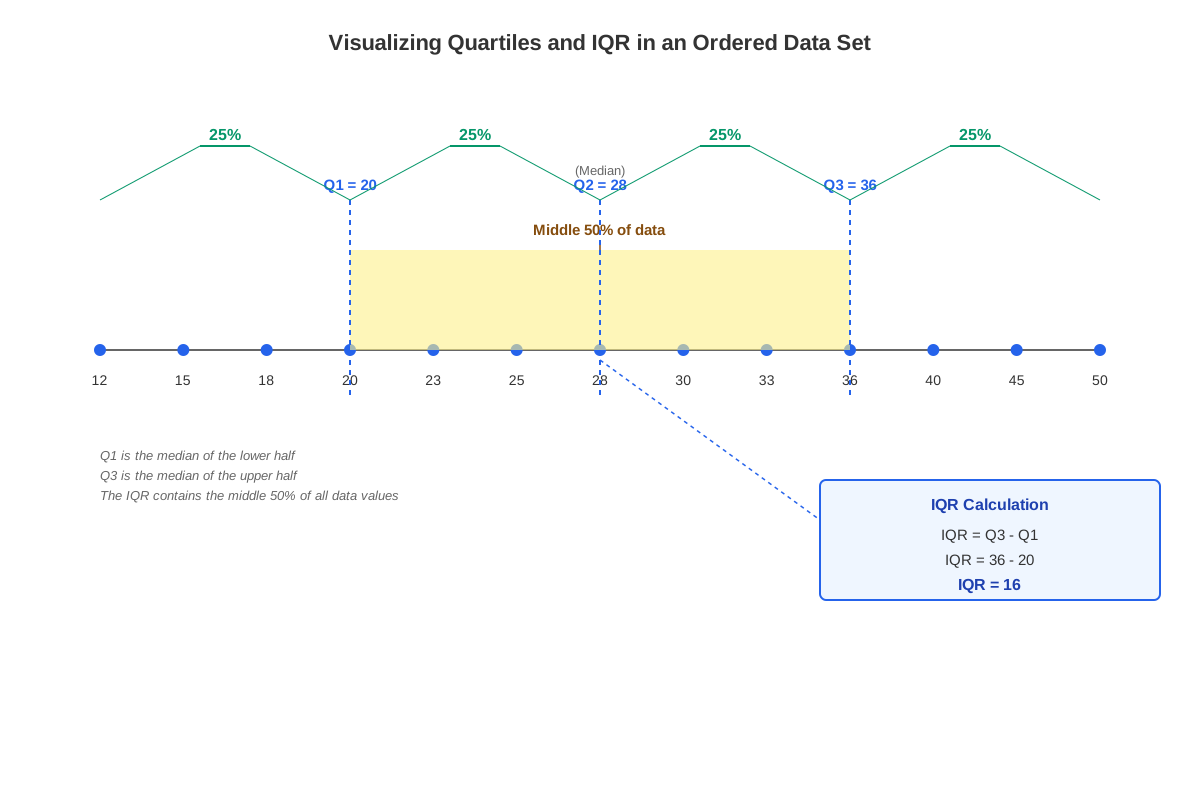
Quartiles divide an ordered data set into four equal parts, each containing 25% of the observations. The three quartile values that create these divisions are:
- First Quartile (Q1): The median of the lower half of the data; 25% of values fall below Q1
- Second Quartile (Q2): The median of the entire data set; 50% of values fall below Q2
- Third Quartile (Q3): The median of the upper half of the data; 75% of values fall below Q3
The space between Q1 and Q3 contains the middle 50% of all data points, and the distance between these two values is the interquartile range.
Calculating Q1 and Q3
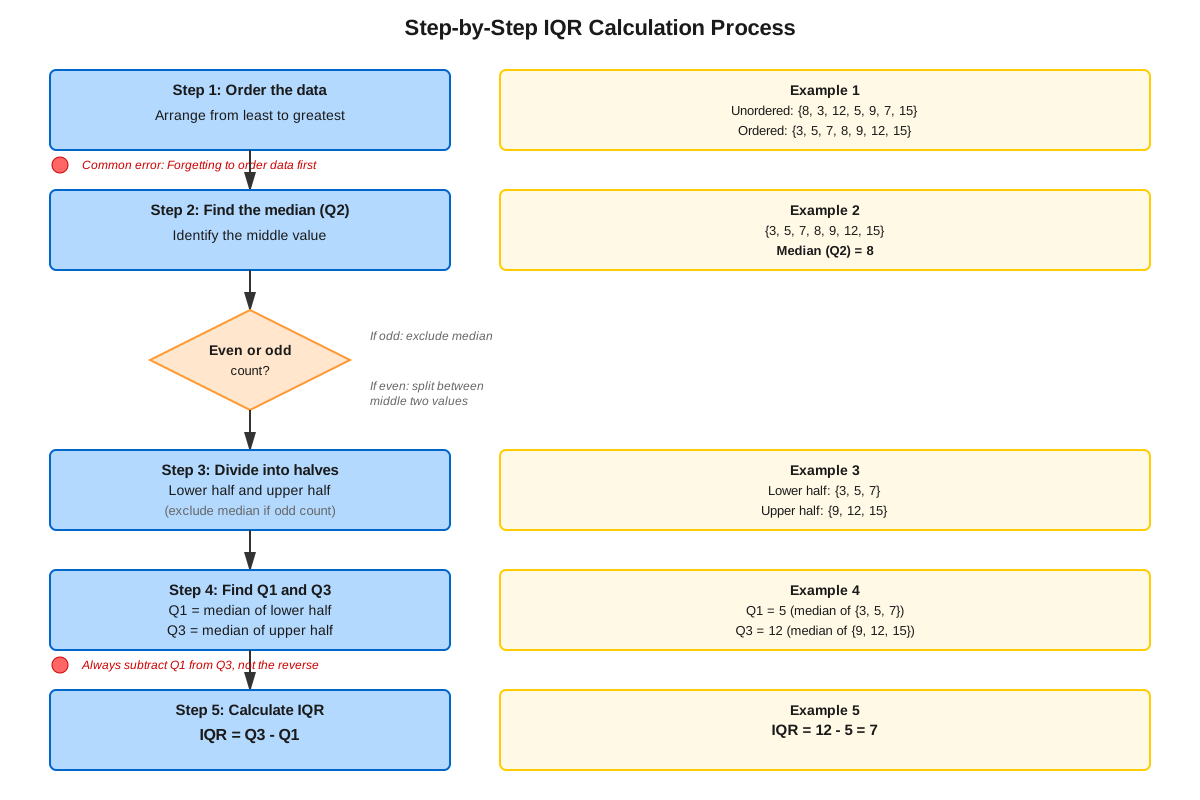
To find quartiles, follow this systematic process:
- Order the data from smallest to largest
- Find the median (Q2) of the entire data set
- Divide the data into lower and upper halves (excluding the median if the data set has an odd number of values)
- Find Q1 as the median of the lower half
- Find Q3 as the median of the upper half
- Calculate IQR by subtracting Q1 from Q3
For data sets with an even number of values, the median falls between two middle values, and the lower half includes all values below this point while the upper half includes all values above it. For data sets with an odd number of values, the median is a single value, and convention typically excludes this median value when dividing the data into halves for quartile calculation.
Step-by-Step Calculation Example
Consider the data set: 3, 7, 8, 12, 13, 14, 18, 21, 23
- Data is already ordered: 3, 7, 8, 12, 13, 14, 18, 21, 23
- Find median (Q2): With 9 values, the median is the 5th value = 13
- Lower half: 3, 7, 8, 12 (excluding median)
- Upper half: 14, 18, 21, 23 (excluding median)
- Q1 = median of lower half: (7 + 8) ÷ 2 = 7.5
- Q3 = median of upper half: (18 + 21) ÷ 2 = 19.5
- IQR = Q3 - Q1: 19.5 - 7.5 = 12
Interpreting IQR Values
The magnitude of the interquartile range reveals important characteristics about data distribution:
| IQR Value | Interpretation |
|---|---|
| Small IQR | Data points cluster tightly around the median; low variability in the middle 50% |
| Large IQR | Data points are widely spread; high variability in the middle 50% |
| IQR = 0 | At least half the data points have identical values |
A larger IQR indicates greater variability among typical values, while a smaller IQR suggests consistency. Comparing IQRs across different data sets allows for meaningful comparisons of spread that aren't distorted by outliers.
IQR and Outlier Detection
The interquartile range serves as the foundation for a standard method of identifying outliers—data points that fall unusually far from the central cluster. A value is typically considered an outlier if it falls:
- Below Q1 - 1.5(IQR), or
- Above Q3 + 1.5(IQR)
This 1.5×IQR rule provides a systematic, objective criterion for flagging potentially anomalous data points that may warrant special attention or investigation.
IQR in Box Plots
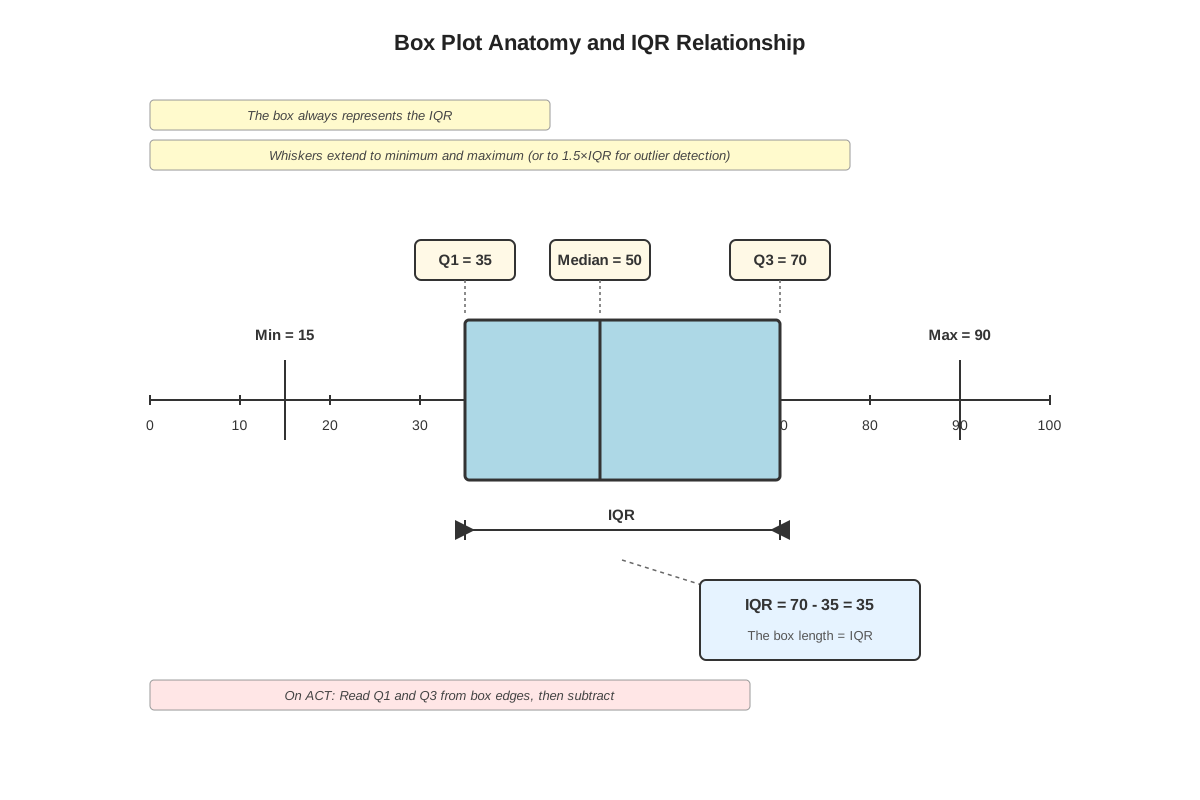
Box plots (also called box-and-whisker plots) visually represent the five-number summary of a data set: minimum, Q1, median, Q3, and maximum. The box portion of the plot extends from Q1 to Q3, making its width a direct visual representation of the interquartile range. A wider box indicates a larger IQR and greater spread in the middle 50% of data, while a narrower box indicates a smaller IQR and more concentrated central values.
Concept Relationships
The interquartile range exists within a hierarchy of statistical measures. At the foundation lies the concept of ordering data, which enables calculation of the median. The median concept extends to quartiles, which divide data into four equal parts. The first and third quartiles (Q1 and Q3) then combine through subtraction to produce the interquartile range.
The IQR connects horizontally to other measures of spread: range (maximum minus minimum) captures total spread but is sensitive to outliers, while standard deviation measures average distance from the mean but requires more complex calculation. The IQR occupies a middle ground—more informative than range, more resistant to outliers than standard deviation, and simpler to calculate than standard deviation.
Moving upward in complexity, the IQR enables outlier detection through the 1.5×IQR rule and supports box plot construction by defining the box boundaries. These applications demonstrate how the IQR serves as both an end result (a measure of spread) and a building block for more sophisticated statistical analysis.
The relationship map flows: Ordered Data → Median → Quartiles (Q1, Q3) → Interquartile Range → Outlier Detection and Box Plot Construction. Each concept depends on those before it and enables those after it.
Quick check — test yourself on Interquartile range so far.
Try Flashcards →High-Yield Facts
⭐ The interquartile range equals Q3 minus Q1, representing the spread of the middle 50% of data
⭐ Data must be ordered from least to greatest before calculating quartiles
⭐ Q1 is the median of the lower half of the data; Q3 is the median of the upper half
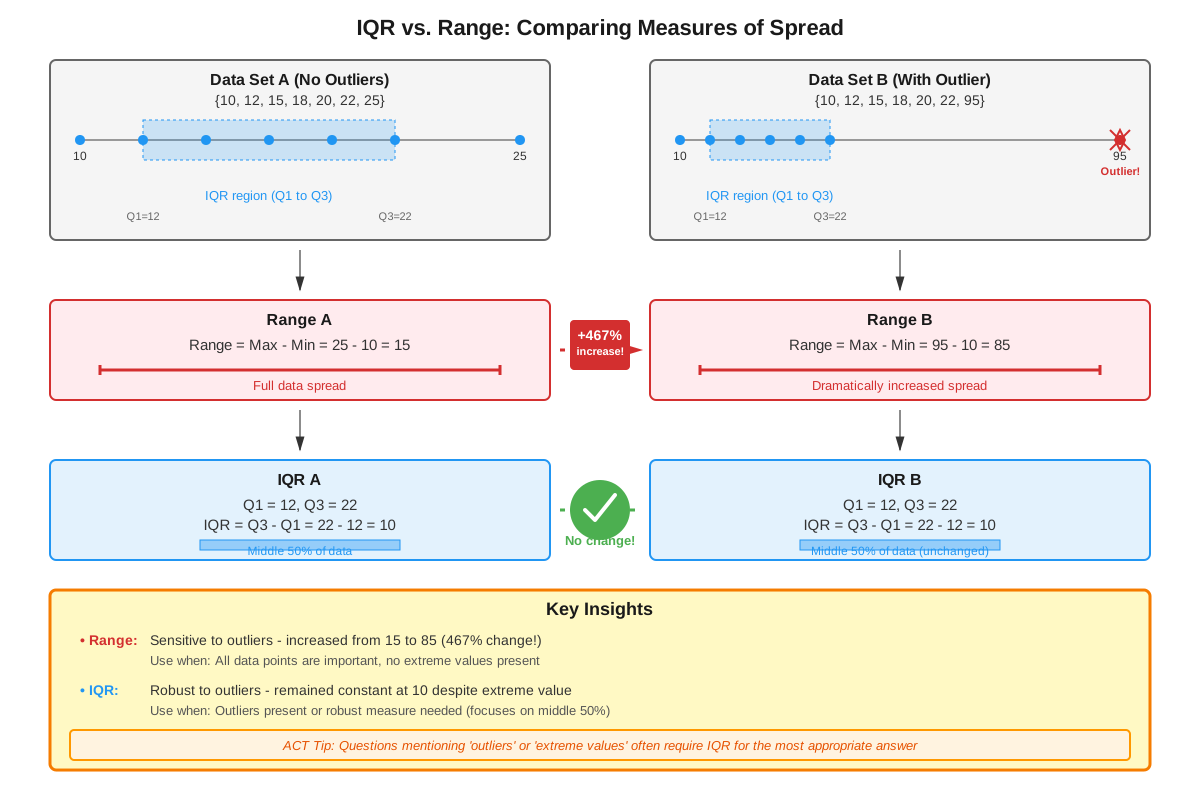
⭐ The IQR is resistant to outliers, unlike the range
⭐ In a box plot, the width of the box represents the IQR
- The IQR can never be negative since Q3 is always greater than or equal to Q1
- When all data values are identical, the IQR equals zero
- The IQR uses the same units as the original data (if data is in dollars, IQR is in dollars)
- Multiplying every data value by a constant multiplies the IQR by that same constant
- Adding a constant to every data value does not change the IQR
- The IQR contains exactly 50% of the data points in any distribution
- For symmetric distributions, Q2 (median) falls exactly halfway between Q1 and Q3
Common Misconceptions
Misconception: The interquartile range is calculated as Q3 ÷ Q1 → Correction: The IQR is the difference (subtraction) between Q3 and Q1, not their quotient. The formula is IQR = Q3 - Q1.
Misconception: The median must be included when finding Q1 and Q3 for odd-numbered data sets → Correction: When a data set has an odd number of values, the median is typically excluded when dividing the data into lower and upper halves for quartile calculation. Only the values below the median form the lower half, and only values above form the upper half.
Misconception: A larger data set always has a larger IQR → Correction: The IQR measures spread, not size. A small data set with widely varying values can have a larger IQR than a large data set with tightly clustered values. The number of data points doesn't determine the IQR; the variability among those points does.
Misconception: The IQR and range measure the same thing → Correction: The range (maximum - minimum) measures total spread including all outliers, while the IQR measures only the spread of the middle 50% of data, making it resistant to extreme values. A single outlier can dramatically change the range but won't affect the IQR.
Misconception: If two data sets have the same median, they must have the same IQR → Correction: The median only describes the center of the data, while the IQR describes spread. Two data sets can share the same median but have completely different IQRs if their values are distributed differently around that center point.
Misconception: The IQR tells you the average value in a data set → Correction: The IQR is a measure of spread or variability, not central tendency. It describes how spread out the middle 50% of values are, not what the typical or average value is. The median or mean describe central tendency.
Worked Examples
Example 1: Direct Calculation from a Data Set
Problem: The following data represents the number of hours 11 students studied for an exam: 2, 3, 4, 5, 5, 6, 7, 8, 9, 10, 15. What is the interquartile range?
Solution:
Step 1: Verify the data is ordered (it is): 2, 3, 4, 5, 5, 6, 7, 8, 9, 10, 15
Step 2: Find the median (Q2). With 11 values, the median is the 6th value: Q2 = 6
Step 3: Identify the lower half (excluding median): 2, 3, 4, 5, 5
Step 4: Find Q1 as the median of the lower half. With 5 values, Q1 is the 3rd value: Q1 = 4
Step 5: Identify the upper half (excluding median): 7, 8, 9, 10, 15
Step 6: Find Q3 as the median of the upper half. With 5 values, Q3 is the 3rd value: Q3 = 9
Step 7: Calculate IQR = Q3 - Q1 = 9 - 4 = 5 hours
Interpretation: The middle 50% of students studied within a 5-hour range. This IQR of 5 indicates moderate variability in study time among typical students, while the outlier value of 15 hours doesn't affect the IQR calculation.
Connection to Learning Objectives: This example demonstrates the core calculation strategy and shows how to apply the IQR formula to ACT-style data sets.
Example 2: Interpreting Changes to IQR
Problem: A data set has Q1 = 12 and Q3 = 28, giving an IQR of 16. If the smallest value in the data set decreases by 10 and the largest value increases by 10, what happens to the IQR?
Solution:
Step 1: Recall that IQR = Q3 - Q1, which depends only on the values at the 25th and 75th percentiles.
Step 2: Recognize that changing the minimum value affects only the lowest 25% of the data, which falls below Q1.
Step 3: Recognize that changing the maximum value affects only the highest 25% of the data, which falls above Q3.
Step 4: Since neither Q1 nor Q3 is affected by changes to the extreme values, the IQR remains unchanged.
Answer: The IQR stays at 16. The interquartile range is resistant to changes in extreme values because it focuses only on the middle 50% of the data.
Connection to Learning Objectives: This example tests conceptual understanding of what the IQR measures and demonstrates why it's preferred over range when outliers are present. It shows the type of reasoning ACT questions require beyond simple calculation.
Exam Strategy
When approaching ACT interquartile range questions, first identify the question type. If given a raw data set, immediately check whether it's ordered—if not, rewrite it in order before attempting any calculations. This single step prevents the most common calculation errors. If the question presents a box plot, remember that the box edges represent Q1 and Q3, making IQR calculation a simple visual subtraction.
Trigger words and phrases that signal IQR questions include: "interquartile range," "middle 50%," "spread of the central values," "Q3 minus Q1," "resistant to outliers," and "box plot width." Questions asking about "which measure of spread is least affected by outliers" are testing IQR conceptually. Phrases like "the data set changes by adding/removing values" often test understanding of what does and doesn't affect the IQR.
For process-of-elimination strategies, immediately eliminate answer choices that would be impossible given the data constraints. If Q1 = 10 and Q3 = 25, the IQR must be 15—eliminate any other values. If a question asks what happens to IQR when a constant is added to all values, eliminate choices suggesting the IQR changes (it doesn't). When comparing measures of spread, eliminate "range" if the question emphasizes outlier resistance.
Time Management Tip: Allocate 60-90 seconds for straightforward IQR calculations and up to 2 minutes for multi-step problems involving interpretation or data manipulation. If a problem requires extensive calculation, double-check that you've correctly identified Q1 and Q3 before computing the difference.
For questions presenting data in unusual formats (tables, graphs, word problems), extract the numerical data set first, then proceed with standard IQR calculation. Don't let complex presentation obscure the straightforward mathematical process underneath.
Memory Techniques
IQR Mnemonic: "Inside Quartiles Range" reminds you that IQR measures the range inside (between) the quartiles, specifically Q1 and Q3.
Quartile Position Memory: Remember "1-2-3, 25-50-75"—Q1 is at 25%, Q2 at 50%, Q3 at 75% of the data. This helps you remember which quartile is which and what percentage of data falls below each.
Calculation Sequence Acronym: "Order, Median, Divide, Quartiles, Subtract" (OMDQS) captures the five-step process: Order data, find Median, Divide into halves, find Quartiles, Subtract for IQR.
Visual Memory Strategy: Picture a box plot in your mind. The box sits in the middle, with its left edge at Q1 and right edge at Q3. The width of this box is the IQR. Whiskers extend to the minimum and maximum, but these don't affect the box width. This visualization reinforces that IQR ignores extreme values.
Resistance Reminder: Think "IQR = Ignores Questionable Readings" to remember that the interquartile range is resistant to outliers and extreme values, unlike the range.
Summary
The interquartile range is a robust measure of statistical spread that quantifies the variability within the middle 50% of a data set by calculating the difference between the third quartile and first quartile (IQR = Q3 - Q1). To find the IQR, data must first be ordered, then the median identified to divide the data into halves, followed by finding Q1 as the median of the lower half and Q3 as the median of the upper half. The IQR's resistance to outliers makes it superior to the range for describing typical spread, and it appears frequently on the ACT in direct calculation problems, box plot interpretation questions, and conceptual scenarios testing understanding of how data changes affect spread measures. Mastery requires both computational accuracy in finding quartiles and conceptual understanding of what the IQR represents and when it's the appropriate measure to use.
Key Takeaways
- The interquartile range (IQR) equals Q3 minus Q1 and represents the spread of the middle 50% of data
- Always order data from least to greatest before calculating quartiles
- Q1 is the median of the lower half; Q3 is the median of the upper half (typically excluding the overall median for odd-numbered sets)
- IQR is resistant to outliers, making it more reliable than range when extreme values are present
- In box plots, the width of the box directly represents the IQR
- Adding a constant to all data values doesn't change the IQR; multiplying all values by a constant multiplies the IQR by that constant
- The IQR serves as the foundation for outlier detection using the 1.5×IQR rule
Related Topics
Standard Deviation: While IQR measures spread using quartiles, standard deviation measures average distance from the mean, providing a different perspective on variability that's more sensitive to all data values including outliers.
Box Plots and Five-Number Summaries: Mastering IQR enables full understanding of box plot construction and interpretation, as the IQR defines the box boundaries and supports visual data analysis.
Percentiles: Quartiles are special cases of percentiles (Q1 = 25th percentile, Q3 = 75th percentile), so understanding IQR builds foundation for working with any percentile value.
Outlier Detection Methods: The 1.5×IQR rule for identifying outliers extends IQR knowledge into data quality assessment and anomaly detection.
Comparing Data Distributions: IQR provides a standardized way to compare spread across different data sets, enabling analysis of which groups show more or less variability.
Practice CTA
Now that you've mastered the concepts, formulas, and strategies for interquartile range, it's time to solidify your understanding through active practice. Attempt the practice questions to test your ability to calculate IQR from various data presentations and interpret its meaning in context. Use the flashcards to reinforce key definitions and formulas until they become automatic. Remember, the ACT rewards both speed and accuracy—practice transforms understanding into the quick, confident performance that earns points on test day. You've built the foundation; now make it unshakeable through deliberate practice!
Sign up free to keep reading
Create a free AnvayaPrep account to finish this ACT guide on Interquartile range — plus flashcards and practice questions.