Overview
The weighted average is a fundamental statistical concept that appears regularly on the ACT Math test, typically in 2-3 questions per exam. Unlike a simple average where all values contribute equally, a weighted average accounts for the fact that some values carry more importance or occur more frequently than others. This concept bridges arithmetic, algebra, and real-world problem-solving, making it an essential skill for achieving a competitive score.
Understanding ACT weighted average problems requires recognizing when different data points have different levels of significance. For instance, if a student earns an A on a final exam worth 40% of their grade and a B on homework worth 10%, these grades cannot simply be averaged together—the final exam's contribution must be weighted more heavily. The ACT frequently tests this concept through scenarios involving test scores, mixtures, group averages, and combined rates.
Mastering weighted averages connects directly to broader mathematical reasoning skills tested on the ACT. This topic integrates with ratio and proportion problems, percentage calculations, and algebraic equation-solving. Students who understand weighted averages can tackle complex multi-step problems involving data analysis, making this a high-yield topic that supports performance across multiple question types in the Statistics and Probability domain.
Learning Objectives
- [ ] Identify when Weighted average is being tested
- [ ] Explain the core rule or strategy behind Weighted average
- [ ] Apply Weighted average to ACT-style questions accurately
- [ ] Distinguish between simple averages and weighted averages in problem contexts
- [ ] Set up and solve algebraic equations involving unknown weights or values
- [ ] Calculate combined group averages when given separate group statistics
- [ ] Verify weighted average solutions using logical reasoning and estimation
Prerequisites
- Basic arithmetic operations: Essential for performing calculations with multiple values and weights
- Understanding of simple averages (mean): Weighted averages build directly on the concept of finding the sum divided by count
- Algebraic equation solving: Many weighted average problems require setting up and solving for unknown variables
- Percentage calculations: Weights are frequently expressed as percentages that must sum to 100%
- Ratio and proportion: Understanding relative quantities helps interpret weight relationships
Why This Topic Matters
Weighted averages appear throughout real-world applications, from calculating grade point averages (where different courses carry different credit hours) to determining investment portfolio returns (where different assets represent different proportions of total investment). Financial analysts use weighted averages to calculate cost of capital, scientists use them to determine average atomic mass, and educators use them to compute fair final grades. This practical relevance makes weighted average problems particularly common on standardized tests.
On the ACT Math test, weighted average questions appear with high frequency—students can expect 2-3 questions directly testing this concept, plus additional questions where weighted average reasoning supports the solution. These problems typically appear in the middle-to-later portions of the test (questions 30-50), indicating medium-to-high difficulty. The ACT presents weighted average scenarios through various contexts: academic grades, mixture problems (combining solutions or foods with different concentrations), group statistics (combining data from separate populations), and rate problems (average speed over different distances).
The ACT specifically favors weighted average questions because they efficiently test multiple skills simultaneously: reading comprehension, algebraic setup, arithmetic computation, and logical reasoning. Questions often include distractors that represent the simple (unweighted) average, testing whether students recognize when weights matter. Understanding this topic thoroughly provides a significant competitive advantage, as these questions are highly predictable in structure once the underlying pattern is recognized.
Core Concepts
The Fundamental Weighted Average Formula
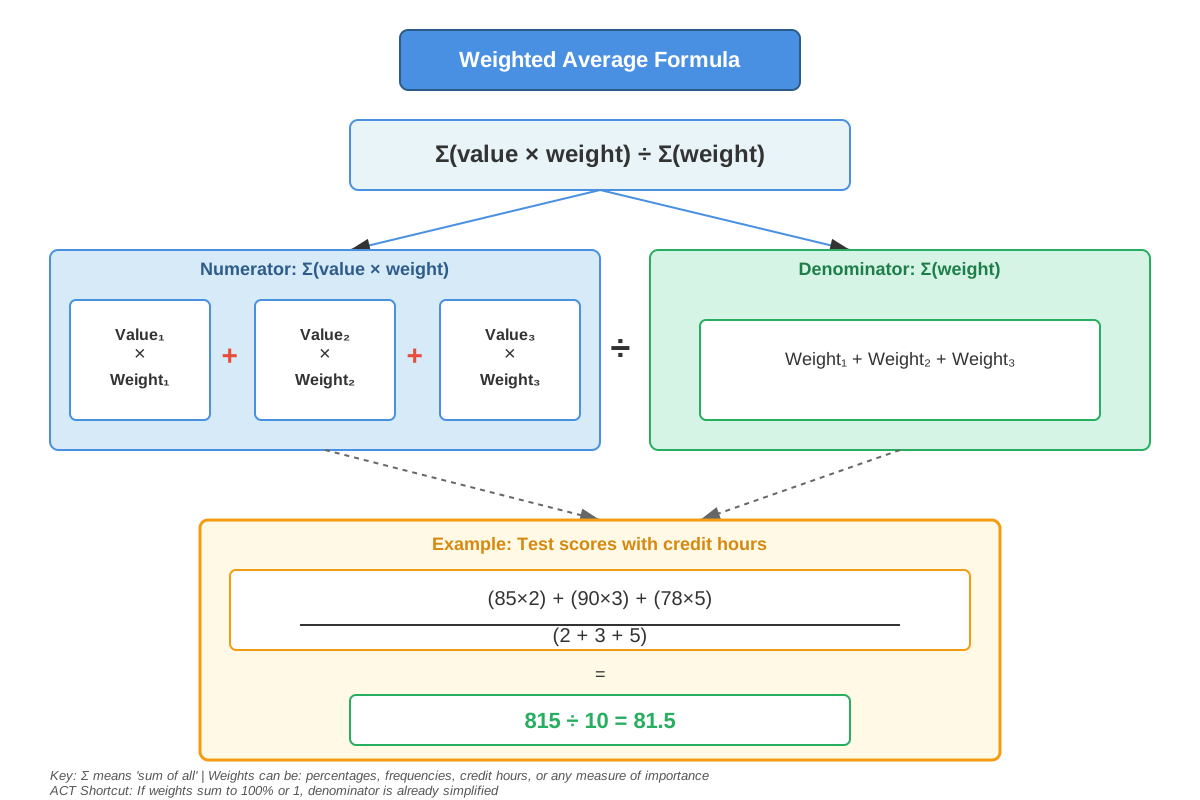
The weighted average is calculated by multiplying each value by its corresponding weight, summing these products, and dividing by the sum of all weights. The formula is:
Weighted Average = (w₁ × v₁ + w₂ × v₂ + ... + wₙ × vₙ) / (w₁ + w₂ + ... + wₙ)Where:
- v₁, v₂, ..., vₙ represent the individual values
- w₁, w₂, ..., wₙ represent the corresponding weights
- n is the number of values
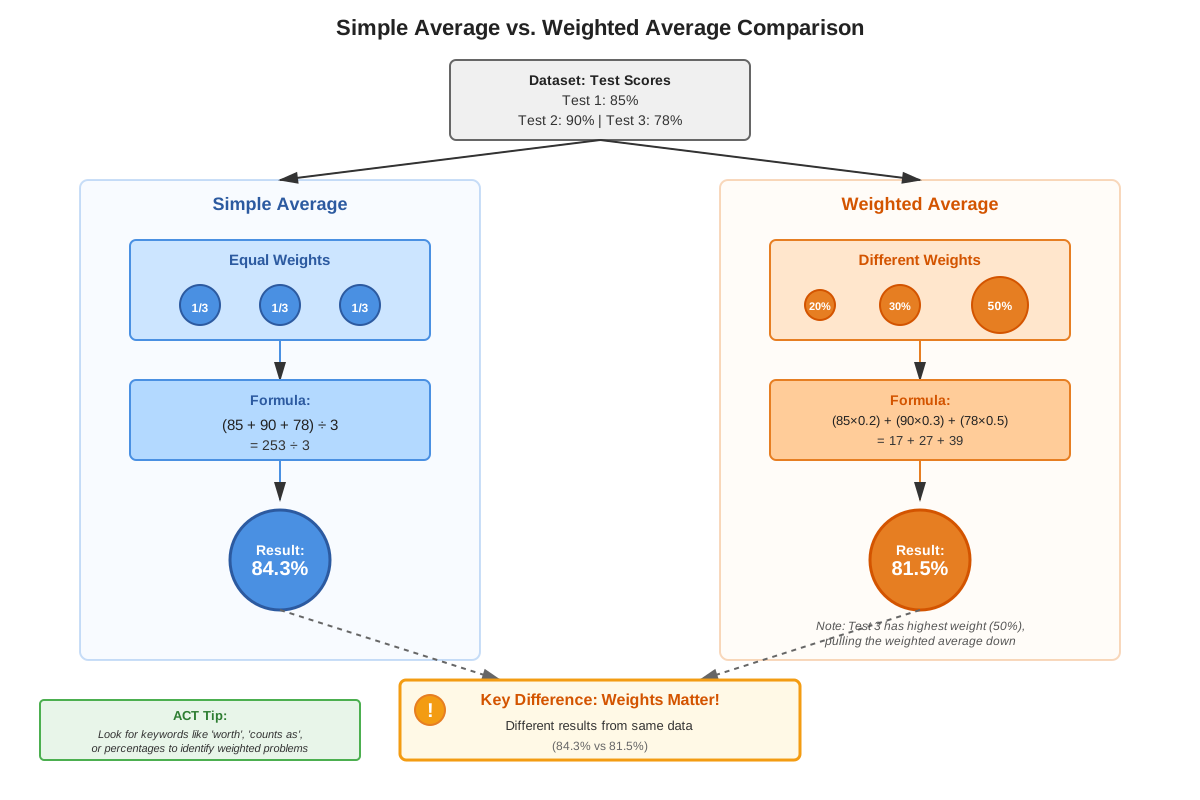
When weights are expressed as percentages that sum to 100%, the denominator equals 1 (or 100%), simplifying the calculation to just the sum of the products. For example, if test scores are weighted as 60% midterm and 40% final, a midterm score of 85 and final score of 92 yields: (0.60 × 85) + (0.40 × 92) = 51 + 36.8 = 87.8.
Distinguishing Weighted from Simple Averages
The critical distinction lies in whether all data points contribute equally. A simple average treats every value identically: sum all values and divide by the count. A weighted average recognizes that some values should influence the result more than others. Consider two scenarios:
| Scenario | Values | Calculation Type | Result |
|---|---|---|---|
| Five test scores: 80, 85, 90, 85, 90 | All equal importance | Simple average: (80+85+90+85+90)/5 | 86 |
| Two test scores: 80 (weight 30%) and 90 (weight 70%) | Different importance | Weighted average: 0.30(80) + 0.70(90) | 87 |
The ACT frequently includes the simple average as a distractor answer choice, testing whether students recognize that weights matter in the problem context.
Setting Up Weighted Average Equations
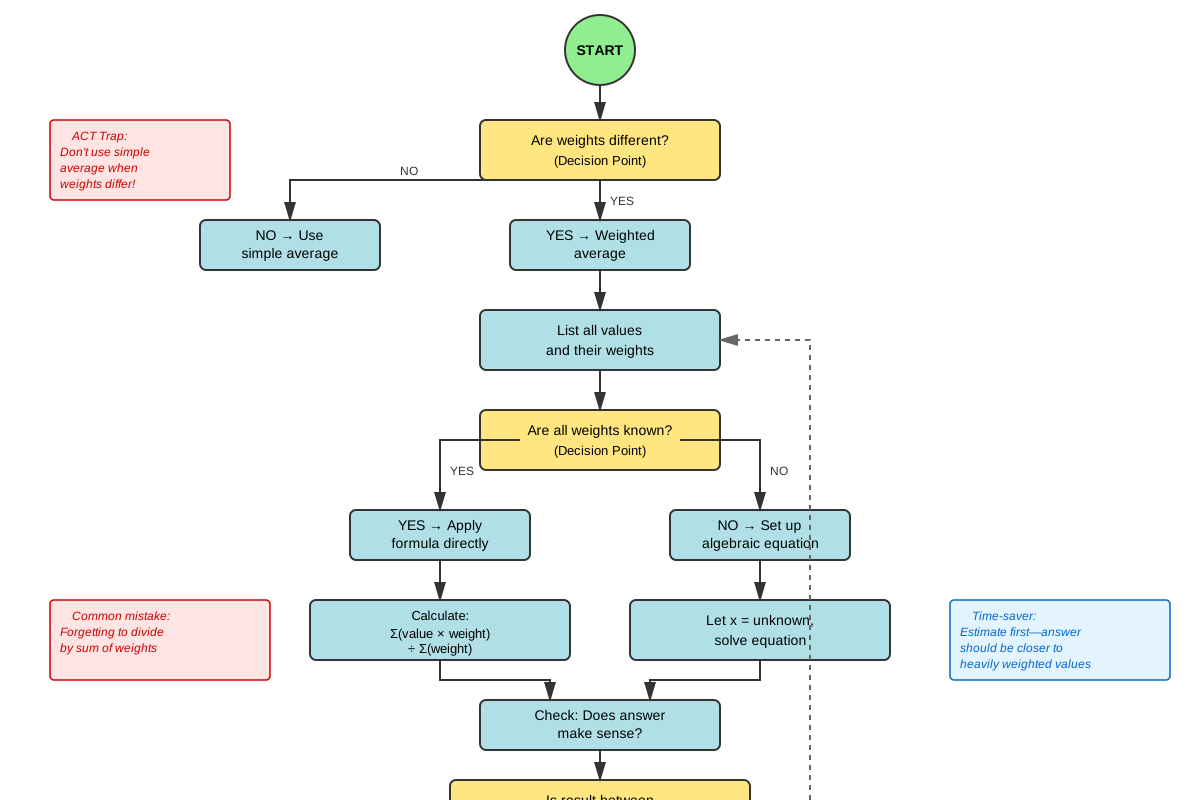
Many ACT problems require translating word problems into algebraic equations. The key steps are:
- Identify the values: What quantities are being averaged?
- Identify the weights: What determines each value's importance (frequency, percentage, quantity)?
- Determine what's unknown: Are you solving for the weighted average, a missing value, or a missing weight?
- Set up the equation: Use the weighted average formula with the unknown as a variable
- Solve algebraically: Isolate the variable using standard algebraic techniques
For example: "A student's grade is 70% tests and 30% homework. If the test average is 88, what homework average is needed for an overall grade of 90?"
Setup: 0.70(88) + 0.30(H) = 90, where H is the unknown homework average.
Combined Group Averages
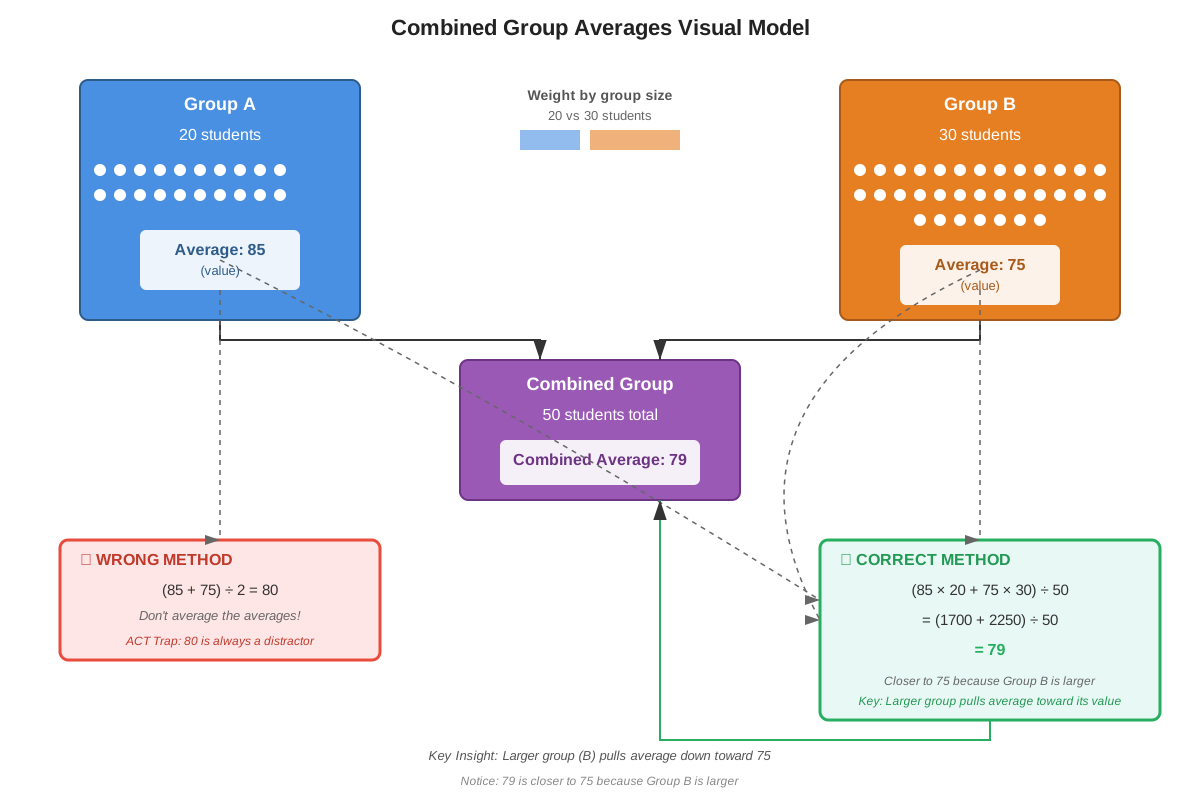
A common ACT scenario involves combining statistics from separate groups. If Group A has n₁ members with average a₁, and Group B has n₂ members with average a₂, the combined average is:
Combined Average = (n₁ × a₁ + n₂ × a₂) / (n₁ + n₂)The group sizes serve as weights because larger groups contribute more individuals to the combined dataset. For instance, if 20 students average 85 on a test and 30 students average 90, the combined average is: (20 × 85 + 30 × 90) / (20 + 30) = (1700 + 2700) / 50 = 4400 / 50 = 88.
This concept extends to mixture problems: combining 10 liters of 20% salt solution with 15 liters of 35% salt solution yields a mixture with concentration: (10 × 0.20 + 15 × 0.35) / (10 + 15) = (2 + 5.25) / 25 = 0.29 or 29%.
Weighted Average with Rates and Distances
When calculating average speed over different segments, the weights are the distances (or times), not the speeds themselves. If a car travels 60 miles at 40 mph and 40 miles at 60 mph, the average speed is NOT (40 + 60)/2 = 50 mph. Instead:
Average Speed = Total Distance / Total TimeTime for first segment: 60 miles ÷ 40 mph = 1.5 hours
Time for second segment: 40 miles ÷ 60 mph = 0.667 hours
Average speed: 100 miles ÷ 2.167 hours ≈ 46.2 mph
Alternatively, using distance as weights: (60 × 40 + 40 × 60) / (60 + 40) = 4800 / 100 = 48 mph (this gives the harmonic mean approach, which differs slightly—the time-based calculation is more accurate for average speed).
Solving for Unknown Weights
Some ACT problems provide the weighted average and values but ask for the weights. For example: "Two tests contribute to a final grade. Test 1 score is 80, Test 2 score is 95, and the final grade is 90. What percentage does Test 2 contribute?"
Let w = weight of Test 2, then (1 - w) = weight of Test 1:
(1 - w)(80) + w(95) = 90
80 - 80w + 95w = 90
80 + 15w = 90
15w = 10
w = 10/15 = 2/3 ≈ 66.7%
Concept Relationships
The weighted average concept builds directly on simple averages, adding the dimension of differential importance. Understanding simple averages (sum divided by count) provides the foundation, while weighted averages extend this by recognizing that "count" can be replaced with "weight" to reflect varying significance.
Weighted averages connect strongly to ratio and proportion because weights represent relative quantities. When a problem states that tests count twice as much as homework, this 2:1 ratio translates to weights of 2/3 and 1/3 respectively. The relationship flows: ratio → weights → weighted average calculation.
The topic also links to percentage problems since weights are frequently expressed as percentages. Converting between decimal and percentage forms (0.40 ↔ 40%) is essential, and recognizing that percentage weights must sum to 100% provides a built-in error-checking mechanism.
For algebraic equation solving, weighted average problems often require setting up equations with unknown variables and solving through standard techniques (distribution, combining like terms, isolation). The relationship is: word problem → weighted average equation → algebraic solution → numerical answer.
In mixture problems, weighted averages determine the concentration or composition of combined substances. The connection is: individual concentrations + quantities → weighted average → final mixture concentration.
Relationship map: Simple Average → Weighted Average → Combined Group Statistics → Mixture Problems; Ratios → Weights → Weighted Average Formula; Percentages ↔ Decimal Weights → Weighted Average Calculation
Quick check — test yourself on Weighted average so far.
Try Flashcards →High-Yield Facts
⭐ The weighted average always falls between the minimum and maximum values being averaged
⭐ When weights are percentages, they must sum to 100% (or 1.0 in decimal form)
⭐ The weighted average is pulled toward the value with the larger weight
⭐ For combined group averages, group sizes serve as the weights
⭐ The simple (unweighted) average is the most common distractor in weighted average problems
- Multiplying each value by its weight before summing is essential—never add values first
- If all weights are equal, the weighted average equals the simple average
- Weighted average problems often require setting up and solving algebraic equations
- In mixture problems, the quantities (volumes, masses) serve as weights for concentrations
- Average speed problems require distance or time as weights, not equal weighting of speeds
- When solving for an unknown value, isolate it algebraically after setting up the weighted average equation
- Estimation can quickly eliminate unreasonable answer choices (weighted average must be between extremes)
- Converting percentages to decimals (divide by 100) prevents calculation errors
- The weighted average formula can be rearranged to solve for any unknown component
- Double-checking that weights sum correctly prevents setup errors
Common Misconceptions
Misconception: All averages are calculated by adding values and dividing by how many there are.
Correction: This only applies to simple averages where all values have equal importance. Weighted averages require multiplying each value by its weight before summing, then dividing by the sum of weights.
Misconception: In a weighted average problem, you can just average the weights and average the values separately.
Correction: Each individual value must be multiplied by its specific weight before any summing occurs. The formula requires (w₁v₁ + w₂v₂ + ...), not (average of weights) × (average of values).
Misconception: When combining two groups with different averages, the combined average is always the simple average of the two group averages.
Correction: The combined average is only the midpoint if both groups are the same size. Otherwise, the larger group's average pulls the combined average toward itself. Use group sizes as weights.
Misconception: For average speed over two segments, you can average the two speeds.
Correction: Average speed requires total distance divided by total time. If segments have different distances, the speeds must be weighted by distance (or time), not averaged equally.
Misconception: If weights are given as ratios (like 3:2), you can use them directly as multipliers.
Correction: Ratios must first be converted to actual weights that sum appropriately. A 3:2 ratio means weights of 3/5 and 2/5 (or 60% and 40%), not weights of 3 and 2 unless the problem specifies these as actual quantities.
Misconception: The weighted average can fall outside the range of values being averaged.
Correction: The weighted average must always fall between (or equal to) the minimum and maximum values. If your calculation produces a result outside this range, an error has occurred.
Worked Examples
Example 1: Grade Calculation with Percentage Weights
Problem: A student's final grade consists of homework (20%), quizzes (30%), and exams (50%). The student earned 88 on homework, 92 on quizzes, and 85 on exams. What is the final grade?
Solution:
Step 1: Identify values and weights
- Values: homework = 88, quizzes = 92, exams = 85
- Weights: homework = 20% = 0.20, quizzes = 30% = 0.30, exams = 50% = 0.50
Step 2: Verify weights sum to 100%
- 0.20 + 0.30 + 0.50 = 1.00 ✓
Step 3: Apply weighted average formula
- Weighted Average = (0.20 × 88) + (0.30 × 92) + (0.50 × 85)
Step 4: Calculate each product
- 0.20 × 88 = 17.6
- 0.30 × 92 = 27.6
- 0.50 × 85 = 42.5
Step 5: Sum the products
- 17.6 + 27.6 + 42.5 = 87.7
Answer: The final grade is 87.7 (or 88 if rounded)
Connection to Learning Objectives: This problem demonstrates applying weighted average to an ACT-style question and explains the core strategy of multiplying each value by its weight before summing.
Example 2: Combined Group Average
Problem: In a school, 40 students in Class A have an average test score of 78, while 60 students in Class B have an average test score of 86. What is the average test score for all 100 students combined?
Solution:
Step 1: Recognize this as a combined group average problem
- Group sizes serve as weights because they represent how many students contribute each average
Step 2: Identify values and weights
- Class A: n₁ = 40 students, average a₁ = 78
- Class B: n₂ = 60 students, average a₂ = 86
Step 3: Apply combined average formula
- Combined Average = (n₁ × a₁ + n₂ × a₂) / (n₁ + n₂)
- Combined Average = (40 × 78 + 60 × 86) / (40 + 60)
Step 4: Calculate the numerator
- 40 × 78 = 3,120
- 60 × 86 = 5,160
- Sum = 3,120 + 5,160 = 8,280
Step 5: Calculate the denominator
- 40 + 60 = 100
Step 6: Divide
- 8,280 / 100 = 82.8
Answer: The combined average is 82.8
Verification: The answer makes sense because 82.8 falls between 78 and 86, and it's closer to 86 because Class B (with the higher average) has more students (60 vs. 40).
Common trap: The simple average of 78 and 86 is 82, which would be a distractor answer choice. This is incorrect because it ignores the different group sizes.
Connection to Learning Objectives: This demonstrates identifying when weighted average is being tested (combined groups scenario) and distinguishing between simple and weighted averages.
Exam Strategy
When approaching ACT weighted average questions, begin by identifying trigger phrases that signal this concept: "weighted," "different importance," "counts as," "worth X%," "combining groups," "mixture," or "average of averages." These phrases indicate that values cannot simply be added and divided.
Step-by-step approach:
- Read carefully to identify: What are the values? What are the weights? What is unknown?
- Check if weights sum correctly: Percentages should total 100%; if given as ratios, convert to fractions
- Set up the equation: Write out the weighted average formula with known and unknown values
- Estimate before calculating: Determine the approximate range where the answer must fall
- Calculate systematically: Multiply each value by its weight, sum products, divide by sum of weights
- Verify the answer: Does it fall within the expected range? Does it make logical sense?
Process of elimination tips:
- Immediately eliminate any answer choice outside the range of given values
- The simple (unweighted) average is almost always a distractor—eliminate it unless all weights are equal
- If one value has a much larger weight, the answer should be very close to that value
- In combined group problems, eliminate answers that equal either individual group average (unless groups are equal size)
Time allocation: Weighted average problems typically require 60-90 seconds. Spend 15-20 seconds on setup and identification, 30-45 seconds on calculation, and 10-15 seconds on verification. If a problem requires solving for an unknown weight or value algebraically, allow up to 2 minutes.
Red flags that indicate weighted average:
- Problem mentions "different weights," "counts more," or "worth more"
- Combining data from groups of different sizes
- Calculating final grades with different category percentages
- Mixture problems combining different concentrations
- Average speed over different distances
Exam Tip: If you're unsure whether a problem requires weighted average, ask: "Do all values contribute equally to the result?" If no, use weighted average.
Memory Techniques
Mnemonic for the weighted average process: "VWMD" = Values, Weights, Multiply, Divide
- Identify Values
- Identify Weights
- Multiply each value by its weight
- Divide by sum of weights
Visualization strategy: Picture a seesaw or balance scale. The weighted average is the balance point (fulcrum). Values with larger weights are heavier and pull the balance point toward themselves. This helps remember that the weighted average is pulled toward the value with the greater weight.
Acronym for checking work: "BRIM"
- Between: Answer must fall between min and max values
- Ratio: Larger weight pulls answer toward that value
- Inclusive: Sum of percentage weights must equal 100%
- Multiply first: Always multiply before adding
Memory hook for combined groups: "Size matters"—when combining group averages, the group sizes are the weights. Larger groups have more influence on the combined average.
Formula memory aid: Think of weighted average as "fair representation"—each value gets represented in proportion to its importance, just like fair voting where each person's vote counts according to their shares or stake.
Summary
Weighted average is a critical ACT Math concept that accounts for the varying importance of different values when calculating an average. Unlike simple averages where all values contribute equally, weighted averages multiply each value by its corresponding weight before summing and dividing by the total weight. The fundamental formula—sum of (weight × value) divided by sum of weights—applies across diverse problem types including grade calculations, combined group statistics, mixture problems, and rate calculations. Success requires recognizing when weights matter (trigger phrases like "counts as," "worth," or "combining groups"), setting up equations correctly, and avoiding the common trap of calculating simple averages when weights differ. The weighted average always falls between the minimum and maximum values being averaged and is pulled toward values with larger weights. Mastering this topic provides a significant advantage on the ACT, as these predictable, high-frequency questions reward systematic application of the core formula and careful attention to whether all values contribute equally.
Key Takeaways
- Weighted average multiplies each value by its weight, sums these products, and divides by the sum of weights—never simply add values and divide by count when weights differ
- Percentage weights must sum to 100%; this provides a built-in error check for problem setup
- The weighted average always falls between the minimum and maximum values and is pulled toward the value with the larger weight
- In combined group problems, group sizes serve as weights—larger groups have proportionally more influence on the combined average
- The simple (unweighted) average is the most common distractor answer choice in ACT weighted average questions
- Trigger phrases like "counts as," "worth X%," "different importance," or "combining groups" signal that weighted average is being tested
- Estimation before calculation helps eliminate unreasonable answers and catches computational errors
Related Topics
Ratio and Proportion: Understanding how to convert ratios to weights and work with proportional relationships strengthens weighted average problem-solving. Mastering weighted averages provides a foundation for more complex ratio problems.
Percentage Calculations: Since weights are frequently expressed as percentages, fluency with percentage-to-decimal conversion and percentage operations directly supports weighted average work.
Algebraic Equation Solving: Many weighted average problems require setting up equations with unknown variables. Strengthening algebra skills enables tackling more complex weighted average scenarios.
Mixture Problems: These represent a specific application of weighted averages where concentrations or compositions are combined. Mastering weighted averages makes mixture problems straightforward.
Statistics and Data Analysis: Weighted averages appear in more advanced statistical concepts like weighted standard deviation and expected value in probability, making this topic foundational for higher-level statistics.
Practice CTA
Now that you've mastered the concepts, formulas, and strategies for weighted average problems, it's time to cement your understanding through practice. Attempt the practice questions to apply these techniques to ACT-style problems, and use the flashcards to reinforce the high-yield facts and formulas. Remember: weighted average questions are highly predictable and appear on every ACT—mastering this topic means guaranteed points on test day. Your systematic practice now will translate directly to confidence and accuracy when you encounter these problems under timed conditions. You've got this!
Sign up free to keep reading
Create a free AnvayaPrep account to finish this ACT guide on Weighted average — plus flashcards and practice questions.