Overview
The ACT Math section contains numerous carefully designed questions that test not just mathematical knowledge, but also attention to detail and the ability to avoid common pitfalls. ACT trigonometry traps represent a category of deliberately misleading question elements that appear in trigonometry problems on the exam. These traps exploit common student errors, hasty calculations, and incomplete understanding of trigonometric concepts. Recognizing these traps is essential because trigonometry questions appear consistently on every ACT Math test, typically comprising 4-6 questions out of the 60 total math questions.
Understanding act trigonometry traps goes beyond simply memorizing formulas—it requires developing a strategic mindset that anticipates where test writers place obstacles. These traps often involve unit confusion (degrees versus radians), sign errors in different quadrants, misapplication of inverse trigonometric functions, confusion between similar-looking identities, and calculation errors with special angles. Students who can identify these traps before falling into them gain a significant competitive advantage, as they avoid losing points on questions where they actually possess the necessary mathematical knowledge.
The relationship between trigonometry traps and broader ACT Math concepts is fundamental to exam success. Trigonometry connects to coordinate geometry, functions, triangles, and even some algebra questions. Many act act trigonometry traps appear in multi-step problems where trigonometry is combined with other mathematical concepts, making trap recognition even more critical. Mastering trap identification not only improves trigonometry performance but also enhances overall test-taking skills applicable across all ACT Math question types.
Learning Objectives
- [ ] Identify when ACT trigonometry traps is being tested
- [ ] Explain the core rule or strategy behind ACT trigonometry traps
- [ ] Apply ACT trigonometry traps to ACT-style questions accurately
- [ ] Recognize the five most common categories of trigonometry traps before attempting calculations
- [ ] Distinguish between trap answer choices and correct solutions in multi-step trigonometry problems
- [ ] Develop a systematic checking process to verify trigonometric answers and avoid common errors
Prerequisites
- Basic trigonometric ratios (SOH-CAH-TOA): Essential for understanding how traps manipulate ratio relationships and which function to apply
- Unit circle knowledge: Required to recognize quadrant-based sign traps and reference angle confusion
- Special angle values (30°, 45°, 60°): Necessary to identify when trap answers use incorrect special angle values
- Pythagorean identity and basic identities: Needed to spot identity misapplication traps and recognize equivalent expressions
- Degree and radian conversion: Critical for avoiding unit confusion traps that mix measurement systems
Why This Topic Matters
Trigonometry trap awareness directly impacts ACT Math scores because these questions are designed to separate students who truly understand concepts from those who have merely memorized formulas. The ACT deliberately includes trap answer choices that result from predictable errors—meaning that students who fall for these traps will find their incorrect answer listed among the choices, creating false confidence. This makes trap recognition more valuable than in free-response formats where obviously wrong answers would be immediately apparent.
Statistical analysis of ACT Math sections reveals that trigonometry questions appear with remarkable consistency, typically 4-6 questions per test. Of these, approximately 60-70% contain at least one deliberate trap element, either in the question setup or among the answer choices. The most common trap types—quadrant sign errors and degree/radian confusion—account for roughly 40% of all trigonometry-related mistakes made by test-takers scoring below 30 on the Math section. Students who master trap recognition can improve their trigonometry accuracy rate from approximately 65% to over 90%.
On the ACT, trigonometry traps appear in several distinct question formats: right triangle problems that require careful attention to which angle is referenced, unit circle questions that test quadrant understanding, graph interpretation problems where phase shifts or amplitude changes create confusion, word problems where the setup itself contains the trap, and identity-based questions where algebraic manipulation can lead to sign errors. Recognizing the trap category immediately upon reading a question allows for strategic problem-solving that avoids the most common pitfalls.
Core Concepts
The Five Primary Trap Categories
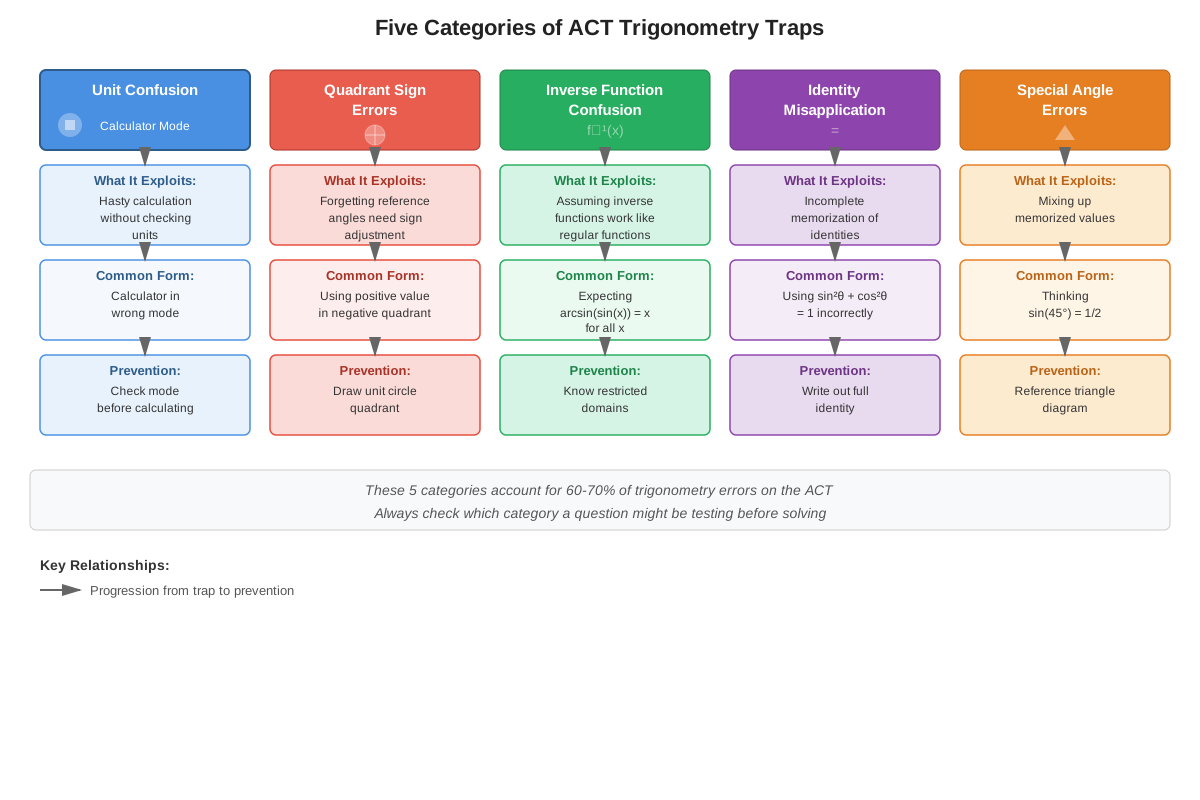
ACT trigonometry traps fall into five major categories that account for the vast majority of deliberate misleading elements in trigonometry questions. Understanding these categories provides a framework for systematic trap identification.
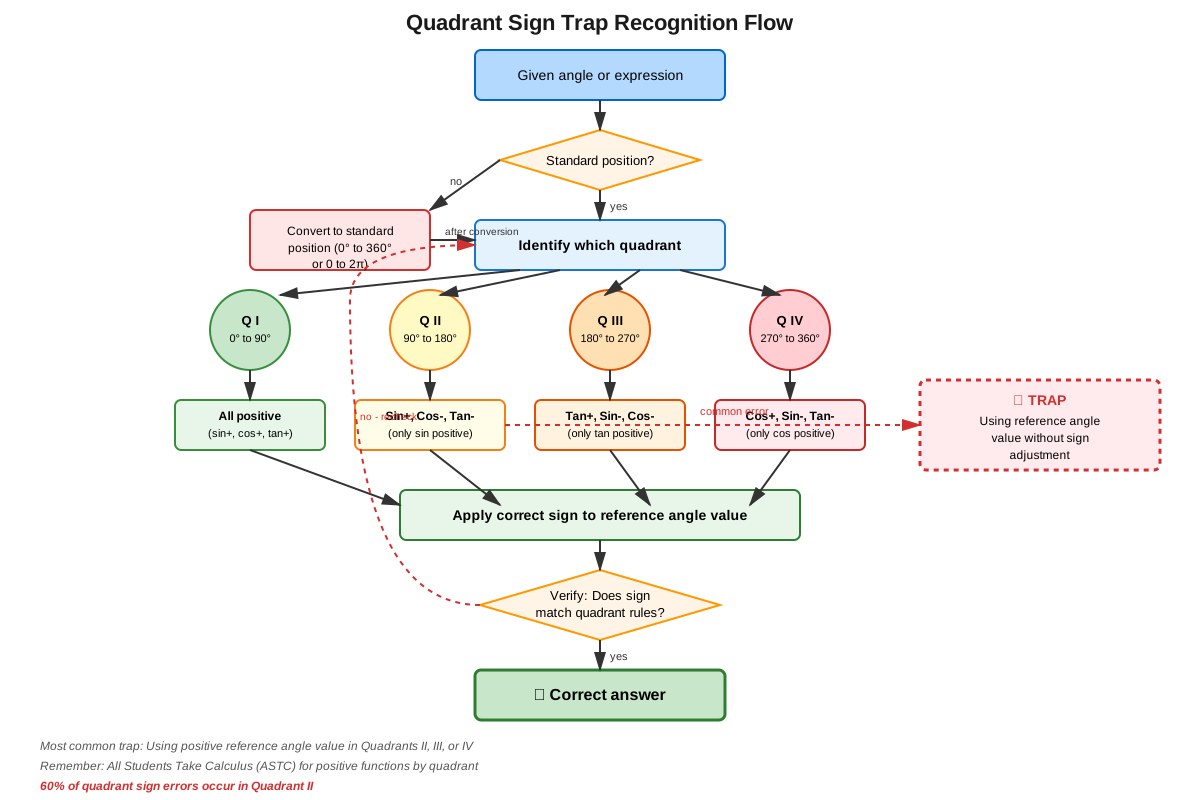
Category 1: Quadrant and Sign Traps exploit confusion about which trigonometric functions are positive or negative in different quadrants. The mnemonic "All Students Take Calculus" reminds students that in Quadrant I (All), all functions are positive; in Quadrant II (Students), only sine is positive; in Quadrant III (Take), only tangent is positive; and in Quadrant IV (Calculus), only cosine is positive. Trap answers frequently present the correct magnitude but wrong sign, or use the sign from an incorrect quadrant.
Category 2: Unit Confusion Traps involve mixing degrees and radians within a single problem. The ACT may provide an angle in degrees but ask for an answer that requires radian mode on a calculator, or vice versa. Some questions deliberately use π notation to suggest radians while the context requires degrees. Students must verify which unit system each part of the problem uses and convert appropriately.
Category 3: Reference Angle and Coterminal Angle Traps test whether students understand that multiple angles can have the same trigonometric values. A question might ask for an angle in a specific range (like 0° to 360°) but trap answers include coterminal angles outside that range, or use the reference angle instead of the actual angle in the specified quadrant.
Category 4: Identity Misapplication Traps present situations where students might incorrectly apply or manipulate trigonometric identities. Common examples include confusing sin²θ + cos²θ = 1 with sin θ + cos θ = 1, incorrectly distributing functions across addition (sin(A + B) ≠ sin A + sin B), or making sign errors when using double-angle or half-angle formulas.
Category 5: Inverse Function Domain and Range Traps exploit confusion about the restricted outputs of inverse trigonometric functions. For example, arcsin and arctan have different ranges (arcsin outputs -π/2 to π/2, arctan outputs -π/2 to π/2, arccos outputs 0 to π), and trap answers often present angles outside these ranges that would be correct if the range restrictions didn't exist.
Trap Recognition Strategies
Developing a systematic approach to trap recognition involves three phases: pre-calculation analysis, calculation verification, and answer choice evaluation.
During pre-calculation analysis, students should identify the trap category most likely to appear based on question characteristics. Questions involving angles greater than 90° or negative angles signal potential quadrant traps. Any problem mixing π notation with degree symbols suggests unit confusion traps. Questions asking for "all angles" or "the angle" with specific range restrictions indicate reference angle traps. Problems requiring algebraic manipulation of trigonometric expressions point toward identity traps. Finally, any question using inverse trigonometric notation (arcsin, sin⁻¹, etc.) should trigger awareness of domain/range traps.
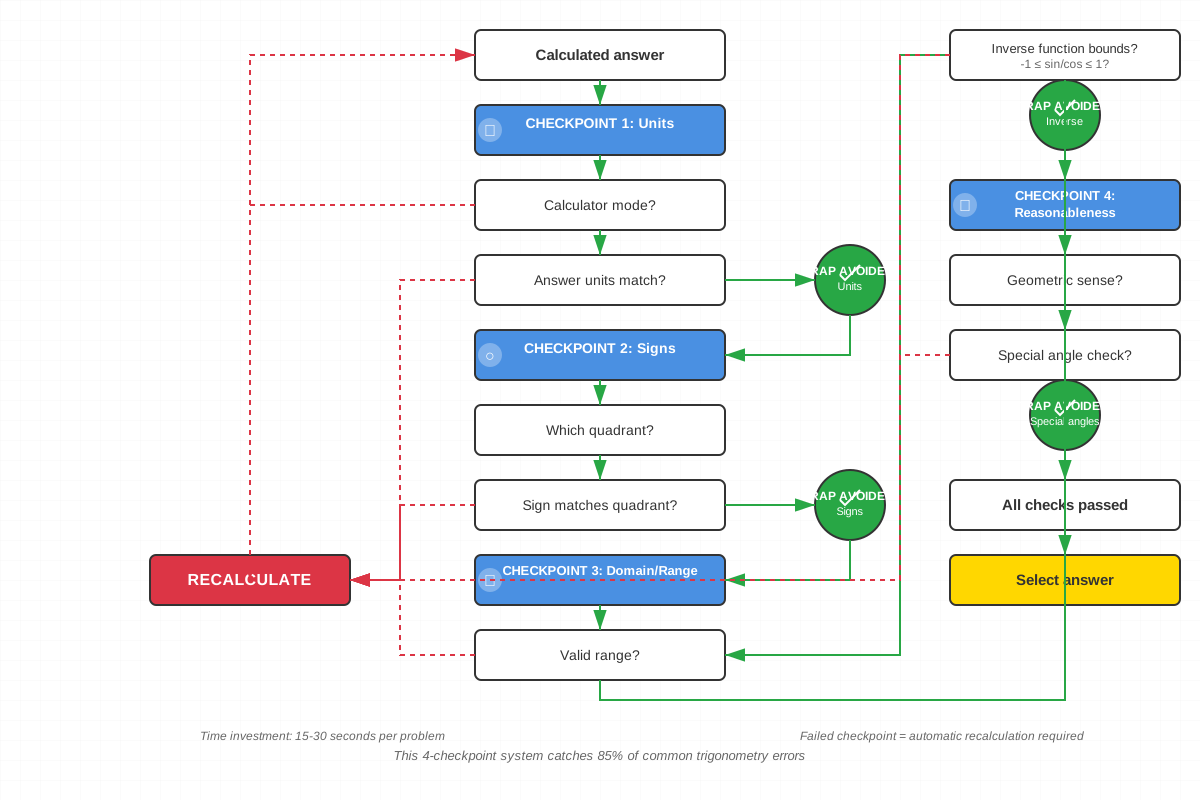
Calculation verification requires checking work against common error patterns. After obtaining an answer, students should ask: "Does this sign make sense for the quadrant?" "Did I use the correct unit throughout?" "Is this answer in the requested range?" "Did I apply identities correctly without illegal operations?" These verification questions catch most trap-induced errors before selecting an answer.
Answer choice evaluation involves examining all options to identify which represent common traps. If an answer choice differs from the calculated answer only in sign, a quadrant trap likely exists. If choices differ by factors of π or 180°, unit confusion may be involved. Multiple answers that are coterminal angles suggest a range restriction trap. Recognizing trap patterns in answer choices helps confirm the correct solution or signals the need to recalculate.
Common Trap Mechanisms in ACT Questions
The ACT employs specific mechanisms to create traps that feel natural to students making common errors. Understanding these mechanisms builds trap immunity.
The "Opposite Angle" Mechanism presents a right triangle or angle scenario where students must carefully identify which angle is referenced. A question might provide information about angle A but ask about angle B, with trap answers corresponding to calculations using the wrong angle. This trap succeeds because students often focus on the most prominent angle or the first angle mentioned.
The "Calculator Mode" Mechanism relies on students using calculators set to the wrong mode (degree vs. radian). A question might be solvable using a calculator, but the correct answer requires radian mode while most students default to degree mode. Trap answers include the result obtained in the wrong mode.
The "Positive Result" Mechanism exploits the tendency to assume trigonometric values are positive. When calculating sin(210°), students might correctly determine the reference angle is 30° and that sin(30°) = 0.5, but forget that sine is negative in the third quadrant, selecting 0.5 instead of -0.5.
The "First Quadrant Assumption" Mechanism appears when inverse functions are involved. Given sin θ = 0.5, students might immediately answer θ = 30°, forgetting that θ could also be 150° (or other coterminal angles). Trap answers include only the first-quadrant solution when multiple solutions exist.
The "Identity Shortcut" Mechanism tempts students to apply non-existent shortcuts. Seeing sin²θ + cos²θ, students might incorrectly simplify to (sin θ + cos θ)², or seeing sin(2θ), they might incorrectly think it equals 2sin θ. Trap answers reflect these illegal operations.
The Trap Avoidance Protocol
Implementing a consistent protocol prevents trap-induced errors. This five-step process should become automatic:
- Identify the trap category by scanning for trigger words and problem characteristics
- Note all units and ranges explicitly, writing them down if necessary
- Determine the quadrant for any angle involved and predict the sign of results
- Calculate carefully with attention to the identified trap category
- Verify the answer against the trap category checklist before selecting
This protocol transforms trap awareness from passive knowledge into active problem-solving strategy.
Concept Relationships
The five trap categories interconnect in complex ways, with many ACT questions incorporating multiple trap types simultaneously. Quadrant and sign traps form the foundation, as they appear in nearly every trigonometry problem involving angles outside the first quadrant. These connect directly to reference angle traps because determining the correct sign requires first finding the reference angle, then applying the appropriate sign based on quadrant. This relationship flows as: identify angle → determine quadrant → find reference angle → apply correct sign.
Unit confusion traps operate somewhat independently but frequently combine with other trap types. A problem might require both unit conversion and quadrant analysis, creating a compound trap where students must avoid two separate errors. The relationship here is multiplicative: each trap type increases the probability of error, making combined traps particularly dangerous.
Identity misapplication traps connect to all other categories because identities are tools used to solve problems where other traps exist. A student might correctly identify a quadrant trap but then fall into an identity trap during algebraic manipulation. This creates a sequential relationship: trap identification → correct calculation → identity application → final answer, where errors at any stage produce trap answers.
Inverse function traps relate most closely to quadrant and reference angle traps because inverse functions essentially ask "which angle produces this value?" The restricted ranges of inverse functions exist precisely to avoid the ambiguity created by multiple angles having the same trigonometric value. Understanding this connection helps students recognize when inverse function range restrictions matter.
The relationship to prerequisite knowledge is hierarchical. Basic trigonometric ratios provide the foundation upon which all traps are built—without understanding what sin, cos, and tan represent, trap recognition is impossible. Unit circle knowledge enables quadrant trap identification. Special angle memorization allows quick verification of answers. Identity knowledge prevents identity traps. This hierarchy means that weakness in prerequisites amplifies susceptibility to traps.
Quick check — test yourself on ACT trigonometry traps so far.
Try Flashcards →High-Yield Facts
⭐ Approximately 60-70% of ACT trigonometry questions contain at least one deliberate trap element in either the question setup or answer choices
⭐ The most common trap type is quadrant sign errors, accounting for roughly 25% of all trigonometry mistakes
⭐ Unit confusion between degrees and radians appears in approximately 15-20% of trigonometry questions
⭐ Inverse trigonometric functions have restricted ranges: arcsin and arctan output between -π/2 and π/2, while arccos outputs between 0 and π
⭐ Reference angle traps most commonly appear when questions ask for angles in specific ranges like 0° to 360° or -180° to 180°
- Trap answers are always mathematically plausible results of common errors, never random numbers
- Calculator mode traps succeed because most calculators default to degree mode while many ACT problems require radian calculations
- The ACT never requires memorization of trigonometric identities beyond the Pythagorean identity and basic reciprocal relationships
- Questions involving angles greater than 360° or less than 0° almost always test understanding of coterminal angles
- Identity traps most frequently involve illegal distribution of functions across addition or subtraction
- When multiple answer choices differ only in sign, a quadrant trap is virtually certain
- The phrase "in the range" or "between" in a question stem signals a potential reference angle or inverse function trap
- Negative angle measures require careful attention to rotation direction and resulting quadrant
- Problems presenting triangles in non-standard orientations often contain "opposite angle" traps
- The ACT includes trap answers that result from using the complementary angle instead of the specified angle
Common Misconceptions
Misconception: All trigonometric values for angles greater than 90° are negative → Correction: The sign depends on the specific function and quadrant; use "All Students Take Calculus" to determine which functions are positive in each quadrant, and remember that each function has its own sign pattern across quadrants.
Misconception: sin⁻¹(x) means 1/sin(x) → Correction: The superscript -1 notation indicates the inverse function (arcsin), not the reciprocal; the reciprocal of sin(x) is csc(x), and confusing these leads to completely incorrect answers on inverse function questions.
Misconception: If sin θ = 0.5, then θ = 30° is the only answer → Correction: Multiple angles have the same sine value; sin θ = 0.5 means θ could be 30°, 150°, or any coterminal angle (30° + 360°n or 150° + 360°n), and the question's specified range determines which answer is correct.
Misconception: Calculators automatically handle degree/radian conversions → Correction: Calculators compute based on their current mode setting; entering sin(π/2) in degree mode yields approximately 0.0274, not 1, because the calculator interprets π/2 as approximately 1.57 degrees rather than 90 degrees in radians.
Misconception: sin(A + B) = sin A + sin B → Correction: Trigonometric functions do not distribute across addition; the correct identity is sin(A + B) = sin A cos B + cos A sin B, and using the incorrect distribution produces trap answers that appear among the choices.
Misconception: The reference angle is always the answer when working with angles in different quadrants → Correction: The reference angle is a tool for finding the magnitude of trigonometric values, but the actual angle in the specified quadrant is usually what the question asks for; confusing these produces answers that are off by 90°, 180°, or other amounts.
Misconception: Negative angles always produce negative trigonometric values → Correction: The sign of a trigonometric value depends on which quadrant the angle terminates in, not whether the angle measure itself is negative; for example, sin(-30°) = -0.5 (negative), but cos(-30°) = √3/2 (positive).
Misconception: All angles can be outputs of inverse trigonometric functions → Correction: Inverse functions have restricted ranges to ensure they are functions (one output per input); arcsin only outputs angles between -90° and 90°, so it cannot output 150° even though sin(150°) = 0.5.
Worked Examples
Example 1: Compound Trap Question
Question: In the coordinate plane, angle θ is in standard position with its terminal side passing through the point (-3, 4). What is the value of cos θ?
Step 1 - Identify potential traps: This question involves a point in Quadrant II (negative x, positive y), immediately signaling a quadrant sign trap. The question asks for cosine, which is negative in Quadrant II.
Step 2 - Calculate the hypotenuse: Using the Pythagorean theorem: r = √((-3)² + 4²) = √(9 + 16) = √25 = 5
Step 3 - Determine the trigonometric ratio: cos θ = adjacent/hypotenuse = x/r = -3/5
Step 4 - Verify the sign: In Quadrant II, cosine is negative (only sine is positive). Our answer of -3/5 has the correct negative sign.
Step 5 - Identify trap answers: Common trap answers would include:
- 3/5 (correct magnitude, wrong sign - the primary trap)
- -4/5 (using the y-coordinate instead of x-coordinate)
- 4/5 (confusing sine and cosine, and wrong sign)
Correct Answer: -3/5
Connection to learning objectives: This example demonstrates identifying the quadrant trap category, explaining the sign rule for Quadrant II, and applying the strategy of verifying signs before selecting an answer.
Example 2: Unit Confusion and Inverse Function Trap
Question: If sin x = √3/2 and 0 ≤ x ≤ π, what is the value of x?
Step 1 - Identify potential traps: The range is given in terms of π (suggesting radians), and the question involves finding an angle from a trigonometric value (inverse function). This signals both a unit confusion trap and a reference angle trap.
Step 2 - Recognize the special angle: sin x = √3/2 corresponds to the special angle 60° or π/3 radians. Since the range is given in radians (0 to π), we should work in radians.
Step 3 - Consider all angles in the range: In the range 0 to π (0° to 180°), sine is positive in both Quadrant I and Quadrant II. The angles with sin x = √3/2 are:
- π/3 (60°) in Quadrant I
- π - π/3 = 2π/3 (120°) in Quadrant II
Step 4 - Determine which answer the question seeks: The question asks for "the value" (singular) but doesn't specify which one. However, examining the range 0 ≤ x ≤ π, both values are valid. If answer choices include both, additional context would determine which is correct. If only one appears, that's the answer. For this example, if both appear as separate choices, the question is flawed; typically, the ACT would ask for "all values" or specify "the smallest value."
Step 5 - Identify trap answers: Common traps would include:
- 60 (using degrees instead of radians - major unit confusion trap)
- π/6 (using the complementary angle, since cos(π/6) = √3/2)
- -π/3 (correct magnitude but wrong sign, outside the specified range)
Correct Answer: π/3 or 2π/3 (both technically correct in the given range; ACT would clarify which is sought)
Connection to learning objectives: This example shows identifying multiple trap categories (unit confusion and reference angle), explaining the strategy of checking all angles in a given range, and applying careful unit consistency throughout the problem.
Exam Strategy
When approaching ACT trigonometry questions, implement a three-phase strategy: scan, solve, and verify. During the scan phase (5-10 seconds), quickly identify trap categories by looking for trigger elements: angles outside 0-90°, π notation mixed with degree symbols, inverse function notation, phrases like "in the range," or non-standard triangle orientations. This initial scan primes awareness of which traps to avoid.
Trigger words and phrases that signal specific trap types include:
- "In standard position" or "terminal side" → quadrant trap likely
- Any use of π without explicit "radians" → unit confusion trap possible
- "Between," "in the range," or "where 0 ≤ θ ≤ 2π" → reference angle or inverse function trap
- "Arcsin," "sin⁻¹," or other inverse notation → domain/range trap certain
- "Simplify" or "equivalent to" with trigonometric expressions → identity trap likely
During the solve phase, work methodically while maintaining awareness of the identified trap category. Write down the quadrant if relevant, note units explicitly, and mark any range restrictions. Avoid rushing through calculations, as speed-induced errors often produce trap answers. If using a calculator, verify the mode setting before computing.
Process-of-elimination strategies specific to trigonometry traps include:
- Immediately eliminate answers with impossible values (like sin θ = 1.5)
- Eliminate answers outside specified ranges
- If your calculated answer differs from all choices only in sign, reconsider the quadrant
- If your answer doesn't appear but a coterminal angle does, check range restrictions
- When answers differ by factors of π or 180°, verify unit consistency
Time allocation for trigonometry questions should average 45-60 seconds per question, with an additional 10-15 seconds for trap verification. Questions combining trigonometry with other concepts (like coordinate geometry) may require up to 90 seconds. If a question requires more than 90 seconds, mark it for review and move on—the ACT rewards efficient time management, and spending excessive time on one question risks missing easier questions later.
The verification phase (5-10 seconds) involves checking the answer against the identified trap category. Ask: "Does this sign make sense?" "Are my units consistent?" "Is this in the requested range?" "Did I answer what was asked?" This final check catches most trap-induced errors and is time well spent, as it prevents losing points on questions where the mathematical work was correct but a trap was overlooked.
Memory Techniques
QUAD-SIGN mnemonic for remembering which functions are positive in each quadrant:
- Quadrant I: All positive
- Upper right (Quadrant II): Sine positive
- Across (Quadrant III): Tangent positive
- Down right (Quadrant IV): Cosine positive
Alternative: "All Students Take Calculus" (same information, different mnemonic)
UNIT-CHECK acronym for avoiding unit confusion:
- Understand the given units
- Note any π notation (suggests radians)
- Identify calculator mode needed
- Transform if necessary
Check final answer units
RANGE-TRAP visualization: Picture the unit circle divided into the restricted ranges of inverse functions. Arcsin and arctan cover the right half (from -90° to 90°), while arccos covers the top half (from 0° to 180°). This visual helps remember that arcsin cannot output 150° even though sin(150°) = 0.5.
The "Sign-Before-Calculate" technique: Before computing any trigonometric value for an angle outside the first quadrant, write down the expected sign based on the quadrant. This physical act of writing "+sin, -cos, -tan" (for Quadrant II, for example) prevents sign errors.
The "Reference-Angle-Plus" method: For any angle outside the first quadrant, think "reference angle PLUS adjustment." The adjustment depends on the quadrant: Quadrant II = 180° - reference, Quadrant III = 180° + reference, Quadrant IV = 360° - reference. This prevents confusing the reference angle with the actual angle.
Summary
ACT trigonometry traps represent deliberate question design elements that exploit common student errors in five primary categories: quadrant and sign confusion, unit mixing between degrees and radians, reference angle and coterminal angle misidentification, identity misapplication, and inverse function domain/range violations. Mastering trap recognition requires developing a systematic approach that includes pre-calculation trap identification, careful calculation with awareness of the trap category, and post-calculation verification before selecting an answer. The most critical skills are determining correct signs based on quadrants, maintaining unit consistency throughout problems, recognizing when multiple angles satisfy a condition and identifying which the question seeks, avoiding illegal operations with trigonometric identities, and understanding the restricted ranges of inverse functions. Success on ACT trigonometry questions depends not just on knowing formulas and concepts, but on anticipating where test writers place obstacles and implementing strategies to avoid them. Students who master trap recognition transform trigonometry from a challenging section into a high-yield opportunity for score improvement.
Key Takeaways
- ACT trigonometry traps appear in 60-70% of trigonometry questions and are designed to catch students who make predictable errors rather than those who lack mathematical knowledge
- The five trap categories—quadrant/sign, unit confusion, reference angle, identity misapplication, and inverse function range—account for virtually all deliberate misleading elements in ACT trigonometry questions
- Quadrant sign errors are the most common trap type, making the "All Students Take Calculus" mnemonic essential for determining which functions are positive in each quadrant
- Unit confusion between degrees and radians requires explicit attention to π notation and calculator mode settings, as trap answers always include results from using the wrong unit system
- Inverse trigonometric functions have restricted ranges (arcsin and arctan: -π/2 to π/2; arccos: 0 to π), and questions frequently include trap answers that fall outside these ranges
- Implementing a systematic scan-solve-verify approach with trap-specific verification questions prevents most trap-induced errors and is worth the 5-10 seconds it requires
- Trap answers are never random—they always represent plausible results of common errors, making them feel correct to students who fall into the trap
Related Topics
Advanced Trigonometric Identities: After mastering trap recognition, students can progress to more complex identity manipulation, including double-angle, half-angle, and sum-to-product formulas. Understanding basic traps provides the foundation for avoiding errors in these more sophisticated applications.
Trigonometric Equations and Inequalities: Solving equations like 2sin²θ - sin θ - 1 = 0 builds on trap awareness, as these problems combine algebraic techniques with trigonometric trap categories, particularly reference angle and quadrant traps.
Law of Sines and Law of Cosines: These tools for solving non-right triangles introduce additional trap opportunities related to ambiguous cases and angle selection, making prior trap mastery essential for success.
Trigonometric Graphs and Transformations: Understanding amplitude, period, phase shift, and vertical shift requires trap awareness, as questions often include trap answers that confuse these transformations or misapply them.
Polar Coordinates and Complex Numbers: These advanced topics use trigonometry extensively, and students who have mastered basic trigonometry traps find the transition smoother, as similar trap patterns appear in these more sophisticated contexts.
Practice CTA
Now that you understand the five categories of ACT trigonometry traps and the strategies to avoid them, it's time to put this knowledge into practice. Attempt the practice questions designed specifically to test trap recognition—each question contains at least one deliberate trap, and your goal is to identify the trap category before solving. Use the flashcards to reinforce the key facts, particularly the quadrant sign rules and inverse function ranges. Remember, trap recognition is a skill that improves with deliberate practice, and each trap you successfully avoid builds the pattern recognition that leads to consistent high performance on test day. You've invested the time to understand these concepts thoroughly—now demonstrate that mastery through practice!
Sign up free to keep reading
Create a free AnvayaPrep account to finish this ACT guide on ACT trigonometry traps — plus flashcards and practice questions.