Overview
Degrees and radians are two fundamental systems for measuring angles, and understanding how to work fluently with both is essential for success on the ACT Math test. While degrees are the more familiar system from everyday geometry, radians represent the mathematical language of trigonometry and calculus. The ACT frequently tests students' ability to convert between these two measurement systems, recognize equivalent angle measures, and apply the correct unit in trigonometric calculations. Questions involving degrees and radians appear regularly in the trigonometry section of the ACT, often integrated with problems about the unit circle, trigonometric functions, and arc length calculations.
Mastering ACT degrees and radians goes beyond simple memorization of conversion formulas. Students must develop an intuitive understanding of what each measurement system represents, recognize when angle measures are expressed in radians versus degrees, and quickly convert between the two systems under time pressure. The ACT particularly favors questions that test whether students can identify common angle measures in both systems (such as recognizing that π/2 radians equals 90 degrees) and apply these conversions within more complex trigonometric problems.
This topic serves as a bridge between basic geometry and advanced trigonometry on the ACT. A solid grasp of angle measurement systems enables students to tackle questions involving trigonometric functions, circular motion, periodic phenomena, and coordinate geometry. Since approximately 4-6 questions on each ACT Math test directly or indirectly involve angle measurements, investing time to master degrees and radians yields significant returns in overall test performance.
Learning Objectives
- [ ] Identify when Degrees and radians is being tested
- [ ] Explain the core rule or strategy behind Degrees and radians
- [ ] Apply Degrees and radians to ACT-style questions accurately
- [ ] Convert angle measures from degrees to radians and vice versa without a calculator
- [ ] Recognize common angle measures in both degree and radian form instantly
- [ ] Determine appropriate angle units for trigonometric function inputs
- [ ] Solve multi-step problems that require angle conversions as an intermediate step
Prerequisites
- Basic angle concepts: Understanding what angles represent and how they're formed is fundamental to working with any angle measurement system
- Circle properties: Knowledge of circle circumference (2πr) provides the geometric foundation for understanding why radians are defined as they are
- Fraction operations: Converting between degrees and radians requires multiplying and simplifying fractions involving π
- Basic trigonometry: Familiarity with sine, cosine, and tangent functions helps contextualize when different angle units are used
Why This Topic Matters
In real-world applications, radians appear throughout physics, engineering, and advanced mathematics. Physicists use radians to describe rotational motion, angular velocity, and wave phenomena. Engineers rely on radian measure for calculations involving gears, pulleys, and circular motion. Computer graphics and animation software use radians for rotation transformations. Even in everyday technology, from the GPS in smartphones to the mechanics of analog clocks, radian-based calculations operate behind the scenes.
On the ACT Math test, degrees and radians questions appear with high frequency—typically 1-2 direct conversion questions plus 2-4 additional questions where angle unit recognition is necessary to solve trigonometric problems correctly. According to ACT test statistics, approximately 7-10% of the Math section involves trigonometry, and nearly all trigonometry questions require facility with both angle measurement systems. These questions most commonly appear in formats such as: direct conversion problems ("Convert 135° to radians"), unit circle identification ("What is cos(π/3)?"), and applied problems involving arc length or sector area.
The ACT particularly favors testing degrees and radians through questions that combine multiple concepts. For example, a question might present a trigonometric equation with angles in radians, requiring students to first recognize the unit, then apply trigonometric identities, and finally solve for an unknown. Students who struggle with angle units often lose points not because they lack trigonometric knowledge, but because they input degree measures into functions expecting radians, or vice versa.
Core Concepts
Definition of Degrees
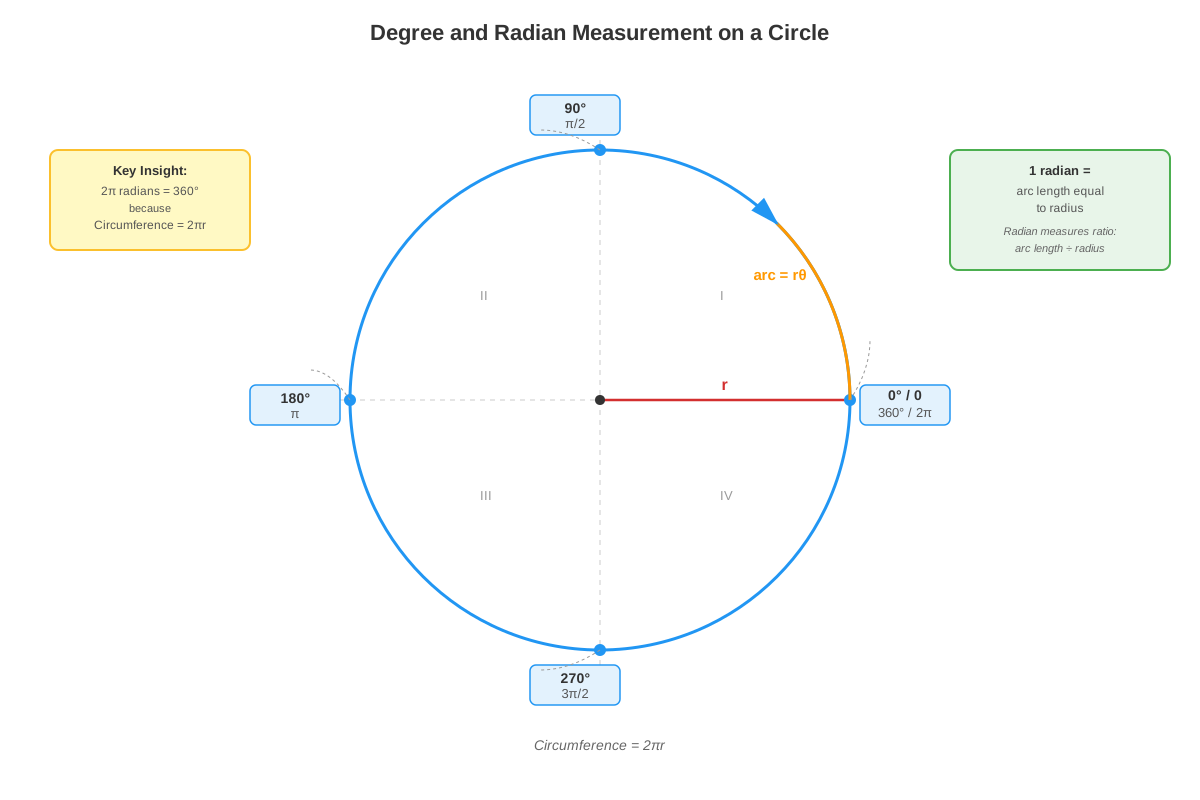
A degree is defined as 1/360th of a complete rotation around a circle. This measurement system dates back to ancient Babylonian mathematics, where the number 360 was chosen for its many divisors, making angle calculations convenient. In degree measure, a full circle contains 360°, a straight angle measures 180°, and a right angle equals 90°. The degree symbol (°) always accompanies degree measurements to distinguish them from radian measures.
Degrees subdivide into minutes and seconds (60 minutes per degree, 60 seconds per minute), though the ACT rarely tests these subdivisions. The key advantage of degrees is their intuitive nature—most students have years of experience working with degree measures in geometry classes, making them the default mental model for angle size.
Definition of Radians
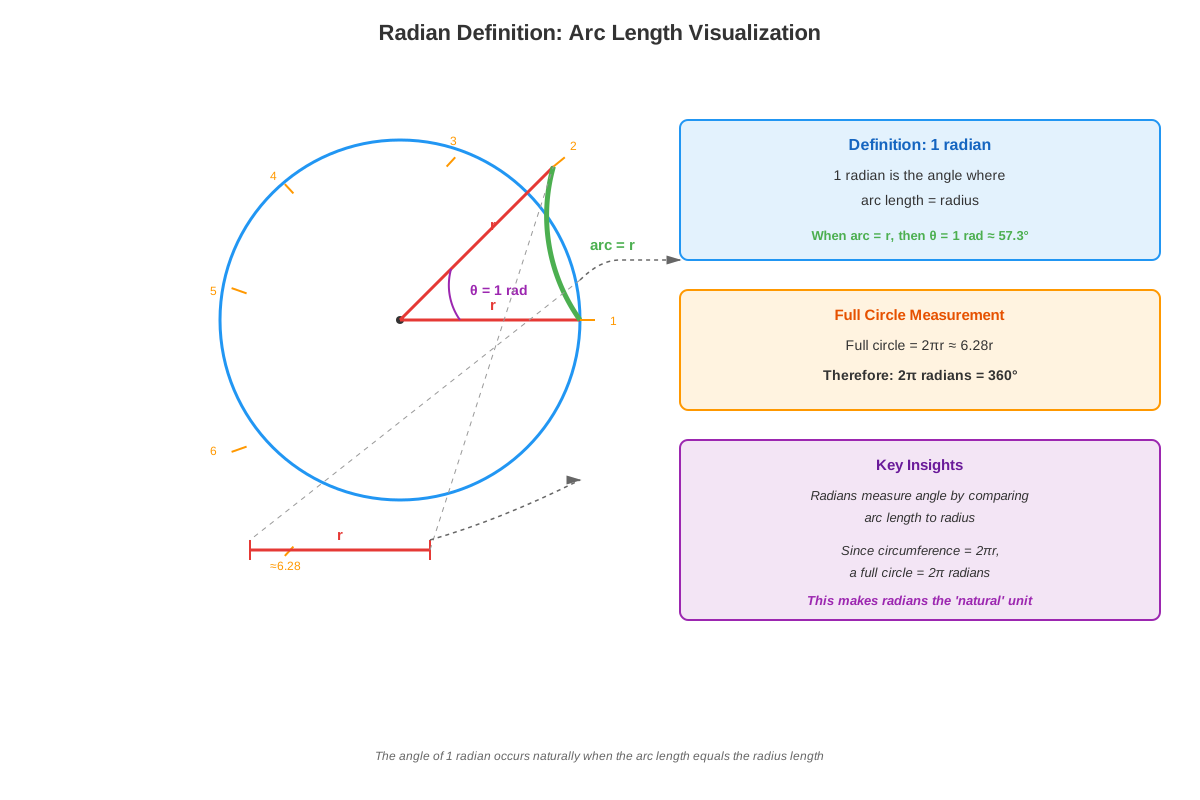
A radian is defined as the angle subtended at the center of a circle by an arc whose length equals the radius of that circle. This definition makes radians the "natural" unit for measuring angles in mathematics because it directly relates angle measure to arc length. In a circle of radius r, if an arc of length r is drawn, the central angle formed measures exactly 1 radian.
Since the circumference of a circle equals 2πr, and this circumference corresponds to one complete rotation, a full circle contains exactly 2π radians. This fundamental relationship—360° = 2π radians—forms the basis for all conversions between the two systems. Radian measures are typically written without a unit symbol, though "rad" may occasionally appear. When an angle is written simply as a number or expression involving π (like π/4 or 3π/2), it's understood to be in radians.
The Conversion Formula
The relationship 360° = 2π radians simplifies to the essential conversion ratio:
180° = π radiansFrom this relationship, two conversion formulas emerge:
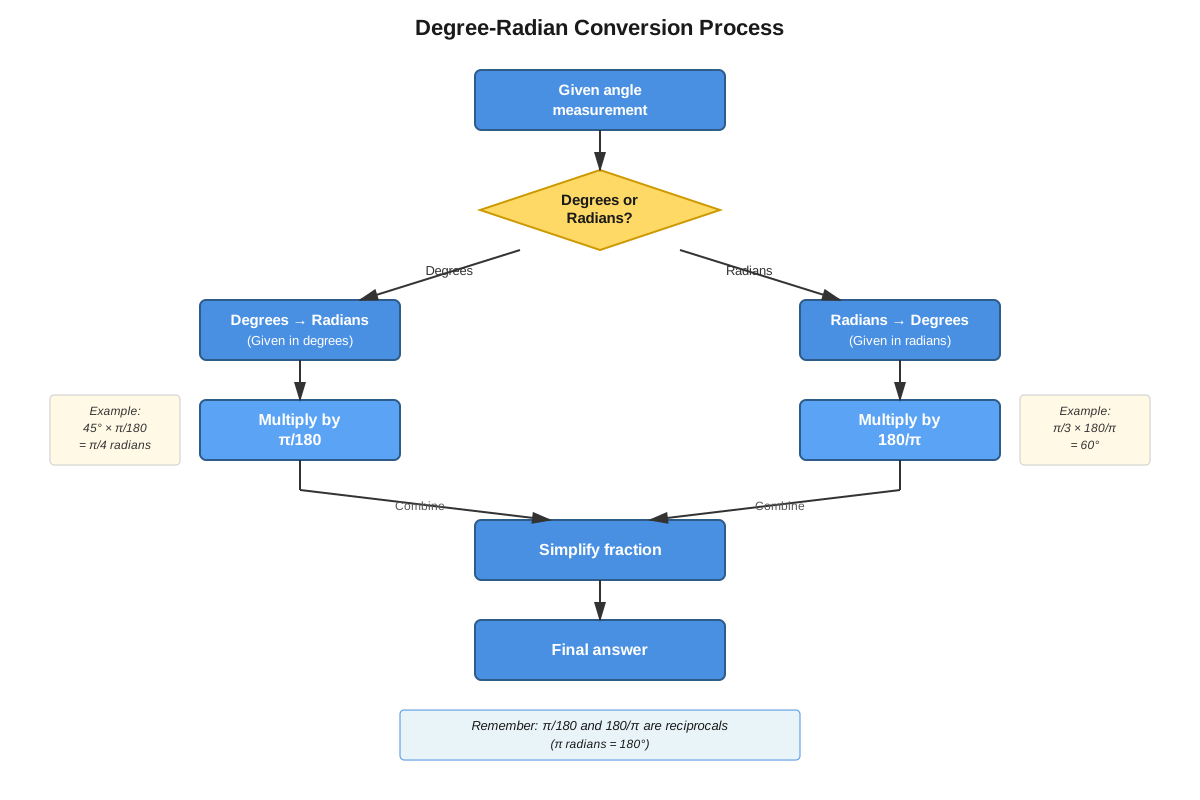
To convert from degrees to radians:
radians = degrees × (π/180°)To convert from radians to degrees:
degrees = radians × (180°/π)These formulas work by multiplying by a conversion factor equal to 1 (since π radians and 180° represent the same angle). The key to applying these formulas correctly is ensuring units cancel appropriately—when converting from degrees to radians, the degree symbols should cancel, leaving only radians.
Common Angle Conversions
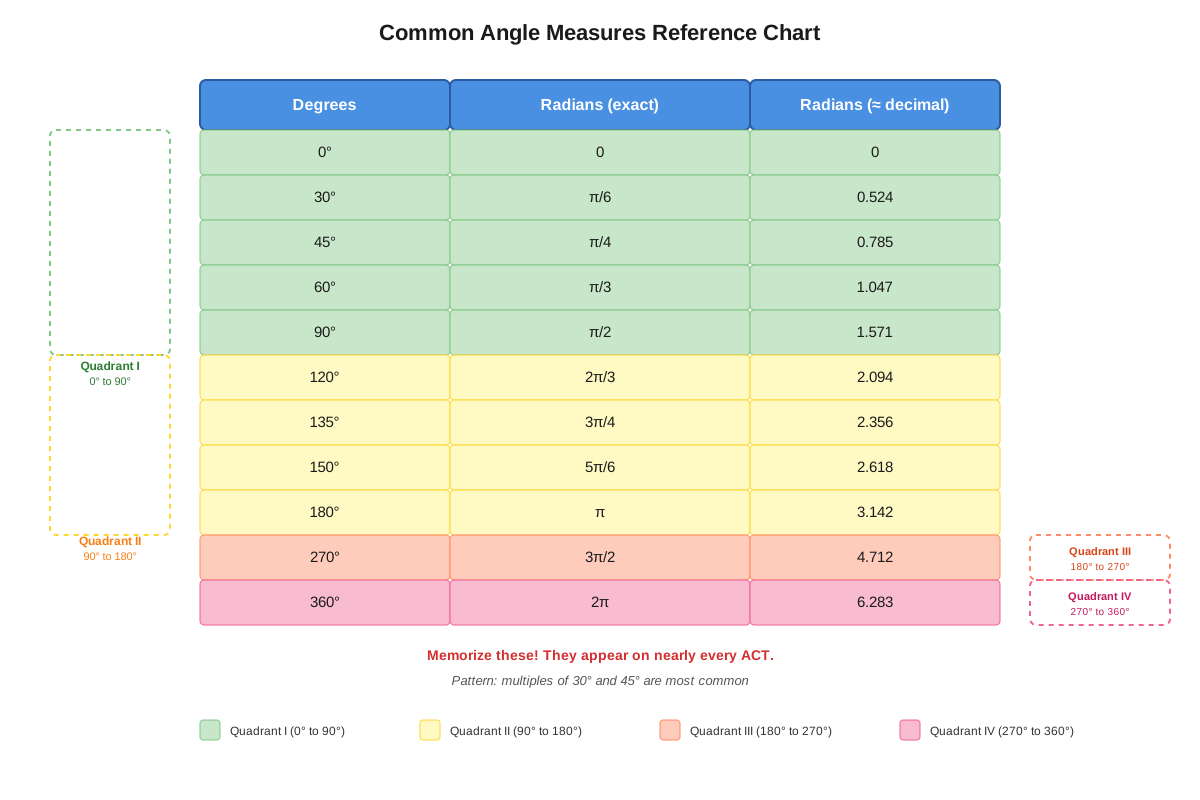
Memorizing frequently-used angle conversions dramatically increases speed on the ACT. The following table presents the most commonly tested angles:
| Degrees | Radians | Decimal (approx) |
|---|---|---|
| 0° | 0 | 0 |
| 30° | π/6 | 0.524 |
| 45° | π/4 | 0.785 |
| 60° | π/3 | 1.047 |
| 90° | π/2 | 1.571 |
| 120° | 2π/3 | 2.094 |
| 135° | 3π/4 | 2.356 |
| 150° | 5π/6 | 2.618 |
| 180° | π | 3.142 |
| 270° | 3π/2 | 4.712 |
| 360° | 2π | 6.283 |
Notice the pattern: common degree measures that are multiples of 30° or 45° correspond to simple fractions of π. This pattern exists because these angles divide the circle into equal parts (12 parts for 30°, 8 parts for 45°).
Recognizing Angle Units in Problems
The ACT tests whether students can identify which unit system a problem uses. Several clues indicate the angle unit:
- Presence of π: If an angle contains π (like 2π/3 or 5π/4), it's in radians
- Degree symbol: If the ° symbol appears, the angle is in degrees
- Context clues: Phrases like "arc length" or "angular velocity" typically use radians
- Calculator mode: Problems may specify "make sure your calculator is in radian mode"
- Answer choices: If answer choices contain π, the problem likely expects radian answers
Working with Trigonometric Functions
Trigonometric functions (sine, cosine, tangent) can accept angles in either degrees or radians, but the calculator or formula must be set to the correct mode. A critical error students make is calculating sin(30) when they mean sin(30°). In radian mode, sin(30) ≈ -0.988, while sin(30°) = 0.5—a dramatic difference that leads to wrong answers.
The ACT often presents trigonometric expressions like sin(π/6) or cos(3π/4) without explicitly stating "radians," expecting students to recognize that angles involving π are in radian measure. Conversely, expressions like sin(45°) clearly indicate degree measure through the degree symbol.
Arc Length and Sector Area
Two important applications that require radian measure are arc length and sector area formulas:
Arc length: s = rθ (where θ must be in radians)
Sector area: A = (1/2)r²θ (where θ must be in radians)
These formulas only work correctly when angles are measured in radians. If an angle is given in degrees, it must first be converted to radians before applying these formulas. The ACT frequently tests this requirement by presenting a problem with an angle in degrees and asking for arc length or sector area, requiring students to recognize the need for conversion.
Concept Relationships
The relationship between degrees and radians forms a bidirectional conversion pathway: degrees ↔ radians. This conversion serves as a gateway skill that enables more advanced trigonometric problem-solving.
Within this topic, the core concepts connect as follows: Definition of radians → establishes the geometric meaning → Conversion formula → enables translation between systems → Common angle conversions → provides memorized shortcuts → Application in trigonometric functions → demonstrates practical usage.
Degrees and radians connect to prerequisite knowledge through circle properties. The circumference formula (C = 2πr) directly explains why a full rotation equals 2π radians. Basic fraction operations enable simplification of conversion calculations, such as reducing (135 × π)/180 to 3π/4.
This topic enables progression to more advanced concepts: Unit circle (requires knowing radian measures of standard angles), Trigonometric graphs (typically use radian measure on the x-axis), Trigonometric equations (may require converting between systems to solve), and Polar coordinates (exclusively use radian measure for angles).
The relationship map: Circle properties → Radian definition → Degree-radian conversion → Trigonometric function evaluation → Arc length/sector area → Advanced trigonometry applications.
Quick check — test yourself on Degrees and radians so far.
Try Flashcards →High-Yield Facts
⭐ 180° equals exactly π radians — this is the fundamental conversion relationship from which all other conversions derive
⭐ To convert degrees to radians, multiply by π/180° — this formula appears directly or indirectly on nearly every ACT test
⭐ To convert radians to degrees, multiply by 180°/π — the reverse conversion is equally important
⭐ Common angles: 30° = π/6, 45° = π/4, 60° = π/3, 90° = π/2 — these four conversions account for the majority of ACT angle conversion questions
⭐ Angles containing π are in radians — this recognition skill prevents unit confusion errors
- A full circle contains 360° or 2π radians
- A straight angle (half circle) measures 180° or π radians
- A right angle measures 90° or π/2 radians
- Radian measures are typically written as fractions involving π (like 5π/6) rather than decimals
- Arc length formula s = rθ requires θ in radians, not degrees
- One radian equals approximately 57.3 degrees
- Trigonometric functions can accept either unit, but calculator mode must match the input
- When no unit is specified and π appears, assume radians
- Negative angles are measured clockwise from the positive x-axis in both systems
- Coterminal angles differ by 360° or 2π radians
Common Misconceptions
Misconception: All angles without a degree symbol are in degrees → Correction: Angles without units are typically in radians, especially when they involve π. The degree symbol (°) must be explicitly present to indicate degree measure.
Misconception: π/4 equals 4 degrees → Correction: π/4 radians equals 45 degrees. Students sometimes confuse the denominator with the degree measure. Always apply the conversion formula: (π/4) × (180°/π) = 45°.
Misconception: To convert degrees to radians, multiply by 180/π → Correction: This is backwards. To convert degrees to radians, multiply by π/180. To convert radians to degrees, multiply by 180/π. The unit you're converting FROM should cancel out.
Misconception: Calculators automatically know which unit you're using → Correction: Calculators have separate degree and radian modes. Calculating sin(30) in radian mode gives approximately -0.988, while sin(30°) in degree mode gives 0.5. Always verify calculator mode matches the problem's angle unit.
Misconception: Radian measures should always be converted to decimals → Correction: On the ACT, radian measures are typically left in exact form involving π (like 2π/3) rather than decimal approximations (like 2.094). Answer choices usually present radians as fractions with π.
Misconception: The arc length formula works with degrees → Correction: The formula s = rθ only works when θ is in radians. If an angle is given in degrees, it must first be converted to radians before applying this formula.
Misconception: Larger radian values mean larger angles than degree values → Correction: The numerical value doesn't indicate size—the unit matters. For example, π/2 radians (approximately 1.57) represents the same angle as 90 degrees, even though 90 is numerically larger.
Worked Examples
Example 1: Direct Conversion with Simplification
Problem: Convert 150° to radians. Express your answer as a fraction in terms of π.
Solution:
Step 1: Identify the conversion formula. Since we're converting from degrees to radians, we use:
radians = degrees × (π/180°)Step 2: Substitute the given angle:
radians = 150° × (π/180°)Step 3: Notice that the degree symbols cancel:
radians = 150 × (π/180)Step 4: Simplify the fraction by finding the greatest common divisor of 150 and 180, which is 30:
radians = (150 ÷ 30)/(180 ÷ 30) × π = 5π/6Answer: 150° = 5π/6 radians
Connection to learning objectives: This example demonstrates applying the conversion formula accurately (Objective 3) and converting between systems without a calculator (Objective 4).
Example 2: Multi-Step Problem with Arc Length
Problem: A circle has a radius of 8 inches. A central angle measures 135°. What is the length of the arc intercepted by this angle?
Solution:
Step 1: Recognize that the arc length formula s = rθ requires θ in radians. The given angle is in degrees, so conversion is necessary.
Step 2: Convert 135° to radians:
radians = 135° × (π/180°) = 135π/180Step 3: Simplify by dividing both numerator and denominator by 45:
θ = 3π/4 radiansStep 4: Apply the arc length formula with r = 8 and θ = 3π/4:
s = rθ = 8 × (3π/4) = 24π/4 = 6π inchesStep 5: If a decimal answer is needed, calculate 6π ≈ 18.85 inches.
Answer: The arc length is 6π inches (or approximately 18.85 inches)
Connection to learning objectives: This example shows identifying when conversion is needed (Objective 1), applying the core conversion strategy (Objective 2), and solving multi-step problems requiring angle conversion as an intermediate step (Objective 7).
Exam Strategy
When approaching ACT questions involving degrees and radians, follow this systematic process:
Step 1: Identify the angle unit — Before performing any calculations, determine whether angles are in degrees or radians. Look for the degree symbol (°) or the presence of π. If neither appears clearly, check answer choices for clues.
Step 2: Check calculator mode — If using a calculator for trigonometric functions, verify the mode matches the angle unit. A quick test: sin(90°) should equal 1 in degree mode, while sin(π/2) should equal 1 in radian mode.
Step 3: Recognize conversion requirements — Certain formulas (arc length, sector area) require radians. If the problem gives degrees but asks for arc length, conversion is necessary.
Step 4: Use memorized conversions when possible — Rather than calculating 45° × (π/180°) every time, instantly recall that 45° = π/4. This saves valuable time.
Trigger words and phrases to watch for:
- "Express in radians" or "express in degrees" — direct conversion required
- "Arc length" or "sector area" — must use radians
- "Make sure your calculator is in [mode]" — explicit unit instruction
- Angles written with π — indicates radian measure
- "Central angle" in circle problems — may require conversion for formulas
Process-of-elimination tips:
- If answer choices mix degrees and radians (some with °, some with π), the question tests conversion
- If all answer choices contain π, the expected answer is in radians
- If converting from degrees to radians, eliminate any answer choice larger than 2π (unless the original angle exceeded 360°)
- If an answer choice equals the original number without conversion (like 45° → 45), eliminate it—conversion always changes the numerical value
Time allocation advice:
Direct conversion questions should take 30-45 seconds. Multi-step problems involving conversion may take 60-90 seconds. If a conversion is taking longer, you may be overcomplicating—check whether the angle is one of the common memorized values.
Memory Techniques
Mnemonic for the conversion ratio: "Pi Over 180" sounds like "Pie Over One-Eighty" — remember that π/180 converts degrees to radians. For the reverse, flip it: 180/π.
Visualization strategy: Picture a circle divided into 360 equal slices (degrees) versus a circle with circumference 2πr wrapped around it (radians). When you "unwrap" the circle's circumference, you get 2π radius-lengths, which equals 2π radians.
The "Special Angles" acronym: SAFE helps remember the four most common conversions:
- Sixty degrees = π/3
- A right angle (90°) = π/2
- Forty-five degrees = π/4
- Eighty degrees... wait, that doesn't work. Instead, remember 30-45-60-90 as the special angles, with denominators 6-4-3-2 (in that order: π/6, π/4, π/3, π/2).
Pattern recognition: Notice that 30° = π/6, and 60° = π/3. The degree measures are in ratio 1:2, and the radian measures are also in ratio 1:2 (since π/6 is half of π/3). This pattern helps verify conversions.
The "Pi is about 3" approximation: For quick estimation, remember π ≈ 3. So π/2 ≈ 1.5, π/3 ≈ 1, π/4 ≈ 0.75, and π/6 ≈ 0.5. This helps catch gross errors (if you calculate that 30° = 5π/6, you'd notice that 5π/6 ≈ 2.5, which is much larger than 30° should be in radians).
Summary
Degrees and radians represent two systems for measuring angles, with 180° equaling exactly π radians forming the fundamental conversion relationship. The ACT tests this topic through direct conversion problems, trigonometric function evaluation, and applied problems involving arc length and sector area. Success requires memorizing common angle conversions (particularly 30° = π/6, 45° = π/4, 60° = π/3, and 90° = π/2), applying conversion formulas accurately (multiply by π/180 for degrees to radians, multiply by 180/π for radians to degrees), and recognizing which unit system a problem uses. Angles containing π are in radians, while angles with the degree symbol are in degrees. Certain formulas, especially arc length (s = rθ) and sector area (A = ½r²θ), require radian measure. Students must also ensure calculator mode matches the angle unit when evaluating trigonometric functions. Mastering this topic enables confident handling of 7-10% of ACT Math questions and provides the foundation for all advanced trigonometry problems.
Key Takeaways
- The fundamental conversion relationship is 180° = π radians, from which all other conversions derive
- Multiply by π/180 to convert degrees to radians; multiply by 180/π to convert radians to degrees
- Memorize the four most common conversions: 30° = π/6, 45° = π/4, 60° = π/3, 90° = π/2
- Angles containing π are in radians; angles with the ° symbol are in degrees
- Arc length and sector area formulas require angles in radians, not degrees
- Always verify calculator mode matches the angle unit before evaluating trigonometric functions
- Leave radian answers in exact form with π (like 5π/6) rather than decimal approximations
Related Topics
Unit Circle: Mastering degrees and radians enables understanding the unit circle, where standard angles are marked in both degree and radian measure, and coordinates represent cosine and sine values.
Trigonometric Functions: Converting between angle units is essential for correctly evaluating sin, cos, tan, and their inverses, particularly when calculator mode must match problem requirements.
Trigonometric Graphs: The graphs of y = sin(x) and y = cos(x) typically use radian measure on the x-axis, with key points at multiples of π/2.
Polar Coordinates: This coordinate system uses radians exclusively for angle measurement, making fluency with radian measure essential for polar graphing and conversions.
Angular Velocity and Circular Motion: Physics applications involving rotation rates and circular paths use radians per second as the standard unit, requiring conversion from degrees when necessary.
Practice CTA
Now that you've mastered the core concepts of degrees and radians, it's time to solidify your understanding through practice! Work through the practice questions to test your conversion skills, tackle ACT-style problems, and build the speed and accuracy you need for test day. Review the flashcards to reinforce common angle conversions until they become automatic. Remember, the difference between knowing these concepts and mastering them lies in consistent practice. You've got this—every practice problem brings you closer to your target score!
Sign up free to keep reading
Create a free AnvayaPrep account to finish this ACT guide on Degrees and radians — plus flashcards and practice questions.