Overview
Finding missing angles is a fundamental skill tested extensively on the ACT Math section, appearing in approximately 3-5 questions per exam. This topic encompasses multiple geometric and trigonometric principles, requiring students to identify angle relationships, apply geometric theorems, and use trigonometric functions to determine unknown angle measures. Mastery of this skill is essential not only for direct angle-finding questions but also for solving complex geometry problems involving polygons, circles, triangles, and coordinate geometry.
The ACT consistently tests ACT finding missing angles through various contexts: interior and exterior angles of polygons, complementary and supplementary angle pairs, vertical angles, angles formed by parallel lines and transversals, angles in right triangles using inverse trigonometric functions, and angles within circles using arc relationships. Students must recognize which geometric principles or trigonometric tools apply to each situation and execute calculations accurately under time pressure.
This topic serves as a bridge between pure geometry and trigonometry, integrating knowledge of angle relationships with computational skills. Success with finding missing angles requires fluency with angle theorems, comfort with algebraic equation-solving, and familiarity with calculator functions for inverse trigonometry. The concepts learned here directly support more advanced topics including triangle congruence, similarity, coordinate geometry transformations, and trigonometric applications in real-world contexts.
Learning Objectives
- [ ] Identify when Finding missing angles is being tested
- [ ] Explain the core rule or strategy behind Finding missing angles
- [ ] Apply Finding missing angles to ACT-style questions accurately
- [ ] Determine missing angles using complementary, supplementary, and vertical angle relationships
- [ ] Calculate unknown angles in polygons using interior and exterior angle sum formulas
- [ ] Apply inverse trigonometric functions (arcsin, arccos, arctan) to find angle measures in right triangles
- [ ] Solve for angles formed by parallel lines cut by transversals using corresponding, alternate interior, and alternate exterior angle relationships
Prerequisites
- Basic angle vocabulary: Understanding terms like acute, obtuse, right, straight, and reflex angles is essential for identifying angle types and applying appropriate strategies
- Algebraic equation solving: Setting up and solving linear equations is required when angle relationships are expressed algebraically (e.g., 2x + 30 = 90)
- Triangle properties: Knowledge of the triangle angle sum theorem (angles sum to 180°) forms the foundation for many angle-finding problems
- Basic trigonometric ratios: Familiarity with sine, cosine, and tangent in right triangles is necessary before applying inverse functions
- Calculator proficiency: Knowing how to use inverse trigonometric functions and switch between degree and radian modes is critical for accurate calculations
Why This Topic Matters
Finding missing angles has immediate practical applications in architecture, engineering, navigation, surveying, and construction. Architects use angle calculations to design roof pitches and structural supports. Engineers determine angles for load-bearing structures and mechanical systems. Surveyors measure land boundaries using angle relationships, while navigators calculate bearings and trajectories using trigonometric angle-finding techniques.
On the ACT Math section, angle-finding questions appear with high frequency across multiple content areas. Approximately 8-12% of the 60 math questions involve angle calculations, making this one of the most heavily tested geometric concepts. These questions typically appear in the Geometry and Trigonometry content domains, with difficulty ranging from straightforward angle pair problems to complex multi-step problems requiring integration of multiple concepts.
The ACT presents angle-finding problems in several characteristic formats: diagrams with algebraic expressions for angles requiring equation setup, word problems describing angle relationships without visual aids, coordinate plane problems requiring angle calculations from slopes or coordinates, and applied trigonometry problems involving real-world scenarios like ramps, ladders, or sight lines. Recognition of these question types enables efficient problem-solving and reduces time spent interpreting unfamiliar presentations.
Core Concepts
Angle Pair Relationships
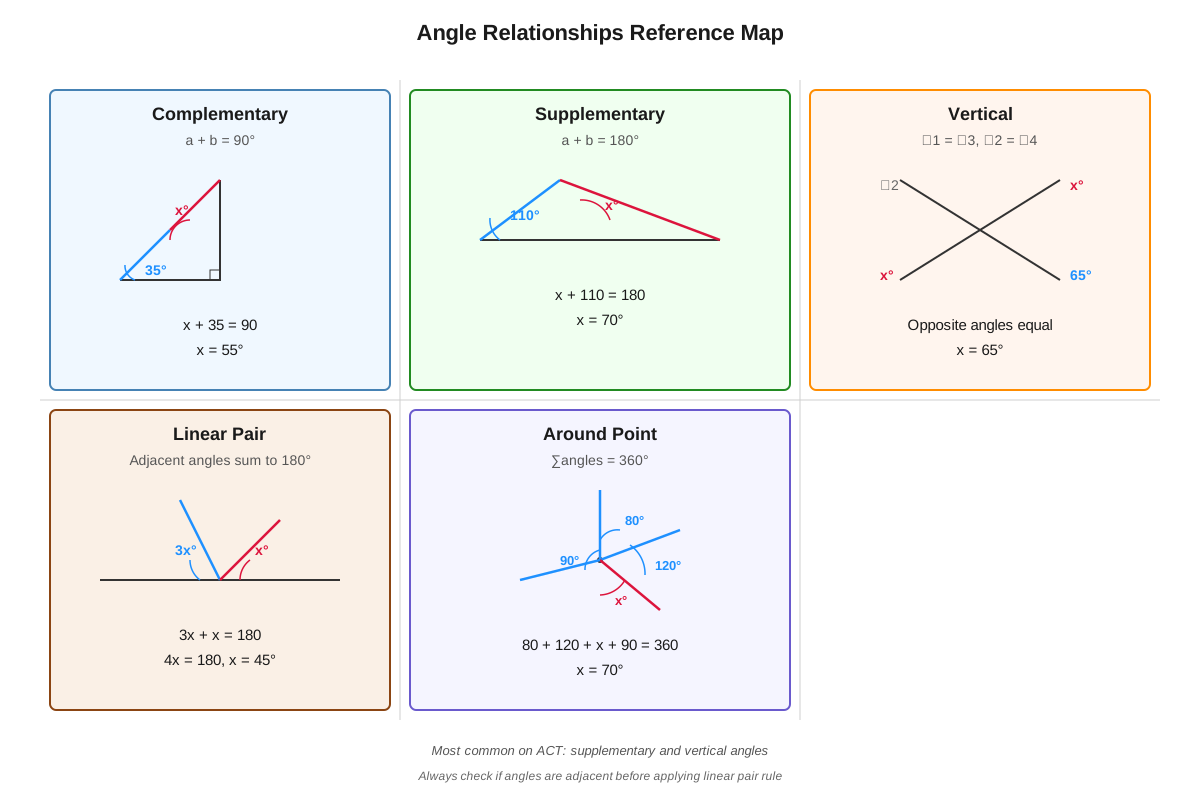
Complementary angles are two angles whose measures sum to 90°. When the ACT states that angles are complementary or shows a right angle divided into two parts, students should immediately set up the equation: angle₁ + angle₂ = 90°. For example, if one angle measures 37°, its complement measures 90° - 37° = 53°.
Supplementary angles are two angles whose measures sum to 180°. These frequently appear as adjacent angles forming a straight line or as angles described in word problems. The fundamental equation is: angle₁ + angle₂ = 180°. Linear pairs (adjacent angles on a straight line) are always supplementary.
Vertical angles are formed when two lines intersect, creating two pairs of opposite angles. Vertical angles are always congruent (equal in measure). This relationship allows immediate angle identification without calculation when one angle in a vertical pair is known.
Angles and Parallel Lines
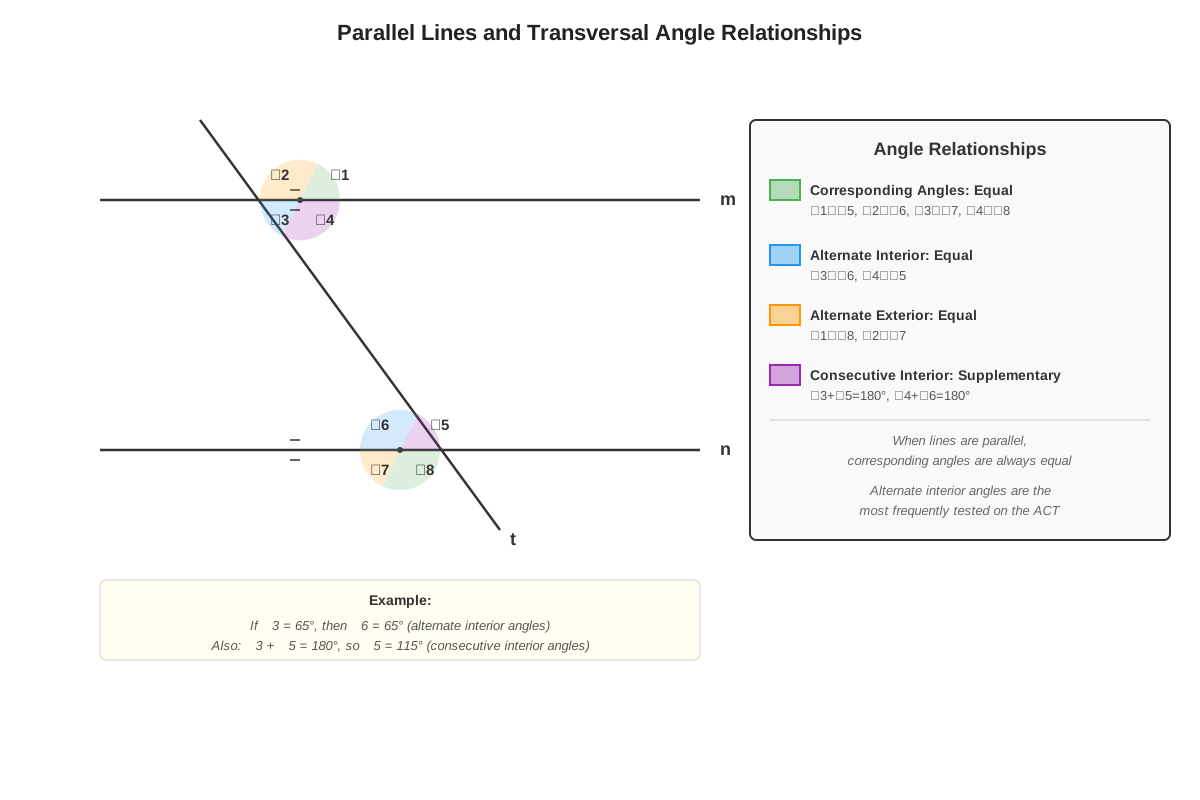
When a transversal (a line crossing two or more lines) intersects parallel lines, eight angles are formed with specific relationships:
- Corresponding angles occupy the same relative position at each intersection and are congruent
- Alternate interior angles lie between the parallel lines on opposite sides of the transversal and are congruent
- Alternate exterior angles lie outside the parallel lines on opposite sides of the transversal and are congruent
- Consecutive interior angles (also called co-interior or same-side interior angles) lie between the parallel lines on the same side of the transversal and are supplementary
These relationships reduce the eight angles to essentially two distinct measures, since knowing one angle determines all others through congruence or supplementary relationships.
Polygon Angle Sums
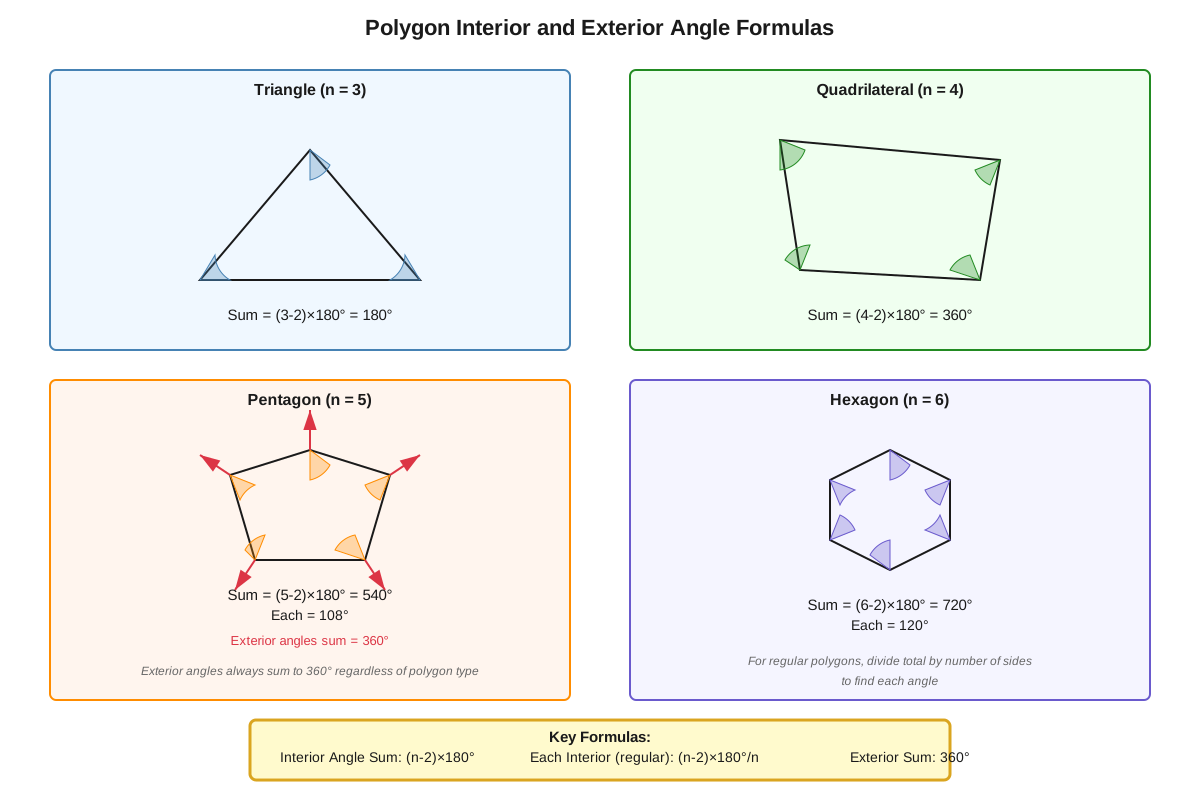
The interior angle sum of any polygon with n sides is given by the formula: (n - 2) × 180°. This formula derives from dividing a polygon into triangles from a single vertex. For example, a hexagon (6 sides) has interior angles summing to (6 - 2) × 180° = 720°.
For regular polygons (all sides and angles equal), each interior angle measures: [(n - 2) × 180°] ÷ n. A regular pentagon has each interior angle measuring [(5 - 2) × 180°] ÷ 5 = 108°.
The exterior angle sum of any polygon always equals 360°, regardless of the number of sides. For regular polygons, each exterior angle measures: 360° ÷ n. This relationship provides an alternative method for finding interior angles, since each interior angle and its adjacent exterior angle are supplementary.
Triangle Angle Relationships
The triangle angle sum theorem states that the three interior angles of any triangle sum to 180°. This fundamental relationship enables finding the third angle when two are known: angle₃ = 180° - angle₁ - angle₂.
An exterior angle of a triangle equals the sum of the two non-adjacent interior angles (remote interior angles). This theorem provides an efficient shortcut for many problems, eliminating the need to find all interior angles individually.
Special triangles have predictable angle measures:
- Equilateral triangles: all angles measure 60°
- Isosceles triangles: two angles are congruent (the base angles)
- Right triangles: one angle measures 90°, and the other two are complementary
Inverse Trigonometric Functions
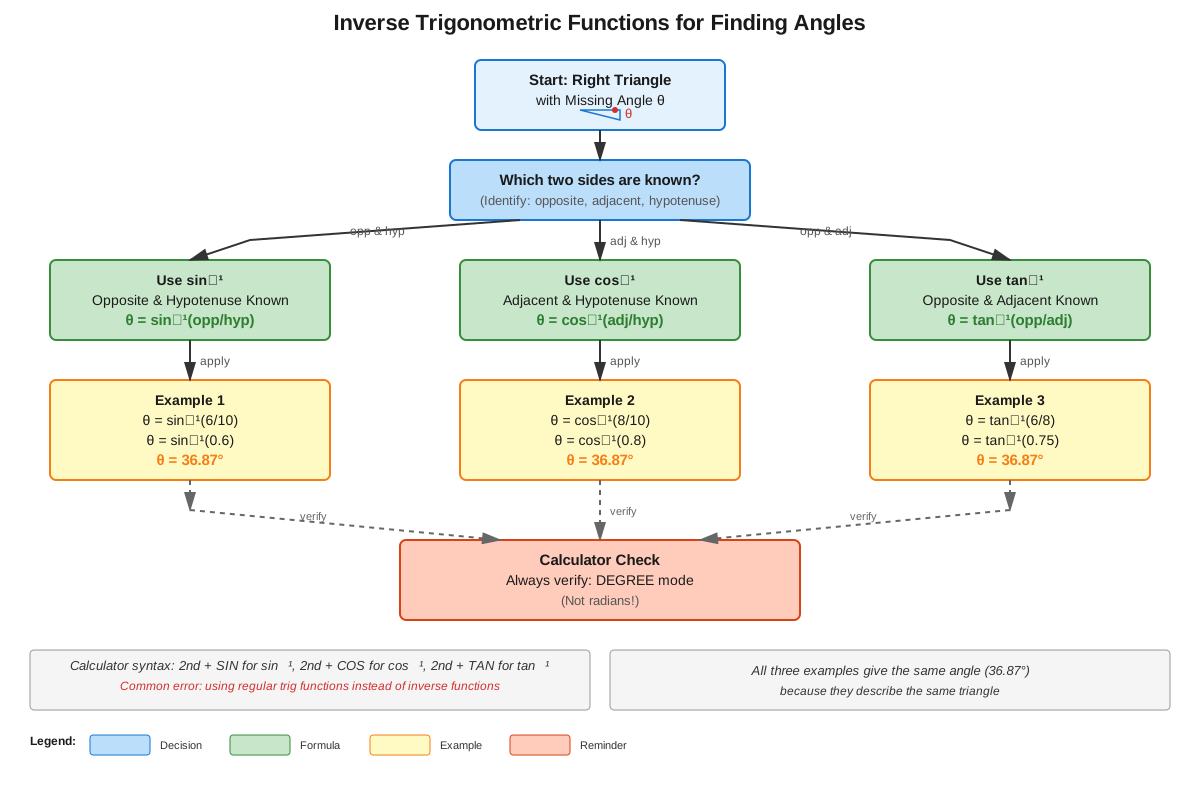
When a right triangle's side lengths are known but an angle measure is needed, inverse trigonometric functions (also called arc functions) are used:
- arcsin(x) or sin⁻¹(x): finds the angle whose sine equals x
- arccos(x) or cos⁻¹(x): finds the angle whose cosine equals x
- arctan(x) or tan⁻¹(x): finds the angle whose tangent equals x
The process involves three steps:
- Identify which trigonometric ratio relates the known sides to the unknown angle
- Calculate the ratio value
- Apply the inverse function using a calculator in degree mode
For example, if the opposite side is 5 and the hypotenuse is 13, then sin(θ) = 5/13, so θ = arcsin(5/13) ≈ 22.6°.
Circle Angle Relationships
Central angles have their vertex at the circle's center and measure equal to their intercepted arc. If a central angle measures 80°, its intercepted arc also measures 80°.
Inscribed angles have their vertex on the circle and measure half their intercepted arc. An inscribed angle intercepting a 100° arc measures 50°.
Angles formed by chords, secants, and tangents follow specific formulas based on their configuration, but the most commonly tested relationship is that an angle inscribed in a semicircle (intercepting a 180° arc) always measures 90°.
Concept Relationships
The angle-finding concepts form an interconnected hierarchy. Basic angle pair relationships (complementary, supplementary, vertical) serve as the foundation, applying to all geometric contexts. These relationships → lead to → parallel line angle theorems, which extend pair relationships to systems of eight angles with multiple congruent and supplementary pairs.
Triangle angle relationships build upon angle sums and pairs, incorporating the 180° sum rule as a special case of polygon angle formulas. The triangle exterior angle theorem → connects to → supplementary angle pairs, since an exterior angle and its adjacent interior angle are supplementary, while also equaling the sum of remote interior angles.
Polygon angle formulas generalize triangle relationships to figures with any number of sides, with the (n - 2) × 180° formula → reducing to → 180° when n = 3 (triangles). Regular polygon formulas → combine with → division to find individual angle measures from total sums.
Inverse trigonometric functions → integrate → right triangle properties with angle-finding, requiring both trigonometric ratio knowledge and calculator skills. These functions → connect to → complementary angles, since in a right triangle, if one acute angle is found, the other equals 90° minus the first.
Circle angle relationships → synthesize → arc measures with angle measures, creating proportional relationships. Central angles → directly correspond to → arcs, while inscribed angles → demonstrate → the half-measure relationship, connecting multiplication/division with geometric properties.
All these concepts → ultimately rely on → algebraic equation-solving, as most ACT problems present angle relationships algebraically (e.g., "angle A measures 3x + 10") requiring students to set up equations based on geometric principles and solve for variables before finding specific angle measures.
High-Yield Facts
⭐ Complementary angles sum to 90°; supplementary angles sum to 180°
⭐ Vertical angles formed by intersecting lines are always congruent
⭐ When parallel lines are cut by a transversal, corresponding angles are congruent and alternate interior angles are congruent
⭐ The sum of interior angles in any polygon is (n - 2) × 180° where n is the number of sides
⭐ The three angles in any triangle sum to 180°
- The exterior angles of any polygon sum to 360°, regardless of the number of sides
- Each interior angle of a regular n-sided polygon measures [(n - 2) × 180°] ÷ n
- An exterior angle of a triangle equals the sum of the two remote interior angles
- Linear pairs (adjacent angles forming a straight line) are always supplementary
- To find an angle in a right triangle when sides are known, use inverse trig functions: θ = arcsin(opposite/hypotenuse), θ = arccos(adjacent/hypotenuse), or θ = arctan(opposite/adjacent)
- Inscribed angles in a circle measure half their intercepted arc
- An angle inscribed in a semicircle always measures 90°
- In an isosceles triangle, the base angles (opposite the congruent sides) are congruent
- Consecutive interior angles formed by parallel lines and a transversal are supplementary
- When using inverse trig functions on the ACT, ensure the calculator is in degree mode, not radian mode
Quick check — test yourself on Finding missing angles so far.
Try Flashcards →Common Misconceptions
Misconception: Complementary angles must be adjacent or form a right angle visually → Correction: Complementary angles only need to sum to 90°; they can be anywhere in a figure or described separately in a problem. The term describes a numerical relationship, not a spatial arrangement.
Misconception: All angles formed by intersecting lines are equal → Correction: Only vertical angles (opposite angles) are congruent. Adjacent angles formed by intersecting lines are supplementary, not equal, unless the lines are perpendicular (forming four 90° angles).
Misconception: The formula (n - 2) × 180° gives the measure of each angle in a polygon → Correction: This formula gives the sum of all interior angles. To find each individual angle in a regular polygon, divide this sum by n: [(n - 2) × 180°] ÷ n.
Misconception: When using inverse trig functions, the answer is always in degrees → Correction: Calculators may be set to radian mode, giving incorrect answers for ACT problems. Always verify the calculator is in degree mode before using arcsin, arccos, or arctan functions.
Misconception: Alternate interior angles are the angles on the same side of the transversal between parallel lines → Correction: Alternate interior angles are on opposite sides of the transversal. Angles on the same side between parallel lines are consecutive interior angles (co-interior angles), which are supplementary, not congruent.
Misconception: In a right triangle, if one angle is 30°, the other must be 30° → Correction: The two acute angles in a right triangle are complementary (sum to 90°). If one acute angle is 30°, the other is 90° - 30° = 60°, not 30°.
Misconception: The exterior angle of a polygon is found by subtracting the interior angle from 360° → Correction: Each exterior angle is supplementary to its adjacent interior angle, so it equals 180° minus the interior angle. The 360° value represents the sum of all exterior angles, not the relationship between one interior-exterior pair.
Worked Examples
Example 1: Parallel Lines and Transversal with Algebraic Expressions
Problem: Two parallel lines are cut by a transversal. One angle measures (4x + 15)° and its corresponding angle measures (6x - 25)°. Find the value of x and the measure of both angles.
Solution:
Step 1: Recognize the angle relationship. Corresponding angles formed by parallel lines and a transversal are congruent, so they have equal measures.
Step 2: Set up the equation based on the congruence relationship:
4x + 15 = 6x - 25Step 3: Solve for x algebraically:
4x + 15 = 6x - 25
15 + 25 = 6x - 4x
40 = 2x
x = 20
Step 4: Substitute x = 20 back into either expression to find the angle measure:
4x + 15 = 4(20) + 15 = 80 + 15 = 95°Step 5: Verify using the other expression:
6x - 25 = 6(20) - 25 = 120 - 25 = 95° ✓Answer: x = 20, and both angles measure 95°
Connection to Learning Objectives: This problem demonstrates identifying when angle-finding is tested (parallel lines with algebraic expressions), explaining the core strategy (using corresponding angle congruence), and applying the concept accurately through algebraic equation-solving.
Example 2: Finding an Angle Using Inverse Trigonometry
Problem: A ladder leans against a wall, with the base of the ladder 8 feet from the wall and the top reaching 15 feet up the wall. What angle does the ladder make with the ground? Round to the nearest tenth of a degree.
Solution:
Step 1: Visualize the situation. The ladder, wall, and ground form a right triangle. The wall is the opposite side (15 ft), the ground distance is the adjacent side (8 ft), and the ladder is the hypotenuse. We need the angle between the ladder and the ground.
Step 2: Identify which trigonometric ratio relates the known sides to the unknown angle. We know the opposite and adjacent sides relative to the angle, so we use tangent:
tan(θ) = opposite/adjacent = 15/8Step 3: Calculate the ratio:
tan(θ) = 15/8 = 1.875Step 4: Apply the inverse tangent function to find the angle. Ensure the calculator is in degree mode:
θ = arctan(1.875)
θ = tan⁻¹(1.875)
θ ≈ 61.9°Answer: The ladder makes an angle of approximately 61.9° with the ground.
Connection to Learning Objectives: This problem illustrates identifying inverse trigonometry as the required strategy, explaining the core approach (selecting the appropriate trig ratio and applying its inverse), and accurately applying the concept to an ACT-style real-world scenario.
Example 3: Polygon Interior Angles
Problem: In a regular octagon, what is the measure of each interior angle?
Solution:
Step 1: Identify that we need the interior angle formula for regular polygons. An octagon has n = 8 sides.
Step 2: Calculate the sum of all interior angles using (n - 2) × 180°:
Sum = (8 - 2) × 180° = 6 × 180° = 1080°Step 3: Since the octagon is regular, all interior angles are equal. Divide the sum by the number of angles:
Each angle = 1080° ÷ 8 = 135°Alternative approach using the direct formula:
Each angle = [(n - 2) × 180°] ÷ n
Each angle = [(8 - 2) × 180°] ÷ 8
Each angle = [6 × 180°] ÷ 8
Each angle = 1080° ÷ 8 = 135°Answer: Each interior angle of a regular octagon measures 135°.
Connection to Learning Objectives: This demonstrates recognizing polygon angle problems, applying the polygon angle sum formula correctly, and executing accurate calculations for ACT-style questions.
Exam Strategy
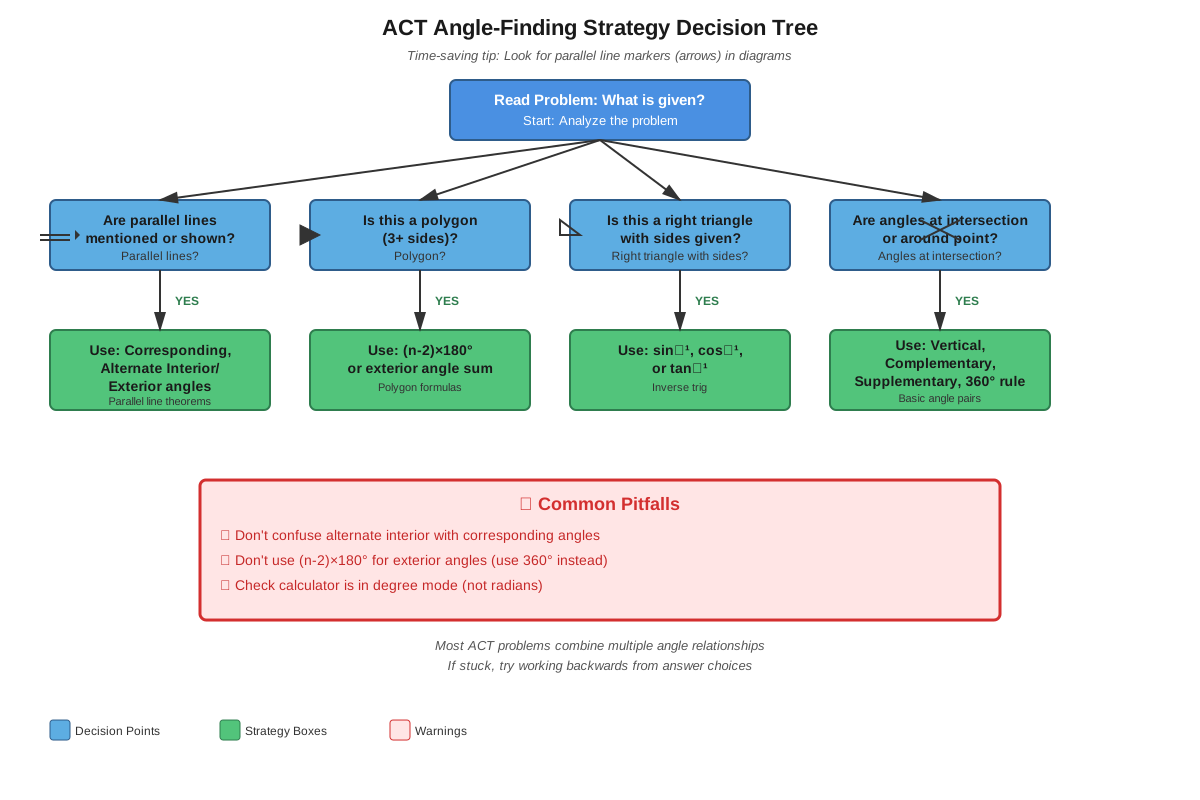
When approaching ACT questions on finding missing angles, begin by identifying the geometric configuration: Are parallel lines present? Is this a triangle, polygon, or circle? Are angle pairs described? This initial classification determines which theorems and formulas apply.
Trigger words and phrases signal specific strategies:
- "Complementary" or "sum to 90°" → set up equation with sum = 90°
- "Supplementary," "linear pair," or "straight line" → set up equation with sum = 180°
- "Parallel lines" with "transversal" → look for corresponding, alternate interior, or consecutive interior angles
- "Regular polygon" → use [(n - 2) × 180°] ÷ n for each interior angle
- "Right triangle" with side lengths given → use inverse trig functions
- "Vertical angles" → set angles equal to each other
For process of elimination, use these angle-finding specific strategies:
- Eliminate any answer choice greater than 180° for interior angles of polygons (unless specifically asking for reflex angles)
- For triangle angles, eliminate choices that would make the sum exceed or fall short of 180°
- When parallel lines are involved, eliminate answers that don't maintain the congruence or supplementary relationships
- For inverse trig problems, eliminate unreasonable answers (e.g., an angle greater than 90° when the opposite side is shorter than the adjacent side)
Time allocation: Simple angle pair problems should take 30-45 seconds. Multi-step problems involving algebraic expressions or multiple angle relationships may require 60-90 seconds. Inverse trigonometry problems typically need 45-60 seconds including calculator use. If a problem requires more than 2 minutes, mark it for review and move forward.
Calculator efficiency: Pre-set your calculator to degree mode at the start of the math section. When using inverse trig functions, double-check that you're using the correct function (sin⁻¹, cos⁻¹, or tan⁻¹) based on which sides are known. Round only at the final step to maintain accuracy.
Diagram strategy: When no diagram is provided, quickly sketch the situation. Even a rough drawing helps visualize angle relationships and prevents errors. When a diagram is provided but states "not drawn to scale," rely on the given measurements and relationships, not visual appearance.
Memory Techniques
COMPLEMENTARY = CORNER: Both start with "C" and complementary angles fit in a corner (right angle = 90°)
SUPPLEMENTARY = STRAIGHT: Both start with "S" and supplementary angles form a straight line (180°)
CAI-CAI for parallel lines: Corresponding Angles Identical, Consecutive Angles Interior sum to 180°
All Students Take Calculus for inverse trig function selection:
- Adjacent and Hypotenuse known → use arccos (cos = A/H)
- Opposite and Hypotenuse known → use arcsin (sin = O/H)
- Opposite and Adjacent known → use arctan (tan = O/A)
"N minus 2, then times 180" for polygon interior angle sum: (n - 2) × 180°
"360 Always" for polygon exterior angles: The exterior angles of any polygon always sum to 360°, regardless of the number of sides
Visualization for vertical angles: Picture an "X" formed by intersecting lines. The angles that are "across" from each other (opposite in the X) are vertical angles and are equal.
Triangle exterior angle memory: "The outside equals the two far insides" - an exterior angle equals the sum of the two remote interior angles
Summary
Finding missing angles on the ACT requires mastery of multiple geometric principles and trigonometric techniques. Students must recognize angle pair relationships (complementary summing to 90°, supplementary summing to 180°, and vertical angles being congruent), apply parallel line theorems (corresponding and alternate interior angles are congruent, consecutive interior angles are supplementary), use polygon angle formulas (interior sum = (n - 2) × 180°, exterior sum = 360°), and employ inverse trigonometric functions when side lengths are known in right triangles. Success depends on quickly identifying which principle applies to each problem configuration, setting up correct equations when angles are expressed algebraically, and executing calculations accurately. The ACT tests these concepts through direct angle-finding questions, multi-step problems requiring multiple angle relationships, and applied problems in real-world contexts. Efficient problem-solving requires recognizing trigger words, maintaining calculator proficiency with inverse trig functions in degree mode, and verifying that answers satisfy the geometric constraints of the problem.
Key Takeaways
- Complementary angles sum to 90°, supplementary angles sum to 180°, and vertical angles are congruent—these three relationships solve the majority of basic angle-finding problems
- When parallel lines are cut by a transversal, corresponding angles and alternate interior angles are congruent, while consecutive interior angles are supplementary
- The interior angles of any polygon sum to (n - 2) × 180°, and this formula is essential for finding missing angles in polygons
- All triangles have interior angles summing to 180°, and an exterior angle equals the sum of the two remote interior angles
- Use inverse trigonometric functions (arcsin, arccos, arctan) to find angles in right triangles when side lengths are known, ensuring your calculator is in degree mode
- Regular polygons have all angles equal, so each interior angle measures [(n - 2) × 180°] ÷ n
- Always set up algebraic equations when angles are expressed with variables, using the appropriate geometric relationship to create the equation
Related Topics
Triangle Congruence and Similarity: After mastering angle-finding, students can determine when triangles are congruent (SSS, SAS, ASA, AAS) or similar (AA, SAS, SSS), which requires identifying equal angles and proportional sides. Angle-finding skills directly enable proving these relationships.
Trigonometric Functions and Identities: Building on inverse trig functions, students progress to working with trig identities, the unit circle, and solving trigonometric equations. The angle-finding foundation makes these advanced topics more accessible.
Coordinate Geometry: Finding angles between lines in the coordinate plane uses inverse tangent with slopes, connecting algebraic and geometric representations. The angle-finding techniques learned here extend to coordinate-based problems.
Circle Theorems: Advanced circle problems involve angles formed by chords, tangents, and secants, building on the basic inscribed and central angle relationships introduced in angle-finding.
Law of Sines and Law of Cosines: These formulas extend angle-finding to non-right triangles, enabling solutions when standard right triangle trigonometry doesn't apply. Mastery of basic angle-finding is prerequisite to understanding these laws.
Practice CTA
Now that you've mastered the core concepts of finding missing angles, it's time to solidify your understanding through practice. Attempt the practice questions to apply these strategies to ACT-style problems, and use the flashcards to reinforce the key formulas and relationships. Remember, consistent practice with immediate feedback is the most effective way to build speed and accuracy for test day. Each problem you solve strengthens your pattern recognition and deepens your geometric intuition. You've built a strong foundation—now put it to work!
Sign up free to keep reading
Create a free AnvayaPrep account to finish this ACT guide on Finding missing angles — plus flashcards and practice questions.