Overview
The law of sines basics represents one of the most powerful tools in trigonometry for solving triangles when traditional right-triangle methods fall short. This fundamental relationship connects the sides of any triangle to the sines of their opposite angles, enabling students to find unknown measurements in oblique (non-right) triangles. On the ACT Math test, this topic appears regularly in the higher-difficulty questions within the Trigonometry content area, typically testing a student's ability to recognize when the law applies and execute calculations accurately under time pressure.
Understanding the ACT law of sines basics is essential because it bridges the gap between basic trigonometric ratios (SOH-CAH-TOA) and more complex geometric problem-solving. While right-triangle trigonometry handles many scenarios, real-world applications and ACT questions frequently involve triangles without right angles. The law of sines provides the mathematical framework to tackle these situations systematically. This topic typically accounts for 1-2 questions per ACT Math section, making it a high-yield area for score improvement.
The law of sines connects directly to fundamental concepts in geometry, algebra, and trigonometry. It relies on understanding angle measurement, triangle properties (such as the angle sum theorem), and the sine function itself. Mastery of this topic opens pathways to more advanced trigonometric applications, including the law of cosines, triangle area formulas, and real-world modeling problems involving navigation, surveying, and physics. For ACT preparation, the law of sines represents a critical skill that separates students scoring in the mid-20s from those achieving scores of 30 and above.
Learning Objectives
- [ ] Identify when Law of sines basics is being tested in ACT questions
- [ ] Explain the core rule or strategy behind Law of sines basics
- [ ] Apply Law of sines basics to ACT-style questions accurately
- [ ] Determine which triangle configuration (AAS, ASA, or SSA) requires the law of sines
- [ ] Calculate unknown side lengths using the law of sines formula
- [ ] Calculate unknown angle measures using the law of sines formula
- [ ] Recognize when the law of sines produces ambiguous cases and handle them appropriately
Prerequisites
- Basic trigonometric ratios (sine, cosine, tangent): The law of sines directly uses the sine function, requiring comfort with evaluating sin(θ) for various angles
- Triangle angle sum theorem: Understanding that angles in a triangle sum to 180° is essential for finding missing angles before applying the law
- Solving proportions and cross-multiplication: The law of sines creates proportional relationships that require algebraic manipulation
- Calculator proficiency with inverse trigonometric functions: Finding angles requires using sin⁻¹ (arcsin) on a calculator
- Basic triangle terminology: Familiarity with terms like opposite side, included angle, and oblique triangle ensures proper formula application
Why This Topic Matters
The law of sines has extensive real-world applications in fields requiring indirect measurement. Surveyors use it to determine distances across rivers or canyons without direct measurement. Navigation systems employ the law to calculate positions using angle measurements from known points. Architects and engineers apply it when designing structures with non-perpendicular components. Astronomers use it to calculate distances to celestial objects through parallax measurements. These practical applications demonstrate why the ACT includes this topic—it represents genuine mathematical literacy beyond the classroom.
On the ACT Math test, law of sines questions typically appear 1-2 times per exam, usually in the final 15 questions where difficulty peaks. These questions are worth the same single point as easier problems, but mastering them significantly improves percentile rankings. According to ACT data, approximately 60% of test-takers answer law of sines questions incorrectly, making this a high-impact area for competitive advantage. Questions usually present a triangle diagram with some measurements given and ask students to find a missing side or angle.
Common ACT presentations include: word problems describing real-world scenarios (surveying, navigation, construction) that require setting up a triangle; pure geometry problems with a diagram showing an oblique triangle with labeled measurements; and multi-step problems where finding one measurement via the law of sines enables solving for additional unknowns. The test frequently combines the law of sines with other concepts like the Pythagorean theorem, coordinate geometry, or the law of cosines, testing conceptual integration rather than isolated skill application.
Core Concepts
The Law of Sines Formula
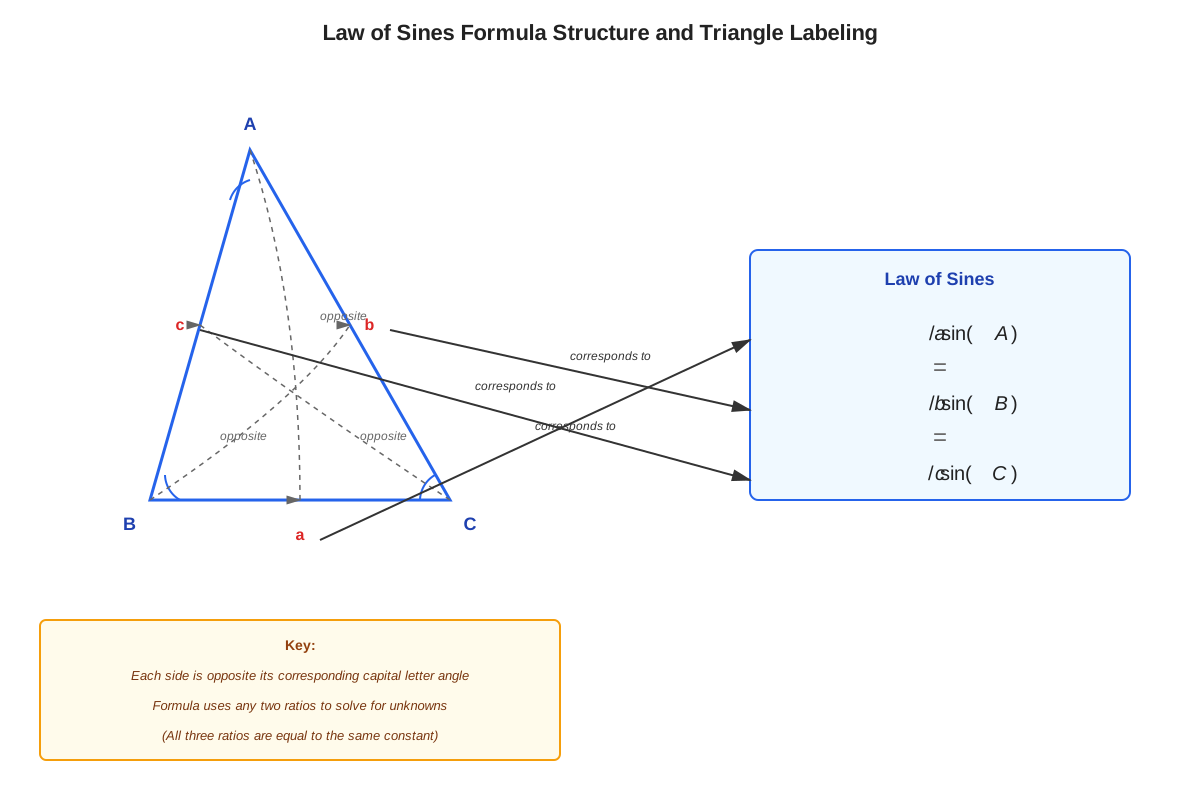
The law of sines states that in any triangle, the ratio of each side length to the sine of its opposite angle is constant. Mathematically, for a triangle with sides a, b, c and opposite angles A, B, C respectively:
a/sin(A) = b/sin(B) = c/sin(C)This can also be written in reciprocal form:
sin(A)/a = sin(B)/b = sin(C)/cBoth forms are mathematically equivalent, but the first form (sides over sines) is generally more intuitive for solving problems. The key insight is that this relationship holds for any triangle—right, acute, or obtuse—making it universally applicable.
When to Apply the Law of Sines
The law of sines is the appropriate tool when you have specific combinations of known information about a triangle:
Angle-Angle-Side (AAS): Two angles and one non-included side are known. Since you can find the third angle using the angle sum theorem (180° - A - B = C), you effectively know all three angles and one side, allowing you to find any remaining side.
Angle-Side-Angle (ASA): Two angles and the included side are known. This is essentially the same as AAS after finding the third angle—you have all angles and one side.
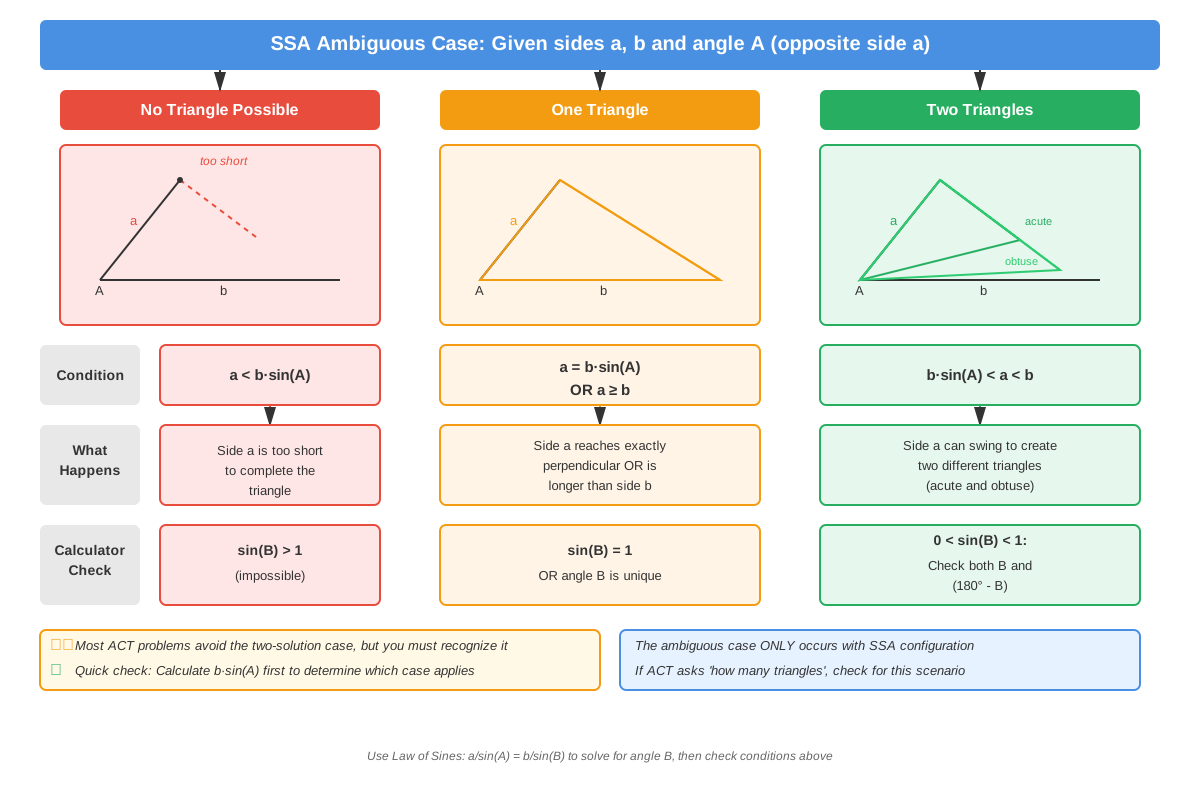
Side-Side-Angle (SSA): Two sides and an angle opposite one of the known sides are given. This case requires caution because it can produce zero, one, or two valid triangles (the ambiguous case).
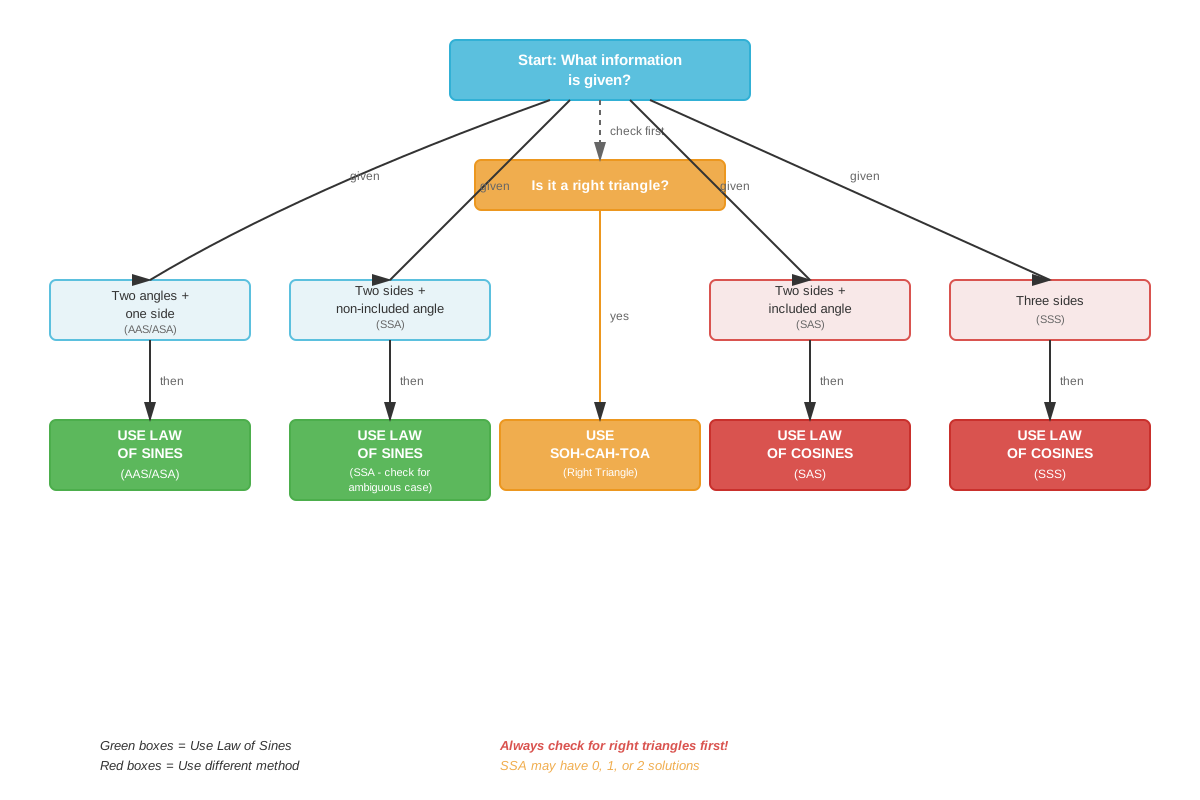
The law of sines is not the best choice when you have Side-Angle-Side (SAS) or Side-Side-Side (SSS) configurations—these require the law of cosines instead.
Setting Up the Proportion
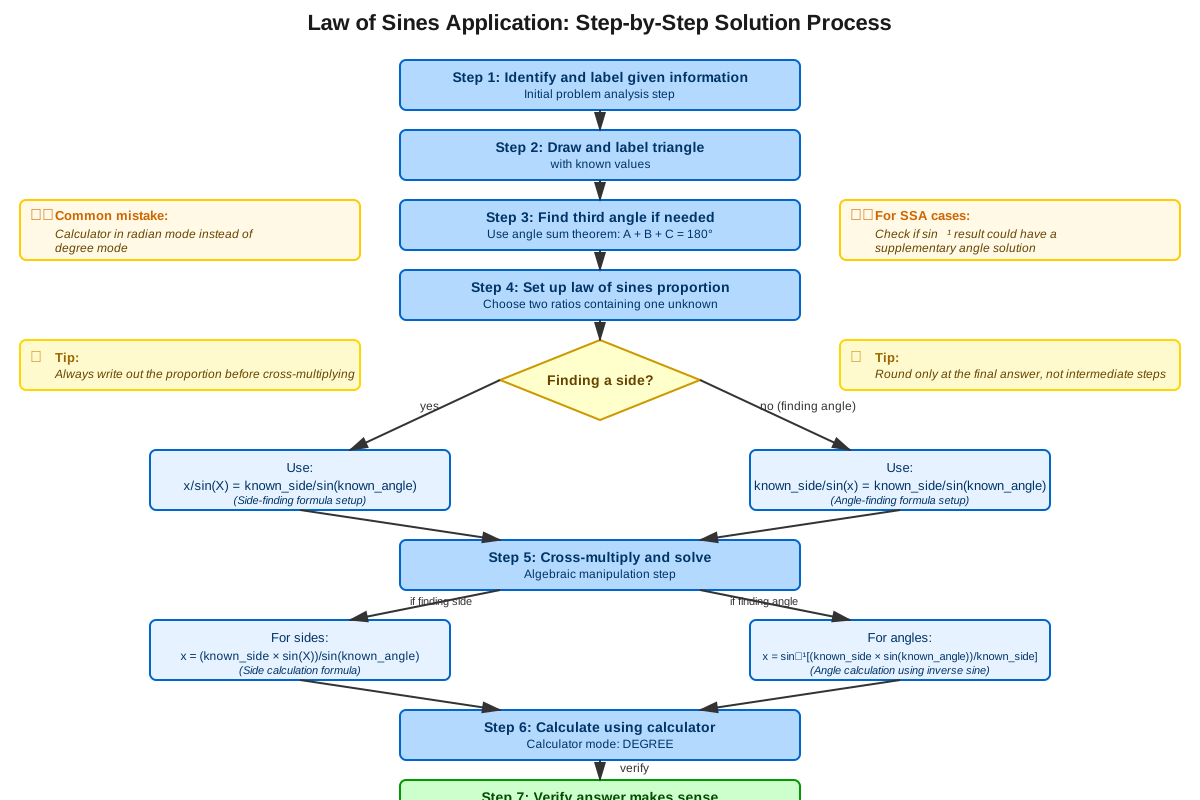
Proper setup is critical for accurate solutions. Follow these steps:
- Label the triangle: Assign lowercase letters (a, b, c) to sides and uppercase letters (A, B, C) to their opposite angles
- Identify knowns and unknowns: Determine which measurements you have and which you need
- Select the appropriate ratio: Use only the parts of the law of sines formula that involve your known and unknown values
- Write the proportion: Set up an equation using two ratios, ensuring each ratio contains one known and one unknown (or both knowns)
For example, if you know side a, angle A, and angle B, and need to find side b, write:
a/sin(A) = b/sin(B)Solving for Unknown Sides
When finding an unknown side length:
- Set up the proportion with the unknown side in the numerator
- Cross-multiply to isolate the unknown
- Calculate the sine values using a calculator
- Solve for the unknown side
Example: Given a = 10, A = 30°, B = 45°, find b.
10/sin(30°) = b/sin(45°)
10/0.5 = b/0.707
20 = b/0.707
b = 20 × 0.707 = 14.14
Solving for Unknown Angles
When finding an unknown angle:
- Set up the proportion with the unknown angle's sine in the numerator
- Cross-multiply and isolate sin(unknown angle)
- Use the inverse sine function (sin⁻¹ or arcsin) to find the angle
- Consider whether the angle could be obtuse (see ambiguous case below)
Example: Given a = 8, b = 10, A = 40°, find B.
8/sin(40°) = 10/sin(B)
8 × sin(B) = 10 × sin(40°)
sin(B) = (10 × 0.643)/8 = 0.804
B = sin⁻¹(0.804) = 53.5°
The Ambiguous Case (SSA)
The ambiguous case occurs with Side-Side-Angle (SSA) configurations when the given angle is acute and opposite the shorter of the two given sides. Because sine is positive for both acute and obtuse angles (sin(θ) = sin(180° - θ)), two different triangles might satisfy the given conditions.
When solving for an angle using inverse sine, your calculator returns only the acute angle. To check for a second solution:
- Calculate the acute angle using sin⁻¹
- Find the supplementary angle: 180° - (acute angle)
- Check if this obtuse angle, combined with the other known angle, produces a valid triangle (sum < 180°)
- If valid, two triangles exist; if not, only one triangle exists
On the ACT, ambiguous case questions are rare but do appear. The test typically asks for "the length of side x" without acknowledging multiple solutions, implying you should provide the answer for the acute angle case unless context suggests otherwise.
Triangle Classification and the Law of Sines
The law of sines works for all triangle types:
| Triangle Type | Angle Characteristics | Law of Sines Application |
|---|---|---|
| Acute | All angles < 90° | Standard application |
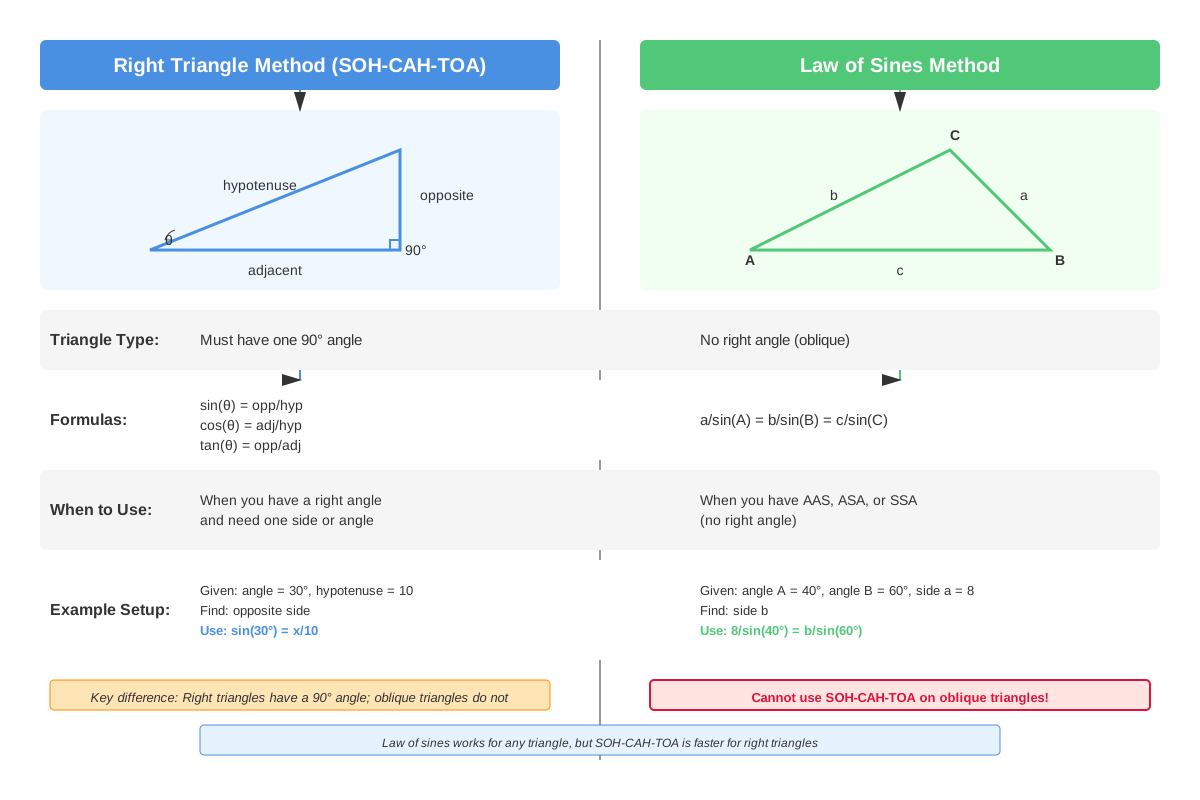
| Right | One angle = 90° | Works but SOH-CAH-TOA is simpler |
| Obtuse | One angle > 90° | Standard application; watch for ambiguous case |
For right triangles, the law of sines reduces to basic trigonometric ratios, confirming its consistency with fundamental principles.
Concept Relationships
The law of sines builds directly on the sine function from basic trigonometry, extending its application beyond right triangles to any triangle configuration. This represents a conceptual leap from "sine as a ratio in right triangles" to "sine as a tool for relating any side to its opposite angle."
The angle sum theorem (angles in a triangle sum to 180°) serves as a critical companion to the law of sines. Most problems require using this theorem to find a third angle before applying the law, creating a two-step solution process: angle sum theorem → law of sines.
Within trigonometry, the law of sines connects to the law of cosines as complementary tools. The relationship follows this decision tree: Given triangle information → Identify configuration (AAS/ASA/SSA vs. SAS/SSS) → Apply law of sines for angle-heavy configurations or law of cosines for side-heavy configurations. Together, these laws provide complete coverage for solving any triangle.
The law of sines also relates to triangle area formulas. The formula Area = (1/2)ab·sin(C) uses the sine function in a similar way, and problems sometimes require finding an area after using the law of sines to determine missing measurements.
Relationship map: Basic sine function → Law of sines → Triangle solving → Law of cosines (alternative method) → Advanced applications (navigation, surveying). Parallel path: Angle sum theorem → Finding missing angles → Enabling law of sines application.
Quick check — test yourself on Law of sines basics so far.
Try Flashcards →High-Yield Facts
⭐ The law of sines formula is a/sin(A) = b/sin(B) = c/sin(C), where lowercase letters represent sides and uppercase letters represent opposite angles
⭐ Use the law of sines when you know two angles and any side (AAS or ASA) or two sides and an angle opposite one of them (SSA)
⭐ Always find the third angle using the angle sum theorem (A + B + C = 180°) before applying the law of sines if only two angles are given
⭐ To solve for an unknown side, cross-multiply and isolate the unknown; to solve for an unknown angle, use inverse sine (sin⁻¹) after isolating the sine of the unknown angle
⭐ The ambiguous case (SSA) can produce two valid triangles when the given angle is acute and opposite the shorter given side
- The law of sines works for all triangle types: acute, right, and obtuse triangles
- When using sin⁻¹ on a calculator, the result is always between 0° and 90°; check if the supplementary angle (180° - result) also works
- The law of sines cannot be used effectively for Side-Angle-Side (SAS) or Side-Side-Side (SSS) configurations—these require the law of cosines
- In ACT problems, diagrams are usually drawn to scale, helping you estimate whether an answer is reasonable
- If a problem gives you enough information to use either the law of sines or basic right-triangle trigonometry, the simpler method (SOH-CAH-TOA) is usually faster
Common Misconceptions
Misconception: The law of sines only works for right triangles. → Correction: The law of sines works for all triangles—acute, right, and obtuse. In fact, for right triangles, basic trigonometric ratios (SOH-CAH-TOA) are typically more efficient, though the law of sines still produces correct results.
Misconception: You can use the law of sines whenever you know three pieces of information about a triangle. → Correction: The law of sines requires specific configurations: two angles and a side (AAS/ASA) or two sides and an angle opposite one of them (SSA). If you have Side-Angle-Side (SAS) or Side-Side-Side (SSS), you must use the law of cosines instead.
Misconception: When solving for an angle, the calculator's sin⁻¹ function always gives the correct answer. → Correction: The sin⁻¹ function only returns acute angles (0° to 90°). If the triangle contains an obtuse angle, you must check whether the supplementary angle (180° - calculator result) is the correct solution by verifying that all angles sum to 180°.
Misconception: The letters a, b, c and A, B, C can be assigned arbitrarily to any sides and angles. → Correction: The law of sines requires that each lowercase letter (side) corresponds to the uppercase letter (angle) directly opposite it. Side a must be opposite angle A, side b opposite angle B, and side c opposite angle C. Incorrect labeling leads to wrong answers.
Misconception: If you know two sides and two angles, you should use all four values in the law of sines formula. → Correction: The law of sines uses only two ratios at a time. Select the ratio containing your unknown value and pair it with a ratio where both values are known. Using more than two ratios simultaneously creates unnecessary complexity and potential errors.
Worked Examples
Example 1: Finding an Unknown Side (AAS Configuration)
Problem: In triangle ABC, angle A = 35°, angle B = 72°, and side a = 15 cm. Find the length of side b.
Solution:
Step 1: Identify the configuration. We have two angles and a side, making this an AAS problem—perfect for the law of sines.
Step 2: Label what we know:
- Angle A = 35°
- Angle B = 72°
- Side a = 15 cm (opposite angle A)
- Side b = ? (opposite angle B)
Step 3: Set up the law of sines proportion using the known side-angle pair and the unknown side-angle pair:
a/sin(A) = b/sin(B)
15/sin(35°) = b/sin(72°)
Step 4: Calculate the sine values:
- sin(35°) ≈ 0.574
- sin(72°) ≈ 0.951
Step 5: Substitute and solve:
15/0.574 = b/0.951
26.13 = b/0.951
b = 26.13 × 0.951
b ≈ 24.85 cmAnswer: Side b is approximately 24.85 cm.
Connection to learning objectives: This example demonstrates identifying when the law of sines applies (AAS configuration), explaining the strategy (setting up the proportion with known and unknown values), and applying the formula accurately to find an unknown side.
Example 2: Finding an Unknown Angle (SSA Configuration with Ambiguous Case Check)
Problem: In triangle XYZ, side x = 20 inches, side y = 25 inches, and angle X = 42°. Find angle Y.
Solution:
Step 1: Identify the configuration. We have two sides and an angle opposite one of them (SSA). This is a law of sines problem, but we must watch for the ambiguous case.
Step 2: Label what we know:
- Side x = 20 inches (opposite angle X)
- Side y = 25 inches (opposite angle Y)
- Angle X = 42°
- Angle Y = ?
Step 3: Set up the law of sines proportion:
x/sin(X) = y/sin(Y)
20/sin(42°) = 25/sin(Y)
Step 4: Calculate sin(42°) and solve for sin(Y):
20/0.669 = 25/sin(Y)
29.89 = 25/sin(Y)
sin(Y) = 25/29.89
sin(Y) ≈ 0.836
Step 5: Use inverse sine to find angle Y:
Y = sin⁻¹(0.836) ≈ 56.8°Step 6: Check for the ambiguous case. The supplementary angle is:
180° - 56.8° = 123.2°Check if this creates a valid triangle:
X + Y = 42° + 123.2° = 165.2°Since 165.2° < 180°, a second triangle is possible with angle Y = 123.2°.
Step 7: Determine which answer the ACT expects. Since the problem asks for "angle Y" without specifying, and angle X (42°) is acute while side y (25) is longer than side x (20), the acute angle solution (56.8°) is more typical. However, both are mathematically valid.
Answer: Angle Y is approximately 56.8° (or possibly 123.2° in the ambiguous case).
Connection to learning objectives: This example shows identifying an SSA configuration, applying the law of sines to find an angle using inverse sine, and recognizing the ambiguous case—demonstrating comprehensive mastery of law of sines basics.
Exam Strategy
When approaching ACT questions involving the law of sines, begin by quickly sketching the triangle if one isn't provided, labeling all given information. This visual reference prevents confusion about which sides correspond to which angles. Look for trigger phrases like "oblique triangle," "non-right triangle," or scenarios describing indirect measurement (surveying across a river, measuring building heights from a distance).
Identify the configuration immediately: Count what you know—two angles and a side? That's AAS/ASA, use law of sines. Two sides and an angle? Check if it's SSA (law of sines) or SAS (law of cosines). This decision takes 5-10 seconds but prevents wasting time on the wrong approach.
For process of elimination, calculate whether your answer makes geometric sense. If you're finding a side opposite a larger angle, it should be longer than a side opposite a smaller angle (larger angles are opposite longer sides). If your calculated angle, when added to the other known angles, exceeds 180°, you've made an error. Use the diagram's scale to estimate: if the diagram shows a side roughly twice as long as another, your numerical answer should reflect this.
Time allocation: Law of sines problems typically require 60-90 seconds. If you're exceeding two minutes, you may be overcomplicating the solution. The ACT rewards efficient problem-solving—set up the proportion, calculate, and move on. Don't second-guess correct work.
Calculator efficiency: Pre-calculate all sine values before setting up proportions to minimize calculator errors. Use parentheses carefully when entering fractions. For inverse sine, ensure your calculator is in degree mode (not radians). Double-check that you're using sin⁻¹ (not sin) when finding angles.
Common trap answers: The ACT often includes the supplementary angle as a distractor in multiple-choice options. If you see two answer choices that sum to 180°, you're likely dealing with an ambiguous case question—verify which angle creates a valid triangle. Another trap is providing sin(angle) instead of the angle itself; always complete the inverse sine step.
Memory Techniques
Mnemonic for when to use law of sines: "Angles And Sides Separate" (AAS/ASA configurations) or "Sides Surround Angles" (SSA configuration). If angles and sides are separated (not adjacent), use law of sines.
Formula memory: Think "Side Over Sine" (SOS) to remember the formula structure: side/sin(opposite angle). This also creates a helpful distress signal metaphor—when you're in distress about solving a triangle, send an SOS!
Visualization strategy: Picture a triangle as a seesaw balanced on its center. Larger angles "weigh more" and have longer sides opposite them. This reinforces that the ratio of side to sine of opposite angle remains constant—it's the "balance point" of the triangle.
Ambiguous case memory: "SSA Sometimes Splits Answers" reminds you that SSA configurations can produce two valid triangles. Visualize a hinge: when you know two sides and an angle not between them, the triangle can "swing" to two different positions.
Acronym for solution steps: SLIP
- Set up the triangle (label and identify configuration)
- Law of sines proportion (write the equation)
- Isolate the unknown (cross-multiply and solve)
- Prove it's reasonable (check against diagram and angle sum)
Summary
The law of sines basics provides a systematic method for solving oblique triangles when you know two angles and a side (AAS/ASA) or two sides and an angle opposite one of them (SSA). The fundamental formula—a/sin(A) = b/sin(B) = c/sin(C)—establishes that the ratio of any side to the sine of its opposite angle remains constant throughout the triangle. Successful application requires correctly identifying when the law applies (versus when the law of cosines is needed), properly labeling sides and their opposite angles, setting up proportions with one known and one unknown value, and executing calculations accurately using a calculator. The ambiguous case (SSA) demands special attention, as it can produce two valid triangles when the given angle is acute and opposite the shorter given side. On the ACT, law of sines questions appear 1-2 times per test, typically in the higher-difficulty range, making them high-yield targets for score improvement. Mastery requires understanding both the conceptual foundation (why the relationship holds for any triangle) and procedural fluency (setting up and solving proportions efficiently under time pressure).
Key Takeaways
- The law of sines formula a/sin(A) = b/sin(B) = c/sin(C) works for all triangles and relates each side to its opposite angle
- Use the law of sines for AAS, ASA, or SSA configurations; use the law of cosines for SAS or SSS configurations
- Always apply the angle sum theorem (A + B + C = 180°) to find missing angles before using the law of sines
- To find a side, cross-multiply and solve; to find an angle, isolate the sine and use sin⁻¹, checking for the ambiguous case
- The SSA configuration can produce zero, one, or two valid triangles—verify that angle sums don't exceed 180°
- Proper labeling is critical: each lowercase side letter must correspond to the uppercase angle letter directly opposite it
- On the ACT, these questions appear 1-2 times per test and separate high scorers from average performers
Related Topics
Law of Cosines: The complementary tool to the law of sines, used for SAS and SSS triangle configurations. Mastering the law of sines first makes the law of cosines easier to understand, as both represent extensions of basic trigonometry to oblique triangles.
Triangle Area Formulas: The formula Area = (1/2)ab·sin(C) uses the sine function similarly to the law of sines. After finding missing measurements with the law of sines, you can calculate areas using this formula.
Vectors and Components: The law of sines underlies vector resolution problems, where forces or velocities at angles must be analyzed. Understanding triangle solving prepares you for physics-based ACT science questions.
Coordinate Geometry with Triangles: Problems involving triangles on the coordinate plane sometimes require the law of sines after using the distance formula to find side lengths.
Advanced Trigonometric Identities: The derivation of the law of sines uses the sine function's properties, connecting to sum/difference formulas and other identities tested on higher-level exams.
Practice CTA
Now that you've mastered the law of sines basics, it's time to cement your understanding through active practice. Work through the practice questions to test your ability to identify when the law applies, set up proportions correctly, and calculate accurately under timed conditions. Use the flashcards to drill the formula, key configurations, and common pitfalls until they become automatic. Remember: the law of sines appears on every ACT, and mastering it can add crucial points to your Math score. The difference between a good score and a great score often comes down to confidently solving these higher-difficulty trigonometry problems. You've got this—now prove it with practice!
Sign up free to keep reading
Create a free AnvayaPrep account to finish this ACT guide on Law of sines basics — plus flashcards and practice questions.