Overview
The Pythagorean identity stands as one of the most fundamental and frequently tested concepts in ACT trigonometry. This identity, expressed as sin²θ + cos²θ = 1, emerges directly from the Pythagorean theorem applied to the unit circle and serves as the foundation for solving countless trigonometric problems. On the ACT Math section, questions involving this identity appear regularly, often disguised within algebraic manipulations, equation solving, or simplification problems that require students to recognize when and how to apply this powerful relationship.
Understanding the ACT Pythagorean identity goes beyond simple memorization—it requires recognizing its various forms and knowing when to deploy it strategically. The ACT frequently tests this concept by presenting trigonometric expressions that appear complex but simplify elegantly when the Pythagorean identity is applied. Students who master this identity gain a significant advantage, as it unlocks solutions to problems involving trigonometric equations, simplifications, and proofs that would otherwise seem intractable.
This topic connects intimately with broader mathematical concepts including the unit circle, right triangle trigonometry, and algebraic manipulation. The Pythagorean identity serves as a bridge between geometric understanding and algebraic facility, demonstrating how spatial relationships translate into powerful computational tools. For ACT success, this identity represents high-yield material that appears across multiple question types and difficulty levels, making it an essential component of any comprehensive test preparation strategy.
Learning Objectives
- [ ] Identify when Pythagorean identity is being tested in ACT questions
- [ ] Explain the core rule or strategy behind Pythagorean identity
- [ ] Apply Pythagorean identity to ACT-style questions accurately
- [ ] Derive alternative forms of the Pythagorean identity (tan²θ + 1 = sec²θ and 1 + cot²θ = csc²θ)
- [ ] Recognize disguised applications of the Pythagorean identity in complex expressions
- [ ] Solve trigonometric equations using the Pythagorean identity within 60 seconds
- [ ] Simplify trigonometric expressions by strategically substituting equivalent forms
Prerequisites
- Basic trigonometric ratios (sine, cosine, tangent): The Pythagorean identity relates sine and cosine, so understanding these fundamental ratios is essential for comprehending the identity's meaning and applications
- Pythagorean theorem (a² + b² = c²): The trigonometric Pythagorean identity derives directly from this geometric theorem applied to the unit circle
- Unit circle fundamentals: Understanding how angles correspond to coordinate points on the unit circle provides the geometric foundation for why sin²θ + cos²θ = 1
- Algebraic manipulation skills: Applying the Pythagorean identity requires rearranging equations, factoring, and substituting expressions
- Reciprocal and quotient trigonometric identities: The alternative forms of the Pythagorean identity involve secant, cosecant, and tangent functions
Why This Topic Matters
The Pythagorean identity appears in approximately 2-4 questions per ACT Math section, making it one of the highest-yield trigonometry concepts for test preparation. These questions typically appear in the latter half of the 60-question section, where difficulty increases and point values remain constant. Mastering this single identity can secure 3-7% of the total Math score, representing a significant return on study investment.
In real-world applications, the Pythagorean identity underpins engineering calculations, physics problems involving wave motion and oscillations, computer graphics transformations, and signal processing. Architects use these relationships when calculating structural loads, while electrical engineers apply them to analyze alternating current circuits. The identity's universality across scientific disciplines reflects its fundamental nature in describing periodic phenomena and circular motion.
On the ACT, the Pythagorean identity most commonly appears in three question formats: direct simplification problems where students must reduce complex trigonometric expressions, equation-solving questions requiring substitution to eliminate one trigonometric function in favor of another, and verification problems where students must determine whether given statements are true. The test writers frequently embed this identity within multi-step problems, testing whether students can recognize the appropriate tool amid algebraic complexity. Questions may present the identity in non-standard forms, require students to manipulate it before application, or combine it with other trigonometric concepts to assess deeper understanding.
Core Concepts
The Fundamental Pythagorean Identity
The Pythagorean identity in its most basic form states:
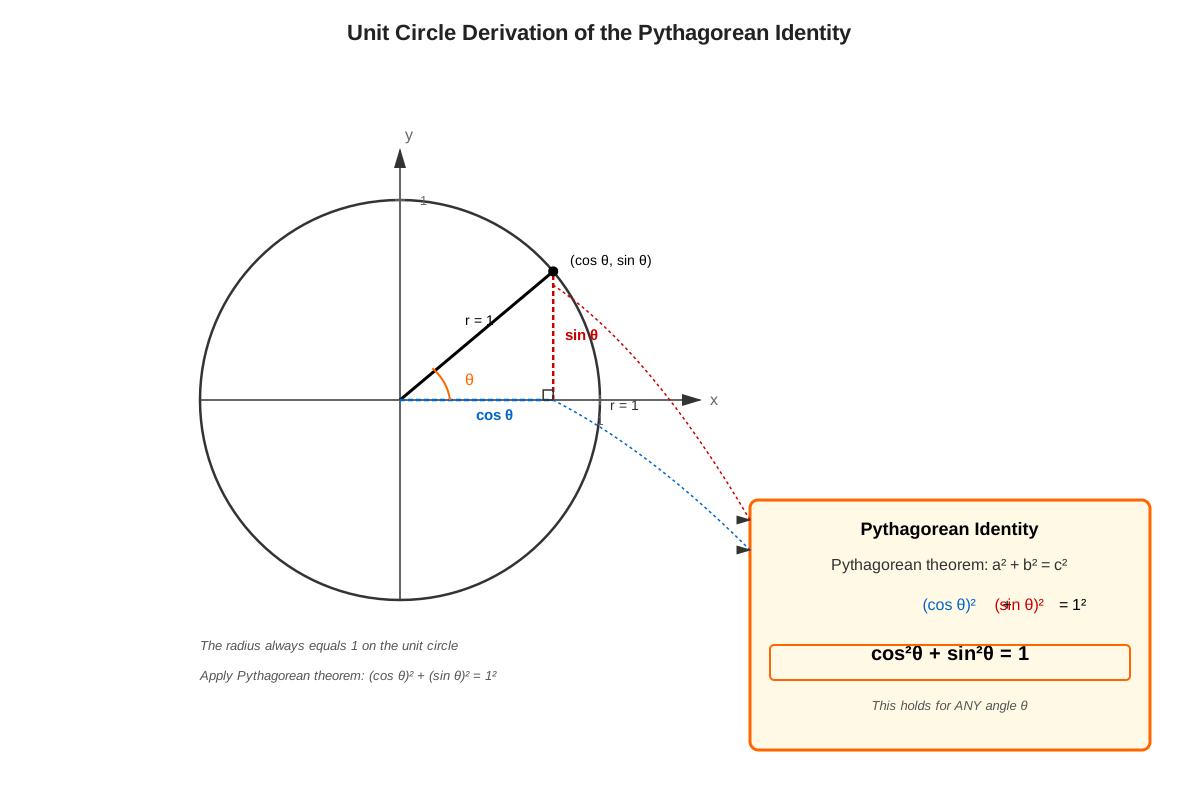
sin²θ + cos²θ = 1This identity holds true for all angle measures θ, whether expressed in degrees or radians. The notation sin²θ is shorthand for (sin θ)², meaning the sine of angle θ, squared. This relationship emerges from the unit circle, where any point on the circle has coordinates (cos θ, sin θ) for some angle θ measured from the positive x-axis. Since the radius of the unit circle equals 1, the Pythagorean theorem applied to the right triangle formed gives us: (cos θ)² + (sin θ)² = 1².
The geometric interpretation provides intuitive understanding: on the unit circle, the horizontal distance from the origin to a point equals cos θ, while the vertical distance equals sin θ. These two perpendicular distances, when combined using the Pythagorean theorem, must equal the radius (which is 1). This geometric foundation explains why the identity remains valid regardless of which quadrant the angle terminates in—the relationship between the coordinates and the radius persists universally.
Alternative Forms of the Pythagorean Identity
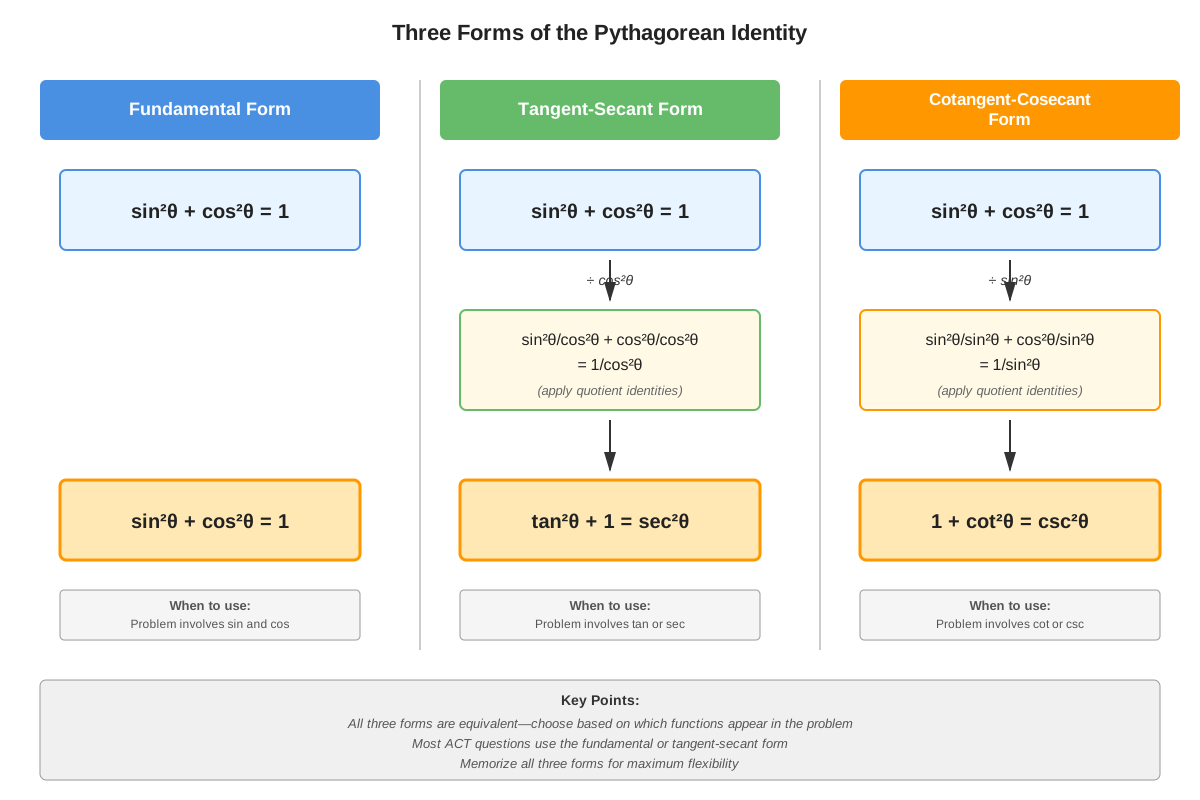
The fundamental identity can be algebraically manipulated to produce two additional forms that prove equally valuable for ACT problem-solving:
Tangent-Secant Form:
tan²θ + 1 = sec²θThis form derives from dividing every term in the fundamental identity by cos²θ:
- sin²θ/cos²θ + cos²θ/cos²θ = 1/cos²θ
- tan²θ + 1 = sec²θ
Cotangent-Cosecant Form:
1 + cot²θ = csc²θThis form emerges from dividing every term in the fundamental identity by sin²θ:
- sin²θ/sin²θ + cos²θ/sin²θ = 1/sin²θ
- 1 + cot²θ = csc²θ
| Identity Form | When to Use | Common ACT Applications |
|---|---|---|
| sin²θ + cos²θ = 1 | Expressions mixing sine and cosine | Simplification, solving for one function given another |
| tan²θ + 1 = sec²θ | Expressions with tangent and secant | Simplifying rational expressions, solving equations |
| 1 + cot²θ = csc²θ | Expressions with cotangent and cosecant | Less common but appears in advanced problems |
Rearranging the Pythagorean Identity
Strategic rearrangement of the fundamental identity creates powerful substitution tools:
- Solving for sin²θ: sin²θ = 1 - cos²θ
- Solving for cos²θ: cos²θ = 1 - sin²θ
- Solving for sin θ: sin θ = ±√(1 - cos²θ)
- Solving for cos θ: cos θ = ±√(1 - sin²θ)
The ± symbol in the square root forms reminds us that both positive and negative values are possible, depending on which quadrant the angle terminates in. ACT questions typically provide sufficient context to determine the correct sign, either through explicit quadrant information or through the problem's constraints.
Recognition Patterns for ACT Questions
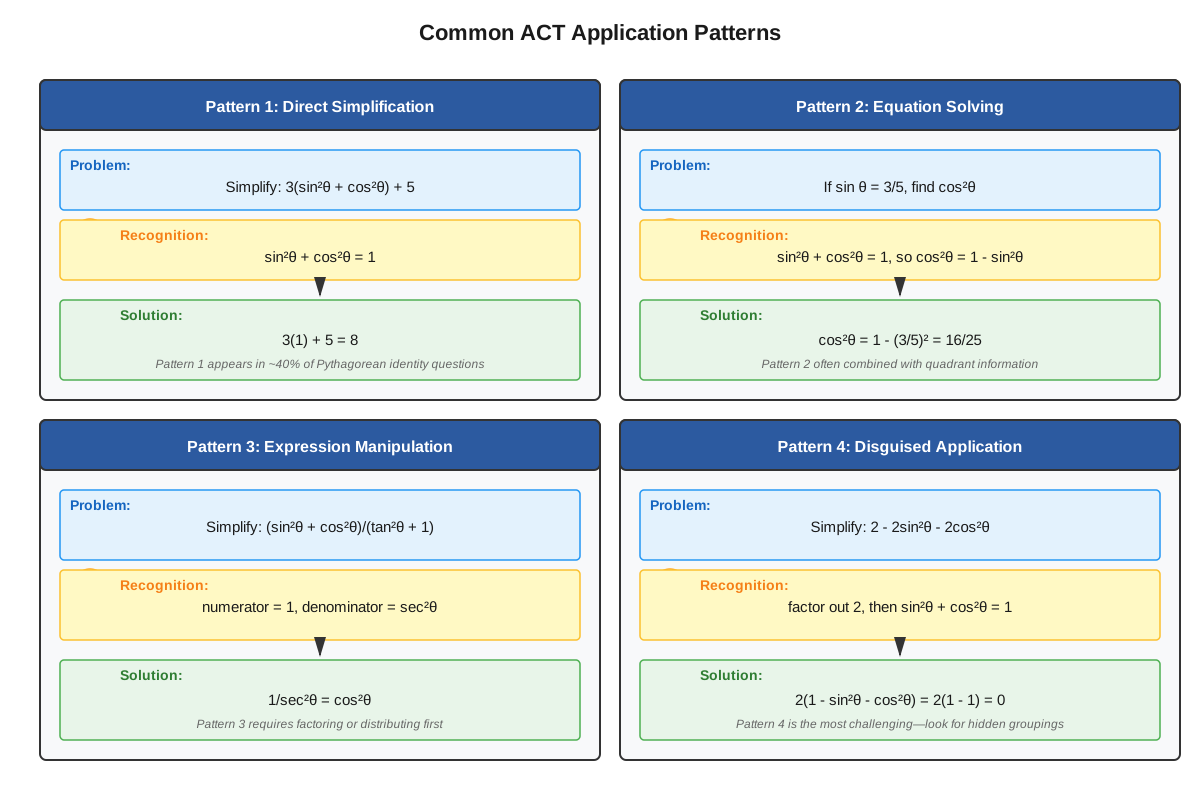
The ACT rarely presents the Pythagorean identity in its naked form. Instead, questions disguise the identity within more complex expressions. Developing pattern recognition skills accelerates problem-solving:
Pattern 1: Sum of Squared Trig Functions
When seeing sin²θ + cos²θ anywhere in an expression, immediately recognize this equals 1.
Pattern 2: Difference from 1
Expressions like 1 - sin²θ or 1 - cos²θ signal an opportunity to substitute the complementary squared function.
Pattern 3: Rational Expressions
Fractions with sin²θ or cos²θ in numerators or denominators often simplify when the Pythagorean identity is applied.
Pattern 4: Equations to Solve
When an equation contains both sine and cosine of the same angle, the Pythagorean identity typically provides the path to solution by eliminating one function.
Application Strategy
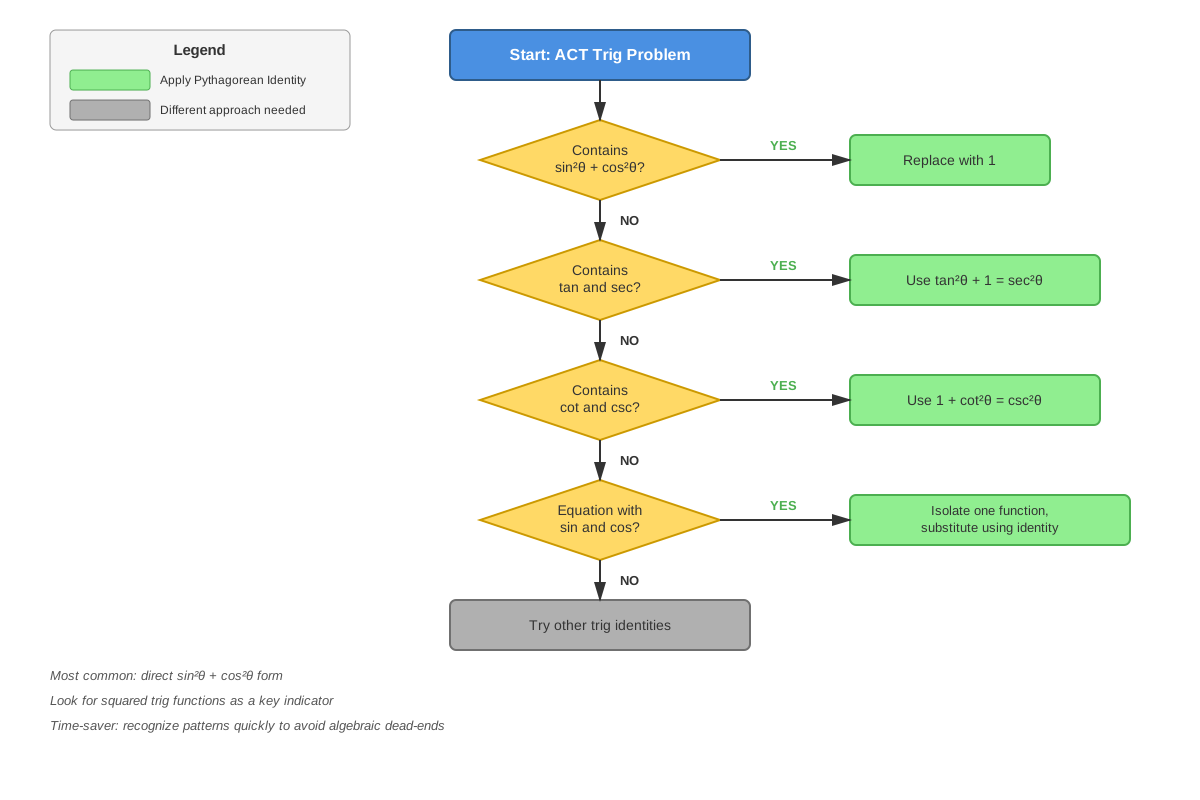
Applying the Pythagorean identity effectively requires a systematic approach:
- Identify all trigonometric functions present in the expression or equation
- Determine which form of the Pythagorean identity matches the functions present
- Decide whether to substitute or to rearrange the identity first
- Execute the substitution carefully, maintaining proper algebraic form
- Simplify the result using standard algebraic techniques
- Verify the answer makes sense in context (checking domain restrictions, sign considerations)
Concept Relationships
The Pythagorean identity serves as a central hub connecting multiple trigonometric concepts. At its foundation lies the unit circle definition of trigonometric functions, which provides the geometric justification for why sin²θ + cos²θ = 1. This geometric relationship → translates into → an algebraic identity that enables computational problem-solving.
The fundamental Pythagorean identity → generates → two alternative forms (tangent-secant and cotangent-cosecant) through algebraic manipulation using reciprocal and quotient identities. These alternative forms → expand → the range of problems solvable using Pythagorean relationships, particularly when dealing with functions beyond sine and cosine.
Within problem-solving contexts, the Pythagorean identity → connects to → algebraic factoring techniques, especially when expressions like sin²θ - cos²θ appear, which can be factored as (sin θ + cos θ)(sin θ - cos θ) and then related back to the Pythagorean identity. The identity also → interfaces with → equation-solving strategies, providing a method to convert equations with two different trigonometric functions into equations with a single function.
Looking forward, mastery of the Pythagorean identity → prepares students for → more advanced trigonometric identities including double-angle formulas, half-angle formulas, and sum-difference identities, all of which frequently employ the Pythagorean identity as a simplification tool. The identity also → supports → calculus applications, where it appears in integration techniques and in simplifying derivatives of trigonometric functions.
High-Yield Facts
⭐ The fundamental Pythagorean identity sin²θ + cos²θ = 1 is valid for all angles θ without exception
⭐ The identity can be rearranged to sin²θ = 1 - cos²θ or cos²θ = 1 - sin²θ for strategic substitution
⭐ The tangent-secant form tan²θ + 1 = sec²θ appears frequently in ACT problems involving tangent or secant
⭐ When an expression contains both sin²θ and cos²θ, look immediately for opportunities to apply the Pythagorean identity
⭐ The identity 1 + cot²θ = csc²θ is the least common form but still appears on approximately 1 in 10 ACT exams
- Dividing the fundamental identity by cos²θ yields the tangent-secant form; dividing by sin²θ yields the cotangent-cosecant form
- The Pythagorean identity derives its name from the Pythagorean theorem applied to the unit circle
- When solving for sin θ or cos θ using the identity, the ± sign requires quadrant analysis to determine the correct sign
- The identity can be used to convert any trigonometric expression into one involving only sine, only cosine, or only tangent
- Expressions like sin⁴θ + cos⁴θ can be simplified using the Pythagorean identity combined with algebraic techniques
- The identity remains valid whether angles are measured in degrees or radians
- On the ACT, approximately 60% of Pythagorean identity questions involve the fundamental form, while 35% use the tangent-secant form
Quick check — test yourself on Pythagorean identity so far.
Try Flashcards →Common Misconceptions
Misconception: The Pythagorean identity only works for acute angles or angles in the first quadrant.
Correction: The identity sin²θ + cos²θ = 1 holds for all real angle measures in all four quadrants. The squaring operation eliminates sign concerns, making the identity universal.
Misconception: sin²θ means sin(θ²) or the sine of theta squared.
Correction: The notation sin²θ means (sin θ)²—first find the sine of θ, then square that result. The exponent applies to the function value, not to the angle itself.
Misconception: When rearranging to sin θ = √(1 - cos²θ), only the positive square root is valid.
Correction: Both positive and negative values are possible: sin θ = ±√(1 - cos²θ). The correct sign depends on which quadrant the angle terminates in. Angles in quadrants I and II have positive sine values, while angles in quadrants III and IV have negative sine values.
Misconception: The Pythagorean identity can be applied to different angles, such as sin²α + cos²β = 1.
Correction: The identity only holds when the same angle appears in both terms: sin²θ + cos²θ = 1. Mixing different angles invalidates the relationship because the geometric foundation (a single point on the unit circle) no longer applies.
Misconception: The alternative forms tan²θ + 1 = sec²θ and 1 + cot²θ = csc²θ are separate, unrelated identities.
Correction: These alternative forms derive directly from the fundamental Pythagorean identity through algebraic manipulation. They represent the same geometric relationship expressed using different trigonometric functions, making them equivalent rather than independent.
Misconception: The Pythagorean identity can be used to find exact values like sin 30° + cos 30°.
Correction: The identity relates sin²θ + cos²θ (squared terms summing to 1), not sin θ + cos θ (unsquared terms). The sum sin θ + cos θ varies with θ and does not equal any constant value.
Worked Examples
Example 1: Simplification Using Direct Substitution
Problem: Simplify the expression (sin²θ + cos²θ)² + sin²θ
Solution:
Step 1: Identify the Pythagorean identity within the expression. The term sin²θ + cos²θ appears inside the parentheses.
Step 2: Apply the fundamental Pythagorean identity: sin²θ + cos²θ = 1
Substituting: (1)² + sin²θ
Step 3: Simplify the expression:
- (1)² = 1
- Therefore: 1 + sin²θ
Final Answer: 1 + sin²θ
Connection to Learning Objectives: This example demonstrates identifying when the Pythagorean identity is being tested (the sum sin²θ + cos²θ appears explicitly) and applying it accurately to simplify an expression. The key recognition skill involves spotting the identity even when embedded within a larger expression.
Example 2: Solving an Equation Using Substitution
Problem: If cos θ = 3/5 and θ is in the first quadrant, find the exact value of sin θ.
Solution:
Step 1: Write the fundamental Pythagorean identity:
sin²θ + cos²θ = 1
Step 2: Rearrange to solve for sin²θ:
sin²θ = 1 - cos²θ
Step 3: Substitute the given value cos θ = 3/5:
sin²θ = 1 - (3/5)²
sin²θ = 1 - 9/25
sin²θ = 25/25 - 9/25
sin²θ = 16/25
Step 4: Take the square root of both sides:
sin θ = ±√(16/25)
sin θ = ±4/5
Step 5: Determine the correct sign using quadrant information. Since θ is in the first quadrant, where all trigonometric functions are positive:
sin θ = 4/5
Final Answer: sin θ = 4/5
Connection to Learning Objectives: This example illustrates the core strategy of rearranging the Pythagorean identity to isolate the desired function, then substituting known values. It also demonstrates the critical thinking required to determine the appropriate sign based on quadrant analysis, a common ACT testing point.
Example 3: Simplifying with the Tangent-Secant Form
Problem: Simplify the expression (sec²θ - 1)/sec²θ
Solution:
Step 1: Recognize that this expression involves secant, suggesting the tangent-secant form of the Pythagorean identity might be useful.
Step 2: Recall the tangent-secant identity: tan²θ + 1 = sec²θ
Step 3: Rearrange to isolate sec²θ - 1:
sec²θ - 1 = tan²θ
Step 4: Substitute into the original expression:
(sec²θ - 1)/sec²θ = tan²θ/sec²θ
Step 5: Convert to sine and cosine for further simplification:
- tan²θ = sin²θ/cos²θ
- sec²θ = 1/cos²θ
Therefore: (sin²θ/cos²θ)/(1/cos²θ)
Step 6: Simplify the complex fraction:
(sin²θ/cos²θ) × (cos²θ/1) = sin²θ
Final Answer: sin²θ
Connection to Learning Objectives: This example demonstrates recognizing when an alternative form of the Pythagorean identity applies and executing a multi-step simplification that combines the identity with function conversions—a sophisticated skill frequently tested on the ACT.
Exam Strategy
When approaching ACT questions involving the Pythagorean identity, implement this systematic strategy:
Trigger Word Recognition: Watch for these phrases that signal Pythagorean identity questions:
- "Simplify the expression"
- "Which of the following is equivalent to"
- "If sin θ = [value], find cos θ"
- "For all values of θ"
- Any expression containing both sine and cosine of the same angle
Initial Assessment Process:
- Scan the expression for sin²θ + cos²θ or related patterns
- Identify which trigonometric functions appear (sine/cosine, tangent/secant, or cotangent/cosecant)
- Determine whether direct substitution or rearrangement is needed
- Check if the problem provides specific angle values or requires general simplification
Time Management: Allocate 45-60 seconds for straightforward Pythagorean identity questions and up to 90 seconds for multi-step problems combining the identity with other concepts. If a solution path isn't apparent within 20 seconds, mark the question and return later rather than consuming excessive time.
Process of Elimination Tips:
- Eliminate answer choices that change the degree of trigonometric terms (e.g., if the question has squared terms, answers with unsquared terms are likely incorrect)
- Eliminate choices that introduce trigonometric functions not present in the original expression unless the question explicitly asks for conversion
- Test answer choices by substituting a convenient angle like θ = 45° or θ = 30° to verify equivalence
- Eliminate choices that would be undefined for certain angles if the original expression is defined for all angles
Common Question Variations:
- Type 1: Direct simplification requiring one substitution
- Type 2: Equation solving requiring rearrangement then substitution
- Type 3: Expression equivalence requiring multiple steps of manipulation
- Type 4: Combined problems integrating the Pythagorean identity with other trigonometric identities
ACT Tip: When stuck, try substituting θ = 45° into both the original expression and answer choices. Since sin 45° = cos 45° = √2/2, this angle often reveals which answer choice is equivalent to the original expression.
Memory Techniques
Primary Mnemonic - "Some People Can":
- Sine squared
- Plus
- Cosine squared equals 1
Visualization Strategy: Picture the unit circle with a right triangle inscribed. The horizontal leg (adjacent) represents cos θ, the vertical leg (opposite) represents sin θ, and the hypotenuse (radius) equals 1. Mentally apply the Pythagorean theorem: (cos θ)² + (sin θ)² = 1².
Alternative Forms Memory Device - "TAn SEC":
- TAngent squared plus 1
- SECant squared
- This reminds you that tan²θ + 1 = sec²θ
Rearrangement Acronym - "SICO":
- SIne squared = 1 - COsine squared
- COsine squared = 1 - SIne squared
- The letters alternate, helping you remember which function to subtract from 1
Quadrant Sign Memory - "All Students Take Calculus":
- Quadrant I: All functions positive
- Quadrant II: Sine (and cosecant) positive
- Quadrant III: Tangent (and cotangent) positive
- Quadrant IV: Cosine (and secant) positive
This helps determine the correct sign when taking square roots in Pythagorean identity problems.
Summary
The Pythagorean identity represents one of the most powerful and frequently tested tools in ACT trigonometry, appearing in multiple question types across various difficulty levels. The fundamental form, sin²θ + cos²θ = 1, derives from the Pythagorean theorem applied to the unit circle and remains valid for all angle measures. Two alternative forms—tan²θ + 1 = sec²θ and 1 + cot²θ = csc²θ—extend the identity's applicability to problems involving other trigonometric functions. Success on ACT questions requires not just memorizing these forms but developing pattern recognition skills to identify when the identity applies, even when disguised within complex expressions. Strategic rearrangement of the identity enables solving for unknown trigonometric values and simplifying expressions that initially appear intractable. The key to mastery lies in recognizing trigger patterns, selecting the appropriate form, executing substitutions accurately, and applying quadrant analysis when determining signs. With focused practice, the Pythagorean identity becomes an automatic tool that unlocks solutions efficiently, securing valuable points on test day.
Key Takeaways
- The fundamental Pythagorean identity sin²θ + cos²θ = 1 holds for all angles and appears in 2-4 questions per ACT Math section
- Two alternative forms (tan²θ + 1 = sec²θ and 1 + cot²θ = csc²θ) derive from the fundamental identity through algebraic manipulation
- Rearranging to sin²θ = 1 - cos²θ or cos²θ = 1 - sin²θ enables strategic substitution in equation-solving problems
- Pattern recognition is critical: immediately identify sin²θ + cos²θ combinations and expressions like 1 - sin²θ as opportunities to apply the identity
- When taking square roots, use quadrant analysis to determine whether the positive or negative value is correct
- The identity serves as a bridge between geometric understanding (unit circle) and algebraic problem-solving
- Allocate 45-90 seconds per question and use angle substitution (θ = 45°) as a verification strategy when uncertain
Related Topics
Double-Angle Identities: These formulas (such as sin 2θ = 2sin θ cos θ and cos 2θ = cos²θ - sin²θ) frequently incorporate the Pythagorean identity during derivation and simplification. Mastering the Pythagorean identity provides the foundation for understanding how double-angle formulas can be expressed in multiple equivalent forms.
Sum and Difference Identities: Formulas like sin(α ± β) and cos(α ± β) often require the Pythagorean identity during proof verification and problem-solving. The identity helps simplify expressions that emerge when expanding these formulas.
Trigonometric Equations: Solving equations like 2sin²θ + sin θ - 1 = 0 requires converting between trigonometric functions using the Pythagorean identity, then applying algebraic techniques like factoring or the quadratic formula.
Graphing Trigonometric Functions: Understanding how sin²θ + cos²θ = 1 relates to the unit circle deepens comprehension of why sine and cosine graphs have amplitude 1 and how their values relate at corresponding angles.
Polar Coordinates and Complex Numbers: The Pythagorean identity underlies the relationship between rectangular and polar coordinate systems, where r² = x² + y² connects to cos²θ + sin²θ = 1 through the substitutions x = r cos θ and y = r sin θ.
Practice CTA
Now that you've mastered the theoretical foundations of the Pythagorean identity, it's time to cement your understanding through active practice. Attempt the practice questions designed specifically to mirror ACT question formats and difficulty levels. Work through each problem systematically, applying the recognition patterns and strategies outlined in this guide. Use the flashcards to reinforce quick recall of the identity's various forms and common rearrangements. Remember: the difference between knowing the Pythagorean identity and scoring points with it lies in repeated, deliberate practice. Challenge yourself to identify the identity's presence even in disguised forms, and track your improvement as solution paths become increasingly automatic. Your investment in practice now translates directly into confidence and points on test day!
Sign up free to keep reading
Create a free AnvayaPrep account to finish this ACT guide on Pythagorean identity — plus flashcards and practice questions.