Overview
Reciprocal trig ratios are fundamental trigonometric functions that extend beyond the basic sine, cosine, and tangent functions most students learn first. These ratios—cosecant (csc), secant (sec), and cotangent (cot)—are simply the reciprocals of sine, cosine, and tangent respectively. While they may seem like additional complexity at first, understanding reciprocal trig ratios actually simplifies many trigonometric problems and provides alternative pathways to solutions that can save valuable time on the ACT.
On the ACT Math section, ACT reciprocal trig ratios appear regularly in the trigonometry subsection, which comprises approximately 4 questions per test. These questions often test whether students can recognize when a reciprocal relationship exists, convert between standard and reciprocal ratios, and apply these functions to solve problems involving right triangles, unit circles, and trigonometric identities. The ACT specifically favors questions that require students to identify equivalent expressions or simplify complex trigonometric expressions where reciprocal ratios provide the key insight.
Understanding reciprocal trig ratios connects directly to broader mathematical concepts including function transformations, algebraic manipulation, and the unit circle. These ratios are not isolated facts to memorize but rather natural extensions of the trigonometric system that reveal deeper patterns in how angles and sides of triangles relate. Mastery of this topic strengthens overall trigonometric fluency and provides essential tools for tackling the most challenging ACT Math problems, particularly those involving trigonometric identities and equation solving.
Learning Objectives
- [ ] Identify when Reciprocal trig ratios is being tested
- [ ] Explain the core rule or strategy behind Reciprocal trig ratios
- [ ] Apply Reciprocal trig ratios to ACT-style questions accurately
- [ ] Convert between standard trigonometric ratios and their reciprocals fluently
- [ ] Evaluate reciprocal trig functions for common angle measures
- [ ] Simplify trigonometric expressions using reciprocal identities
- [ ] Recognize equivalent forms of trigonometric expressions involving reciprocals
Prerequisites
- Basic trigonometric ratios (sine, cosine, tangent): Reciprocal ratios are defined as the multiplicative inverses of these fundamental functions
- Right triangle relationships: Understanding how sides relate to angles provides the foundation for all trigonometric ratios
- Unit circle concepts: The unit circle framework extends reciprocal ratios beyond right triangles to all angle measures
- Fraction operations and reciprocals: The mathematical concept of reciprocals (multiplicative inverses) is essential for understanding these ratios
- Special angle values (30°, 45°, 60°): These common angles appear frequently in ACT questions involving reciprocal ratios
Why This Topic Matters
Reciprocal trig ratios have practical applications in fields ranging from engineering to physics. In navigation, secant and cosecant functions help calculate distances and bearings. In wave mechanics and signal processing, these functions describe oscillations and periodic phenomena. Architects use reciprocal ratios when calculating structural angles and load distributions. Understanding these ratios provides a complete toolkit for analyzing any relationship involving angles and distances.
On the ACT, reciprocal trig ratios appear in approximately 1-2 questions per test, making them a high-yield topic relative to study time investment. These questions typically fall into three categories: direct evaluation (finding csc, sec, or cot of a given angle), expression simplification (reducing complex expressions using reciprocal identities), and equation solving (finding angles or values when reciprocal functions are involved). The ACT particularly favors questions that combine reciprocal ratios with other algebraic concepts, testing whether students can recognize multiple solution pathways.
Common question formats include: providing a triangle diagram and asking for a reciprocal ratio value, presenting a trigonometric expression and asking for an equivalent form, giving one trig ratio value and asking students to find a reciprocal ratio, or embedding reciprocal ratios within word problems involving angles of elevation or depression. The test writers specifically design questions where recognizing the reciprocal relationship provides the fastest solution path, rewarding students who have internalized these concepts rather than relying solely on calculator computations.
Core Concepts
Definition of Reciprocal Trig Ratios
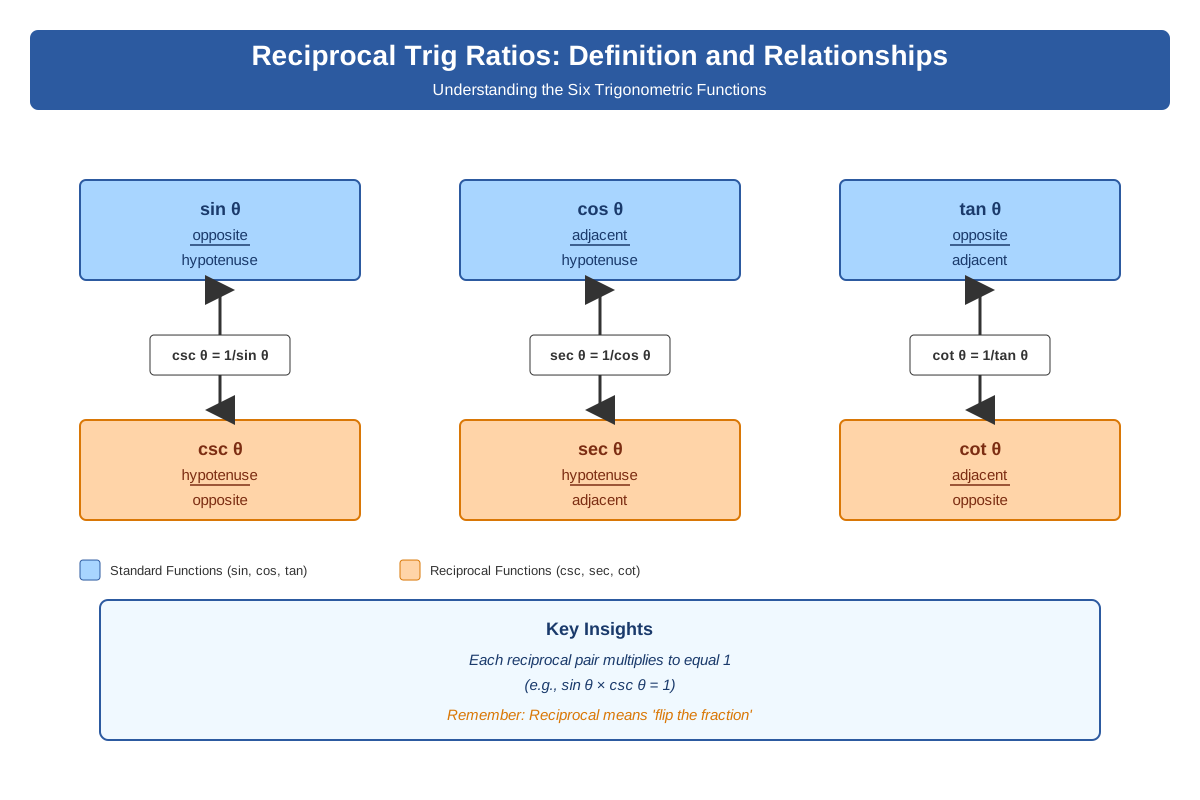
The three reciprocal trig ratios are defined as the multiplicative inverses of the three basic trigonometric functions. For any angle θ:
- Cosecant (csc θ) = 1/sin θ = hypotenuse/opposite
- Secant (sec θ) = 1/cos θ = hypotenuse/adjacent
- Cotangent (cot θ) = 1/tan θ = adjacent/opposite
These definitions hold true in multiple contexts: right triangle ratios, unit circle coordinates, and general angle measures. The reciprocal relationship means that if you know any basic trig ratio, you can immediately find its reciprocal by taking the multiplicative inverse. Importantly, these are true reciprocals in the algebraic sense: sin θ × csc θ = 1, cos θ × sec θ = 1, and tan θ × cot θ = 1 for all angles where both functions are defined.
Right Triangle Interpretation
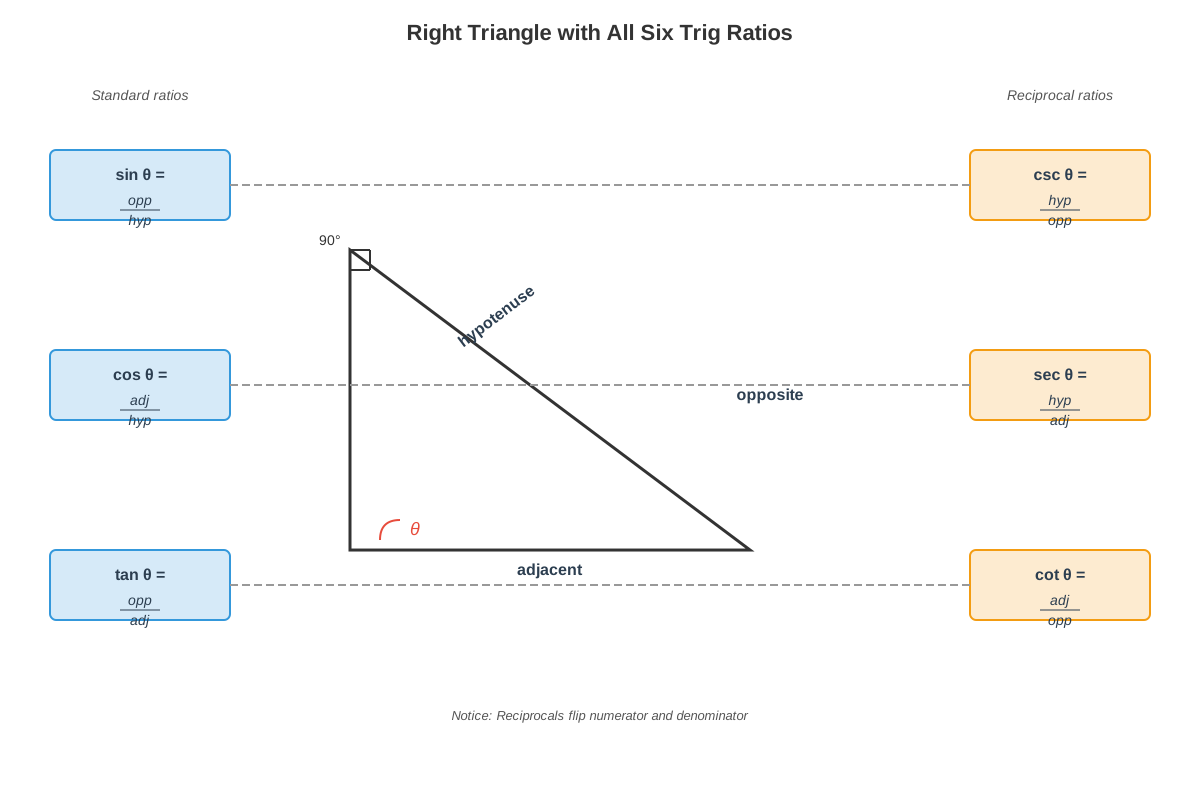
In a right triangle context, reciprocal ratios provide alternative ways to express side relationships. While sine relates the opposite side to the hypotenuse, cosecant relates the hypotenuse to the opposite side—essentially flipping the fraction. This perspective is particularly useful when a problem provides information about the hypotenuse and asks about other sides, or when the given information naturally aligns with the reciprocal ratio's structure.
For example, if a right triangle has an opposite side of 3 and a hypotenuse of 5, then sin θ = 3/5, which means csc θ = 5/3. Rather than calculating sine and then taking the reciprocal, recognizing that cosecant directly represents hypotenuse/opposite allows immediate evaluation. This direct recognition saves time and reduces calculation errors on the ACT.
Unit Circle Values
On the unit circle, reciprocal ratios extend naturally from the coordinate definitions. For a point (x, y) on the unit circle at angle θ:
- sin θ = y, so csc θ = 1/y (undefined when y = 0)
- cos θ = x, so sec θ = 1/x (undefined when x = 0)
- tan θ = y/x, so cot θ = x/y (undefined when y = 0)
This framework reveals why certain reciprocal functions are undefined at specific angles. Cosecant is undefined at 0°, 180°, and 360° (where sine equals zero), secant is undefined at 90° and 270° (where cosine equals zero), and cotangent is undefined at 0°, 180°, and 360° (where tangent equals zero or sine equals zero).
Special Angle Values
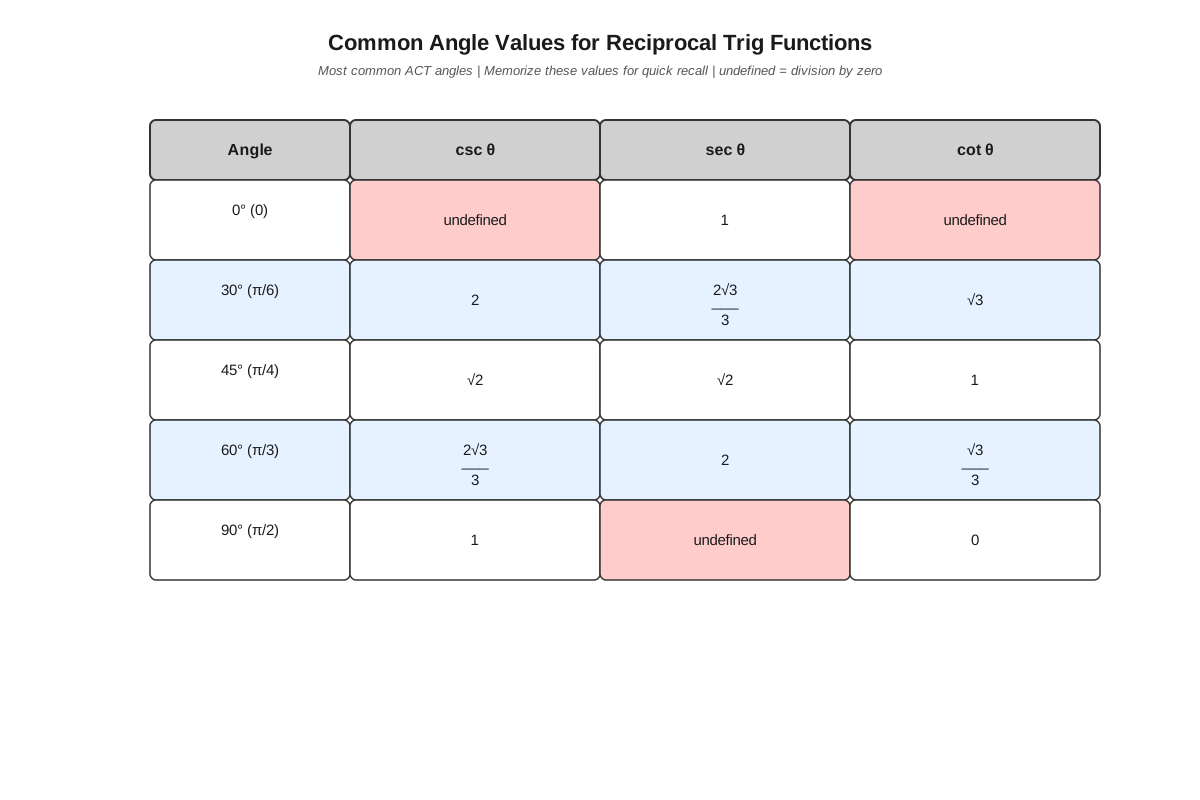
For the ACT, memorizing reciprocal ratio values for special angles provides significant advantage:
| Angle | sin | cos | tan | csc | sec | cot |
|---|---|---|---|---|---|---|
| 30° | 1/2 | √3/2 | √3/3 | 2 | 2√3/3 | √3 |
| 45° | √2/2 | √2/2 | 1 | √2 | √2 | 1 |
| 60° | √3/2 | 1/2 | √3 | 2√3/3 | 2 | √3/3 |
Notice the symmetry: csc 30° = sec 60° = 2, and cot 30° = tan 60° = √3. These complementary angle relationships (cofunctions) appear frequently on the ACT and provide quick verification of answers.
Reciprocal Identities and Simplification
The fundamental reciprocal identities form the basis for simplifying complex trigonometric expressions:
- csc θ = 1/sin θ and sin θ = 1/csc θ
- sec θ = 1/cos θ and cos θ = 1/sec θ
- cot θ = 1/tan θ and tan θ = 1/cot θ
Additionally, cotangent has an alternative definition: cot θ = cos θ/sin θ, which derives from tan θ = sin θ/cos θ. This dual definition makes cotangent particularly versatile in expression simplification.
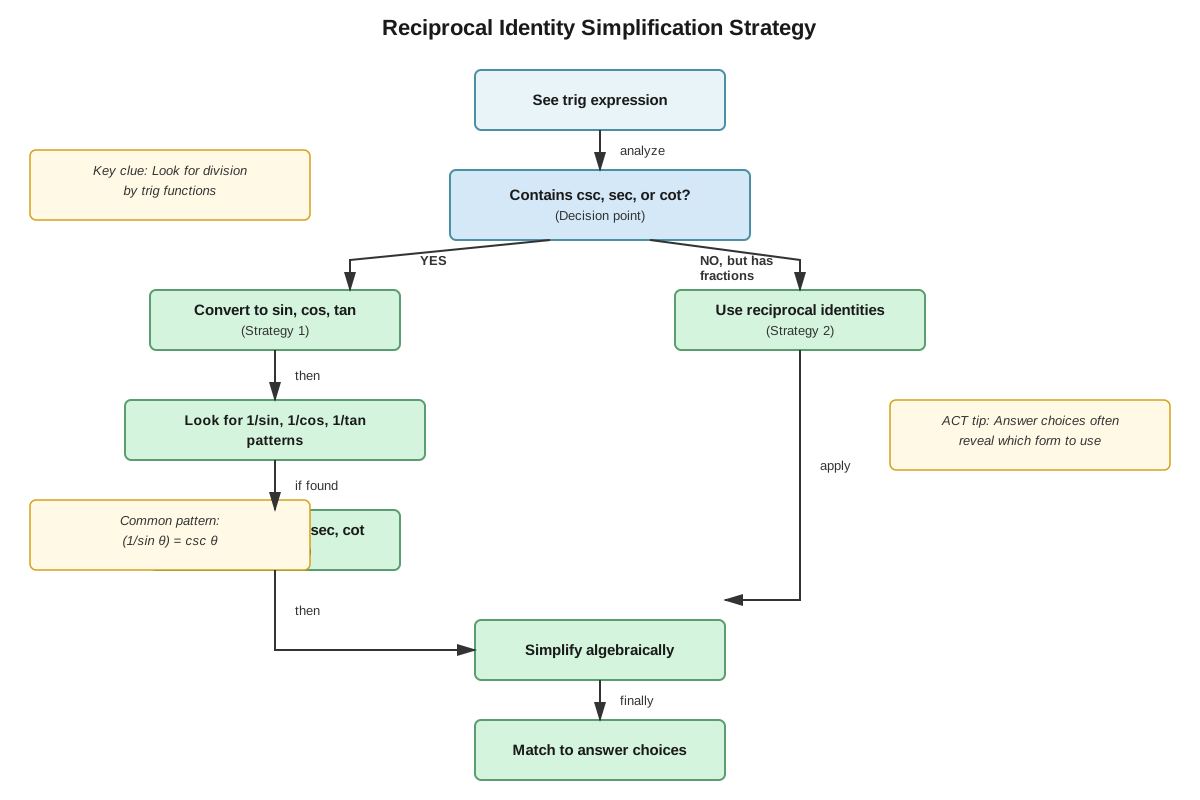
When simplifying expressions, look for opportunities to convert between forms. For instance, (sin θ)(csc θ) always equals 1, so any expression containing this product can be simplified immediately. Similarly, expressions like tan θ × cot θ or sec θ × cos θ reduce to 1, eliminating terms and simplifying calculations.
Problem-Solving Applications
ACT questions involving reciprocal ratios typically require one of three approaches:
- Direct evaluation: Given an angle, find the reciprocal ratio value
- Conversion: Given one ratio, find another using reciprocal relationships
- Simplification: Reduce a complex expression using reciprocal identities
For direct evaluation, identify the angle, recall or calculate the basic trig ratio, then take the reciprocal. For conversion problems, use the reciprocal relationship directly rather than calculating intermediate values. For simplification, look for products that equal 1 or opportunities to convert all terms to sines and cosines.
Concept Relationships
The reciprocal trig ratios connect directly to basic trigonometric functions through multiplicative inverse relationships. Sine leads to cosecant, cosine leads to secant, and tangent leads to cotangent through simple reciprocation. This relationship is bidirectional: knowing either function immediately gives you the other.
Within the reciprocal ratios themselves, cotangent connects to both cosecant and secant through the Pythagorean identity: 1 + cot² θ = csc² θ. Similarly, secant and tangent relate through: 1 + tan² θ = sec² θ. These identities extend the Pythagorean theorem into trigonometric form and provide powerful tools for solving equations.
The unit circle serves as the unifying framework connecting all six trigonometric functions. Coordinates (x, y) generate all ratios: y gives sine (and thus cosecant), x gives cosine (and thus secant), and y/x gives tangent (and thus cotangent). This geometric foundation ensures all relationships remain consistent across different angle measures.
Reciprocal ratios also connect to cofunction identities: csc θ = sec(90° - θ), sec θ = csc(90° - θ), and cot θ = tan(90° - θ). These relationships reveal the complementary nature of trigonometric functions and provide alternative calculation pathways on the ACT.
High-Yield Facts
⭐ Cosecant is the reciprocal of sine: csc θ = 1/sin θ = hypotenuse/opposite
⭐ Secant is the reciprocal of cosine: sec θ = 1/cos θ = hypotenuse/adjacent
⭐ Cotangent is the reciprocal of tangent: cot θ = 1/tan θ = adjacent/opposite
⭐ The product of a function and its reciprocal always equals 1: sin θ × csc θ = 1, cos θ × sec θ = 1, tan θ × cot θ = 1
⭐ Cotangent has an alternative definition: cot θ = cos θ/sin θ
- Cosecant is undefined when sine equals zero (0°, 180°, 360°)
- Secant is undefined when cosine equals zero (90°, 270°)
- Cotangent is undefined when tangent equals zero or sine equals zero (0°, 180°, 360°)
- For 45°, both secant and cosecant equal √2
- For 30° and 60°, reciprocal ratios show complementary relationships: csc 30° = sec 60° = 2
- The Pythagorean identity extends to reciprocals: 1 + cot² θ = csc² θ and 1 + tan² θ = sec² θ
- Reciprocal ratios are always greater than or equal to 1 in absolute value (when defined)
- Converting complex expressions to sines and cosines often reveals simplification opportunities
Quick check — test yourself on Reciprocal trig ratios so far.
Try Flashcards →Common Misconceptions
Misconception: Cosecant is the reciprocal of cosine because both start with "cos."
Correction: Cosecant is the reciprocal of sine, not cosine. The "co-" prefix indicates a cofunction relationship (related to complementary angles), not a reciprocal relationship. Secant is the reciprocal of cosine.
Misconception: Reciprocal trig ratios can be calculated by simply swapping the numerator and denominator of the basic ratio's fraction form.
Correction: While this works for the fraction representation (if sin θ = 3/5, then csc θ = 5/3), it's more accurate to understand reciprocals as multiplicative inverses. The reciprocal of 0.6 is 1/0.6 = 1.667, not obtained by "swapping" parts of the decimal.
Misconception: Cotangent equals tangent because "cot" sounds like "caught" which means "got" or "have."
Correction: Cotangent is the reciprocal of tangent (cot θ = 1/tan θ), not equal to it. They are inverse functions, meaning cot θ × tan θ = 1, not cot θ = tan θ.
Misconception: Reciprocal trig functions can never be negative.
Correction: Reciprocal trig functions follow the same sign conventions as their corresponding basic functions. If sin θ is negative (in quadrants III and IV), then csc θ is also negative. The reciprocal of a negative number is negative.
Misconception: When a reciprocal trig function is undefined, its corresponding basic function is also undefined.
Correction: Reciprocal functions are undefined when their corresponding basic function equals zero, not when the basic function is undefined. For example, csc 0° is undefined because sin 0° = 0, but sin 0° itself is perfectly defined.
Misconception: Secant and cosecant are interchangeable because they both involve the hypotenuse.
Correction: While both secant and cosecant have the hypotenuse in the numerator, secant relates to the adjacent side (sec θ = hypotenuse/adjacent) while cosecant relates to the opposite side (csc θ = hypotenuse/opposite). They are distinct functions with different values.
Misconception: Reciprocal ratios are only useful for theoretical math and don't appear on the ACT.
Correction: The ACT regularly tests reciprocal trig ratios, typically 1-2 questions per test. These questions often provide the fastest solution path when students recognize reciprocal relationships rather than calculating basic ratios first.
Worked Examples
Example 1: Direct Evaluation from a Right Triangle
Problem: In right triangle ABC, angle A measures 30°, the side opposite to angle A has length 7, and angle C is the right angle. What is the value of sec A?
Solution:
Step 1: Identify what secant represents.
Secant is the reciprocal of cosine, and in a right triangle, sec A = hypotenuse/adjacent.
Step 2: Determine the triangle's dimensions.
Given: opposite side = 7, angle A = 30°
Using sin 30° = 1/2, we have: 7/hypotenuse = 1/2
Therefore: hypotenuse = 14
Step 3: Find the adjacent side using the Pythagorean theorem.
adjacent² + 7² = 14²
adjacent² + 49 = 196
adjacent² = 147
adjacent = 7√3
Step 4: Calculate sec A directly.
sec A = hypotenuse/adjacent = 14/(7√3) = 2/√3 = 2√3/3
Alternative approach: Since we know sec 30° = 2√3/3 from special angle values, we could have used this directly, demonstrating the value of memorizing special angles.
Connection to learning objectives: This problem requires identifying that a reciprocal ratio is being tested (sec A), explaining the core strategy (using the definition sec = hypotenuse/adjacent), and applying it accurately to find the answer.
Example 2: Simplifying a Complex Expression
Problem: Simplify the expression: (sin θ × sec θ)/tan θ
Solution:
Step 1: Convert all terms to sines and cosines.
sin θ × sec θ = sin θ × (1/cos θ) = sin θ/cos θ
This equals tan θ
Step 2: Substitute into the original expression.
(sin θ × sec θ)/tan θ = tan θ/tan θ = 1
Alternative approach using reciprocals:
Step 1: Recognize that sec θ = 1/cos θ
Expression becomes: (sin θ/cos θ)/tan θ
Step 2: Recognize that sin θ/cos θ = tan θ
Expression becomes: tan θ/tan θ = 1
Key insight: When you see products or quotients of trig functions, look for opportunities to use reciprocal identities. The product sin θ × csc θ = 1, cos θ × sec θ = 1, and tan θ × cot θ = 1 should be automatic simplifications.
Connection to learning objectives: This demonstrates applying reciprocal ratios to simplify expressions, a common ACT question type. Recognizing that sec θ converts to 1/cos θ is the key strategy that unlocks the solution.
Exam Strategy
When approaching ACT questions involving reciprocal trig ratios, first scan for trigger words: "cosecant," "secant," "cotangent," "csc," "sec," or "cot" immediately signal that reciprocal ratios are being tested. Also watch for phrases like "reciprocal of sine" or expressions written as 1/sin θ, which indicate reciprocal relationships even without using the formal function names.
Time-saving recognition: If a problem gives you one trig ratio and asks for another, check whether they're reciprocals before doing any calculation. If sin θ = 2/5, then csc θ = 5/2 immediately—no calculator needed. This recognition can save 30-45 seconds per question, crucial time on the ACT.
Process of elimination strategy: When answer choices contain reciprocal trig functions, eliminate options that violate basic properties. Reciprocal ratios (when defined) always have absolute value ≥ 1, so eliminate any answer showing |csc θ| < 1, |sec θ| < 1, or |cot θ| < 1 for acute angles. Also eliminate answers that show incorrect signs based on the quadrant.
Calculator usage: Most ACT-approved calculators don't have dedicated csc, sec, or cot buttons. To calculate these, find the basic ratio first, then use the reciprocal (1/x or x⁻¹) button. For example, to find sec 40°, calculate cos 40°, then press the reciprocal button. However, recognizing relationships algebraically is often faster than calculator computation.
Expression simplification approach: When faced with complex trigonometric expressions, convert everything to sines and cosines first. This common denominator approach makes reciprocal relationships obvious and simplification straightforward. After simplifying in terms of sine and cosine, convert back to the requested form if needed.
Allocation recommendation: Spend no more than 60-90 seconds on straightforward reciprocal ratio questions (direct evaluation or simple conversion). For complex simplification problems, allocate up to 2 minutes, but if you don't see the path forward within 30 seconds, mark it and return later. These questions often have elegant solutions that become apparent with fresh eyes.
Memory Techniques
Mnemonic for reciprocal pairs: "Cats Sit Calmly" helps remember Cosecant is reciprocal of Sine, Secant is reciprocal of Cosine, and Cotangent is reciprocal of tangent (the C appears in both).
Visualization strategy: Picture a right triangle with the hypotenuse as the "top" of a fraction. For reciprocal ratios, the hypotenuse stays on top: csc = hyp/opp, sec = hyp/adj. This contrasts with basic ratios where hypotenuse is in the denominator (sin = opp/hyp, cos = adj/hyp).
"Flip it" rule: When you see a basic trig function and need its reciprocal, mentally say "flip it." If sin θ = 3/5, flip it: csc θ = 5/3. This simple verbal cue reinforces the reciprocal relationship.
Special angle pattern: For 30-60-90 triangles, remember "2 is special." Both csc 30° and sec 60° equal exactly 2 (no radicals). This clean value makes these angles easy to verify and remember.
Product equals one: Remember "Product Equals One" (PEO) for any function times its reciprocal. This helps you quickly simplify expressions: whenever you see sin × csc, cos × sec, or tan × cot, replace with 1 immediately.
Undefined angles: "Zero Kills Reciprocals" (ZKR) reminds you that reciprocal functions are undefined when their corresponding basic function equals zero. If the denominator would be zero, the reciprocal is undefined.
Summary
Reciprocal trig ratios—cosecant, secant, and cotangent—are the multiplicative inverses of sine, cosine, and tangent respectively. These functions provide alternative expressions for angle-side relationships in triangles and extend trigonometric analysis beyond the three basic ratios. On the ACT, recognizing reciprocal relationships enables rapid problem-solving, particularly when converting between equivalent expressions or simplifying complex trigonometric statements. The key to mastery is understanding that csc θ = 1/sin θ, sec θ = 1/cos θ, and cot θ = 1/tan θ, along with memorizing values for special angles (30°, 45°, 60°). These ratios follow the same sign conventions as their corresponding basic functions and are undefined when the basic function equals zero. Success on ACT questions requires both computational fluency (quickly finding reciprocal values) and conceptual understanding (recognizing when reciprocal relationships simplify problems). The most efficient approach combines memorized special angle values with the ability to convert between sines/cosines and their reciprocals instantly, eliminating unnecessary calculator work and reducing time per question.
Key Takeaways
- Reciprocal trig ratios are defined as: csc θ = 1/sin θ, sec θ = 1/cos θ, and cot θ = 1/tan θ
- The product of any trig function and its reciprocal always equals 1, providing immediate simplification opportunities
- In right triangles, reciprocal ratios place the hypotenuse in the numerator: csc = hyp/opp, sec = hyp/adj, cot = adj/opp
- Memorizing reciprocal values for special angles (30°, 45°, 60°) enables rapid problem-solving without calculators
- Reciprocal functions are undefined when their corresponding basic function equals zero
- Converting complex expressions to sines and cosines reveals reciprocal relationships and simplification paths
- ACT questions test reciprocal ratios through direct evaluation, expression simplification, and conversion between equivalent forms
Related Topics
Pythagorean Identities: The fundamental identity sin² θ + cos² θ = 1 extends to reciprocal forms: 1 + cot² θ = csc² θ and 1 + tan² θ = sec² θ. Mastering reciprocal ratios provides the foundation for understanding and applying these extended identities.
Cofunction Identities: Reciprocal ratios connect to complementary angle relationships, where csc θ = sec(90° - θ) and cot θ = tan(90° - θ). Understanding reciprocals deepens comprehension of how trigonometric functions relate across complementary angles.
Trigonometric Equations: Solving equations involving csc, sec, or cot requires fluency with reciprocal ratios. This topic builds directly on reciprocal ratio mastery and appears in advanced ACT questions.
Graphing Trigonometric Functions: The graphs of cosecant, secant, and cotangent functions show asymptotes where the reciprocal functions are undefined. Understanding reciprocal ratios is essential for analyzing these graphs and their transformations.
Law of Sines and Cosines: Advanced triangle-solving techniques sometimes involve reciprocal ratios, particularly when working with non-right triangles. Reciprocal ratio fluency enables more efficient problem-solving in these contexts.
Practice CTA
Now that you've mastered the core concepts of reciprocal trig ratios, it's time to cement your understanding through practice. Work through the practice questions to test your ability to identify, explain, and apply these ratios in ACT-style problems. Use the flashcards to drill special angle values and reciprocal relationships until they become automatic. Remember: the difference between knowing these concepts and scoring points is the ability to recognize and apply them quickly under test conditions. Your investment in practice now will pay dividends in both speed and accuracy on test day. You've got this!
Sign up free to keep reading
Create a free AnvayaPrep account to finish this ACT guide on Reciprocal trig ratios — plus flashcards and practice questions.