Overview
Reference angles are a fundamental concept in trigonometry that simplifies the evaluation of trigonometric functions for angles of any measure. A reference angle is the acute angle (between 0° and 90°) formed between the terminal side of an angle in standard position and the x-axis. This concept is particularly powerful because it allows students to reduce any angle—no matter how large or in which quadrant it terminates—to a familiar acute angle whose trigonometric values are easier to determine or recall.
On the ACT Math test, reference angles appear frequently in trigonometry questions, often combined with unit circle concepts, special right triangles, and the evaluation of sine, cosine, and tangent functions. Understanding ACT reference angles is essential because the exam regularly tests whether students can find exact trigonometric values for angles beyond the first quadrant (0° to 90°). Questions may ask students to evaluate expressions like sin(150°), cos(240°), or tan(315°), all of which require reference angle knowledge to solve efficiently without a calculator—or to verify calculator results.
The concept of reference angles bridges multiple mathematical ideas: it connects the unit circle to coordinate geometry, relates all four quadrants through symmetry, and provides a systematic method for extending first-quadrant trigonometric knowledge to all angles. Mastering reference angles also prepares students for more advanced topics like trigonometric identities, graphing trigonometric functions, and solving trigonometric equations—all of which may appear on the ACT in various forms.
Learning Objectives
- [ ] Identify when Reference angles is being tested in ACT questions
- [ ] Explain the core rule or strategy behind Reference angles
- [ ] Apply Reference angles to ACT-style questions accurately
- [ ] Calculate the reference angle for any given angle in degrees or radians
- [ ] Determine the correct sign (positive or negative) of trigonometric functions in each quadrant
- [ ] Evaluate exact trigonometric values for non-acute angles using reference angles and special triangles
Prerequisites
- Special Right Triangles (30-60-90 and 45-45-90): Essential for determining exact trigonometric values of reference angles without a calculator
- Unit Circle Basics: Understanding angles in standard position and how angles relate to coordinates on the unit circle
- Quadrant System: Knowledge of the four quadrants and how to identify which quadrant contains a given angle
- Basic Trigonometric Functions: Familiarity with sine, cosine, and tangent definitions and their relationship to right triangles
- Angle Measurement: Ability to work with both degree and radian measures and convert between them
Why This Topic Matters
Reference angles represent one of the most practical applications of trigonometry, appearing not only in pure mathematics but also in physics (analyzing vector components), engineering (calculating forces at various angles), navigation (determining directional bearings), and computer graphics (rotating objects). The concept demonstrates mathematical elegance: rather than memorizing trigonometric values for hundreds of angles, students need only know values for a handful of acute angles and apply systematic rules.
On the ACT Math test, reference angles appear in approximately 2-4 questions per exam, making them a high-yield topic relative to the limited study time available. These questions typically fall into several categories: direct evaluation of trigonometric functions at non-acute angles (e.g., "What is cos(210°)?"), solving equations involving trigonometric functions, analyzing trigonometric graphs, and word problems involving periodic phenomena or angular measurements. The ACT particularly favors angles that are multiples of 30° and 45° because these produce exact values rather than decimal approximations.
Questions testing reference angles often appear in the latter half of the ACT Math section (questions 40-60), where more advanced mathematical reasoning is required. They may be standalone trigonometry questions or integrated into coordinate geometry problems. The ACT frequently combines reference angle concepts with other topics like the Pythagorean theorem, similar triangles, or algebraic manipulation, making this a connector topic that demonstrates mathematical maturity.
Core Concepts
Definition of Reference Angles
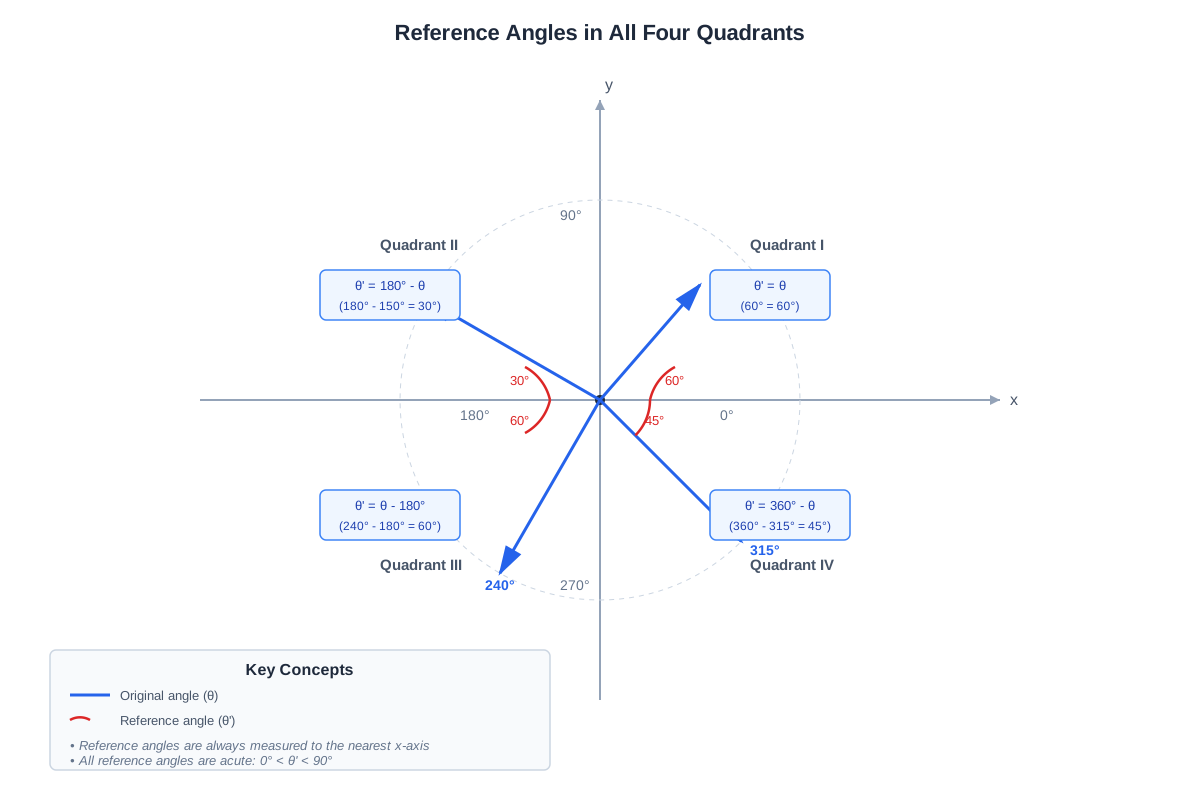
A reference angle is defined as the smallest positive acute angle formed between the terminal side of an angle in standard position and the x-axis. An angle is in standard position when its vertex is at the origin and its initial side lies along the positive x-axis. The terminal side is where the angle "ends" after rotating from the initial side.
The key characteristics of reference angles are:
- They are always positive
- They are always acute (between 0° and 90°, or between 0 and π/2 radians)
- They are measured to the nearest part of the x-axis (not the y-axis)
- Every angle has exactly one reference angle
Finding Reference Angles by Quadrant
The method for calculating a reference angle depends on which quadrant contains the terminal side of the original angle. Here's the systematic approach:
| Quadrant | Angle Range (degrees) | Reference Angle Formula | Example |
|---|---|---|---|
| I | 0° < θ < 90° | θ' = θ | 60° → 60° |
| II | 90° < θ < 180° | θ' = 180° - θ | 150° → 30° |
| III | 180° < θ < 270° | θ' = θ - 180° | 210° → 30° |
| IV | 270° < θ < 360° | θ' = 360° - θ | 315° → 45° |
For angles in radians, the formulas are analogous:
| Quadrant | Angle Range (radians) | Reference Angle Formula | Example |
|---|---|---|---|
| I | 0 < θ < π/2 | θ' = θ | π/6 → π/6 |
| II | π/2 < θ < π | θ' = π - θ | 5π/6 → π/6 |
| III | π < θ < 3π/2 | θ' = θ - π | 7π/6 → π/6 |
| IV | 3π/2 < θ < 2π | θ' = 2π - θ | 11π/6 → π/6 |
Working with Angles Greater than 360° or Negative Angles
Before finding a reference angle, angles must first be converted to their coterminal angle between 0° and 360° (or 0 and 2π radians). Coterminal angles are angles that share the same terminal side.
For angles greater than 360°:
- Divide the angle by 360° (or 2π)
- Find the remainder
- The remainder is the coterminal angle between 0° and 360°
Example: 495° = 360° + 135°, so the coterminal angle is 135°
For negative angles:
- Add 360° (or 2π) repeatedly until the result is positive
- Use the resulting positive angle
Example: -120° + 360° = 240°
The CAST Rule (Signs of Trigonometric Functions)
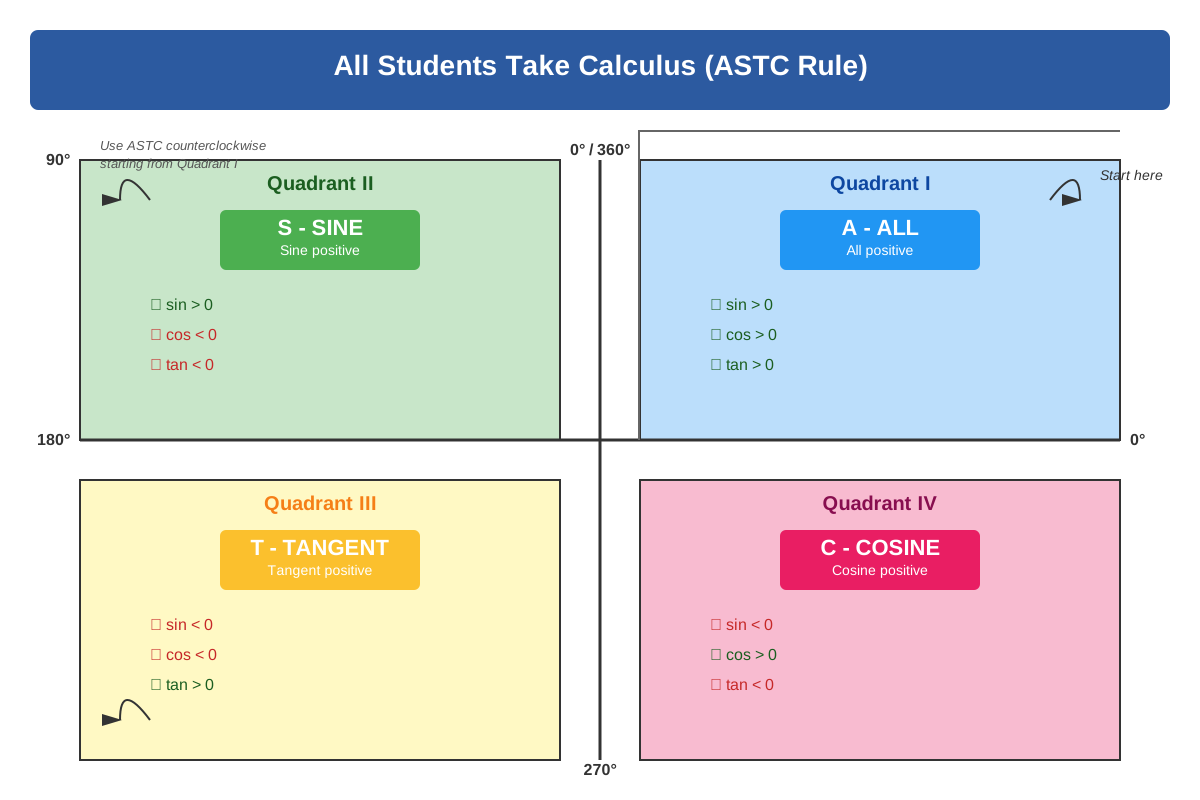
Once the reference angle is determined, the sign of the trigonometric function depends on the quadrant of the original angle. The CAST rule (also called the "All Students Take Calculus" mnemonic) indicates which functions are positive in each quadrant:
- Quadrant I (0° to 90°): All functions are positive (sin, cos, tan all positive)
- Quadrant II (90° to 180°): Sine (and cosecant) are positive; cosine and tangent are negative
- Quadrant III (180° to 270°): Tangent (and cotangent) are positive; sine and cosine are negative
- Quadrant IV (270° to 360°): Cosine (and secant) are positive; sine and tangent are negative
Evaluating Trigonometric Functions Using Reference Angles
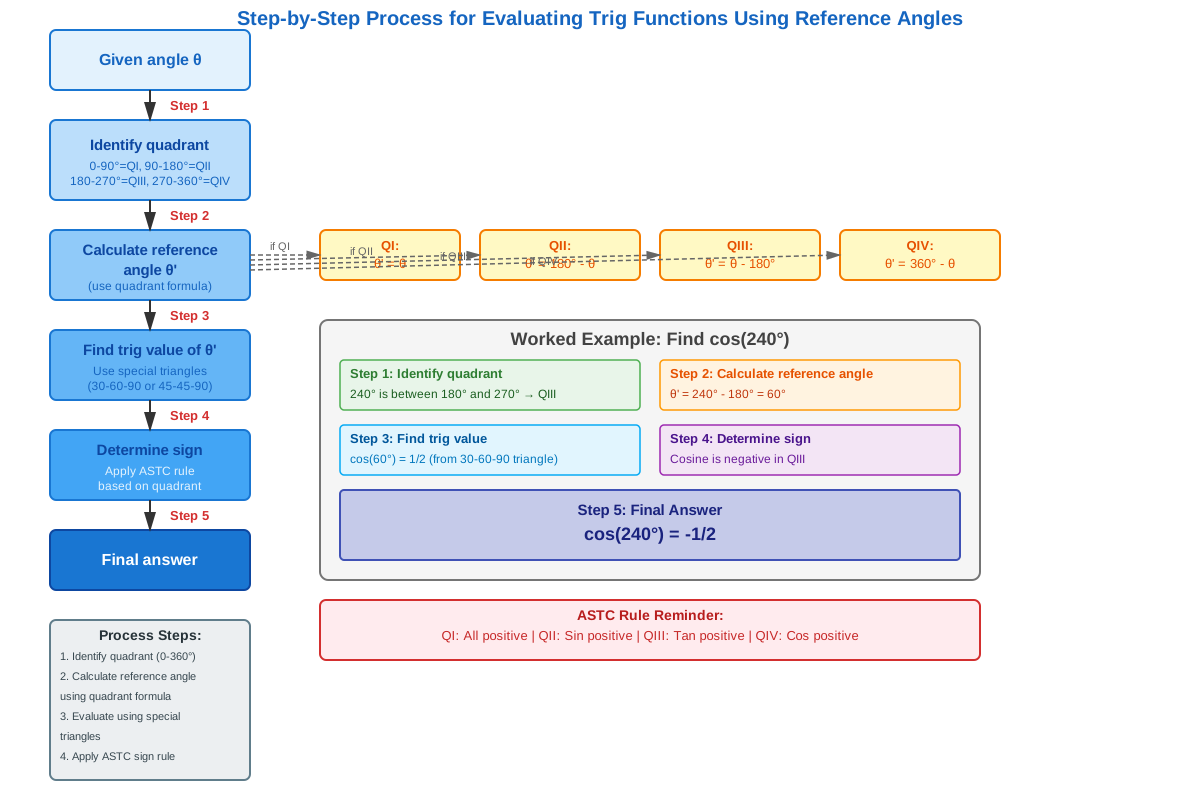
The complete process for evaluating any trigonometric function involves three steps:
- Find the reference angle using the appropriate formula for the quadrant
- Evaluate the trigonometric function of the reference angle (often using special right triangles)
- Apply the correct sign based on the quadrant of the original angle (using CAST)
For example, to find sin(240°):
- 240° is in Quadrant III (between 180° and 270°)
- Reference angle: 240° - 180° = 60°
- sin(60°) = √3/2
- In Quadrant III, sine is negative
- Therefore, sin(240°) = -√3/2
Special Angles and Their Reference Angles
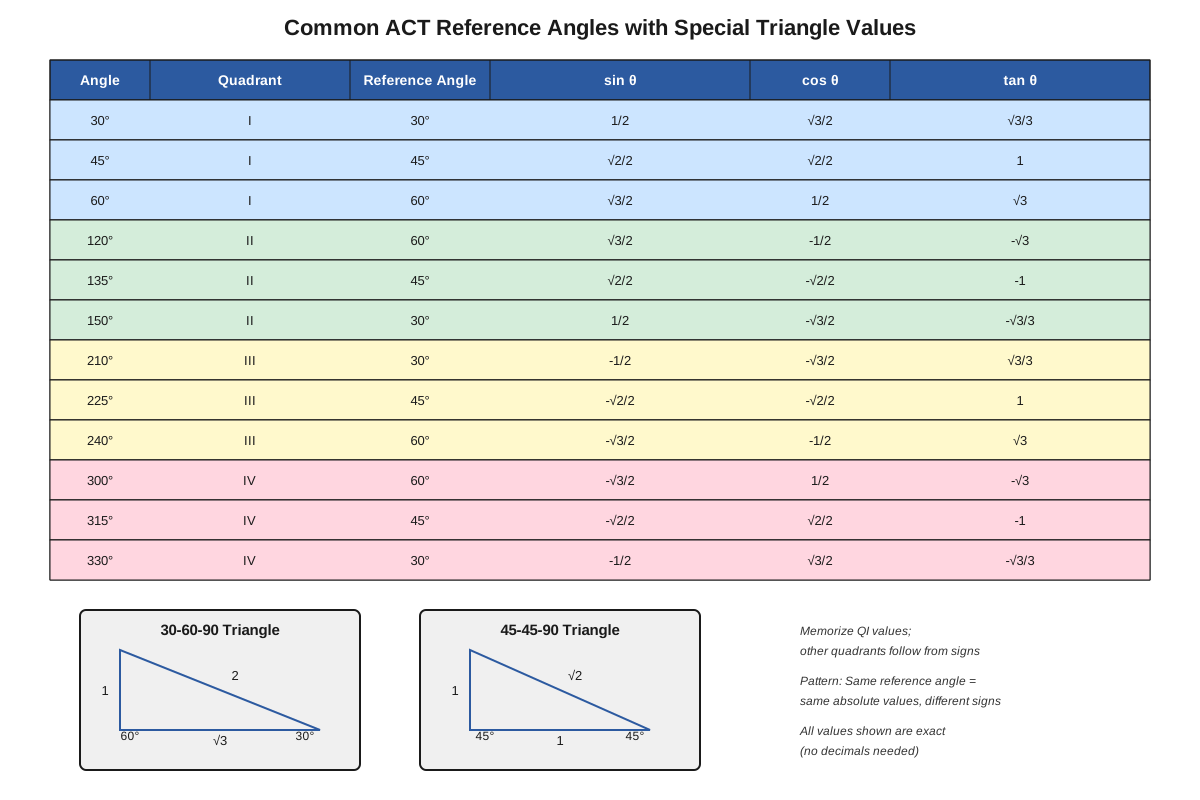
The ACT heavily emphasizes angles whose reference angles are 30°, 45°, or 60° (or π/6, π/4, π/3 in radians) because these correspond to special right triangles with known exact values:
Common angles with 30° reference angle:
- 30°, 150°, 210°, 330° (or π/6, 5π/6, 7π/6, 11π/6)
Common angles with 45° reference angle:
- 45°, 135°, 225°, 315° (or π/4, 3π/4, 5π/4, 7π/4)
Common angles with 60° reference angle:
- 60°, 120°, 240°, 300° (or π/3, 2π/3, 4π/3, 5π/3)
Concept Relationships
Reference angles serve as the bridge between first-quadrant trigonometry and the complete unit circle. The relationship flow works as follows:
Special Right Triangles → provide exact values for 30°, 45°, and 60° → Reference Angles → extend these values to all four quadrants → Unit Circle → enables evaluation of trigonometric functions at any angle
Within the topic itself, concepts connect hierarchically:
- Standard Position and Quadrants (foundation) → determines which formula to use
- Coterminal Angles (preprocessing) → reduces any angle to 0°-360° range
- Reference Angle Calculation (core skill) → identifies the acute angle
- CAST Rule (sign determination) → applies correct positive/negative sign
- Trigonometric Evaluation (final step) → produces the exact or approximate value
Reference angles also connect forward to more advanced topics: they're essential for understanding trigonometric identities (like the symmetry identities), inverse trigonometric functions (which return angles in restricted ranges), and trigonometric graphs (where reference angles help identify key points on sine and cosine curves).
The concept relates to coordinate geometry through the unit circle, where any angle θ corresponds to a point (cos θ, sin θ) on the circle. The reference angle represents the "horizontal distance" from the x-axis to this point, regardless of which quadrant contains the point.
High-Yield Facts
⭐ The reference angle is always between 0° and 90° (0 and π/2 radians) and is always positive
⭐ In Quadrant II, the reference angle equals 180° minus the angle (or π minus the angle in radians)
⭐ In Quadrant III, the reference angle equals the angle minus 180° (or the angle minus π in radians)
⭐ In Quadrant IV, the reference angle equals 360° minus the angle (or 2π minus the angle in radians)
⭐ The CAST rule determines signs: All positive in QI, Sine positive in QII, Tangent positive in QIII, Cosine positive in QIV
- The trigonometric function of any angle equals ± the same function of its reference angle, where the sign depends on the quadrant
- Coterminal angles (angles differing by 360° or 2π) have the same reference angle and identical trigonometric values
- Angles of 0°, 90°, 180°, 270°, and 360° (the quadrantal angles) technically have reference angles of 0° or 90°
- For angles greater than 360° or less than 0°, first find the coterminal angle between 0° and 360° before determining the reference angle
- The reference angle for 150° is 30°, for 210° is 30°, and for 330° is 30°—all have the same reference angle but different signs for their trigonometric values
- sin(θ) and sin(180° - θ) have the same value because they have the same reference angle and sine is positive in both Quadrants I and II
- The most commonly tested reference angles on the ACT are 30°, 45°, and 60° (π/6, π/4, and π/3)
Quick check — test yourself on Reference angles so far.
Try Flashcards →Common Misconceptions
Misconception: The reference angle is always the angle minus 180° or the angle divided by 2.
Correction: The reference angle formula depends entirely on which quadrant contains the angle. Each quadrant has its own specific formula, and students must first identify the quadrant before applying the correct calculation method.
Misconception: Reference angles can be negative or obtuse.
Correction: By definition, reference angles are always positive acute angles (between 0° and 90°). If a calculation produces a negative or obtuse result, an error has occurred in identifying the quadrant or applying the formula.
Misconception: The reference angle for 120° is 120° because it's already less than 180°.
Correction: The reference angle must be acute (less than 90°). For 120°, which is in Quadrant II, the reference angle is 180° - 120° = 60°. The reference angle is measured to the x-axis, not just any value less than 180°.
Misconception: All trigonometric functions of an angle have the same sign as the functions of its reference angle.
Correction: The reference angle only provides the magnitude (absolute value) of the trigonometric function. The sign must be determined separately using the CAST rule based on the original angle's quadrant. For example, cos(150°) = -cos(30°), not +cos(30°).
Misconception: To find the reference angle for a negative angle, simply remove the negative sign.
Correction: Negative angles must first be converted to their positive coterminal angle (by adding 360° or 2π), and then the reference angle is found using the standard quadrant-based formulas. For example, -30° becomes 330°, which has a reference angle of 30°, but the process requires the intermediate step.
Misconception: The reference angle for 270° is 90° because 360° - 270° = 90°.
Correction: While this calculation is technically correct, 270° is a quadrantal angle (on the boundary between quadrants), and its trigonometric values should be evaluated directly rather than through reference angles. The sine of 270° is -1, cosine is 0, and tangent is undefined—these don't follow the typical reference angle pattern.
Misconception: Reference angles only work with degrees, not radians.
Correction: Reference angles work identically with both degree and radian measures. The same conceptual approach applies; only the formulas use π instead of 180° and 2π instead of 360°. For example, the reference angle for 5π/6 (Quadrant II) is π - 5π/6 = π/6.
Worked Examples
Example 1: Evaluating a Trigonometric Function in Quadrant III
Problem: Find the exact value of cos(225°).
Solution:
Step 1: Identify the quadrant.
225° is between 180° and 270°, so it's in Quadrant III.
Step 2: Calculate the reference angle.
For Quadrant III, use the formula: θ' = θ - 180°
Reference angle = 225° - 180° = 45°
Step 3: Evaluate the trigonometric function of the reference angle.
cos(45°) = √2/2 (from the 45-45-90 special right triangle)
Step 4: Determine the sign using the CAST rule.
In Quadrant III, only tangent is positive; cosine is negative.
Step 5: Apply the sign to get the final answer.
cos(225°) = -√2/2
Connection to Learning Objectives: This example demonstrates the complete process of applying reference angles to ACT-style questions, showing how to identify when the concept is being tested (evaluating a trigonometric function at a non-acute angle), explaining the core strategy (find reference angle, evaluate, apply sign), and executing accurately.
Example 2: Working with Radians and Negative Angles
Problem: Find the exact value of sin(-5π/3).
Solution:
Step 1: Convert the negative angle to a positive coterminal angle.
Add 2π to the negative angle:
-5π/3 + 2π = -5π/3 + 6π/3 = π/3
Wait, that gives us π/3, which is in Quadrant I. Let's verify: -5π/3 is negative, so we're rotating clockwise. Adding 2π once:
-5π/3 + 6π/3 = π/3
Actually, let's reconsider. -5π/3 is a large negative angle. Let's add 2π:
-5π/3 + 2π = -5π/3 + 6π/3 = π/3
This seems too simple. Let me recalculate: -5π/3 radians. Adding 2π (which is 6π/3):
-5π/3 + 6π/3 = 1π/3 = π/3
So the coterminal angle is π/3, which is in Quadrant I.
Step 2: Identify the quadrant.
π/3 is between 0 and π/2, so it's in Quadrant I.
Step 3: Calculate the reference angle.
In Quadrant I, the reference angle equals the angle itself: π/3
Step 4: Evaluate the trigonometric function.
sin(π/3) = √3/2 (from the 30-60-90 triangle, where π/3 = 60°)
Step 5: Determine the sign.
In Quadrant I, all trigonometric functions are positive.
Step 6: Final answer.
sin(-5π/3) = √3/2
Alternative approach verification: We could also think of -5π/3 as rotating clockwise 5π/3 radians. Since 5π/3 is in Quadrant IV when measured counterclockwise (5π/3 = 300°), rotating clockwise by this amount is equivalent to rotating counterclockwise by 2π - 5π/3 = π/3, confirming our answer.
Connection to Learning Objectives: This example shows how to handle negative angles and radian measures, both common on the ACT. It reinforces the systematic approach and demonstrates that multiple paths can lead to the correct answer.
Exam Strategy
When approaching ACT questions involving reference angles, follow this systematic process:
Recognition triggers: Watch for these phrases and formats that signal reference angle questions:
- "Find the exact value of trig function"
- Questions asking for sine, cosine, or tangent of angles like 120°, 135°, 150°, 210°, 225°, 240°, 300°, 315°, 330°
- Problems involving angles in radians like 2π/3, 3π/4, 5π/6, 7π/6, 5π/4, 4π/3, 5π/3, 7π/4, 11π/6
- Any trigonometric evaluation where the angle is not in the first quadrant
- Questions about "equivalent expressions" involving trigonometric functions
Step-by-step approach:
- Identify the quadrant (2-3 seconds): Quickly determine where the angle terminates
- Calculate the reference angle (3-5 seconds): Apply the correct formula for that quadrant
- Evaluate the reference angle (5-10 seconds): Use special right triangles or known values
- Apply the sign (2-3 seconds): Use CAST to determine positive or negative
- Verify (3-5 seconds): Check that your answer makes sense
Process of elimination tips:
- Eliminate any answer choices with the wrong sign by quickly checking which functions are positive in the angle's quadrant
- If answer choices include both exact values (like √3/2) and decimal approximations, the question likely expects exact values using special triangles
- For multiple-choice questions, you can verify your answer using a calculator if the angle is in degrees (most ACT-approved calculators can evaluate trig functions)
- If two answer choices differ only in sign, focus on determining the correct quadrant and applying CAST correctly
Time allocation: Reference angle questions should take 30-45 seconds once the concept is mastered. If you're spending more than one minute, you may be overcomplicating the problem. Practice the systematic approach until it becomes automatic.
Calculator strategy: While calculators can evaluate trigonometric functions, the ACT often asks for exact values (like √2/2 rather than 0.707...). Use your calculator to verify your work, but rely on reference angles and special triangles to find exact values. Additionally, ensure your calculator is in the correct mode (degrees vs. radians) before calculating.
Memory Techniques
CAST Mnemonic: "All Students Take Calculus" helps remember which functions are positive in each quadrant, reading counterclockwise from Quadrant I:
- Quadrant I: All positive
- Quadrant II: Sine positive
- Quadrant III: Tangent positive
- Quadrant IV: Cosine positive
Alternative CAST: "Add Sugar To Coffee" (same pattern, different phrase)
Quadrant II Formula: "180 Take Away" - In Quadrant II, you take away the angle from 180° to get the reference angle (180° - θ)
Quadrant III Formula: "Subtract 180" - In Quadrant III, you subtract 180° from the angle (θ - 180°)
Quadrant IV Formula: "360 Minus" - In Quadrant IV, you subtract the angle from 360° (360° - θ)
Visual Memory Aid: Picture the unit circle divided into four quadrants. Imagine the reference angle as always "falling down" to the x-axis, creating a small acute angle. This visual helps remember that reference angles are always measured to the nearest x-axis, not the y-axis.
Special Angle Pattern: The three special reference angles follow a pattern:
- 30° (π/6): sin = 1/2, cos = √3/2, tan = √3/3
- 45° (π/4): sin = √2/2, cos = √2/2, tan = 1
- 60° (π/3): sin = √3/2, cos = 1/2, tan = √3
Notice that sine and cosine values for 30° and 60° are swapped (complementary angles).
Radian Conversion Memory: Remember that π = 180°, so:
- π/6 = 30°
- π/4 = 45°
- π/3 = 60°
- π/2 = 90°
For other common angles, multiply: 2π/3 = 2 × 60° = 120°, 3π/4 = 3 × 45° = 135°, etc.
Summary
Reference angles provide a systematic method for evaluating trigonometric functions of any angle by reducing the problem to finding the trigonometric value of an acute angle and then applying the appropriate sign based on the quadrant. The reference angle is always the positive acute angle formed between the terminal side of an angle in standard position and the x-axis, calculated using quadrant-specific formulas: in Quadrant II use 180° - θ, in Quadrant III use θ - 180°, and in Quadrant IV use 360° - θ. The CAST rule determines which trigonometric functions are positive in each quadrant (All in QI, Sine in QII, Tangent in QIII, Cosine in QIV), while the others are negative. For angles outside the 0° to 360° range or negative angles, first find the coterminal angle within the standard range. The ACT heavily tests this concept with special angles (30°, 45°, 60° and their multiples) that correspond to special right triangles, making memorization of these exact values essential for efficient problem-solving.
Key Takeaways
- Reference angles are always positive acute angles (0° to 90°) measured from the terminal side to the x-axis
- Each quadrant has a specific formula for finding reference angles: QII uses 180° - θ, QIII uses θ - 180°, QIV uses 360° - θ
- The CAST rule (All, Sine, Tangent, Cosine) determines which trigonometric functions are positive in each quadrant, reading counterclockwise from Quadrant I
- The trigonometric value of any angle equals ± the same function of its reference angle, where the sign depends on the quadrant
- Master the exact trigonometric values for 30°, 45°, and 60° (and their radian equivalents π/6, π/4, π/3) as these are the most commonly tested reference angles on the ACT
- Always convert angles greater than 360° or negative angles to coterminal angles between 0° and 360° before finding the reference angle
- Reference angle problems typically take 30-45 seconds when approached systematically: identify quadrant → find reference angle → evaluate → apply sign
Related Topics
Unit Circle Mastery: Understanding the complete unit circle with all special angles and their coordinates builds directly on reference angle knowledge and enables quick evaluation of trigonometric functions without calculation.
Trigonometric Identities: Reference angles provide the foundation for understanding symmetry identities like sin(π - θ) = sin(θ) and cos(π + θ) = -cos(θ), which appear frequently on the ACT.
Inverse Trigonometric Functions: When solving equations like sin(x) = 1/2, reference angles help identify all solutions within a given interval, not just the principal value returned by inverse functions.
Graphing Trigonometric Functions: Reference angles help identify key points on sine, cosine, and tangent graphs, particularly when determining y-values at specific x-coordinates.
Trigonometric Equations: Solving equations like 2cos(x) - 1 = 0 requires finding reference angles and then determining all angles in the specified domain that have that reference angle.
Polar Coordinates and Complex Numbers: Reference angles extend to these topics where angles determine position and magnitude in two-dimensional systems.
Practice CTA
Now that you've mastered the concept of reference angles, it's time to solidify your understanding through practice! Work through the practice questions to test your ability to identify quadrants, calculate reference angles quickly, and evaluate trigonometric functions accurately. The flashcards will help you memorize the special angle values and quadrant rules until they become automatic. Remember, reference angles are one of the highest-yield topics on the ACT Math section—investing 15-20 minutes in focused practice now will pay dividends on test day. You've got this!
Sign up free to keep reading
Create a free AnvayaPrep account to finish this ACT guide on Reference angles — plus flashcards and practice questions.