Overview
Right triangle trigonometry forms one of the most frequently tested concepts on the ACT Math section, appearing in approximately 4-6 questions per exam. This topic builds upon fundamental geometry principles and introduces the powerful relationships between angles and side lengths in right triangles through the trigonometric ratios: sine, cosine, and tangent. Understanding these relationships enables students to solve complex problems involving heights, distances, angles, and real-world applications that would otherwise require advanced geometric reasoning.
The ACT consistently tests right triangle trigonometry through direct calculation problems, word problems involving angles of elevation and depression, and multi-step problems that combine trigonometric ratios with other geometric concepts. Mastery of this topic is essential not only for earning points on trigonometry questions but also for efficiently solving certain geometry and coordinate geometry problems where trigonometric relationships provide shortcuts. The predictable nature of ACT right triangle trigonometry questions makes this a high-yield study area where focused preparation translates directly into score improvements.
Right triangle trigonometry serves as the foundation for more advanced trigonometric concepts, including the unit circle, trigonometric identities, and periodic functions. However, the ACT focuses primarily on the basic ratios and their applications within right triangles, making this topic accessible to students who master the core definitions and practice recognizing when to apply each ratio. The connection between right triangle trigonometry and coordinate geometry, particularly in calculating distances and slopes, makes this topic central to the ACT Math curriculum.
Learning Objectives
- [ ] Identify when right triangle trigonometry is being tested in ACT questions
- [ ] Explain the core rule or strategy behind right triangle trigonometry
- [ ] Apply right triangle trigonometry to ACT-style questions accurately
- [ ] Calculate unknown side lengths using sine, cosine, and tangent ratios
- [ ] Determine unknown angles using inverse trigonometric functions
- [ ] Recognize and solve problems involving special right triangles combined with trigonometric ratios
- [ ] Translate word problems involving angles of elevation and depression into trigonometric equations
Prerequisites
- Basic right triangle properties: Understanding that right triangles contain one 90-degree angle and that the sum of all angles equals 180 degrees is essential for setting up trigonometric equations correctly
- Pythagorean theorem: The relationship a² + b² = c² frequently appears alongside trigonometric ratios and helps verify solutions or find missing sides when two sides are known
- Special right triangles (30-60-90 and 45-45-90): These triangles provide exact values for trigonometric ratios at common angles and often appear in ACT problems
- Basic algebra skills: Solving equations, manipulating fractions, and isolating variables are necessary for working with trigonometric ratios
- Calculator proficiency: Knowing how to use sine, cosine, tangent, and their inverse functions on a scientific calculator is crucial for ACT success
Why This Topic Matters
Right triangle trigonometry extends far beyond the classroom, serving as the mathematical foundation for fields including architecture, engineering, navigation, surveying, and physics. Architects use trigonometric ratios to calculate roof pitches and structural angles. Engineers apply these principles when designing ramps, bridges, and support structures. Pilots and sailors rely on trigonometry for navigation calculations, while surveyors use angles of elevation and depression to measure distances and heights that cannot be directly measured.
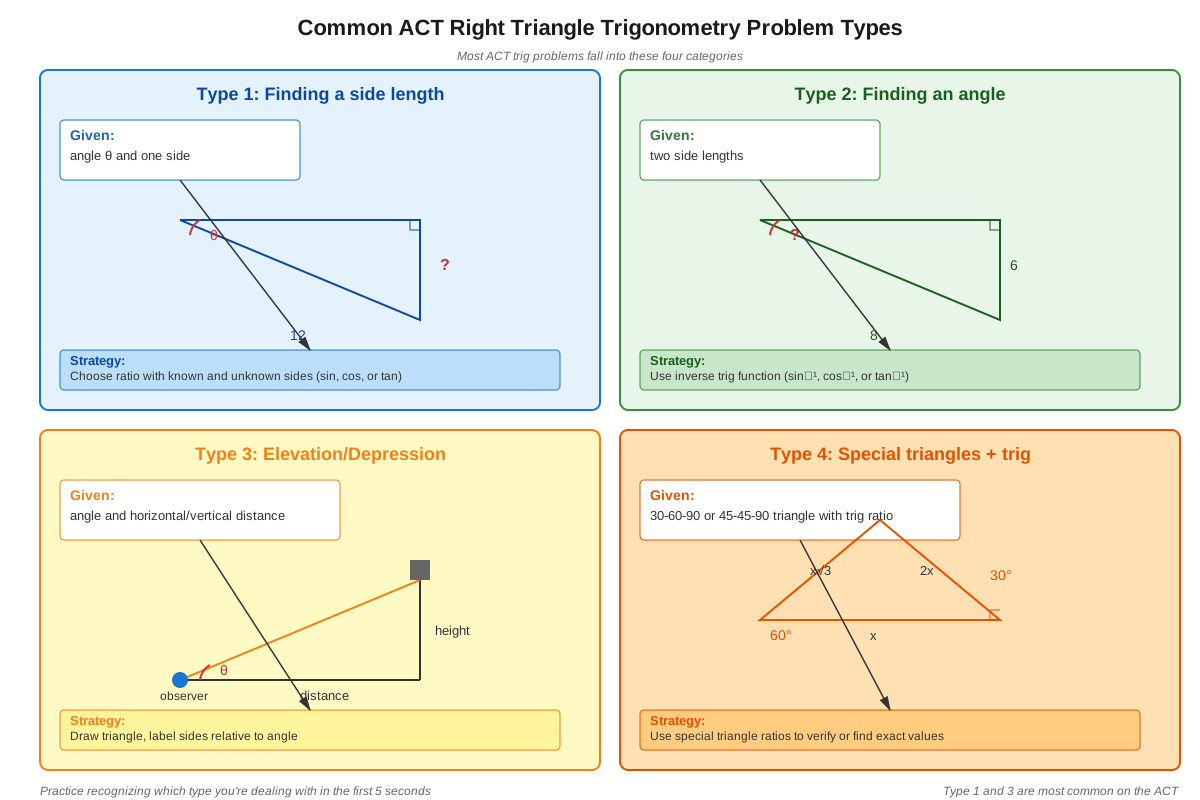
On the ACT Math section, right triangle trigonometry appears with remarkable consistency, typically comprising 4-6 questions out of the 60 total math questions. This represents approximately 7-10% of the exam, making it one of the highest-yield topics for focused study. Questions range from straightforward ratio calculations worth one point each to complex multi-step problems that integrate trigonometry with other mathematical concepts. The ACT favors certain question types: direct calculation of sides or angles, word problems involving real-world scenarios (especially angles of elevation and depression), problems requiring identification of the appropriate trigonometric ratio, and questions combining trigonometry with coordinate geometry or other geometric figures.
The predictable nature of ACT trigonometry questions makes this topic particularly valuable for score improvement. Unlike some mathematical concepts that can be tested in countless variations, right triangle trigonometry questions follow recognizable patterns. Students who master the core ratios, practice identifying which ratio to use, and develop fluency with calculator operations can reliably earn points on these questions, making this topic an efficient use of study time with high return on investment.
Core Concepts
The Three Primary Trigonometric Ratios
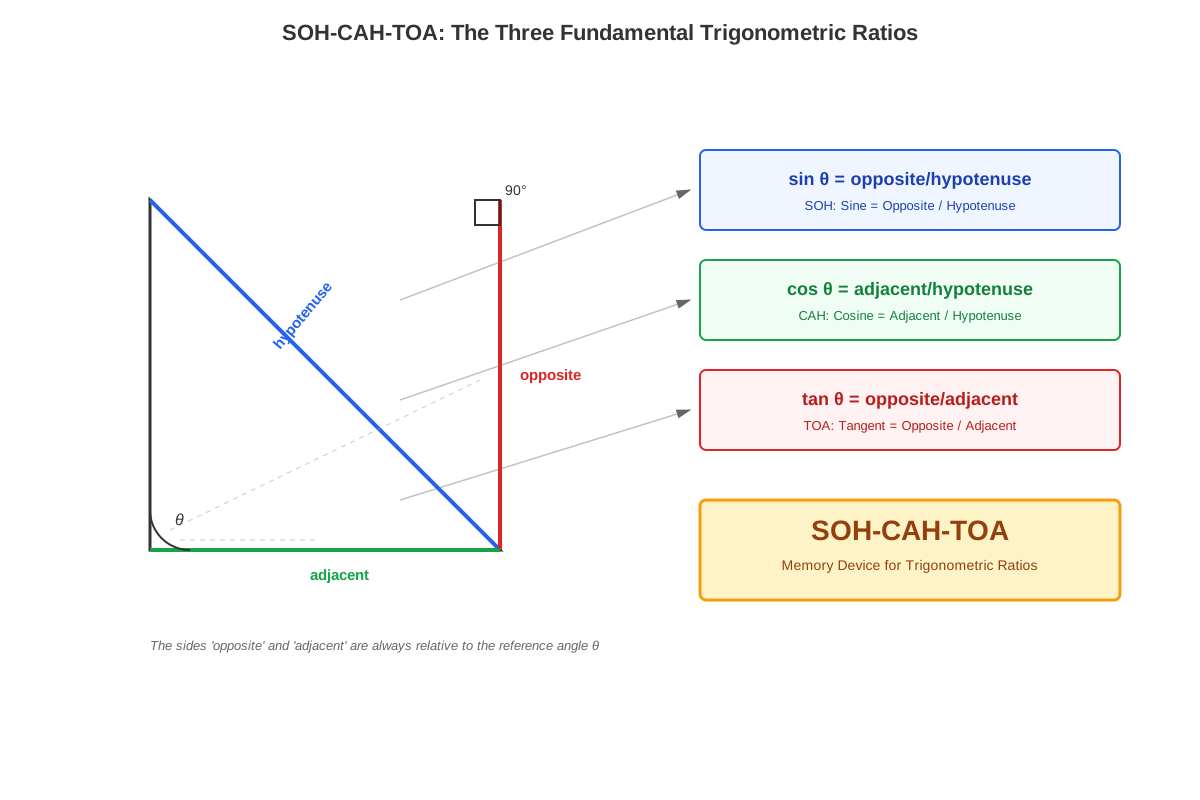
The foundation of right triangle trigonometry rests on three fundamental ratios that relate the angles of a right triangle to the lengths of its sides. These ratios—sine, cosine, and tangent—remain constant for any given angle regardless of the triangle's size, making them powerful tools for solving problems.
For any acute angle θ (theta) in a right triangle:
- Sine (sin θ) = opposite/hypotenuse
- Cosine (cos θ) = adjacent/hypotenuse
- Tangent (tan θ) = opposite/adjacent
The hypotenuse is always the longest side of the right triangle, located opposite the right angle. The opposite side is the side across from the angle in question, while the adjacent side is the side next to the angle that is not the hypotenuse. Correctly identifying these three sides relative to the angle being considered is the critical first step in applying trigonometric ratios.
The SOH-CAH-TOA Memory Device
The most widely used mnemonic for remembering the three primary ratios is SOH-CAH-TOA:
- SOH: Sine = Opposite/Hypotenuse
- CAH: Cosine = Adjacent/Hypotenuse
- TOA: Tangent = Opposite/Adjacent
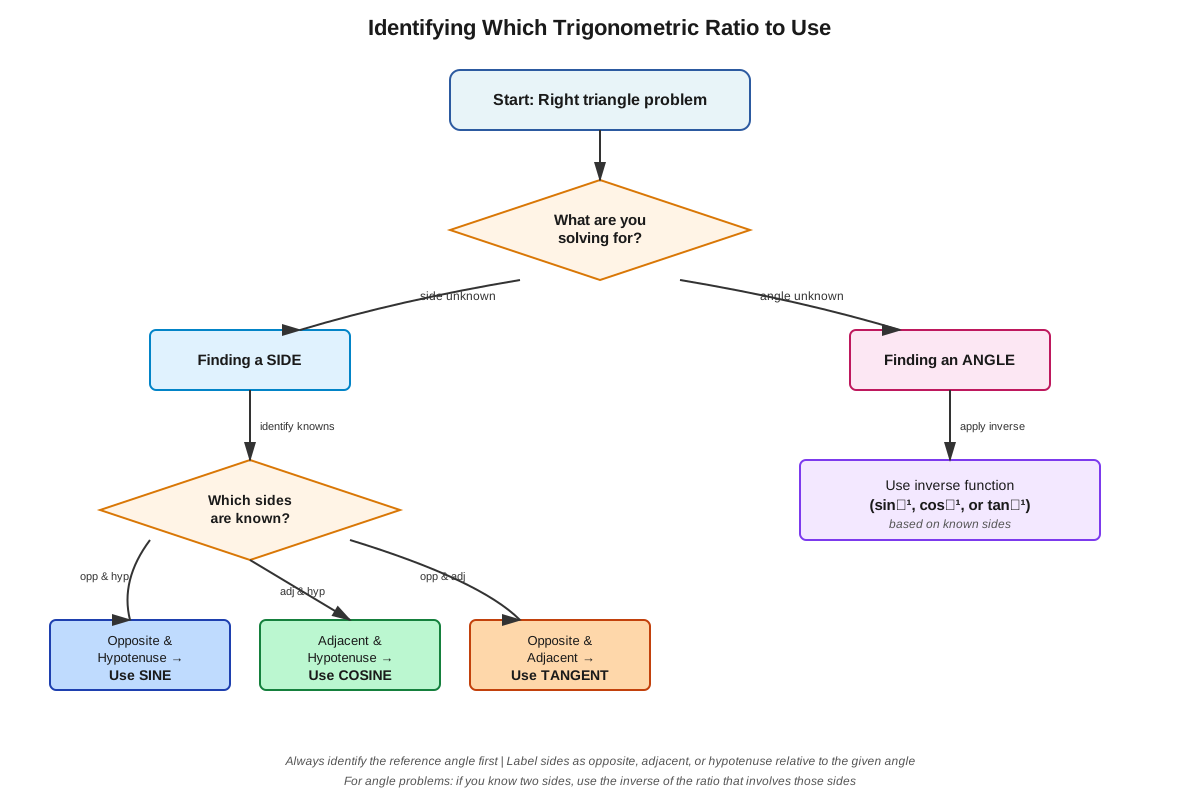
This mnemonic should become automatic, as quickly identifying the correct ratio saves valuable time on the ACT. When approaching any right triangle problem, students should immediately label the sides relative to the angle in question (opposite, adjacent, hypotenuse) and then select the appropriate ratio based on which sides are known or need to be found.
Inverse Trigonometric Functions
When the side lengths are known but an angle measure is unknown, inverse trigonometric functions (also called arc functions) are used. These functions are denoted as sin⁻¹, cos⁻¹, and tan⁻¹ (or arcsin, arccos, arctan) and are accessed on calculators using the "2nd" or "shift" key followed by the trigonometric function button.
For example, if sin θ = 0.5, then θ = sin⁻¹(0.5) = 30°. The inverse function "undoes" the trigonometric ratio to reveal the angle. On the ACT, problems requiring inverse functions typically provide two side lengths and ask for an angle measure, or they present a ratio and ask for the corresponding angle.
Complementary Angle Relationships
In a right triangle, the two acute angles are complementary, meaning they sum to 90 degrees. This creates a special relationship between sine and cosine: the sine of one acute angle equals the cosine of the other acute angle. Specifically, sin θ = cos(90° - θ) and cos θ = sin(90° - θ). While this relationship appears less frequently on the ACT than the basic ratios, recognizing it can provide shortcuts in certain problems.
Common Angle Values
The ACT frequently uses angles with known exact trigonometric values. Memorizing these values eliminates the need for calculator use and speeds up problem-solving:
| Angle | sin | cos | tan |
|---|---|---|---|
| 0° | 0 | 1 | 0 |
| 30° | 1/2 | √3/2 | √3/3 |
| 45° | √2/2 | √2/2 | 1 |
| 60° | √3/2 | 1/2 | √3 |
| 90° | 1 | 0 | undefined |
These values derive from the special right triangles (30-60-90 and 45-45-90) and appear frequently enough on the ACT to justify memorization.
Angles of Elevation and Depression
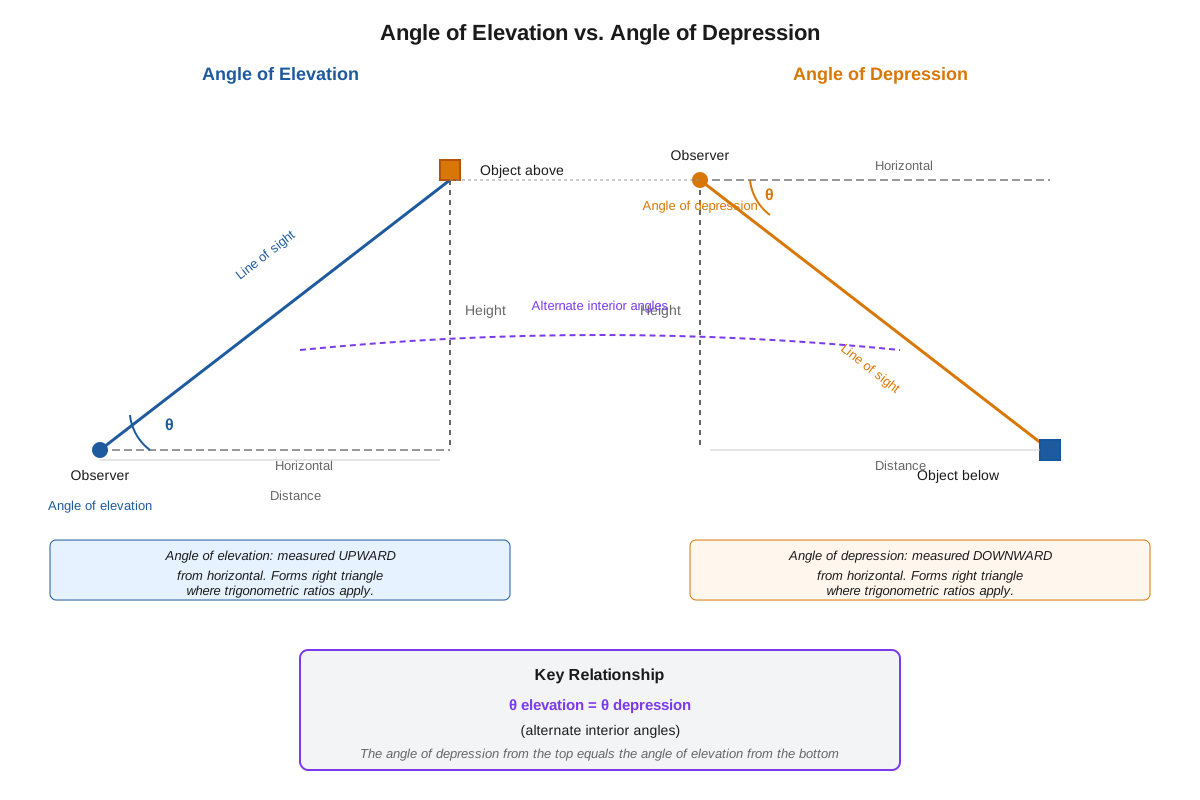
Angles of elevation and angles of depression represent common real-world applications of right triangle trigonometry that appear regularly on the ACT. An angle of elevation is measured upward from a horizontal line to an object above the observer. An angle of depression is measured downward from a horizontal line to an object below the observer.
A crucial geometric principle: when two horizontal lines are parallel (such as the ground and a line at eye level), the angle of elevation from one point equals the angle of depression from another point, as they are alternate interior angles. This relationship frequently appears in ACT problems involving observers looking at objects from different heights.
Setting Up Trigonometric Equations
The process for solving right triangle trigonometry problems follows a consistent pattern:
- Draw and label a diagram if one is not provided, marking the right angle, known sides, known angles, and the unknown quantity
- Identify the angle from which you're working (the reference angle)
- Label sides relative to that angle as opposite, adjacent, or hypotenuse
- Select the appropriate ratio based on which two sides are involved (known and unknown)
- Set up the equation using the trigonometric ratio
- Solve algebraically for the unknown, using inverse functions if solving for an angle
- Check reasonableness of the answer (angles should be between 0° and 90°, sides should follow triangle inequality)
Concept Relationships
The concepts within right triangle trigonometry form a hierarchical structure where understanding each level depends on mastery of the previous level. At the foundation lies the ability to identify and label the sides of a right triangle relative to a given angle (opposite, adjacent, hypotenuse). This identification skill → enables selection of the appropriate trigonometric ratio (sine, cosine, or tangent) → which allows setup of an equation relating known and unknown quantities → leading to algebraic solution for the unknown side or angle.
The three primary ratios (sine, cosine, tangent) connect to each other through their definitions and through the complementary angle relationships in right triangles. Understanding that tangent equals sine divided by cosine (tan θ = sin θ/cos θ) provides a backup method when one ratio is more convenient than another. The inverse trigonometric functions connect directly to the primary ratios as their mathematical inverses, transforming ratio values back into angle measures.
Right triangle trigonometry builds directly on prerequisite knowledge of the Pythagorean theorem, which provides an alternative method for finding side lengths when two sides are known. Special right triangles (30-60-90 and 45-45-90) connect to trigonometry by providing the exact values for trigonometric ratios at common angles. These special triangles serve as both a verification tool and a shortcut method for problems involving their characteristic angles.
The topic extends outward to connect with coordinate geometry (using trigonometry to find distances and angles in the coordinate plane), vectors (decomposing forces and velocities into components), and more advanced trigonometry (the unit circle and trigonometric functions of any angle). Within the ACT context, right triangle trigonometry most frequently connects to geometry problems involving polygons, circles, and three-dimensional figures where right triangles can be identified within more complex shapes.
High-Yield Facts
⭐ The three primary trigonometric ratios are sine = opposite/hypotenuse, cosine = adjacent/hypotenuse, and tangent = opposite/adjacent
⭐ SOH-CAH-TOA is the standard mnemonic for remembering which ratio uses which sides
⭐ The hypotenuse is always the longest side and is always opposite the right angle
⭐ Inverse trigonometric functions (sin⁻¹, cos⁻¹, tan⁻¹) are used to find angle measures when side lengths are known
⭐ In angle of elevation and depression problems, these angles are equal when measured from parallel horizontal lines
- The two acute angles in a right triangle are complementary (sum to 90°)
- sin 30° = 1/2, sin 45° = √2/2, and sin 60° = √3/2 are the most commonly tested exact values
- cos 30° = √3/2, cos 45° = √2/2, and cos 60° = 1/2 are complementary to the sine values
- tan 45° = 1 because the opposite and adjacent sides are equal in a 45-45-90 triangle
- When solving for a side length, multiply or divide to isolate the variable; when solving for an angle, use the inverse function
- Calculator mode (degree vs. radian) must be set to degrees for ACT problems unless otherwise specified
- The tangent ratio is particularly useful when the hypotenuse is neither given nor needed
- Trigonometric ratios remain constant for a given angle regardless of the triangle's size (similar triangles have equal ratios)
- Drawing a clear diagram with all known information labeled is essential for avoiding errors in side identification
Quick check — test yourself on Right triangle trigonometry so far.
Try Flashcards →Common Misconceptions
Misconception: The opposite and adjacent sides are fixed for a given triangle → Correction: The opposite and adjacent sides are defined relative to the angle being considered. The same side can be opposite to one acute angle and adjacent to the other acute angle in the same triangle. Always identify sides relative to the specific angle you're working with.
Misconception: The hypotenuse can be either of the two longer sides → Correction: The hypotenuse is specifically the side opposite the right angle and is always the longest side of a right triangle. It never forms one of the sides of the right angle itself.
Misconception: Sine, cosine, and tangent can be used interchangeably → Correction: Each ratio relates specific sides of the triangle. Using the wrong ratio will produce an incorrect answer. The ratio must be selected based on which two sides (of opposite, adjacent, and hypotenuse) are involved in the problem.
Misconception: Inverse trigonometric functions are the reciprocals of the regular functions → Correction: Inverse functions (sin⁻¹, cos⁻¹, tan⁻¹) are not the same as reciprocals (1/sin, 1/cos, 1/tan). The inverse functions find the angle when given a ratio, while reciprocals are different ratios entirely (cosecant, secant, cotangent, which rarely appear on the ACT).
Misconception: Angles of elevation and depression are always different values → Correction: When measured from parallel horizontal lines (such as ground level and eye level), the angle of elevation from one point equals the angle of depression from another point due to alternate interior angles. This relationship is frequently tested on the ACT.
Misconception: Calculator answers are always correct → Correction: Calculators can give incorrect answers if set to the wrong mode (radians instead of degrees), if parentheses are used incorrectly, or if the wrong function is pressed. Always check that answers are reasonable (acute angles should be between 0° and 90°, side lengths should satisfy triangle inequality).
Misconception: You need to memorize all trigonometric values → Correction: While knowing exact values for 30°, 45°, and 60° is helpful, the ACT allows calculator use. Focus on understanding which ratio to use and how to set up the equation correctly rather than memorizing extensive tables of values.
Worked Examples
Example 1: Finding a Side Length Using Tangent
Problem: A ladder leans against a wall, forming a 65° angle with the ground. If the base of the ladder is 8 feet from the wall, how high up the wall does the ladder reach?
Solution:
Step 1: Draw and label a diagram. We have a right triangle where the ground and wall meet at a right angle. The angle at the base of the ladder (where it touches the ground) is 65°. The distance from the wall to the base of the ladder is 8 feet (this is the adjacent side to the 65° angle). We need to find the height up the wall (the opposite side to the 65° angle).
Step 2: Identify the sides relative to the 65° angle:
- Adjacent = 8 feet (given)
- Opposite = ? (what we're finding)
- Hypotenuse = not needed for this problem
Step 3: Select the appropriate ratio. Since we have adjacent and need opposite, we use tangent (TOA: Tangent = Opposite/Adjacent).
Step 4: Set up the equation:
tan(65°) = opposite/adjacent
tan(65°) = height/8
Step 5: Solve for height:
height = 8 × tan(65°)
height = 8 × 2.1445
height ≈ 17.16 feet
Step 6: Check reasonableness. The height (17.16 feet) is greater than the base distance (8 feet), which makes sense because the angle is greater than 45°. When the angle exceeds 45°, the opposite side should be longer than the adjacent side.
Connection to learning objectives: This problem demonstrates identifying when trigonometry is being tested (angle and one side given, another side needed), selecting the core strategy (tangent ratio for opposite and adjacent), and applying the concept accurately to reach the correct answer.
Example 2: Finding an Angle Using Inverse Sine
Problem: A wheelchair ramp rises 3 feet over a horizontal distance of 20 feet. What angle does the ramp make with the ground? (Note: The 20 feet is measured along the ground, not along the ramp itself.)
Solution:
Step 1: Draw and label a diagram. We have a right triangle where the vertical rise is 3 feet and the horizontal distance is 20 feet. We need to find the angle between the ramp and the ground.
Step 2: Identify what we know and what we need. We know the opposite side (3 feet, the rise) and the adjacent side (20 feet, the horizontal distance) relative to the angle we're finding. We need the angle itself.
Step 3: Select the appropriate ratio. Since we have opposite and adjacent, we could use tangent. Let's call the angle θ.
tan(θ) = opposite/adjacent = 3/20 = 0.15
Step 4: Use the inverse function to find the angle:
θ = tan⁻¹(0.15)
θ ≈ 8.53°
Step 5: Verify using an alternative approach. We could also use sine if we first find the hypotenuse using the Pythagorean theorem:
hypotenuse² = 3² + 20² = 9 + 400 = 409
hypotenuse ≈ 20.22 feet
Then: sin(θ) = 3/20.22 ≈ 0.1484
θ = sin⁻¹(0.1484) ≈ 8.53°
The answers match, confirming our solution.
Step 6: Check reasonableness. An angle of about 8.5° is quite shallow, which makes sense for a wheelchair ramp (ADA guidelines require ramps to be no steeper than about 4.8°, so this ramp is actually steeper than allowed, but the math is correct for the given measurements).
Connection to learning objectives: This problem shows how to identify when inverse trigonometric functions are needed (when finding an angle from known sides), demonstrates the core strategy of selecting the appropriate ratio and applying its inverse, and illustrates how to verify answers using alternative approaches.
Exam Strategy
When approaching ACT right triangle trigonometry questions, begin by quickly scanning for the key indicators: the presence of a right triangle (either explicitly stated or implied through perpendicular lines), at least one angle measure, and at least one side length. Questions asking for "height," "distance," "angle," or using phrases like "angle of elevation" or "angle of depression" are strong signals that trigonometry is being tested.
Trigger words and phrases to watch for include: "angle of elevation," "angle of depression," "from the ground," "from eye level," "looking up at," "looking down at," "ladder against a wall," "ramp," "slope," "incline," "how high," "how far," and "what angle." These phrases almost always indicate a right triangle trigonometry problem. Additionally, watch for problems that mention "perpendicular," "vertical," or "horizontal," as these words establish the right angle needed for trigonometric ratios.
Time allocation strategy: Right triangle trigonometry problems on the ACT typically require 45-90 seconds each. Straightforward ratio calculations should take about 45 seconds, while word problems requiring diagram creation and multi-step solutions may take up to 90 seconds. If a problem requires more than 90 seconds, consider marking it for review and moving on, as the ACT rewards efficient time management. Practice with timed problems builds the speed needed to handle these questions within the time constraint.
Process-of-elimination approach: When answer choices are given, use estimation to eliminate unreasonable options before calculating. For angle measures, eliminate any answers greater than 90° (since we're working with acute angles in right triangles) or negative angles. For side lengths, use the triangle inequality (the sum of any two sides must exceed the third side) and the fact that the hypotenuse must be the longest side. If an answer choice for a side length is longer than the hypotenuse or violates basic geometric principles, eliminate it immediately.
Calculator efficiency tips: Ensure your calculator is in degree mode before the exam begins (most ACT problems use degrees, not radians). Practice the key sequence for inverse functions on your specific calculator model, as this varies by brand. When setting up calculations, use parentheses to ensure proper order of operations, especially when dividing or multiplying by trigonometric values. For example, to calculate x = 10/sin(30°), enter it as 10 ÷ sin(30) with appropriate parentheses to avoid errors.
Diagram strategy: Even when a diagram is provided, redraw it with your own labels if the given diagram is unclear or doesn't show the information you need. Always label the right angle, mark the given angle, and clearly identify which sides are opposite, adjacent, and hypotenuse relative to your reference angle. This visual organization prevents the most common error in trigonometry: using the wrong ratio because sides were misidentified.
Memory Techniques
SOH-CAH-TOA remains the most effective mnemonic for the three primary ratios. To make it more memorable, create a story: "Some Old Hippie Caught Another Hippie Tripping On Acid" (though any personally meaningful phrase works). The key is to practice until SOH-CAH-TOA becomes automatic, requiring no conscious thought to recall.
The "opposite is across" visualization: Remember that the opposite side is literally across from the angle you're considering. Visualize drawing a line from the angle through the triangle—the side that line crosses first (not including the adjacent side) is the opposite side. This mental image helps prevent confusion when identifying sides.
The "adjacent is next door" memory aid: The adjacent side is the neighbor of the angle, sharing a vertex with it. Think of "adjacent" as meaning "next to" or "beside," just as adjacent rooms in a building share a wall. The adjacent side shares a vertex with the reference angle but is not the hypotenuse.
The "H is for huge" reminder: The hypotenuse is the longest side, and both words start with "H." This simple association helps remember that the hypotenuse must be longer than either leg of the right triangle.
Inverse function visualization: Think of inverse trigonometric functions as "undoing" the regular functions. If sin(30°) = 0.5 "does" something to 30° to get 0.5, then sin⁻¹(0.5) "undoes" it to get back to 30°. This cause-and-effect relationship helps remember when to use inverse functions: when you have the ratio and need the angle.
The 30-60-90 triangle memory technique: Visualize an equilateral triangle with sides of length 2, then drop a perpendicular from one vertex to the opposite side, creating two 30-60-90 triangles. The sides are 1 (short leg, opposite 30°), √3 (long leg, opposite 60°), and 2 (hypotenuse). The pattern 1 : √3 : 2 can be remembered as "one, root three, two" in order from smallest to largest.
The 45-45-90 triangle memory technique: Picture a square with sides of length 1, then draw a diagonal. This creates two 45-45-90 triangles with legs of 1 and hypotenuse of √2. The pattern 1 : 1 : √2 is easy to remember because the two legs are equal (both 45° angles), and the hypotenuse is √2 times the leg length.
Summary
Right triangle trigonometry provides the mathematical framework for relating angles and side lengths in right triangles through three fundamental ratios: sine (opposite/hypotenuse), cosine (adjacent/hypotenuse), and tangent (opposite/adjacent). Success on ACT questions requires mastering the identification of sides relative to a reference angle, selecting the appropriate ratio based on which sides are known or needed, and accurately setting up and solving trigonometric equations. The SOH-CAH-TOA mnemonic serves as the essential tool for remembering which ratio uses which sides. Inverse trigonometric functions (sin⁻¹, cos⁻¹, tan⁻¹) enable calculation of angle measures when side lengths are known. Common ACT applications include angles of elevation and depression, where recognizing that these angles are equal when measured from parallel lines is crucial. The topic appears in 4-6 questions per ACT exam, making it a high-yield area for focused study. Consistent practice with side identification, ratio selection, and calculator operations builds the speed and accuracy needed to reliably earn points on these predictable question types.
Key Takeaways
- The three primary trigonometric ratios (sine, cosine, tangent) relate specific pairs of sides in a right triangle and must be selected based on which sides are involved in the problem
- SOH-CAH-TOA is the essential mnemonic: Sine = Opposite/Hypotenuse, Cosine = Adjacent/Hypotenuse, Tangent = Opposite/Adjacent
- Sides must be identified relative to the reference angle: opposite is across from the angle, adjacent is next to the angle (but not the hypotenuse), and the hypotenuse is always opposite the right angle and is always the longest side
- Inverse trigonometric functions (sin⁻¹, cos⁻¹, tan⁻¹) are used to find angle measures when a ratio is known, while regular functions find ratios when angles are known
- Angles of elevation and depression are equal when measured from parallel horizontal lines, a relationship frequently tested on the ACT
- Drawing and labeling a clear diagram is the most important step for avoiding errors in side identification and ratio selection
- Right triangle trigonometry appears in 4-6 ACT questions per exam, making it one of the highest-yield topics for focused preparation
Related Topics
Unit Circle and Trigonometric Functions: After mastering right triangle trigonometry, students progress to understanding how trigonometric functions extend beyond acute angles to any angle measure using the unit circle. This expansion enables work with periodic functions and more complex trigonometric equations.
Law of Sines and Law of Cosines: These formulas extend trigonometric relationships to non-right triangles, allowing calculation of sides and angles in any triangle. Mastery of right triangle trigonometry provides the foundation for understanding these more general laws.
Trigonometric Identities: Relationships such as sin²θ + cos²θ = 1 and the double-angle formulas build on the basic ratios learned in right triangle trigonometry. Understanding the fundamental definitions makes these identities more intuitive.
Vectors and Components: Decomposing vectors into horizontal and vertical components uses the same sine and cosine ratios learned in right triangle trigonometry, applying them to physics and engineering contexts.
Coordinate Geometry Applications: Calculating distances, slopes, and angles in the coordinate plane often involves creating right triangles and applying trigonometric ratios, connecting algebra and geometry through trigonometry.
Practice CTA
Now that you've mastered the core concepts of right triangle trigonometry, it's time to solidify your understanding through active practice. Attempt the practice questions to test your ability to identify when trigonometry is being tested, select the appropriate ratio, and solve problems accurately under timed conditions. Use the flashcards to drill the essential facts, ratios, and special angle values until they become automatic. Remember that trigonometry questions are among the most predictable on the ACT—consistent practice with these question types translates directly into points on test day. You've built the foundation; now practice applying it until these problems become second nature!
Sign up free to keep reading
Create a free AnvayaPrep account to finish this ACT guide on Right triangle trigonometry — plus flashcards and practice questions.