Overview
Trigonometric identities basics form a critical foundation for solving complex problems on the ACT Math test. These identities are equations involving trigonometric functions that remain true for all values of the variables involved. Understanding these fundamental relationships allows students to simplify expressions, solve equations, and transform one trigonometric form into another—skills that appear frequently in the higher-difficulty questions that separate good scores from excellent ones.
On the ACT, ACT trigonometric identities basics typically appear in 2-4 questions per test, often embedded within coordinate geometry, function analysis, or equation-solving contexts. These questions test whether students can recognize when an identity applies, select the appropriate identity for a given situation, and manipulate expressions using these relationships. Mastery of trigonometric identities is essential because they serve as tools that unlock otherwise intractable problems, particularly those involving simplification of complex expressions or verification of equivalence between different trigonometric forms.
The relationship between trigonometric identities and other Math concepts is extensive. These identities build directly upon the unit circle, right triangle trigonometry, and the definitions of the six trigonometric functions. They connect forward to more advanced topics including trigonometric equations, graphing transformations, and even calculus concepts that occasionally appear on the ACT. Students who master these basics gain a significant advantage in the Trigonometry subscore and overall Math score, as these identities provide shortcuts and verification methods that save valuable time during the exam.
Learning Objectives
- [ ] Identify when Trigonometric identities basics is being tested
- [ ] Explain the core rule or strategy behind Trigonometric identities basics
- [ ] Apply Trigonometric identities basics to ACT-style questions accurately
- [ ] Recognize and apply the Pythagorean identities in various forms
- [ ] Use reciprocal and quotient identities to transform expressions
- [ ] Verify trigonometric identities through algebraic manipulation
- [ ] Select the most efficient identity for solving a given problem under time constraints
Prerequisites
- Unit circle values: Essential for understanding where trigonometric identities originate and for verifying identity applications with specific angle values
- Six trigonometric functions: Must know definitions of sine, cosine, tangent, cosecant, secant, and cotangent to understand how identities relate these functions
- Right triangle trigonometry: Provides the geometric foundation for understanding why these algebraic relationships hold true
- Algebraic manipulation: Required for transforming expressions and verifying identities through factoring, combining fractions, and simplifying
- Pythagorean theorem: The geometric basis for the most important family of trigonometric identities
Why This Topic Matters
Trigonometric identities represent one of the most practical applications of mathematical relationships in both academic and real-world contexts. Engineers use these identities to analyze wave patterns in electrical circuits, physicists apply them to describe oscillating systems and periodic motion, and computer graphics programmers rely on them to render rotations and transformations efficiently. The ability to recognize that two different-looking expressions are actually equivalent is a fundamental skill in mathematical reasoning that extends far beyond trigonometry.
On the ACT Math test, trigonometric identities appear with high frequency relative to other advanced topics. Approximately 15-20% of the trigonometry questions (which themselves constitute about 7% of the entire Math section) directly test identity knowledge. These questions typically appear in positions 45-60 of the Math section, placing them among the more challenging problems that significantly impact scoring at the higher percentiles. Students aiming for scores above 30 must demonstrate proficiency with these identities.
The ACT tests trigonometric identities in several distinct ways: direct simplification problems where students must reduce an expression using identities, equivalence questions asking which expression equals a given trigonometric form, equation-solving problems where identities enable factoring or substitution, and verification questions where students must determine if a proposed identity is valid. The test writers favor questions that combine identity knowledge with algebraic manipulation, ensuring that students must both recognize the appropriate identity and execute the transformation correctly.
Core Concepts
The Reciprocal Identities
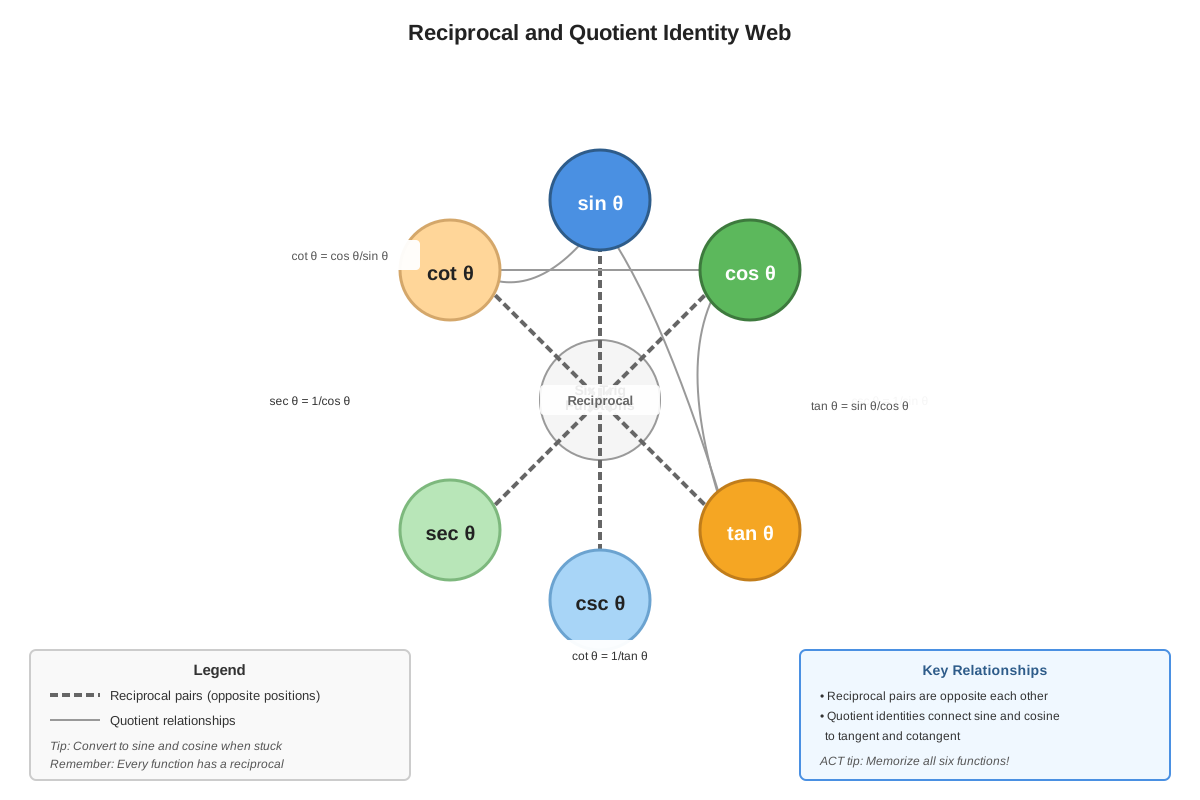
The reciprocal identities establish the fundamental relationships between the three primary trigonometric functions (sine, cosine, tangent) and their reciprocals (cosecant, secant, cotangent). These identities are direct consequences of how these functions are defined:
csc(θ) = 1/sin(θ)
sec(θ) = 1/cos(θ)
cot(θ) = 1/tan(θ)
These can also be expressed in their inverse forms:
sin(θ) = 1/csc(θ)
cos(θ) = 1/sec(θ)
tan(θ) = 1/cot(θ)
On the ACT, reciprocal identities most commonly appear when a problem provides information about one function and asks for the value of its reciprocal, or when simplifying complex fractions involving trigonometric expressions. Recognizing that multiplying a function by its reciprocal always yields 1 is particularly useful for simplification.
The Quotient Identities
The quotient identities express tangent and cotangent in terms of sine and cosine:
tan(θ) = sin(θ)/cos(θ)
cot(θ) = cos(θ)/sin(θ)
These identities derive from the coordinate definitions of the trigonometric functions on the unit circle, where a point at angle θ has coordinates (cos(θ), sin(θ)). The quotient identities are essential for converting between different trigonometric functions, particularly when simplifying expressions that mix tangent or cotangent with sine and cosine.
ACT questions frequently require students to rewrite tangent in terms of sine and cosine to enable cancellation or further simplification. For example, an expression like sin(θ)·tan(θ) can be rewritten as sin(θ)·sin(θ)/cos(θ) = sin²(θ)/cos(θ), which may match an answer choice or enable further manipulation.
The Pythagorean Identities
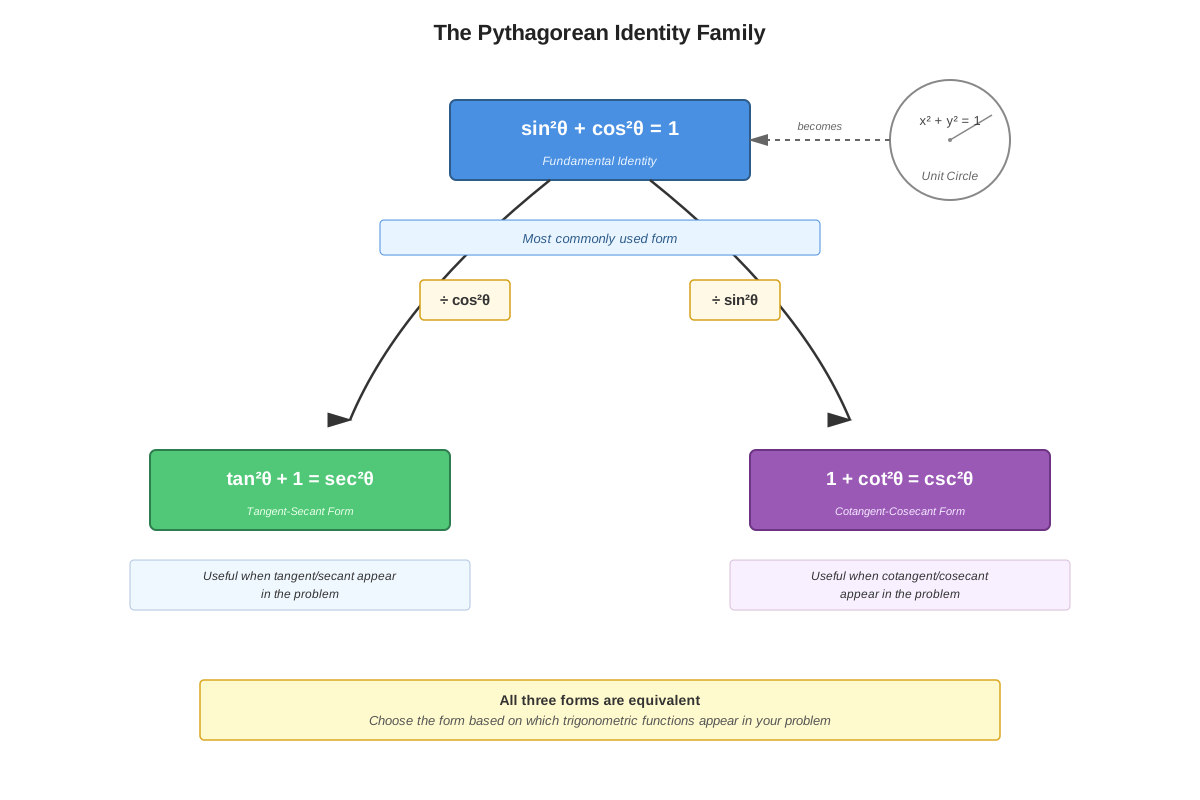
The Pythagorean identities are the most important and frequently tested family of trigonometric identities. The fundamental Pythagorean identity states:
sin²(θ) + cos²(θ) = 1This identity comes directly from the Pythagorean theorem applied to the unit circle, where the radius (hypotenuse) equals 1, and the legs are cos(θ) and sin(θ).
By dividing the fundamental identity by cos²(θ), we obtain the second Pythagorean identity:
tan²(θ) + 1 = sec²(θ)By dividing the fundamental identity by sin²(θ), we obtain the third Pythagorean identity:
1 + cot²(θ) = csc²(θ)These three identities can be rearranged into multiple useful forms:
| Original Form | Alternative Form 1 | Alternative Form 2 |
|---|---|---|
| sin²(θ) + cos²(θ) = 1 | sin²(θ) = 1 - cos²(θ) | cos²(θ) = 1 - sin²(θ) |
| tan²(θ) + 1 = sec²(θ) | tan²(θ) = sec²(θ) - 1 | 1 = sec²(θ) - tan²(θ) |
| 1 + cot²(θ) = csc²(θ) | cot²(θ) = csc²(θ) - 1 | 1 = csc²(θ) - cot²(θ) |
The ability to recognize when to use each form is crucial for ACT success. If an expression contains sin²(θ) and the answer choices contain only cosine, substituting sin²(θ) = 1 - cos²(θ) is the key move.
Even-Odd Identities
The even-odd identities describe the symmetry properties of trigonometric functions:
sin(-θ) = -sin(θ)    [sine is odd]
cos(-θ) = cos(θ)     [cosine is even]
tan(-θ) = -tan(θ)    [tangent is odd]
These identities reflect the geometric properties of the unit circle under reflection across the x-axis. Cosine, which measures horizontal distance, remains unchanged when the angle is negated, while sine and tangent, which involve vertical components, change sign.
On the ACT, these identities appear when problems involve negative angles or when verifying whether a given equation is an identity. Understanding that cosine is an even function while sine and tangent are odd functions helps students quickly evaluate expressions and eliminate incorrect answer choices.
Cofunction Identities
The cofunction identities relate trigonometric functions of complementary angles (angles that sum to 90° or π/2 radians):
sin(90° - θ) = cos(θ)
cos(90° - θ) = sin(θ)
tan(90° - θ) = cot(θ)
csc(90° - θ) = sec(θ)
sec(90° - θ) = csc(θ)
cot(90° - θ) = tan(θ)
These identities explain why sine and cosine are called "cofunctions," as are tangent and cotangent, and secant and cosecant. The geometric interpretation involves the complementary angles in a right triangle: the sine of one acute angle equals the cosine of the other acute angle.
While less frequently tested than Pythagorean identities, cofunction identities appear on the ACT when problems involve expressions like sin(90° - x) or when working with complementary angle relationships in geometric contexts.
Concept Relationships
The trigonometric identities form an interconnected web of relationships that build upon each other systematically. The reciprocal identities serve as the foundation, defining the three secondary trigonometric functions (cosecant, secant, cotangent) in terms of the three primary functions (sine, cosine, tangent). These reciprocal relationships enable conversion between any pair of reciprocal functions.
The quotient identities build upon the reciprocal identities by expressing tangent and cotangent in terms of sine and cosine. This creates a hierarchy: tangent = sine/cosine, and cotangent = 1/tangent = cosine/sine. This relationship means that any expression involving all six trigonometric functions can ultimately be rewritten using only sine and cosine.
The Pythagorean identities represent the most powerful family, derived from the geometric Pythagorean theorem applied to the unit circle. The fundamental identity (sin²θ + cos²θ = 1) generates the other two Pythagorean identities through algebraic manipulation (dividing by cos²θ or sin²θ). These identities enable substitution strategies that transform expressions containing one function into expressions containing another.
The relationship map flows as follows:
Unit Circle Definition → Reciprocal Identities → Quotient Identities → Pythagorean Identities → Complex Expression Simplification
Additionally, the even-odd identities and cofunction identities connect to the prerequisite knowledge of function symmetry and complementary angles, respectively. These identities often work in combination: a problem might require using a cofunction identity to convert sin(90° - θ) to cos(θ), then applying a Pythagorean identity to substitute cos²(θ) = 1 - sin²(θ).
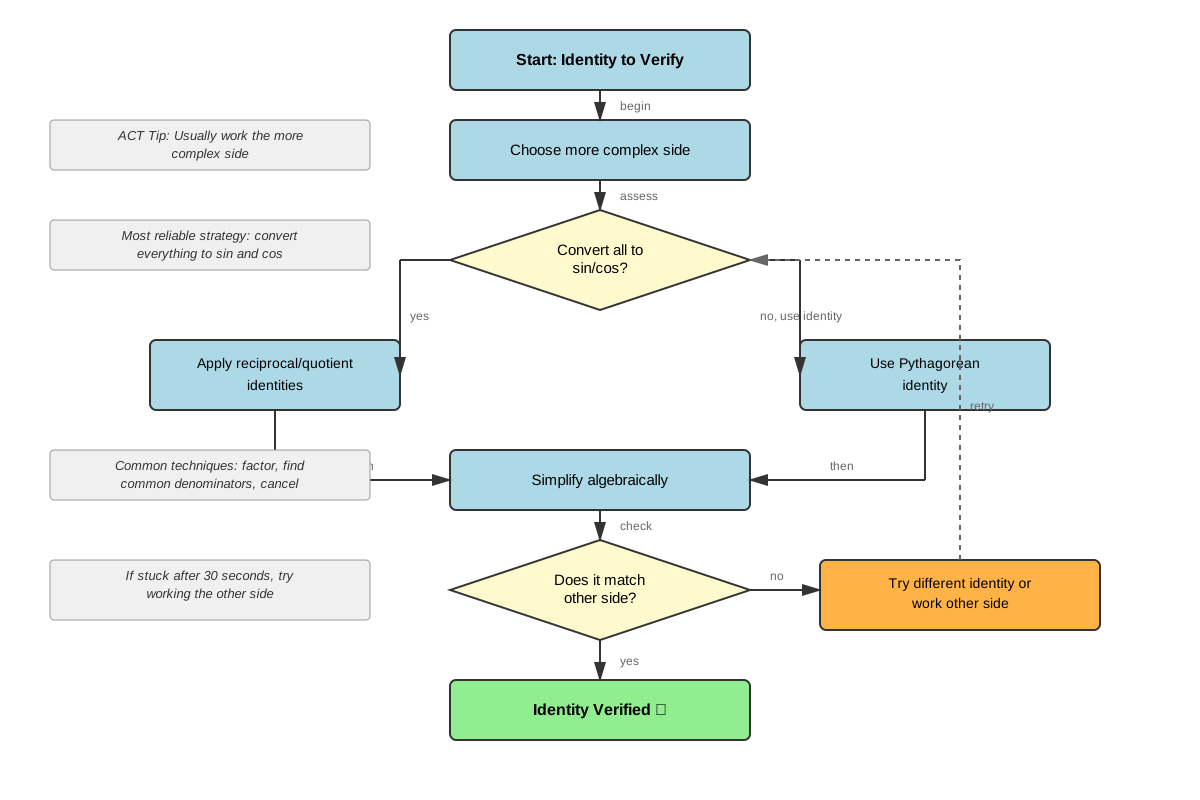
Understanding these relationships allows students to develop problem-solving strategies: when stuck, convert everything to sine and cosine using quotient and reciprocal identities, then apply Pythagorean identities to simplify. This systematic approach works for the vast majority of ACT trigonometric identity questions.
High-Yield Facts
⭐ The fundamental Pythagorean identity sin²(θ) + cos²(θ) = 1 is the most frequently tested trigonometric identity on the ACT
⭐ Any expression containing tan(θ) can be rewritten as sin(θ)/cos(θ), which often enables simplification
⭐ The identity tan²(θ) + 1 = sec²(θ) appears frequently in problems involving tangent and secant together
⭐ Reciprocal identities allow immediate conversion: csc(θ) = 1/sin(θ), sec(θ) = 1/cos(θ), cot(θ) = 1/tan(θ)
⭐ When an expression contains sin²(θ) and answer choices contain cos(θ), substitute sin²(θ) = 1 - cos²(θ)
- The identity 1 + cot²(θ) = csc²(θ) is less common but appears in advanced ACT problems involving cotangent
- Cosine is an even function: cos(-θ) = cos(θ), while sine and tangent are odd functions
- The cofunction identity sin(90° - θ) = cos(θ) connects complementary angles
- Multiplying a function by its reciprocal always equals 1: sin(θ)·csc(θ) = 1
- The expression sin²(θ) means (sin(θ))², not sin(θ²)
- All Pythagorean identities can be rearranged to isolate any term, creating six useful forms from three identities
- When verifying an identity, work with one side at a time rather than manipulating both sides simultaneously
- The quotient identity cot(θ) = cos(θ)/sin(θ) is the reciprocal of tan(θ) = sin(θ)/cos(θ)
- Factoring techniques like difference of squares apply to trigonometric expressions: sin²(θ) - cos²(θ) = (sin(θ) + cos(θ))(sin(θ) - cos(θ))
- The domain restrictions of trigonometric functions affect when identities are valid: tan(θ) is undefined when cos(θ) = 0
Quick check — test yourself on Trigonometric identities basics so far.
Try Flashcards →Common Misconceptions
Misconception: sin²(θ) + cos²(θ) = 1 only works for special angles like 30°, 45°, and 60°.
Correction: This identity is true for ALL angle values. It's called an identity precisely because it holds universally, not just for specific angles. Students can verify this with any angle on the unit circle.
Misconception: sin²(θ) means sin(θ²), so sin²(30°) = sin(900°).
Correction: The notation sin²(θ) means (sin(θ))², which is the sine function applied first, then the result squared. For sin²(30°), calculate sin(30°) = 0.5, then square it to get 0.25, not sin(900°).
Misconception: The reciprocal of sin(θ) is sin⁻¹(θ).
Correction: The reciprocal of sin(θ) is csc(θ) = 1/sin(θ). The notation sin⁻¹(θ) represents the inverse sine function (arcsine), which is completely different—it's the angle whose sine is θ, not the reciprocal.
Misconception: When simplifying (sin(θ) + cos(θ))², the result is sin²(θ) + cos²(θ) = 1.
Correction: Squaring a binomial requires using the formula (a + b)² = a² + 2ab + b². Therefore, (sin(θ) + cos(θ))² = sin²(θ) + 2sin(θ)cos(θ) + cos²(θ) = 1 + 2sin(θ)cos(θ), which does not simplify to 1.
Misconception: To verify an identity, manipulate both sides simultaneously until they look the same.
Correction: When verifying identities, work with only one side of the equation (usually the more complex side) and transform it until it matches the other side. Manipulating both sides can lead to circular reasoning and invalid proofs.
Misconception: tan²(θ) + 1 = sec²(θ) can be rearranged to tan(θ) + 1 = sec(θ) by taking the square root of both sides.
Correction: Taking the square root of both sides of tan²(θ) + 1 = sec²(θ) gives √(tan²(θ) + 1) = |sec(θ)|, NOT tan(θ) + 1 = sec(θ). The square root of a sum is not the sum of the square roots.
Misconception: All trigonometric equations are identities.
Correction: An identity is true for all values in the domain, while an equation may only be true for specific values. For example, sin²(θ) + cos²(θ) = 1 is an identity, but sin(θ) = 0.5 is an equation with specific solutions (θ = 30° + 360°n or θ = 150° + 360°n).
Misconception: The Pythagorean identities only work in degrees, not radians.
Correction: Trigonometric identities are independent of the angle measurement system. They work equally well whether angles are measured in degrees, radians, or any other unit, because they express fundamental relationships between the functions themselves.
Worked Examples
Example 1: Simplifying Using Multiple Identities
Problem: Simplify the expression (sin²(θ) + cos²(θ))/cos(θ) + tan(θ)·sin(θ)
Solution:
Step 1: Recognize that the numerator of the first term contains the fundamental Pythagorean identity.
- sin²(θ) + cos²(θ) = 1
- So the expression becomes: 1/cos(θ) + tan(θ)·sin(θ)
Step 2: Apply the reciprocal identity to 1/cos(θ).
- 1/cos(θ) = sec(θ)
- Expression is now: sec(θ) + tan(θ)·sin(θ)
Step 3: Apply the quotient identity to tan(θ).
- tan(θ) = sin(θ)/cos(θ)
- Expression becomes: sec(θ) + (sin(θ)/cos(θ))·sin(θ)
Step 4: Simplify the second term.
- (sin(θ)/cos(θ))·sin(θ) = sin²(θ)/cos(θ)
Step 5: Combine the terms over a common denominator.
- sec(θ) + sin²(θ)/cos(θ) = 1/cos(θ) + sin²(θ)/cos(θ) = (1 + sin²(θ))/cos(θ)
Step 6: Apply the Pythagorean identity in rearranged form.
- Since sin²(θ) = 1 - cos²(θ), we have 1 + sin²(θ) = 1 + 1 - cos²(θ) = 2 - cos²(θ)
Final Answer: (2 - cos²(θ))/cos(θ) or equivalently 2sec(θ) - cos(θ)
Connection to Learning Objectives: This problem demonstrates the application of multiple identities in sequence (Pythagorean, reciprocal, and quotient), showing how to recognize which identity applies at each step—a key skill for ACT success.
Example 2: Verifying an Identity
Problem: Verify that (1 - sin²(θ))/sin(θ) = cos²(θ)/sin(θ) is an identity.
Solution:
Step 1: Choose to work with the left side since it appears more complex.
- Start with: (1 - sin²(θ))/sin(θ)
Step 2: Recognize that 1 - sin²(θ) matches the rearranged Pythagorean identity.
- From sin²(θ) + cos²(θ) = 1, we get cos²(θ) = 1 - sin²(θ)
Step 3: Substitute cos²(θ) for 1 - sin²(θ).
- (1 - sin²(θ))/sin(θ) = cos²(θ)/sin(θ)
Step 4: Confirm that the left side now matches the right side exactly.
- cos²(θ)/sin(θ) = cos²(θ)/sin(θ) ✓
Verification Complete: The identity is valid because we successfully transformed the left side into the right side using only valid trigonometric identities and algebraic operations.
Connection to Learning Objectives: This example shows the proper technique for verifying identities—working with one side only and using strategic substitutions based on recognizing patterns that match known identities. This skill directly addresses the objective of explaining the core strategy behind trigonometric identities.
Example 3: ACT-Style Multiple Choice
Problem: Which of the following is equivalent to (sec²(θ) - 1)/tan(θ)?
A) sin(θ)
B) cos(θ)
C) tan(θ)
D) sec(θ)
E) csc(θ)
Solution:
Step 1: Recognize that sec²(θ) - 1 appears in a Pythagorean identity.
- From tan²(θ) + 1 = sec²(θ), we can rearrange to get sec²(θ) - 1 = tan²(θ)
Step 2: Substitute tan²(θ) for sec²(θ) - 1.
- (sec²(θ) - 1)/tan(θ) = tan²(θ)/tan(θ)
Step 3: Simplify the fraction.
- tan²(θ)/tan(θ) = tan(θ)
Answer: C) tan(θ)
Connection to Learning Objectives: This problem type is extremely common on the ACT. It tests the ability to identify when a specific identity applies (recognizing sec²(θ) - 1 as tan²(θ)) and execute the simplification accurately under time pressure.
Exam Strategy
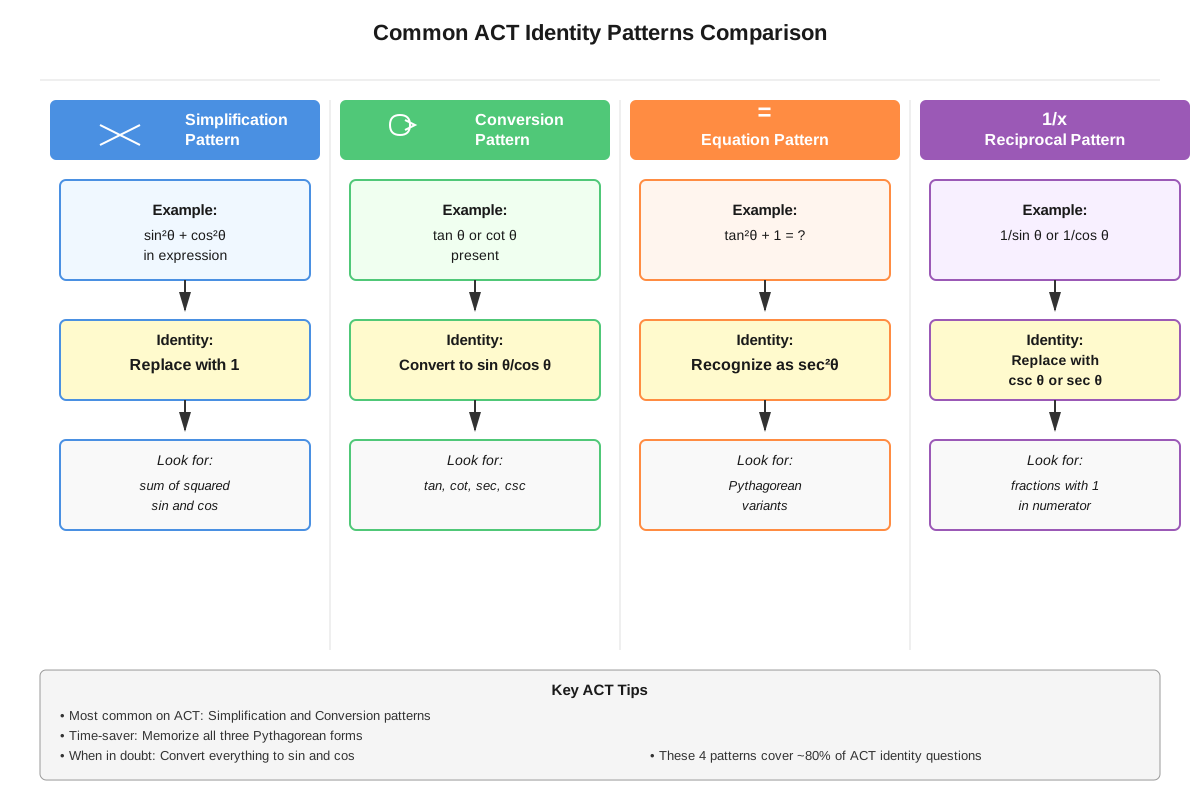
When approaching ACT questions involving trigonometric identities, begin by identifying what the question is asking: simplification, verification, or finding an equivalent expression. Read the answer choices first—they often provide clues about which identity to apply. If answer choices contain only sine and cosine while the problem includes tangent or other functions, plan to convert everything to sine and cosine using quotient and reciprocal identities.
Trigger words and phrases that signal identity questions include: "simplify," "equivalent to," "which expression equals," "verify that," "for all values of θ," and "identity." The phrase "for all values" specifically indicates an identity rather than an equation with specific solutions. When you see expressions like sin²(θ) + cos²(θ), 1 - cos²(θ), or tan²(θ) + 1, immediately recognize these as Pythagorean identity patterns.
For process-of-elimination strategies, test special angle values when unsure. If a proposed identity or simplification is valid, it must work for all angles, so testing θ = 0°, 30°, 45°, or 90° can quickly eliminate incorrect answers. However, be careful: just because an equation works for one angle doesn't prove it's an identity—it must work for all angles. Use this technique to eliminate wrong answers, not to confirm correct ones.
Time allocation is critical for identity problems. These questions typically appear in the latter portion of the ACT Math section and can be time-consuming if approached inefficiently. Allocate no more than 90 seconds per identity question. If you don't immediately recognize which identity applies, convert everything to sine and cosine—this systematic approach works for most problems and prevents wasting time on unproductive strategies. If a problem requires more than three identity applications, consider marking it for review and moving on, as ACT identity questions rarely require lengthy manipulations.
When stuck, look for these common patterns: expressions with sin²(θ) or cos²(θ) usually need the fundamental Pythagorean identity; expressions mixing tangent with sine or cosine need the quotient identity; expressions with both tangent and secant need tan²(θ) + 1 = sec²(θ); and expressions with reciprocal functions (csc, sec, cot) often simplify by converting to their reciprocals (sin, cos, tan).
Memory Techniques
Mnemonic for Reciprocal Pairs: "Cool Students Can Solve Challenging Tests" helps remember the three reciprocal pairs:
- Cosecant/Sine
- Cosecant/Sine
- seCant/Cosine
- Cotangent/Tangent
Visualization for Pythagorean Identity: Picture a right triangle inscribed in a unit circle. The horizontal leg is cos(θ), the vertical leg is sin(θ), and the hypotenuse (radius) is 1. The Pythagorean theorem immediately gives sin²(θ) + cos²(θ) = 1². This mental image makes the identity intuitive rather than memorized.
Acronym for Quotient Identities: "SOH-CAH-TOA" extends to quotient identities: Tangent = Opposite/Adjacent = Sine/Cosine. The familiar mnemonic from right triangle trigonometry directly gives tan(θ) = sin(θ)/cos(θ).
Pattern Recognition for Pythagorean Variations: Remember "1-2-3" for the three Pythagorean identities:
- 1: sin²(θ) + cos²(θ) = 1 (the fundamental one)
- 2: tan²(θ) + 1 = sec²(θ) (divide by cos²(θ), which appears in 2 of these functions)
- 3: 1 + cot²(θ) = csc²(θ) (divide by sin²(θ), the 3rd option)
Finger Counting for Even-Odd: Hold up your hand with fingers representing the functions in alphabetical order: Cosine, Cotangent, Cosecant, Secant, Sine, Tangent. The "C" functions (first three fingers) include Cosine (even), while Sine and Tangent (last two fingers) are odd. This physical memory aid helps recall which functions change sign with negative angles.
Summary
Trigonometric identities basics encompass the fundamental relationships between trigonometric functions that remain true for all angle values. The reciprocal identities define the relationships between the six trigonometric functions, establishing that csc(θ) = 1/sin(θ), sec(θ) = 1/cos(θ), and cot(θ) = 1/tan(θ). The quotient identities express tan(θ) = sin(θ)/cos(θ) and cot(θ) = cos(θ)/sin(θ), enabling conversion between functions. Most importantly, the Pythagorean identities—sin²(θ) + cos²(θ) = 1, tan²(θ) + 1 = sec²(θ), and 1 + cot²(θ) = csc²(θ)—provide powerful tools for simplification and substitution. These identities work together systematically: reciprocal and quotient identities allow conversion to common functions, while Pythagorean identities enable substitution and simplification. Mastery requires recognizing patterns, selecting appropriate identities efficiently, and executing algebraic manipulations accurately. For ACT success, students must identify when identity questions appear, understand the strategic approach for each identity type, and apply these relationships confidently to simplify expressions and verify equivalences within the time constraints of the exam.
Key Takeaways
- The fundamental Pythagorean identity sin²(θ) + cos²(θ) = 1 is the most essential and frequently tested trigonometric identity on the ACT
- Reciprocal identities (csc = 1/sin, sec = 1/cos, cot = 1/tan) and quotient identities (tan = sin/cos, cot = cos/sin) enable systematic conversion between all six trigonometric functions
- When stuck on an identity problem, convert all functions to sine and cosine using quotient and reciprocal identities, then apply Pythagorean identities
- Recognizing patterns like "sec²(θ) - 1" or "1 - cos²(θ)" as Pythagorean identity components is crucial for efficient problem-solving
- Testing special angle values (0°, 30°, 45°, 90°) can eliminate incorrect answer choices but cannot prove an identity is valid
- Identity verification requires working with one side of the equation at a time, transforming it to match the other side
- Time management is critical—allocate no more than 90 seconds per identity question and use systematic approaches rather than trial and error
Related Topics
Sum and Difference Identities: Building on these basic identities, sum and difference formulas express sin(A ± B), cos(A ± B), and tan(A ± B) in terms of the individual functions. Mastering basic identities provides the foundation for understanding these more complex relationships.
Double-Angle and Half-Angle Identities: These specialized identities derive from sum identities and express trigonometric functions of 2θ or θ/2 in terms of functions of θ. The Pythagorean identities are essential prerequisites for deriving and applying these formulas.
Trigonometric Equations: Solving equations like 2sin²(θ) - sin(θ) - 1 = 0 requires using identities to transform the equation into solvable form. The basic identities covered here are the primary tools for these transformations.
Graphing Trigonometric Functions: Understanding identities helps explain why certain transformations produce equivalent graphs and enables simplification of complex functions before graphing.
Law of Sines and Law of Cosines: These advanced triangle-solving techniques connect to trigonometric identities through their derivations and applications, particularly when simplifying expressions in non-right triangles.
Practice CTA
Now that you've mastered the fundamentals of trigonometric identities, it's time to solidify your understanding through active practice. Work through the practice questions to test your ability to recognize identity patterns, select appropriate strategies, and execute simplifications accurately under timed conditions. Use the flashcards to reinforce quick recall of the essential identities—speed and accuracy with these basics will give you a significant advantage on test day. Remember, trigonometric identities are tools that unlock complex problems, and like any tool, they become more effective with practice. Challenge yourself with increasingly difficult problems, and you'll find that what once seemed complicated becomes second nature. Your investment in mastering these identities will pay dividends not only on the ACT but in any future mathematical endeavors.
Sign up free to keep reading
Create a free AnvayaPrep account to finish this ACT guide on Trigonometric identities basics — plus flashcards and practice questions.