Overview
Trigonometric word problems represent one of the most practical and frequently tested applications of trigonometry on the ACT Math test. These problems require students to translate real-world scenarios—such as finding the height of a building, determining the angle of elevation to a plane, or calculating distances across bodies of water—into mathematical relationships using sine, cosine, tangent, and their reciprocal functions. Unlike straightforward computational trigonometry questions, ACT trigonometric word problems demand both conceptual understanding and the ability to visualize spatial relationships, making them a critical skill for achieving top scores in the higher-difficulty range of the exam.
The ACT consistently includes 2-4 trigonometric word problems per test, typically appearing in the latter half of the 60-question Math section where difficulty increases. These problems test whether students can move beyond memorizing formulas to actually applying trigonometric ratios in context. Success requires recognizing key geometric configurations (particularly right triangles), identifying which trigonometric function relates the given information to the unknown quantity, and executing calculations accurately under time pressure.
Mastery of trigonometric word problems connects directly to broader mathematical reasoning skills tested throughout the ACT Math section. These problems integrate coordinate geometry, triangle properties, unit conversions, and algebraic manipulation—all while requiring careful reading comprehension to extract relevant numerical information from verbal descriptions. Students who excel at these problems demonstrate the synthesis of multiple mathematical domains, which is precisely what distinguishes high scorers from average performers on standardized tests.
Learning Objectives
- [ ] Identify when trigonometric word problems are being tested in ACT questions
- [ ] Explain the core rule or strategy behind solving trigonometric word problems
- [ ] Apply trigonometric word problems concepts to ACT-style questions accurately
- [ ] Construct accurate diagrams from verbal descriptions of spatial relationships
- [ ] Determine which trigonometric ratio (sine, cosine, tangent) applies to specific problem contexts
- [ ] Convert between angle measurements and solve for unknown sides or angles in applied contexts
- [ ] Recognize and avoid common setup errors that lead to incorrect trigonometric equations
Prerequisites
- Right triangle trigonometry fundamentals: Understanding SOH-CAH-TOA and the definitions of sine, cosine, and tangent is essential for setting up equations from word problem descriptions
- Basic geometry of triangles: Knowledge of angle relationships, complementary angles, and triangle properties enables proper diagram construction and problem visualization
- Pythagorean theorem: Many trigonometric word problems involve verifying or finding side lengths, requiring this foundational relationship
- Angle measurement concepts: Familiarity with degrees and the relationship between angles of elevation/depression ensures correct problem interpretation
- Algebraic equation solving: After setting up trigonometric equations, students must isolate variables and perform inverse operations accurately
Why This Topic Matters
Trigonometric word problems bridge the gap between abstract mathematics and real-world applications, demonstrating how mathematical tools solve practical problems in navigation, architecture, surveying, and engineering. Professionals in fields ranging from construction to aviation use these exact techniques daily to calculate distances, heights, and angles that cannot be measured directly. Understanding these applications helps students appreciate mathematics as a problem-solving toolkit rather than a collection of disconnected formulas.
On the ACT specifically, trigonometric word problems appear with high frequency and predictability. Statistical analysis of released ACT exams shows that approximately 3-5% of all Math questions involve applied trigonometry, with these questions typically positioned in the difficulty range of questions 40-55 out of 60. These problems often serve as "gatekeeper" questions that separate students scoring in the 28-30 range from those achieving perfect or near-perfect scores. The ACT favors certain problem types repeatedly: angle of elevation/depression scenarios (approximately 40% of trigonometric word problems), distance calculations using right triangles (30%), and height determination problems (25%).
Common manifestations on the ACT include: a person observing an object at a known angle and distance, requiring calculation of the object's height; two observers at different positions viewing the same object, creating multiple triangles; problems involving shadows and the sun's angle; and navigation scenarios where a path changes direction at a specific angle. The exam writers deliberately embed these problems in realistic contexts to test whether students can extract mathematical structure from verbal descriptions—a higher-order skill than simple computation.
Core Concepts
The Right Triangle Foundation
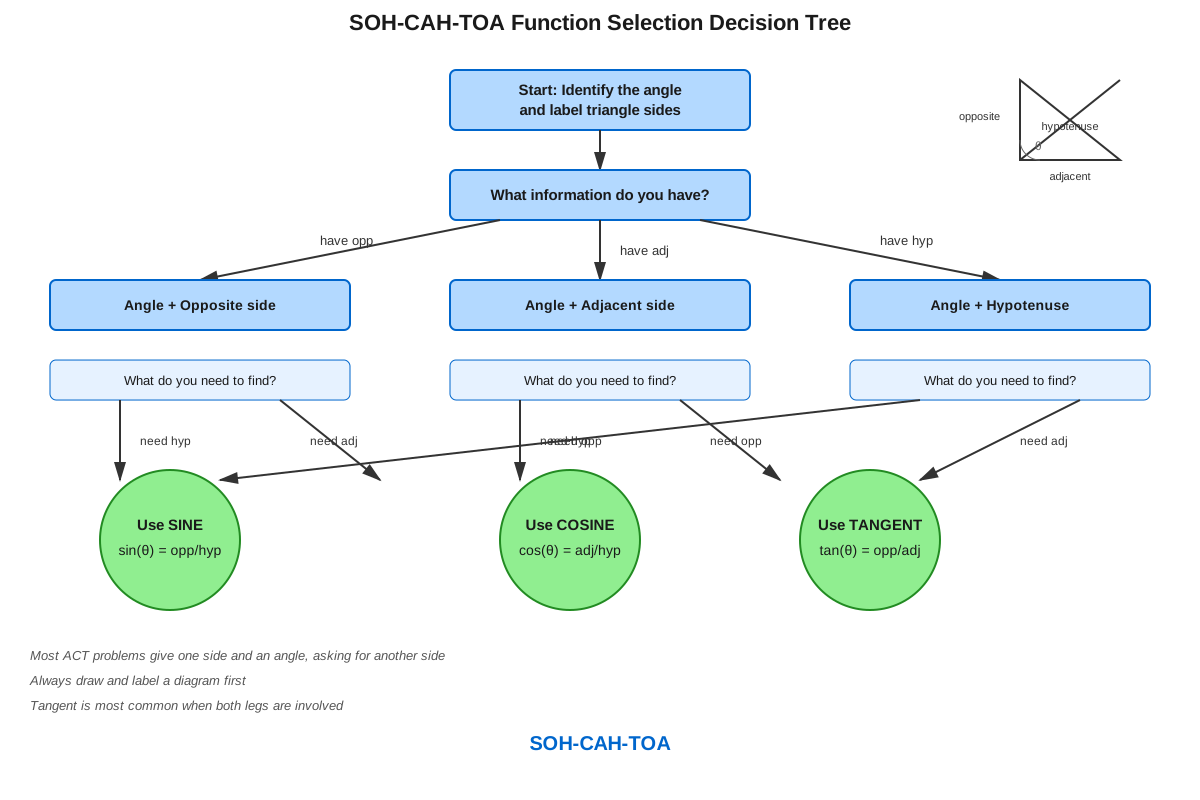
All trigonometric word problems on the ACT ultimately reduce to relationships within right triangles. The fundamental insight is recognizing that whenever a problem describes an angle and involves finding a distance or height, a right triangle exists (or can be constructed) within the scenario. The three primary trigonometric ratios relate angles to side lengths:
sin(θ) = opposite/hypotenuse
cos(θ) = adjacent/hypotenuse
tan(θ) = opposite/adjacent
The key to success is correctly identifying which sides of the right triangle correspond to "opposite," "adjacent," and "hypotenuse" relative to the angle in question. The hypotenuse is always the longest side, opposite the right angle. The opposite side is across from the angle being considered, while the adjacent side touches the angle (but isn't the hypotenuse).
Angle of Elevation and Depression
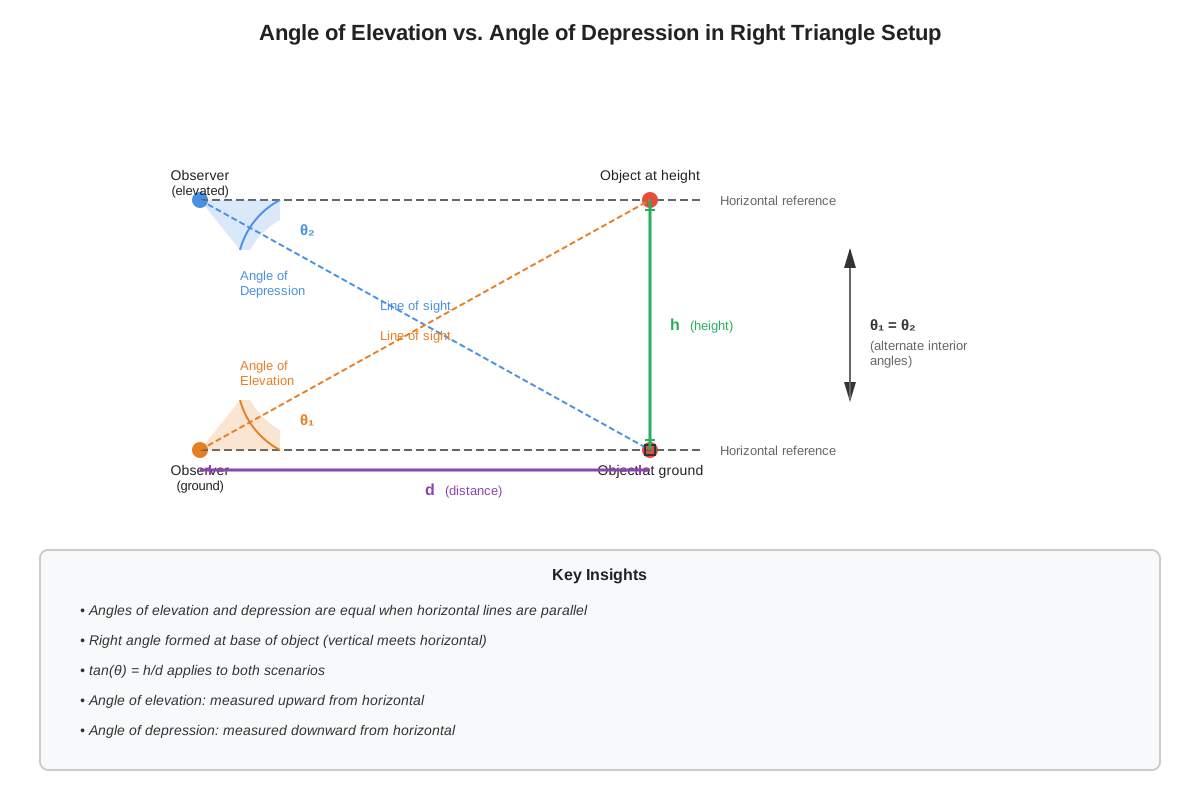
The most frequently tested concept in ACT trigonometric word problems involves angles of elevation and angles of depression. An angle of elevation is measured upward from a horizontal line to an object above the observer. Conversely, an angle of depression is measured downward from a horizontal line to an object below the observer.
Critical insight: When two people observe each other, one's angle of elevation equals the other's angle of depression due to alternate interior angles formed by parallel horizontal lines. This relationship frequently appears in problems involving observers at different heights.
In these problems, the horizontal distance typically becomes the "adjacent" side, while the vertical height difference becomes the "opposite" side, making tangent the most commonly used function:
tan(angle) = height/distanceProblem Setup Strategy
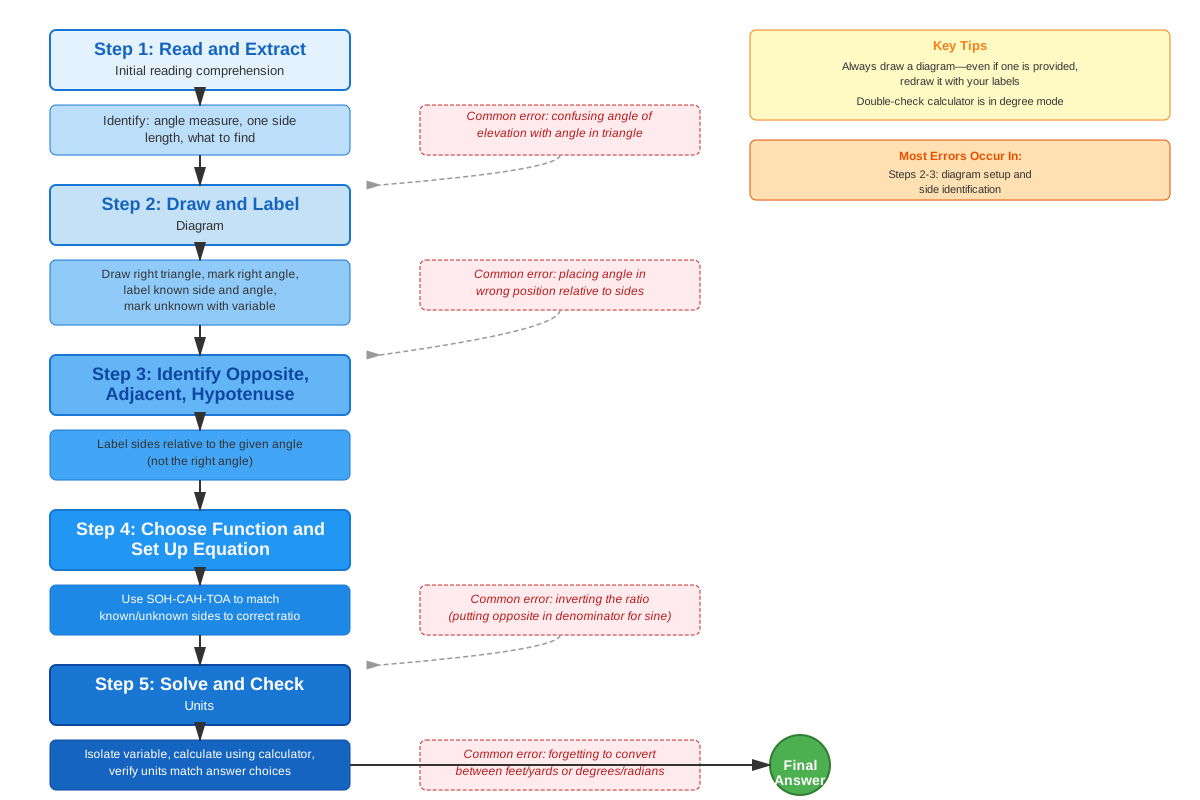
The systematic approach to solving trigonometric word problems involves four distinct steps:
- Read carefully and identify all given information: Note all measurements (distances, heights, angles) and what quantity the problem asks you to find
- Draw an accurate diagram: Sketch the scenario, labeling all known values and using a variable for the unknown quantity
- Identify the right triangle(s): Mark the right angle explicitly and label the sides relative to the angle you'll use (opposite, adjacent, hypotenuse)
- Select the appropriate trigonometric ratio: Choose the function that relates the known information to the unknown variable
Common Problem Configurations
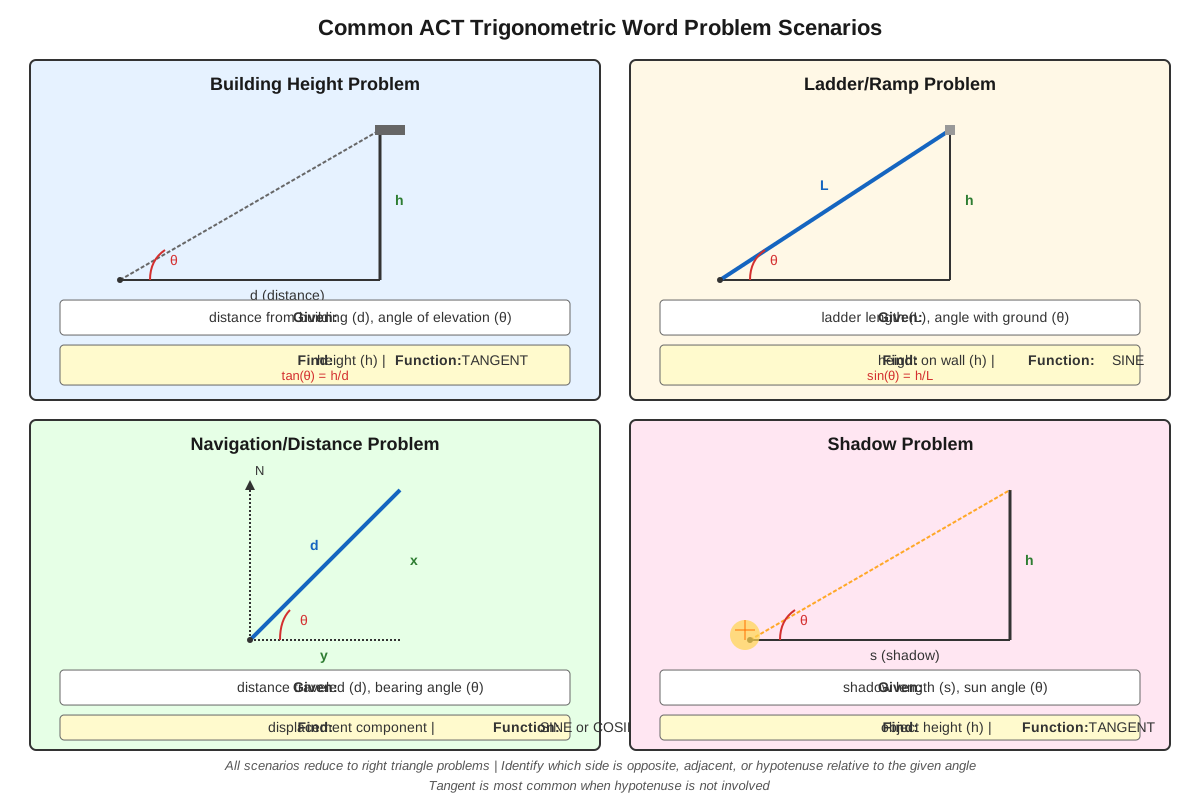
| Configuration Type | Typical Setup | Best Ratio to Use | Key Recognition Feature |
|---|---|---|---|
| Observer to elevated object | Horizontal distance known, find height | tan(θ) = h/d | "Angle of elevation" phrase |
| Shadow problems | Shadow length known, find object height | tan(θ) = h/s | Sun angle and shadow mentioned |
| Distance across obstacle | Height known, find horizontal distance | tan(θ) = h/d or cos(θ) = d/hyp | Cannot measure directly across |
| Ladder/ramp problems | Length and angle known, find height/base | sin(θ) = h/L or cos(θ) = b/L | Leaning object described |
| Two-observer problems | Multiple angles given | Multiple equations | Two different viewing positions |
Inverse Trigonometric Functions
When the problem provides two sides and asks for an angle, students must use inverse trigonometric functions (arcsin, arccos, arctan, often written as sin⁻¹, cos⁻¹, tan⁻¹). On the ACT, these appear less frequently but still require understanding:
If tan(θ) = 0.75, then θ = tan⁻¹(0.75) ≈ 36.87°Most ACT problems provide the angle and ask for a side length, but approximately 15% reverse this relationship. Calculator proficiency with inverse functions is essential.
Unit Awareness and Conversion
ACT trigonometric word problems occasionally require unit conversions, particularly between feet and inches, or miles and feet. Always verify that all measurements use consistent units before setting up equations. A common error involves mixing feet and yards in the same calculation, leading to answers that are off by a factor of 3.
Multi-Step Problems
Advanced ACT trigonometric word problems may require finding an intermediate value before calculating the final answer. For example, a problem might require:
- Using one trigonometric ratio to find a side length
- Using that side length with the Pythagorean theorem to find another side
- Using a second trigonometric ratio to find the final answer
These multi-step problems typically appear in positions 50-60 on the ACT and separate top scorers from others.
Concept Relationships
The concepts within trigonometric word problems form a hierarchical structure. At the foundation lies right triangle recognition—the ability to see or construct right triangles within verbal descriptions. This skill leads directly to proper diagram construction, which enables correct side labeling (opposite, adjacent, hypotenuse). Once sides are properly labeled, students can select the appropriate trigonometric ratio, which then allows equation setup and algebraic solution.
The relationship between angles of elevation and depression connects to the prerequisite knowledge of parallel lines and transversals from geometry. Understanding that horizontal sight lines are parallel enables recognition that alternate interior angles are equal, which simplifies many two-observer problems.
Trigonometric word problems also connect forward to more advanced topics. The problem-solving framework developed here—translating verbal descriptions into mathematical diagrams and equations—applies directly to vectors, polar coordinates, and parametric equations in higher mathematics. Additionally, the spatial reasoning required for these problems strengthens skills needed for coordinate geometry and geometric transformations elsewhere on the ACT.
The relationship map flows as follows:
Verbal description → Diagram construction → Right triangle identification → Side/angle labeling → Ratio selection → Equation setup → Algebraic solution → Answer verification
High-Yield Facts
⭐ The tangent function (tan = opposite/adjacent) is used in approximately 60% of ACT trigonometric word problems, particularly those involving angles of elevation or depression with known horizontal distances.
⭐ An observer's angle of elevation to an object always equals that object's angle of depression to the observer due to alternate interior angles formed by parallel horizontal lines.
⭐ When a problem states "from a point on the ground," the right angle is at that ground point, with the vertical height as one leg and horizontal distance as the other leg.
⭐ Shadow problems always use the tangent ratio: tan(sun's angle) = height of object / length of shadow.
⭐ If a problem gives you the length of a ladder or ramp and an angle, you'll use sine to find height (sin = opposite/hypotenuse) and cosine to find base distance (cos = adjacent/hypotenuse).
- Problems involving "line of sight" or "direct distance" typically refer to the hypotenuse of the right triangle, requiring sine or cosine.
- When two angles are given in a problem, you'll likely need to use both to set up a system of equations or find an intermediate value.
- The phrase "how much higher" or "height above" indicates you should subtract one height from another after calculating both.
- ACT problems rarely require angles beyond 0-90 degrees; if you calculate an angle outside this range, recheck your setup.
- Calculator mode matters: ensure your calculator is in degree mode (not radians) for all ACT trigonometric word problems unless explicitly stated otherwise.
- If the problem asks for an answer "to the nearest foot" or "to the nearest degree," round only your final answer, not intermediate calculations.
- Problems involving bearings or compass directions (N, S, E, W) can be converted to standard angle measurements by drawing a coordinate system.
Quick check — test yourself on Trigonometric word problems so far.
Try Flashcards →Common Misconceptions
Misconception: The angle of elevation is measured from the object down to the observer.
Correction: The angle of elevation is always measured upward from the horizontal at the observer's position to the line of sight toward the object. The angle originates at the observer, not at the object being viewed.
Misconception: In any triangle problem involving an angle, you can use trigonometric ratios.
Correction: Trigonometric ratios (SOH-CAH-TOA) only apply to right triangles. If the problem doesn't explicitly state or imply a right angle exists, you cannot use these basic ratios and may need the Law of Sines or Law of Cosines instead (though these rarely appear on the ACT).
Misconception: The "opposite" and "adjacent" sides are fixed properties of a triangle.
Correction: Which side is "opposite" and which is "adjacent" depends entirely on which angle you're considering. If you switch to a different acute angle in the same right triangle, the opposite and adjacent sides swap roles (though the hypotenuse remains constant).
Misconception: When a problem gives an angle in a diagram, that's always the angle to use in your trigonometric ratio.
Correction: Sometimes you need to find a complementary angle or use angle relationships to determine the correct angle for your calculation. Always identify which angle relates the known side to the unknown side you're trying to find.
Misconception: If the problem asks for height and gives distance, you should always divide distance by the tangent of the angle.
Correction: The correct setup is tan(angle) = height/distance, which means height = distance × tan(angle). Dividing by tangent would give you the reciprocal relationship, leading to an incorrect answer.
Misconception: Angles of elevation and depression are complementary (add to 90°).
Correction: Angles of elevation and depression from two observers looking at each other are equal (not complementary) because they're alternate interior angles. Complementary angles appear when considering the two acute angles within a single right triangle.
Worked Examples
Example 1: Classic Angle of Elevation Problem
Problem: A person standing 50 feet from the base of a building measures the angle of elevation to the top of the building as 67°. What is the height of the building to the nearest foot?
Solution:
Step 1 - Identify given information and unknown:
- Horizontal distance from building: 50 feet
- Angle of elevation: 67°
- Unknown: height of building (h)
Step 2 - Draw and label a diagram:
Sketch a right triangle where:
- The base (horizontal leg) = 50 feet
- The height (vertical leg) = h (unknown)
- The angle at the observer's position = 67°
- The right angle is at the base of the building
Step 3 - Identify the relationship:
Relative to the 67° angle:
- Opposite side = h (the height we're finding)
- Adjacent side = 50 feet (the horizontal distance)
- We need the ratio that relates opposite to adjacent: tangent
Step 4 - Set up the equation:
tan(67°) = h/50Step 5 - Solve for h:
h = 50 × tan(67°)
h = 50 × 2.3559
h = 117.795 feet
Step 6 - Round appropriately:
To the nearest foot: h = 118 feet
Connection to learning objectives: This problem demonstrates the core strategy of identifying the right triangle configuration, selecting the appropriate trigonometric ratio based on which sides are known and unknown, and applying the ratio accurately to find the answer.
Example 2: Two-Observer Problem
Problem: Two observers are 100 feet apart on level ground, both looking at the top of a tower that stands between them. The first observer measures an angle of elevation of 55°, while the second observer measures an angle of elevation of 48°. How tall is the tower to the nearest foot?
Solution:
Step 1 - Understand the configuration:
- Two right triangles share the same vertical height (the tower)
- The sum of their bases equals 100 feet
- Let h = height of tower, x = distance from first observer to tower base
Step 2 - Set up equations for both triangles:
For the first observer (55° angle):
tan(55°) = h/x
Therefore: h = x × tan(55°)
For the second observer (48° angle):
tan(48°) = h/(100-x)
Therefore: h = (100-x) × tan(48°)
Step 3 - Since both expressions equal h, set them equal:
x × tan(55°) = (100-x) × tan(48°)Step 4 - Solve for x:
x × 1.4281 = (100-x) × 1.1106
1.4281x = 111.06 - 1.1106x
1.4281x + 1.1106x = 111.06
2.5387x = 111.06
x = 43.74 feet
Step 5 - Find h using either equation:
h = 43.74 × tan(55°)
h = 43.74 × 1.4281
h = 62.46 feet
Step 6 - Round to nearest foot:
h = 62 feet
Verification: Check with the second equation: h = (100-43.74) × tan(48°) = 56.26 × 1.1106 = 62.48 feet ✓
Connection to learning objectives: This advanced problem requires setting up multiple trigonometric equations, using algebraic manipulation to solve a system, and demonstrates how complex word problems can be broken down into manageable steps using the same fundamental trigonometric ratios.
Exam Strategy
When approaching ACT trigonometric word problems, implement this systematic process to maximize accuracy and efficiency:
Trigger word recognition is your first line of defense. Watch for these phrases that signal trigonometric word problems: "angle of elevation," "angle of depression," "line of sight," "from a point on the ground," "shadow," "ladder leaning against," "ramp," "how high," "how far," and "bearing." These phrases immediately indicate you'll need to construct a right triangle and apply trigonometric ratios.
Time allocation for these problems should be approximately 90-120 seconds each. If you find yourself exceeding two minutes, mark the question and return to it after completing easier problems. These questions typically appear in positions 45-58, where you should already be working more deliberately.
Diagram construction is non-negotiable. Even if the problem provides a diagram, redraw it in your test booklet with all given information clearly labeled. This physical act of drawing helps your brain process the spatial relationships and often reveals the solution path. Mark the right angle with a small square, label all known measurements, and use a clear variable (like h or d) for the unknown.
Process of elimination strategies specific to trigonometric word problems:
- Eliminate answers with wrong units: If the problem asks for feet and an answer choice is in inches without conversion, eliminate it
- Use estimation: Before calculating, estimate whether the answer should be larger or smaller than the given measurements. For angles less than 45°, the opposite side is shorter than the adjacent side
- Check reasonableness: A 60-foot ladder cannot reach 80 feet high; a person 100 feet away cannot see a 10-foot building at a 75° angle of elevation
Calculator efficiency matters significantly. Pre-calculate common trigonometric values if time permits (tan(45°)=1, sin(30°)=0.5, cos(60°)=0.5), but more importantly, practice the button sequence for your specific calculator model. Know whether your calculator requires angle-first or function-first input, and always verify degree mode before beginning.
Answer verification technique: After solving, quickly check if your answer makes physical sense. If you calculated that a building is 500 feet tall when someone is standing 20 feet away at a 30° angle, something went wrong—that would require a much steeper angle.
Memory Techniques
SOH-CAH-TOA remains the foundational mnemonic for remembering trigonometric ratios:
- Sine = Opposite / Hypotenuse
- Cosine = Adjacent / Hypotenuse
- Tangent = Opposite / Adjacent
For remembering which function to use in word problems, use "Tall Buildings Use Tangent": When finding heights of tall objects (buildings, towers, trees) with a known horizontal distance and angle, tangent is almost always the correct choice.
Elevation goes UP, Depression goes DOWN: Visualize an elevator going up for elevation, and a sad face looking down for depression. Both angles are measured from the horizontal, but in opposite vertical directions.
"Same Side, Same Function": When you know the hypotenuse and need to find another side, use sine if you're finding the opposite side, cosine if you're finding the adjacent side. When both legs are involved (no hypotenuse), use tangent.
The "Horizontal-Vertical-Tangent" triangle: In your mind, always picture the standard angle of elevation problem as an L-shape: horizontal distance on the bottom, vertical height on the side, with tangent connecting them. This mental image helps you quickly set up the equation tan(angle) = vertical/horizontal.
Inverse function reminder: "To find an angle, press the inverse button" - When the problem gives you sides and asks for an angle, you need sin⁻¹, cos⁻¹, or tan⁻¹. If it gives you an angle and asks for a side, use the regular function.
Summary
Trigonometric word problems on the ACT require students to translate real-world scenarios into mathematical relationships using right triangle trigonometry. Success depends on four core competencies: recognizing when a problem involves right triangles, constructing accurate diagrams from verbal descriptions, selecting the appropriate trigonometric ratio (sine, cosine, or tangent) based on which sides are known and unknown, and executing algebraic solutions accurately. The most frequently tested scenarios involve angles of elevation and depression, where tangent typically provides the relationship between horizontal distance and vertical height. Students must understand that "opposite" and "adjacent" are relative to the angle being considered, that angles of elevation and depression between two observers are equal (not complementary), and that systematic problem-solving—reading carefully, drawing diagrams, labeling completely, and verifying answers—prevents the common errors that cost points on test day. Mastery of these problems requires both conceptual understanding of trigonometric ratios and practical skill in spatial visualization and equation setup.
Key Takeaways
- Trigonometric word problems always reduce to right triangle relationships; your first task is identifying or constructing the right triangle within the scenario
- Tangent (opposite/adjacent) is the most frequently useful ratio for ACT problems, especially those involving angles of elevation/depression with horizontal distances
- Drawing an accurate, labeled diagram is essential—this step alone prevents the majority of setup errors and clarifies which trigonometric ratio to use
- Angles of elevation and depression between two observers are equal, not complementary, due to alternate interior angles formed by parallel horizontal lines
- "Opposite" and "adjacent" are relative to the specific angle you're using, not fixed properties of the triangle; always identify sides relative to your chosen angle
- Verify your answer makes physical sense before moving on—unreasonable results (like a 200-foot building viewed from 10 feet away at a 20° angle) indicate setup errors
- Practice systematic problem-solving: read carefully → draw diagram → label everything → select ratio → set up equation → solve → verify
Related Topics
Law of Sines and Law of Cosines: These advanced trigonometric tools extend beyond right triangles to solve any triangle when sufficient information is given. While rarely tested on the ACT, understanding these laws provides a complete toolkit for triangle problems and appears occasionally in the most difficult questions.
Vectors and Components: Trigonometric ratios are fundamental to breaking vectors into horizontal and vertical components, a skill that connects to physics applications and advanced coordinate geometry problems on the ACT.
Unit Circle and Radian Measure: Though the ACT primarily uses degree measure, understanding the unit circle provides deeper insight into why trigonometric ratios work and prepares students for calculus-level mathematics.
Three-Dimensional Geometry: Extending trigonometric reasoning to three dimensions involves finding angles and distances in rectangular prisms, pyramids, and other solids—an advanced application that occasionally appears in the final questions of the ACT Math section.
Mastering trigonometric word problems provides the foundation for all these advanced topics while simultaneously strengthening spatial reasoning and problem-solving skills applicable throughout mathematics.
Practice CTA
Now that you've thoroughly reviewed trigonometric word problems, it's time to cement your understanding through active practice. Attempt the practice questions associated with this topic, focusing on drawing clear diagrams and systematically applying the problem-solving framework outlined in this guide. Use the flashcards to reinforce key concepts like the definitions of angles of elevation and depression, when to use each trigonometric ratio, and common problem configurations. Remember: understanding the concepts is only half the battle—developing speed and accuracy through repeated practice is what translates knowledge into points on test day. Challenge yourself with increasingly difficult problems, and review any mistakes carefully to identify whether errors stem from conceptual misunderstanding or calculation mistakes. You've got this!
Sign up free to keep reading
Create a free AnvayaPrep account to finish this ACT guide on Trigonometric word problems — plus flashcards and practice questions.