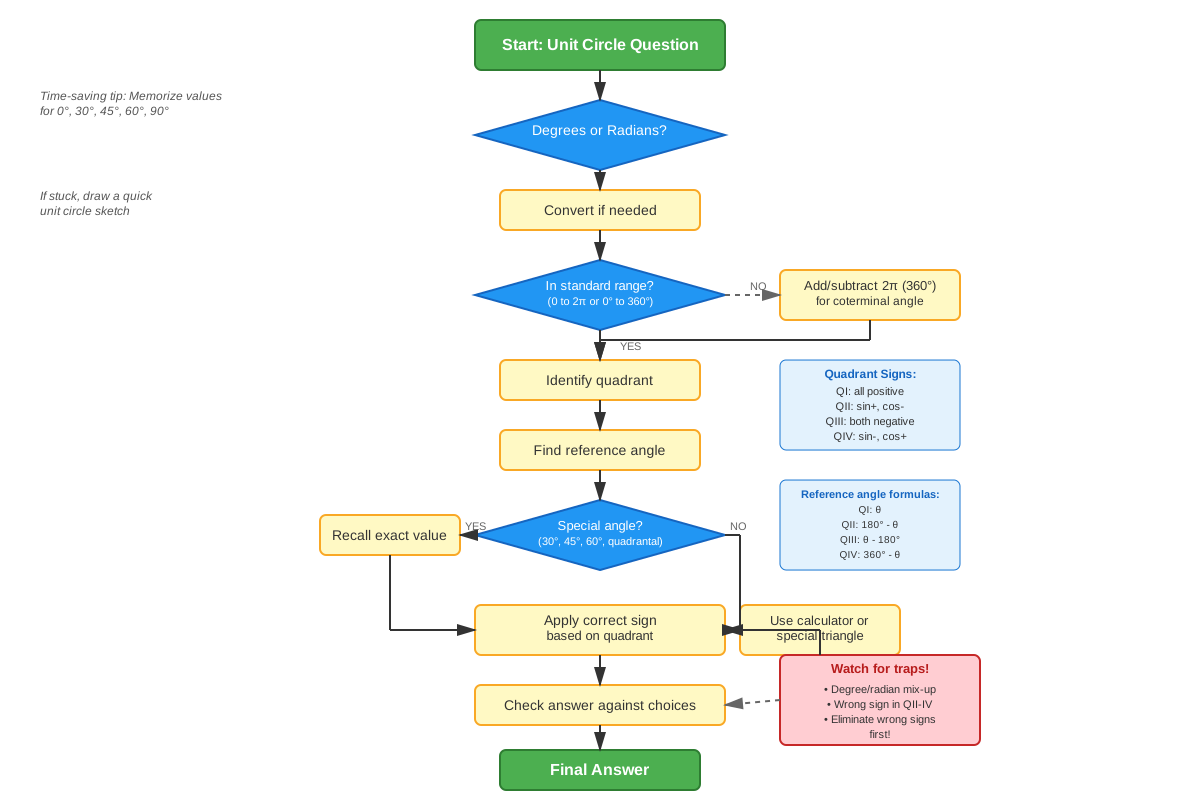
Overview
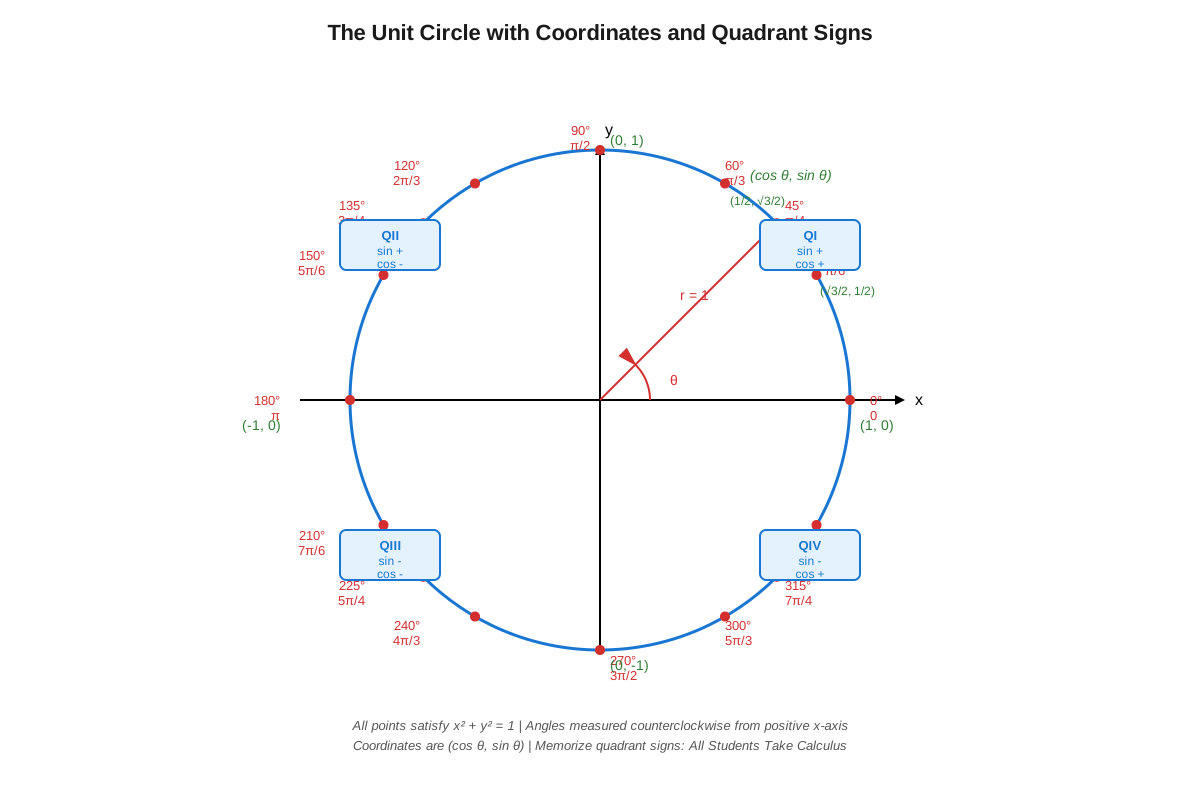
The unit circle is one of the most fundamental tools in trigonometry and serves as the foundation for understanding trigonometric functions, their values, and their relationships. The unit circle basics involve understanding a circle with radius 1 centered at the origin of a coordinate plane, where angles are measured from the positive x-axis and can be expressed in both degrees and radians. Every point on this circle corresponds to coordinates (cos θ, sin θ), creating an elegant connection between geometry and trigonometry that appears frequently on standardized tests.
For ACT test-takers, mastering ACT unit circle basics is essential because trigonometry questions constitute approximately 7-10% of the Math section, and many of these questions either directly reference the unit circle or require unit circle knowledge to solve efficiently. Understanding the unit circle allows students to quickly evaluate trigonometric functions at common angles, determine signs of trig values in different quadrants, and solve problems involving periodic functions without relying solely on calculators. This knowledge becomes particularly valuable when dealing with angles beyond the standard 0° to 90° range.
The unit circle connects to broader mathematical concepts including coordinate geometry, right triangle trigonometry, and function transformations. It serves as the bridge between the basic SOH-CAH-TOA definitions learned in geometry and the more sophisticated understanding of trigonometric functions as periodic, continuous functions. Students who master unit circle basics gain the ability to visualize trigonometric relationships spatially, making complex problems more intuitive and manageable under timed test conditions.
Learning Objectives
- [ ] Identify when Unit circle basics is being tested
- [ ] Explain the core rule or strategy behind Unit circle basics
- [ ] Apply Unit circle basics to ACT-style questions accurately
- [ ] Convert between degree and radian measures fluently
- [ ] Determine the exact values of sine, cosine, and tangent for common angles
- [ ] Identify the signs of trigonometric functions in all four quadrants
- [ ] Use reference angles to find trigonometric values for any angle
Prerequisites
- Right triangle trigonometry (SOH-CAH-TOA): The unit circle extends these basic definitions to all angles, not just acute angles in right triangles
- Coordinate plane understanding: The unit circle exists in the xy-plane, requiring familiarity with plotting points and understanding quadrants
- Basic angle measurement: Knowledge of degrees and the concept of angle rotation provides the foundation for understanding positions on the unit circle
- Pythagorean theorem: This theorem explains why x² + y² = 1 for all points on the unit circle and helps derive coordinate values
- Special right triangles (30-60-90 and 45-45-90): These triangles generate the exact values for common angles on the unit circle
Why This Topic Matters
The unit circle represents a critical intersection of algebra, geometry, and trigonometry that appears throughout higher mathematics and real-world applications. In physics and engineering, the unit circle describes circular motion, wave behavior, and oscillations. In computer graphics and game design, unit circle concepts enable rotation transformations and animation. Navigation systems, signal processing, and alternating current electricity all rely on principles rooted in unit circle trigonometry.
On the ACT Math section, unit circle questions appear in approximately 2-4 questions per test, making this a high-yield topic relative to study time investment. These questions typically test whether students can evaluate trigonometric functions at specific angles, understand the relationship between angle measures and coordinate positions, or apply trigonometric identities that stem from unit circle properties. The ACT frequently presents these concepts in various disguises: direct evaluation problems, equation-solving questions, or application problems involving periodic phenomena.
Common question formats include: evaluating sin(240°) or cos(5π/6), determining which quadrant produces specific sign combinations for trig functions, finding angles that satisfy certain trigonometric equations, and identifying equivalent angle measures. The ACT also tests unit circle understanding indirectly through questions about trigonometric graphs, amplitude and period problems, and inverse trigonometric functions. Students who can quickly recall unit circle values and relationships gain significant time advantages, often solving these problems in 30 seconds rather than 2 minutes.
Core Concepts
The Unit Circle Definition
The unit circle is defined as the set of all points in the coordinate plane that are exactly 1 unit away from the origin (0, 0). Mathematically, this is expressed by the equation x² + y² = 1, which comes directly from the distance formula. Every point (x, y) on the unit circle satisfies this equation, creating a perfect circle with radius 1. This simple geometric object becomes powerful when we associate angles with points on the circle.
An angle θ (theta) in standard position has its vertex at the origin, its initial side along the positive x-axis, and its terminal side rotating counterclockwise for positive angles (clockwise for negative angles). The point where the terminal side intersects the unit circle has coordinates (cos θ, sin θ). This definition extends trigonometric functions beyond right triangles to all real numbers, making sine and cosine functions of any angle, not just acute angles.
Radian and Degree Measure
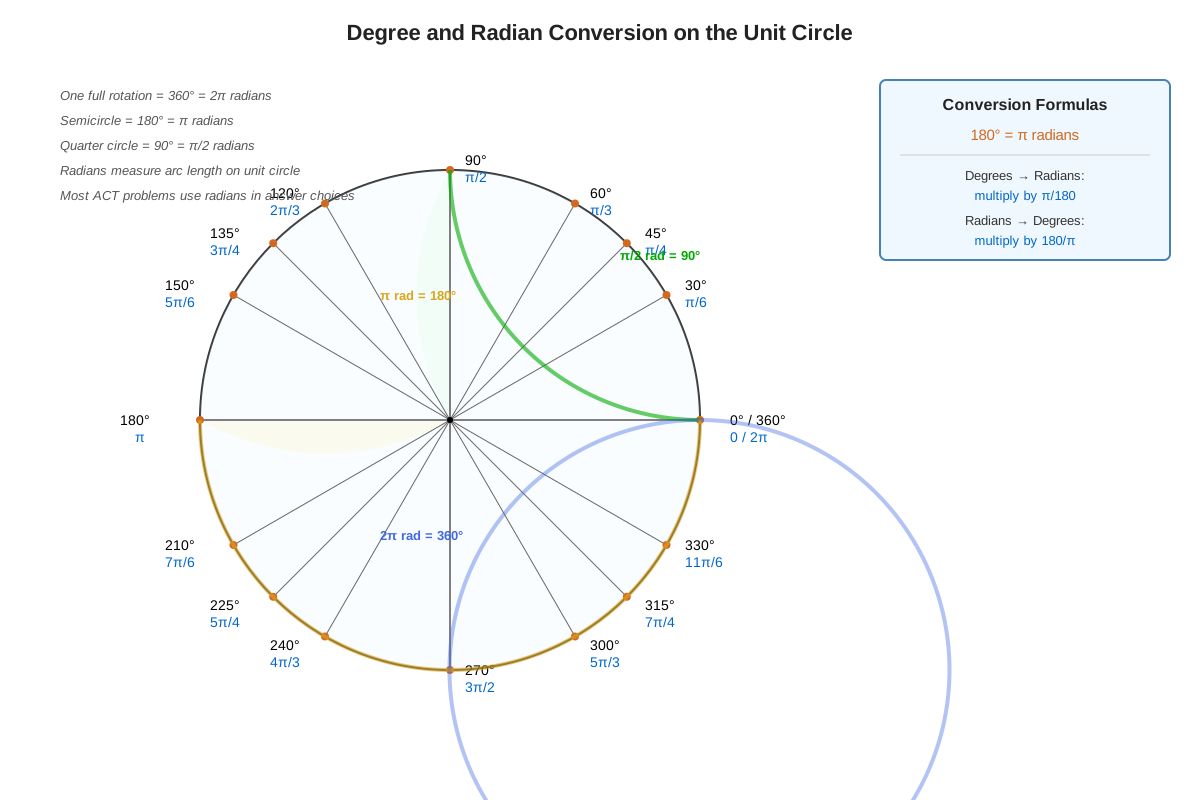
Angles can be measured in degrees or radians, and the ACT tests both systems. A complete rotation around the circle equals 360° or 2π radians. The conversion relationship is:
π radians = 180°To convert from degrees to radians: multiply by π/180
To convert from radians to degrees: multiply by 180/π
Common angle conversions that appear frequently on the ACT:
| Degrees | Radians | Decimal Radians |
|---|---|---|
| 0° | 0 | 0 |
| 30° | π/6 | ~0.524 |
| 45° | π/4 | ~0.785 |
| 60° | π/3 | ~1.047 |
| 90° | π/2 | ~1.571 |
| 120° | 2π/3 | ~2.094 |
| 135° | 3π/4 | ~2.356 |
| 150° | 5π/6 | ~2.618 |
| 180° | π | ~3.142 |
| 210° | 7π/6 | ~3.665 |
| 225° | 5π/4 | ~3.927 |
| 240° | 4π/3 | ~4.189 |
| 270° | 3π/2 | ~4.712 |
| 300° | 5π/3 | ~5.236 |
| 315° | 7π/4 | ~5.498 |
| 330° | 11π/6 | ~5.760 |
| 360° | 2π | ~6.283 |
Coordinates and Trigonometric Values
For any angle θ, the point on the unit circle has coordinates (cos θ, sin θ), where:
- The x-coordinate equals cos θ (the cosine of the angle)
- The y-coordinate equals sin θ (the sine of the angle)
- The tangent equals sin θ / cos θ, or y/x
This relationship means that trigonometric functions can be understood geometrically as coordinates on the unit circle. The key angles and their exact coordinate values must be memorized for ACT success:
Quadrant I (0° to 90°):
- 0°: (1, 0) → cos 0° = 1, sin 0° = 0
- 30° (π/6): (√3/2, 1/2)
- 45° (π/4): (√2/2, √2/2) or (1/√2, 1/√2)
- 60° (π/3): (1/2, √3/2)
- 90° (π/2): (0, 1) → cos 90° = 0, sin 90° = 1
Quadrant II (90° to 180°):
- 120° (2π/3): (-1/2, √3/2)
- 135° (3π/4): (-√2/2, √2/2)
- 150° (5π/6): (-√3/2, 1/2)
- 180° (π): (-1, 0)
Quadrant III (180° to 270°):
- 210° (7π/6): (-√3/2, -1/2)
- 225° (5π/4): (-√2/2, -√2/2)
- 240° (4π/3): (-1/2, -√3/2)
- 270° (3π/2): (0, -1)
Quadrant IV (270° to 360°):
- 300° (5π/3): (1/2, -√3/2)
- 315° (7π/4): (√2/2, -√2/2)
- 330° (11π/6): (√3/2, -1/2)
- 360° (2π): (1, 0)
Reference Angles
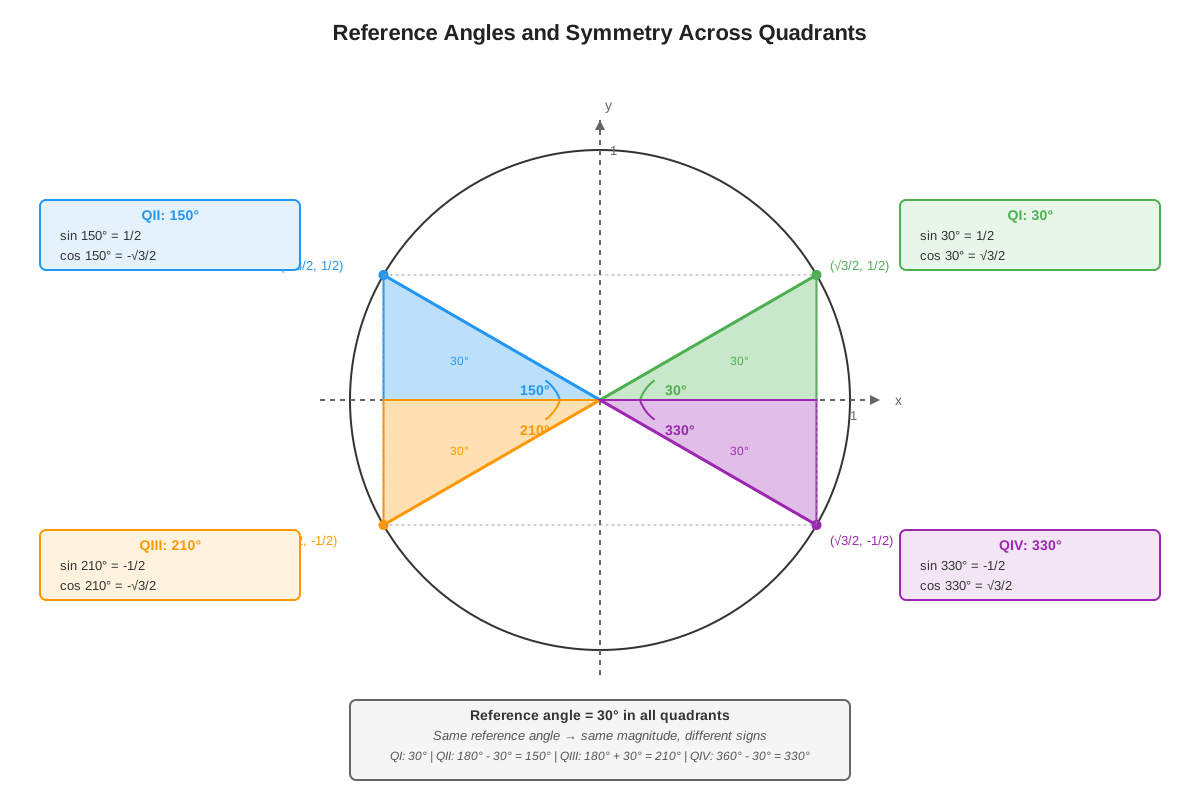
A reference angle is the acute angle formed between the terminal side of an angle and the x-axis. Reference angles allow us to find trigonometric values for any angle by relating it back to a familiar first-quadrant angle. The reference angle is always between 0° and 90° (0 and π/2 radians).
To find a reference angle:
- Quadrant I: The angle itself is the reference angle
- Quadrant II: Reference angle = 180° - θ (or π - θ)
- Quadrant III: Reference angle = θ - 180° (or θ - π)
- Quadrant IV: Reference angle = 360° - θ (or 2π - θ)
The absolute values of trigonometric functions at any angle equal the values at its reference angle. The signs depend on the quadrant.
Signs of Trigonometric Functions by Quadrant
Understanding which trigonometric functions are positive or negative in each quadrant is crucial for ACT problems. The mnemonic "All Students Take Calculus" helps remember:
- Quadrant I (0° to 90°): All functions positive (sine, cosine, tangent all positive)
- Quadrant II (90° to 180°): Sine positive (cosine and tangent negative)
- Quadrant III (180° to 270°): Tangent positive (sine and cosine negative)
- Quadrant IV (270° to 360°): Cosine positive (sine and tangent negative)
This pattern occurs because:
- Sine (y-coordinate) is positive when y > 0 (Quadrants I and II)
- Cosine (x-coordinate) is positive when x > 0 (Quadrants I and IV)
- Tangent (y/x) is positive when x and y have the same sign (Quadrants I and III)
Special Triangle Values
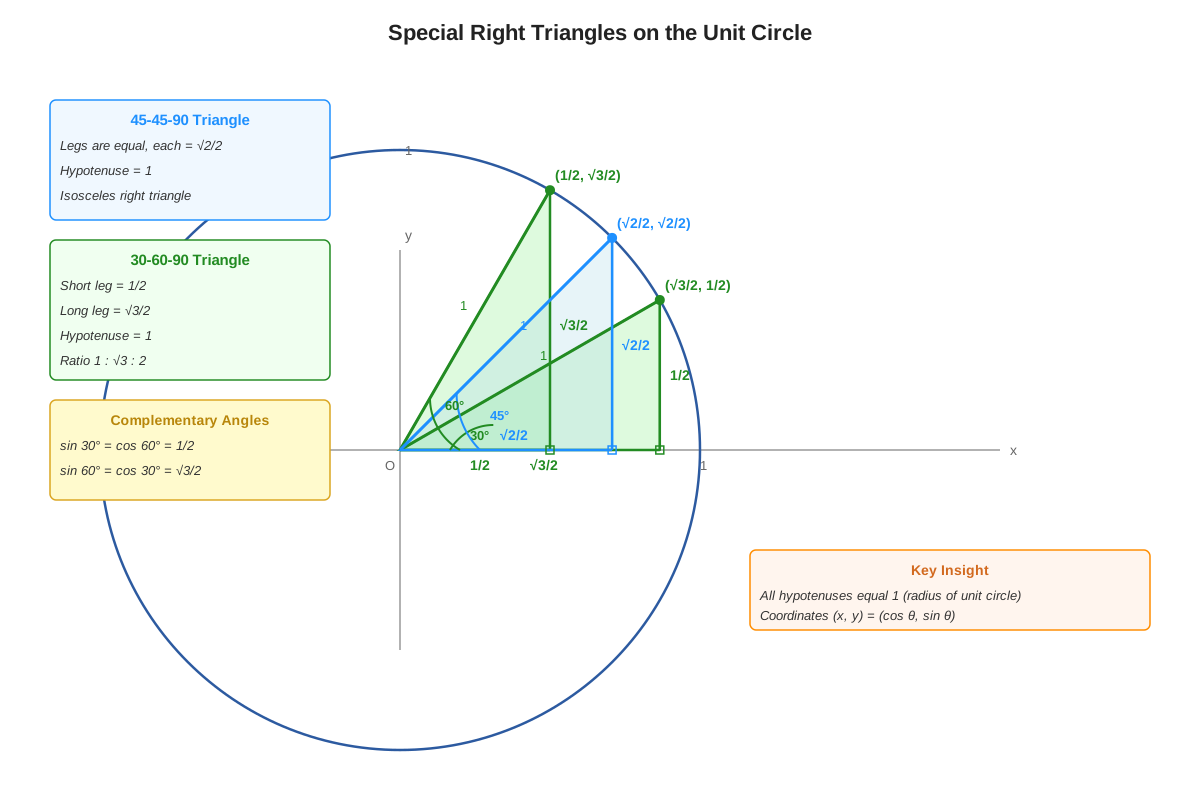
The exact values on the unit circle come from two special right triangles:
45-45-90 triangle: sides in ratio 1:1:√2
- Creates angles of 45°, 135°, 225°, 315°
- Coordinates involve √2/2
30-60-90 triangle: sides in ratio 1:√3:2
- Creates angles of 30°, 60°, 120°, 150°, 210°, 240°, 300°, 330°
- Coordinates involve 1/2 and √3/2
These triangles, when inscribed in the unit circle, generate all the common angle values that appear on the ACT.
Concept Relationships
The unit circle serves as the central organizing principle that connects multiple trigonometric concepts. Right triangle trigonometry (SOH-CAH-TOA) → extends to → unit circle definitions → which enable → evaluation of trig functions at any angle → which supports → graphing trigonometric functions and solving trigonometric equations.
The relationship between coordinates and trigonometric values creates the fundamental identity: cos²θ + sin²θ = 1, derived directly from the unit circle equation x² + y² = 1. This Pythagorean identity becomes the foundation for all other trigonometric identities.
Reference angles connect back to special right triangles, allowing any angle's trigonometric values to be determined from memorized first-quadrant values. The quadrant system determines signs, while reference angles determine magnitudes, working together to provide complete information about trigonometric function values.
Radian measure connects the unit circle to arc length and sector area formulas, since one radian is defined as the angle subtending an arc equal in length to the radius. This makes radians the "natural" unit for circular motion and calculus applications.
The unit circle also connects to periodic function behavior: since angles differing by 360° (or 2π radians) return to the same position on the circle, trigonometric functions repeat with period 2π. This periodicity explains why sin(θ) = sin(θ + 360°) and similar relationships.
High-Yield Facts
⭐ The unit circle has radius 1 and is centered at the origin, with equation x² + y² = 1
⭐ For any angle θ on the unit circle, the coordinates are (cos θ, sin θ)
⭐ To convert degrees to radians, multiply by π/180; to convert radians to degrees, multiply by 180/π
⭐ The reference angle is always acute (0° to 90°) and determines the magnitude of trig values
⭐ "All Students Take Calculus" indicates which functions are positive in each quadrant (I: all, II: sine, III: tangent, IV: cosine)
- The three most common angles are 30° (π/6), 45° (π/4), and 60° (π/3)
- At 45°, sine and cosine are equal: both equal √2/2
- At 30° and 60°, the sine and cosine values swap: sin 30° = cos 60° = 1/2, and cos 30° = sin 60° = √3/2
- Tangent equals sine divided by cosine (y/x), so tan θ = sin θ / cos θ
- The quadrantal angles (0°, 90°, 180°, 270°, 360°) have at least one coordinate equal to 0 or ±1
- Angles coterminal with θ (differing by multiples of 360° or 2π) have identical trigonometric values
- Sine values range from -1 to 1, as do cosine values, since they represent coordinates on a circle of radius 1
- The unit circle extends trigonometric functions to negative angles: negative angles rotate clockwise from the positive x-axis
- Complementary angles (summing to 90°) have the property that sin θ = cos(90° - θ)
- The unit circle makes it clear why tan 90° is undefined: the x-coordinate (cosine) equals zero, making division impossible
Quick check — test yourself on Unit circle basics so far.
Try Flashcards →Common Misconceptions
Misconception: The unit circle only works for angles between 0° and 360°.
Correction: The unit circle works for all real number angles. Angles greater than 360° or less than 0° simply wrap around the circle multiple times. For example, 450° = 90° + 360°, so it has the same position and trigonometric values as 90°.
Misconception: Radians are just another way to write degrees, so π/4 = 45.
Correction: Radians and degrees are different units measuring the same thing (angles). π/4 radians equals 45 degrees, but π/4 ≈ 0.785, not 45. Always convert properly using the relationship π radians = 180°.
Misconception: The reference angle for 210° is 210° - 180° = 30°, and since 210° is in Quadrant III where sine is negative, sin 210° = -sin 30° = -1/2. But the coordinates are (-√3/2, -1/2), so this seems wrong.
Correction: This reasoning is actually correct! The y-coordinate (sine value) is indeed -1/2. The confusion arises from mixing up which coordinate corresponds to which angle. At 30°, the coordinates are (√3/2, 1/2), so sin 30° = 1/2 and cos 30° = √3/2. At 210°, both coordinates are negative, giving (-√3/2, -1/2).
Misconception: Tangent is always between -1 and 1 like sine and cosine.
Correction: Tangent can take any real value from negative infinity to positive infinity. Since tan θ = sin θ / cos θ, tangent becomes very large when cosine approaches zero, and is undefined when cosine equals zero (at 90° and 270°).
Misconception: In Quadrant II, all trigonometric functions are negative except sine.
Correction: Cosecant (csc = 1/sin) is also positive in Quadrant II because it's the reciprocal of sine. Similarly, in Quadrant III, cotangent (cot = 1/tan) is positive along with tangent, and in Quadrant IV, secant (sec = 1/cos) is positive along with cosine.
Misconception: The coordinates at 45° are (1/2, 1/2) because 45° is halfway between 0° and 90°.
Correction: The coordinates at 45° are (√2/2, √2/2), not (1/2, 1/2). The point (1/2, 1/2) doesn't even lie on the unit circle since (1/2)² + (1/2)² = 1/4 + 1/4 = 1/2 ≠ 1. The coordinates must satisfy x² + y² = 1.
Misconception: To find sin 150°, use the reference angle 30° and since 150° is in Quadrant II, sin 150° = -sin 30° = -1/2.
Correction: In Quadrant II, sine is positive! The correct answer is sin 150° = sin 30° = 1/2. Only cosine and tangent are negative in Quadrant II. Always check the "All Students Take Calculus" rule.
Worked Examples
Example 1: Evaluating Trigonometric Functions at Non-Standard Angles
Problem: Find the exact value of cos 240° without using a calculator.
Solution:
Step 1: Determine which quadrant contains 240°.
Since 180° < 240° < 270°, the angle 240° is in Quadrant III.
Step 2: Find the reference angle.
For Quadrant III angles, reference angle = θ - 180°
Reference angle = 240° - 180° = 60°
Step 3: Determine the sign of cosine in Quadrant III.
Using "All Students Take Calculus," in Quadrant III, only tangent is positive.
Therefore, cosine is negative in Quadrant III.
Step 4: Find the cosine of the reference angle.
cos 60° = 1/2 (this is a memorized unit circle value)
Step 5: Apply the correct sign.
cos 240° = -cos 60° = -1/2
Answer: cos 240° = -1/2
Connection to learning objectives: This problem demonstrates identifying when unit circle basics is being tested (evaluating a trig function at a specific angle), explaining the core strategy (using reference angles and quadrant signs), and applying the concept accurately to reach the correct answer.
Example 2: Converting and Evaluating with Radians
Problem: If sin θ = √3/2 and π/2 < θ < π, find the exact value of tan θ.
Solution:
Step 1: Interpret the given information.
sin θ = √3/2 means the y-coordinate on the unit circle is √3/2.
The condition π/2 < θ < π means θ is in Quadrant II (between 90° and 180°).
Step 2: Identify which angle has sin θ = √3/2.
From memorized unit circle values, sin 60° = √3/2 and sin 120° = √3/2.
Since θ must be in Quadrant II, θ = 120° = 2π/3 radians.
Step 3: Find the coordinates at this angle.
At 120° (or 2π/3), the reference angle is 60°.
The coordinates at 60° are (1/2, √3/2).
In Quadrant II, x is negative and y is positive.
Therefore, the coordinates at 120° are (-1/2, √3/2).
Step 4: Calculate tangent.
tan θ = sin θ / cos θ = y/x
tan θ = (√3/2) / (-1/2) = (√3/2) × (-2/1) = -√3
Answer: tan θ = -√3
Verification: This makes sense because in Quadrant II, tangent is negative (sine positive, cosine negative, so their ratio is negative).
Connection to learning objectives: This problem requires understanding radian measure, using the unit circle to find coordinates, and applying the relationship between trigonometric functions to solve for an unknown value.
Exam Strategy
When approaching ACT questions involving unit circle basics, follow this systematic process:
Step 1: Identify the angle and its measurement unit
Immediately note whether the angle is given in degrees or radians. If in radians, consider converting to degrees if that's more comfortable, though with practice, working directly in radians becomes faster.
Step 2: Determine the quadrant
Quickly classify the angle into Quadrant I, II, III, or IV. For angles greater than 360° or less than 0°, find the coterminal angle between 0° and 360° by adding or subtracting 360° (or 2π).
Step 3: Find the reference angle
Calculate the acute reference angle using the appropriate formula for the quadrant. This reference angle will be one of the common angles (30°, 45°, 60°) in most ACT problems.
Step 4: Recall the exact value
Use memorized unit circle values for the reference angle. If you haven't memorized these, you'll waste valuable time and likely need to guess.
Step 5: Apply the correct sign
Use the "All Students Take Calculus" rule to determine whether the function is positive or negative in that quadrant.
Trigger words and phrases to watch for:
- "Exact value" signals that you should give an answer with radicals (like √2/2), not decimals
- "In standard position" confirms the angle is measured from the positive x-axis
- "Terminal side" refers to where the angle ends after rotation
- "Coterminal angles" means angles that differ by multiples of 360° or 2π
- "Reference angle" explicitly asks for the acute angle to the x-axis
Process-of-elimination tips:
- If asked for sine or cosine, eliminate any answer choices outside the range [-1, 1]
- If the angle is in Quadrant I, eliminate negative answers for sine, cosine, and tangent
- If asked for tangent at 90° or 270°, eliminate all numerical answers (tangent is undefined there)
- For angles near 0° or 180°, sine values should be near 0; for angles near 90° or 270°, cosine values should be near 0
Time allocation:
Unit circle problems should take 30-60 seconds once you've mastered the material. If you find yourself taking longer than 90 seconds, you likely need to strengthen your memorization of common angle values. Consider marking the question and returning to it if time permits, rather than getting stuck.
Memory Techniques
Mnemonic for quadrant signs: "All Students Take Calculus"
- All functions positive in Quadrant I
- Sine positive in Quadrant II
- Tangent positive in Quadrant III
- Cosine positive in Quadrant IV
Mnemonic for special angle values: "1, 2, 3" pattern
For angles 30°, 45°, 60°, the sine values follow a pattern:
- sin 30° = √1/2 = 1/2
- sin 45° = √2/2
- sin 60° = √3/2
The cosine values are the same list reversed:
- cos 30° = √3/2
- cos 45° = √2/2
- cos 60° = √1/2 = 1/2
Visualization strategy: The "hand trick"
Hold your left hand up with fingers spread. Starting from the thumb (representing 0°) and moving to the pinky (representing 90°):
- Thumb = 0° → sin 0° = √0/2 = 0
- Index = 30° → sin 30° = √1/2 = 1/2
- Middle = 45° → sin 45° = √2/2
- Ring = 60° → sin 60° = √3/2
- Pinky = 90° → sin 90° = √4/2 = 1
Acronym for radian conversions: "Pretty Helpful Conversions"
- Pi = 180°
- Half pi (π/2) = 90°
- Complete circle = 2π = 360°
Coordinate memory technique:
Remember that at 45°, sine and cosine are equal (both √2/2), creating a diagonal line. At 30° and 60°, the values "swap" between sine and cosine. The smaller angle (30°) has the smaller sine value (1/2), while the larger angle (60°) has the larger sine value (√3/2).
Quadrant visualization:
Picture the coordinate plane with large Roman numerals I, II, III, IV in each quadrant. Mentally place the "All Students Take Calculus" letters in order, connecting the positive function to its quadrant.
Summary
Unit circle basics form the cornerstone of trigonometry on the ACT, providing a geometric framework for understanding trigonometric functions at all angles. The unit circle—a circle of radius 1 centered at the origin—establishes that any angle θ corresponds to a point with coordinates (cos θ, sin θ), directly connecting geometric position to trigonometric values. Mastery requires memorizing exact values for common angles (30°, 45°, 60° and their multiples), fluently converting between degrees and radians using the relationship π radians = 180°, and understanding how reference angles and quadrant signs work together to determine trigonometric values for any angle. The "All Students Take Calculus" mnemonic ensures quick recall of which functions are positive in each quadrant, while special right triangles (30-60-90 and 45-45-90) generate the exact coordinate values that appear repeatedly on the ACT. Students who internalize these concepts can evaluate trigonometric expressions rapidly and accurately, solving problems that might otherwise require extensive calculator work or guessing.
Key Takeaways
- The unit circle has equation x² + y² = 1, and every point on it has coordinates (cos θ, sin θ) for some angle θ
- Memorize exact values for 30°, 45°, 60° and their multiples in all four quadrants—these appear on virtually every ACT test
- Convert between degrees and radians using π radians = 180°; common conversions include π/6 = 30°, π/4 = 45°, π/3 = 60°, π/2 = 90°
- Use reference angles (the acute angle to the x-axis) to find magnitudes, then apply quadrant signs using "All Students Take Calculus"
- In Quadrant I all trig functions are positive; in II only sine; in III only tangent; in IV only cosine
- The coordinates at 45° are (√2/2, √2/2); at 30° are (√3/2, 1/2); at 60° are (1/2, √3/2)
- Tangent equals sine divided by cosine (y/x), and is undefined when cosine equals zero (at 90° and 270°)
Related Topics
Trigonometric Identities: Building on unit circle basics, trigonometric identities like the Pythagorean identity (sin²θ + cos²θ = 1) derive directly from the unit circle equation. Mastering the unit circle makes these identities intuitive rather than arbitrary formulas to memorize.
Graphing Trigonometric Functions: The unit circle explains why sine and cosine graphs have amplitude 1, period 2π, and specific shapes. Understanding how angles map to y-coordinates (for sine) and x-coordinates (for cosine) makes graph transformations logical.
Solving Trigonometric Equations: Finding all angles that satisfy equations like sin θ = 1/2 requires unit circle knowledge to identify all positions where the y-coordinate equals 1/2, not just the first-quadrant solution.
Inverse Trigonometric Functions: Understanding the unit circle helps clarify why inverse trig functions have restricted ranges and how to interpret their outputs as angles.
Polar Coordinates: The unit circle provides the foundation for polar coordinates, where points are described by distance from origin and angle, directly extending unit circle concepts.
Practice CTA
Now that you've mastered the fundamentals of unit circle basics, it's time to solidify your understanding through active practice. Work through the practice questions to test your ability to evaluate trigonometric functions, convert between angle measures, and apply reference angles under timed conditions. Use the flashcards to drill the exact values for common angles until recall becomes automatic—this memorization will save you valuable minutes on test day. Remember, the difference between knowing these concepts and truly mastering them lies in repeated application. Every practice problem you solve builds the speed and confidence you'll need to excel on the ACT Math section!
Sign up free to keep reading
Create a free AnvayaPrep account to finish this ACT guide on Unit circle basics — plus flashcards and practice questions.