Overview
Chronological structure refers to the organizational pattern in which events, ideas, or information are presented in the order they occurred in time, from earliest to latest. On the ACT Reading test, understanding how authors use chronological organization is crucial for tracking narrative progression, identifying cause-and-effect relationships, and answering questions about sequence and timing. This structural pattern appears frequently in both fiction passages (particularly literary narratives and memoirs) and nonfiction passages (especially natural science and social science texts that describe processes, historical developments, or biographical information).
The ACT Reading section consistently tests students' ability to recognize and navigate ACT chronological structure through questions that ask about the order of events, the relationship between earlier and later developments, or how information unfolds across a passage. Approximately 15-20% of Craft and Structure questions directly or indirectly assess chronological understanding. Students who master this topic gain a significant advantage because they can quickly map passage organization, predict where specific information will appear, and eliminate wrong answers that misrepresent temporal relationships.
Understanding chronological structure connects to broader Reading skills including main idea identification, detail location, and inference-making. When students recognize that a passage follows a time-based organization, they can more efficiently navigate back to specific sections when answering questions, understand how earlier events influence later outcomes, and distinguish between what happened versus what might happen. This foundational skill supports success across all four passage types on the ACT Reading test.
Learning Objectives
- [ ] Identify when Chronological structure is being tested in ACT Reading questions
- [ ] Explain the core rule or strategy behind Chronological structure analysis
- [ ] Apply Chronological structure recognition to ACT-style questions accurately
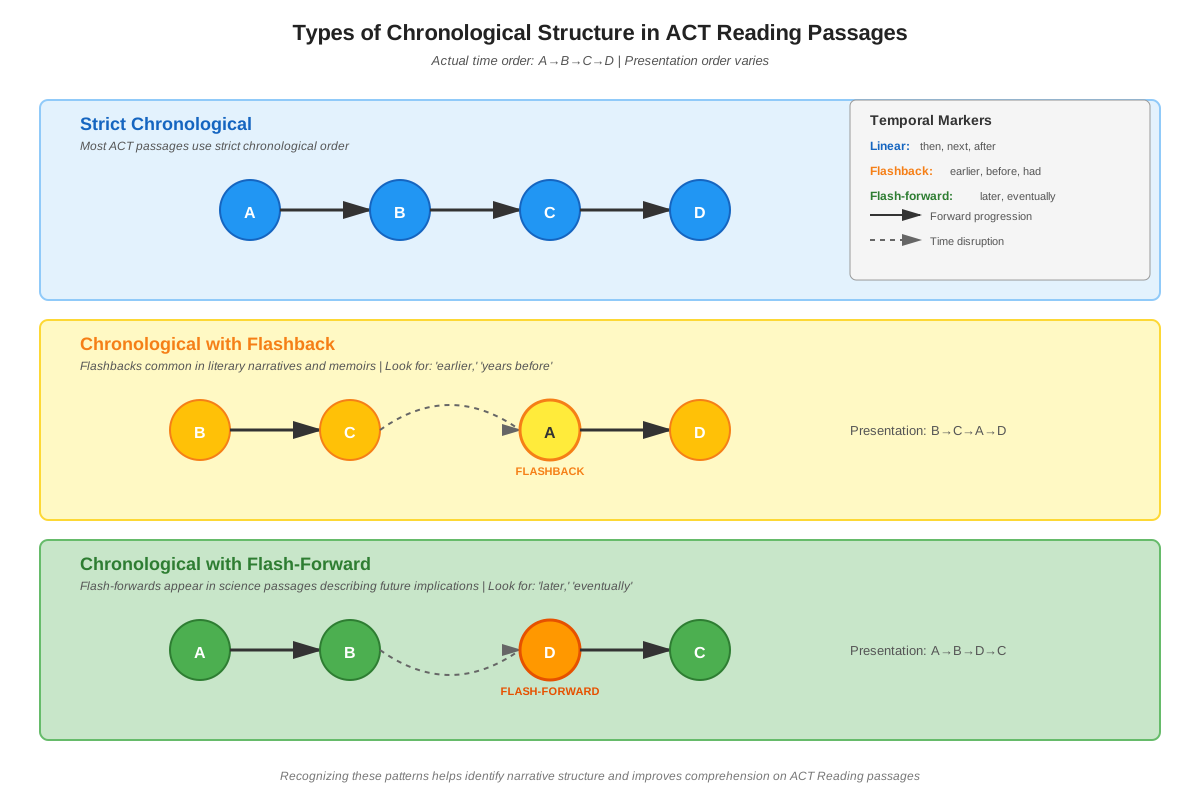
- [ ] Distinguish between strict chronological order and modified chronological patterns (flashbacks, flash-forwards)
- [ ] Use temporal markers and transition words to map passage organization quickly
- [ ] Predict question types that commonly test chronological understanding
- [ ] Analyze how authors use chronological structure to develop themes and arguments
Prerequisites
- Basic reading comprehension skills: Understanding literal meaning is necessary before analyzing organizational structure
- Familiarity with narrative elements: Recognizing plot, setting, and character development helps identify chronological progression in fiction
- Understanding of transition words: Temporal markers like "first," "then," "subsequently" signal chronological organization
- Ability to identify main ideas: Recognizing the central focus helps determine whether time-based organization is primary or secondary
Why This Topic Matters
Chronological structure appears in approximately 60-70% of ACT Reading passages to some degree, making it one of the most frequently encountered organizational patterns. Even passages that aren't purely chronological often contain chronologically-ordered sections or subsections. Questions directly testing chronological understanding appear 2-3 times per test on average, while many other question types (cause-effect, detail location, inference) require implicit understanding of temporal relationships.
In real-world contexts, recognizing chronological organization helps readers process historical accounts, scientific procedures, biographical information, news reports, and instructional materials. This skill transfers directly to college-level reading across disciplines, from history textbooks to lab reports to case studies. Students who can quickly identify and navigate chronological structure save valuable time on the ACT, spending less effort searching for information and more time analyzing answer choices.
On the ACT, chronological structure testing appears in several common forms: questions asking about the sequence of events, questions requiring students to identify what happened before or after a specific moment, questions about how the passage is organized, and questions asking about the relationship between earlier and later information. Literary Narrative passages frequently use chronological structure with occasional flashbacks, while Natural Science passages often describe processes or discoveries chronologically. Social Science passages may present historical developments or biographical information in time order, and Humanities passages might trace the evolution of an artistic movement or cultural phenomenon.
Core Concepts
Definition and Characteristics of Chronological Structure
Chronological structure organizes information according to temporal sequence, presenting events, ideas, or developments in the order they occurred in time. This organizational pattern follows a linear progression from past to present (or from beginning to end of a described period). In its purest form, chronological structure begins with the earliest event and proceeds systematically through time to the most recent event or outcome.
Key characteristics include:
- Sequential organization: Each element follows logically from the previous one in time
- Temporal markers: Words and phrases indicating time relationships (dates, time words, sequence indicators)
- Causal connections: Earlier events often influence or cause later events
- Progressive development: Ideas, situations, or understanding evolve across the passage
Types of Chronological Organization
| Type | Description | Common in ACT Passages |
|---|---|---|
| Strict Linear | Events presented in exact order they occurred, no deviations | Natural Science process descriptions, some Social Science historical accounts |
| Modified Linear | Generally chronological but with brief flashbacks or contextual background | Literary Narratives, biographical passages |
| Framed Narrative | Present-day frame with chronological flashback forming main content | Some Literary Narratives and memoirs |
| Parallel Timelines | Two or more chronological sequences presented alternately | Comparative historical passages, dual-perspective narratives |
Temporal Markers and Signal Words
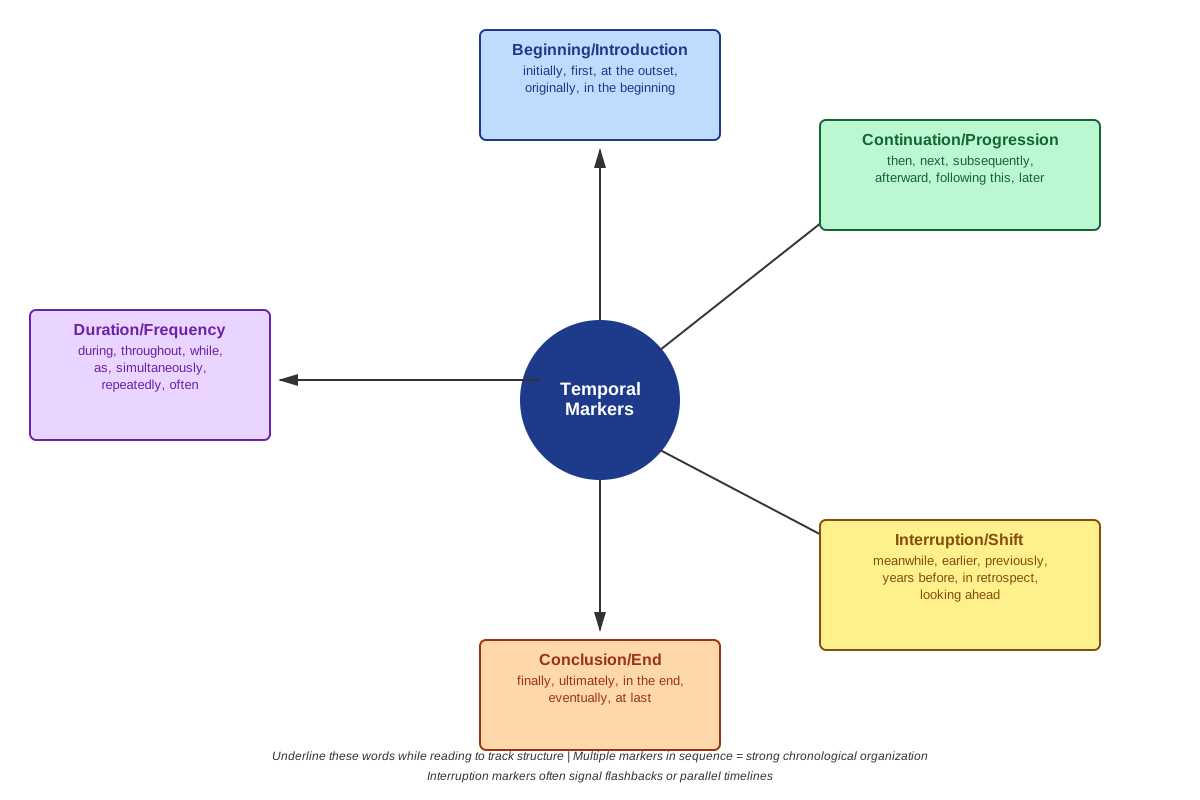
Recognizing temporal markers allows students to quickly identify chronological structure and track position within the timeline. These linguistic signals fall into several categories:
Explicit time references:
- Specific dates and times: "In 1963," "During the summer of 2010," "At 3:00 PM"
- Historical periods: "During the Renaissance," "In the Paleozoic Era"
- Age indicators: "At age seven," "When she turned thirty"
Sequence indicators:
- Beginning markers: "first," "initially," "originally," "at the outset"
- Middle markers: "then," "next," "subsequently," "afterward," "following this"
- Ending markers: "finally," "ultimately," "in the end," "eventually"
Duration and frequency markers:
- "For three years," "throughout the decade," "during this period"
- "Always," "never," "occasionally," "frequently"
Relative time indicators:
- "Before," "after," "prior to," "following," "since"
- "Earlier," "later," "previously," "meanwhile," "simultaneously"
Chronological Structure in Different Passage Types
Literary Narrative passages often employ chronological structure to trace character development or plot progression. However, these passages frequently include flashbacks (analepsis) where the narrative temporarily moves backward in time to provide context, or flash-forwards (prolepsis) where future events are previewed. The ACT tests whether students can track these temporal shifts and understand how they relate to the main timeline.
Natural Science passages commonly use chronological structure when describing:
- Scientific processes (photosynthesis steps, geological formation)
- Historical development of scientific understanding
- Experimental procedures and results
- Evolutionary or developmental sequences
Social Science passages employ chronological organization for:
- Historical events and movements
- Biographical information about significant figures
- Development of social institutions or practices
- Evolution of ideas or theories over time
Humanities passages may present chronological structure when discussing:
- An artist's career development
- Evolution of artistic or musical styles
- Historical development of cultural practices
- Biographical information about cultural figures
Identifying Chronological Structure Questions
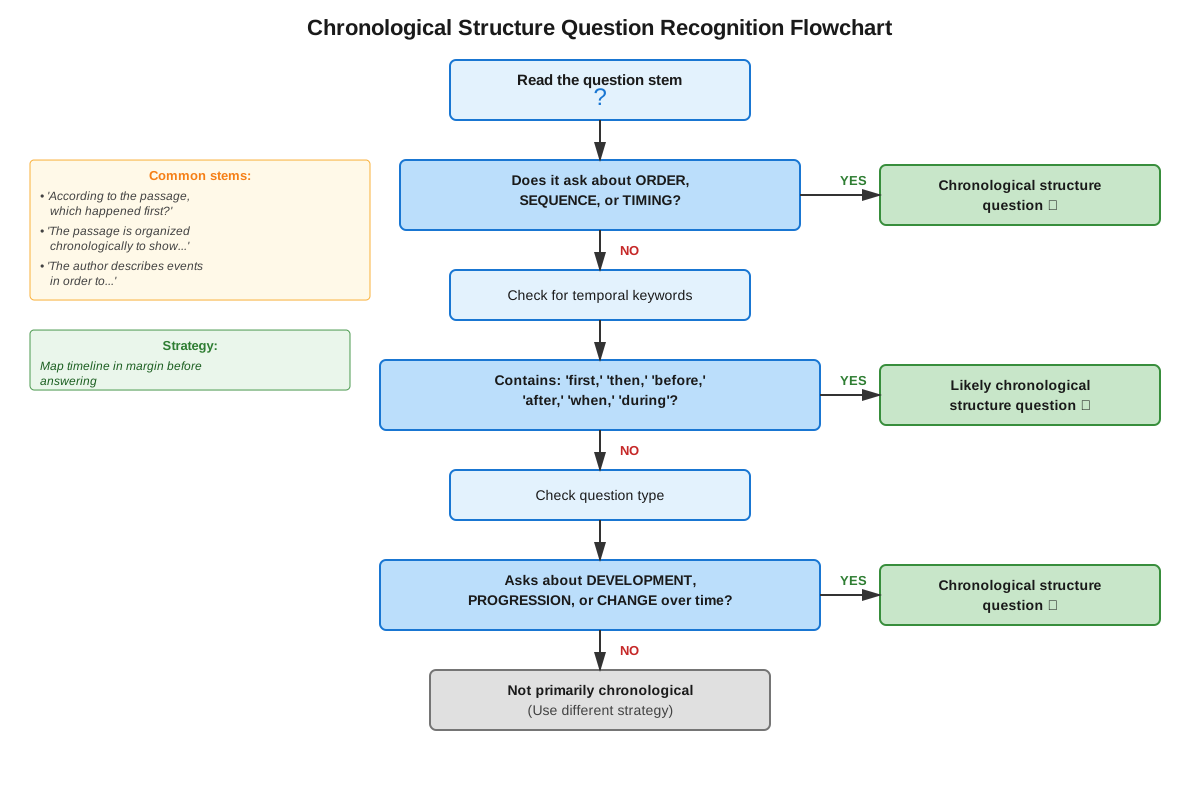
ACT questions test chronological structure through several question formats:
- Direct sequence questions: "According to the passage, which of the following events occurred first?"
- Organizational questions: "The passage is best described as organized..."
- Temporal relationship questions: "The passage indicates that X happened before Y in order to..."
- Cause-effect questions: "What effect did the earlier event have on the later development?"
- Detail location questions: Questions requiring knowledge of where in the chronological sequence specific information appears
Strategies for Mapping Chronological Structure
Effective readers create mental or physical maps of chronological structure while reading:
- Note temporal markers: Circle or mentally note dates, time words, and sequence indicators
- Track major events: Identify 3-5 key events or developments as anchors
- Recognize shifts: Flag any departures from linear chronology (flashbacks, contextual background)
- Connect cause-effect: Notice how earlier events influence later ones
- Identify beginning and end points: Clearly establish the temporal boundaries of the passage
Concept Relationships
Chronological structure serves as a foundational organizational pattern that connects to multiple other reading comprehension skills. Understanding temporal organization leads to improved ability to identify cause-and-effect relationships, since causes necessarily precede effects in time. This temporal framework supports inference-making by establishing what information was available or what conditions existed at different points in the sequence.
The relationship between chronological structure and main idea identification is bidirectional: recognizing that a passage follows chronological organization helps predict that the main idea likely involves development, change, or progression over time, while identifying a main idea about historical development or process suggests chronological organization will be present.
Chronological structure connects to detail location skills because understanding the temporal framework allows readers to predict where specific information will appear. If a question asks about an early event, readers know to search the beginning of the passage; if it asks about outcomes or results, the end of the passage becomes the target area.
Within the Craft and Structure domain, chronological structure relates to other organizational patterns through contrast and combination. Some passages use comparison-contrast structure organized chronologically (comparing two developments across the same time period), while others employ cause-effect structure that necessarily involves chronological elements (causes before effects). Understanding these relationships helps students recognize when multiple organizational patterns operate simultaneously.
High-Yield Facts
⭐ Chronological structure organizes information in the order events occurred in time, from earliest to latest
⭐ Temporal markers (dates, time words, sequence indicators) signal chronological organization and help track position in the timeline
⭐ Approximately 60-70% of ACT Reading passages use chronological structure as a primary or secondary organizational pattern
⭐ Flashbacks and flash-forwards represent departures from strict chronological order but still relate to the main timeline
⭐ Questions about sequence, order of events, or "what happened first/last" directly test chronological structure understanding
- Natural Science passages frequently use chronological structure to describe processes, procedures, or scientific developments
- Literary Narrative passages often combine chronological structure with flashbacks to provide character background or context
- Recognizing chronological structure helps predict where specific information will appear in the passage
- Cause-effect relationships necessarily involve chronological elements since causes precede effects
- The beginning of a chronologically-structured passage typically establishes the starting point or earliest event, while the conclusion presents outcomes or most recent developments
Quick check — test yourself on Chronological structure so far.
Try Flashcards →Common Misconceptions
Misconception: All passages follow strict chronological order from beginning to end.
Correction: While many passages use chronological structure, they often include flashbacks, contextual background, or thematic digressions that temporarily depart from linear time progression. Students must recognize these variations while still tracking the main chronological framework.
Misconception: If a passage mentions a date early on, the entire passage must be chronologically organized.
Correction: A single date reference doesn't guarantee chronological structure. Students should look for multiple temporal markers and assess whether the overall organization follows time sequence or uses another primary pattern (like comparison-contrast or problem-solution) with chronological elements.
Misconception: Chronological structure only appears in history or biography passages.
Correction: Chronological organization appears across all passage types, including Natural Science (describing processes or experiments), Literary Narrative (plot progression), and Humanities (tracing artistic development). Students should expect to encounter time-based organization in any passage type.
Misconception: Events mentioned first in the passage always happened first chronologically.
Correction: Authors may begin with a recent or dramatic event, then flash back to explain earlier developments. The order of presentation doesn't always match the chronological order of events. Students must distinguish between narrative order (how the author presents information) and chronological order (when events actually occurred).
Misconception: Chronological structure questions are always easy because they just ask about order.
Correction: While some chronological questions are straightforward, others require careful analysis of complex temporal relationships, understanding of cause-effect connections across time, or recognition of subtle sequence indicators. These questions can be medium to difficult depending on passage complexity.
Misconception: Temporal markers always appear at the beginning of paragraphs.
Correction: While paragraph-initial temporal markers are common, time indicators can appear anywhere in a sentence or paragraph. Students must scan entire sections for dates, time words, and sequence indicators rather than only checking paragraph openings.
Worked Examples
Example 1: Literary Narrative with Flashback
Passage excerpt: "Sarah stood at the airport gate, watching the plane taxi away. She couldn't believe it had come to this. Just three months earlier, she and Michael had been planning their future together, mapping out dreams over coffee at their favorite café. That was before the argument, before the silence, before everything fell apart. Now, as the plane disappeared into the clouds, she wondered if she'd made the right choice."
Question: According to the passage, which of the following events occurred first chronologically?
A) Sarah watched the plane taxi away
B) Sarah and Michael had an argument
C) Sarah and Michael planned their future at a café
D) Sarah wondered if she'd made the right choice
Solution Process:
Step 1: Identify the narrative present (the "now" of the passage). The opening sentence establishes Sarah at the airport as the present moment.
Step 2: Locate temporal markers indicating sequence:
- "Just three months earlier" signals a flashback
- "That was before" indicates events preceding the flashback
- "Now" returns to the present
Step 3: Map the chronological sequence:
- Sarah and Michael planned their future (three months before present)
- They had an argument (after planning, before present)
- Silence followed (after argument, before present)
- Sarah stands at airport watching plane (present)
- Sarah wonders about her choice (present)
Step 4: Evaluate answer choices:
- A: Present moment, not first
- B: Occurred after planning, not first
- C: Explicitly stated as "three months earlier," before the argument
- D: Present moment, not first
Answer: C
This question tests the ability to distinguish between narrative order (how the author presents events) and chronological order (when events actually occurred). The passage begins with the present, flashes back, then returns to present—a common ACT pattern.
Example 2: Natural Science Process Description
Passage excerpt: "Photosynthesis occurs in two main stages. During the light-dependent reactions, which take place in the thylakoid membranes, chlorophyll absorbs light energy and converts it to chemical energy in the form of ATP and NADPH. Subsequently, the light-independent reactions (Calvin cycle) use this chemical energy to convert carbon dioxide into glucose. This second stage occurs in the stroma and can proceed without direct light, though it depends on the products of the first stage."
Question: Based on the passage, which of the following must occur before glucose production can begin?
F) Carbon dioxide must be converted to chemical energy
G) The Calvin cycle must produce ATP
H) Light energy must be converted to ATP and NADPH
J) The stroma must transfer energy to the thylakoid membranes
Solution Process:
Step 1: Identify the chronological structure. The passage uses sequence indicators: "first," "during," "subsequently," "second stage."
Step 2: Map the process chronologically:
- Light-dependent reactions occur (in thylakoid membranes)
- Chlorophyll absorbs light energy
- Light energy converts to ATP and NADPH
- Light-independent reactions (Calvin cycle) begin
- ATP and NADPH are used
- Carbon dioxide converts to glucose
Step 3: Identify what the question asks: what must happen BEFORE glucose production begins. Glucose production occurs in step 6, so we need something from steps 1-5.
Step 4: Evaluate answer choices:
- F: Incorrect—carbon dioxide converts to glucose (not to chemical energy), and this IS glucose production, not before it
- G: Incorrect—Calvin cycle uses ATP (doesn't produce it), and this is reversed
- H: Correct—this is step 3, which must occur before the Calvin cycle can use ATP/NADPH to produce glucose
- J: Incorrect—energy transfers from thylakoid to stroma (not the reverse), and this isn't mentioned
Answer: H
This question tests understanding of chronological sequence in a scientific process, requiring students to identify prerequisite steps and understand cause-effect relationships across time.
Exam Strategy
Approaching Chronological Structure Questions
Step 1: Identify the question type. Look for trigger words and phrases:
- "First," "last," "before," "after," "sequence," "order"
- "According to the passage, which occurred..."
- "The passage is organized..."
- "What happened prior to..."
Step 2: Return to the passage strategically. Don't rely on memory for sequence questions—verify the order in the text. Use your initial reading notes about temporal markers to locate relevant sections quickly.
Step 3: Create a mental timeline. For complex chronological questions, briefly map 3-5 key events in order. This prevents confusion when answer choices present events in different sequences.
Step 4: Watch for narrative vs. chronological order. Remember that the order the author presents information may differ from the order events occurred. Look for flashback indicators like "earlier," "previously," "before this," or explicit time references that place events in the past.
Time Allocation
Chronological structure questions typically require 30-45 seconds once you've located the relevant passage section. Budget slightly more time (up to 60 seconds) for questions involving complex sequences or multiple temporal shifts. The time investment in creating a mental timeline during initial reading (10-15 seconds) pays dividends by making chronological questions faster to answer.
Process of Elimination Tips
Eliminate answers that reverse chronological order: If the passage clearly states A happened before B, eliminate any answer suggesting B preceded A.
Eliminate answers mixing narrative and chronological order: Wrong answers often confuse the order information appears in the passage with the order events occurred in time.
Watch for "extreme" temporal language: Answers using "always," "never," "first," or "last" are often incorrect unless the passage explicitly supports such absolute claims.
Verify temporal markers: If an answer choice claims something happened "before" or "after" something else, find the temporal marker in the passage that confirms or contradicts this relationship.
Trigger Words in Questions
Questions testing chronological structure commonly include:
- Sequence words: "first," "last," "next," "then," "finally," "initially," "ultimately"
- Temporal prepositions: "before," "after," "during," "prior to," "following," "since"
- Order language: "sequence," "order," "chronological," "timeline"
- Organizational language: "structured," "organized," "arranged," "presented"
When you see these triggers, immediately activate chronological structure analysis strategies.
Memory Techniques
TIMEMAP Acronym
Use TIMEMAP to remember the process for analyzing chronological structure:
- Temporal markers: Identify dates, time words, sequence indicators
- Initial event: Determine the starting point of the chronological sequence
- Major events: Note 3-5 key developments as anchors
- End point: Identify the conclusion or most recent event
- Modifications: Flag flashbacks, flash-forwards, or departures from linear order
- Arrange mentally: Create a mental timeline of the sequence
- Predict questions: Anticipate what chronological questions might ask
Visualization Strategy
Picture a horizontal timeline in your mind as you read chronologically-structured passages. Place major events along this line from left (earliest) to right (most recent). When you encounter flashbacks, visualize them as loops that temporarily move backward on the timeline before returning to the main sequence. This spatial representation makes temporal relationships concrete and memorable.
Temporal Marker Categories Mnemonic
Remember the three main categories of temporal markers with SRD:
- Sequence indicators (first, then, next, finally)
- Relative time words (before, after, earlier, later)
- Dates and durations (1963, three years, during the summer)
Summary
Chronological structure represents one of the most common organizational patterns on the ACT Reading test, appearing in 60-70% of passages across all four passage types. This structure organizes information according to temporal sequence, presenting events, ideas, or developments in the order they occurred in time. Success with chronological structure requires recognizing temporal markers (dates, time words, sequence indicators), distinguishing between narrative order and chronological order, and tracking temporal relationships even when passages include flashbacks or other modifications to strict linear progression. The ACT tests chronological understanding through direct sequence questions, organizational questions, and questions requiring knowledge of cause-effect relationships across time. Students who master chronological structure gain significant advantages in detail location, inference-making, and time management, as understanding the temporal framework allows efficient navigation back to specific passage sections. The key to success lies in actively mapping chronological structure during initial reading, creating mental timelines of major events, and carefully verifying temporal relationships when answering questions rather than relying on memory.
Key Takeaways
- Chronological structure organizes information in temporal sequence from earliest to latest events
- Temporal markers (dates, time words like "first/then/finally," and sequence indicators) signal chronological organization
- Narrative order (how the author presents information) may differ from chronological order (when events actually occurred)
- Approximately 2-3 questions per ACT Reading test directly assess chronological structure understanding
- Creating a mental timeline of 3-5 major events during initial reading accelerates answering chronological questions
- Chronological structure appears across all passage types, not just historical or biographical texts
- Recognizing chronological organization helps predict where specific information will appear in the passage
Related Topics
Cause-and-Effect Relationships: Understanding chronological structure provides the foundation for analyzing cause-effect relationships, since causes necessarily precede effects in time. Mastering chronological structure enables more sophisticated analysis of how earlier events influence later outcomes.
Flashback and Foreshadowing: These literary devices represent modifications to strict chronological structure. Understanding the baseline chronological pattern allows recognition of when and why authors depart from linear time progression.
Organizational Patterns: Chronological structure is one of several organizational patterns tested on the ACT, alongside comparison-contrast, problem-solution, and thematic organization. Recognizing how these patterns combine and interact deepens overall passage comprehension.
Transition Words and Phrases: Temporal markers represent a specific category of transition words. Mastering chronological structure enhances overall understanding of how transitions signal relationships between ideas.
Detail Location Strategies: Understanding passage organization, particularly chronological structure, dramatically improves efficiency in locating specific details when answering questions.
Practice CTA
Now that you've mastered the core concepts of chronological structure, it's time to apply this knowledge! Work through the practice questions to test your ability to identify temporal markers, map chronological sequences, and distinguish between narrative and chronological order. The flashcards will help reinforce key concepts and temporal marker categories. Remember: recognizing chronological structure isn't just about answering specific questions—it's a foundational skill that improves your efficiency and accuracy across the entire ACT Reading section. Approach each practice passage by actively mapping its chronological structure, and you'll see your confidence and speed improve dramatically!
Sign up free to keep reading
Create a free AnvayaPrep account to finish this ACT guide on Chronological structure — plus flashcards and practice questions.