Overview
ACT integration traps represent one of the most challenging and frequently tested elements within the Reading section's Integration of Knowledge and Ideas question category. These traps are deliberately constructed wrong answer choices that appear correct on first glance but contain subtle distortions, misapplications, or logical flaws that make them incorrect. Understanding these traps is essential because they specifically target students who read quickly or make assumptions based on partial information rather than careful textual analysis.
The ACT test makers design integration questions to assess whether students can synthesize information across multiple paragraphs, connect ideas from different sections of a passage, and understand how authors develop arguments through the relationship between claims and evidence. ACT act integration traps exploit common reading mistakes: assuming causation from correlation, confusing the author's view with a cited source's opinion, or selecting answers that are factually true but don't answer the specific question asked. These traps appear in approximately 30-40% of Reading questions and are particularly prevalent in questions asking about author's purpose, comparative relationships, or how evidence supports claims.
Mastering integration traps connects directly to fundamental Reading skills including main idea identification, author's tone and purpose analysis, and evidence-based reasoning. Students who can identify and avoid these traps demonstrate advanced critical reading abilities that extend beyond simple comprehension to analytical thinking. This skill set forms the foundation for success on the most difficult Reading questions, which typically appear in the 30-36 score range and separate high scorers from those in the mid-20s range.
Learning Objectives
- [ ] Identify when ACT integration traps is being tested
- [ ] Explain the core rule or strategy behind ACT integration traps
- [ ] Apply ACT integration traps to ACT-style questions accurately
- [ ] Distinguish between trap answers and correct answers by analyzing specific textual evidence
- [ ] Recognize the six most common types of integration traps and their characteristic features
- [ ] Develop a systematic elimination process that prioritizes trap identification before selecting answers
- [ ] Evaluate answer choices for logical consistency with the passage's overall argument structure
Prerequisites
- Basic passage comprehension skills: Students must be able to understand literal meaning and identify main ideas, as integration traps build upon these foundational skills by adding layers of complexity and misdirection.
- Understanding of question types: Familiarity with different ACT Reading question formats (main idea, detail, inference, vocabulary-in-context) is necessary because integration traps manifest differently across question types.
- Evidence location skills: The ability to quickly locate relevant passage sections is essential, as avoiding traps requires verifying answer choices against specific textual evidence rather than relying on memory or general impressions.
- Basic logical reasoning: Students should understand fundamental concepts like cause-and-effect relationships, comparison and contrast, and the difference between facts and opinions, as many traps exploit confusion in these areas.
Why This Topic Matters
Integration traps directly impact ACT Reading scores more than any other single factor because they appear across all passage types (Literary Narrative, Social Science, Humanities, and Natural Science) and question categories. Research on ACT scoring patterns reveals that students who consistently fall for integration traps typically score in the 18-24 range, while those who can identify and avoid them score 28 and above. The difference between a 24 and a 30 on Reading often comes down to avoiding just 3-4 trap answers per test.
On a typical ACT Reading test, approximately 12-16 questions out of 40 contain at least one carefully constructed trap answer. These questions are not randomly distributed—they cluster in the Integration of Knowledge and Ideas category, which comprises roughly 35% of all Reading questions. Test makers invest significant effort in crafting these traps because they effectively differentiate between students who truly understand a passage and those who have only surface-level comprehension.
Integration traps appear most frequently in questions that ask students to: identify the author's purpose or perspective, determine how evidence supports a claim, compare viewpoints presented in the passage, understand cause-and-effect relationships, or synthesize information from multiple paragraphs. These question types require students to move beyond simple recall and demonstrate analytical thinking—exactly the skills that colleges value and that the ACT aims to measure. Students who master trap identification develop critical reading skills that benefit them not just on test day but throughout their academic careers.
Core Concepts
What Are Integration Traps?
Integration traps are incorrect answer choices specifically designed to appear correct by incorporating true information from the passage, using familiar language, or presenting logical-sounding statements that don't actually answer the question asked. Unlike random distractors, these traps are sophisticated and target predictable reading errors. The term "integration" refers to the cognitive process of combining information from multiple sources or passage sections—precisely where these traps exploit student weaknesses.
The fundamental principle behind integration traps is that partial correctness does not equal full correctness. An answer choice might contain accurate facts from the passage, use the author's exact words, or describe something that actually happened—yet still be wrong because it misrepresents relationships between ideas, applies information to the wrong context, or answers a different question than the one being asked.
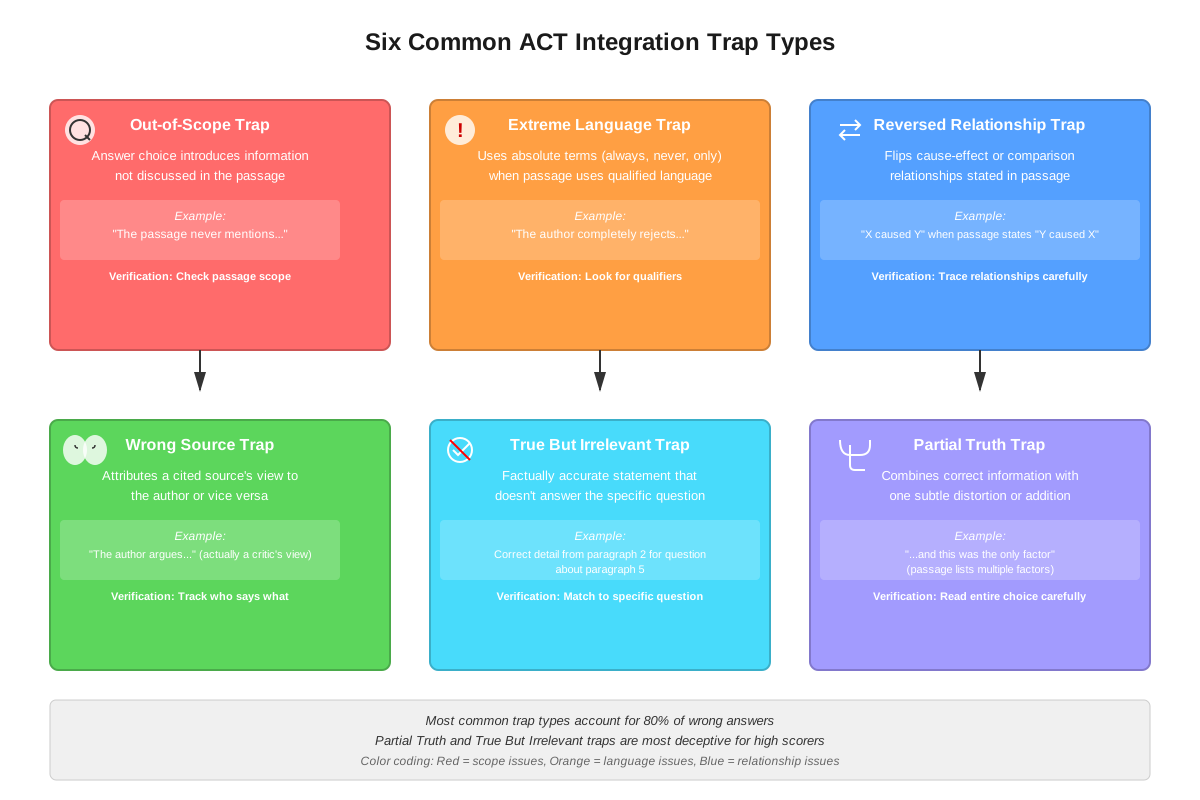
The Six Major Types of Integration Traps
1. The Scope Shift Trap
This trap presents information that is too broad, too narrow, or otherwise misaligned with the question's scope. For example, if a question asks about the author's main argument in paragraph 3, a trap answer might describe the main argument of the entire passage (too broad) or a single supporting detail from paragraph 3 (too narrow).
Recognition pattern: Look for answers that feel "close but not quite right" in terms of how much territory they cover. The correct answer will match the exact scope specified in the question stem.
2. The Relationship Reversal Trap
This sophisticated trap correctly identifies two concepts from the passage but reverses their relationship. If the passage states "X caused Y," the trap might say "Y caused X" or "X and Y are both effects of Z." These traps are particularly common in science passages discussing cause-and-effect relationships.
Recognition pattern: When an answer mentions two concepts you recognize from the passage, pause and verify the exact relationship between them before selecting it.
3. The Source Confusion Trap
Passages frequently present multiple viewpoints: the author's perspective, historical figures' opinions, critics' arguments, or research findings. This trap attributes a statement or belief to the wrong source. For instance, if the passage describes a theory the author is critiquing, the trap might present that theory as the author's own position.
Recognition pattern: Questions using words like "the author believes," "according to the passage," or "the narrator suggests" are testing your ability to distinguish sources. Always verify who said or believes what.
4. The Extreme Language Trap
The ACT rewards precise reading. This trap uses absolute language (always, never, only, must, impossible, all, none) when the passage uses qualified language (often, sometimes, may, suggests, typically). Conversely, it might use weak language when the passage makes a strong claim.
Recognition pattern: Compare the strength of language in the answer choice to the strength of language in the relevant passage section. Mismatches indicate trap answers.
| Passage Language | Trap Answer Language | Why It's Wrong |
|---|---|---|
| "often leads to" | "always causes" | Overstates certainty |
| "the primary factor" | "one factor among many" | Understates importance |
| "impossible to determine" | "difficult to determine" | Weakens absolute statement |
| "suggests that" | "proves that" | Overstates evidence strength |
5. The True But Irrelevant Trap
This is perhaps the most insidious trap type. The answer choice contains information that is factually accurate according to the passage but doesn't answer the specific question asked. Students who recognize true information often select these answers without verifying relevance.
Recognition pattern: After identifying that an answer is supported by the passage, ask a second question: "Does this actually answer what they're asking?" The question stem is your guide—stay focused on its specific requirements.
6. The Inference Overreach Trap
Integration questions often require inference, but the ACT defines inference narrowly: conclusions that must be true based on passage evidence, not possibilities or likely scenarios. This trap presents reasonable-sounding inferences that go beyond what the passage actually supports.
Recognition pattern: Correct inferences stay very close to the text and require minimal logical steps. If you find yourself thinking "well, that could be true" or "that makes sense," you may be looking at an overreach trap. The correct answer will feel almost inevitable given the passage evidence.
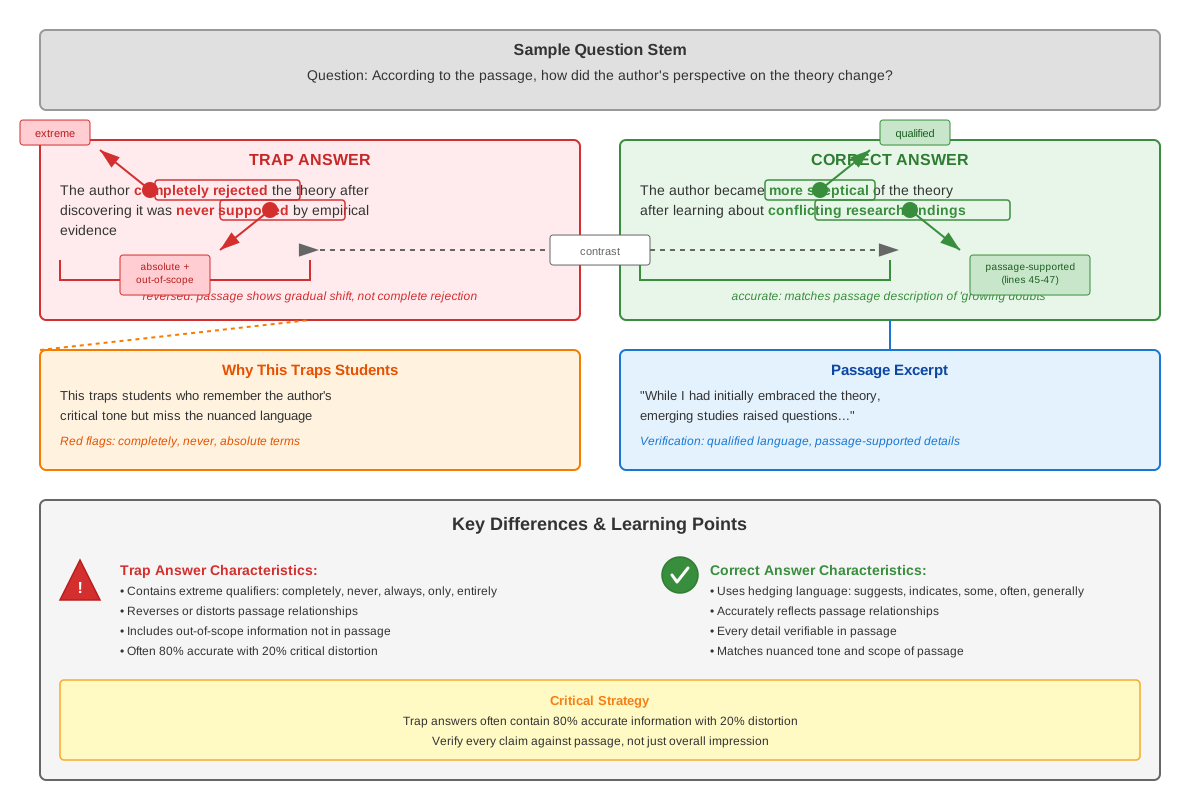
The Anatomy of a Trap Answer
Understanding how trap answers are constructed helps in identifying them. Test makers follow a systematic process:
- Start with passage content: Every trap incorporates real information from the passage to create familiarity
- Add a distortion: Introduce one of the six trap types listed above
- Use confident language: Present the trap with the same grammatical structure and tone as correct answers
- Position strategically: Often place traps as choice B or C, where students' eyes naturally land first
The key insight is that trap answers are designed to be selected, not to be obviously wrong. They succeed by exploiting predictable reading behaviors: skimming instead of careful reading, relying on memory instead of checking the passage, or selecting the first answer that sounds good rather than comparing all options.
The Correct Answer Pattern
While trap answers share common features, correct answers also follow predictable patterns:
- Precise language: Matches the passage's level of certainty and qualification
- Complete relevance: Answers the entire question, not just part of it
- Accurate relationships: Correctly represents how ideas connect in the passage
- Proper attribution: Assigns statements and beliefs to the correct sources
- Appropriate scope: Covers exactly what the question asks about—no more, no less
- Direct support: Can be defended by pointing to specific passage sentences
Concept Relationships
The six trap types are not isolated phenomena but interconnected strategies that often appear in combination. A single trap answer might combine Extreme Language with Source Confusion, for example, by stating "The author insists that all cases demonstrate..." when the passage actually says "Critics have argued that many cases suggest..."
Integration traps connect directly to the prerequisite skill of evidence location because avoiding traps requires returning to the passage to verify answer choices rather than relying on memory. This relationship is bidirectional: students who practice trap identification become better at evidence location, and students who consistently check evidence naturally avoid more traps.
The relationship map for this topic flows as follows:
Question Stem Analysis → identifies what's being asked and the required scope → Passage Evidence Location → finds relevant text sections → Answer Choice Evaluation → applies trap recognition patterns → Elimination Process → removes trap answers systematically → Verification → confirms the remaining answer against passage text → Selection → chooses the correct answer with confidence
Integration traps also connect forward to more advanced Reading skills. Students who master trap identification develop stronger critical thinking abilities that transfer to Craft and Structure questions (analyzing word choice, text structure, and point of view) and Key Ideas and Details questions (determining main ideas and supporting details). The analytical mindset required to spot traps—questioning assumptions, verifying relationships, and demanding textual evidence—represents the core of advanced reading comprehension.
High-Yield Facts
⭐ Approximately 30-40% of ACT Reading questions contain at least one carefully constructed trap answer designed to exploit common reading errors.
⭐ The True But Irrelevant trap is the most frequently used trap type, appearing in roughly 25% of all integration questions.
⭐ Trap answers almost always contain real information from the passage—the trap lies in how that information is presented or applied, not in fabricated content.
⭐ Questions asking about the author's purpose, perspective, or main argument have the highest concentration of Source Confusion traps.
⭐ Extreme language words (always, never, only, must, all, none) appear in wrong answers approximately 3 times more often than in correct answers.
- Relationship Reversal traps are most common in Natural Science passages discussing cause-and-effect or process sequences.
- The Scope Shift trap frequently appears in questions that specify a particular paragraph or section, with trap answers describing content from different passage sections.
- Correct answers typically use more qualified language (may, can, often, suggests, indicates) than trap answers.
- When two answer choices seem equally correct, one is usually a True But Irrelevant trap—return to the question stem to determine which actually answers what's being asked.
- Integration traps are deliberately placed in positions B and C more often than A or D because test makers know students tend to focus on middle options first.
- Questions using the phrase "according to the passage" are specifically testing whether students can distinguish between what the passage actually states versus what seems reasonable or likely.
- The Inference Overreach trap becomes more common in the fourth passage (Natural Science) because students are tired and more likely to accept reasonable-sounding conclusions without verification.
- Trap answers often use synonyms or paraphrases of passage language rather than exact quotes, creating a false sense of accuracy.
- Students who fall for 3 or more integration traps per test typically score below 25 on Reading, while those who avoid all traps score 30 or above.
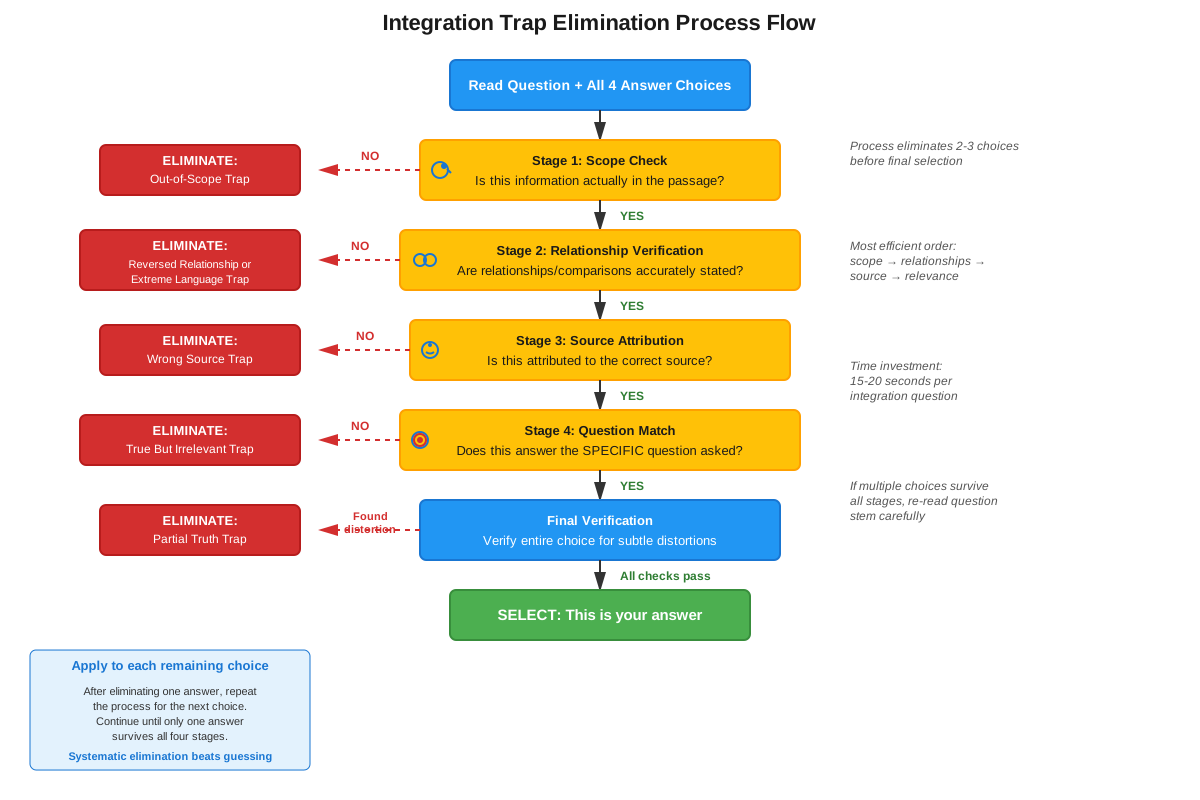
- The most effective trap avoidance strategy is systematic elimination: actively look for reasons to eliminate answers rather than searching for reasons to select them.
Quick check — test yourself on ACT integration traps so far.
Try Flashcards →Common Misconceptions
Misconception: If an answer choice contains information from the passage, it must be correct.
Correction: Trap answers deliberately incorporate true passage information but distort relationships, scope, or relevance. The presence of accurate facts does not guarantee a correct answer—you must verify that the information is applied correctly and answers the specific question asked.
Misconception: The correct answer will always use different words than the passage (paraphrasing), so answers with exact passage language are traps.
Correction: Both correct answers and traps can use exact passage language or paraphrases. The ACT tests comprehension, not vocabulary recognition. Focus on whether the answer accurately represents passage meaning, regardless of whether it uses the same words.
Misconception: Integration questions require making educated guesses or inferences that go beyond the passage text.
Correction: ACT "inference" questions require conclusions that must be true based on passage evidence, not possibilities or likely scenarios. Correct answers stay very close to the text and require minimal logical leaps. If you're making assumptions or adding outside knowledge, you're likely falling for an Inference Overreach trap.
Misconception: Longer, more detailed answer choices are more likely to be correct because they provide more information.
Correction: Answer length has no correlation with correctness on the ACT. Trap answers are often longer because they include extra details to seem comprehensive and authoritative. Evaluate answers based on accuracy and relevance, not length or detail level.
Misconception: If you can't find direct evidence for an answer in the passage, it must be wrong.
Correction: While correct answers must be supported by the passage, that support sometimes comes from synthesizing information across multiple paragraphs or understanding implicit relationships. The key is that the support must exist—you should be able to point to specific passage content that justifies the answer, even if it requires combining information from different sections.
Misconception: Extreme language words (always, never, all, none) automatically make an answer wrong.
Correction: While extreme language appears more often in trap answers, it's not automatically incorrect. If the passage itself uses absolute language or makes categorical claims, the correct answer may reflect that. Always compare the answer's language strength to the passage's language strength rather than applying a blanket rule.
Misconception: The correct answer will be the one that sounds most sophisticated or uses the most academic language.
Correction: The ACT does not reward complexity for its own sake. Correct answers are characterized by accuracy and precision, not sophisticated vocabulary. Some of the most effective trap answers use impressive-sounding language to mask logical flaws or scope problems.
Worked Examples
Example 1: Identifying a Source Confusion Trap
Passage excerpt: "While many historians have argued that economic factors were the primary cause of the conflict, Martinez contends that cultural tensions played an equally significant role. She acknowledges the economic pressures but insists that focusing solely on financial motivations oversimplifies a complex historical moment."
Question: According to the passage, Martinez's position differs from that of many historians in that she:
Answer Choices:
- A) Believes economic factors were the primary cause of the conflict
- B) Argues that cultural tensions were as important as economic factors
- C) Dismisses economic explanations entirely in favor of cultural analysis
- D) Agrees with the traditional historical interpretation of the conflict
Analysis:
First, identify what the question is asking: How does Martinez's view differ from other historians' views?
From the passage:
- Many historians: economic factors were PRIMARY cause
- Martinez: cultural tensions played EQUALLY SIGNIFICANT role (acknowledges economic pressures but adds cultural dimension)
Now evaluate each answer:
Choice A: This is a Source Confusion trap. The passage states that "many historians" believe economic factors were primary, not Martinez. This trap reverses the attribution, assigning the historians' view to Martinez.
Choice B: This accurately represents Martinez's position—she argues cultural tensions were "equally significant," meaning as important as economic factors. This matches the passage directly.
Choice C: This is an Extreme Language trap. Martinez "acknowledges the economic pressures," so she doesn't dismiss them entirely. The word "entirely" makes this too strong.
Choice D: This contradicts the passage. The question asks how Martinez DIFFERS from traditional interpretation, and the passage clearly shows she adds a cultural dimension that others haven't emphasized.
Correct Answer: B
This example demonstrates how Source Confusion traps work by correctly identifying information from the passage but attributing it to the wrong person or group. The key strategy is to track who says what and verify attribution before selecting an answer.
Example 2: Recognizing Multiple Trap Types
Passage excerpt: "The experiment yielded surprising results. While the researchers had hypothesized that increased temperature would accelerate the reaction, they found that temperatures above 40°C actually slowed the process. This unexpected finding suggests that the enzyme involved may denature at higher temperatures, though further research is needed to confirm this mechanism. The results challenge previous assumptions about optimal conditions for this type of reaction."
Question: Based on the passage, which of the following can be most reasonably inferred about the enzyme involved in the reaction?
Answer Choices:
- A) It functions most efficiently at temperatures above 40°C
- B) It has been proven to denature at high temperatures
- C) It may lose functionality at temperatures exceeding 40°C
- D) It always performs better at lower temperatures than at higher temperatures
Analysis:
The question asks for a reasonable inference about the enzyme. Key passage information:
- Temperatures above 40°C slowed the reaction
- This "suggests" the enzyme "may denature" at higher temperatures
- "Further research is needed to confirm"
Evaluate each answer:
Choice A: This is a Relationship Reversal trap. The passage states that temperatures ABOVE 40°C slowed the reaction, meaning the enzyme does NOT function most efficiently at those temperatures. This reverses the actual finding.
Choice B: This is an Extreme Language trap combined with Inference Overreach. The passage says the enzyme "may denature" and that "further research is needed to confirm." The word "proven" is too strong—the passage presents this as a hypothesis, not a confirmed fact.
Choice C: This correctly captures the passage's qualified language. "May lose functionality" matches "may denature," and "exceeding 40°C" accurately represents "above 40°C." This stays close to the text without overstating certainty.
Choice D: This is another Extreme Language trap. The word "always" makes an absolute claim that the passage doesn't support. The passage only discusses this specific experiment and enzyme, not universal principles about enzyme behavior.
Correct Answer: C
This example shows how multiple trap types can appear in a single question set. The correct answer (C) uses appropriately qualified language that matches the passage's level of certainty, while traps use extreme language (B and D) or reverse relationships (A). The key strategy is to match the strength and precision of language between the passage and answer choices.
Exam Strategy
The Four-Step Trap Avoidance Process
Step 1: Analyze the Question Stem (15 seconds)
Before looking at answer choices, identify exactly what's being asked. Underline key words that define scope (e.g., "in paragraph 3," "the author's main argument," "according to Martinez"). This prevents Scope Shift and True But Irrelevant traps.
Step 2: Locate Relevant Evidence (30 seconds)
Return to the passage and identify the specific section(s) that address the question. Don't rely on memory—even strong readers misremember details under time pressure. Mark or mentally note the relevant lines.
Step 3: Predict Before Reading Choices (10 seconds)
Based on the passage evidence, formulate a rough prediction of what the correct answer should say. This prevents trap answers from seeming more attractive than they should.
Step 4: Eliminate Systematically (45 seconds)
Read each answer choice while actively looking for trap characteristics. Use the process of elimination rather than searching for the "right" answer. Cross out choices as you identify traps, and verify the remaining answer against passage text before selecting.
Trigger Words and Phrases
Questions most likely to contain integration traps use these phrases:
- "According to the passage" (watch for Source Confusion)
- "The author's main purpose" (watch for Scope Shift)
- "It can reasonably be inferred" (watch for Inference Overreach)
- "The passage suggests" (watch for Extreme Language)
- "In lines X-Y, the author indicates" (watch for True But Irrelevant)
Answer choices containing these words warrant extra scrutiny:
- Absolute terms: always, never, only, must, all, none, impossible, certain
- Causal language: causes, results in, leads to, produces, creates (verify direction)
- Attribution words: believes, argues, claims, suggests, maintains (verify source)
Time Allocation Strategy
Exam Tip: Spend more time eliminating wrong answers than searching for the right answer. On integration questions, invest 60-90 seconds total: 15 seconds on the question stem, 30 seconds locating evidence, and 45 seconds on systematic elimination.
Don't rush integration questions to save time for other questions. These are high-value questions where careful analysis pays off. Missing an integration question because you fell for a trap wastes more time than you save by rushing, because you've spent time reading and thinking but earned no points.
The Verification Checkpoint
Before selecting your final answer, complete this three-part verification:
- Relevance check: Does this answer the specific question asked?
- Evidence check: Can I point to passage text that supports this?
- Trap check: Does this contain any of the six trap characteristics?
If you can't confidently answer "yes, yes, no" to these three questions, reconsider your choice.
Memory Techniques
The TRAPS Acronym
Remember the five most common trap characteristics with TRAPS:
- Too extreme (absolute language that overstates passage claims)
- Reversed relationships (correct concepts but wrong connections)
- Attribution errors (right information, wrong source)
- Partially relevant (true but doesn't answer the question)
- Scope shifted (too broad, too narrow, or wrong section)
The "Three-Second Rule" Visualization
When an answer choice immediately seems correct, visualize a red stop sign and count to three. This brief pause prevents impulsive selection of True But Irrelevant traps. Use those three seconds to ask: "Does this answer what they're actually asking?"
The Source Tracker Method
For passages presenting multiple viewpoints, create a quick mental map:
- Author = what the passage itself argues or presents as fact
- Others = what the passage describes people believing or arguing
When you see attribution words in questions or answers, mentally check your source map before selecting.
The Language Strength Spectrum
Visualize a spectrum from weak to strong language:
Weak ← → Moderate ← → Strong
(may, can, suggests) | (often, typically, indicates) | (always, must, proves)
Match the answer's position on this spectrum to the passage's position. Mismatches indicate traps.
Summary
ACT integration traps represent sophisticated wrong answer choices designed to exploit common reading errors by incorporating true passage information while distorting relationships, scope, attribution, or relevance. The six major trap types—Scope Shift, Relationship Reversal, Source Confusion, Extreme Language, True But Irrelevant, and Inference Overreach—appear in approximately 30-40% of Reading questions and are the primary factor differentiating mid-range scores from top scores. Successful trap avoidance requires a systematic approach: carefully analyzing question stems to identify scope and requirements, locating specific passage evidence rather than relying on memory, predicting answers before reading choices, and eliminating options by actively searching for trap characteristics. The key insight is that partial correctness does not equal full correctness—trap answers succeed by seeming familiar and reasonable while containing subtle but critical flaws. Students who master trap identification develop the analytical reading skills necessary to score 28 and above on ACT Reading by consistently avoiding the 3-4 trap answers per test that separate high scorers from mid-range performers.
Key Takeaways
- Integration traps are not random wrong answers but carefully constructed distractors that incorporate true passage information while distorting relationships, scope, or relevance
- The True But Irrelevant trap is the most common type—always verify that an answer doesn't just contain accurate information but actually answers the specific question asked
- Extreme language (always, never, only, must, all, none) appears in wrong answers approximately three times more often than in correct answers, making it a reliable trap indicator
- Source Confusion traps are especially prevalent in questions about author's purpose or perspective—always verify who said or believes what before selecting an answer
- The most effective trap avoidance strategy is systematic elimination: actively look for reasons to eliminate answers rather than searching for reasons to select them
- Correct answers match the passage's level of certainty and qualification—compare language strength between answers and passage text to identify mismatches
- Spending 60-90 seconds on integration questions through careful analysis yields better results than rushing, as these high-value questions separate top scorers from mid-range performers
Related Topics
Craft and Structure Questions: After mastering integration traps, students should explore how trap patterns appear in questions about word choice, text structure, and point of view. The analytical skills developed through trap identification transfer directly to these more nuanced question types.
Evidence-Based Reading Strategies: Understanding integration traps reinforces the importance of evidence-based reading across all question types. Students who master trap avoidance naturally develop stronger skills in locating, interpreting, and applying textual evidence.
Comparative Passages: Some ACT Reading tests include paired passages requiring comparison. Integration traps in these questions often involve confusing which passage contains which information—an advanced application of Source Confusion traps.
Time Management for Reading: Mastering trap identification enables more efficient time allocation because students can confidently invest time in high-value integration questions while moving quickly through straightforward detail questions.
Critical Reading for College: The analytical mindset required to identify integration traps—questioning assumptions, verifying relationships, demanding evidence—represents essential college-level reading skills that extend far beyond standardized testing.
Practice CTA
Now that you understand the six major types of integration traps and the systematic strategies for avoiding them, it's time to apply these concepts to real ACT-style questions. The practice questions and flashcards will help you recognize trap patterns quickly and build the confidence needed to navigate even the most challenging integration questions on test day. Remember: every trap you learn to identify is a point you'll earn on the actual exam. Start practicing now to transform this knowledge into automatic, test-day skills that will elevate your Reading score to the next level!
Sign up free to keep reading
Create a free AnvayaPrep account to finish this ACT guide on ACT integration traps — plus flashcards and practice questions.