Overview
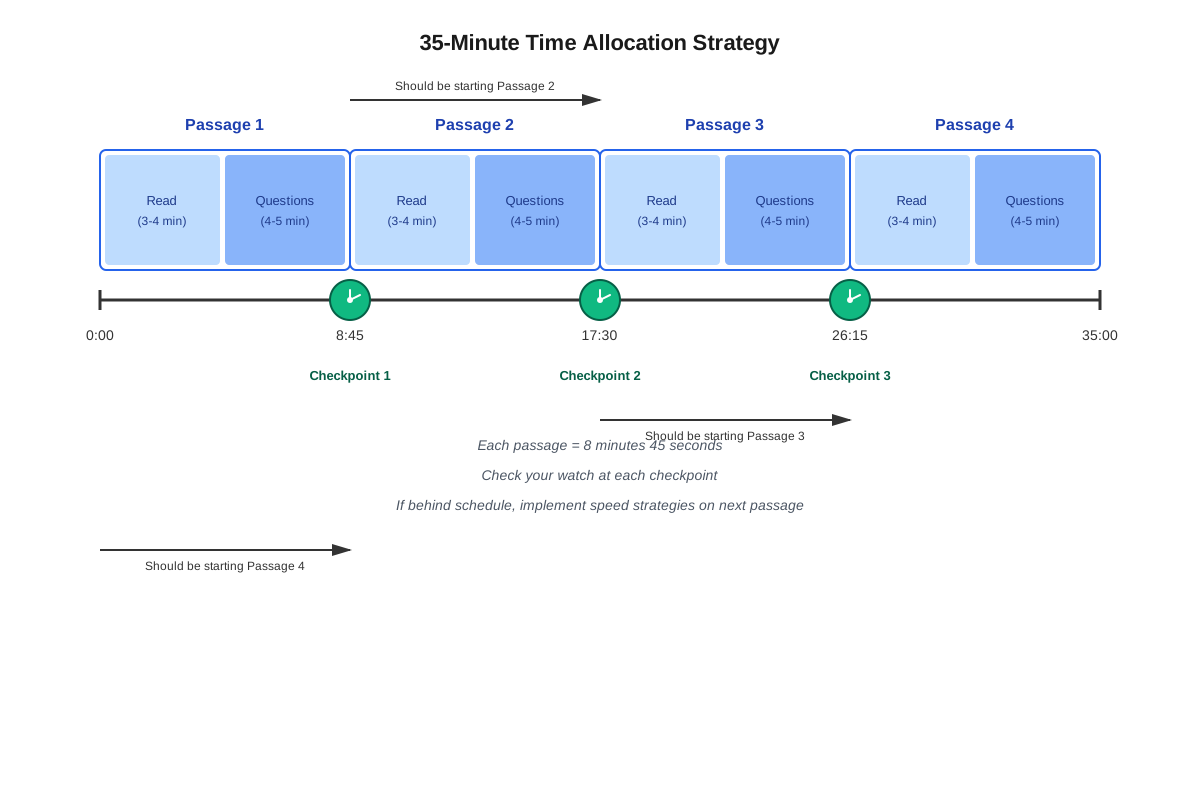
ACT reading pacing is one of the most critical yet often overlooked skills for achieving a competitive score on the ACT Reading section. Students face a formidable challenge: they must read four passages of approximately 750 words each and answer 40 questions—all within just 35 minutes. This translates to roughly 8 minutes and 45 seconds per passage, including both reading time and question-answering time. Without a deliberate, practiced approach to act reading pacing, even strong readers can find themselves rushing through the final passage or leaving questions blank.
The importance of mastering pacing extends beyond simply finishing on time. Poor pacing creates a cascade of problems: increased anxiety, careless errors on easy questions, insufficient time to tackle complex inference questions, and the inability to return to passages for verification. Students who develop effective pacing strategies not only complete all sections but also maintain consistent accuracy throughout the test. They learn to allocate time strategically, recognizing which questions deserve more attention and which passages might be approached more efficiently.
Understanding act act reading pacing connects directly to every other aspect of ACT Reading success. Effective pacing enables students to apply their comprehension strategies fully, utilize process-of-elimination techniques without rushing, and maintain the mental stamina needed for the entire 35-minute section. This topic serves as the foundation upon which all other reading skills rest—without proper time management, even the most sophisticated analytical abilities cannot be fully deployed.
Learning Objectives
- [ ] Identify when ACT reading pacing is being tested
- [ ] Explain the core rule or strategy behind ACT reading pacing
- [ ] Apply ACT reading pacing to ACT-style questions accurately
- [ ] Calculate and implement optimal time allocation for each passage and question set
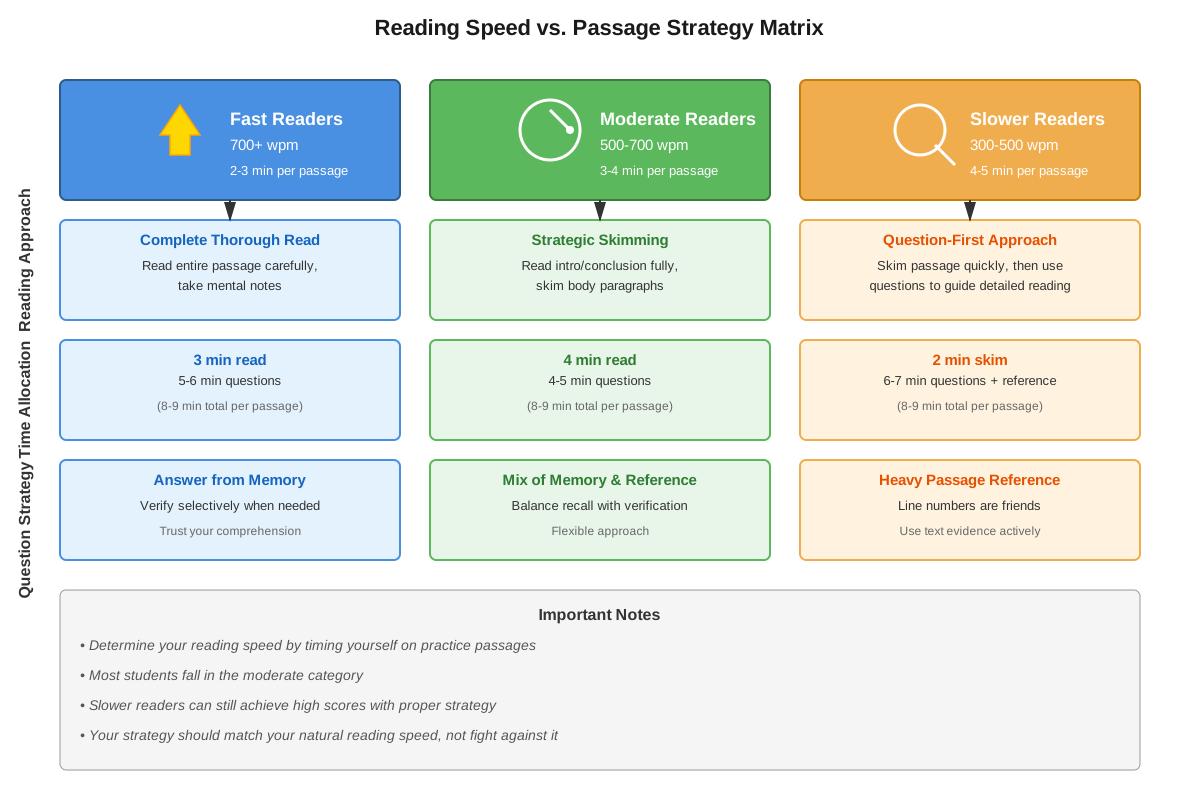
- [ ] Recognize personal reading speed and adjust strategies accordingly
- [ ] Develop a systematic approach to passage selection and question ordering
- [ ] Execute emergency time-management protocols when falling behind schedule
Prerequisites
- Basic reading comprehension skills: Students must be able to understand college-level prose passages without significant vocabulary or syntax barriers, as pacing strategies assume baseline comprehension ability.
- Familiarity with ACT Reading passage types: Knowledge of the four passage types (Literary Narrative/Prose Fiction, Social Science, Humanities, and Natural Science) allows for strategic passage ordering decisions.
- Understanding of ACT question formats: Recognition of detail questions, inference questions, main idea questions, and vocabulary-in-context questions enables efficient question triage.
- Ability to use a timing device: Students must be comfortable checking a watch or timer periodically without disrupting their concentration.
Why This Topic Matters
In the real world, time management and efficient information processing are essential professional skills. Lawyers must review case files under deadline pressure, medical professionals must make rapid assessments with limited information, and business analysts must extract key insights from lengthy reports quickly. The ACT Reading section simulates these real-world demands, testing not just comprehension but the ability to work efficiently under time constraints.
From an exam perspective, pacing appears in approximately 100% of ACT Reading sections—not as a discrete question type, but as an underlying challenge that affects every single question. Students who run out of time typically miss 5-10 questions at the end, immediately capping their score at 28 or below regardless of their actual reading ability. Conversely, students who master pacing often see score improvements of 3-5 points without any change in their comprehension skills. The ACT deliberately designs the Reading section to be time-pressured; the average student cannot comfortably finish all passages using their natural reading pace.
Common manifestations of pacing challenges include: rushing through the fourth passage and missing easy detail questions; spending 12-15 minutes on the first passage and having only 3-4 minutes for the last; re-reading passages multiple times due to poor initial focus; and getting stuck on difficult questions early in the section. Each of these patterns indicates a need for systematic pacing strategies rather than simply "reading faster."
Core Concepts
The 8-9 Minute Rule
The fundamental principle of ACT reading pacing is the 8-9 minute allocation per passage. With 35 minutes total and four passages, students have approximately 8 minutes and 45 seconds per passage-question set combination. However, this should be understood as a flexible guideline rather than a rigid rule. The optimal approach involves:
- 3-4 minutes for active reading of the passage
- 4-5 minutes for answering the 10 questions
- 30-60 seconds as a buffer for difficult questions or passage review
This breakdown ensures that students spend adequate time understanding the passage initially, which actually saves time when answering questions. Students who rush through reading in 2 minutes often spend 7-8 minutes on questions because they must constantly return to the passage to verify details they didn't absorb.
Strategic Passage Ordering
Not all passages are created equal in terms of difficulty or time requirements. A sophisticated pacing strategy includes passage selection flexibility. Students should:
- Quickly preview all four passages (15-20 seconds total)
- Identify which passage type aligns with personal strengths
- Complete passages in order of confidence, not test booklet order
- Save the most challenging passage for last when time pressure is greatest
| Passage Type | Typical Difficulty | Average Time Needed | Strategic Considerations |
|---|---|---|---|
| Natural Science | Medium | 8-9 minutes | Clear structure, technical vocabulary |
| Social Science | Medium | 8-9 minutes | Straightforward arguments, data-driven |
| Humanities | Medium-High | 9-10 minutes | Abstract concepts, nuanced arguments |
| Literary Narrative | Variable | 8-11 minutes | Character analysis, implicit meanings |
The Question Triage System
Within each passage, questions vary significantly in difficulty and time requirements. Effective pacing requires question triage—the ability to quickly categorize questions and allocate time accordingly:
Quick Questions (30-45 seconds each):
- Direct detail questions with line references
- Vocabulary-in-context questions
- Questions asking "according to the passage"
Medium Questions (60-90 seconds each):
- Inference questions requiring synthesis of multiple details
- Function questions asking why an author included something
- Comparative questions in dual passages
Slow Questions (90-120 seconds each):
- Main idea or primary purpose questions
- Complex inference questions without clear passage references
- EXCEPT/NOT questions requiring verification of multiple answer choices
The strategic approach involves answering quick questions first to build momentum and secure easy points, then tackling medium questions, and finally addressing slow questions with remaining time.
The Checkpoint System
Maintaining awareness of time throughout the section prevents the common problem of discovering with 5 minutes remaining that two passages remain. The checkpoint system involves:
- After 9 minutes: Complete Passage 1 and begin Passage 2
- After 18 minutes: Complete Passage 2 and begin Passage 3
- After 27 minutes: Complete Passage 3 and begin Passage 4
- At 32 minutes: Be on the final 2-3 questions of Passage 4
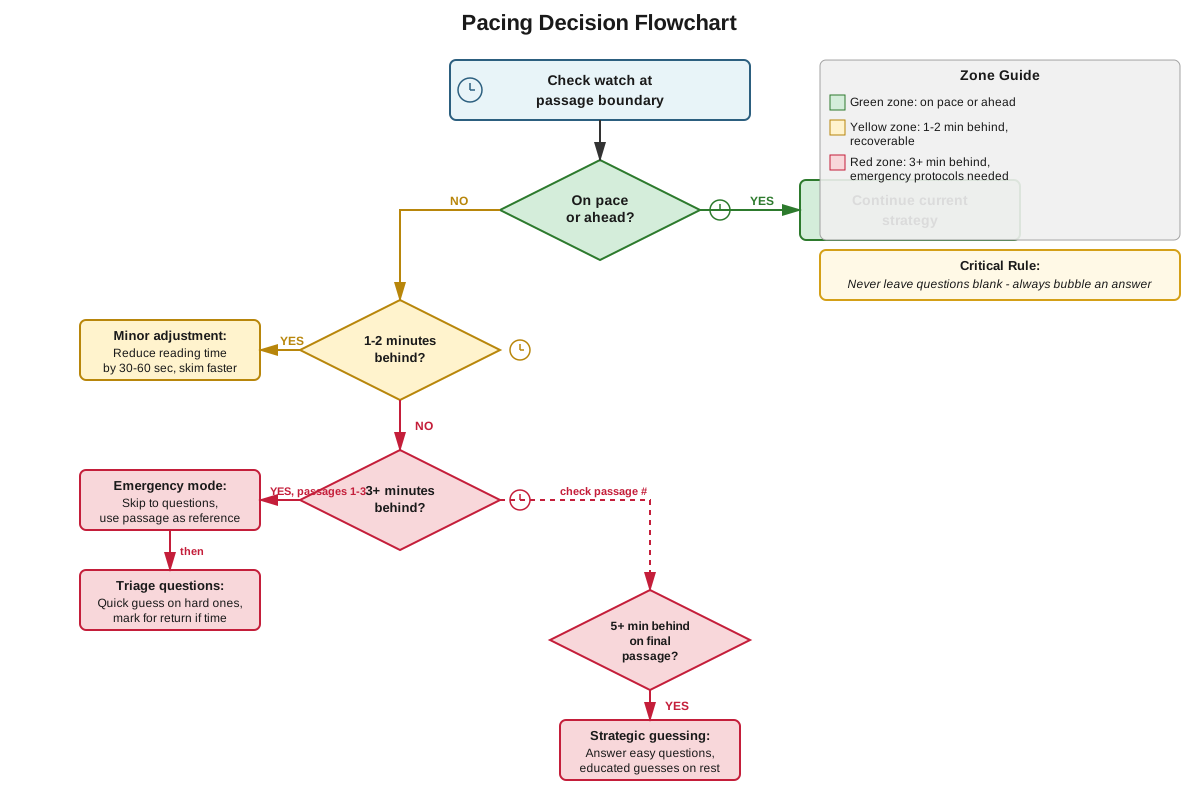
If behind schedule at any checkpoint, students should implement emergency protocols: skip to easier questions, reduce passage re-reading, or make educated guesses on the most time-consuming questions.
Active Reading for Efficiency
Paradoxically, spending adequate time on the initial reading actually improves overall pacing. Active reading strategies include:
- Reading at a consistent, moderate pace (not skimming, not word-by-word)
- Mentally noting paragraph topics and transitions
- Identifying the author's main argument or the passage's central conflict
- Marking (mentally or with light pencil) key names, dates, and transitions
- Resisting the urge to re-read sentences unless genuinely confusing
Students who skim passages to "save time" typically spend that saved time (and more) re-reading sections while answering questions. The optimal approach balances thorough initial comprehension with forward momentum.
The Bubble Strategy
Time is lost not just in reading and thinking but also in the mechanical process of filling answer bubbles. Efficient students develop a bubble strategy:
- Circle answers in the test booklet first
- Transfer answers in groups (after completing each passage or every 5 questions)
- Double-check that question numbers align with bubble sheet numbers
- In the final 2 minutes, ensure all bubbles are filled (guess if necessary)
This approach reduces the cognitive switching between reading/analyzing and bubble-filling, maintaining better focus and reducing errors.
Concept Relationships
The core concepts of ACT reading pacing form an interconnected system where each element supports the others. The 8-9 Minute Rule serves as the foundation, establishing the time budget that all other strategies must work within. This rule directly enables the Checkpoint System, which provides the monitoring mechanism to ensure the time budget is being followed throughout the test.
Strategic Passage Ordering interacts with the 8-9 Minute Rule by allowing students to optimize their time allocation—completing easier passages slightly faster (7-8 minutes) creates a time cushion for more challenging passages (9-10 minutes). This flexibility prevents the rigid application of timing that can create unnecessary stress.
The Question Triage System operates within each passage's time allocation, ensuring that the 4-5 minutes devoted to questions is spent efficiently. This system directly supports the Checkpoint System because answering quick questions first helps students stay on pace, while slow questions can be saved for the end when time pressure is greatest.
Active Reading for Efficiency enables all other strategies by ensuring that the 3-4 minutes spent reading generates sufficient comprehension to answer questions quickly. Poor initial reading undermines the Question Triage System because even "quick" questions become time-consuming when passage details weren't absorbed.
The Bubble Strategy serves as the operational component that prevents time leakage during the mechanical aspects of test-taking, ensuring that the time allocated to reading and answering is actually spent on those activities rather than on administrative tasks.
Relationship map: Active Reading → enables → Quick Question Answering → supports → 8-9 Minute Rule → monitored by → Checkpoint System → adjusted through → Strategic Passage Ordering → optimized by → Question Triage System → protected by → Bubble Strategy.
High-Yield Facts
⭐ The ACT Reading section provides 8 minutes and 45 seconds per passage on average, but strategic students aim for 8-9 minutes to build a time cushion.
⭐ Spending 3-4 minutes on active initial reading typically saves 1-2 minutes during question answering compared to skimming.
⭐ Students should check their time at three critical checkpoints: 9 minutes (after Passage 1), 18 minutes (after Passage 2), and 27 minutes (after Passage 3).
⭐ Passage ordering is flexible—students can complete passages in any order, and should tackle their strongest passage type first.
⭐ Detail questions with line references typically require 30-45 seconds, while complex inference questions may require 90-120 seconds.
- Questions should be answered in order of difficulty within each passage, not necessarily in the order presented.
- The final 2 minutes should be reserved for bubbling any remaining answers and making educated guesses on incomplete questions.
- Re-reading entire passages is almost never time-efficient; targeted re-reading of specific paragraphs or sentences is preferable.
- Students who consistently run out of time should consider skipping the most difficult passage entirely and ensuring perfect accuracy on three passages.
- Natural Science and Social Science passages typically have more straightforward questions than Literary Narrative passages.
- The ACT does not penalize wrong answers, so every bubble should be filled even if guessing is necessary.
- Practicing with a timer during preparation is essential—pacing skills do not develop through untimed practice alone.
Quick check — test yourself on ACT reading pacing so far.
Try Flashcards →Common Misconceptions
Misconception: Reading faster is the solution to ACT reading pacing problems.
Correction: Reading speed is only one component of pacing. Most students benefit more from strategic question ordering, passage selection, and eliminating time-wasting behaviors (like excessive re-reading) than from simply reading faster. Forced speed-reading often reduces comprehension, which increases question-answering time.
Misconception: All passages must be completed in the order they appear in the test booklet.
Correction: Students have complete freedom to tackle passages in any order. Strategic test-takers preview all passages and complete them in order of personal confidence, saving the most challenging for last when time pressure is greatest and guessing becomes more acceptable.
Misconception: Spending more time on difficult questions will eventually lead to the correct answer.
Correction: On the ACT, spending more than 90-120 seconds on a single question typically indicates diminishing returns. After this point, students should make their best guess, mark the question for review if time permits, and move forward. Protecting time for easier questions is more valuable than exhausting time on one difficult question.
Misconception: Skimming passages saves enough time to answer more questions carefully.
Correction: Skimming typically backfires because students must re-read sections multiple times while answering questions, ultimately spending more total time than if they had read carefully initially. Active reading at a moderate pace is more time-efficient overall.
Misconception: Checking time frequently disrupts concentration and should be avoided.
Correction: Strategic time-checking at predetermined checkpoints (every 9 minutes) actually reduces anxiety by providing information needed for strategic adjustments. The disruption is minimal (2-3 seconds) and prevents the much larger disruption of discovering with 5 minutes left that two passages remain.
Misconception: Strong readers don't need pacing strategies because they naturally read quickly.
Correction: The ACT Reading section is designed to be time-pressured even for strong readers. Without deliberate pacing strategies, strong readers often spend too much time on early passages, over-analyze questions, or fail to implement efficient question-answering sequences. Pacing strategies benefit all skill levels.
Worked Examples
Example 1: Implementing the Checkpoint System
Scenario: A student begins the ACT Reading section and completes the first passage (Natural Science) and its questions. She checks her watch and sees that 10 minutes have elapsed. She is 1 minute and 15 seconds behind her target pace.
Analysis and Strategy:
- Recognize the situation: The first checkpoint (9 minutes) has been exceeded by 1:15. This is not yet critical but requires adjustment.
- Evaluate the cause: The student should quickly reflect—did she spend too long reading (more than 4 minutes) or too long on questions (more than 6 minutes)? If reading took too long, she should focus on maintaining forward momentum in the next passage. If questions took too long, she should implement stricter question triage.
- Implement adjustment: For Passage 2, the student should aim for 8:30 total time to get back on track. This can be achieved by:
- Reading at a slightly brisker pace while maintaining comprehension (target: 3:30 instead of 4:00)
- Answering quick questions first and saving the most difficult question for last
- Limiting any single question to 90 seconds maximum
- Execute the plan: The student completes Passage 2 in 8:30, checking her watch at 18:30 total elapsed time. She is now only 30 seconds behind pace, which is manageable.
- Continue monitoring: At the next checkpoint (after Passage 3), she should again assess her time and make any necessary adjustments for the final passage.
Key Takeaway: Small timing deficits can be corrected through minor adjustments in subsequent passages. The checkpoint system provides the information needed to make these strategic corrections before time pressure becomes critical.
Example 2: Strategic Passage Ordering
Scenario: A student opens the Reading section and takes 20 seconds to preview all four passages. He identifies:
- Passage I: Literary Narrative about a family relationship (his weakest area)
- Passage II: Social Science about economic policy (medium difficulty for him)
- Passage III: Humanities about art history (his strongest area)
- Passage IV: Natural Science about geology (medium difficulty for him)
Analysis and Strategy:
- Prioritize strengths: The student decides to complete passages in this order: III (Humanities), II (Social Science), IV (Natural Science), I (Literary Narrative).
- Rationale for ordering:
- Passage III first: Completing his strongest passage first builds confidence, ensures high accuracy on these 10 questions, and likely takes only 7-8 minutes, creating a time cushion.
- Passages II and IV next: These medium-difficulty passages are completed while mental energy is still high, targeting 8-9 minutes each.
- Passage I last: The most challenging passage is saved for last. If time becomes tight, he can make educated guesses on the most difficult questions without sacrificing performance on passages where he's stronger.
- Execute with time awareness:
- Completes Passage III in 7:45 (ahead of pace by 1 minute)
- Completes Passage II in 8:30 (still 30 seconds ahead)
- Completes Passage IV in 9:00 (now on pace at 25:15 total)
- Has 9:45 remaining for Passage I, which is adequate even for his weakest passage type
- Outcome: By ordering passages strategically, the student maximizes his score potential. Even if he struggles with Passage I and needs to guess on 2-3 questions, he has secured strong performance on the other three passages (likely 27-30 correct out of 30 questions), positioning him for a score of 30+ overall.
Key Takeaway: Passage ordering is a powerful tool for optimizing both time management and score potential. Students should play to their strengths and protect their performance on passages where they can excel.
Exam Strategy
When approaching ACT Reading with pacing in mind, students should implement a systematic process that begins before reading the first word. Upon opening the test booklet, invest 15-20 seconds previewing all four passages to identify topics and determine optimal ordering. This small time investment pays dividends by ensuring the most strategic sequence.
Trigger phrases that indicate time-intensive questions include:
- "The author would most likely agree..." (requires inference and synthesis)
- "The main purpose of the passage is..." (requires holistic understanding)
- "EXCEPT" or "NOT" (requires checking multiple answer choices)
- "It can reasonably be inferred..." (requires careful reasoning)
When encountering these triggers, students should recognize that 90-120 seconds may be needed and plan accordingly—either tackle these questions when time permits or save them for the end of the passage.
Process-of-elimination becomes more efficient with pacing awareness. Rather than carefully evaluating all four answer choices for every question, students should:
- Quickly eliminate obviously wrong answers (15-20 seconds)
- If one answer remains, select it and move forward
- If two answers remain, invest time comparing them (30-45 seconds)
- If uncertain after 90 seconds, make the best guess and mark for review
Time allocation advice for different scenarios:
- If ahead of pace: Use extra time to review marked questions or double-check answers on the current passage, but resist the temptation to over-analyze questions that were already answered correctly.
- If on pace: Maintain current strategy and continue monitoring at checkpoints.
- If behind pace by 1-2 minutes: Implement minor adjustments—reduce re-reading, answer questions in strict order of difficulty, limit difficult questions to 90 seconds.
- If behind pace by 3+ minutes: Implement emergency protocols—skip the most difficult 1-2 questions per remaining passage, reduce reading time to 3 minutes per passage, ensure all bubbles are filled even if guessing.
Exam Tip: In the final 2 minutes, shift from "answering mode" to "completion mode." Ensure every bubble is filled, even if guessing randomly on incomplete questions. A 25% chance (random guess) is better than 0% (blank answer).
Memory Techniques
The "3-4-5" Rule: Remember passage time allocation with three numbers:
- 3-4 minutes reading
- 4-5 minutes answering questions
- 5 passages total... wait, only 4 passages (this intentional error helps the numbers stick)
PACE Acronym for the checkpoint system:
- Passage 1 done at 9 minutes
- After 18 minutes, two passages complete
- Check again at 27 minutes (three passages done)
- End at 35 minutes (all four complete)
The "Quick-Medium-Slow" Visualization: Picture a traffic light:
- Green (Quick): Detail questions with line references—go fast (30-45 seconds)
- Yellow (Medium): Inference questions—proceed with caution (60-90 seconds)
- Red (Slow): EXCEPT/NOT questions and main idea questions—stop and think carefully (90-120 seconds)
The "Rule of Nines": Every 9 minutes, one passage should be complete. This simple rule makes checkpoint monitoring automatic: 9, 18, 27, done.
Bubble Strategy Reminder: "Circle, Transfer, Verify" (CTV) - like a TV show you watch in three acts:
- Circle answers in the booklet
- Transfer to bubble sheet in groups
- Verify numbers align
Summary
ACT reading pacing is the foundational skill that enables all other reading strategies to function effectively within the 35-minute time constraint. The core principle involves allocating approximately 8-9 minutes per passage, with 3-4 minutes for active reading and 4-5 minutes for answering questions. Students must implement a checkpoint system (monitoring time at 9, 18, and 27 minutes) to ensure they remain on pace throughout the section. Strategic passage ordering allows students to tackle passages in order of personal confidence rather than test booklet order, maximizing score potential by ensuring strong performance on easier passages. Within each passage, question triage—categorizing questions as quick, medium, or slow—enables efficient time allocation to individual questions. Active reading at a moderate pace, rather than skimming, actually saves time overall by reducing the need for re-reading during question answering. When time pressure increases, students should implement emergency protocols including educated guessing on difficult questions and ensuring all bubbles are filled. Mastering these pacing strategies typically results in score improvements of 3-5 points by preventing the time-related errors that plague most test-takers.
Key Takeaways
- The 8-9 minute per passage allocation (3-4 minutes reading, 4-5 minutes questions) is the foundation of effective ACT reading pacing
- Checkpoint monitoring at 9, 18, and 27 minutes prevents time-related disasters and enables strategic adjustments
- Passage ordering is flexible—complete passages in order of personal confidence, not test booklet order
- Question triage (quick/medium/slow) ensures time is invested where it generates the most points
- Active reading at moderate pace is more time-efficient than skimming because it reduces re-reading during questions
- Emergency protocols (educated guessing, ensuring all bubbles filled) should be implemented when 3+ minutes behind pace
- Pacing skills require deliberate practice with timed sections—untimed practice does not develop time management abilities
Related Topics
Passage-Specific Reading Strategies: After mastering general pacing, students should develop specialized approaches for each passage type (Literary Narrative, Social Science, Humanities, Natural Science), as each type has unique structural patterns and question tendencies that enable further time optimization.
Question Type Mastery: Deep understanding of the six main ACT Reading question types (detail, inference, main idea, vocabulary-in-context, function, and comparative) allows for more sophisticated question triage and faster answer identification.
Active Reading Techniques: Advanced annotation strategies, paragraph mapping, and main idea identification methods enhance the efficiency of the initial reading phase, supporting better pacing overall.
Stress Management and Test Anxiety: Even perfect pacing strategies can be undermined by anxiety. Learning to maintain composure under time pressure ensures that pacing skills can be executed consistently on test day.
Practice CTA
Now that you understand the principles and strategies of ACT reading pacing, it's time to put these concepts into practice. Complete the practice questions and review the flashcards to reinforce your understanding of time allocation, checkpoint monitoring, and strategic passage ordering. Remember: pacing skills only develop through deliberate, timed practice. Set a timer for 35 minutes, implement the strategies you've learned, and track your progress at each checkpoint. With consistent practice, these pacing techniques will become automatic, freeing your mental energy to focus on comprehension and analysis. You've got this—strategic pacing is the key that unlocks your full potential on ACT Reading!
Sign up free to keep reading
Create a free AnvayaPrep account to finish this ACT guide on ACT reading pacing — plus flashcards and practice questions.