Overview
The ACT reading section strategy represents a comprehensive approach to tackling one of the most time-pressured sections of the ACT exam. Unlike subject-specific knowledge that can be memorized, reading strategy encompasses the systematic methods, timing techniques, and analytical approaches that enable students to efficiently navigate four distinct passages and 40 questions in just 35 minutes. This topic is not about what to read, but rather how to read, when to read, and how to maximize accuracy while managing severe time constraints.
Mastering ACT reading section strategy is essential because raw reading ability alone rarely translates to optimal scores. The ACT reading section tests not just comprehension, but the ability to quickly identify relevant information, distinguish between closely-related answer choices, and maintain focus across diverse passage types including Literary Narrative/Prose Fiction, Social Science, Humanities, and Natural Science. Students who approach the section without a deliberate strategy often find themselves rushing through final questions, misreading answer choices, or spending disproportionate time on difficult questions at the expense of easier ones.
The strategic framework for ACT reading connects intimately with understanding passage types, question categories, and time management principles. While knowledge of specific passage structures (narrative arcs, argumentative frameworks, scientific explanations) provides the foundation, strategic application determines whether that knowledge translates into correct answers within the allotted time. This topic serves as the operational blueprint that integrates all other reading skills into a cohesive, executable test-day approach.
Learning Objectives
- [ ] Identify when ACT reading section strategy is being tested
- [ ] Explain the core rule or strategy behind ACT reading section strategy
- [ ] Apply ACT reading section strategy to ACT-style questions accurately
- [ ] Evaluate and select the most efficient passage order based on individual strengths
- [ ] Implement time-management protocols that ensure completion of all 40 questions
- [ ] Distinguish between questions requiring passage reference versus prior knowledge application
- [ ] Synthesize multiple strategic elements (skimming, annotation, elimination) into a personalized approach
Prerequisites
- Basic reading comprehension: Understanding main ideas, supporting details, and author's purpose forms the foundation upon which strategic approaches are built
- Familiarity with ACT format: Knowing the test structure (4 passages, 10 questions each, 35 minutes total) allows for realistic strategy implementation
- Question type recognition: Distinguishing between detail, inference, vocabulary, and main idea questions enables targeted strategic responses
- Time awareness: Basic ability to monitor elapsed time and pace oneself prevents strategy breakdown under pressure
Why This Topic Matters
The ACT reading section consistently challenges even strong readers because it demands speed, accuracy, and adaptability simultaneously. Approximately 25% of the composite ACT score derives from the reading section, making it a critical component for college admissions and scholarship eligibility. Students who master strategic approaches typically see score improvements of 3-6 points compared to those relying solely on natural reading ability.
From a practical standpoint, the skills developed through strategic ACT reading preparation—rapid information processing, critical evaluation of claims, and efficient resource allocation—directly transfer to college-level coursework where students must digest substantial reading assignments under time pressure. The ability to quickly identify relevant information while filtering extraneous details proves invaluable across academic disciplines and professional contexts.
On the ACT exam itself, reading strategy appears in every single question, though not always explicitly. The test consistently includes questions that reward strategic thinking: questions positioned early that reference late-passage content (testing whether students read thoroughly), paired questions where the first answer constrains the second (testing systematic approach), and deliberately confusing answer choices that exploit common misreading patterns (testing careful elimination). Approximately 60% of reading questions can be answered more efficiently with proper strategy than through comprehensive passage re-reading, making strategic competence a high-yield investment of preparation time.
Core Concepts
The Three-Phase Reading Approach
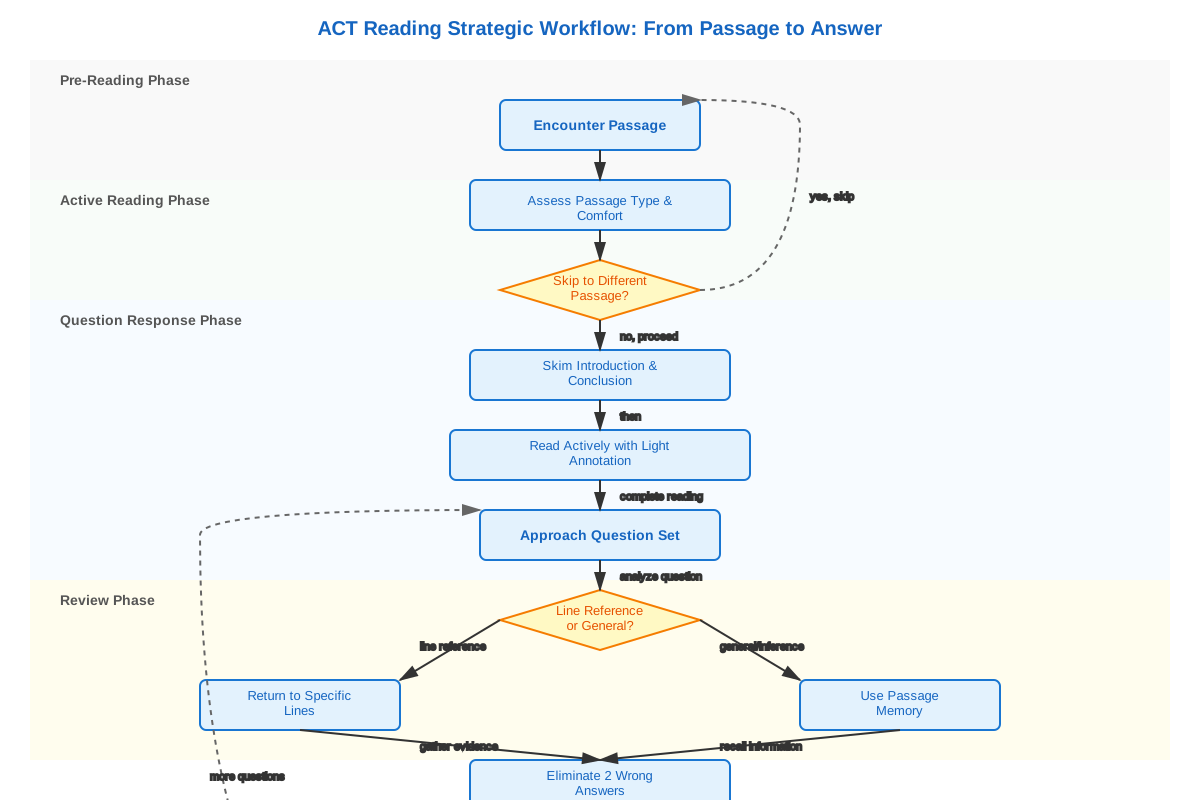
The foundation of effective ACT reading section strategy rests on a three-phase approach: Preview, Active Reading, and Strategic Answering. This framework ensures systematic coverage while preventing common pitfalls like passive reading or premature answering.
Phase 1: Preview (30-45 seconds) involves rapidly scanning the passage to identify its type, structure, and general topic. Students should note the passage introduction (which identifies genre and author), glance at paragraph beginnings to understand organizational flow, and identify any unusual formatting (dialogue, dates, scientific terminology). This preview creates a mental framework that accelerates comprehension during active reading.
Phase 2: Active Reading (3-4 minutes) constitutes the core engagement with the passage. Rather than reading every word at uniform speed, strategic readers adjust pace based on content density. Introductory paragraphs and topic sentences receive careful attention, while examples and descriptive passages can be skimmed more quickly. Effective annotation during this phase includes underlining key claims, circling transitions, and bracketing contrasting viewpoints. The goal is not memorization but rather creating a mental map of where information resides.
Phase 3: Strategic Answering (4-5 minutes) applies the knowledge gained in phases 1 and 2 to the question set. This phase emphasizes question order optimization, strategic passage reference, and systematic elimination. Students should tackle questions in order of difficulty (usually starting with line-reference and vocabulary questions), use passage structure knowledge to locate relevant sections quickly, and eliminate answer choices methodically rather than selecting the first plausible option.
Passage Order Selection
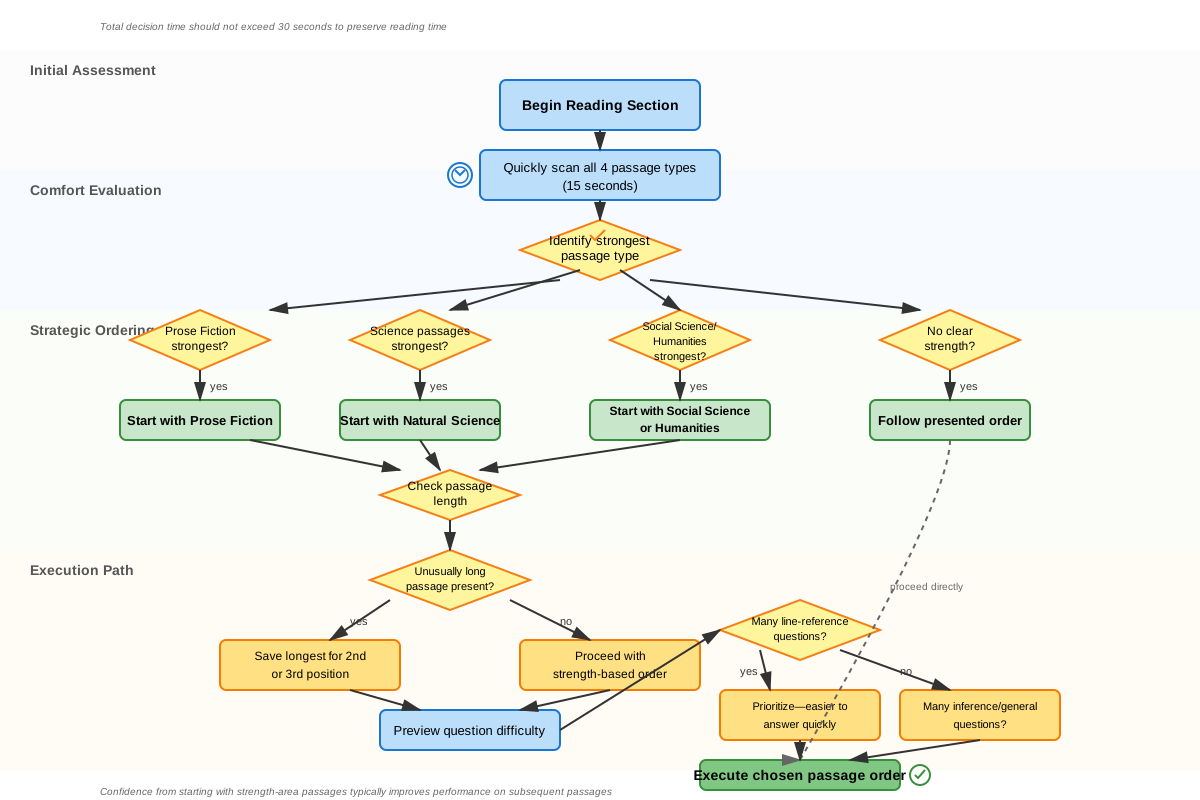
One of the most impactful strategic decisions occurs before reading any passage: determining the order in which to approach the four passages. The ACT always presents passages in the same sequence (Literary Narrative/Prose Fiction, Social Science, Humanities, Natural Science), but students need not complete them in this order.
Strength-based ordering involves beginning with the passage type that aligns with individual strengths. Students comfortable with narrative structure and character analysis might start with Prose Fiction, while those with scientific backgrounds might begin with Natural Science. This approach builds confidence and ensures that early questions—when mental energy is highest—play to strengths.
Difficulty-based ordering prioritizes passages based on perceived complexity. Many students preview all four passages (spending 1-2 minutes total) and rank them from easiest to hardest based on topic familiarity, vocabulary density, and passage length. This ensures that challenging passages receive adequate time rather than being rushed at the end.
| Ordering Strategy | Advantages | Disadvantages | Best For |
|---|---|---|---|
| Sequential (given order) | No decision time required; familiar routine | May encounter difficult passages when fatigued | Students who perform consistently across types |
| Strength-first | Builds confidence; maximizes early accuracy | May leave weakest passage for time pressure | Students with clear type preferences |
| Difficulty-based | Ensures all passages receive appropriate time | Requires preview time; subjective assessment | Students with variable performance by topic |
| Natural Science last | Saves most detail-dense for when warmed up | May face time pressure on hardest passage | Students who struggle with scientific content |
Time Management Protocols
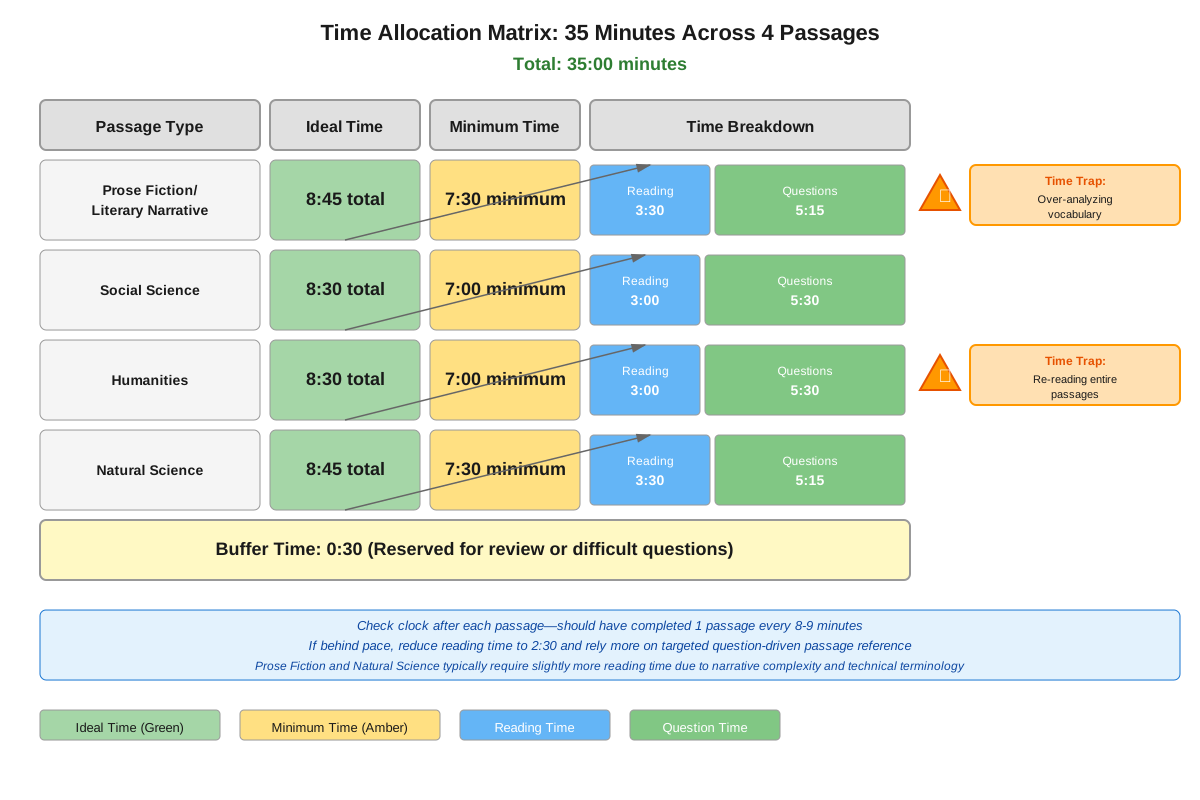
Effective time management in ACT reading requires both macro-level planning (time per passage) and micro-level execution (time per question). The standard allocation provides 8 minutes 45 seconds per passage, but strategic readers build in buffer time for difficult questions and passage transitions.
The 8-minute passage protocol structures each passage attempt: 30 seconds preview, 3.5 minutes active reading, 4 minutes answering questions. This leaves approximately 3 minutes of buffer time across the entire section for difficult questions or unexpected challenges. Students should mark their answer document at 8-minute intervals (questions 10, 20, 30, 40) to monitor pacing without constant clock-watching.
The question triage system prevents time loss on individual difficult questions. When encountering a question that doesn't yield an answer within 30-45 seconds, strategic readers mark it, select their best guess, and move forward. After completing all other questions in that passage, they return to marked questions with fresh perspective. This prevents the common trap of spending 3 minutes on a single question while leaving easier questions unattempted.
Strategic Annotation Techniques
Annotation serves as the bridge between reading and answering, creating a reference system that eliminates the need for complete passage re-reading. However, excessive annotation wastes time and creates visual clutter. Strategic annotation focuses on high-yield elements.
Structural markers identify passage organization: numbering paragraphs (if not pre-numbered), bracketing the thesis or main claim, and marking major transitions ("however," "in contrast," "furthermore"). These markers enable rapid navigation when questions reference specific passage sections.
Content markers highlight testable information: underlining proper names and dates (frequently referenced in questions), circling unfamiliar vocabulary (often tested), and starring surprising or counterintuitive claims (common question topics). The key is selectivity—marking everything is equivalent to marking nothing.
Relationship markers capture connections between ideas: drawing arrows between cause and effect, using "+" and "−" symbols to indicate positive and negative viewpoints, and noting comparisons with simple symbols. These markers prove especially valuable for inference and relationship questions.
Answer Choice Elimination
The ACT reading section rewards systematic elimination more than intuitive selection. Each question includes one correct answer and three distractors, with distractors typically falling into predictable categories.
Extreme language distractors use absolute terms ("always," "never," "only," "completely") that rarely appear in correct answers. ACT passages typically present nuanced arguments, and correct answers reflect this nuance with qualified language ("often," "typically," "suggests," "may").
Out-of-scope distractors introduce information not addressed in the passage. These answers may be factually true in the real world but lack passage support. Strategic readers verify every answer choice against passage content rather than relying on outside knowledge.
Distortion distractors contain passage vocabulary and concepts but misrepresent relationships or emphasis. These prove most challenging because they feel familiar. Careful readers check not just whether answer elements appear in the passage, but whether the relationships described match passage claims.
Reversal distractors flip passage meaning, often by changing a single word. A passage stating "the theory was initially rejected but later accepted" might include a distractor claiming "the theory was initially accepted but later rejected." Strategic readers pay special attention to temporal markers and logical connectors.
Concept Relationships
The strategic elements of ACT reading form an interconnected system where each component reinforces others. The three-phase reading approach (Preview → Active Reading → Strategic Answering) provides the temporal structure, while passage order selection determines the sequence in which this approach is applied. Time management protocols govern the pace of all activities, ensuring that strategic intentions don't collapse under time pressure.
Annotation techniques directly support strategic answering by creating reference points that eliminate re-reading time. The quality of annotations during active reading determines the efficiency of the answering phase. Similarly, answer choice elimination depends on the comprehension developed during active reading—superficial reading produces insufficient knowledge to distinguish subtle distractors.
The relationship flows as follows: Passage Order Selection → determines sequence → Three-Phase Approach → executed within → Time Management Protocols → supported by → Strategic Annotation → which enables → Efficient Answer Choice Elimination → resulting in → Maximized Accuracy and Completion.
Understanding these relationships prevents the common error of treating strategies as isolated techniques. Students who annotate without time awareness may create beautiful markings but fail to complete the section. Those who manage time without strategic elimination may finish all questions but sacrifice accuracy. The integrated application of all strategic elements produces optimal results.
Quick check — test yourself on ACT reading section strategy so far.
Try Flashcards →High-Yield Facts
⭐ The ACT reading section contains exactly 40 questions across 4 passages, with 35 minutes total time, averaging 8 minutes 45 seconds per passage.
⭐ Approximately 60-70% of reading questions can be answered by referencing specific passage sections rather than requiring complete passage comprehension.
⭐ Questions appear in rough passage order—early questions typically reference early passage content, though exceptions exist to test thorough reading.
⭐ The first and last sentence of each paragraph contain disproportionately high amounts of testable information compared to middle sentences.
⭐ Answer choices containing extreme or absolute language ("always," "never," "only") are incorrect approximately 85% of the time.
- Passages always appear in the same order: Literary Narrative/Prose Fiction, Social Science, Humanities, Natural Science, but can be completed in any sequence.
- Line reference questions (those citing specific lines) should typically be answered first as they require minimal passage comprehension.
- Vocabulary-in-context questions test word meaning based on passage usage, not dictionary definitions, making context analysis essential.
- Paired passages (appearing in one of the four passage slots) require additional strategy as some questions address each passage individually while others compare both.
- The ACT reading section never requires outside knowledge—all answers must be supported by passage content, even for passages on familiar topics.
- Strategic guessing on difficult questions yields better results than leaving questions blank, as there is no penalty for incorrect answers.
- Annotation should take no more than 5-10 seconds per paragraph to avoid time waste while maintaining utility.
- Questions asking about the "main purpose" or "primary function" typically have answers that are broader than detail-focused students initially select.
- Inference questions require answers supported by passage evidence, not creative speculation—the correct inference is always the most conservative option.
- Time spent previewing all four passages (1-2 minutes total) typically produces better overall scores than immediately diving into the first passage.
Common Misconceptions
Misconception: Reading faster automatically improves ACT reading scores. → Correction: Reading speed matters less than strategic reading—knowing what to read carefully, what to skim, and how to navigate efficiently. Many high scorers read at moderate speeds but excel at identifying relevant information and eliminating wrong answers systematically.
Misconception: Every word of the passage must be read and understood to answer questions correctly. → Correction: Approximately 30-40% of passage content is never directly tested. Strategic readers develop the ability to identify high-yield content (thesis statements, transitions, contrasts) while moving more quickly through supporting examples and descriptive passages.
Misconception: The passage order provided by the ACT is optimal for all students. → Correction: Passage order should be personalized based on individual strengths and weaknesses. Students who consistently struggle with Prose Fiction but excel at Natural Science should consider reordering to build confidence and ensure adequate time for challenging passages.
Misconception: Annotation wastes valuable time that should be spent reading. → Correction: Strategic annotation (5-10 seconds per paragraph) saves substantially more time during the answering phase by eliminating the need to re-read large passage sections. The key is selective annotation focused on structure and testable content rather than comprehensive highlighting.
Misconception: The correct answer will always be explicitly stated in the passage. → Correction: While all correct answers must be supported by passage content, inference questions require combining multiple passage elements or recognizing implications. The correct answer represents the most conservative inference that can be defended with passage evidence.
Misconception: Difficult questions should be answered before moving on to ensure they receive adequate attention. → Correction: Time spent struggling with one difficult question often exceeds the time needed to answer three easier questions. The triage approach (mark, guess, return later) prevents time loss and often produces better results as later questions provide context that clarifies earlier difficult items.
Misconception: Answer choices that use passage vocabulary are more likely to be correct. → Correction: Distortion distractors deliberately use passage vocabulary while misrepresenting relationships or emphasis. Correct answers may paraphrase passage content using different terminology, requiring comprehension rather than word-matching.
Worked Examples
Example 1: Applying the Three-Phase Approach to a Social Science Passage
Passage Setup: A 95-line Social Science passage discusses the economic impact of urban green spaces, presenting research findings and policy implications.
Phase 1: Preview (30 seconds)
- Scan the italicized introduction: "This passage discusses research on urban parks and economic development"
- Note paragraph structure: 5 paragraphs, approximately 20 lines each
- Identify key terms in paragraph openings: "economic benefits," "property values," "critics argue," "recent studies," "policy recommendations"
- Mental framework established: Research-based argument with counterarguments and policy applications
Phase 2: Active Reading (3.5 minutes)
- Paragraph 1: Introduces topic and thesis (urban green spaces provide measurable economic benefits). Underline thesis, star as likely main idea question topic.
- Paragraph 2: Details property value research. Circle specific statistics (15% increase), note researcher name (likely detail question).
- Paragraph 3: Presents counterarguments. Bracket entire paragraph, mark with "−" to indicate opposing view.
- Paragraph 4: Refutes counterarguments with recent studies. Draw arrow from paragraph 3 to 4 showing relationship.
- Paragraph 5: Policy recommendations. Star opening sentence as conclusion/main purpose content.
Phase 3: Strategic Answering (4 minutes)
- Question 1 (line reference to paragraph 2): Quickly locate circled statistics, eliminate answers not supported by specific data, select answer matching passage claim.
- Question 2 (vocabulary-in-context): Return to marked word, read surrounding sentence, eliminate answers that don't fit context, select answer that maintains passage meaning.
- Question 3 (main purpose): Reference starred thesis and conclusion, eliminate detail-focused answers, select answer capturing overall argument about economic benefits and policy.
- Question 4 (inference about critics): Locate bracketed paragraph 3, identify what critics claim, eliminate answers that overstate or distort criticism, select most conservative inference.
- Continue through remaining questions, using annotations to navigate efficiently.
Result: Completed passage in 7 minutes 45 seconds with high accuracy, leaving buffer time for next passage.
Example 2: Implementing Answer Choice Elimination on a Challenging Inference Question
Question: Based on the passage, the author would most likely agree with which of the following statements about technological innovation?
Passage Context: A Humanities passage discussing the relationship between artistic movements and technological change, arguing that technology enables but doesn't determine artistic expression.
Answer Choices:
A) Technological advances always precede artistic innovation and determine its direction.
B) Artists have historically resisted technological change due to concerns about authenticity.
C) Technology provides new tools for artistic expression while artists retain creative control.
D) The relationship between technology and art is too complex to be meaningfully analyzed.
Elimination Process:
Step 1: Identify extreme language
- Choice A contains "always" and "determine"—absolute language rarely correct in ACT reading
- Choice D contains "too complex"—extreme dismissal unlikely in analytical passage
- Eliminate A and D
Step 2: Verify remaining choices against passage
- Choice B: Scan passage for discussion of artist resistance. Passage mentions some initial skepticism but emphasizes eventual adoption. "Historically resisted" overstates and distorts passage emphasis.
- Choice C: Matches passage thesis that technology "enables but doesn't determine." "Provides new tools" aligns with "enables," while "artists retain creative control" aligns with "doesn't determine."
Step 3: Confirm choice C with passage evidence
- Locate thesis statement: "While technological innovations have expanded artistic possibilities, the creative vision remains fundamentally human."
- Choice C accurately paraphrases this relationship without distortion.
Answer: C
Strategic Insight: This example demonstrates how systematic elimination (extreme language → passage verification → evidence confirmation) produces correct answers more reliably than intuitive selection. Even without perfect passage comprehension, strategic elimination narrowed options from four to two, then careful passage reference identified the correct answer.
Exam Strategy
When approaching ACT reading questions, begin by identifying question type, as this determines optimal strategy. Line reference questions should be answered first—they provide specific passage locations and require minimal overall comprehension. Vocabulary-in-context questions follow similar logic, as they test specific word usage rather than broad understanding.
Trigger words signal question types and optimal approaches:
- "According to the passage" or "The passage states" → Detail question requiring direct passage reference
- "It can reasonably be inferred" or "The passage suggests" → Inference question requiring conservative conclusion from passage evidence
- "The main purpose" or "The primary function" → Big-picture question requiring synthesis of thesis and conclusion
- "As it is used in line X" → Vocabulary question requiring context analysis, not dictionary definition
Process-of-elimination tips specific to ACT reading:
- Eliminate answers containing information not mentioned in the passage (out-of-scope)
- Eliminate answers using extreme or absolute language unless passage explicitly supports such claims
- Eliminate answers that reverse or distort passage relationships
- Between two remaining answers, select the one with more specific passage support
Time allocation should follow the 8-minute passage protocol with built-in flexibility. If a passage proves particularly easy, complete it in 7 minutes and bank the extra time. If a passage proves challenging, don't exceed 9.5 minutes—guess on remaining questions and move forward. The goal is completing all 40 questions, as unanswered questions guarantee zero points while guessed questions offer 25% probability of correctness.
Question order optimization within each passage: tackle line-reference and vocabulary questions first (typically 3-4 per passage), then detail questions, then inference questions, saving main idea and synthesis questions for last when passage comprehension is strongest. This approach builds momentum and ensures that questions requiring minimal comprehension are answered even if time runs short.
Memory Techniques
PARS - Remember the strategic reading phases:
- Preview the passage structure
- Actively read with annotation
- Reference passage for answers
- Systematically eliminate wrong choices
TIME - Remember time management priorities:
- Track 8-minute intervals
- Identify difficult questions immediately
- Mark and move past time-sinks
- Ensure all 40 questions attempted
SCAN - Remember what to annotate:
- Structure markers (thesis, transitions, conclusions)
- Content markers (names, dates, key terms)
- Argument markers (claims, evidence, counterarguments)
- Navigation markers (paragraph numbers, brackets)
NOSE - Remember answer elimination sequence:
- No passage support (out-of-scope)
- Overstated claims (extreme language)
- Switched relationships (reversals)
- Evidence-check remaining options
Visualization strategy: Picture the ACT reading section as four separate mini-tests rather than one overwhelming challenge. Each passage represents a fresh start with its own 8-minute window. This mental framing reduces anxiety and prevents one difficult passage from undermining confidence on subsequent passages.
Acronym for passage order decision: SELF - Strength-based, Easiest-first, Last-to-first, Familiar-topic-first. Choose one ordering principle and apply consistently during practice to develop automatic decision-making.
Summary
Mastering ACT reading section strategy requires integrating multiple systematic approaches into a cohesive test-day protocol. The foundation rests on the three-phase approach—Preview, Active Reading, and Strategic Answering—executed within strict time management parameters of approximately 8 minutes per passage. Strategic readers personalize passage order based on individual strengths, use selective annotation to create efficient reference systems, and apply systematic answer choice elimination to maximize accuracy. Success depends not on reading every word or possessing perfect comprehension, but rather on efficiently identifying relevant information, distinguishing between closely-related answer choices, and maintaining disciplined pacing across all four passages. The strategic framework transforms the ACT reading section from an overwhelming time-pressured challenge into a manageable sequence of specific, executable tasks. Students who internalize these strategies through deliberate practice typically achieve scores reflecting their true reading ability rather than being limited by time pressure or unsystematic approaches.
Key Takeaways
- The three-phase approach (Preview → Active Reading → Strategic Answering) provides the structural framework for efficient passage completion within 8-minute windows
- Passage order should be personalized based on individual strengths rather than accepting the given sequence, with most students benefiting from starting with their strongest passage type
- Strategic annotation focuses on structure, testable content, and relationships rather than comprehensive highlighting, taking no more than 5-10 seconds per paragraph
- Systematic answer choice elimination (removing extreme language, out-of-scope content, and distortions) proves more reliable than intuitive answer selection
- Time management requires both macro-level planning (8 minutes per passage) and micro-level execution (30-45 seconds per question with immediate triage of difficult items)
- Approximately 60-70% of questions can be answered through targeted passage reference rather than complete comprehension, making navigation skills as important as reading ability
- All correct answers must be supported by passage content—inference questions require conservative conclusions based on evidence, not creative speculation
Related Topics
Question Type Analysis explores the specific characteristics and optimal approaches for each ACT reading question category (detail, inference, vocabulary, main idea, function, relationship). Mastering general reading strategy provides the foundation, while question-type expertise enables targeted tactical responses.
Passage Type Strategies examines the unique structural patterns and common question focuses for Literary Narrative/Prose Fiction, Social Science, Humanities, and Natural Science passages. Strategic competence transfers across passage types, but type-specific knowledge further optimizes performance.
Paired Passage Techniques addresses the specialized strategies required for the paired passage format, including individual passage analysis, comparison question approaches, and time allocation adjustments. This builds directly on general reading strategy while adding complexity.
Advanced Time Management develops sophisticated pacing techniques including adaptive timing based on passage difficulty, strategic question skipping protocols, and end-of-section optimization. This represents the next level beyond foundational time management.
Error Pattern Analysis teaches students to identify personal error patterns (rushing, overthinking, misreading, content gaps) and develop targeted correction strategies. This metacognitive skill leverages strategic knowledge to drive continuous improvement.
Practice CTA
Now that you've mastered the strategic framework for ACT reading success, it's time to put these techniques into action. Access the practice questions to apply the three-phase approach, test your annotation efficiency, and refine your elimination skills under timed conditions. Use the flashcards to internalize key strategic principles until they become automatic. Remember: strategy transforms potential into performance. Every practice session using these systematic approaches builds the habits that will maximize your score on test day. Your investment in strategic preparation will pay dividends not just on the ACT, but in every academic challenge requiring efficient information processing and critical analysis.
Sign up free to keep reading
Create a free AnvayaPrep account to finish this ACT guide on ACT reading section strategy — plus flashcards and practice questions.