Overview
The line reference strategy is one of the most critical skills for achieving a high score on the ACT Reading section. This strategy provides a systematic approach to answering questions that direct students to specific lines or paragraphs within a passage. Unlike general comprehension questions that require understanding of the entire passage, line reference questions offer a built-in roadmap—they tell you exactly where to look for the answer. However, many students make the mistake of reading only the referenced lines, missing crucial context that surrounds them.
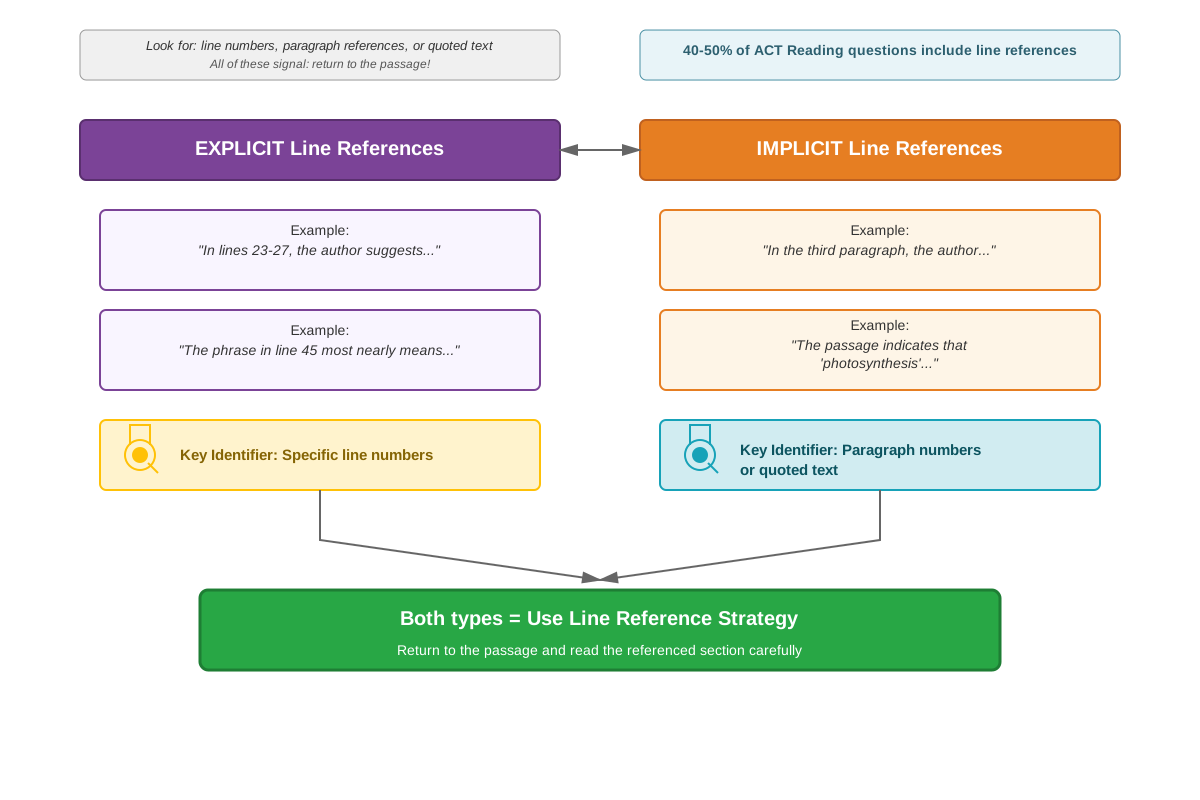
Mastering the ACT line reference strategy transforms these questions from potential time traps into quick point opportunities. Approximately 40-50% of ACT Reading questions include some form of line reference, whether explicit (e.g., "In lines 23-27...") or implicit (e.g., "In the third paragraph..."). Students who develop a systematic approach to these questions consistently outperform those who read randomly or rely solely on memory. The strategy involves a precise three-step process: locating the reference, reading strategically around it, and matching the passage evidence to answer choices.
This topic serves as a foundational skill that connects to virtually every other ACT Reading strategy. It reinforces close reading techniques, supports evidence-based answer selection, and provides structure for time management. The line reference strategy works in tandem with passage annotation, question type identification, and process of elimination techniques. Students who master this approach gain confidence and speed, allowing them to allocate more time to challenging inference and synthesis questions.
Learning Objectives
- [ ] Identify when Line reference strategy is being tested
- [ ] Explain the core rule or strategy behind Line reference strategy
- [ ] Apply Line reference strategy to ACT-style questions accurately
- [ ] Determine the optimal reading window around line references (typically 5 lines before and after)
- [ ] Distinguish between questions requiring literal comprehension versus contextual inference from referenced lines
- [ ] Execute the three-step line reference process consistently under timed conditions
- [ ] Recognize when line references serve as distractors versus genuine answer locations
Prerequisites
- Basic passage comprehension skills: Students must be able to understand main ideas and supporting details in college-level prose, as line reference strategy builds upon fundamental reading comprehension.
- Familiarity with ACT question formats: Understanding how ACT questions are structured helps students quickly identify line reference questions and distinguish them from other question types.
- Ability to identify evidence in text: Students should already know how to locate specific information and recognize when passage content supports or contradicts a claim.
- Time management awareness: Basic understanding of ACT Reading timing (approximately 8-9 minutes per passage) provides context for why efficient line reference strategy matters.
Why This Topic Matters
The line reference strategy represents one of the highest-yield skills for ACT Reading improvement because it directly addresses nearly half of all questions on the test. According to ACT data analysis, passages typically contain 4-5 line reference questions out of 10 total questions per passage. These questions are designed to be more straightforward than inference or synthesis questions, making them ideal targets for quick, accurate points that boost overall scores.
In real-world applications, the skill of returning to source material to verify claims and extract precise information translates directly to academic research, professional analysis, and critical reading in college coursework. Students who develop strong line reference habits become better at citing evidence, avoiding misinterpretation, and building arguments based on textual support rather than assumptions.
On the ACT, line reference questions appear in several distinct formats: explicit line citations ("lines 34-38"), paragraph references ("the third paragraph"), quoted phrases ("the author's statement that 'innovation requires failure'"), and implicit references through specific details mentioned in the question stem. Each passage type—Literary Narrative, Social Science, Humanities, and Natural Science—employs line references differently. Literary passages often use them for character analysis and figurative language interpretation, while science passages use them to test understanding of experimental procedures or data interpretation. Social Science and Humanities passages frequently include line references for author's purpose and rhetorical strategy questions.
Core Concepts
The Three-Step Line Reference Process
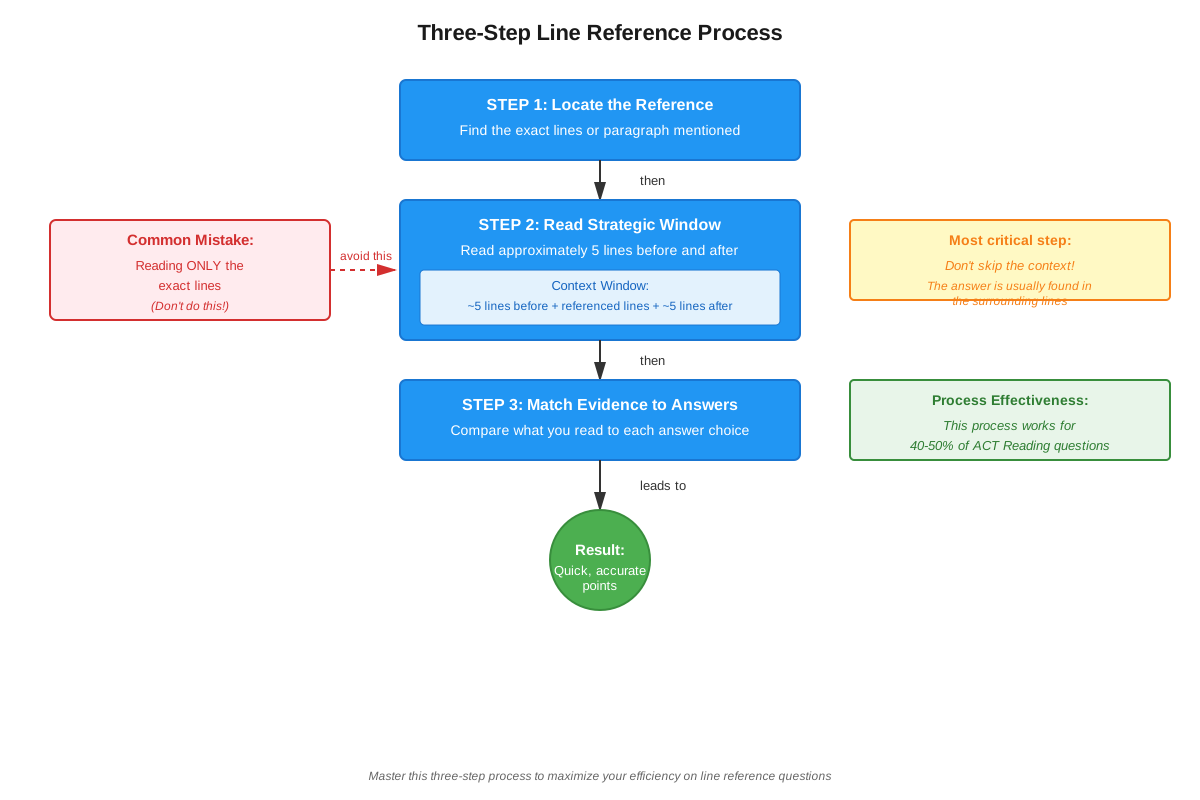
The line reference strategy follows a systematic three-step approach that maximizes accuracy while minimizing time expenditure. This process must become automatic through practice.
Step 1: Locate and Mark - When encountering a line reference question, immediately locate the referenced lines in the passage. Use your pencil to bracket or underline the exact lines mentioned. This physical marking prevents confusion when moving between question and passage, especially under time pressure.
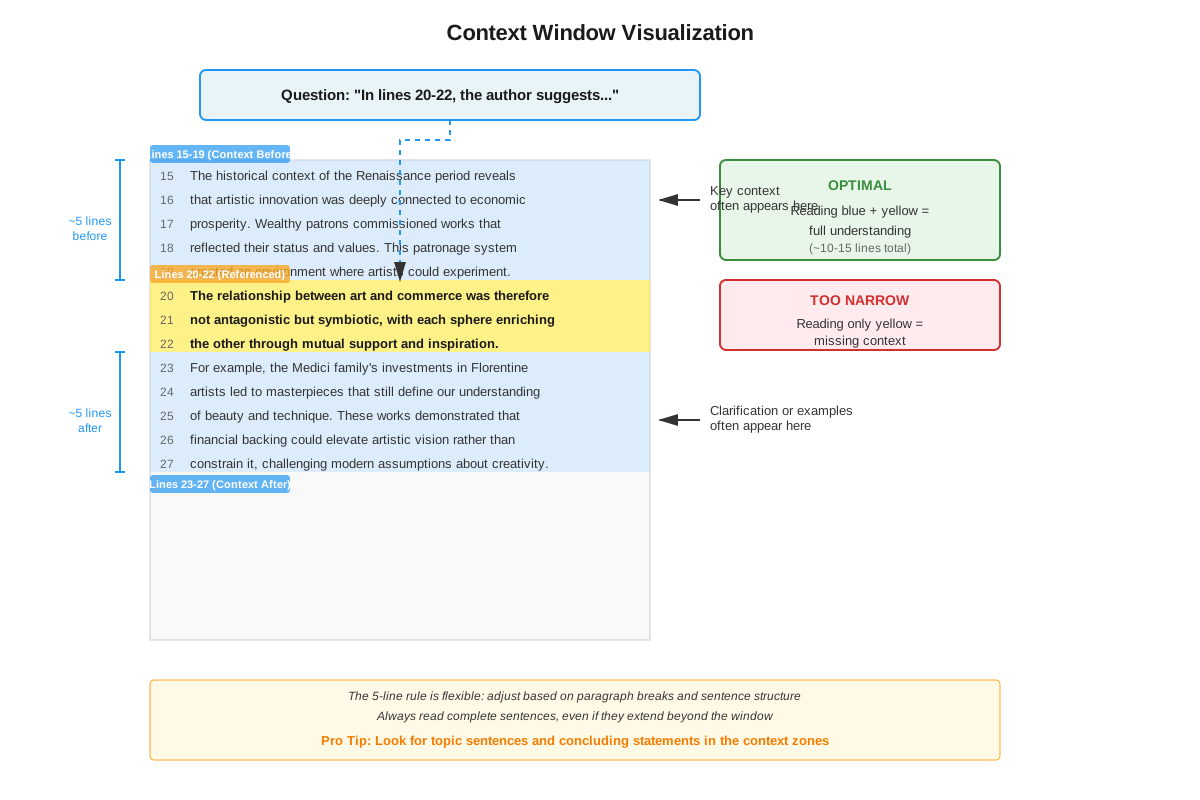
Step 2: Read the Context Window - Never read only the referenced lines. The ACT deliberately designs line reference questions to require contextual understanding. Read approximately 5 lines before and 5 lines after the reference (the "context window"). This window captures topic sentences, transitions, and explanatory details that clarify meaning. For paragraph references, read the entire paragraph plus the final sentence of the preceding paragraph and the first sentence of the following paragraph.
Step 3: Predict and Match - Before looking at answer choices, formulate a brief prediction of the answer based on passage evidence. This prediction acts as an anchor, preventing answer choices from distorting your understanding. Then systematically compare each answer choice to the passage, eliminating options that contradict, distort, or extend beyond the text.
Understanding the Context Window
The context window concept is central to effective ACT line reference strategy. The ACT test writers deliberately reference lines that, when read in isolation, could support multiple interpretations. The surrounding context provides the disambiguating information needed to select the correct answer.
Consider why context matters: sentences connect through pronouns, transitional phrases, and logical relationships. A line stating "This approach failed" means nothing without knowing what "this approach" refers to or why it failed. The preceding lines establish the referent; the following lines often explain consequences or introduce contrasts.
The optimal context window varies slightly by question type:
| Question Type | Recommended Window | Rationale |
|---|---|---|
| Vocabulary in context | 3-5 lines before/after | Need to understand how the word functions in the sentence and paragraph |
| Detail/fact questions | 5-7 lines before/after | May need topic sentence and supporting examples |
| Function questions | Entire paragraph | Must understand paragraph's role in passage structure |
| Inference from lines | 5-10 lines before/after | Need sufficient evidence to support logical conclusion |
Line Reference Question Identification
Recognizing line reference questions quickly allows for immediate strategy deployment. These questions contain specific markers:
Explicit markers: "In lines 23-27," "Lines 45-48 suggest," "According to the third paragraph," "In the passage, the author states (lines 12-15)"
Implicit markers: Questions that quote specific phrases, mention particular examples by name, or reference distinct sections of the passage without line numbers
Hybrid markers: Questions that combine line references with other question types, such as "The author's tone in lines 34-38 can best be described as..."
Common Line Reference Question Types
Line reference questions test several distinct skills:
Literal Comprehension: These questions ask what the passage directly states. The answer is explicitly present in the referenced lines or immediate context. Key phrases include "according to the passage," "the author states," "the passage indicates."
Vocabulary in Context: These questions provide a word from the passage and ask for its meaning as used in that specific context. The correct answer often differs from the word's most common definition.
Function and Purpose: These questions ask why the author included specific information or how it serves the passage's overall purpose. Look for phrases like "the author mentions X in order to," "the function of lines 23-27 is to," "the author includes this detail primarily to."
Inference from Referenced Lines: These questions require drawing logical conclusions based on the referenced content. The answer isn't stated explicitly but must be supported by passage evidence. Watch for "suggests," "implies," "most likely," "probably."
The Trap of Reading Only Referenced Lines
A critical error students make is reading exclusively the lines mentioned in the question. The ACT deliberately exploits this tendency by:
- Placing key context in surrounding sentences
- Using pronouns in referenced lines that require earlier sentences for clarification
- Including transitional phrases that signal contrast or continuation
- Positioning referenced lines mid-argument, requiring both setup and conclusion for full understanding
Test writers know that students under time pressure will take shortcuts. Questions are specifically designed so that reading only the referenced lines leads to plausible but incorrect answer choices. These "trap answers" use language from the referenced lines but misrepresent their meaning or function.
Matching Evidence to Answer Choices
After reading the context window, the matching process requires precision. Effective matching involves:
Direct comparison: Place your finger on the relevant passage section and read each answer choice while looking at the text. This prevents memory distortion.
Word-for-word verification: Correct answers often paraphrase passage content. Verify that the paraphrase accurately captures the original meaning without adding, subtracting, or distorting information.
Elimination of extremes: Watch for answer choices that use absolute language ("always," "never," "only," "all") unless the passage itself uses such language. The ACT typically favors nuanced, qualified statements.
Rejection of out-of-scope content: Eliminate answers that introduce information not present in the passage, even if the information seems logical or true in the real world.
Concept Relationships
The line reference strategy serves as a hub connecting multiple ACT Reading skills. Understanding these relationships strengthens overall reading performance.
Line Reference Strategy → Evidence-Based Answering: The systematic process of returning to the passage and matching text to answer choices reinforces the fundamental principle that every correct answer must have explicit textual support. This relationship is bidirectional—strong evidence-based answering habits make line reference strategy more effective.
Passage Annotation → Line Reference Strategy: Effective annotation during the initial passage reading (marking main ideas, transitions, and key details) accelerates line reference location. When a question references lines 34-38, pre-existing annotations help students quickly recall what that section discusses and locate it efficiently.
Question Type Identification → Line Reference Strategy: Recognizing whether a line reference question tests literal comprehension, inference, function, or vocabulary determines how to read the context window and what to look for in answer choices. The strategy adapts based on question type.
Time Management → Line Reference Strategy: Because line reference questions provide built-in navigation, they typically consume less time than general questions. Strategic students often tackle line reference questions first, building confidence and banking time for more challenging questions.
Process of Elimination → Line Reference Strategy: The matching phase of line reference strategy relies heavily on systematic elimination. Each answer choice is tested against passage evidence, with mismatches eliminated until only the supported answer remains.
The relationship map flows as follows:
Initial Passage Reading with Annotation → Question Type Identification → Line Reference Strategy Deployment → Context Window Reading → Evidence-Based Matching → Process of Elimination → Answer Selection → Time Saved for Complex Questions
High-Yield Facts
⭐ Line reference questions constitute approximately 40-50% of all ACT Reading questions, making this strategy essential for score improvement.
⭐ Always read 5 lines before and 5 lines after the referenced lines to capture necessary context; reading only the referenced lines leads to trap answers.
⭐ The correct answer to a line reference question must be directly supported by the passage—no outside knowledge, logical leaps, or assumptions are required.
⭐ Paragraph reference questions require reading the entire paragraph plus transition sentences from adjacent paragraphs to understand function and purpose.
⭐ Vocabulary-in-context questions test the word's meaning in that specific passage, not its dictionary definition or most common usage.
- Line reference questions are typically more straightforward than inference or synthesis questions, making them high-priority targets for quick points.
- Questions that quote specific phrases from the passage function as line references even without explicit line numbers—search for the quoted text.
- The ACT deliberately places pronouns, transitional phrases, and dependent clauses in referenced lines to force context reading.
- Trap answers often use exact language from the referenced lines but misrepresent the meaning or function of that content.
- Function questions ("the author mentions X in order to") require understanding the passage's overall argument structure, not just local content.
- When two answer choices seem equally supported, the one that requires less inference and stays closer to explicit passage content is typically correct.
- Line reference questions appear in predictable patterns: most passages include 1-2 vocabulary questions, 2-3 detail questions, and 1-2 function questions with line references.
- Reading the context window takes approximately 20-30 seconds but dramatically increases accuracy, making it a worthwhile time investment.
- The first and last sentences of paragraphs contain disproportionately important context for line reference questions.
- If a line reference question seems impossible to answer, the context window was likely too narrow—expand the reading range.
Quick check — test yourself on Line reference strategy so far.
Try Flashcards →Common Misconceptions
Misconception: Line reference questions are easier because they tell you where to look, so you can skip reading the full passage.
Correction: While line references provide navigation, they don't eliminate the need for passage comprehension. Understanding the passage's overall structure, main idea, and argument flow is essential for correctly interpreting referenced lines. Many line reference questions test how specific details support broader themes, requiring both local and global understanding.
Misconception: Reading only the exact lines referenced is sufficient to answer the question correctly.
Correction: The ACT deliberately designs line reference questions to require contextual understanding. Referenced lines often contain pronouns, transitional phrases, or partial ideas that only make sense with surrounding context. Reading exclusively the referenced lines leads directly to trap answers that use passage language but misrepresent meaning.
Misconception: If an answer choice uses the same words as the referenced lines, it must be correct.
Correction: Trap answers frequently incorporate exact language from the passage but distort its meaning, take it out of context, or combine it with unsupported claims. Correct answers often paraphrase passage content rather than quoting it directly. Always verify that the answer choice accurately represents the passage's meaning, not just its vocabulary.
Misconception: Line reference questions test memorization of passage details.
Correction: These questions test reading comprehension and evidence-based reasoning, not memory. Students should always return to the passage to verify answers rather than relying on recollection from the initial reading. The ACT expects and encourages passage consultation—that's why line references are provided.
Misconception: All line reference questions are straightforward detail questions with obvious answers.
Correction: Line reference questions span multiple difficulty levels and question types. While some test literal comprehension, others require inference, analysis of rhetorical function, or understanding of complex relationships between ideas. Vocabulary-in-context questions with line references can be particularly challenging when words have multiple meanings or technical usage.
Misconception: The context window should be the same size for all line reference questions.
Correction: The optimal context window varies based on question type and passage structure. Function questions typically require reading entire paragraphs, while vocabulary questions might need only 3-4 surrounding lines. Students should adjust their context window based on whether the question tests detail, function, inference, or vocabulary.
Worked Examples
Example 1: Detail Question with Line Reference
Passage Excerpt (lines 28-42):
"The traditional view of coral reefs as static underwater structures has been thoroughly debunked by recent research. Marine biologists now understand that reefs are dynamic ecosystems in constant flux. Individual coral polyps grow, reproduce, and die in cycles that span decades, while the reef structure itself evolves over centuries. This temporal complexity makes reef conservation particularly challenging.
Dr. Sarah Chen's team at the Pacific Marine Institute has documented how even small temperature fluctuations trigger cascading changes throughout reef communities. A mere one-degree increase in water temperature can cause coral bleaching, a stress response in which corals expel their symbiotic algae. Without these algae, corals lose both their color and their primary food source."
Question: According to lines 35-38, coral bleaching occurs when:
A) Coral polyps complete their natural life cycle
B) Reef structures evolve over multiple centuries
C) Corals expel their symbiotic algae due to stress
D) Marine biologists document temperature changes
Solution Process:
Step 1 - Locate: Lines 35-38 contain: "A mere one-degree increase in water temperature can cause coral bleaching, a stress response in which corals expel their symbiotic algae."
Step 2 - Read Context: Reading the context window (lines 30-42) reveals that the paragraph discusses temporal complexity and Dr. Chen's research on temperature effects. The sentence immediately before the reference explains that temperature fluctuations trigger changes, providing crucial context for understanding bleaching as a response to environmental stress.
Step 3 - Predict and Match: The passage explicitly states that coral bleaching is "a stress response in which corals expel their symbiotic algae." This directly matches answer choice C.
Elimination:
- A: Mentions coral polyps' life cycle, which appears earlier in the passage but isn't related to bleaching
- B: Discusses reef evolution over centuries, which is about reef structure, not bleaching
- C: ✓ Directly matches the passage's definition of coral bleaching
- D: Describes what scientists do, not what causes bleaching
Answer: C
Learning Objective Connection: This example demonstrates identifying when line reference strategy is being tested (explicit line citation) and applying the strategy accurately by reading context and matching evidence.
Example 2: Function Question with Paragraph Reference
Passage Excerpt (lines 45-58):
"Critics argue that the museum's new interactive exhibits sacrifice educational rigor for entertainment value. They point to the virtual reality stations and gamified learning modules as evidence of 'dumbing down' complex historical narratives. However, this criticism misses a fundamental shift in how contemporary audiences engage with information.
Museum director James Patterson defends the changes by citing visitor data. Since implementing interactive elements, the museum has seen a 40% increase in repeat visits and a 65% increase in time spent in exhibits. More significantly, post-visit surveys reveal that visitors retain more factual information and report deeper emotional connections to historical events. 'We're not simplifying history,' Patterson explains. 'We're making it accessible and memorable.'"
Question: The author includes the second paragraph (lines 51-58) primarily in order to:
A) Provide statistical evidence that contradicts critics' concerns
B) Explain why museums should prioritize entertainment over education
C) Describe the specific interactive technologies the museum uses
D) Argue that emotional connections are more important than facts
Solution Process:
Step 1 - Locate: The question references the second paragraph (lines 51-58), which begins with "Museum director James Patterson..."
Step 2 - Read Context: Reading the entire paragraph plus the transition from the first paragraph is essential. The first paragraph presents critics' arguments; the second paragraph begins with "However," signaling a contrast. The paragraph provides specific data (40% increase, 65% increase) and quotes the director defending the changes.
Step 3 - Predict and Match: The paragraph's function is to counter the critics' claims using concrete evidence. The data shows that interactive exhibits actually improve both engagement and learning, contradicting the "dumbing down" criticism.
Elimination:
- A: ✓ Accurately describes the paragraph's function—using statistics to refute critics' concerns
- B: Distorts the passage; it argues for accessibility, not entertainment over education
- C: The paragraph mentions that interactive elements exist but doesn't describe specific technologies
- D: Misrepresents the passage; it states visitors retain MORE facts, not that emotions replace facts
Answer: A
Learning Objective Connection: This example shows how to identify function questions with paragraph references and apply the strategy by understanding the paragraph's role in the passage's argumentative structure.
Exam Strategy
Approaching Line Reference Questions Systematically
Develop a consistent routine for every line reference question:
- Read the question stem carefully to identify exactly what is being asked (detail, function, inference, vocabulary)
- Locate the reference immediately before reading answer choices
- Bracket or underline the referenced lines in the passage
- Read the context window (5 lines before and after, or entire paragraph for paragraph references)
- Formulate a brief prediction based on passage evidence
- Compare each answer choice to the passage while looking at the text
- Eliminate systematically using evidence-based reasoning
Trigger Words and Phrases
Recognize these question stem patterns that signal line reference strategy:
Explicit line references: "In lines X-Y," "According to lines X-Y," "Lines X-Y indicate," "The passage states (lines X-Y)"
Paragraph references: "In the third paragraph," "The second paragraph primarily," "According to the final paragraph"
Quoted phrases: Any question that includes text in quotation marks from the passage
Implicit references: "The author mentions [specific detail]," "The passage describes [specific example]," "According to the author's discussion of [specific topic]"
Process of Elimination Tips
For detail questions: Eliminate answers that contradict the passage, add information not present, or use passage vocabulary in incorrect contexts.
For function questions: Eliminate answers that describe what the passage says rather than why the author included it. Focus on purpose and rhetorical strategy.
For vocabulary questions: Eliminate the word's most common definition if it doesn't fit the passage context. Test each answer choice by substituting it into the original sentence.
For inference questions: Eliminate answers that require assumptions beyond what the passage supports. The correct inference should feel like a small, logical step from explicit content.
Time Allocation Advice
Exam Tip: Line reference questions should take 30-45 seconds each, including time to locate, read context, and match answers. If a line reference question exceeds one minute, mark it and return after completing faster questions.
Efficient line reference strategy creates time savings that compound across the test. By handling these questions quickly and accurately, students bank extra minutes for challenging inference, synthesis, and comparison questions that require more extensive passage analysis.
Strategic sequencing: Consider answering line reference questions before general questions. This approach provides multiple benefits: it reinforces passage familiarity, builds confidence through quick correct answers, and often provides insights that help with broader comprehension questions.
Memory Techniques
The "5-5-5" Rule
Remember the core line reference strategy with "5-5-5":
- 5 lines before the reference
- 5 lines after the reference
- 5 seconds to predict before looking at answers
This mnemonic captures the essential context window and the prediction step that prevents answer choice contamination.
The "LAMP" Process
Use LAMP to remember the four-step approach:
- Locate the reference
- Analyze the context window
- Match evidence to answers
- Prove or eliminate each choice
Visualization Strategy
Picture line references as spotlights illuminating a small section of a dark stage. The spotlight shows you where to look, but you need to see the surrounding stage (context) to understand what's happening in the lit area. The actors (ideas) move in and out of the spotlight, and their actions only make sense when you see where they came from and where they're going.
The "Context Sandwich"
Visualize the referenced lines as the filling in a sandwich, with the surrounding context as the bread. You need both bread slices (before and after) to have a complete sandwich. Reading only the filling leaves you hungry for understanding.
Acronym for Question Types
Remember common line reference question types with "DVFI":
- Detail (what the passage states)
- Vocabulary (word meaning in context)
- Function (why the author included it)
- Inference (what the passage suggests)
Summary
The line reference strategy is a systematic approach to answering ACT Reading questions that direct students to specific lines or paragraphs within passages. This high-yield strategy addresses approximately 40-50% of all ACT Reading questions, making it essential for score improvement. The core process involves three steps: locating and marking the referenced lines, reading a context window of approximately 5 lines before and after the reference, and matching passage evidence to answer choices through systematic elimination. The critical insight is that reading only the referenced lines leads to trap answers; the ACT deliberately designs these questions to require contextual understanding. Students must recognize various line reference formats (explicit line numbers, paragraph references, quoted phrases, and implicit references) and adapt their approach based on question type (detail, vocabulary, function, or inference). Mastery requires consistent application of the strategy under timed conditions, resistance to the temptation to rely on memory rather than returning to the passage, and careful verification that answer choices accurately represent passage content without distortion or addition. The line reference strategy connects to broader ACT Reading skills including evidence-based answering, passage annotation, and time management, serving as a foundational technique that supports overall reading comprehension and test performance.
Key Takeaways
- Always read 5 lines before and after line references to capture essential context; never read only the exact lines mentioned in the question
- Line reference questions appear in approximately 40-50% of ACT Reading questions, making this strategy one of the highest-yield skills for score improvement
- The three-step process (Locate, Analyze context, Match evidence) must become automatic through consistent practice under timed conditions
- Correct answers must be directly supported by passage evidence—eliminate choices that require assumptions, add information, or distort passage meaning
- Different question types require different context windows: vocabulary questions need 3-5 surrounding lines, while function questions typically require reading entire paragraphs
- Trap answers frequently use exact passage language but misrepresent its meaning—verify that answer choices accurately capture the passage's intended meaning, not just its vocabulary
- Strategic students tackle line reference questions first to build confidence, reinforce passage familiarity, and bank time for more challenging questions
Related Topics
Evidence-Based Answer Selection: This broader strategy encompasses line reference techniques but extends to all question types. Mastering line reference strategy provides the foundation for evidence-based reasoning across the entire ACT Reading section, teaching students to verify every answer against passage content.
Passage Annotation Techniques: Effective annotation during initial passage reading accelerates line reference location and provides context clues. Students who master line reference strategy benefit from developing complementary annotation skills that mark main ideas, transitions, and key details.
Question Type Identification: Recognizing whether questions test detail, inference, function, vocabulary, or synthesis determines how to apply line reference strategy. This topic explores the full taxonomy of ACT Reading question types and appropriate strategies for each.
Time Management and Question Sequencing: Understanding which questions to answer first and how to allocate time across passages builds on line reference strategy's efficiency benefits. Students learn to leverage quick line reference questions to create time for challenging synthesis questions.
Process of Elimination Techniques: This advanced strategy refines the matching phase of line reference strategy, teaching systematic approaches to eliminating incorrect answers and identifying subtle distinctions between plausible choices.
Practice CTA
Now that you understand the line reference strategy, it's time to put this knowledge into action. Complete the practice questions to apply the three-step process under realistic conditions, paying special attention to reading context windows and matching evidence systematically. Use the flashcards to reinforce key concepts like the "5-5-5" rule and the LAMP process. Remember: line reference questions are point opportunities—master this strategy, and you'll see immediate improvement in both accuracy and speed. Every practice question you complete strengthens the neural pathways that make this strategy automatic on test day. You've got this!
Sign up free to keep reading
Create a free AnvayaPrep account to finish this ACT guide on Line reference strategy — plus flashcards and practice questions.