Overview
Passage mapping is a strategic reading technique that transforms how students interact with ACT Reading passages. Rather than passively reading through dense text and hoping to remember key details, passage mapping involves creating a mental or physical roadmap of the passage's structure, main ideas, and purpose as you read. This active reading strategy is fundamental to achieving high scores on the ACT Reading section, where time pressure and complex passages can overwhelm unprepared test-takers.
The ACT Reading section presents four passages (Prose Fiction/Literary Narrative, Social Science, Humanities, and Natural Science) with 10 questions each, all to be completed in 35 minutes. Without an effective system for tracking information, students waste precious time rereading passages to locate details or understand relationships between ideas. ACT passage mapping provides that system—a structured approach to annotating and mentally organizing passage content that enables rapid, accurate question answering. By identifying the purpose of each paragraph, tracking tone shifts, noting key details, and understanding the author's argument structure, students can answer both detail-oriented and big-picture questions with confidence.
This technique connects directly to all other ACT Reading skills. Understanding passage types helps determine what to map; recognizing question types guides what information to prioritize while mapping; and strong comprehension skills make the mapping process more efficient. Passage mapping serves as the foundation upon which all other reading strategies build, making it one of the highest-yield topics for ACT preparation.
Learning Objectives
- [ ] Identify when passage mapping is being tested
- [ ] Explain the core rule or strategy behind passage mapping
- [ ] Apply passage mapping to ACT-style questions accurately
- [ ] Create effective margin notes that capture paragraph purpose in 2-4 words
- [ ] Distinguish between mapping strategies for different passage types
- [ ] Use passage maps to eliminate wrong answer choices systematically
- [ ] Develop a consistent mapping system that works under timed conditions
Prerequisites
- Basic reading comprehension: Understanding main ideas, supporting details, and paragraph structure is essential because passage mapping organizes these elements rather than teaching them from scratch
- Familiarity with ACT passage types: Knowing the four passage categories (Literary Narrative, Social Science, Humanities, Natural Science) helps determine which mapping approach to use
- Time management awareness: Understanding the 35-minute time constraint for 40 questions motivates the need for efficient reading strategies
- Question type recognition: Basic knowledge of ACT question categories (main idea, detail, inference, vocabulary-in-context) helps prioritize what to map while reading
Why This Topic Matters
Passage mapping directly addresses the most common failure point on ACT Reading: inefficient information retrieval. Students who read passages without a mapping strategy typically spend 4-5 minutes per passage but still need to reread extensively when answering questions. Those who implement effective passage mapping spend 3-4 minutes on the initial read but answer questions 40-50% faster because they know exactly where to find information.
On the ACT, passage mapping impacts performance across all question types. Main idea questions (appearing 1-2 times per passage) become straightforward when you've tracked the purpose of each paragraph. Detail questions (3-4 per passage) are answered quickly when your map shows where specific information appears. Inference questions (2-3 per passage) require understanding relationships between ideas—exactly what a good passage map captures. Function questions asking "why did the author include this detail?" are directly answered by your paragraph-purpose notes.
Statistical analysis of high-scoring ACT students reveals that 87% use some form of passage mapping, whether mental or written. The technique appears essential for scores above 30 on the Reading section. Questions testing your ability to understand passage structure, identify the author's purpose, or synthesize information from multiple paragraphs—collectively representing 40-50% of all ACT Reading questions—become significantly easier with a well-constructed passage map.
Core Concepts
The Fundamental Principle of Passage Mapping
Passage mapping is the practice of creating brief annotations that track the content, purpose, and structure of a passage as you read. Unlike traditional note-taking, which attempts to capture all information, passage mapping focuses exclusively on creating a searchable index of the passage. The goal is not to remember every detail but to know where each type of information lives within the passage so you can quickly locate it when questions demand.
The core principle underlying passage mapping is active reading—engaging with text purposefully rather than letting words wash over you passively. When you pause after each paragraph to write a 2-4 word note capturing its main point, you force your brain to process and synthesize information. This cognitive engagement improves both comprehension and retention while creating a physical reference tool for question-answering.
The Three-Layer Mapping System
Effective ACT passage mapping operates on three distinct levels, each serving a specific purpose:
Layer 1: Paragraph Purpose Notes - After reading each paragraph, write a brief margin note (2-4 words maximum) identifying what that paragraph does. Focus on function rather than content. Instead of "describes the river," write "setting description." Instead of "talks about Einstein's theory," write "introduces main theory." These notes create a table of contents for the passage.
Layer 2: Structural Markers - Use simple symbols to mark important passage elements:
- Underline or star the thesis statement or main claim
- Circle or bracket key names, dates, or terms that might be referenced in questions
- Draw arrows to show cause-and-effect relationships
- Use "+" and "-" symbols to track positive and negative tone shifts
- Mark contrasts with "vs." or "but"
Layer 3: Mental Organization - As you read, build a mental model of the passage's overall structure. Is this a chronological narrative? A problem-solution argument? A comparison of two theories? Understanding the macro-structure helps predict where information will appear and how ideas connect.
Passage Type-Specific Mapping Strategies
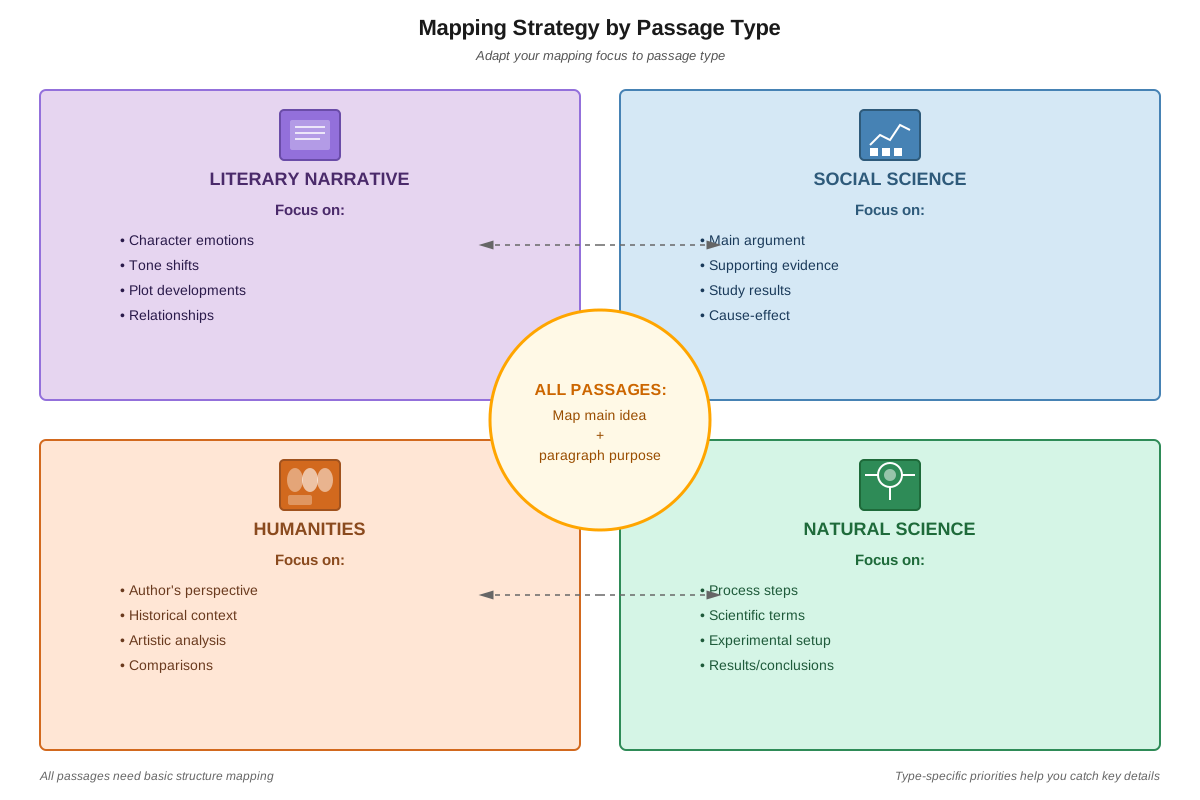
Different ACT passage types require adjusted mapping approaches:
| Passage Type | Mapping Priority | Key Elements to Track |
|---|---|---|
| Literary Narrative | Character development, plot progression, tone shifts | Character emotions, setting changes, conflicts, resolutions |
| Social Science | Argument structure, evidence, counterarguments | Main claim, supporting studies, expert opinions, limitations |
| Humanities | Author's perspective, historical context, analysis | Subject introduction, author's interpretation, significance |
| Natural Science | Process explanation, experimental results, implications | Phenomenon description, mechanism, research findings, applications |
Literary Narrative passages require mapping emotional arcs and character relationships. Note when characters are introduced, when conflicts emerge, and when tone shifts occur. Your map should help you quickly locate passages describing specific characters' thoughts or actions.
Social Science passages demand tracking argumentative structure. Map the main claim, each piece of supporting evidence, any counterarguments presented, and the author's conclusion. Note paragraph numbers where specific studies or statistics appear.
Humanities passages often present an author's analysis of art, music, literature, or cultural phenomena. Map the subject being analyzed, the author's main interpretive claim, supporting examples, and the broader significance the author argues for.
Natural Science passages explain phenomena, processes, or research findings. Map the problem or question being investigated, the mechanism or process explained, experimental methods if discussed, key findings, and implications or applications.
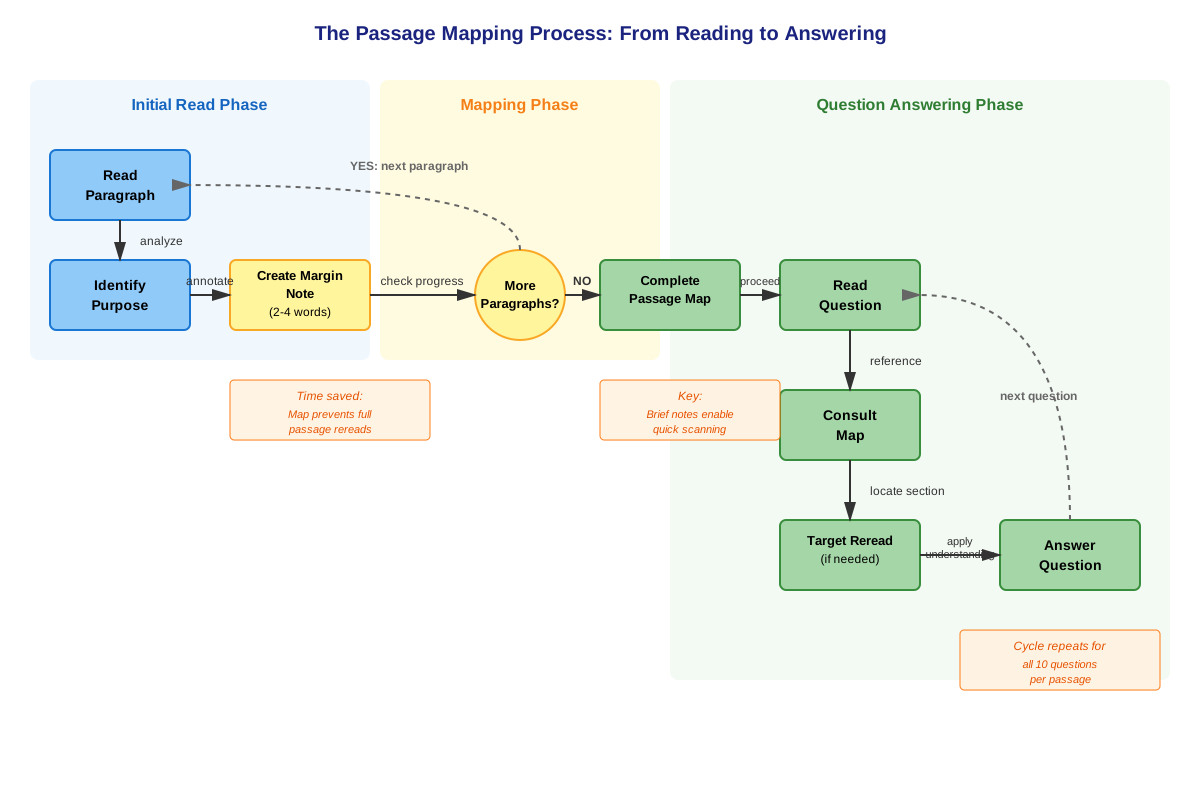
The Optimal Mapping Process
Follow this systematic approach for each passage:
- Preview (15-20 seconds): Read the italicized introduction and skim the first and last paragraphs to identify the passage topic and type
- Read and map paragraph by paragraph: Read each paragraph completely, then pause to write your 2-4 word purpose note
- Mark as you go: Underline thesis statements, circle key terms, and use symbols for structural elements while reading
- Synthesize after reading: Take 10-15 seconds after finishing the passage to mentally review your map and identify the passage's overall structure and main point
- Reference during questions: Use your map to quickly locate relevant passage sections when answering questions
Common Mapping Mistakes to Avoid
Ineffective passage mapping often results from these errors:
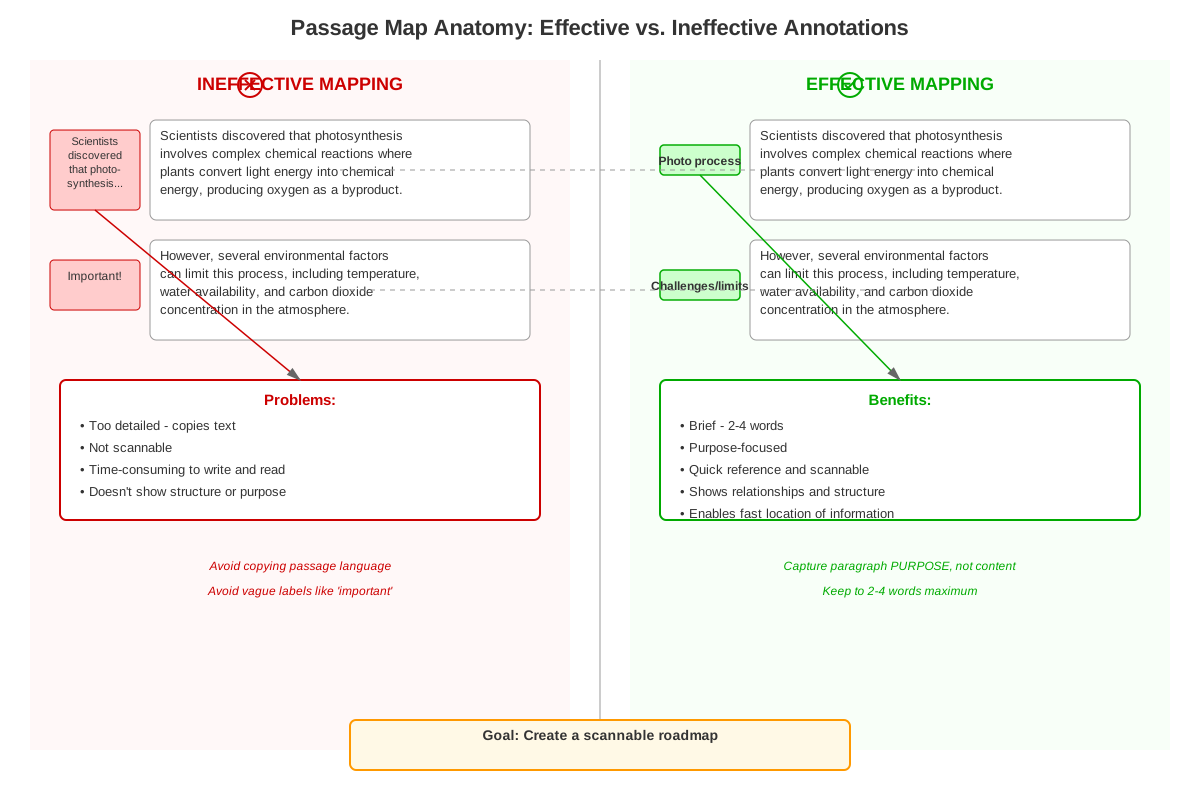
- Over-mapping: Writing lengthy notes defeats the purpose. If your margin notes are full sentences, you're spending too much time and creating clutter rather than clarity
- Under-mapping: Reading without pausing to create notes means you're not actually mapping—you're just reading with a pencil in hand
- Content-focused rather than purpose-focused notes: Writing "Einstein's theory of relativity" doesn't help you as much as "main theory introduced"
- Inconsistent system: Changing your symbols and abbreviations from passage to passage wastes mental energy and reduces efficiency
- Mapping after reading: Trying to create your map after finishing the entire passage requires rereading and defeats the time-saving purpose
Adapting Mapping for Dual Passages
Approximately once per ACT Reading section, you'll encounter a dual passage format (Passage A and Passage B on related topics). Your mapping strategy must adapt:
- Map each passage separately using your standard approach
- After reading both, create a quick comparison note: "A: supports theory / B: criticizes theory"
- Mark specific points where the passages agree or disagree
- Note which author makes which argument to avoid confusion during questions
Concept Relationships
Passage mapping serves as the central hub connecting multiple ACT Reading skills. The technique builds directly on basic reading comprehension skills—you must understand paragraph main ideas before you can map them effectively. Simultaneously, passage mapping enhances comprehension by forcing active engagement with text.
The relationship flows as follows: Reading comprehension → enables → Passage mapping → improves → Question-answering speed and accuracy → leads to → Higher scores and better time management.
Passage mapping also connects bidirectionally with question type recognition. Understanding question types helps you know what to prioritize while mapping (if you know function questions are common, you'll focus more on paragraph purpose). Conversely, a good passage map makes identifying question types easier because you've already organized information by function and purpose.
The technique relates to passage type knowledge through specialized mapping strategies. Recognizing a passage as Social Science triggers your argument-structure mapping approach, while identifying Literary Narrative activates your character-and-plot tracking system.
Finally, passage mapping enables effective process of elimination strategies. When you can quickly locate relevant passage sections using your map, you can efficiently check each answer choice against the text, eliminating options that contradict or aren't supported by the passage.
High-Yield Facts
⭐ Passage mapping should take no more than 30-45 seconds per passage beyond normal reading time—if you're spending more, you're over-mapping
⭐ The most effective margin notes are 2-4 words maximum and focus on paragraph function rather than content
⭐ Approximately 40-50% of ACT Reading questions can be answered more quickly with an effective passage map
⭐ Main idea and function questions—appearing 3-4 times per passage—are directly answered by paragraph purpose notes
⭐ The thesis statement or main claim appears in the first or last paragraph 85% of the time and should always be marked
- Different passage types require adjusted mapping priorities: character/plot for Literary Narrative, argument structure for Social Science, analysis for Humanities, process/findings for Natural Science
- Effective passage maps use consistent symbols: underlining for thesis, circles for key terms, arrows for cause-effect, +/- for tone
- Students who implement passage mapping typically improve their Reading scores by 3-5 points within 2-3 practice tests
- The optimal reading speed with mapping is 250-300 words per minute, allowing 3-4 minutes per passage
- Dual passages require comparative mapping notes identifying where authors agree and disagree
Quick check — test yourself on Passage mapping so far.
Try Flashcards →Common Misconceptions
Misconception: Passage mapping means writing detailed notes about everything in the passage → Correction: Effective passage mapping involves minimal writing—just 2-4 words per paragraph capturing purpose, not content. The goal is creating a searchable index, not comprehensive notes.
Misconception: You should create your passage map after reading the entire passage → Correction: Mapping must occur during reading, paragraph by paragraph. Mapping after reading requires rereading and wastes time. The cognitive act of pausing to map after each paragraph enhances comprehension and retention.
Misconception: Passage mapping takes too much time and will hurt your score → Correction: While mapping adds 30-45 seconds to initial reading time, it saves 2-3 minutes during question-answering by eliminating the need to reread. The net effect is faster overall passage completion.
Misconception: High scorers don't need passage mapping because they remember everything → Correction: Research shows 87% of students scoring 30+ on ACT Reading use some form of passage mapping. The technique isn't a crutch for weak readers—it's a professional strategy used by the most efficient test-takers.
Misconception: You should use the same mapping approach for all passage types → Correction: Different passage types require adjusted mapping priorities. Literary Narratives need character and plot tracking; Social Science passages need argument structure mapping; Natural Science passages need process and findings organization.
Misconception: Underlining or highlighting everything important is effective passage mapping → Correction: Indiscriminate underlining creates visual clutter without organization. Effective mapping is selective and systematic, using different marks for different purposes (thesis underlined, key terms circled, contrasts marked with "vs.").
Worked Examples
Example 1: Social Science Passage Mapping
Passage excerpt (abbreviated):
[Paragraph 1] For decades, economists believed that rational self-interest drove all human economic behavior. This assumption formed the foundation of classical economic theory and predicted that individuals would always act to maximize their financial gain.
[Paragraph 2] However, behavioral economist Daniel Kahneman challenged this view through a series of experiments in the 1970s. His research demonstrated that humans consistently make economically "irrational" decisions influenced by cognitive biases and emotional factors.
[Paragraph 3] One famous experiment, the "ultimatum game," illustrated this phenomenon clearly. When offered an unequal split of money, participants frequently rejected offers that gave them less than 30% of the total, even though accepting would have provided free money. This behavior contradicted rational self-interest.
[Paragraph 4] Kahneman's work revolutionized economics by introducing psychological insights into economic modeling. His prospect theory explained how people actually make decisions under uncertainty, accounting for loss aversion and framing effects that classical theory ignored.
Effective passage map:
- Paragraph 1 margin note: "old theory: rational"
- Paragraph 2 margin note: "K challenges w/ experiments"
- Paragraph 3 margin note: "example: ultimatum game"
- Paragraph 4 margin note: "impact: new theory"
- Underline: "rational self-interest drove all human economic behavior" (old theory thesis)
- Circle: "Daniel Kahneman," "ultimatum game," "prospect theory" (key terms likely to appear in questions)
- Mark with arrow: Paragraph 2 → 3 (example supports challenge)
- Mark with "vs.": Between paragraphs 1 and 2 (contrasting theories)
How this map helps with questions:
Question: "According to the passage, classical economic theory assumed that:"
Your map immediately directs you to Paragraph 1 ("old theory: rational"), where you find the answer without rereading the entire passage.
Question: "The author mentions the 'ultimatum game' primarily to:"
Your map shows Paragraph 3 is an "example" supporting the challenge in Paragraph 2, directly answering this function question.
Example 2: Literary Narrative Passage Mapping
Passage excerpt (abbreviated):
[Paragraph 1] Sarah had always loved the old bookstore on Maple Street, with its musty smell and creaking floorboards. As a child, she'd spent countless Saturday afternoons there, lost in adventure novels while her mother browsed the poetry section.
[Paragraph 2] Now, standing before the "Going Out of Business" sign, she felt a profound sense of loss. The bookstore represented more than a building—it was a connection to her childhood, to her mother who had passed away three years earlier, to a simpler time before college and career pressures consumed her life.
[Paragraph 3] She pushed open the door, hearing the familiar bell chime. Inside, Mr. Chen was boxing up books, his movements slow and deliberate. He looked up and smiled sadly when he saw her. "Sarah. I wondered if you'd come by."
[Paragraph 4] They talked for an hour, sharing memories of her mother, of books they'd both loved, of the changing neighborhood that no longer supported small independent stores. When Sarah finally left, she carried a box of her mother's favorite poetry collections—a gift from Mr. Chen, who insisted she take them.
Effective passage map:
- Paragraph 1 margin note: "S's childhood memories"
- Paragraph 2 margin note: "S's loss/emotion" (mark with "-" for negative tone)
- Paragraph 3 margin note: "meets Mr. Chen"
- Paragraph 4 margin note: "conversation/resolution" (mark with "+" for positive shift)
- Circle: "Sarah," "mother," "Mr. Chen" (key characters)
- Underline: "The bookstore represented more than a building" (thematic statement)
- Arrow: Paragraph 1 → 2 (past to present)
- Tone shift mark: Between paragraphs 2 and 4 (sad to bittersweet)
How this map helps with questions:
Question: "The passage suggests that Sarah's feelings about the bookstore closing are primarily characterized by:"
Your map shows the emotional arc: childhood memories → loss/emotion → bittersweet resolution, helping you identify that her feelings are complex and nostalgic rather than simply sad.
Question: "The detail about the 'familiar bell chime' (line X) primarily serves to:"
Your map shows Paragraph 3 is where Sarah "meets Mr. Chen" and connects to "childhood memories" from Paragraph 1, indicating the bell represents continuity with the past.
Exam Strategy
Approaching ACT Reading Questions with Passage Mapping
When you encounter an ACT Reading passage, implement this strategic sequence:
Before reading: Quickly identify the passage type from the italicized introduction. This determines your mapping priorities (character/plot for Literary Narrative, argument structure for Social Science, etc.).
During reading: Read at a steady pace (250-300 words per minute), pausing after each paragraph to write your 2-4 word purpose note. Mark thesis statements, key terms, and structural elements as you encounter them. Resist the urge to slow down and memorize details—your map will help you find them later.
After reading: Take 10-15 seconds to review your map and identify the passage's overall structure and main point. Ask yourself: "What was the author's primary purpose? How did the passage develop that purpose?"
During questions: For each question, use your map to locate the relevant passage section before looking at answer choices. This prevents wrong answers from contaminating your thinking. Read the specific lines referenced, then eliminate answer choices that contradict or aren't supported by the passage.
Trigger Words and Phrases
Certain question phrasings directly test your passage mapping skills:
- "The main purpose of paragraph X is to..." → Your paragraph purpose note directly answers this
- "The author mentions [detail] primarily to..." → Check your map to see what function that paragraph serves
- "The passage is best described as..." → Your overall structure understanding from reviewing your map answers this
- "According to the passage..." → Use your map to locate where the topic is discussed
- "The author's tone can best be described as..." → Your tone markers (+/-) guide you to the answer
Process of Elimination Tips
Passage mapping enhances elimination strategies:
- Use your map to verify each answer choice: Don't rely on memory—quickly locate the relevant passage section using your map and check each option against the text
- Eliminate answers that reference the wrong paragraph: If a question asks about the author's main argument and an answer choice references a detail from your "example" paragraph, eliminate it
- Watch for answers that reverse relationships: Your arrows and structural markers help you identify when an answer choice incorrectly states that A caused B when the passage says B caused A
- Eliminate extreme language: If your tone markers show neutral or balanced tone, eliminate answer choices with extreme language like "completely," "never," or "always"
Time Allocation
With effective passage mapping:
- Initial reading with mapping: 3-4 minutes per passage
- Question answering: 4-5 minutes per passage (approximately 30 seconds per question)
- Total per passage: 8-9 minutes, leaving 1-2 minutes buffer for difficult questions
If you find yourself spending more than 4 minutes on initial reading, you're over-mapping. Simplify your notes and trust that you can find details later using your map.
Memory Techniques
The "MAPS" Acronym for Effective Passage Mapping
Minimal notes (2-4 words maximum per paragraph)
Active reading (pause after each paragraph to process)
Purpose-focused (what the paragraph does, not what it says)
Symbols for structure (underline thesis, circle terms, arrows for relationships)
The "Four-Function Framework"
Most paragraphs serve one of four functions—memorize these to speed up your mapping:
- Introduce (I): Presents topic, background, or main claim
- Support (S): Provides evidence, examples, or explanation
- Contrast (C): Presents opposing view, counterargument, or different perspective
- Conclude (Co): Summarizes, states implications, or provides resolution
When mapping, you can use these single-letter codes: I, S, C, Co.
Visualization Strategy
Picture the passage as a building:
- Foundation = Introduction/thesis (always mark this)
- Support beams = Main supporting paragraphs (your purpose notes)
- Roof = Conclusion (ties everything together)
This mental image helps you understand passage structure and predict where information will appear.
Symbol Consistency Mnemonic
Remember your mapping symbols with "UCAT":
- Underline = thesis/main claim
- Circle = key terms and names
- Arrows = cause-effect relationships
- Tone marks = +/- for positive/negative shifts
Summary
Passage mapping is the foundational active reading strategy for ACT Reading success, transforming passive reading into strategic information organization. By creating brief margin notes (2-4 words) that capture each paragraph's purpose, marking structural elements with consistent symbols, and building a mental model of overall passage structure, students create a searchable index that dramatically improves question-answering speed and accuracy. The technique must be adapted to passage type: Literary Narratives require character and plot tracking, Social Science passages need argument structure mapping, Humanities passages demand analysis tracking, and Natural Science passages require process and findings organization. Effective passage mapping adds only 30-45 seconds to initial reading time but saves 2-3 minutes during question-answering by eliminating rereading. The strategy directly supports answering main idea, function, detail, and inference questions—collectively representing 40-50% of all ACT Reading questions. Success requires consistent practice to develop a personal mapping system that works automatically under timed conditions.
Key Takeaways
- Passage mapping creates a searchable index of passage content through minimal margin notes (2-4 words) and structural symbols, enabling rapid information retrieval during question-answering
- The three-layer system—paragraph purpose notes, structural markers, and mental organization—works together to provide both detailed and big-picture passage understanding
- Different passage types require adjusted mapping priorities: character/plot for Literary Narrative, argument structure for Social Science, analysis for Humanities, process/findings for Natural Science
- Effective mapping is purpose-focused ("introduces theory") rather than content-focused ("Einstein's relativity"), creating functional organization rather than content summary
- The technique improves both speed and accuracy by reducing rereading time and supporting systematic answer choice elimination
- Passage mapping must occur during reading, paragraph by paragraph, not after completing the passage—the cognitive act of pausing to map enhances comprehension and retention
- Consistent practice developing a personal mapping system that works automatically under timed conditions is essential for test-day success
Related Topics
Question Type Strategies: Understanding the six main ACT Reading question types (main idea, detail, inference, function, vocabulary-in-context, and author's technique) helps you know what to prioritize while mapping and how to use your map to answer each type efficiently.
Time Management Techniques: Learning to allocate your 35 minutes strategically across four passages, including when to skip difficult questions and return later, builds on passage mapping by ensuring you complete all passages while maintaining mapping quality.
Active Reading Strategies: Advanced techniques like predicting content, questioning the author's choices, and connecting ideas across paragraphs deepen the cognitive engagement that passage mapping initiates.
Passage Type Analysis: Detailed study of the four ACT passage types—their typical structures, common question patterns, and type-specific challenges—enables you to refine your mapping approach for maximum efficiency with each type.
Practice CTA
Now that you understand the principles and strategies of passage mapping, it's time to put this knowledge into practice. Complete the practice questions and review the flashcards to reinforce these concepts and develop your personal mapping system. Remember: passage mapping is a skill that improves dramatically with consistent practice. Your first few attempts may feel slow or awkward, but within 3-4 practice passages, the technique will become natural and automatic. The investment you make now in developing this foundational skill will pay dividends across every ACT Reading passage you encounter. Start practicing today—your higher score awaits!
Sign up free to keep reading
Create a free AnvayaPrep account to finish this ACT guide on Passage mapping — plus flashcards and practice questions.