Overview
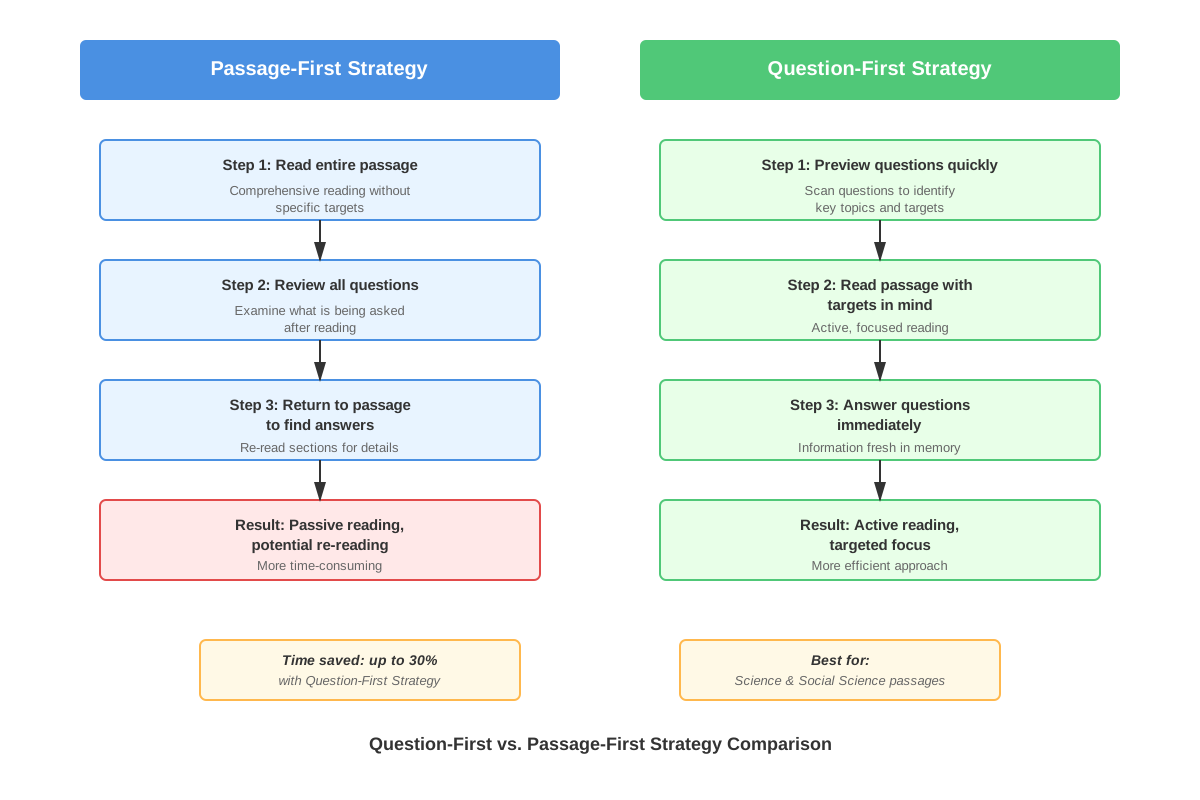
The question-first strategy represents a fundamental approach to tackling ACT Reading passages that can dramatically improve both accuracy and time management. Unlike traditional reading comprehension methods where students read the entire passage before examining questions, this strategy involves previewing questions before diving into the passage text. This tactical shift allows test-takers to read with purpose, knowing exactly what information they need to extract and where to focus their attention.
On the ACT Reading section, time pressure is one of the most significant challenges students face. With only 35 minutes to complete four passages and 40 questions, efficient reading becomes paramount. The ACT question-first strategy addresses this challenge by transforming passive reading into active information hunting. Rather than absorbing every detail and hoping to remember relevant information when questions appear, students using this approach know their targets before they begin reading. This method proves particularly effective for certain passage types and question formats, though it requires practice to implement smoothly.
Understanding when and how to apply the question-first strategy connects directly to broader ACT Reading skills including passage navigation, question type recognition, and time allocation. This approach complements other essential techniques such as annotation, main idea identification, and process of elimination. Mastering this strategy provides students with a flexible tool that can be adapted based on passage difficulty, personal reading speed, and specific question demands, making it an indispensable component of a comprehensive ACT Reading preparation plan.
Learning Objectives
- [ ] Identify when Question-first strategy is being tested
- [ ] Explain the core rule or strategy behind Question-first strategy
- [ ] Apply Question-first strategy to ACT-style questions accurately
- [ ] Determine which question types benefit most from the question-first approach
- [ ] Execute a systematic process for previewing questions before reading passages
- [ ] Evaluate when to switch between question-first and passage-first strategies based on passage characteristics
- [ ] Integrate question-first strategy with annotation and note-taking techniques for maximum efficiency
Prerequisites
- Basic ACT Reading format knowledge: Understanding the test structure (4 passages, 10 questions each, 35 minutes total) is essential for appreciating why time-saving strategies matter
- Question type familiarity: Recognizing different ACT question categories (detail, inference, main idea, vocabulary-in-context) helps determine which questions to preview
- Passage type awareness: Knowing the four passage types (Literary Narrative/Prose Fiction, Social Science, Humanities, Natural Science) allows for strategic approach selection
- Active reading skills: Basic ability to identify topic sentences, transitions, and paragraph structure enables efficient information location after previewing questions
Why This Topic Matters
The question-first strategy addresses one of the most common complaints among ACT test-takers: running out of time before completing all passages. Research on ACT Reading performance indicates that approximately 40% of students fail to finish all four passages within the allotted time, often leaving an entire passage blank or rushing through final questions with diminished accuracy. By implementing a question-first approach, students can reduce wasted reading time by up to 30%, focusing only on passage sections that directly relate to questions.
This strategy appears relevant across all four ACT Reading passages, though its effectiveness varies by passage type. Natural Science and Social Science passages, which tend to be more factual and structured, respond particularly well to question-first approaches. These passages typically contain 6-8 detail questions that ask about specific facts, dates, or processes—information that can be efficiently located when you know what you're searching for. Literary Narrative passages may benefit less from this strategy since they often require holistic understanding of character development and tone.
In practical terms, the ACT frequently tests this skill indirectly through question design. Approximately 60% of ACT Reading questions are detail or inference questions that reference specific line numbers or paragraph locations. These questions practically invite a question-first approach, as they tell you exactly where to look. Additionally, 15-20% of questions ask about specific vocabulary words in context, another question type that benefits enormously from targeted reading. Understanding when and how to employ question-first strategy can mean the difference between a score in the mid-20s and breaking into the 30+ range.
Core Concepts
The Fundamental Principle
The question-first strategy operates on a simple but powerful principle: reading with a purpose is more efficient than reading comprehensively and hoping to remember everything. Traditional reading instruction emphasizes thorough comprehension before attempting questions, but standardized tests like the ACT don't reward comprehensive understanding—they reward correct answers. The question-first approach recognizes this distinction and optimizes for test performance rather than complete mastery.
When implementing this strategy, students spend approximately 60-90 seconds previewing questions before reading the passage. This preview doesn't involve attempting to answer questions; rather, it involves identifying what information the questions seek. Students note key terms, line references, and question types, creating a mental roadmap of what matters in the upcoming passage. This preparation transforms the reading experience from passive absorption to active hunting.
The Three-Phase Process
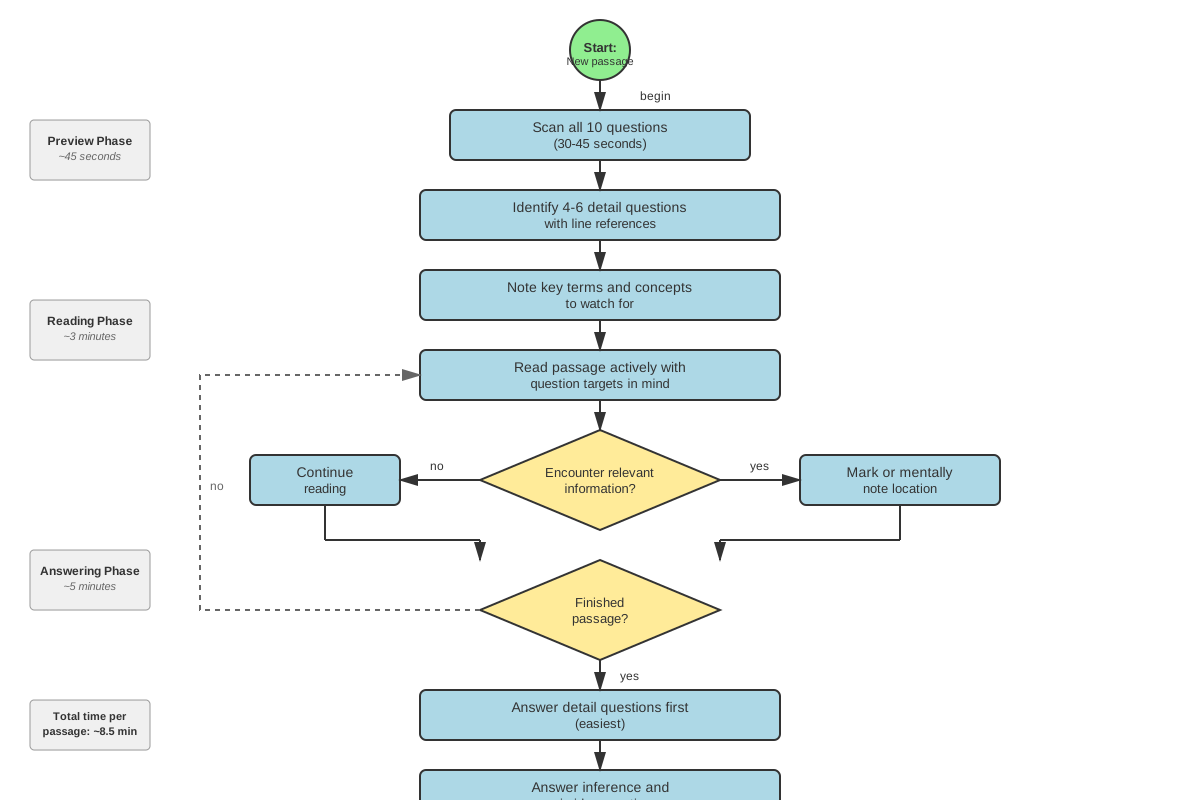
The question-first strategy follows a systematic three-phase approach:
- Question Preview Phase (60-90 seconds): Rapidly scan all 10 questions for the passage, noting line references, proper nouns, dates, and specific concepts mentioned. Don't read answer choices during this phase—focus solely on question stems. Mark questions that reference specific lines or paragraphs.
- Targeted Reading Phase (4-5 minutes): Read the passage with your question preview in mind. When you encounter information related to a previewed question, slow down and read carefully. For sections not referenced in questions, maintain a faster pace while still tracking main ideas and passage structure.
- Question Answering Phase (3-4 minutes): Return to questions in order, using your targeted reading and passage annotations to locate answers efficiently. For questions you identified during preview as line-specific, jump directly to those lines rather than searching the entire passage.
Question Type Suitability
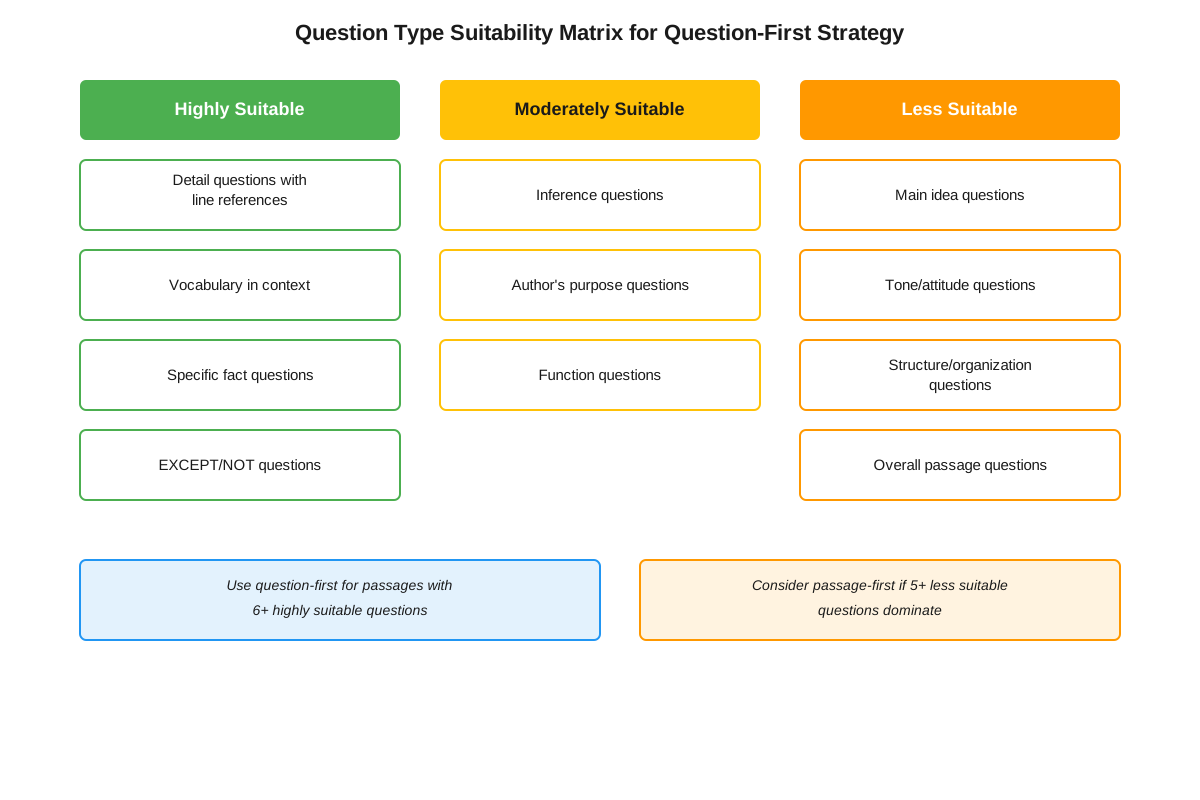
Not all ACT Reading questions benefit equally from the question-first approach. Understanding which question types work best with this strategy is crucial:
| Question Type | Suitability | Reason |
|---|---|---|
| Detail Questions | Excellent | Often include line references; easy to locate specific information |
| Vocabulary-in-Context | Excellent | Always reference specific words/lines; no need for full passage comprehension |
| Inference Questions (specific) | Good | When tied to particular paragraphs or sections, targeted reading works well |
| Main Idea Questions | Poor | Require holistic understanding; can't be answered from targeted reading alone |
| Author's Purpose/Tone | Poor | Need comprehensive passage understanding and attention to nuance |
| Structure/Organization | Moderate | Benefit from knowing what to look for, but still require passage-level awareness |
Strategic Marking During Preview
Effective question preview involves more than just reading question stems—it requires strategic notation. Students should develop a quick marking system:
- Circle or underline line references (e.g., "lines 23-27") to create instant navigation points
- Star proper nouns, dates, or unique terms that will be easy to locate in the passage
- Note question numbers next to relevant information as you read the passage
- Mark "MAIN IDEA" or "TONE" for questions requiring holistic understanding, signaling these need different treatment
Passage Type Adaptations
The question-first strategy requires modification based on passage type:
Natural Science Passages: These highly structured passages with clear topic sentences and factual content are ideal for question-first approaches. Preview questions thoroughly, then skim topic sentences to understand organization before targeted reading.
Social Science Passages: Similar to Natural Science but may include more interpretation. Use question-first strategy for factual questions while reading more carefully for analytical sections.
Humanities Passages: These passages about arts, culture, or philosophy often blend facts with interpretation. Use a modified approach: preview questions but plan for more comprehensive reading of interpretive sections.
Literary Narrative/Prose Fiction: These passages require the most caution with question-first strategy. Character development, tone, and thematic elements emerge gradually. Preview questions but expect to read more comprehensively, especially in dialogue-heavy sections.
Integration with Active Reading
The question-first strategy doesn't replace active reading—it enhances it. As students read with their question preview in mind, they should still:
- Annotate main ideas at the beginning or end of paragraphs
- Mark transitions that signal shifts in topic or perspective
- Note contrasts (however, but, although) that often contain answer information
- Underline thesis statements and concluding sentences that address main idea questions
This integration creates a dual-purpose reading experience: targeted information gathering for specific questions combined with structural awareness for holistic questions.
Concept Relationships
The question-first strategy serves as a central hub connecting multiple ACT Reading skills. At its foundation, this strategy depends on question type recognition—students must quickly categorize questions during preview to determine which merit targeted reading. This recognition skill flows directly from understanding ACT question patterns and formats.
The strategy connects forward to time management techniques, as the minutes saved through targeted reading can be reallocated to more challenging passages or questions. Specifically: Question Type Recognition → Question-First Strategy → Improved Time Management → Ability to Attempt All Questions.
Laterally, the question-first approach integrates with annotation strategies. The question preview informs what to annotate, while annotations made during reading help answer questions efficiently. This creates a reinforcing cycle: Question Preview → Targeted Annotation → Efficient Question Answering.
The strategy also relates inversely to passage-first approaches. Students must understand both methods to make strategic decisions: Passage Characteristics Assessment → Strategy Selection (Question-First vs. Passage-First) → Execution → Performance Evaluation. Literary passages with complex character development might trigger a passage-first approach, while science passages with numerous detail questions favor question-first.
Finally, this strategy connects to process of elimination techniques. By reading with specific questions in mind, students gather targeted evidence that makes eliminating wrong answers more systematic and confident.
High-Yield Facts
⭐ The question-first strategy is most effective for detail questions with line references, which comprise approximately 40% of ACT Reading questions.
⭐ Previewing questions should take 60-90 seconds per passage; spending more time diminishes the time-saving benefits.
⭐ Natural Science and Social Science passages benefit most from question-first strategy due to their factual, structured nature.
⭐ Main idea and author's tone questions typically require comprehensive reading and should not drive the question-first preview.
⭐ Circling line references during question preview creates instant navigation points that save 15-30 seconds per question.
- Questions containing proper nouns, dates, or unique technical terms are ideal candidates for targeted reading after preview.
- The strategy works best when combined with active annotation, not as a replacement for engagement with the text.
- Literary Narrative passages require modified question-first approaches due to their emphasis on character development and tone.
- Approximately 60% of ACT Reading questions can be answered more efficiently using question-first strategy compared to passage-first reading.
- Students should mark "holistic" questions (main idea, tone, purpose) during preview to remind themselves these need comprehensive attention.
- The question-first approach reduces the cognitive load of trying to remember everything, allowing focus on specific, testable information.
- Transitioning between question preview and passage reading should be seamless; excessive back-and-forth wastes time.
Quick check — test yourself on Question-first strategy so far.
Try Flashcards →Common Misconceptions
Misconception: The question-first strategy means you don't need to read the passage carefully.
Correction: The strategy changes what you read carefully, not whether you read carefully. Sections relevant to questions require close attention, while less relevant sections can be skimmed for structure and main ideas. Complete comprehension still matters for holistic questions.
Misconception: You should read all answer choices during the question preview phase.
Correction: Reading answer choices during preview wastes time and creates confusion. The preview phase focuses solely on question stems to identify what information to seek. Answer choices are evaluated only after reading the relevant passage sections.
Misconception: Question-first strategy works equally well for all passage types.
Correction: Passage type significantly affects strategy effectiveness. Factual, structured passages (Natural Science, Social Science) respond better to this approach than Literary Narrative passages that require understanding character development, tone, and thematic elements that emerge gradually.
Misconception: If you use question-first strategy, you should answer questions in the order you encounter relevant information while reading.
Correction: Despite reading with questions in mind, you should still answer questions in the order presented. The ACT designs question sequences to build understanding progressively, and skipping around can cause confusion and missed context.
Misconception: The question-first strategy is only for slow readers who struggle with time.
Correction: Even strong readers benefit from question-first strategy because it improves efficiency and accuracy. Knowing what information matters helps all readers focus attention appropriately, reducing the chance of missing key details or misinterpreting questions.
Misconception: You need to memorize all question details during the preview phase.
Correction: The preview phase creates awareness and mental preparation, not memorization. Students should make quick notes or marks on their test booklet to externalize the information rather than relying on memory.
Worked Examples
Example 1: Natural Science Passage Application
Scenario: A Natural Science passage about photosynthesis contains these questions:
- Question 21: According to lines 15-18, what is the primary function of chlorophyll?
- Question 22: The passage indicates that the Calvin cycle occurs in which part of the chloroplast?
- Question 23: Which of the following best describes the main idea of the passage?
- Question 24: As it is used in line 34, the word "fix" most nearly means...
Question-First Strategy Application:
Step 1 - Preview (60 seconds):
- Circle "lines 15-18" for Question 21; note "chlorophyll function"
- Star "Calvin cycle" and "chloroplast" for Question 22 (no line reference, but specific terms)
- Mark Question 23 as "MAIN IDEA" - needs holistic reading
- Circle "line 34" for Question 24; note "fix" definition
Step 2 - Targeted Reading (4 minutes):
Begin reading the passage. When reaching lines 15-18, slow down and read carefully about chlorophyll's function. Make a marginal note: "Q21 - chlorophyll absorbs light energy." Continue reading at moderate pace, tracking the passage structure for the main idea question.
When encountering "Calvin cycle" (likely around line 25-30), slow down again. Read carefully about where it occurs. Note: "Q22 - Calvin cycle in stroma."
At line 34, when "fix" appears in context ("plants fix carbon dioxide"), slow down. Read surrounding sentences for context. Note: "Q24 - fix = convert/capture."
Throughout, maintain awareness of the passage's overall structure and main argument for Question 23.
Step 3 - Answer Questions (3 minutes):
- Question 21: Jump directly to lines 15-18 and your annotation. Answer confidently based on targeted reading.
- Question 22: Locate your "Calvin cycle" annotation. Answer based on that specific section.
- Question 23: Synthesize your understanding of passage structure and main argument. This takes slightly longer but benefits from the focused reading of other sections.
- Question 24: Return to line 34 and context. Use surrounding sentences to determine meaning.
Result: By knowing what to look for, the student read relevant sections carefully while maintaining efficient pace elsewhere, completing all questions with high accuracy in approximately 8 minutes.
Example 2: Literary Narrative Passage - Modified Approach
Scenario: A Literary Narrative passage about a character's childhood memory contains these questions:
- Question 31: The narrator's tone in the passage can best be described as...
- Question 32: According to lines 45-48, what did the narrator's grandmother do each morning?
- Question 33: The passage suggests that the narrator's relationship with her grandmother was primarily characterized by...
- Question 34: Which of the following best describes the main purpose of the passage?
Question-First Strategy Application:
Step 1 - Preview (60 seconds):
- Mark Question 31 as "TONE" - needs comprehensive reading with attention to word choice
- Circle "lines 45-48" for Question 32; note "grandmother's morning routine"
- Mark Question 33 as "RELATIONSHIP" - needs holistic understanding but focused on grandmother interactions
- Mark Question 34 as "PURPOSE" - needs comprehensive understanding
Step 2 - Modified Reading Approach (5 minutes):
Recognize that 3 of 4 questions require holistic understanding. Decision: Use a modified strategy. Read the passage more comprehensively than you would for a science passage, but with heightened awareness of:
- Tone indicators (word choice, imagery, sentence structure)
- All grandmother interactions (for relationship question)
- Specific detail at lines 45-48
When reaching lines 45-48, slow down significantly and make a clear annotation: "Q32 - grandmother made tea, watched sunrise."
Throughout reading, note tone indicators: "warm," "gentle," "nostalgic" - mark these for Question 31.
Step 3 - Answer Questions (3 minutes):
- Question 31: Synthesize tone indicators noted throughout passage
- Question 32: Jump directly to lines 45-48 and annotation for quick, confident answer
- Question 33: Review grandmother interactions noted during reading
- Question 34: Consider overall passage structure and emotional arc
Result: The modified approach recognized that Literary Narrative passages require more comprehensive reading while still benefiting from question preview. The one detail question (32) was answered efficiently, while holistic questions benefited from reading with awareness of what to notice.
Exam Strategy
Trigger Recognition
Certain question characteristics signal that question-first strategy will be particularly effective:
- Line reference questions: Any question stating "lines X-Y" or "line X" is an immediate candidate for targeted reading
- Proper noun questions: Questions mentioning specific names, places, or unique terms that will be easy to locate
- Vocabulary-in-context questions: These always reference specific lines and benefit enormously from targeted reading
- "According to the passage" questions: These typically ask for specific details rather than interpretation
Process-of-Elimination Integration
The question-first strategy enhances process of elimination by providing focused evidence:
- After targeted reading, you have specific passage evidence fresh in mind
- Eliminate answers that contradict your targeted reading immediately
- For remaining choices, return to the passage section with specific focus rather than searching broadly
- Use your annotations as quick reference points to verify or eliminate choices
Exam Tip: When using question-first strategy, make your annotations specific enough to eliminate wrong answers without rereading entire sections. Write brief phrases, not just question numbers.
Time Allocation Framework
Effective time management with question-first strategy follows this pattern:
- Question Preview: 60-90 seconds (no more, or you lose the time benefit)
- Passage Reading: 4-5 minutes (varies by passage type and question distribution)
- Question Answering: 3-4 minutes (faster for detail questions, slower for holistic questions)
- Total per passage: 8-9 minutes, leaving 1-2 minutes buffer for difficult questions
Adaptive Strategy Selection
Not every passage warrants full question-first strategy. Make quick decisions:
Use Full Question-First Strategy When:
- 6+ questions have line references or specific terms
- Passage is Natural Science or Social Science
- You're running behind on time and need efficiency
Use Modified Strategy When:
- Passage is Literary Narrative with emphasis on character/tone
- Most questions are holistic (main idea, purpose, tone)
- Passage is short (under 80 lines) and manageable to read comprehensively
Use Passage-First Strategy When:
- Passage is very short (under 60 lines)
- You're ahead on time and can afford comprehensive reading
- Questions are predominantly holistic with few detail questions
Common Trap Avoidance
ACT test writers create traps that question-first strategy helps avoid:
- Detail confusion: By reading with specific questions in mind, you're less likely to confuse similar details
- Scope errors: Targeted reading helps you stay focused on what the question actually asks rather than bringing in outside information
- Time traps: Without strategy, students often reread passages multiple times searching for answers; question-first prevents this
Memory Techniques
The "PREVIEW" Acronym
Proper nouns - Circle names, places, unique terms
References - Mark all line references
Estimate - Gauge how many detail vs. holistic questions
Vocabulary - Note vocabulary-in-context questions
Identify - Mark main idea/tone questions for comprehensive attention
Execute - Begin targeted reading with your roadmap
Write - Make brief annotations as you find relevant information
The Three-Phase Visualization
Visualize the strategy as a hunting expedition:
- Scout the terrain (question preview) - identify where the targets are
- Navigate with purpose (targeted reading) - move through the passage knowing what you're hunting
- Collect your prizes (answer questions) - gather the information you targeted
The 60-4-3 Rule
Remember the time allocation as 60-4-3:
- 60 seconds for question preview
- 4 minutes for passage reading
- 3 minutes for answering questions
This simple number sequence helps maintain efficient pacing.
Question Type Suitability Mnemonic: "DIVE"
Detail questions - Excellent for question-first
Inference questions (specific) - Good for question-first
Vocabulary-in-context - Excellent for question-first
Everything holistic (main idea, tone, purpose) - Poor for question-first
Summary
The question-first strategy represents a paradigm shift in ACT Reading approach, transforming passive comprehension into active information hunting. By spending 60-90 seconds previewing questions before reading, students create a mental roadmap that guides their attention to testable information. This strategy proves most effective for detail questions with line references, vocabulary-in-context questions, and specific inference questions—collectively comprising approximately 60% of ACT Reading questions. The approach requires adaptation based on passage type, with Natural Science and Social Science passages responding better than Literary Narrative passages that demand holistic understanding of character and tone. Successful implementation involves three distinct phases: question preview (marking line references and key terms), targeted reading (slowing down for relevant sections while maintaining efficient pace elsewhere), and strategic question answering (using annotations to locate evidence quickly). When integrated with active annotation and process of elimination techniques, the question-first strategy can reduce reading time by up to 30% while improving accuracy, making it an essential tool for achieving competitive ACT Reading scores.
Key Takeaways
- The question-first strategy involves previewing all questions for 60-90 seconds before reading the passage, creating a roadmap of what information to target
- Approximately 60% of ACT Reading questions (detail, vocabulary-in-context, and specific inference questions) benefit significantly from this approach
- Natural Science and Social Science passages are ideal for question-first strategy due to their factual, structured nature
- Main idea, tone, and purpose questions require comprehensive reading and should not drive the question preview focus
- Effective implementation requires marking line references, circling proper nouns and unique terms, and making brief annotations while reading
- The strategy must be adapted based on passage type, with Literary Narrative passages requiring more comprehensive reading despite question preview
- Time allocation should follow the 60-4-3 pattern: 60 seconds preview, 4 minutes reading, 3 minutes answering
Related Topics
Passage-First Strategy: The complementary approach to question-first, involving comprehensive passage reading before examining questions. Understanding both strategies enables flexible, passage-appropriate decision-making.
Question Type Classification: Deep knowledge of ACT question categories (detail, inference, main idea, vocabulary-in-context, structure) enhances question-first strategy by improving preview efficiency and targeted reading focus.
Active Annotation Techniques: Methods for marking passages during reading, including underlining, marginal notes, and symbol systems. These techniques integrate seamlessly with question-first strategy to create efficient reference points.
Time Management and Pacing: Comprehensive strategies for allocating 35 minutes across four passages, including when to skip difficult questions and how to maintain consistent pace throughout the section.
Process of Elimination Methods: Systematic approaches to eliminating wrong answers, which become more effective when combined with the focused evidence gathering that question-first strategy provides.
Practice CTA
Now that you understand the question-first strategy's principles, phases, and applications, it's time to put this knowledge into practice. The accompanying practice questions will challenge you to implement this strategy across different passage types and question formats. Start with Natural Science passages to build confidence with the approach, then progress to more challenging Literary Narrative passages that require modified implementation. Remember: the strategy feels awkward initially but becomes natural with repetition. Each practice passage you complete strengthens your ability to preview efficiently, read with purpose, and answer questions accurately. Your investment in mastering this high-yield strategy will pay dividends on test day—commit to practicing it consistently, and watch your reading efficiency and accuracy improve dramatically!
Sign up free to keep reading
Create a free AnvayaPrep account to finish this ACT guide on Question-first strategy — plus flashcards and practice questions.