Overview
The skimming strategy is one of the most powerful time-management and comprehension tools available to ACT Reading test-takers. Unlike traditional close reading, which requires careful attention to every word and sentence, skimming involves rapidly moving through a passage to identify its main ideas, structure, and key details without getting bogged down in minor supporting information. This technique is particularly crucial for the ACT Reading section, where students face four passages of approximately 750 words each and must answer 40 questions in just 35 minutes—leaving roughly 8-9 minutes per passage including question-answering time.
Mastering the ACT skimming strategy enables students to build a mental map of where information is located within a passage, allowing them to return quickly to relevant sections when answering specific questions. Rather than attempting to memorize every detail during the initial read, skilled skimmers focus on understanding the passage's overall purpose, tone, structure, and the function of each paragraph. This approach transforms the reading process from a linear, time-consuming activity into an efficient information-gathering mission that prioritizes what the test actually assesses.
The skimming strategy connects fundamentally to all other ACT Reading skills, serving as the foundation for effective passage navigation. Whether dealing with Literary Narrative, Social Science, Humanities, or Natural Science passages, the ability to quickly extract main ideas and locate supporting details determines success. This technique works synergistically with active reading strategies, question-type recognition, and time management skills to create a comprehensive approach to the Reading section. Students who master skimming typically see significant score improvements because they can allocate more time to challenging questions while maintaining high accuracy on detail-oriented items.
Learning Objectives
- [ ] Identify when Skimming strategy is being tested
- [ ] Explain the core rule or strategy behind Skimming strategy
- [ ] Apply Skimming strategy to ACT-style questions accurately
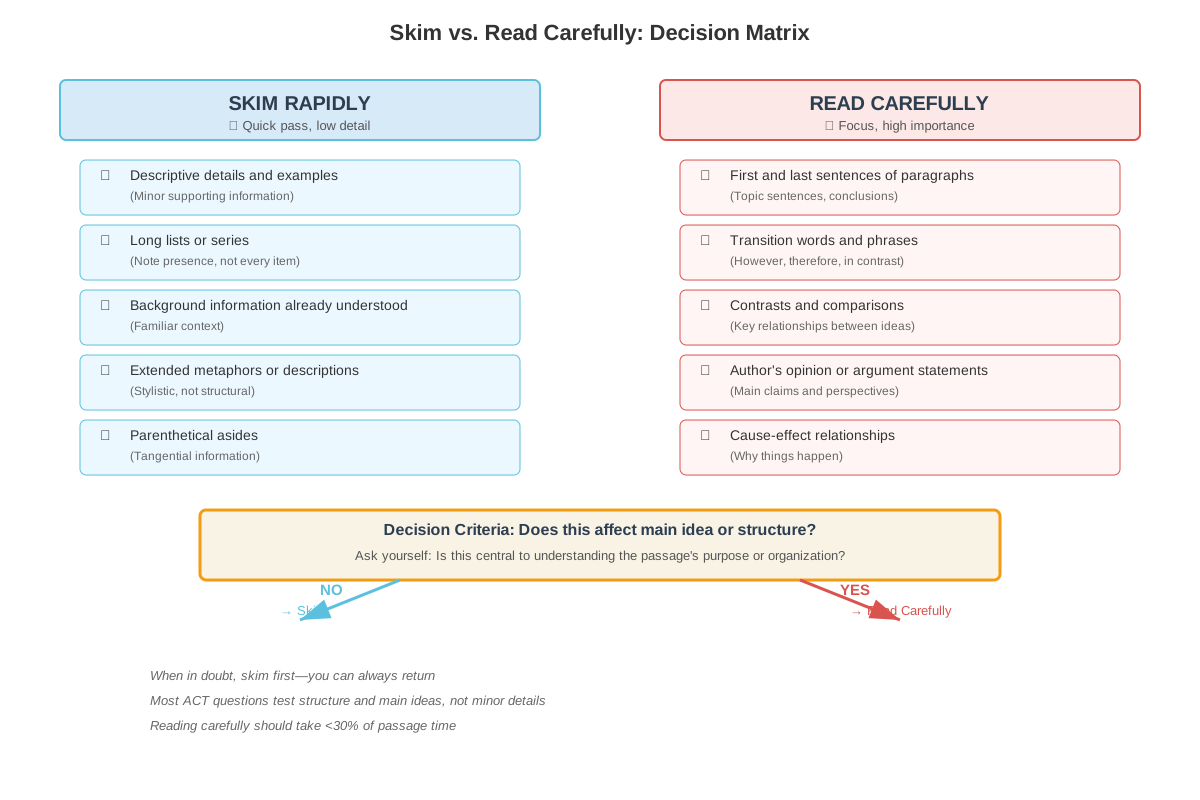
- [ ] Distinguish between information that requires careful reading versus content suitable for skimming
- [ ] Execute a complete skim of an ACT passage in 2-3 minutes while retaining essential structural information
- [ ] Utilize paragraph function identification to create an effective passage roadmap
- [ ] Demonstrate the ability to return to specific passage locations efficiently based on question requirements
Prerequisites
- Basic reading comprehension skills: Understanding literal meaning and main ideas forms the foundation upon which skimming techniques build efficiency
- Familiarity with ACT passage types: Knowing the four passage categories (Literary Narrative, Social Science, Humanities, Natural Science) helps predict content organization and adjust skimming approach
- Understanding of question types: Recognizing the difference between main idea, detail, inference, and vocabulary questions determines when to skim versus when to read carefully
- Time awareness: Basic time management consciousness is necessary to appreciate why skimming is essential for ACT success
Why This Topic Matters
The ACT Reading section's time constraint is its most challenging feature. With only 35 minutes for four passages and 40 questions, students have approximately 52 seconds per question—but this calculation assumes zero time spent reading the passages themselves. In reality, students must balance reading time with question-answering time, making efficiency paramount. The skimming strategy directly addresses this challenge by reducing initial reading time from 5-6 minutes per passage to 2-3 minutes, effectively doubling the time available for answering questions.
Research on ACT score distributions reveals that students who run out of time or rush through the final passage typically score 3-5 points lower than their actual reading ability would suggest. The skimming strategy prevents this score deflation by ensuring consistent pacing across all four passages. Additionally, approximately 60-65% of ACT Reading questions test main idea, purpose, structure, and tone—all elements that effective skimming captures. Only 35-40% of questions require specific detail recall, and these can be answered by returning to the passage with targeted re-reading.
On actual ACT exams, skimming proves particularly valuable for Natural Science passages, which often contain dense technical information that students don't need to fully comprehend to answer questions correctly. Similarly, Social Science passages frequently include statistical data or study descriptions that serve as supporting evidence rather than testable content. The skimming strategy helps students distinguish between "need to know" and "nice to know" information, preventing the common pitfall of spending excessive time on details that never appear in questions.
Core Concepts
The Fundamental Principle of ACT Skimming
The skimming strategy operates on a crucial insight: the ACT Reading section tests comprehension of passage structure and main ideas far more than memorization of specific details. When students skim effectively, they create a mental outline of the passage that includes three essential components: the main idea or thesis, the function of each paragraph, and the location of key supporting details. This approach recognizes that perfect comprehension of every sentence is neither possible nor necessary within the time constraints.
Effective skimming differs fundamentally from speed reading. Speed readers attempt to process all information at an accelerated pace, while skimmers selectively focus attention on high-value content while rapidly moving past low-value material. The key is knowing what to focus on and what to skip, which requires understanding how ACT passages are constructed and what the test-makers typically ask about.
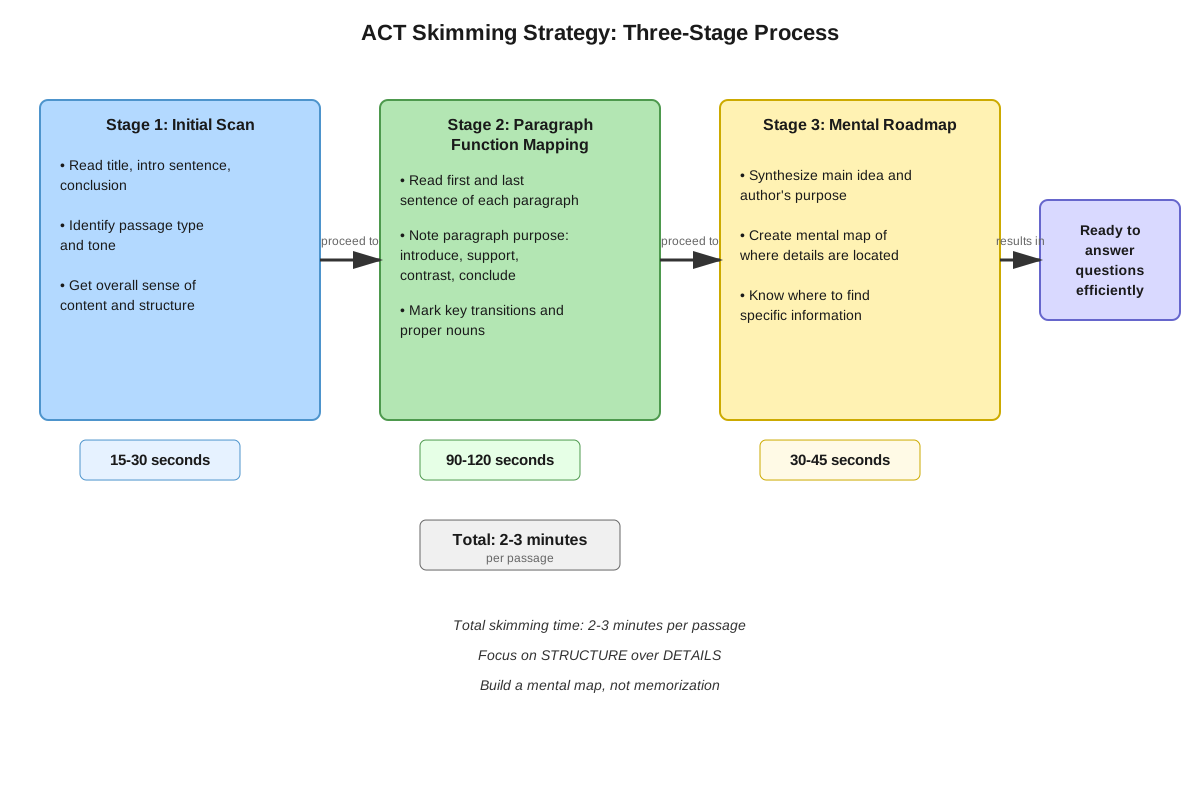
The Three-Phase Skimming Process
Phase 1: The Opening Read (30-45 seconds)
The first paragraph of any ACT passage deserves careful attention because it typically establishes the main idea, introduces key concepts, and sets the tone. Students should read the opening paragraph at near-normal speed, identifying:
- The passage's central topic or subject
- The author's purpose (to inform, persuade, entertain, or analyze)
- The initial tone (objective, enthusiastic, critical, nostalgic, etc.)
- Any thesis statement or main argument
Phase 2: The Middle Skim (60-90 seconds)
For the middle paragraphs, students should employ true skimming technique, which involves:
- Reading the first sentence of each paragraph completely (topic sentences usually appear here)
- Scanning the middle sentences for transition words, names, dates, and key terms
- Reading the last sentence if it appears to contain a conclusion or transition
- Noting the paragraph's function (Does it provide an example? Present a contrasting view? Describe a process? Offer evidence?)
During this phase, students should resist the urge to fully comprehend complex sentences or technical explanations. Instead, they should simply note that "Paragraph 3 discusses the experiment methodology" or "Paragraph 4 presents opposing viewpoints." This creates a mental roadmap without requiring full comprehension.
Phase 3: The Closing Read (20-30 seconds)
The final paragraph often contains conclusions, summaries, or the author's final perspective. Like the opening paragraph, this section warrants more careful attention. Students should read it at moderate speed, looking for:
- Restatement or evolution of the main idea
- Final conclusions or recommendations
- Resolution of any conflicts or questions raised earlier
- The author's ultimate message or takeaway
What to Focus On While Skimming
| High-Priority Elements | Why They Matter | How to Identify Them |
|---|---|---|
| Main idea/thesis | Tested in 25-30% of questions | Usually in first or last paragraph; look for broad, encompassing statements |
| Paragraph functions | Essential for navigation | Ask "What is this paragraph doing?" not "What does it say?" |
| Transition words | Signal structure and relationships | "However," "Furthermore," "In contrast," "For example" |
| Proper nouns | Easy to relocate when needed | Names, places, dates, titles—they stand out visually |
| Tone indicators | Frequently tested | Adjectives describing emotions or judgments |
| Structural markers | Reveal organization | "First," "Second," "Finally," "On the other hand" |
What to Skim Past Quickly
Certain passage elements rarely appear in questions and can be skimmed rapidly:
- Lengthy examples: Note that an example exists, but don't memorize details
- Statistical data: Observe that numbers are present; return if a question asks about them
- Technical processes: Understand the general concept, not the step-by-step mechanism
- Extended descriptions: Capture the overall impression, not every descriptive detail
- Lists of items: Note the category being listed, not each individual item
- Background information: Recognize it as context, not primary content
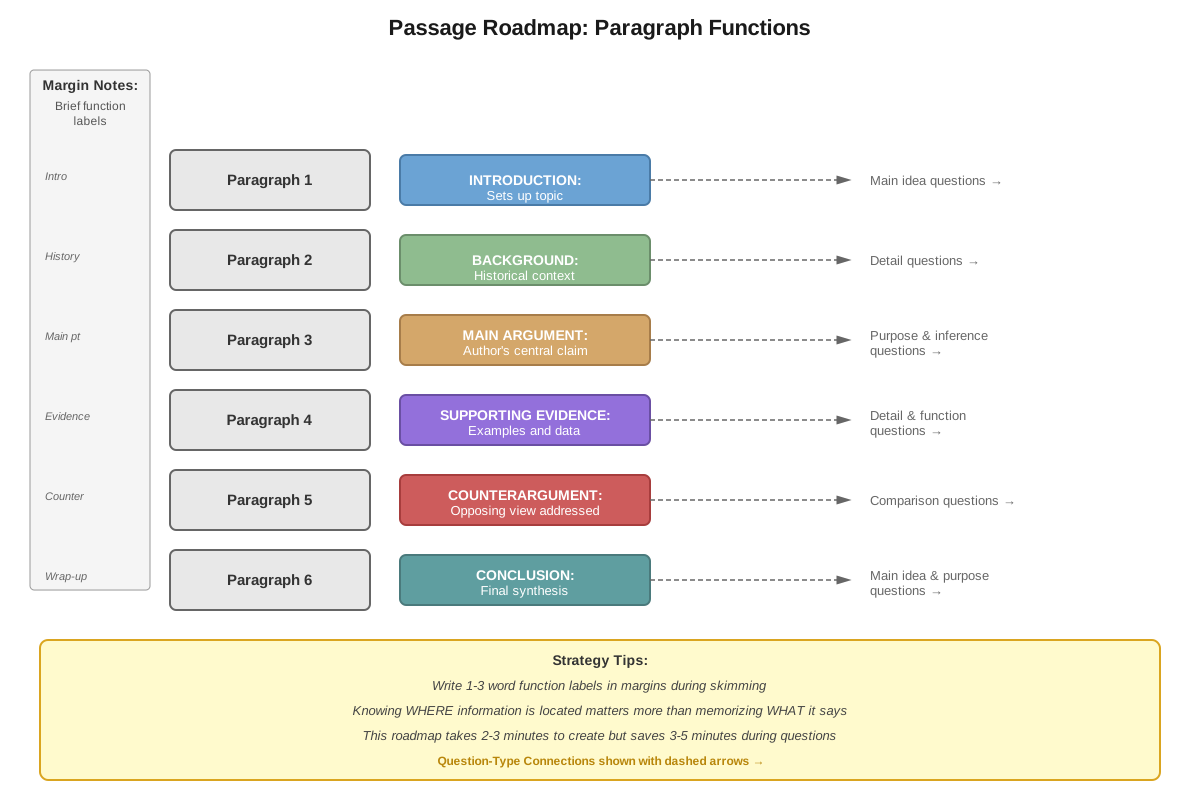
Paragraph Function Identification
One of the most powerful aspects of the skimming strategy involves categorizing each paragraph by its function rather than its content. Common paragraph functions include:
- Introduction/Setup: Establishes context, introduces topic
- Thesis/Main Argument: States the central claim or idea
- Supporting Evidence: Provides examples, data, or reasoning
- Contrast/Counterargument: Presents opposing views or complications
- Analysis/Explanation: Breaks down concepts or interprets information
- Transition: Connects ideas or shifts focus
- Conclusion/Summary: Wraps up arguments or restates main points
By mentally labeling each paragraph with its function, students create a structural map that makes returning to specific information quick and efficient.
The Annotation Approach
While skimming, minimal annotation enhances retention and navigation without slowing reading speed. Effective annotations include:
- Circling or underlining the main idea when identified
- Bracketing the first sentence of each paragraph
- Marking transition words with a quick slash or underline
- Noting paragraph numbers in the margin with brief function labels ("ex," "contrast," "concl")
- Starring or checking particularly important sentences
These annotations should take no more than 10-15 seconds total and serve as visual anchors when returning to the passage.
Concept Relationships
The skimming strategy serves as the central hub connecting multiple ACT Reading skills. It directly enables efficient time management by reducing initial reading time, which in turn allows more time for careful question analysis and answer verification. The mental roadmap created through skimming facilitates quick passage navigation, which is essential for answering detail questions and evidence-based questions that require returning to specific passage locations.
Skimming builds upon active reading skills by requiring students to engage with text purposefully rather than passively. However, it refines active reading by adding selectivity—not all information deserves equal attention. The strategy also connects to question-type recognition because understanding what the ACT typically asks helps determine what to focus on while skimming.
The relationship flow operates as follows:
Passage Type Recognition → Skimming Strategy Selection → Paragraph Function Identification → Mental Roadmap Creation → Efficient Question Answering → Targeted Re-reading → Accurate Answer Selection
Additionally, skimming interacts with passage difficulty assessment. When a passage proves particularly challenging, effective skimmers adjust their approach, spending slightly more time on the opening and closing paragraphs while skimming middle sections even more rapidly. This adaptive application demonstrates mastery of the strategy.
Quick check — test yourself on Skimming strategy so far.
Try Flashcards →High-Yield Facts
⭐ The ACT Reading section allows approximately 8-9 minutes per passage, making skimming essential for time management
⭐ Effective skimming reduces initial reading time to 2-3 minutes, leaving 5-6 minutes for questions
⭐ The first and last paragraphs of ACT passages contain the highest concentration of testable main ideas
⭐ Approximately 60-65% of ACT Reading questions can be answered using information captured through effective skimming
⭐ Paragraph function identification is more valuable than detailed content comprehension for passage navigation
- Topic sentences (usually first sentences of paragraphs) contain the most concentrated information about paragraph content
- Transition words signal relationships between ideas and are crucial for understanding passage structure
- Proper nouns (names, places, dates) serve as excellent visual anchors for relocating information
- The skimming strategy is equally applicable to all four ACT passage types, though execution varies slightly
- Students who skim effectively typically score 3-5 points higher than those who attempt to read every word carefully
- Detail questions requiring specific information should trigger immediate return to the passage, not reliance on memory
- The mental roadmap created through skimming remains accurate for 90-95% of questions
Common Misconceptions
Misconception: Skimming means reading so fast that comprehension is impossible → Correction: Effective skimming involves selective attention, reading some parts carefully (first/last paragraphs, topic sentences) while moving quickly past less important material. The goal is strategic comprehension, not speed for its own sake.
Misconception: Students must understand every detail before attempting questions → Correction: The ACT is an open-book test—the passage remains available while answering questions. Skimming creates a roadmap that enables efficient return to specific sections when detail questions arise, making initial memorization unnecessary.
Misconception: Skimming only works for easy passages → Correction: Skimming is actually most valuable for difficult passages because it prevents students from getting stuck on confusing sections. When a paragraph proves challenging, skimmers note its general function and move forward, returning only if a question requires that specific information.
Misconception: All paragraphs deserve equal reading time → Correction: ACT passages have hierarchical information structure. Opening and closing paragraphs typically contain more testable content than middle paragraphs, which often provide supporting examples or extended descriptions that can be skimmed rapidly.
Misconception: Skimming eliminates the need to return to the passage → Correction: Skimming creates a mental map that makes returning to the passage more efficient, not unnecessary. For detail questions, students should always return to verify answers rather than relying on memory from the initial skim.
Misconception: The skimming strategy is the same for all passage types → Correction: While the core principles remain constant, effective skimmers adjust their approach based on passage type. Literary Narrative passages may require more attention to character development and plot, while Natural Science passages benefit from identifying the main scientific concept and skimming technical details.
Worked Examples
Example 1: Natural Science Passage Skim
Passage Excerpt (abbreviated for demonstration):
[Paragraph 1] The phenomenon of bioluminescence—the production and emission of light by living organisms—has fascinated scientists for centuries. While fireflies provide the most familiar example, bioluminescence occurs most commonly in marine environments, where approximately 90% of organisms living below 500 meters produce light.
[Paragraph 2] The chemical mechanism underlying bioluminescence involves a light-emitting molecule called luciferin and an enzyme called luciferase. When luciferin reacts with oxygen in the presence of luciferase, the reaction produces light with minimal heat generation, making it remarkably efficient compared to incandescent bulbs...
[Paragraph 3] Marine organisms employ bioluminescence for various purposes. The anglerfish uses a luminescent lure to attract prey in the dark ocean depths. Certain squid species release glowing clouds to confuse predators...
[Paragraph 4] Recent research has revealed potential applications of bioluminescence in medical imaging and environmental monitoring...
Skimming Process:
- Paragraph 1 (careful read, 20 seconds): Main idea identified—bioluminescence is light production by organisms, common in deep ocean. Mental note: "Intro to topic, establishes prevalence."
- Paragraph 2 (quick skim, 15 seconds): First sentence read completely—identifies chemical mechanism. Middle sentences contain technical details (luciferin, luciferase, oxygen reaction). Mental note: "Explains how it works—technical details here if needed."
- Paragraph 3 (quick skim, 15 seconds): First sentence signals "various purposes." Scan reveals examples (anglerfish, squid). Mental note: "Examples of uses—can return for details."
- Paragraph 4 (moderate read, 15 seconds): "Recent research" signals new direction. Mentions applications. Mental note: "Modern applications—conclusion."
Total time: 65 seconds
Mental roadmap created: "Passage about bioluminescence. P1=intro/definition, P2=chemical mechanism, P3=examples of uses, P4=modern applications."
Question approach: If asked about the main idea, answer immediately using P1 information. If asked about specific organisms, return to P3. If asked about the chemical process, return to P2.
Example 2: Literary Narrative Passage Skim
Passage Excerpt (abbreviated):
[Paragraph 1] The summer I turned twelve, my grandmother decided to teach me the art of quilting, though I protested that I'd rather spend my days exploring the woods behind her farmhouse. "Patience," she said, threading her needle with practiced ease, "is something you'll need whether you're tracking deer or stitching fabric."
[Paragraph 2] The first quilt square took me three hours to complete, and even then, my stitches wandered like a creek after heavy rain. Grandmother examined my work without comment, then quietly ripped out every stitch...
[Paragraph 3] By August, something had shifted. My hands had learned what my mind couldn't articulate—the rhythm of the needle, the tension of the thread...
[Paragraph 4] Years later, standing in my own kitchen with my daughter asking to learn, I finally understood what Grandmother had known all along...
Skimming Process:
- Paragraph 1 (careful read, 25 seconds): Establishes narrator (12 years old), grandmother, conflict (wants to explore vs. learning quilting), grandmother's wisdom about patience. Mental note: "Setup—reluctant student learning quilting."
- Paragraph 2 (moderate skim, 20 seconds): First sentence shows struggle (three hours, poor quality). Grandmother's response (ripping stitches). Mental note: "Initial failure and challenge."
- Paragraph 3 (moderate skim, 15 seconds): "By August" signals time passage. "Something had shifted" indicates change. Mentions learning/improvement. Mental note: "Progress and growth."
- Paragraph 4 (careful read, 20 seconds): "Years later" signals major time jump. Narrator now teaching daughter. "Finally understood" suggests realization/theme. Mental note: "Resolution—cycle continues, wisdom understood."
Total time: 80 seconds
Mental roadmap created: "Coming-of-age story about learning quilting from grandmother. P1=setup/conflict, P2=struggle, P3=improvement, P4=adult perspective/theme."
Question approach: Character development questions answered using progression P1→P3→P4. Theme questions focus on P1 (patience quote) and P4 (understanding). Detail questions about the quilting process return to P2-P3.
Exam Strategy
When approaching ACT Reading passages with the skimming strategy, follow this systematic process:
Before Reading:
- Glance at the passage type indicator (Literary Narrative, Social Science, etc.)
- Note the passage length and adjust time allocation accordingly
- Set a mental timer: 2-3 minutes for skimming, 5-6 minutes for questions
During Skimming:
- Read the first paragraph at 75-80% of normal reading speed
- For middle paragraphs, read only first sentences completely, scan the rest
- Watch for trigger words: "however," "therefore," "for example," "in contrast," "most importantly"
- Circle or mentally note the main idea when you identify it
- Label paragraph functions mentally or with brief margin notes
- Read the last paragraph at 75-80% of normal reading speed
- Resist the urge to fully understand confusing sections—note their location and move on
Question-Answering Phase:
- Start with main idea and tone questions—these use information from your skim
- For detail questions, use your mental roadmap to return to the relevant paragraph
- Read 2-3 sentences around the referenced line or concept
- Eliminate answers that contradict the passage or go beyond what's stated
- For "EXCEPT" or "NOT" questions, verify each answer choice against the passage
Trigger Phrases in Questions:
- "The main purpose..." → Use your understanding from first/last paragraphs
- "According to the passage..." → Return to passage; don't rely on memory
- "The author's tone can best be described as..." → Recall tone indicators from your skim
- "In lines 45-50..." → Go directly to those lines and read surrounding context
- "The passage suggests..." → Inference question; combine information from multiple paragraphs
Time Management:
- If a passage seems particularly difficult, skim it even more quickly (90 seconds) and rely heavily on returning to the passage for questions
- If you're running behind, maintain your skimming pace but work more quickly on easier questions to bank time for harder ones
- Never spend more than 60 seconds on a single question; mark it and return if time permits
Memory Techniques
FIRST Acronym for Skimming Focus:
- First paragraph (read carefully)
- Initial sentences (of each middle paragraph)
- Roadmap (create mental structure)
- Structure words (transitions and signals)
- Terminal paragraph (read carefully)
The "Paragraph Job" Visualization:
Imagine each paragraph as a worker with a specific job in building the passage. As you skim, assign each paragraph a job title: "Introducer," "Evidence Provider," "Contraster," "Concluder." This makes the passage structure memorable and concrete.
The 2-3-2 Rule:
- 2 minutes for skimming
- 3 minutes for answering most questions
- 2 minutes for difficult questions and review
Topic Sentence Spotlight:
Visualize a spotlight illuminating only the first sentence of each paragraph. This mental image reinforces the habit of focusing attention on topic sentences while dimming focus on supporting details.
The Roadmap Rhyme:
"First and last, read with care / Middle paragraphs, note what's there / Functions matter more than facts / Return to details when the question asks"
Summary
The skimming strategy represents a fundamental shift in how students approach ACT Reading passages, prioritizing strategic comprehension over complete understanding. By investing 2-3 minutes in creating a mental roadmap of passage structure, main ideas, and paragraph functions, students gain 5-6 minutes for careful question analysis and answer verification. The strategy operates on three core principles: selective attention (reading some parts carefully while moving quickly past others), structural awareness (understanding how paragraphs function within the passage), and efficient navigation (using the mental roadmap to return quickly to relevant sections). Effective skimming requires reading opening and closing paragraphs at moderate speed, focusing on topic sentences in middle paragraphs, and noting transition words and structural markers throughout. This approach aligns perfectly with ACT question design, which emphasizes main ideas, purpose, tone, and structure over specific detail memorization. Students who master skimming transform time pressure from a liability into an advantage, completing all four passages with time remaining for review while maintaining high accuracy across all question types.
Key Takeaways
- The skimming strategy reduces initial reading time to 2-3 minutes per passage, doubling the time available for answering questions
- First and last paragraphs deserve careful reading; middle paragraphs can be skimmed by focusing on topic sentences and paragraph functions
- Creating a mental roadmap of passage structure is more valuable than memorizing specific details
- Approximately 60-65% of ACT Reading questions can be answered using information captured through effective skimming alone
- Detail questions should always trigger a return to the passage rather than reliance on memory
- Paragraph function identification (introduction, evidence, contrast, conclusion) enables efficient navigation
- The skimming strategy is adaptive—adjust reading speed based on passage difficulty and question requirements
Related Topics
Active Reading Techniques: Building on skimming, active reading involves deeper engagement strategies like prediction, questioning, and summarization that enhance comprehension for challenging passages.
Question Type Identification: Understanding the six main ACT Reading question types (main idea, detail, inference, vocabulary, purpose, tone) helps determine when skimming provides sufficient information versus when targeted re-reading is necessary.
Time Management Strategies: Comprehensive time allocation across all four passages, including when to skip difficult questions and how to pace yourself to avoid rushing through the final passage.
Passage Type Strategies: Specific approaches for Literary Narrative, Social Science, Humanities, and Natural Science passages that build on general skimming principles with type-specific adjustments.
Annotation Systems: Advanced marking techniques that complement skimming by creating visual anchors without slowing reading speed.
Practice CTA
Now that you understand the skimming strategy, it's time to put these techniques into action! Access the practice questions to apply your new skills to authentic ACT-style passages, and use the flashcards to reinforce key concepts like paragraph function identification and trigger word recognition. Remember, skimming is a skill that improves dramatically with practice—your first attempts may feel awkward, but within 5-10 passages, the strategy will become natural and automatic. Each practice session brings you closer to the efficient, confident reading approach that leads to top ACT scores. Start practicing today and watch your reading speed and comprehension work together rather than against each other!
Sign up free to keep reading
Create a free AnvayaPrep account to finish this ACT guide on Skimming strategy — plus flashcards and practice questions.