Overview
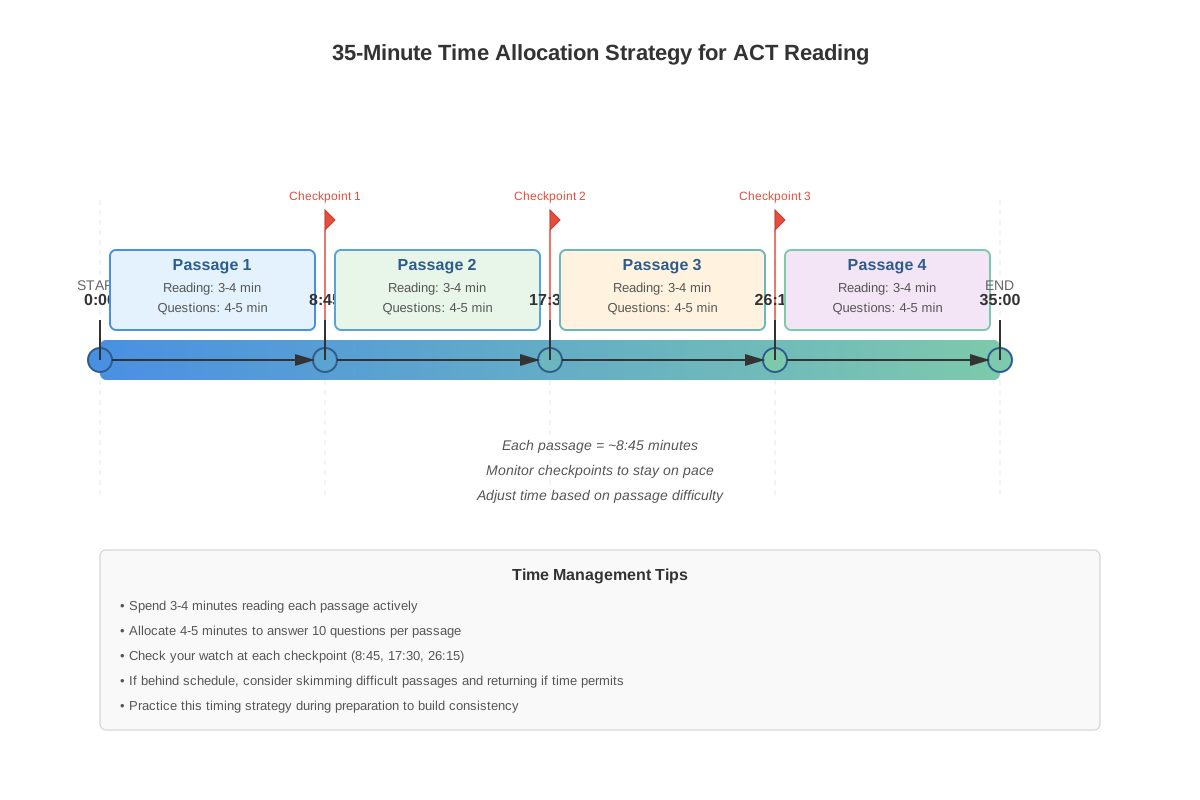
The ACT Reading section presents one of the most challenging time constraints in standardized testing: students must read four passages and answer 40 questions in just 35 minutes. This translates to approximately 8 minutes and 45 seconds per passage, including both reading time and question-answering time. Time management in reading is not merely about reading faster—it's about developing a strategic approach that maximizes accuracy while working within strict time limits. Students who master ACT time management in reading consistently outperform those with equal comprehension skills but poor pacing strategies.
Understanding time management for the ACT Reading section requires recognizing that this skill integrates multiple competencies: passage navigation, question prioritization, strategic skimming versus deep reading, and knowing when to move forward rather than perseverate on difficult questions. The difference between a score of 25 and a score of 32 often comes down not to reading ability, but to the efficient allocation of limited time resources. Students must learn to balance speed with accuracy, recognizing that rushing through passages leads to careless errors while spending too long on any single question creates a cascade effect that compromises performance on subsequent items.
Time management in reading connects fundamentally to all other ACT Reading concepts because it serves as the framework within which all other skills operate. Understanding passage types helps students allocate time appropriately based on difficulty and familiarity. Question type recognition enables faster identification of where to locate answers. Active reading strategies become more effective when deployed within a structured time framework. Essentially, time management is the meta-skill that allows all other reading competencies to function optimally under test conditions.
Learning Objectives
- [ ] Identify when time management in reading is being tested
- [ ] Explain the core rule or strategy behind time management in reading
- [ ] Apply time management in reading to ACT-style questions accurately
- [ ] Develop a personalized pacing strategy that allocates time across all four passages
- [ ] Recognize warning signs of poor time management during practice and actual testing
- [ ] Implement triage techniques to maximize points within time constraints
- [ ] Adjust reading speed and depth based on question types and passage difficulty
Prerequisites
- Basic reading comprehension skills: Students must be able to understand college-level prose passages without time constraints before learning to manage time effectively
- Familiarity with ACT Reading passage types: Understanding the four passage types (Literary Narrative/Prose Fiction, Social Science, Humanities, Natural Science) allows for appropriate time allocation strategies
- Knowledge of ACT question formats: Recognizing different question types enables students to estimate time requirements for various items
- Experience with full-length passages: Students should have read complete ACT-length passages to understand the typical reading load before implementing time strategies
Why This Topic Matters
Time management in reading represents one of the highest-leverage skills for ACT score improvement. Unlike content knowledge that requires extensive study, time management strategies can be learned and implemented relatively quickly, often producing immediate score gains of 3-5 points. The ACT deliberately creates time pressure to differentiate between students who can merely comprehend text and those who can process information efficiently—a skill highly valued in college coursework where students must complete extensive reading assignments within limited timeframes.
On the ACT Reading section, approximately 100% of questions are affected by time management because every question exists within the 35-minute constraint. Research on ACT performance indicates that roughly 60-70% of students report not finishing the Reading section, and among those who do finish, many rush through the final passage, resulting in significantly lower accuracy rates. Questions on the fourth passage typically show 10-15% lower accuracy rates than those on the first passage, not because they're inherently more difficult, but because students are rushing or have run out of time entirely.
Time management challenges appear in several specific ways on the ACT Reading section. First, passages vary in difficulty and density, with Natural Science passages often containing more technical vocabulary and Literary Narrative passages requiring closer attention to tone and character development. Second, questions themselves vary in time requirements—detail questions can often be answered in 20-30 seconds, while inference questions may require 45-60 seconds of careful reasoning. Third, the test deliberately includes time-consuming elements like EXCEPT questions, Roman numeral questions, and questions requiring comparison across multiple paragraphs. Students without effective time management strategies often spend 3-4 minutes on these complex questions, leaving insufficient time for easier questions later in the section.
Core Concepts
The 8-Minute Framework
The foundational principle of time management in reading on the ACT is the 8-minute framework: allocating approximately 8 minutes and 45 seconds per passage, which breaks down into roughly 3-4 minutes for reading and 4-5 minutes for answering questions. This framework provides structure while allowing flexibility based on individual reading speeds and passage difficulty. Students should aim to complete each passage within this timeframe, recognizing that some passages may take 7 minutes while others require 9 minutes, but the average should remain around 8-9 minutes.
The 8-minute framework must be practiced extensively because it feels unnaturally fast for most students initially. During practice, students should use a timer to track their pace on each passage, gradually building the ability to maintain this rhythm without constant clock-checking. The goal is to develop an internal sense of appropriate pacing—knowing intuitively when you're spending too long on a question or passage without becoming anxious about time.
Strategic Passage Selection
Not all passages are created equal, and strategic passage selection involves choosing the order in which to approach passages based on individual strengths and passage characteristics. The ACT always presents passages in the same order: Literary Narrative/Prose Fiction, Social Science, Humanities, and Natural Science. However, students are not required to complete passages in this order. Many high-scoring students begin with their strongest passage type, building confidence and momentum before tackling more challenging material.
Strategic passage selection requires self-awareness about personal strengths and weaknesses. Students who excel at analyzing literature might begin with the Prose Fiction passage, while those with strong science backgrounds might start with Natural Science. The key principle is to secure points on easier passages first, ensuring that time pressure doesn't cause errors on questions you should answer correctly. This strategy also provides a psychological advantage—starting with a confidence-building passage reduces test anxiety and improves overall performance.
The Two-Pass Question Strategy
The two-pass question strategy involves moving through questions in two distinct phases: first, answering all questions that can be completed quickly and confidently, then returning to more time-consuming or difficult questions. During the first pass, students should answer straightforward detail questions, vocabulary-in-context questions, and any other items where the answer location is immediately apparent. Questions that require extensive re-reading, complex inference, or comparison across multiple paragraphs should be marked and saved for the second pass.
This strategy maximizes point accumulation by ensuring that easy points are never left on the table due to time constraints. If time runs short, students have already answered the most accessible questions and can make educated guesses on remaining items. The two-pass strategy also reduces anxiety because students know they're not "stuck" on difficult questions—they can move forward and return if time permits.
Active Reading with Time Awareness
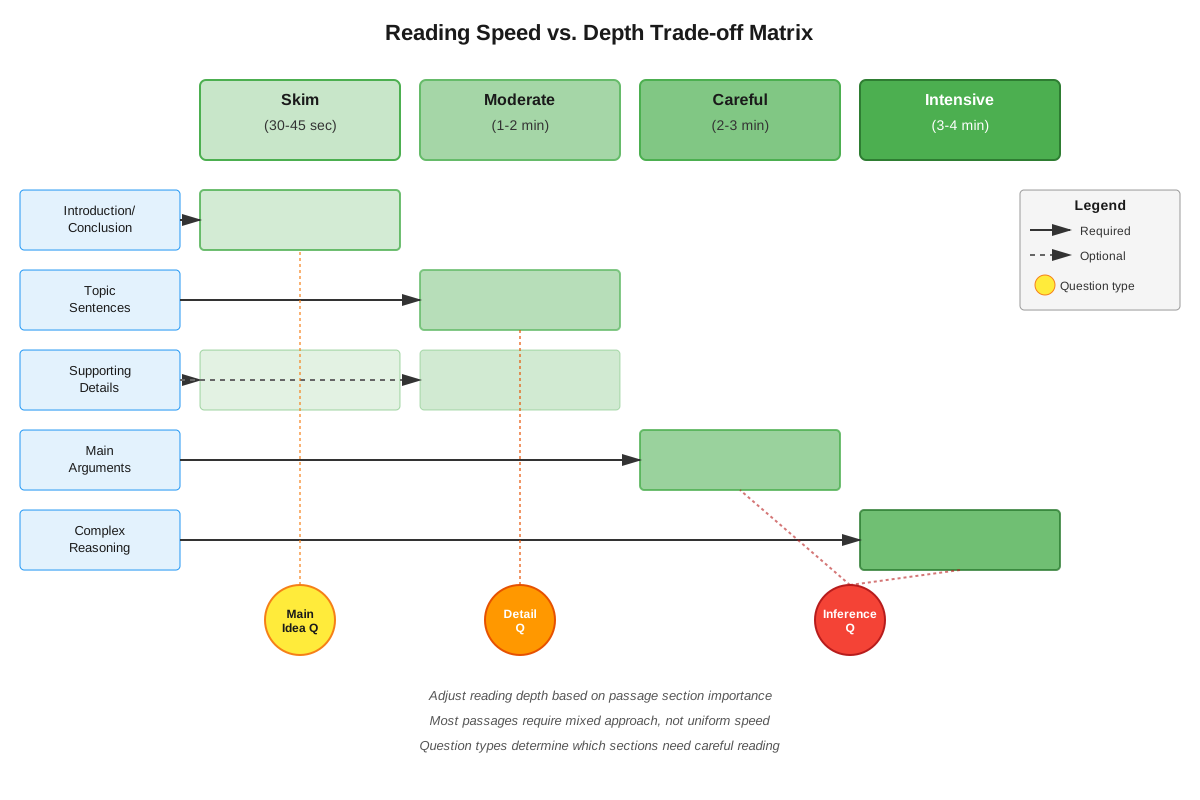
Active reading strategies must be adapted for time-constrained environments. On the ACT, students cannot read as slowly and carefully as they might for a literature class. Instead, they must practice active reading with time awareness, which involves reading at a brisk pace (approximately 250-300 words per minute) while still engaging with the text through mental summarization, noting main ideas, and tracking passage structure.
Effective active reading for the ACT includes several specific techniques:
- Paragraph-by-paragraph summarization: After each paragraph, mentally summarize the main point in 5-7 words
- Structural mapping: Note the purpose of each paragraph (introduction, example, counterargument, conclusion)
- Author's purpose tracking: Continuously ask "Why is the author including this information?"
- Selective annotation: Mark only the most crucial information (thesis, major transitions, key examples)
These techniques maintain comprehension while preventing the over-reading that consumes excessive time. Students should practice reading passages in 3-4 minutes while still being able to answer main idea and structure questions accurately.
Question Triage System
A question triage system categorizes questions by difficulty and time requirement, allowing students to make strategic decisions about where to invest their limited time. Questions can be classified into three categories:
| Category | Characteristics | Time Investment | Strategy |
|---|---|---|---|
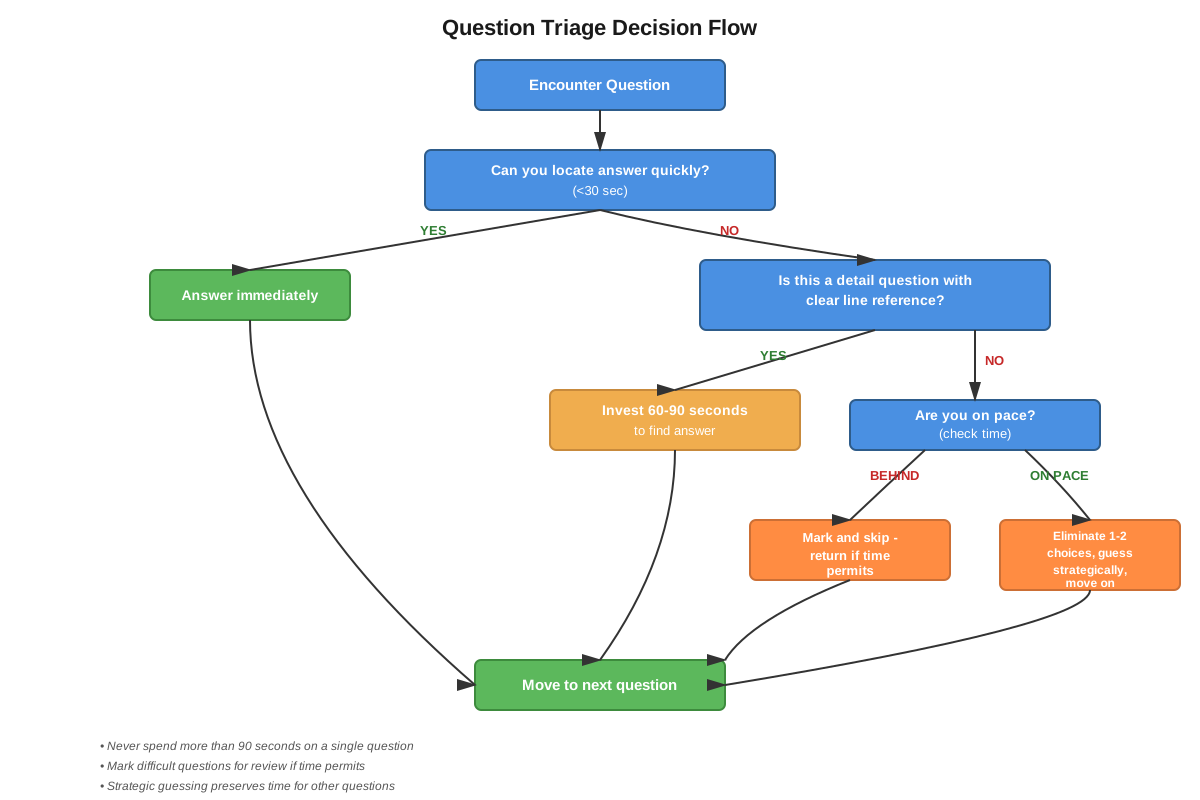
| Quick Points | Detail questions, vocabulary in context, clearly marked line references | 20-30 seconds | Answer immediately on first pass |
| Standard Questions | Most inference questions, function questions, moderate complexity | 45-60 seconds | Answer on first pass if comfortable, otherwise mark for second pass |
| Time Sinks | EXCEPT questions, Roman numeral questions, questions requiring extensive re-reading | 90+ seconds | Save for second pass, guess strategically if time is short |
The triage system prevents students from spending 2-3 minutes on a single difficult question while leaving easier questions unanswered. By recognizing time sinks immediately, students can make conscious decisions about whether to invest time or move forward and return later.
Pacing Checkpoints
Pacing checkpoints are specific time markers that help students monitor their progress and adjust their speed accordingly. Effective checkpoints for the ACT Reading section include:
- After Passage 1 (approximately 9 minutes elapsed): Check that you've completed the first passage and have 26 minutes remaining
- After Passage 2 (approximately 18 minutes elapsed): Confirm you're at the halfway point with 17 minutes remaining
- After Passage 3 (approximately 27 minutes elapsed): Ensure you have 8 minutes for the final passage
- With 5 minutes remaining: Be on the final passage with at least 5 questions completed
These checkpoints provide early warning if pacing is off-track, allowing for strategic adjustments. If a student reaches the first checkpoint at 11 minutes, they know to increase speed slightly on subsequent passages. If they reach it at 7 minutes, they may have rushed and should verify their answers or maintain a slightly more careful pace.
Strategic Guessing and Moving On
Perhaps the most difficult aspect of time management is knowing when to guess and move forward rather than continuing to work on a challenging question. The strategic guessing principle states: if you've spent 90 seconds on a question without making progress toward the answer, make your best guess and move on. This principle prevents the common scenario where students spend 3-4 minutes on a single question, ultimately guess anyway, and have sacrificed time that could have been used to answer multiple other questions correctly.
Strategic guessing involves making educated guesses rather than random selections. Even when uncertain, students can often eliminate 1-2 answer choices, improving their odds to 33-50% rather than 25%. The key is to make the guess decisively and move forward without ruminating on the question, which wastes additional mental energy and time.
Concept Relationships
The core concepts of time management in reading form an interconnected system where each element supports and enhances the others. The 8-minute framework provides the overarching structure within which all other strategies operate. This framework → enables → strategic passage selection, as students can only choose passage order effectively when they know they must maintain consistent pacing across all four passages.
Strategic passage selection → leads to → improved confidence and momentum, which → supports → more effective active reading with time awareness. When students begin with their strongest passage type, they read more efficiently and with better comprehension, reinforcing good pacing habits for subsequent passages.
Active reading with time awareness → directly enables → the two-pass question strategy, because students who read efficiently have adequate time to implement a two-pass approach. Conversely, students who spend 6-7 minutes reading a passage have insufficient time for two passes through the questions.
The question triage system → depends on → pacing checkpoints, as students can only make informed triage decisions when they know their current time status. If a student has fallen behind at a pacing checkpoint, they must be more aggressive in categorizing questions as time sinks and saving them for later (or guessing if necessary).
All of these strategies → culminate in → strategic guessing and moving on, which serves as the safety valve for the entire time management system. When other strategies haven't provided sufficient time, strategic guessing prevents complete time collapse and maximizes overall point accumulation.
These concepts also connect to prerequisite knowledge: understanding passage types informs strategic passage selection, while familiarity with question formats enables effective question triage. The entire time management system builds upon basic reading comprehension skills, as students must first be able to understand passages before they can learn to read them efficiently under time pressure.
High-Yield Facts
⭐ The ACT Reading section provides 8 minutes and 45 seconds per passage on average (35 minutes ÷ 4 passages)
⭐ Approximately 60-70% of students do not finish the ACT Reading section, making time management a significant competitive advantage
⭐ Questions on the fourth passage show 10-15% lower accuracy rates primarily due to time pressure, not increased difficulty
⭐ The optimal reading time for an ACT passage is 3-4 minutes, leaving 4-5 minutes for questions
⭐ EXCEPT questions and Roman numeral questions typically require 90+ seconds and should be saved for a second pass
- Students are not required to complete passages in the order presented and should consider starting with their strongest passage type
- Pacing checkpoints should occur after each passage to allow for strategic speed adjustments
- The two-pass question strategy (answering easy questions first, then returning to difficult ones) maximizes point accumulation under time constraints
- Active reading at 250-300 words per minute maintains comprehension while preventing over-reading
- If 90 seconds have been spent on a question without progress, strategic guessing and moving forward is more effective than continued work
- Detail questions with clear line references typically require only 20-30 seconds and should be answered immediately
- Spending more than 10 minutes on any single passage creates a cascade effect that compromises performance on remaining passages
- Mental paragraph-by-paragraph summarization maintains comprehension while supporting faster reading speeds
Quick check — test yourself on Time management in reading so far.
Try Flashcards →Common Misconceptions
Misconception: Reading faster automatically improves time management and scores.
Correction: Effective time management requires strategic reading, not just faster reading. Students who rush through passages without comprehension must re-read extensively when answering questions, ultimately spending more time overall. The goal is efficient reading with maintained comprehension, typically 250-300 words per minute with active engagement strategies.
Misconception: All questions require equal time investment, so students should work through them sequentially.
Correction: ACT Reading questions vary dramatically in time requirements, from 20-second detail questions to 2-minute EXCEPT questions. Sequential question-answering often results in spending excessive time on difficult questions while leaving easier questions unanswered. The two-pass strategy ensures maximum point accumulation by prioritizing quick, high-confidence questions.
Misconception: Checking the clock frequently helps maintain good pacing.
Correction: Excessive clock-checking increases anxiety and disrupts reading flow. Instead, students should establish pacing checkpoints (after each passage) and develop an internal sense of appropriate pacing through timed practice. Checking time 4 times during the section (after each passage) is sufficient.
Misconception: Students should always complete passages in the order presented (Prose Fiction, Social Science, Humanities, Natural Science).
Correction: The ACT does not require passages to be completed in order, and strategic passage selection based on individual strengths can improve both confidence and scores. Students should identify their strongest passage type during practice and consider starting with that type on test day to build momentum.
Misconception: Spending extra time on difficult questions demonstrates persistence and leads to correct answers.
Correction: After 90 seconds without progress on a question, additional time investment rarely leads to correct answers and creates time deficits that compromise performance on other questions. Strategic guessing and moving forward maximizes overall point accumulation. Students can return to difficult questions if time permits after completing easier items.
Misconception: Time management strategies only benefit slow readers.
Correction: Even fast readers benefit from time management strategies because the ACT Reading section challenges all students with time pressure. Fast readers who lack strategic approaches often rush through passages, miss important details, and make careless errors. Time management strategies help all students optimize their performance within the 35-minute constraint.
Misconception: Annotating passages extensively improves comprehension and is worth the time investment.
Correction: While selective annotation can be helpful, extensive underlining, circling, and note-taking consumes valuable time without proportional comprehension benefits. Students should limit annotation to major structural elements (thesis, key transitions, main examples) and rely primarily on mental summarization to track passage content.
Worked Examples
Example 1: Implementing the 8-Minute Framework
Scenario: A student is practicing with an ACT Natural Science passage about climate change. She needs to implement the 8-minute framework effectively.
Step 1 - Set the timer: Before beginning, set a timer for 8 minutes and 45 seconds. This creates accountability and builds awareness of appropriate pacing.
Step 2 - Read strategically (Target: 3-4 minutes): Begin reading the passage at a brisk but controlled pace (approximately 250-300 words per minute). After each paragraph, mentally summarize the main point:
- Paragraph 1: "Introduction to greenhouse effect basics"
- Paragraph 2: "Carbon dioxide's role in warming"
- Paragraph 3: "Recent temperature data showing increase"
- Paragraph 4: "Debate about human vs. natural causes"
- Paragraph 5: "Scientific consensus on human impact"
After completing the passage, check the timer. If 4 minutes or less have elapsed, proceed to questions. If more than 4.5 minutes have elapsed, note that reading speed needs to increase on future passages.
Step 3 - First pass through questions (Target: 3-4 minutes): Quickly scan all 10 questions, answering those that are straightforward:
- Question 1 (main idea): Answer immediately - 30 seconds
- Question 2 (detail with line reference): Answer immediately - 25 seconds
- Question 3 (inference requiring re-reading): Mark and skip - 10 seconds
- Question 4 (vocabulary in context): Answer immediately - 20 seconds
- Question 5 (detail with line reference): Answer immediately - 30 seconds
- Question 6 (EXCEPT question): Mark and skip - 10 seconds
- Question 7 (function question): Answer immediately - 40 seconds
- Question 8 (inference): Answer immediately - 45 seconds
- Question 9 (detail): Answer immediately - 25 seconds
- Question 10 (author's purpose): Answer immediately - 35 seconds
After the first pass, 7 questions are answered (approximately 3 minutes and 40 seconds elapsed), and 2 questions are marked for return.
Step 4 - Second pass (Target: remaining time): Return to marked questions:
- Question 3: Re-read relevant section and answer - 50 seconds
- Question 6 (EXCEPT): Work through each answer choice - 75 seconds
Step 5 - Check timing: Total time elapsed: 8 minutes and 30 seconds. This is within the target range, indicating effective pacing.
Key Learning: This example demonstrates how the 8-minute framework structures the entire passage approach, with specific time allocations for reading and question-answering. The two-pass strategy ensured that easy points were secured before investing time in more challenging questions.
Example 2: Strategic Passage Selection and Recovery
Scenario: A student is taking a full-length ACT Reading section. After completing the Prose Fiction passage (his weakest type), he checks the clock and realizes 11 minutes have elapsed—2 minutes behind pace.
Step 1 - Recognize the problem: At the first pacing checkpoint (after Passage 1), the student should have 26 minutes remaining but instead has only 24 minutes. This 2-minute deficit will compound if not addressed.
Step 2 - Implement strategic passage selection: Rather than proceeding to the Social Science passage (second in order), the student scans the remaining three passages and identifies that the Natural Science passage is about astronomy—a topic he finds interesting and reads quickly. He decides to complete Natural Science next, saving Social Science and Humanities for later.
Step 3 - Adjust reading strategy: Knowing he's behind pace, the student commits to reading the Natural Science passage in 3 minutes (rather than his usual 3.5 minutes) by:
- Reading at the upper end of his comfortable speed range
- Limiting annotation to only the thesis and major transitions
- Trusting his comprehension rather than re-reading any sentences
Step 4 - Implement aggressive question triage: During the question phase, the student is more decisive about skipping time-consuming questions:
- Immediately identifies and skips an EXCEPT question (saving 90+ seconds)
- Skips one complex inference question that would require extensive re-reading
- Answers 8 of 10 questions in first pass
Step 5 - Strategic guessing: With 4 minutes remaining for the passage and 2 questions unanswered, the student:
- Spends 60 seconds on the inference question, makes progress, and selects an answer
- Spends only 30 seconds on the EXCEPT question, eliminates one obviously wrong answer, and makes an educated guess among the remaining three
Step 6 - Check recovery: Total time for Natural Science passage: 7 minutes and 45 seconds. This is 1 minute faster than the target, recovering half of the initial deficit.
Step 7 - Continue with adjusted strategy: For the remaining two passages, the student maintains heightened awareness of pacing, continues aggressive question triage, and completes the section with 2 minutes remaining—enough time to return to 2-3 questions he had marked for review.
Key Learning: This example demonstrates how pacing checkpoints enable early problem detection, strategic passage selection can leverage individual strengths, and adjusted strategies can recover from time deficits. The student's willingness to make strategic guesses on time-consuming questions prevented the initial 2-minute deficit from becoming a catastrophic time collapse.
Exam Strategy
When approaching ACT Reading questions, students should develop a systematic process that maximizes efficiency while maintaining accuracy. Begin each passage by quickly scanning the questions (10-15 seconds total) to identify any that reference specific line numbers or paragraphs—this preview helps focus attention during reading. However, avoid reading questions in detail before the passage, as this consumes time without proportional benefit.
Trigger words and phrases that indicate time-consuming questions include:
- "EXCEPT" or "NOT" (requires checking all answer choices)
- "Roman numerals" (requires evaluating multiple statements)
- "In order to..." or "The author mentions X in order to..." (function questions requiring careful analysis)
- "Which of the following statements about..." without line references (requires searching entire passage)
- "Both passages..." or "Unlike Passage A..." (in paired passages, requires comparison)
When encountering these trigger phrases, immediately assess your current time status. If you're on pace or ahead, you can invest the necessary time. If you're behind pace, mark these questions for second pass or strategic guessing.
Process-of-elimination tips specific to time management:
- On first pass, if you can eliminate 2 answer choices within 15 seconds but cannot decide between the remaining 2, make your best guess and move on rather than spending 60+ additional seconds
- For EXCEPT questions, if you can identify 3 answer choices that are clearly supported by the passage, select the remaining choice without fully verifying it's incorrect—this saves 30-45 seconds
- When time is short (less than 2 minutes remaining), use aggressive elimination: read only the first half of each answer choice, eliminating those that are clearly wrong based on the opening words
Time allocation advice for different question types:
- Detail questions with line references: 20-30 seconds maximum
- Vocabulary in context: 20-30 seconds maximum
- Main idea questions: 30-45 seconds
- Inference questions: 45-60 seconds
- Function questions: 45-60 seconds
- EXCEPT questions: 90-120 seconds (save for second pass)
- Roman numeral questions: 90-120 seconds (save for second pass)
Develop a personal "time budget" for each passage based on these guidelines. If you've spent 3 minutes on the first 4 questions, you're likely spending too long per question and need to accelerate. Conversely, if you've completed 7 questions in 2 minutes, verify that you're not rushing and making careless errors.
Exam Tip: Practice with a visible timer during all preparation work, but position it where you must make a deliberate choice to look at it (not in constant peripheral vision). This builds time awareness without creating anxiety. On test day, check your time only at pacing checkpoints—after each passage.
Memory Techniques
The "3-4-5" Rule: Remember the time breakdown for each passage with "3-4-5":
- 3 minutes minimum for reading
- 4 minutes average for questions
- 5 questions should be answered in the first 2 minutes of question work
The "SKIP" Acronym for identifying time-sink questions:
- Several statements (Roman numerals)
- Komplex comparisons (across paragraphs or passages)
- Inverse questions (EXCEPT, NOT)
- Paragraph-wide searches (no line references)
The "Quarter System" Visualization: Imagine the 35-minute section divided into four quarters of approximately 8-9 minutes each. Visualize a pie chart with four equal slices, each representing one passage. This mental image helps maintain awareness that each passage deserves roughly equal time investment.
The "90-Second Rule" Hand Signal: During practice, make a physical gesture (such as tapping your paper twice) whenever you've spent 90 seconds on a question. This kinesthetic reinforcement builds awareness of when you've reached the decision point for strategic guessing.
The "Checkpoint Chant": Create a mental rhythm for pacing checkpoints: "Nine-Eighteen-Twenty-Seven-Done" (representing minutes elapsed after each passage: 9, 18, 27, and completion at 35). Rehearsing this sequence before the test helps you remember to check your pacing.
The "Traffic Light" System: Mentally categorize questions using traffic light colors:
- Green (go immediately): Detail questions with line references, vocabulary in context
- Yellow (proceed with caution): Standard inference questions, function questions
- Red (stop and save for later): EXCEPT questions, Roman numerals, complex comparisons
This color-coding system provides an intuitive framework for question triage that's easy to remember and apply under test pressure.
Summary
Time management in reading represents the meta-skill that enables all other ACT Reading competencies to function effectively within the 35-minute constraint. The foundation of effective time management is the 8-minute framework, which allocates approximately 8 minutes and 45 seconds per passage, broken down into 3-4 minutes for reading and 4-5 minutes for questions. Strategic passage selection allows students to leverage individual strengths by choosing passage order based on comfort and confidence rather than the presented sequence. The two-pass question strategy maximizes point accumulation by ensuring easy questions are answered before time-consuming items, preventing the common scenario where students run out of time with unanswered questions they could have completed correctly. Active reading with time awareness maintains comprehension at 250-300 words per minute through mental summarization and structural mapping. Question triage systems categorize items by time requirement, enabling strategic decisions about where to invest limited time resources. Pacing checkpoints after each passage provide early warning of time deficits, allowing for strategic adjustments before problems become catastrophic. Finally, strategic guessing and moving on prevents excessive time investment in single questions, recognizing that after 90 seconds without progress, additional time rarely leads to correct answers. Mastering these interconnected strategies transforms time from an obstacle into a manageable constraint, enabling students to demonstrate their true reading comprehension abilities under test conditions.
Key Takeaways
- The ACT Reading section provides 8 minutes and 45 seconds per passage on average; effective time management requires allocating approximately 3-4 minutes for reading and 4-5 minutes for questions
- Strategic passage selection based on individual strengths (rather than presented order) builds confidence and momentum while securing points on easier passages first
- The two-pass question strategy—answering quick, high-confidence questions first, then returning to time-consuming items—maximizes point accumulation and prevents leaving easy questions unanswered
- Question triage identifies time sinks (EXCEPT questions, Roman numerals, questions without line references) that should be saved for second pass or strategic guessing if time is short
- Pacing checkpoints after each passage (at 9, 18, and 27 minutes) enable early detection of time deficits and strategic adjustments before problems compound
- The 90-second rule states that if no progress has been made on a question after 90 seconds, strategic guessing and moving forward is more effective than continued work
- Active reading at 250-300 words per minute with mental paragraph summarization maintains comprehension while preventing the over-reading that consumes excessive time
Related Topics
Question Type Recognition and Strategy: Understanding the specific characteristics and optimal approaches for each ACT Reading question type (detail, inference, function, vocabulary-in-context, main idea) enables more accurate time estimation and efficient question-answering. Mastering time management provides the framework within which question-type strategies operate most effectively.
Active Reading Strategies: Techniques such as annotation, mental summarization, and structural mapping support comprehension while maintaining appropriate reading speed. Time management skills determine how these strategies are adapted for time-constrained environments versus untimed reading.
Passage Structure Analysis: Understanding how ACT passages are organized (introduction, development, examples, conclusion) enables faster comprehension and more efficient answer location. Time management and structure analysis work synergistically—structural awareness speeds reading, while good pacing ensures adequate time for structural analysis.
Evidence-Based Answer Selection: The skill of identifying textual evidence that supports answer choices becomes more efficient when combined with time management strategies. Students who manage time well have adequate opportunity to verify answers against passage evidence rather than rushing to conclusions.
Test Anxiety Management: Time pressure is a primary source of test anxiety, and effective time management strategies reduce anxiety by providing structure and control. Conversely, managing test anxiety improves time management by preventing panic-driven rushing or freezing.
Practice CTA
Now that you've mastered the strategies and concepts of time management in reading, it's time to put your knowledge into practice. Complete the practice questions and flashcards for this topic, applying the 8-minute framework, two-pass strategy, and question triage system you've learned. Remember that time management skills improve dramatically with deliberate practice—each timed passage you complete builds your internal sense of appropriate pacing and strengthens your ability to make strategic decisions under pressure. Approach practice with the same intensity and time constraints you'll face on test day, using pacing checkpoints to monitor your progress and adjust your strategies. Your investment in mastering time management will pay dividends not only on the ACT Reading section but throughout your academic career, where efficient information processing under time constraints is essential for success. You've got this—now go practice with purpose and watch your scores improve!
Sign up free to keep reading
Create a free AnvayaPrep account to finish this ACT guide on Time management in reading — plus flashcards and practice questions.