Overview
Environmental science data represents a critical component of the ACT Science test, appearing in approximately 20-30% of all science passages. This topic encompasses the interpretation and analysis of data related to ecosystems, pollution, climate patterns, natural resources, and human impacts on the environment. Unlike pure biology or chemistry questions, ACT environmental science data questions require students to synthesize information from multiple scientific disciplines while analyzing graphs, tables, and experimental designs that reflect real-world environmental scenarios.
Mastering environmental science data interpretation is essential for ACT success because these passages frequently combine multiple data representations—such as line graphs showing temperature trends over time, bar charts comparing pollution levels across regions, and tables presenting biodiversity measurements. The ACT Science section tests not memorization of environmental facts, but rather the ability to extract relevant information, identify trends, compare datasets, and draw logical conclusions from presented evidence. Students who excel at environmental science data questions demonstrate strong skills in pattern recognition, quantitative reasoning, and scientific literacy.
Environmental science data connects to broader scientific reasoning skills tested throughout the ACT Science section. The data interpretation strategies learned here apply equally to passages in physics, chemistry, and biology. Additionally, environmental science passages often integrate concepts from earth science (weather patterns, geological processes), biology (population dynamics, food webs), and chemistry (chemical reactions, pH levels), making this topic an excellent bridge between discrete scientific disciplines and reinforcing the interdisciplinary nature of modern scientific inquiry.
Learning Objectives
- [ ] Identify when Environmental science data is being tested in ACT passages
- [ ] Explain the core rule or strategy behind Environmental science data interpretation
- [ ] Apply Environmental science data analysis to ACT-style questions accurately
- [ ] Extract quantitative information from multiple data representations simultaneously
- [ ] Recognize common environmental science variables and their typical relationships
- [ ] Distinguish between correlation and causation in environmental datasets
- [ ] Evaluate the validity of conclusions based on presented environmental data
Prerequisites
- Basic graph reading skills: Understanding x-axis, y-axis, scales, and units is fundamental to interpreting any environmental data representation
- Scientific method knowledge: Recognizing independent variables, dependent variables, and controls helps identify what environmental factors are being tested
- Unit conversion familiarity: Environmental data often uses metric units (kilometers, kilograms, Celsius) that require comfortable navigation
- Percentage and ratio calculations: Many environmental questions involve comparing proportions or calculating percent change in populations or pollution levels
- Basic ecological vocabulary: Terms like population, ecosystem, and species should be familiar, though specific definitions will be provided in passages
Why This Topic Matters
Environmental science data interpretation skills extend far beyond standardized testing into real-world applications that affect daily decision-making and civic participation. Understanding how to read climate data, pollution reports, and biodiversity studies enables informed opinions on policy issues ranging from local water quality to global climate agreements. These analytical skills prepare students for college-level coursework in environmental science, public health, urban planning, and numerous STEM fields where data-driven decision-making is paramount.
On the ACT Science test, environmental science passages appear in 2-3 of the 6-7 total passages, making this one of the most frequently tested content areas. These passages typically present as Data Representation (30-40% of environmental questions) or Research Summaries (50-60% of environmental questions), with occasional appearances in Conflicting Viewpoints passages where scientists debate environmental issues. Questions range from straightforward data extraction ("According to Figure 1, what was the CO₂ level in 2010?") to complex synthesis ("Based on the relationship between temperature and species diversity shown in Study 2, which conclusion is most supported?").
Common manifestations of environmental science data on the ACT include: temperature and precipitation patterns over time, population growth or decline curves, pollution concentration measurements across different locations, energy consumption comparisons, soil composition analyses, water quality indicators (pH, dissolved oxygen, turbidity), biodiversity indices, and carbon cycle diagrams. Recognizing these recurring themes allows students to quickly orient themselves within passages and anticipate the types of questions that will follow.
Core Concepts
Types of Environmental Data Representations
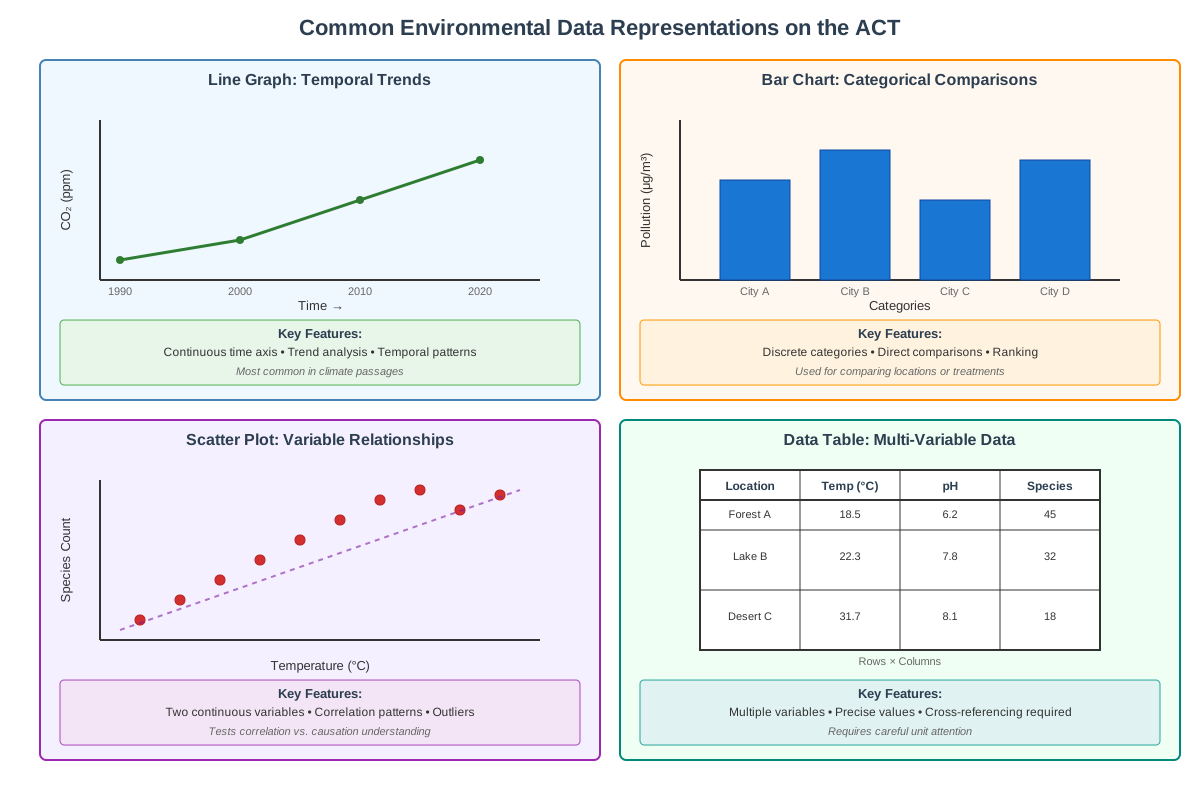
The ACT presents environmental science information through several standard formats, each requiring specific interpretation strategies. Line graphs most commonly display changes over time, such as atmospheric CO₂ concentrations across decades or seasonal temperature fluctuations. When analyzing line graphs, identify the time scale (hours, years, centuries), note whether multiple variables are plotted simultaneously, and look for inflection points where trends change direction.
Bar charts typically compare discrete categories, such as pollution levels across different cities or energy production from various sources (solar, wind, coal, nuclear). The key strategy involves comparing relative heights and identifying the highest and lowest values quickly. Scatter plots reveal relationships between two continuous variables, like the correlation between rainfall and crop yield or the relationship between elevation and species diversity. Students must determine whether relationships are positive (both increase together), negative (one increases as the other decreases), or absent (no clear pattern).
Tables present numerical data in organized rows and columns, often showing multiple measurements across different conditions or time periods. Environmental science tables frequently include units that vary by column (temperature in °C, precipitation in cm, population in thousands), requiring careful attention to avoid unit confusion. Pie charts occasionally appear to show proportional breakdowns, such as the percentage composition of greenhouse gases or land use categories within a region.
Key Environmental Variables and Relationships
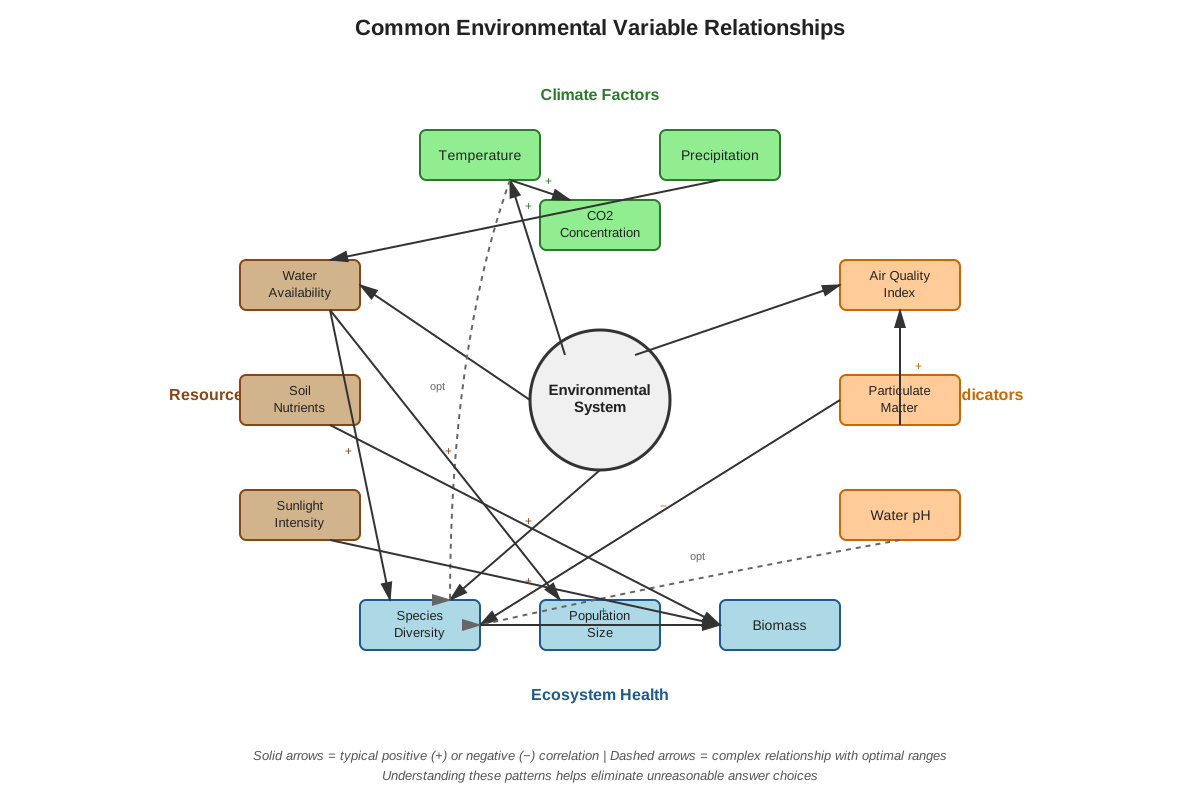
Understanding common environmental variables and their typical interactions accelerates passage comprehension. Temperature serves as an independent variable in countless environmental studies, affecting reaction rates, organism metabolism, water density, and atmospheric circulation patterns. Temperature generally correlates positively with evaporation rates and negatively with dissolved oxygen in water.
Precipitation (rainfall, snowfall) influences soil moisture, plant growth, erosion rates, and aquatic ecosystem health. The relationship between precipitation and biodiversity typically follows a positive correlation up to a threshold, beyond which flooding may reduce diversity. pH levels measure acidity or alkalinity on a 0-14 scale, with 7 being neutral. Environmental pH affects nutrient availability in soil, aquatic organism survival, and chemical weathering rates. Most organisms thrive in narrow pH ranges, making pH a critical limiting factor.
Population density (organisms per unit area) connects to resource availability, competition, and carrying capacity. ACT passages often present population data showing exponential growth followed by leveling at carrying capacity, or boom-and-bust cycles in predator-prey relationships. Dissolved oxygen (DO) in aquatic systems indicates water quality, with higher levels supporting more diverse aquatic life. DO decreases with increasing temperature and increases with water turbulence and photosynthesis.
Nutrient concentrations (nitrogen, phosphorus) affect primary productivity but can cause eutrophication when excessive. The relationship between nutrients and algae growth is positive until oxygen depletion occurs, creating dead zones. Carbon dioxide levels relate to photosynthesis rates, ocean acidification, and climate patterns through the greenhouse effect.
Data Analysis Strategies
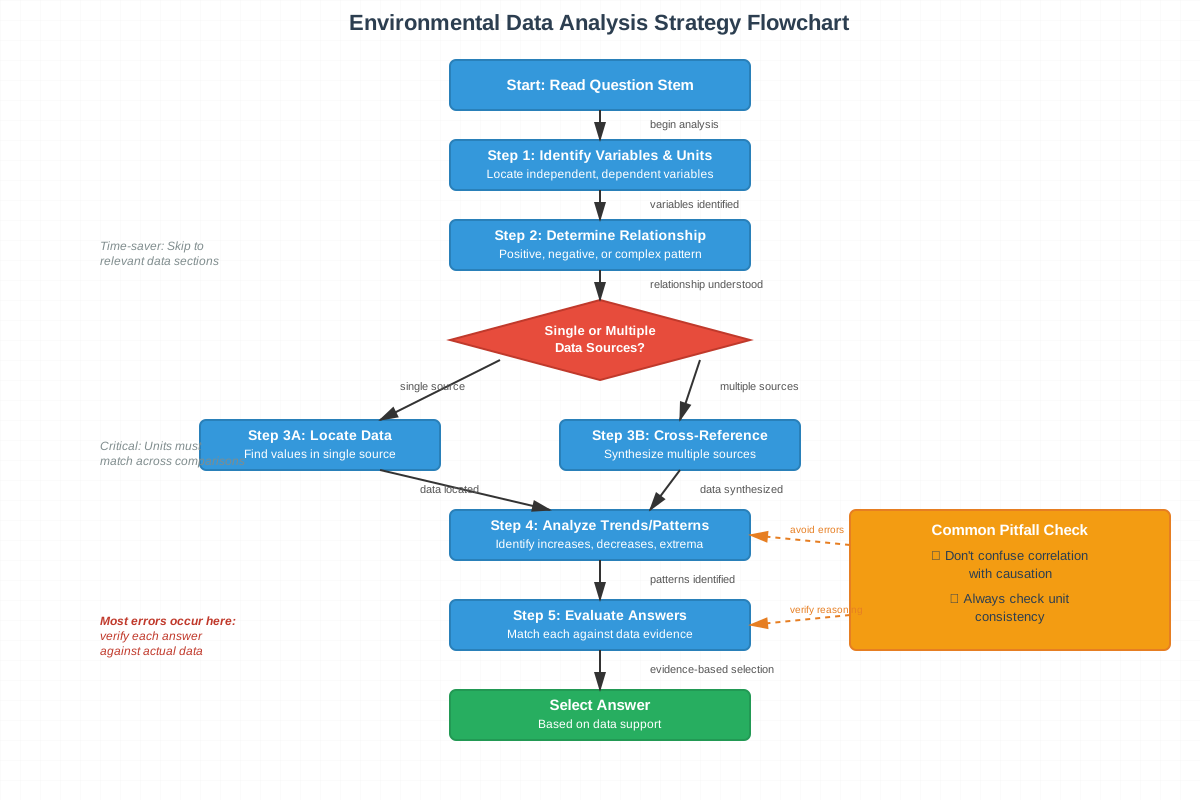
Effective environmental science data analysis follows systematic approaches. First, identify all variables by examining axis labels, table headers, and figure legends. Distinguish independent variables (manipulated by researchers or naturally varying) from dependent variables (measured outcomes). Second, determine the scale and units for each variable, noting whether scales are linear or logarithmic, and whether units change between figures.
Third, identify trends and patterns by looking for increases, decreases, cyclical patterns, or threshold effects. Many environmental relationships are non-linear, showing exponential growth, logarithmic curves, or bell-shaped distributions. Fourth, compare across conditions by examining how changing one variable affects others. ACT questions frequently ask students to predict outcomes under new conditions by extrapolating established patterns.
Fifth, integrate multiple data sources by connecting information from different figures or studies within the same passage. A question might require reading a temperature value from Figure 1 and then using that temperature to predict a population outcome shown in Figure 2. This cross-referencing skill distinguishes high-scoring students from average performers.
Common Environmental Science Scenarios
Certain environmental scenarios appear repeatedly on the ACT. Climate change studies present temperature records, ice core data, or sea level measurements over time, often requiring students to identify warming trends or correlate CO₂ with temperature. Pollution monitoring passages show contaminant concentrations across locations or time periods, testing whether students can identify sources, track dispersion patterns, or evaluate cleanup effectiveness.
Ecosystem studies examine species diversity, population dynamics, or food web relationships, often manipulating variables like predator presence, resource availability, or habitat size. Water quality assessments measure parameters like pH, dissolved oxygen, turbidity, and bacterial counts, requiring students to evaluate overall ecosystem health. Energy and resource studies compare renewable versus non-renewable sources, efficiency rates, or consumption patterns across regions or time periods.
Soil and agriculture passages present data on soil composition, nutrient levels, crop yields, or erosion rates under different management practices. These passages often test understanding of limiting factors—the resource in shortest supply that constrains growth.
Concept Relationships
Environmental science data interpretation builds upon fundamental graph reading skills, which enable extraction of specific values and identification of general trends. These basic skills → support comparative analysis across multiple datasets → which enables synthesis and prediction of outcomes under novel conditions. The progression from simple data extraction to complex synthesis mirrors the difficulty gradient of ACT questions within each passage.
Within environmental science specifically, understanding individual variables (temperature, pH, population density) → provides the foundation for recognizing variable relationships (how temperature affects dissolved oxygen) → which enables evaluation of ecosystem health and prediction of environmental changes. The concept of limiting factors connects to population dynamics, which relates to biodiversity patterns, which influences ecosystem stability—creating an interconnected web of environmental concepts.
Environmental science data interpretation also connects to the scientific method, as most passages present experimental or observational studies. Recognizing independent and dependent variables, controls, and experimental design strengthens the ability to evaluate data validity and draw appropriate conclusions. Additionally, quantitative reasoning skills (calculating percent change, comparing ratios, interpolating values) learned in mathematics directly apply to environmental data analysis, demonstrating the interdisciplinary nature of ACT Science.
High-Yield Facts
⭐ Environmental science passages appear in 2-3 of the 6-7 total ACT Science passages, making them among the most frequently tested topics
⭐ Temperature and time are the most common independent variables in environmental data representations
⭐ Dissolved oxygen in water decreases as temperature increases—an inverse relationship tested repeatedly
⭐ Population growth curves typically show exponential growth followed by leveling at carrying capacity
⭐ pH scale ranges from 0-14, with 7 being neutral; most organisms thrive in narrow pH ranges near neutral
- Eutrophication occurs when excess nutrients (nitrogen, phosphorus) cause algae blooms that deplete oxygen
- Biodiversity generally increases with habitat size and resource availability up to a threshold
- Carbon dioxide levels and global temperature show strong positive correlation in climate data
- Precipitation and plant growth typically show positive correlation in water-limited environments
- Species diversity often peaks at intermediate disturbance levels, not at maximum or minimum disturbance
- Turbidity (water cloudiness) increases with sediment and decreases with settling time or filtration
- Energy efficiency comparisons require calculating output energy divided by input energy
- Soil pH affects nutrient availability, with most nutrients most available near neutral pH
- Predator-prey relationships often show cyclical patterns with predator peaks lagging behind prey peaks
- Renewable energy sources (solar, wind) show variable output depending on weather conditions
Quick check — test yourself on Environmental science data so far.
Try Flashcards →Common Misconceptions
Misconception: Correlation always implies causation in environmental data → Correction: Two variables may correlate without one causing the other; both might be influenced by a third variable. For example, ice cream sales and drowning deaths correlate because both increase in summer, but ice cream doesn't cause drowning.
Misconception: Environmental data always shows linear relationships → Correction: Many environmental relationships are non-linear, showing exponential growth, logarithmic curves, threshold effects, or cyclical patterns. Population growth, for instance, is exponential initially but levels off at carrying capacity.
Misconception: Higher values always indicate better environmental conditions → Correction: Context determines whether high values are positive or negative. High dissolved oxygen is beneficial, but high turbidity, high pollution levels, or extremely high pH indicate poor conditions.
Misconception: All environmental changes occur gradually over long time periods → Correction: While some changes (climate shifts) occur over decades or centuries, others (algae blooms, fish kills, flooding) happen rapidly over days or weeks. ACT passages test both timescales.
Misconception: Environmental science questions require extensive outside knowledge → Correction: The ACT provides all necessary information within passages. Success depends on data interpretation skills, not memorized environmental facts. Students should extract answers from graphs and tables rather than relying on prior knowledge.
Misconception: Units don't matter as long as the numbers are correct → Correction: Misreading units is a common error source. A temperature of 30°C is very different from 30°F, and confusing mg/L with g/L changes values by a factor of 1000.
Misconception: The first figure always contains the answer to the first question → Correction: ACT questions deliberately jump between figures to test integration skills. Question 1 might reference Figure 2, while Question 3 might require combining information from Figures 1 and 3.
Worked Examples
Example 1: Multi-Variable Climate Data Analysis
Passage Context: Figure 1 shows atmospheric CO₂ concentration (ppm) from 1960-2020 as a line graph with values ranging from 315 ppm to 415 ppm, showing steady increase. Figure 2 shows global average temperature anomaly (°C above 1960 baseline) for the same period, ranging from 0°C to +1.2°C, also showing increase.
Question: Based on Figures 1 and 2, during which decade did both CO₂ concentration and temperature anomaly increase most rapidly?
Solution Process:
Step 1: Identify what "increase most rapidly" means—the steepest slope on each graph.
Step 2: Examine Figure 1 (CO₂) decade by decade:
- 1960-1970: Gradual increase, relatively shallow slope
- 1970-1980: Similar gradual increase
- 1980-1990: Slightly steeper increase
- 1990-2000: Steeper increase
- 2000-2010: Steepest increase
- 2010-2020: Very steep, similar to 2000-2010
Step 3: Examine Figure 2 (temperature) decade by decade:
- 1960-1970: Minimal change, nearly flat
- 1970-1980: Slight increase
- 1980-1990: Moderate increase
- 1990-2000: Steeper increase
- 2000-2010: Steepest increase
- 2010-2020: Continued steep increase
Step 4: Identify overlap—both variables show steepest increase during 2000-2010.
Answer: 2000-2010
Connection to Learning Objectives: This example demonstrates identifying environmental science data (climate variables), applying the core strategy of comparing slopes across time periods, and accurately answering an ACT-style synthesis question requiring analysis of multiple figures.
Example 2: Water Quality Assessment
Passage Context: Table 1 presents water quality measurements from four sampling sites along a river:
| Site | Distance from Factory (km) | pH | Dissolved Oxygen (mg/L) | Turbidity (NTU) | Fish Species Count |
|---|---|---|---|---|---|
| A | 0.5 | 6.2 | 4.1 | 45 | 3 |
| B | 2.0 | 6.8 | 5.8 | 28 | 7 |
| C | 5.0 | 7.1 | 7.2 | 12 | 12 |
| D | 10.0 | 7.3 | 8.1 | 8 | 15 |
Question: Based on Table 1, as distance from the factory increases, which statement best describes the relationship between dissolved oxygen and fish species diversity?
Solution Process:
Step 1: Identify the relevant variables—distance from factory (independent), dissolved oxygen (dependent), and fish species count (dependent).
Step 2: Track dissolved oxygen as distance increases:
- 0.5 km: 4.1 mg/L
- 2.0 km: 5.8 mg/L
- 5.0 km: 7.2 mg/L
- 10.0 km: 8.1 mg/L
Pattern: Dissolved oxygen increases with distance
Step 3: Track fish species count as distance increases:
- 0.5 km: 3 species
- 2.0 km: 7 species
- 5.0 km: 12 species
- 10.0 km: 15 species
Pattern: Fish diversity increases with distance
Step 4: Determine relationship between dissolved oxygen and fish diversity—both increase together, showing positive correlation.
Step 5: Consider biological reasoning (though not required)—higher dissolved oxygen supports more diverse fish communities because different species have different oxygen requirements.
Answer: As dissolved oxygen increases, fish species diversity increases, showing a positive correlation.
Connection to Learning Objectives: This example shows identifying environmental science data in table format, applying the strategy of tracking multiple variables simultaneously, recognizing common environmental relationships (DO and biodiversity), and distinguishing correlation patterns.
Exam Strategy
When approaching ACT environmental science data passages, begin with a 30-second preview of all figures and tables before reading questions. Note the types of data representations (graphs, tables, diagrams), identify the main variables being measured, and observe the general trends (increasing, decreasing, cyclical). This preview creates a mental map that accelerates question answering.
Trigger words signal specific question types and required strategies. "According to Figure X" indicates direct data extraction—find the specific value without interpretation. "Based on" or "consistent with" requires comparing data to conclusions. "If the trend continues" demands extrapolation beyond presented data. "Which hypothesis is supported" requires evaluating multiple figures to find supporting evidence. "Compared to" signals a comparison question requiring relative analysis rather than absolute values.
For process of elimination, first eliminate answers with values outside the range shown in figures or answers that contradict clear trends. If a graph shows consistent increase, eliminate any answer suggesting decrease. Second, eliminate answers requiring information not provided in the passage—the ACT never requires outside knowledge. Third, eliminate answers that confuse variables (swapping independent and dependent variables) or misread units.
Time allocation for environmental science passages should follow the 5-6 minute per passage guideline, with approximately 45-60 seconds per question. Data extraction questions (finding specific values) should take 30-40 seconds, while synthesis questions (combining multiple figures) may require 60-90 seconds. If a question requires more than 90 seconds, mark it and return after completing easier questions.
Common question patterns include: (1) Direct extraction—"What was the temperature at Site B?" (2) Trend identification—"As pH increased, dissolved oxygen..." (3) Comparison—"Which site had the highest biodiversity?" (4) Extrapolation—"If the pattern continues, what would the value be in 2025?" (5) Synthesis—"Based on Figures 1 and 2, which conclusion is supported?" (6) Experimental design—"Which variable was manipulated by the researchers?"
Exam Tip: When questions reference multiple figures, write down the value from the first figure before moving to the second. This prevents confusion and reduces the need to flip back and forth repeatedly.
Memory Techniques
TEMP-POP mnemonic for common environmental variables: Temperature, Elevation, Moisture, Precipitation, PH, Oxygen, Population. These seven variables appear in the majority of environmental science passages.
DO-DOWN for dissolved oxygen relationships: Dissolved Oxygen goes DOWN when temperature goes up, and DOWN when pollution goes up. This inverse relationship is heavily tested.
CLIP for analyzing any graph: Check axes and units, Look for trends, Identify highest/lowest values, Predict what happens beyond the data range. This four-step process ensures systematic graph analysis.
Visualization strategy: Picture environmental relationships as physical scenarios. Imagine hot water holding less dissolved oxygen (like a warm soda going flat faster than cold soda). Visualize population growth as a J-curve that flattens into an S-curve when hitting resource limits. These mental images make abstract data concrete.
SCALE acronym for table analysis: Scan for patterns, Check units carefully, Arrange data mentally from high to low, Look for relationships between columns, Eliminate impossible answers. This systematic approach prevents careless errors in table-based questions.
Summary
Environmental science data interpretation forms a cornerstone of ACT Science success, appearing in approximately one-third of all passages. Mastery requires systematic analysis of graphs, tables, and charts presenting information about ecosystems, pollution, climate, populations, and natural resources. The core strategy involves identifying variables, determining their relationships (positive correlation, negative correlation, or no relationship), and extracting or synthesizing information to answer questions. Success depends not on memorizing environmental facts but on developing strong data interpretation skills applicable across all scientific disciplines. Key environmental variables include temperature, pH, dissolved oxygen, precipitation, and population density, with common relationships such as the inverse correlation between temperature and dissolved oxygen appearing repeatedly. Students must practice reading multiple data representations simultaneously, tracking units carefully, distinguishing correlation from causation, and extrapolating trends beyond presented data ranges. The ACT rewards systematic approaches: preview figures before reading questions, use trigger words to identify question types, eliminate impossible answers quickly, and allocate time efficiently across questions of varying difficulty.
Key Takeaways
- Environmental science data appears in 2-3 of every 6-7 ACT Science passages, making it one of the highest-yield topics for focused study
- Success requires data interpretation skills, not memorization of environmental facts—all necessary information appears within passages
- Temperature and dissolved oxygen show an inverse relationship (as temperature increases, dissolved oxygen decreases) in aquatic systems
- Population growth typically follows exponential increase followed by leveling at carrying capacity, creating an S-shaped curve
- Always check units carefully when extracting values from graphs and tables, as unit confusion is a common error source
- Questions requiring synthesis of multiple figures test higher-order thinking and typically appear later in question sets
- Systematic approaches (CLIP for graphs, SCALE for tables) prevent careless errors and improve speed
Related Topics
Climate Science and Atmospheric Data: Building on environmental science data skills, climate passages present more complex long-term datasets including ice core records, atmospheric composition changes, and global temperature reconstructions. Mastering environmental data interpretation provides the foundation for analyzing these multi-century datasets.
Ecology and Population Dynamics: Advanced ecological passages explore predator-prey relationships, competition, symbiosis, and succession using mathematical models and field data. The population analysis skills developed in environmental science data directly transfer to these more complex ecological scenarios.
Chemistry of Natural Systems: Understanding how chemical principles apply to environmental contexts—such as pH in natural waters, nutrient cycling, or pollutant reactions—requires integrating environmental data interpretation with chemical reasoning. This interdisciplinary topic appears frequently in Research Summary passages.
Earth Science and Geological Data: Passages presenting rock layers, fossil records, geological time scales, and plate tectonics use similar data representation formats as environmental science but focus on longer time scales and different variables. The graph and table interpretation strategies transfer directly.
Practice CTA
Now that you've mastered the core concepts and strategies for environmental science data interpretation, it's time to apply these skills to authentic ACT-style questions. Complete the practice questions associated with this topic to reinforce your understanding of data extraction, trend identification, and multi-figure synthesis. Use the flashcards to memorize key relationships like the inverse correlation between temperature and dissolved oxygen, and common environmental variables. Remember: environmental science data questions reward systematic analysis and careful attention to units and scales. With focused practice, you'll develop the pattern recognition skills that enable quick, accurate responses on test day. Your investment in mastering this high-yield topic will pay dividends across multiple passages on every ACT Science section you encounter!
Sign up free to keep reading
Create a free AnvayaPrep account to finish this ACT guide on Environmental science data — plus flashcards and practice questions.