Overview
The counterargument is one of the most sophisticated and high-scoring elements of ACT Writing essays. When students address opposing viewpoints and explain why their position remains stronger despite these objections, they demonstrate critical thinking skills that ACT graders specifically look for in top-scoring essays. Understanding how to effectively incorporate ACT counterargument strategies separates essays that score in the 7-9 range from those that plateau at 4-6. This skill shows intellectual maturity and the ability to engage with complex ideas from multiple perspectives.
On the ACT Writing test, students must analyze three different perspectives on a contemporary issue and develop their own perspective while engaging with the provided viewpoints. The most effective essays don't simply ignore perspectives that differ from the writer's position—they acknowledge these alternative views, explain their merits, and then demonstrate why the writer's perspective is ultimately more compelling. This process of acknowledgment, consideration, and rebuttal forms the heart of counterargument strategy.
Counterargument connects directly to other essential Writing concepts including thesis development, evidence selection, and logical reasoning. A strong counterargument reinforces the main argument by showing that the writer has considered all angles of an issue. It also demonstrates the analytical thinking and perspective-taking skills that are fundamental to the Ideas and Analysis scoring domain, which accounts for one-fourth of the total Writing score.
Learning Objectives
- [ ] Identify when Counterargument is being tested in ACT Writing prompts and scoring rubrics
- [ ] Explain the core rule or strategy behind Counterargument construction and placement
- [ ] Apply Counterargument to ACT-style questions and essay prompts accurately
- [ ] Distinguish between weak acknowledgment and strong counterargument development
- [ ] Construct effective rebuttals that strengthen rather than undermine the main argument
- [ ] Integrate counterarguments seamlessly into essay structure without disrupting flow
- [ ] Evaluate the relative strength of different perspectives to determine which merit counterargument treatment
Prerequisites
- Basic argument structure: Understanding thesis statements, supporting evidence, and logical reasoning is essential because counterarguments must fit coherently within the overall argumentative framework
- Perspective analysis: The ability to understand and summarize different viewpoints accurately ensures that counterarguments address real opposing positions rather than straw man versions
- Paragraph organization: Knowledge of topic sentences, supporting details, and transitions allows for smooth integration of counterargument paragraphs into the essay structure
- Evidence evaluation: Skills in assessing the strength and relevance of different types of support help determine which counterarguments require the most thorough rebuttal
Why This Topic Matters
In professional and academic contexts, the ability to anticipate objections and address them preemptively demonstrates intellectual rigor and persuasive sophistication. Lawyers address counterarguments in briefs, scientists discuss alternative explanations in research papers, and business leaders acknowledge potential concerns when proposing new initiatives. The counterargument skill developed for the ACT transfers directly to college writing across disciplines.
On the ACT Writing test, counterargument appears in approximately 85-90% of essays scoring 9 or higher in the Ideas and Analysis domain. The scoring rubric explicitly rewards essays that "examine different perspectives" and "evaluate implications, complexities, and tensions." Essays that ignore opposing viewpoints or dismiss them without genuine engagement rarely score above a 6 in Ideas and Analysis, regardless of how well-written they may be in other respects.
Counterargument typically appears in ACT essays in several forms: dedicated counterargument paragraphs that address one of the provided perspectives, brief acknowledgments within body paragraphs that note limitations of the writer's own evidence, or comparative analysis that weighs multiple perspectives against each other. The most sophisticated essays integrate counterargument throughout rather than isolating it in a single paragraph, showing ongoing engagement with complexity.
Core Concepts
What Is a Counterargument?
A counterargument is the acknowledgment and examination of a viewpoint that opposes or differs from the writer's main argument. In ACT Writing, this typically involves engaging with one or more of the three provided perspectives that conflict with the writer's own perspective. Effective counterargument has three essential components: fair representation of the opposing view, genuine consideration of its merits or reasoning, and explanation of why the writer's position remains stronger despite the validity of certain opposing points.
The distinction between mere acknowledgment and true counterargument is crucial. Simply stating "Some people believe X, but they are wrong" does not constitute effective counterargument. Instead, strong counterargument demonstrates understanding: "Perspective Two raises the valid concern that X could lead to Y, and this concern deserves serious consideration given Z evidence. However, this risk can be mitigated through A and B approaches, and the benefits of my position still outweigh these potential drawbacks because..."
The Structure of Effective Counterargument
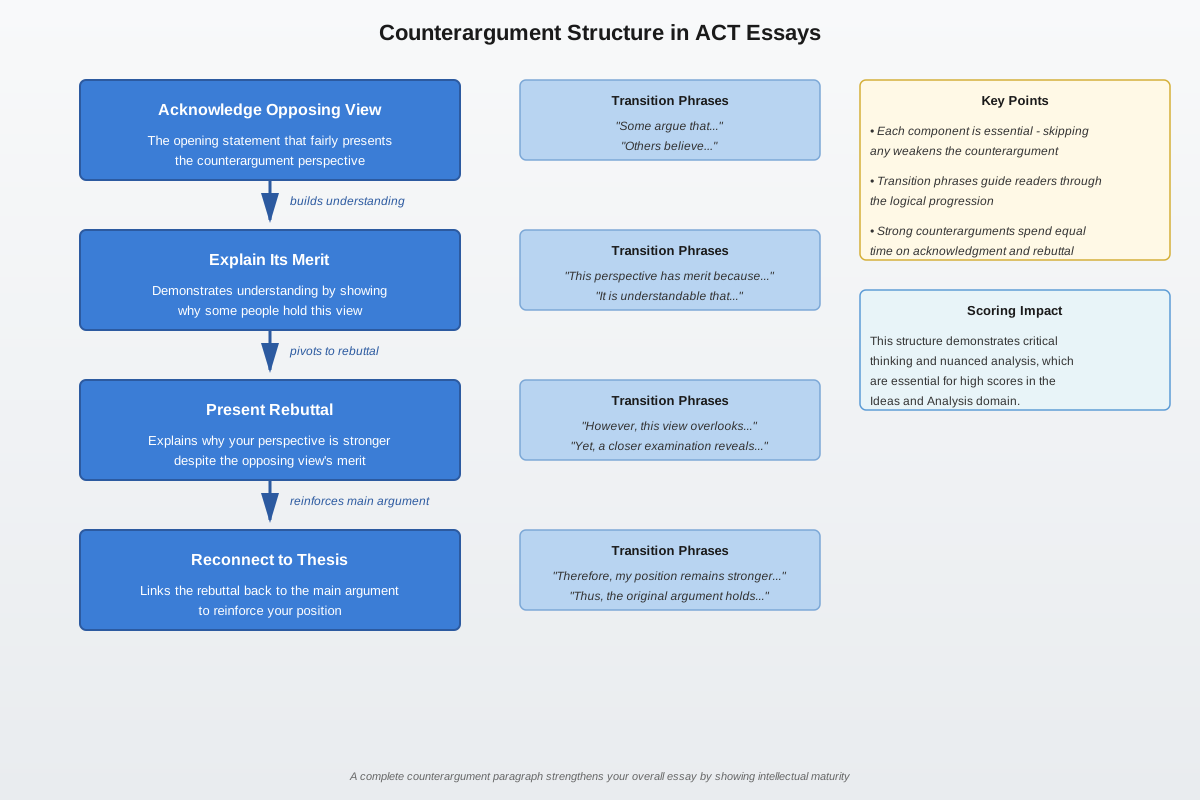
Effective counterargument follows a predictable pattern that ACT graders recognize and reward:
- Introduction of the opposing view: Present the counterargument fairly and accurately, often using phrases like "Proponents of Perspective Two argue that..." or "One might reasonably object that..."
- Acknowledgment of validity: Identify what is reasonable, logical, or compelling about the opposing position. This shows intellectual honesty and prevents the essay from appearing one-sided or naive.
- Rebuttal or limitation: Explain why, despite its merits, the opposing view is ultimately less convincing than the writer's position. This might involve showing that the opposing view applies only in limited circumstances, relies on questionable assumptions, or is outweighed by stronger considerations.
- Reinforcement of main argument: Connect the rebuttal back to the thesis, showing how addressing this counterargument actually strengthens the overall argument.
Types of Counterargument Approaches
| Approach | Description | When to Use | Example Signal Phrase |
|---|---|---|---|
| Concession-Refutation | Admit the opposing view has merit in some contexts, then show why your view is stronger overall | When the opposing view has genuine validity but limited scope | "While it is true that..., this overlooks..." |
| Alternative Explanation | Acknowledge the same evidence but interpret it differently | When both sides use similar facts but draw different conclusions | "This data could suggest X, but more likely indicates Y because..." |
| Questioning Assumptions | Identify and challenge the underlying premises of the opposing view | When the opposing argument rests on debatable foundations | "This perspective assumes that..., but this assumption is questionable given..." |
| Weighing Competing Values | Show that while the opposing view prioritizes one value, your view better balances multiple important considerations | When different perspectives emphasize different priorities | "Although Perspective Two rightly values X, it neglects the equally important consideration of Y..." |
Placement and Integration
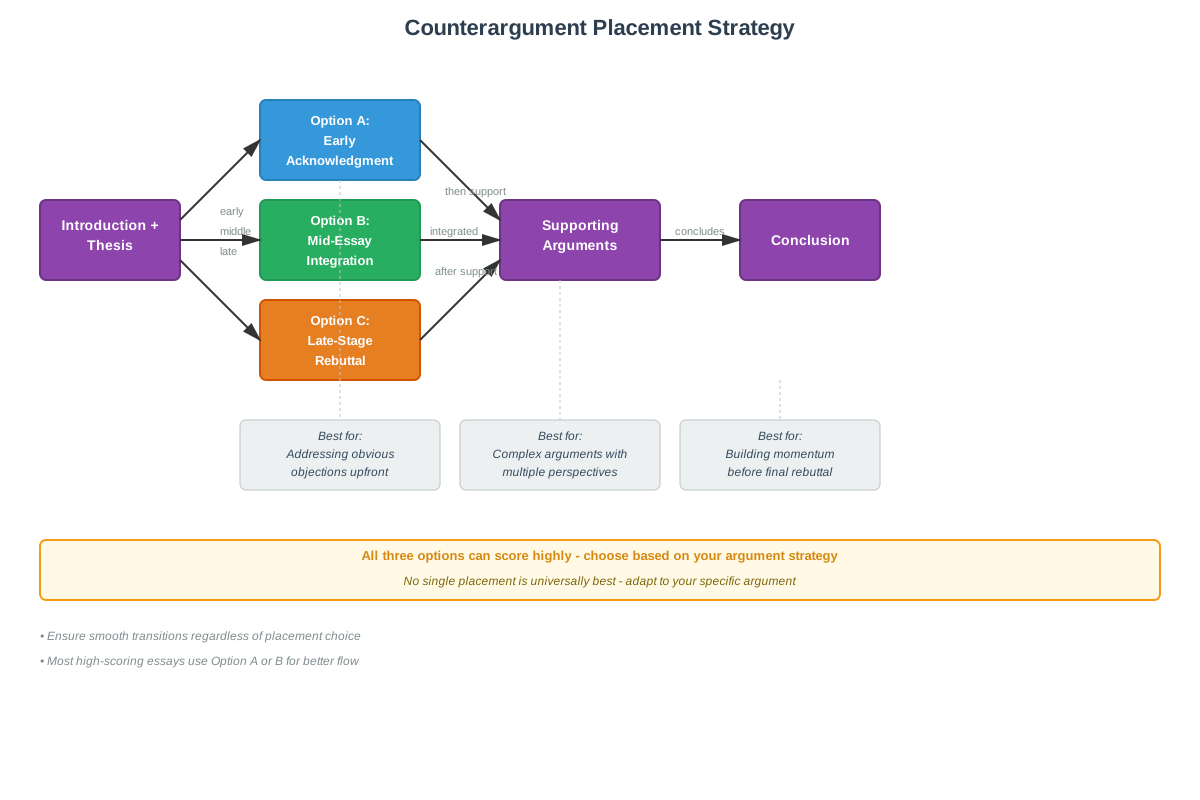
Counterargument can appear in multiple locations within an ACT essay, each with strategic advantages:
Dedicated counterargument paragraph: Typically placed after presenting the main supporting arguments, this approach allows for thorough development of the opposing view and detailed rebuttal. This placement (usually the third or fourth body paragraph) shows that the writer has built a strong case before addressing objections.
Integrated within body paragraphs: Brief counterargument moments can appear within paragraphs primarily devoted to supporting the main argument. For example, after presenting evidence for the main claim, the writer might note "While critics might point to X as a limitation, this concern is addressed by Y." This approach creates a more sophisticated, nuanced argument throughout.
Early acknowledgment: Some essays briefly acknowledge the strongest opposing view immediately after the introduction, then spend the body paragraphs systematically building the case for the writer's position. This approach works well when the opposing view is particularly compelling and needs to be addressed upfront.
The Rebuttal: The Heart of Counterargument
The rebuttal is where counterargument demonstrates its value. Weak rebuttals simply assert that the opposing view is wrong; strong rebuttals explain why and how the writer's position remains superior. Effective rebuttal strategies include:
- Showing limited applicability: "This concern applies primarily to X situation, but the majority of cases involve Y circumstances where my position is more appropriate"
- Demonstrating unintended consequences: "While this approach might achieve A, it would simultaneously create problems B and C that outweigh the benefits"
- Revealing false dichotomies: "This perspective assumes we must choose between X and Y, but a more nuanced approach can incorporate elements of both"
- Providing superior alternatives: "Rather than the either-or choice this perspective presents, a better solution would combine..."
Common Pitfalls in Counterargument
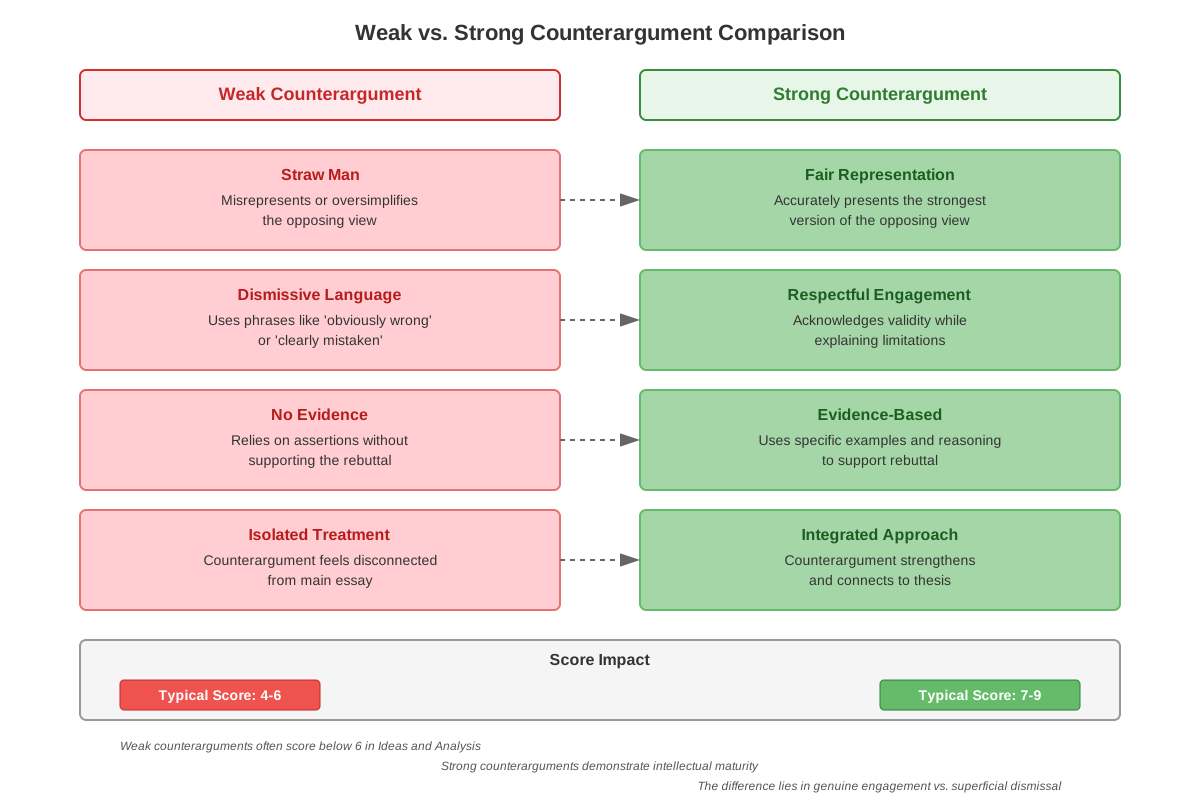
Students often make several mistakes when attempting counterargument. The straw man fallacy occurs when the writer misrepresents the opposing view to make it easier to refute, such as exaggerating its claims or ignoring its strongest points. The dismissive acknowledgment happens when students mention an opposing view but immediately dismiss it without genuine engagement: "Some people think X, but this is clearly wrong."
Another common error is the self-undermining counterargument, where the writer gives so much credit to the opposing view that it actually weakens the main argument. The key is balance: acknowledge genuine merits without conceding so much that the reader questions why the writer doesn't simply adopt the opposing position.
Concept Relationships
Counterargument connects directly to thesis development because the thesis must be defensible against objections. A thesis that cannot withstand counterargument is too weak or absolute. The process of considering counterarguments often leads writers to refine their thesis statements to be more nuanced and defensible.
The relationship flows: Thesis Statement → generates → Main Supporting Arguments → which anticipate → Potential Objections → which require → Counterargument and Rebuttal → which ultimately strengthen → Overall Argument.
Counterargument also relies heavily on evidence evaluation skills. To effectively rebut an opposing view, the writer must assess the quality, relevance, and sufficiency of evidence supporting that view. This creates a bidirectional relationship: strong evidence evaluation enables effective counterargument, and the process of constructing counterarguments sharpens evidence evaluation skills.
Within the ACT Writing scoring domains, counterargument primarily affects Ideas and Analysis (by demonstrating engagement with complexity and multiple perspectives) but also influences Development and Support (by adding depth to the argument) and Organization (by requiring smooth integration of opposing views into the essay structure).
High-Yield Facts
⭐ Essays scoring 9+ in Ideas and Analysis almost always include substantive counterargument that acknowledges opposing perspectives fairly before explaining why the writer's view is stronger
⭐ The ACT Writing rubric explicitly rewards "examining different perspectives" and "evaluating implications, complexities, and tensions"—all of which counterargument directly addresses
⭐ Effective counterargument requires three components: fair representation, acknowledgment of validity, and explanation of why the writer's position remains superior
⭐ Counterargument should address the strongest opposing view, not the weakest—refuting a weak objection does little to strengthen the argument
⭐ The rebuttal portion of counterargument must connect back to the thesis and show how addressing the objection actually reinforces the main argument
- Counterargument typically appears in 85-90% of essays scoring 8 or higher on the ACT Writing test
- The most sophisticated essays integrate counterargument throughout rather than isolating it in a single paragraph
- Signal phrases like "Admittedly," "While it is true that," "Proponents of this view argue," and "One might reasonably object" help introduce counterarguments smoothly
- Counterargument paragraphs typically require 6-8 sentences to develop fully: 2-3 sentences presenting the opposing view, 1-2 acknowledging its merits, 2-3 providing rebuttal, and 1 connecting back to the thesis
- The straw man fallacy (misrepresenting the opposing view) is one of the most common counterargument errors and significantly weakens the essay
- Effective counterargument demonstrates intellectual maturity and critical thinking—qualities ACT graders specifically look for in top-scoring essays
- Time management is crucial: students should allocate 5-7 minutes to developing counterargument within the 40-minute essay time limit
Quick check — test yourself on Counterargument so far.
Try Flashcards →Common Misconceptions
Misconception: Counterargument weakens the essay by giving attention to opposing views
Correction: Effective counterargument actually strengthens the essay by demonstrating that the writer has considered all angles and that the thesis holds up even when challenged. Ignoring opposing views makes the argument appear one-sided and naive.
Misconception: Counterargument means simply stating that the opposing view is wrong
Correction: True counterargument requires fair representation of the opposing view, acknowledgment of what is valid or reasonable about it, and then explanation of why the writer's position is ultimately more compelling. Simple dismissal is not counterargument.
Misconception: The counterargument paragraph should address all three perspectives that differ from the writer's view
Correction: Effective counterargument focuses on the strongest or most relevant opposing perspective and develops it thoroughly. Trying to address multiple opposing views in one paragraph typically results in superficial treatment of each.
Misconception: Counterargument should always appear in a dedicated paragraph separate from the main supporting arguments
Correction: While a dedicated counterargument paragraph is one effective approach, sophisticated essays often integrate counterargument throughout, addressing potential objections within body paragraphs that primarily support the main argument.
Misconception: The rebuttal should completely demolish the opposing view and show it has no merit whatsoever
Correction: The most effective rebuttals acknowledge that the opposing view has some validity in certain contexts or raises legitimate concerns, but then explain why the writer's position is stronger overall, addresses more important considerations, or provides a better balance of competing values.
Misconception: Counterargument is optional and only necessary if there's extra time at the end of the essay
Correction: Counterargument is essential for achieving top scores in Ideas and Analysis. It should be planned from the beginning as an integral part of the essay structure, not treated as an optional addition.
Worked Examples
Example 1: Technology in Education Prompt
Prompt Context: The ACT prompt presents three perspectives on whether schools should increase technology use in classrooms. Perspective One argues for maximum technology integration, Perspective Two advocates for minimal technology to preserve traditional learning, and Perspective Three suggests balanced, selective use.
Student's Position: The writer supports Perspective Three (balanced approach) and needs to address Perspective One (maximum technology integration).
Weak Counterargument Attempt:
"Some people think schools should use as much technology as possible. However, this is wrong because too much screen time is bad for students. Therefore, a balanced approach is better."
Why This Is Weak: This counterargument commits several errors. It misrepresents Perspective One by reducing it to "as much technology as possible" without acknowledging its reasoning. It dismisses the view without genuine engagement. The rebuttal is superficial and doesn't explain why or how the balanced approach addresses the legitimate goals of technology integration.
Strong Counterargument:
"Perspective One raises compelling points about technology's potential to personalize learning and prepare students for a digital workforce. Indeed, adaptive learning software can identify individual student needs and adjust difficulty levels in ways that traditional instruction cannot easily replicate. Furthermore, technological literacy is undeniably essential for success in most modern careers. However, this perspective overlooks the research showing that excessive screen time correlates with decreased attention spans and reduced face-to-face social skill development—skills that remain crucial regardless of technological advancement. More importantly, the assumption that maximum technology integration automatically produces better outcomes ignores the quality of implementation. A balanced approach that strategically deploys technology for tasks where it offers genuine advantages (such as data visualization or collaborative projects) while preserving direct instruction and hands-on activities for concept development actually achieves Perspective One's goals more effectively than blanket technology adoption. By being selective rather than comprehensive, schools can maximize technology's benefits while minimizing its drawbacks."
Why This Is Strong: This counterargument fairly represents Perspective One and acknowledges its valid points (personalized learning, workforce preparation). It then provides specific, reasoned rebuttal (attention span research, implementation quality matters) and shows how the writer's balanced approach actually achieves the opposing view's goals more effectively. The counterargument strengthens rather than merely defends the thesis.
Example 2: Community Service Requirements Prompt
Prompt Context: Three perspectives on whether high schools should require community service for graduation. The writer opposes mandatory service requirements.
Student's Position: Community service should be voluntary, not required.
Effective Counterargument Development:
"Admittedly, Perspective Two's argument for mandatory community service requirements deserves serious consideration. Proponents correctly note that required service exposes students to community needs they might otherwise never encounter, potentially inspiring lifelong civic engagement. The data supporting this perspective is not insignificant: studies show that approximately 60% of students who complete required service continue volunteering afterward, suggesting that the mandate does create lasting positive habits for many participants.
Nevertheless, this perspective underestimates the crucial difference between intrinsically and extrinsically motivated service. When students volunteer because they genuinely care about a cause, they invest more effort, develop deeper connections with the communities they serve, and gain more meaningful learning experiences. Mandatory service, by contrast, often becomes a box-checking exercise where students select the easiest or most convenient option rather than causes that genuinely resonate with them. More fundamentally, the concept of 'mandatory volunteering' contains an inherent contradiction—true service stems from generosity and choice, not obligation. By requiring service, schools risk teaching students that helping others is a burden to be endured rather than a privilege to be embraced.
Rather than mandating service, schools could achieve Perspective Two's laudable goals through alternative approaches: showcasing diverse service opportunities, recognizing outstanding volunteers, and integrating service-learning into existing coursework where students see direct connections between their studies and community needs. These methods would expose students to community engagement while preserving the voluntary nature that makes service meaningful."
Analysis: This extended counterargument demonstrates several sophisticated techniques. It uses specific data (60% continuation rate) to show genuine engagement with the opposing view's evidence. It identifies the core assumption (that exposure alone creates engagement) and challenges it with reasoning about intrinsic versus extrinsic motivation. Most importantly, it offers alternative solutions that achieve the opposing view's goals without its drawbacks, showing that the writer has thought deeply about the issue from multiple angles.
Exam Strategy
When approaching ACT Writing prompts, immediately identify which of the three provided perspectives most strongly opposes your own position—this will be your primary counterargument target. During the planning phase (first 5-8 minutes), jot down 2-3 specific points that make this opposing perspective appealing or reasonable. This prevents you from creating a straw man version that's easy to knock down but doesn't reflect the actual strength of the opposing view.
Trigger phrases that signal opportunities for counterargument in your own writing include: "One might argue," "Critics contend," "Admittedly," "While it is true that," "Proponents of this view suggest," and "A reasonable objection would be." These phrases help you transition smoothly into counterargument mode and signal to graders that you're engaging with complexity.
For process of elimination in multiple-choice questions about argument structure (if applicable in related ACT sections), eliminate answer choices that suggest ignoring opposing views entirely or that recommend dismissing objections without explanation. The ACT consistently rewards nuanced engagement over one-sided argumentation.
Time allocation is critical: plan to spend approximately 8-10 minutes of your 40-minute essay time on counterargument development. This typically means 2-3 minutes during planning to identify the strongest opposing view and outline your rebuttal, and 5-7 minutes during drafting to write the counterargument paragraph or integrate counterargument moments throughout your essay. If you're running short on time, a well-developed counterargument is more valuable than a third supporting paragraph that simply adds another reason for your position.
Exam Tip: The strongest counterarguments address the opposing view that is most different from your own position, not the one that's easiest to refute. Graders recognize when students cherry-pick weak objections to knock down.
Watch for complexity indicators in the prompt itself. Phrases like "tensions," "competing values," "trade-offs," or "unintended consequences" signal that the prompt is specifically designed to reward counterargument. When you see these indicators, make counterargument a central feature of your essay, not an afterthought.
Memory Techniques
ACE Counterargument: Remember that effective counterargument requires three components:
- Acknowledge the opposing view fairly
- Concede what is valid or reasonable about it
- Explain why your position is ultimately stronger
The STAR Method for rebuttal development:
- State the opposing view
- Tell what's reasonable about it
- Analyze its limitations or problems
- Reconnect to your thesis
Visualization Strategy: Picture counterargument as a bridge. One side represents the opposing view, the other represents your position. The bridge itself is the counterargument—it acknowledges both sides exist, allows you to cross over to understand the opposing view, but ultimately leads back to your position, now stronger because you've made the journey.
The "Yes, But, Because" Formula: When drafting counterargument quickly, use this structure:
- "Yes, [opposing view] raises the valid point that [specific concern]"
- "But this perspective overlooks/underestimates [limitation]"
- "Because [explanation], my position of [thesis] remains stronger"
Acronym for Common Rebuttal Strategies - QUAL:
- Question underlying assumptions
- Unveil unintended consequences
- Apply only in limited contexts
- Leverage superior alternatives
Summary
Counterargument is an essential component of high-scoring ACT Writing essays, demonstrating the intellectual sophistication and critical thinking that graders specifically reward in the Ideas and Analysis domain. Effective counterargument requires three key elements: fair representation of opposing views, genuine acknowledgment of their merits or reasoning, and clear explanation of why the writer's position remains superior despite valid objections. Rather than weakening the essay, well-developed counterargument actually strengthens the overall argument by showing that the thesis can withstand scrutiny from multiple perspectives. Students should identify the strongest opposing perspective during the planning phase, allocate 8-10 minutes to counterargument development, and integrate rebuttals that connect back to the thesis. The most sophisticated essays don't isolate counterargument in a single paragraph but instead demonstrate ongoing engagement with complexity throughout. By mastering counterargument strategies—including concession-refutation, questioning assumptions, and weighing competing values—students can elevate their essays from competent to exceptional, consistently achieving scores of 8 or higher in Ideas and Analysis.
Key Takeaways
- Counterargument is essential for scoring 8+ in Ideas and Analysis; it appears in 85-90% of top-scoring essays and demonstrates engagement with complexity
- Effective counterargument has three components: fair representation of the opposing view, acknowledgment of its validity, and explanation of why your position is stronger
- Address the strongest opposing perspective, not the weakest—refuting a compelling objection strengthens your argument far more than dismissing a weak one
- The rebuttal must do more than simply disagree; it should explain why, how, and under what conditions your position is superior
- Counterargument can be integrated throughout the essay or developed in a dedicated paragraph, but it must be planned from the beginning, not added as an afterthought
- Common errors include straw man fallacies, dismissive acknowledgment, and self-undermining concessions that give too much credit to the opposing view
- Use signal phrases like "Admittedly," "While it is true that," and "Proponents argue" to introduce counterarguments smoothly and demonstrate sophisticated thinking
Related Topics
Thesis Development and Refinement: Understanding counterargument helps writers craft more defensible, nuanced thesis statements that anticipate objections. Mastering counterargument naturally leads to stronger thesis construction.
Evidence Evaluation and Analysis: The skills used to assess the strength of opposing arguments transfer directly to evaluating evidence for your own position. These topics are mutually reinforcing.
Logical Fallacies and Reasoning: Recognizing fallacies in opposing arguments (and avoiding them in rebuttals) deepens understanding of both counterargument and logical reasoning more broadly.
Perspective Analysis: The ACT Writing test requires engaging with three provided perspectives. Counterargument skills enable more sophisticated analysis of how these perspectives relate to each other and to your own position.
Organization and Transitions: Integrating counterargument smoothly requires advanced organizational skills and sophisticated transitional phrases that signal shifts between supporting and opposing views.
Practice CTA
Now that you understand the principles and strategies of effective counterargument, it's time to apply these concepts to actual ACT-style prompts. The practice questions and flashcards will help you identify counterargument opportunities, construct effective rebuttals, and integrate opposing views smoothly into your essays. Remember: counterargument isn't just about acknowledging other perspectives—it's about demonstrating that your position is strong enough to withstand scrutiny from multiple angles. Each practice essay you write is an opportunity to refine this crucial skill. Start practicing today, and watch your Ideas and Analysis scores climb!
Sign up free to keep reading
Create a free AnvayaPrep account to finish this ACT guide on Counterargument — plus flashcards and practice questions.