Overview
The ACT Writing test presents a unique challenge: students must produce a well-organized, persuasive essay in just 40 minutes. ACT writing time management is the strategic allocation of these precious minutes across the planning, drafting, and revising phases of essay composition. Unlike multiple-choice sections where students can skip and return to questions, the essay demands a linear workflow where poor time management can result in incomplete arguments, missing perspectives, or rushed conclusions that significantly lower scores.
Mastering ACT writing time management is essential because the essay scoring rubric evaluates not just what students write, but how completely and coherently they develop their ideas. An essay that presents brilliant insights in the first two paragraphs but lacks a conclusion or fails to address all three perspectives will score lower than a fully developed essay with moderate insights. Time management directly impacts a student's ability to demonstrate all four scoring domains: Ideas and Analysis, Development and Support, Organization, and Language Use and Conventions.
This topic sits at the intersection of strategic planning and execution within the Essay Organization and Style unit. While other topics in this unit address what to write and how to structure arguments, time management governs when and how efficiently students complete each component. Effective time management enables students to implement organizational strategies, develop sophisticated analysis, and maintain stylistic consistency—all within the strict 40-minute constraint that defines the ACT Writing test.
Learning Objectives
- [ ] Identify when ACT writing time management is being tested
- [ ] Explain the core rule or strategy behind ACT writing time management
- [ ] Apply ACT writing time management to ACT-style questions accurately
- [ ] Create and execute a personalized time allocation plan for the 40-minute essay period
- [ ] Recognize warning signs of time mismanagement during the writing process
- [ ] Adjust pacing strategies in real-time based on progress checkpoints
- [ ] Prioritize essay components to maximize scoring potential when time runs short
Prerequisites
- Basic essay structure knowledge: Understanding introductions, body paragraphs, and conclusions is necessary because time management strategies allocate specific minutes to each structural component
- Familiarity with ACT Writing prompt format: Recognizing the three-perspective structure allows for efficient planning without wasting time deciphering the task
- Typing or handwriting speed baseline: Knowing personal composition speed enables realistic time allocation for drafting phases
- Understanding of the ACT Writing scoring rubric: Awareness of the four scoring domains helps prioritize which elements deserve the most time investment
Why This Topic Matters
In real-world academic and professional settings, time-constrained writing is ubiquitous—from college essay exams to workplace reports with tight deadlines. The time management skills developed for the ACT Writing test transfer directly to these scenarios, teaching students to balance quality with efficiency and to make strategic decisions about depth versus breadth of coverage.
On the ACT itself, time management appears in every single Writing test administration. While the exam doesn't explicitly test time management as a separate skill, it creates conditions where poor time management guarantees lower scores. According to ACT data, approximately 15-20% of test-takers fail to write a conclusion paragraph, and another 25-30% produce conclusions that are clearly rushed or underdeveloped. These statistics directly correlate with inadequate time management rather than lack of writing ability.
The topic manifests in several observable ways during the exam. Students who mismanage time typically produce essays with disproportionate paragraph lengths (an extensive introduction but thin body paragraphs), incomplete analysis of all three perspectives, missing transitions between ideas, and increased grammatical errors in later paragraphs as panic sets in. Conversely, students who implement effective time management strategies demonstrate consistent paragraph development, complete structural elements, and maintained writing quality throughout the essay.
Core Concepts
The 40-Minute Framework
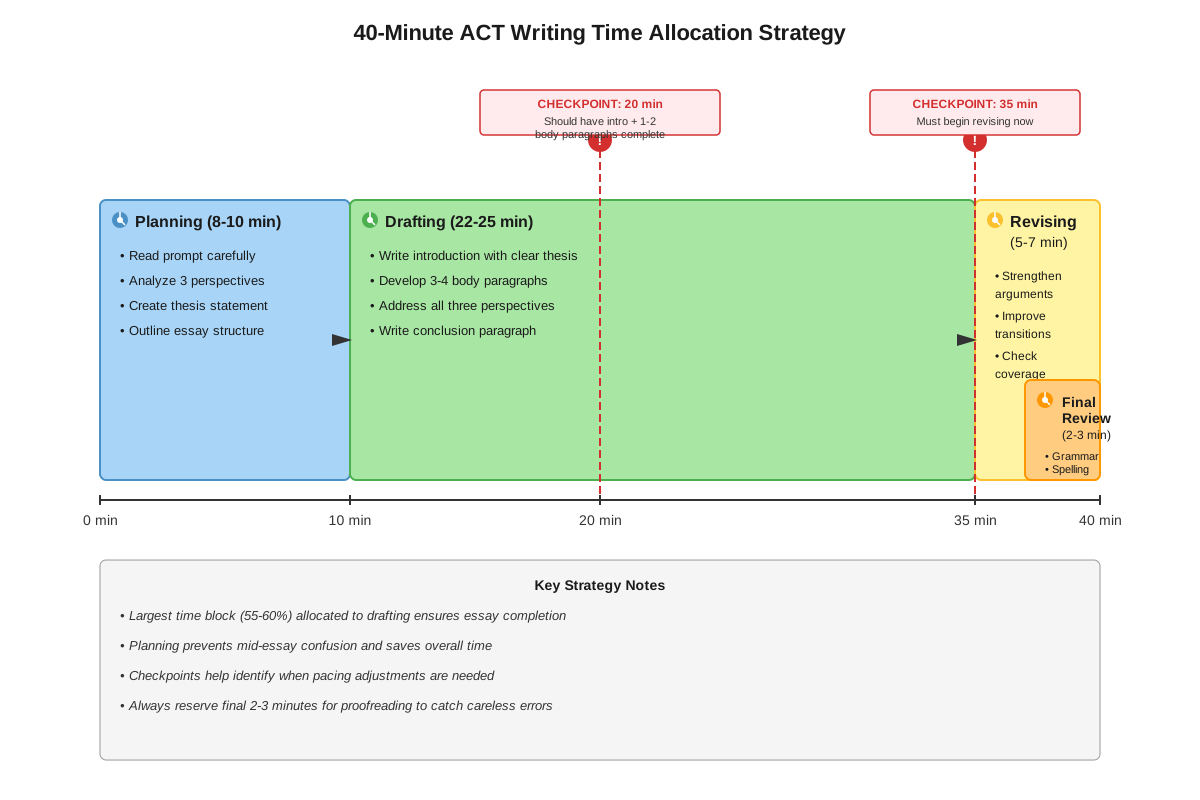
The ACT provides exactly 40 minutes for the Writing test, and this non-negotiable constraint requires a structured approach. The most effective time management strategy divides these 40 minutes into three distinct phases: planning (8-10 minutes), drafting (25-27 minutes), and revising (3-5 minutes). This allocation reflects the cognitive demands of each phase and the relative impact on scoring.
The planning phase, though it produces no visible text, is the highest-leverage use of time. These 8-10 minutes allow students to analyze the prompt, evaluate all three perspectives, formulate a thesis, and create a detailed outline. Students who skip or rush planning inevitably waste more time during drafting as they pause to figure out what to write next, often producing disorganized essays that require extensive revision.
The drafting phase consumes the majority of available time because it involves the actual composition of 400-600 words across four to five paragraphs. Within this 25-27 minute window, students should allocate time proportionally: approximately 4-5 minutes for the introduction, 5-6 minutes for each body paragraph (15-18 minutes total for three body paragraphs), and 4-5 minutes for the conclusion.
The revision phase, though brief, is critical for catching errors that lower the Language Use and Conventions score. These final 3-5 minutes should focus on high-impact corrections: fixing sentence fragments, correcting subject-verb agreement errors, and ensuring paragraph transitions exist.
The Checkpoint System
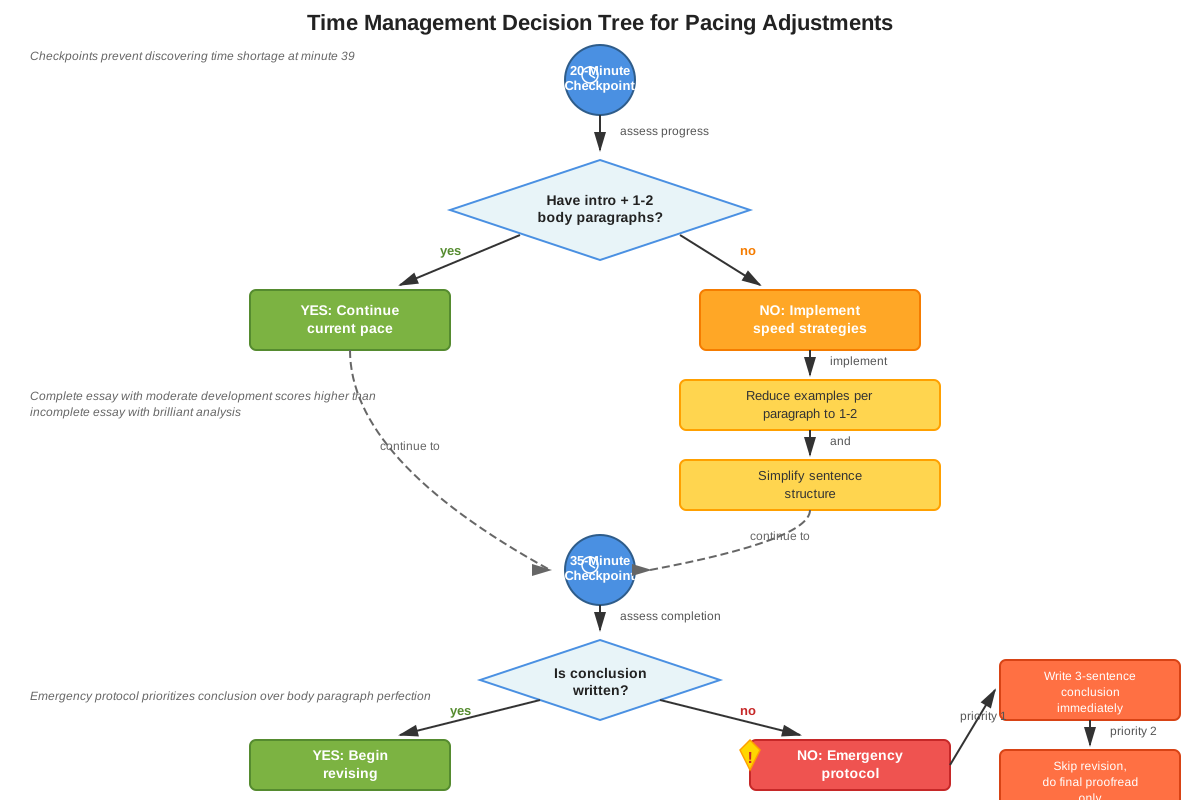
Effective time management requires progress checkpoints—predetermined moments when students assess their pacing and make adjustments. The most practical checkpoint system uses three time markers: 10 minutes elapsed (planning should be complete), 30 minutes elapsed (introduction and at least two body paragraphs should be complete), and 35 minutes elapsed (full draft should be complete, beginning revision).
These checkpoints serve as early warning systems. If a student reaches the 10-minute mark still reading the prompt, they must immediately begin outlining even if the analysis feels incomplete. If the 30-minute checkpoint arrives with only the introduction and one body paragraph complete, the student must accelerate by simplifying the remaining body paragraphs or reducing the planned number from three to two.
The checkpoint system prevents the most common time management failure: discovering with five minutes remaining that two body paragraphs and the entire conclusion still need to be written. By that point, recovery is impossible, and the essay will receive lower scores across multiple domains.
Proportional Allocation Strategy
Not all essay components deserve equal time investment. The proportional allocation strategy directs more time toward high-impact elements that influence multiple scoring domains. Body paragraphs, which demonstrate Ideas and Analysis, Development and Support, and Organization, warrant the largest time investment. The introduction and conclusion, while necessary for Organization scores, should be efficient rather than elaborate.
| Essay Component | Time Allocation | Scoring Impact | Strategic Priority |
|---|---|---|---|
| Planning/Outline | 8-10 minutes | Indirect (enables all domains) | Highest |
| Introduction | 4-5 minutes | Organization | Medium |
| Body Paragraph 1 | 5-6 minutes | All four domains | Highest |
| Body Paragraph 2 | 5-6 minutes | All four domains | Highest |
| Body Paragraph 3 | 5-6 minutes | All four domains | High |
| Conclusion | 4-5 minutes | Organization | Medium |
| Revision | 3-5 minutes | Language Use | Medium-High |
This table illustrates why rushing the planning phase to "save time" for drafting is counterproductive—planning enables efficient execution of all subsequent phases. Similarly, it shows why students should never sacrifice body paragraph development to write an elaborate introduction.
The Triage Protocol
When time management goes awry despite best efforts, students need a triage protocol—a predetermined plan for salvaging the maximum possible score. This protocol prioritizes completeness over perfection because incomplete essays receive significantly lower scores than complete essays with minor flaws.
The triage hierarchy operates as follows: First priority is ensuring a conclusion exists, even if it's only two sentences. An essay without a conclusion loses substantial Organization points. Second priority is addressing all three perspectives in some capacity, even if one receives only a single sentence of analysis. Third priority is maintaining thesis clarity throughout the essay. Fourth priority is including specific examples and evidence. Fifth priority is sophisticated vocabulary and varied sentence structure.
If a student reaches the 35-minute mark without a complete draft, they should immediately write a two-sentence conclusion, then use any remaining time to add supporting details to body paragraphs. This approach guarantees a complete structural framework while maximizing Development and Support scores within the available time.
Efficiency Techniques
Several efficiency techniques reduce time waste without compromising quality. The template introduction strategy involves memorizing a flexible opening structure that can be adapted to any prompt in 60-90 seconds: "The issue of [topic] has generated considerable debate, with advocates proposing various approaches to [central question]. While some argue [Perspective 1], and others contend [Perspective 2], a comprehensive analysis reveals [thesis statement]." This template ensures a functional introduction without consuming excessive planning time.
The perspective integration technique addresses all three perspectives within body paragraphs rather than dedicating separate paragraphs to each perspective. This approach reduces redundancy and saves 3-5 minutes while often producing more sophisticated analysis. For example, a body paragraph might argue for Perspective 1 while simultaneously explaining why Perspectives 2 and 3 are less compelling in specific contexts.
The conclusion shortcut recognizes that conclusions need only restate the thesis and provide brief synthesis—they don't require new examples or extensive elaboration. A three-sentence conclusion (thesis restatement, synthesis of main points, final thought) takes 2-3 minutes and fulfills all organizational requirements.
Concept Relationships
The core concepts within ACT writing time management form an interconnected system where each element supports the others. The 40-Minute Framework establishes the overall structure, which the Checkpoint System monitors and enforces. When checkpoints reveal pacing problems, the Proportional Allocation Strategy guides decisions about where to invest remaining time, and the Triage Protocol provides emergency procedures when standard allocation becomes impossible. Efficiency Techniques reduce the time required for each component, creating buffer time that makes checkpoint targets more achievable.
These time management concepts connect directly to prerequisite knowledge of essay structure—students cannot allocate time to introduction, body paragraphs, and conclusion without understanding what these components entail. They also relate to the broader Essay Organization and Style unit: effective time management enables students to implement sophisticated organizational patterns, develop arguments thoroughly, and maintain consistent style throughout the essay.
The relationship map flows as follows: Essay Structure Knowledge → enables → 40-Minute Framework → monitored by → Checkpoint System → triggers → Proportional Allocation Strategy or Triage Protocol → enhanced by → Efficiency Techniques → produces → Complete, Well-Developed Essay. This progression shows how time management serves as the execution mechanism for all other writing skills.
High-Yield Facts
⭐ The ACT Writing test provides exactly 40 minutes to plan, draft, and revise a complete essay
⭐ Approximately 8-10 minutes should be devoted to planning and outlining before any drafting begins
⭐ Students who fail to write a conclusion paragraph typically score 2-3 points lower across all domains
⭐ The optimal checkpoint system uses three time markers: 10 minutes (planning complete), 30 minutes (introduction + 2 body paragraphs complete), and 35 minutes (full draft complete)
⭐ Body paragraphs warrant the largest time investment because they impact all four scoring domains simultaneously
- Each body paragraph should receive approximately 5-6 minutes of drafting time for optimal development
- The revision phase should focus on high-impact errors (fragments, subject-verb agreement) rather than minor stylistic improvements
- Template structures for introductions and conclusions can reduce composition time by 40-50% without sacrificing quality
- Students should allocate time proportionally to scoring impact rather than equally across all essay components
- The triage protocol prioritizes essay completeness over perfection when time runs short
- Efficiency techniques can create 3-5 minutes of buffer time for unexpected challenges or additional revision
- Practicing with a visible timer during preparation builds accurate internal pacing for test day
Quick check — test yourself on ACT writing time management so far.
Try Flashcards →Common Misconceptions
Misconception: More planning time always produces better essays → Correction: Planning beyond 10 minutes yields diminishing returns and reduces drafting time below the minimum needed for adequate development. The optimal planning duration is 8-10 minutes, after which students should begin drafting even if the plan feels incomplete.
Misconception: The introduction deserves the most time because it creates the first impression → Correction: Body paragraphs impact scoring more significantly than introductions because they demonstrate Ideas and Analysis, Development and Support, Organization, and Language Use simultaneously. A functional introduction takes only 4-5 minutes, while body paragraphs warrant 5-6 minutes each.
Misconception: Skipping the conclusion to spend more time on body paragraphs is an acceptable trade-off → Correction: Essays without conclusions receive substantially lower Organization scores that outweigh any gains from slightly more developed body paragraphs. A two-sentence conclusion takes only 2-3 minutes and is always worth including.
Misconception: Revision time can be eliminated if the draft is written carefully → Correction: Even skilled writers produce errors under time pressure, and the Language Use and Conventions domain specifically evaluates error frequency. The 3-5 minutes allocated to revision typically catches 5-10 errors that would otherwise lower scores.
Misconception: Faster writers should use the same time allocation as slower writers → Correction: Time allocation should be personalized based on individual composition speed. Faster writers can allocate more time to planning and revision, while slower writers may need to use efficiency techniques and reduce body paragraphs from three to two.
Misconception: Checking the clock frequently during the essay wastes time → Correction: Strategic time checks at predetermined checkpoints (10, 30, and 35 minutes) take only 1-2 seconds total and prevent catastrophic pacing failures. The time invested in monitoring is recovered many times over through improved pacing.
Worked Examples
Example 1: Standard Time Management Execution
Scenario: A student receives a prompt about whether schools should require community service for graduation. The student has practiced the 40-minute framework and aims to write a four-paragraph essay (introduction, two body paragraphs, conclusion) with efficient time management.
Execution:
Minutes 0-9 (Planning Phase): The student reads the prompt and all three perspectives (2 minutes), decides to support Perspective 1 (required community service) while acknowledging valid concerns from Perspectives 2 and 3 (1 minute), and creates a detailed outline (6 minutes):
- Introduction: Hook about civic engagement, thesis supporting required service with qualifications
- Body Paragraph 1: Benefits of required service (develops citizenship, provides needed community support, exposes students to diverse experiences)
- Body Paragraph 2: Addressing concerns (acknowledge scheduling/equity issues from Perspectives 2 and 3, propose solutions like flexible timing and school-provided transportation)
- Conclusion: Restate thesis, synthesize main points, final thought about balanced implementation
Minutes 10-14 (Introduction): The student writes a four-sentence introduction using a template structure, establishing context and stating the thesis clearly. At the 10-minute checkpoint, planning is complete as scheduled.
Minutes 15-20 (Body Paragraph 1): The student develops the first body paragraph with a clear topic sentence, three supporting points with specific examples (mentioning how service develops empathy, provides resume-building experiences, and addresses community needs), and a concluding sentence that links back to the thesis.
Minutes 21-26 (Body Paragraph 2): The student develops the second body paragraph, acknowledging counterarguments from Perspectives 2 and 3, then explaining how thoughtful implementation addresses these concerns. At the 30-minute checkpoint, the student has completed the introduction and both body paragraphs—slightly ahead of schedule.
Minutes 27-31 (Conclusion): The student writes a three-sentence conclusion that restates the thesis, synthesizes the main arguments, and provides a final thought about implementation. At the 35-minute checkpoint, the complete draft is finished.
Minutes 32-40 (Revision): The student reads through the essay, correcting a subject-verb agreement error, fixing two comma splices, adding a transition phrase between body paragraphs, and strengthening a weak topic sentence. The student finishes with one minute remaining.
Outcome: The essay is complete, well-organized, addresses all perspectives, and contains minimal errors—likely scoring 8-10 in most domains.
Example 2: Triage Protocol Activation
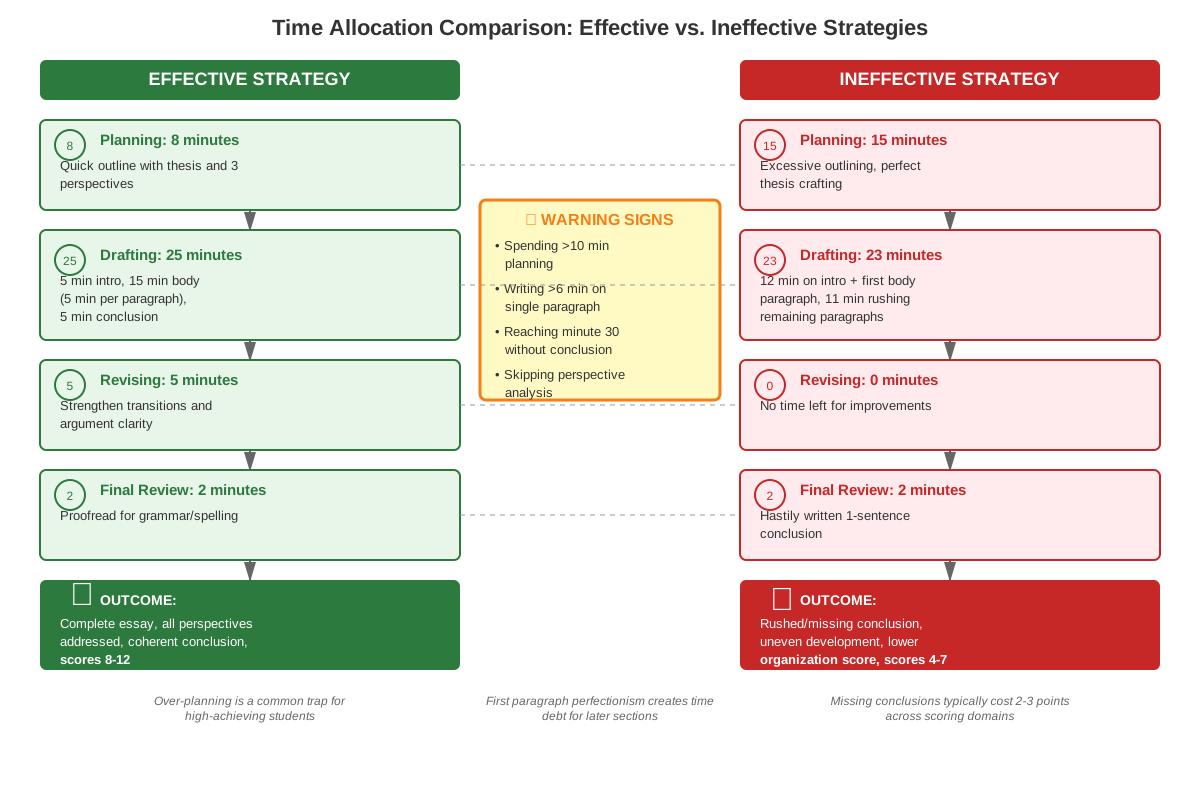
Scenario: A student struggles with the planning phase, spending 15 minutes trying to formulate the perfect thesis. At the 15-minute mark, the student has only a rough outline and no drafted text. The student must activate the triage protocol to salvage the essay.
Execution:
Minute 15 (Recognition): The student checks the clock at what should be the midpoint of Body Paragraph 1 and realizes only the outline exists. The student immediately recognizes the need for triage and shifts strategy.
Minutes 15-20 (Rapid Introduction): Rather than crafting an elaborate introduction, the student writes a three-sentence version: context sentence, acknowledgment of perspectives, thesis statement. This takes 5 minutes instead of the planned 4-5 because the student is now writing under pressure.
Minutes 21-28 (Body Paragraph 1 - Priority): The student writes the first body paragraph with full development, knowing this is the highest-impact component. The paragraph includes a topic sentence, two supporting points with examples, and a concluding sentence (7 minutes).
Minutes 29-35 (Body Paragraph 2 - Streamlined): The student writes a second body paragraph but simplifies it to one main supporting point with an example rather than the planned two points. This paragraph takes 6 minutes but is complete and functional.
Minute 36 (Triage Decision): The student has 4 minutes remaining and must choose between writing a third body paragraph or ensuring a conclusion exists. Following the triage protocol (completeness over perfection), the student chooses to write the conclusion.
Minutes 36-38 (Conclusion - Minimum Viable): The student writes a two-sentence conclusion: thesis restatement and brief synthesis. This takes 2 minutes.
Minutes 38-40 (Targeted Revision): The student quickly scans for sentence fragments and subject-verb agreement errors, fixing two obvious mistakes.
Outcome: The essay is complete with all structural components, addresses the prompt adequately, and demonstrates competent writing despite the time management failure. The essay likely scores 6-8 in most domains—lower than optimal but far better than an incomplete essay would score (4-6 range). The student learns the critical importance of adhering to the planning time limit.
Exam Strategy
When approaching the ACT Writing test, students should begin by writing their time checkpoints directly on the test booklet or scratch paper: note the current time, then calculate and write down the times for 10 minutes elapsed, 30 minutes elapsed, and 35 minutes elapsed. This external reminder system prevents the need to perform mental math during the stressful testing situation.
Trigger phrases that indicate time management is being tested don't exist in the traditional sense because time management isn't explicitly assessed—but students can recognize when they're falling behind. Warning signs include: still reading the prompt after 3 minutes, still outlining after 12 minutes, completing only the introduction after 20 minutes, or feeling rushed or panicked at any point. These internal triggers should prompt immediate strategy adjustment.
Process-of-elimination doesn't apply to essay writing, but students can use a similar principle for time allocation decisions: when choosing where to invest remaining time, eliminate options that don't impact multiple scoring domains. For example, if 5 minutes remain and the choice is between adding sophisticated vocabulary to the introduction or writing a conclusion, eliminate the vocabulary enhancement because it impacts only Language Use, while the conclusion impacts Organization significantly.
Time allocation advice specific to the ACT Writing test: Never spend more than 10 minutes planning, regardless of how incomplete the plan feels. Never spend more than 5 minutes on the introduction, even if it seems underdeveloped. Always reserve at least 2 minutes for a conclusion, even if body paragraphs feel incomplete. Always reserve at least 3 minutes for revision, even if the draft feels rough. These absolute rules prevent the most common time management failures.
Students should practice writing complete essays in 40 minutes at least 5-7 times before test day, using a timer and enforcing the checkpoint system. This practice builds accurate internal pacing and reveals personal tendencies (rushing planning, over-developing introductions, slow handwriting) that require strategy adjustments.
Memory Techniques
The "10-30-35" Rule: Remember the three critical checkpoints by visualizing a clock face: 10 (planning complete), 30 (introduction + 2 body paragraphs complete), 35 (full draft complete). The numbers form a pattern (10, 30, 35) that's easy to recall and write down immediately when the test begins.
The "PDRC" Acronym: The four phases of essay writing are Plan, Draft, Revise, Check. This acronym reminds students that all four phases are necessary and should occur in sequence. The "Check" phase refers to the final 30-second scan to ensure the conclusion exists and the essay addresses all three perspectives.
The "Body First" Principle: When time runs short, remember "body first"—body paragraphs receive priority over introduction and conclusion refinement because they impact all four scoring domains. Visualize the essay as a human body: the torso (body paragraphs) is essential for life, while the head and feet (introduction and conclusion) are important but can be minimal if necessary.
The "2-2-2" Minimum: In a worst-case scenario, remember that a complete essay can consist of 2 body paragraphs, 2 sentences in the introduction, and 2 sentences in the conclusion. This "2-2-2" minimum ensures completeness even under severe time pressure.
The "Checkpoint Clock" Visualization: Imagine a stopwatch with three colored zones: green (0-10 minutes, planning), yellow (10-35 minutes, drafting), and red (35-40 minutes, revision). This color-coded mental image helps students recognize which phase they should be in at any given moment.
Summary
ACT writing time management is the strategic allocation of the 40-minute essay period across planning, drafting, and revising phases to maximize scoring potential. The optimal framework dedicates 8-10 minutes to planning and outlining, 25-27 minutes to drafting (with body paragraphs receiving the largest time investment), and 3-5 minutes to revision. A checkpoint system at 10, 30, and 35 minutes provides early warning of pacing problems and enables real-time adjustments. When time management fails, a triage protocol prioritizes essay completeness over perfection, ensuring that all structural components exist even if development is minimal. Efficiency techniques like template introductions and streamlined conclusions reduce time requirements without sacrificing quality. Students must practice timed essay writing repeatedly to develop accurate internal pacing and identify personal tendencies that require strategy modifications. Effective time management doesn't guarantee a high score, but poor time management virtually guarantees a lower score by preventing students from demonstrating their full writing capabilities within the four scoring domains.
Key Takeaways
- The 40-minute ACT Writing test requires structured time allocation: 8-10 minutes planning, 25-27 minutes drafting, 3-5 minutes revising
- Checkpoint monitoring at 10, 30, and 35 minutes prevents catastrophic pacing failures and enables strategic adjustments
- Body paragraphs warrant the largest time investment because they impact all four scoring domains simultaneously
- Essay completeness (including a conclusion) is more important than perfection in any single component
- Planning time should never exceed 10 minutes, even if the outline feels incomplete, because adequate drafting time is essential
- Efficiency techniques like template structures and perspective integration can create 3-5 minutes of buffer time for unexpected challenges
- Repeated practice with a timer is the only way to develop accurate internal pacing for test day
Related Topics
Essay Structure and Organization: Mastering time management enables students to implement sophisticated organizational patterns because adequate time exists for each structural component. Students should study thesis development, paragraph structure, and transition techniques to maximize the quality of writing produced within the time-managed framework.
Perspective Analysis and Integration: Effective time management creates sufficient planning time to analyze all three perspectives deeply and drafting time to integrate them meaningfully into body paragraphs. Students should study techniques for evaluating perspective strengths and weaknesses and for synthesizing multiple viewpoints.
Evidence and Example Development: When time management creates adequate drafting time for body paragraphs, students can focus on developing specific, relevant examples that strengthen arguments. Students should study techniques for generating examples quickly and connecting them explicitly to thesis claims.
Language Use and Conventions: The revision time created by effective time management allows students to catch and correct errors that impact the Language Use domain. Students should study common grammatical errors, sentence variety techniques, and word choice strategies to maximize revision efficiency.
Practice CTA
Now that you understand the strategic framework for ACT writing time management, it's time to put these concepts into practice. Attempt the practice questions and flashcards to reinforce the checkpoint system, time allocation strategies, and triage protocols. Remember: time management is a skill that improves dramatically with deliberate practice. Each timed essay you write builds more accurate internal pacing and reveals personal tendencies that require adjustment. Commit to writing at least 5-7 complete practice essays under timed conditions before test day—this investment will pay dividends not just on the ACT, but in every time-constrained writing situation you encounter throughout your academic and professional career. You've got this!
Sign up free to keep reading
Create a free AnvayaPrep account to finish this ACT guide on ACT writing time management — plus flashcards and practice questions.