Overview
Coherence is one of the most frequently tested concepts in the ACT English section, appearing in approximately 15-20% of all questions. At its core, coherence refers to the logical flow and clarity of ideas within a passage, ensuring that sentences and paragraphs connect smoothly and that readers can follow the writer's train of thought without confusion. When a passage demonstrates strong coherence, each sentence builds naturally upon the previous one, transitions guide readers through shifts in topic or emphasis, and the overall organization supports the writer's purpose. The ACT tests coherence through questions about sentence placement, paragraph organization, transition words, and the logical sequencing of ideas.
Understanding coherence is essential for success on the ACT because it represents a significant portion of the Rhetorical Skills questions, which account for roughly 40% of the English section. Unlike Usage/Mechanics questions that focus on grammar rules, coherence questions require students to think about the passage as a whole and evaluate how individual components work together to create meaning. These questions often ask students to determine the best placement for a sentence, choose the most appropriate transition word, or decide whether a sentence should be added or deleted based on how it affects the passage's logical flow.
Coherence connects intimately with other Writing concepts tested on the ACT, including organization, transitions, relevance, and purpose. While organization deals with the overall structure of a passage, coherence focuses on the smooth connections between ideas at the sentence and paragraph level. Mastering coherence enables students to tackle complex questions about passage structure, writer's intent, and effective communication—skills that extend beyond the exam into academic and professional writing contexts.
Learning Objectives
- [ ] Identify when Coherence is being tested in ACT English questions
- [ ] Explain the core rule or strategy behind Coherence
- [ ] Apply Coherence to ACT-style questions accurately
- [ ] Evaluate whether sentences logically connect to surrounding context
- [ ] Determine the most effective placement for sentences within paragraphs
- [ ] Select appropriate transition words and phrases that maintain logical flow
- [ ] Assess whether adding or deleting information enhances or disrupts coherence
Prerequisites
- Basic sentence structure: Understanding subjects, predicates, and how complete sentences function is necessary to evaluate how sentences connect to one another
- Paragraph structure: Familiarity with topic sentences, supporting details, and concluding sentences helps students recognize when ideas flow logically within paragraphs
- Transition words and phrases: Basic knowledge of common transitions (however, therefore, additionally) provides the foundation for selecting appropriate connectors between ideas
- Reading comprehension: The ability to understand main ideas and supporting details enables students to evaluate whether sentences contribute to or detract from a passage's coherence
Why This Topic Matters
In real-world writing, coherence determines whether readers can understand and engage with a text. Professional documents, academic essays, and even everyday emails require logical flow to communicate effectively. Writers who master coherence can guide readers through complex arguments, present information in digestible sequences, and ensure that their intended message comes across clearly. Poor coherence leads to confusion, misunderstanding, and reader frustration—problems that undermine even the most insightful ideas.
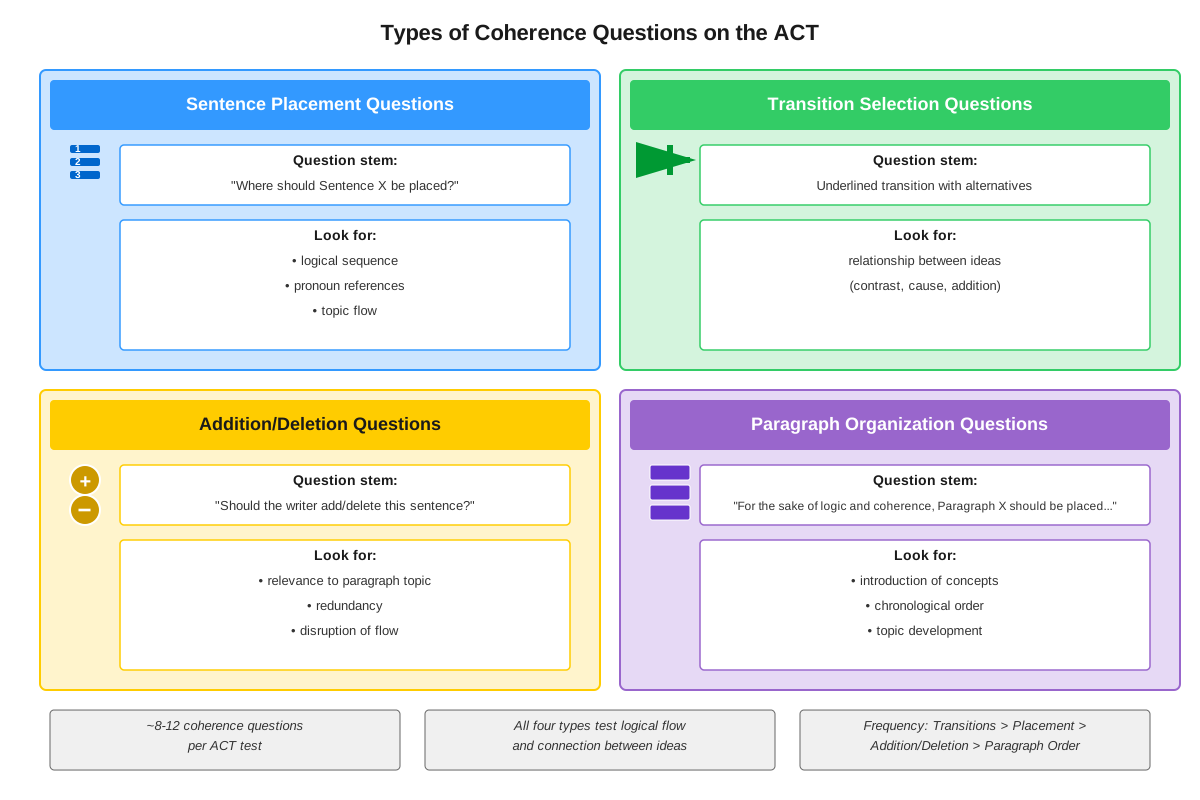
On the ACT English section, coherence questions appear in multiple formats and account for a substantial portion of the exam. Students can expect to encounter 8-12 coherence-related questions per test, distributed across the five passages. These questions typically appear as:
- Sentence placement questions: "For the sake of logic and coherence, Sentence 3 should be placed..."
- Transition selection questions: "Which choice provides the most logical transition?"
- Addition/deletion questions: "Should the writer add this sentence here?"
- Paragraph ordering questions: "Which sequence of paragraphs is most logical?"
The ACT frequently embeds coherence questions within narrative, persuasive, and expository passages. In narrative passages, coherence questions often test chronological sequencing and the logical flow of events. In persuasive passages, they assess whether arguments build logically and whether evidence supports claims appropriately. In expository passages, they evaluate whether information is presented in a clear, organized manner that helps readers understand complex topics.
Core Concepts
Understanding Coherence
Coherence refers to the quality of logical connection and consistency throughout a piece of writing. A coherent passage demonstrates clear relationships between ideas, with each sentence flowing naturally from the previous one and contributing to the overall purpose. ACT coherence questions specifically test whether students can identify and create these logical connections in various contexts.
Three essential elements create coherence in writing:
- Logical sequencing: Ideas appear in an order that makes sense to readers
- Clear connections: Relationships between ideas are explicit through transitions, pronouns, and repeated key terms
- Consistent focus: All sentences relate to the main idea without introducing irrelevant tangents
Types of Coherence Tested on the ACT
Sentence-Level Coherence
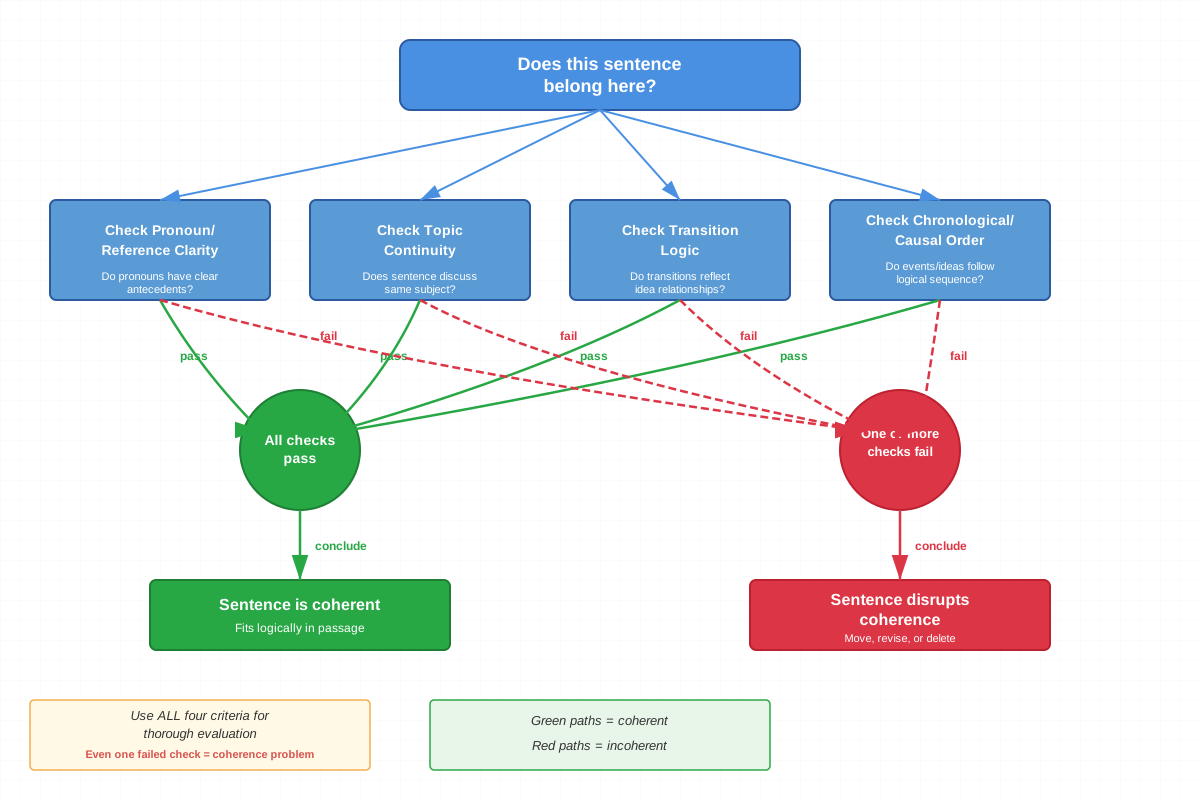
Sentence-level coherence examines whether individual sentences connect logically to those immediately before and after them. The ACT tests this through questions that ask students to evaluate sentence placement or determine whether a sentence fits in a particular location.
Key indicators of sentence-level coherence include:
- Pronoun references: Pronouns should clearly refer to nouns mentioned in previous sentences
- Transitional logic: The relationship between consecutive sentences should be clear (cause-effect, contrast, addition, etc.)
- Chronological consistency: Events should follow a logical time sequence
- Topical continuity: Each sentence should relate to the same subject or theme as surrounding sentences
Paragraph-Level Coherence
Paragraph-level coherence focuses on how sentences work together within a paragraph to develop a single main idea. The ACT tests this by asking whether sentences belong in specific paragraphs or whether paragraphs should be reordered.
Characteristics of coherent paragraphs:
- Unified topic: All sentences relate to a single main idea, typically introduced in a topic sentence
- Logical development: Supporting sentences build upon each other in a clear progression
- Appropriate transitions: Connections between sentences guide readers through the paragraph's development
- Effective conclusion: The paragraph ends in a way that completes the idea or transitions to the next paragraph
Passage-Level Coherence
Passage-level coherence addresses how paragraphs work together to create a unified whole. The ACT tests this through questions about paragraph ordering and whether information should be added or deleted based on the passage's overall purpose.
Elements of passage-level coherence:
- Clear organizational pattern: The passage follows a recognizable structure (chronological, spatial, order of importance, etc.)
- Consistent purpose: All paragraphs contribute to the writer's main goal
- Smooth transitions between paragraphs: Readers can follow the progression from one paragraph to the next
- Unified tone and style: The writing maintains consistency throughout
Transition Words and Coherence
Transition words and phrases serve as signposts that guide readers through a text, explicitly showing relationships between ideas. The ACT frequently tests whether students can select transitions that accurately reflect the logical relationship between sentences or paragraphs.
| Relationship Type | Transition Examples | When to Use |
|---|---|---|
| Addition | furthermore, moreover, additionally, also | Adding similar or supporting information |
| Contrast | however, nevertheless, on the other hand, yet | Introducing opposing or different ideas |
| Cause-Effect | therefore, consequently, as a result, thus | Showing that one idea results from another |
| Example | for instance, for example, specifically, namely | Providing specific illustrations |
| Time | meanwhile, subsequently, previously, finally | Indicating temporal relationships |
| Emphasis | indeed, in fact, certainly, undoubtedly | Stressing importance or truth |
Sentence Placement Strategy
When the ACT asks where a sentence should be placed, students must evaluate how the sentence connects to surrounding context. The correct placement creates the smoothest logical flow.
Steps for sentence placement questions:
- Read the sentence carefully: Identify key words, pronouns, and the main idea
- Look for connection clues: Note specific references, time markers, or logical relationships
- Test each option: Read the passage with the sentence in each proposed location
- Evaluate coherence: Determine which placement creates the clearest logical flow
- Verify pronoun references: Ensure pronouns have clear antecedents in the chosen location
Addition and Deletion Questions
The ACT often asks whether a sentence should be added to or deleted from a passage. These questions test whether students understand how the sentence affects coherence and whether it contributes to or distracts from the passage's purpose.
Criteria for addition questions:
- Relevance: Does the sentence relate directly to the paragraph's main idea?
- Redundancy: Does the sentence repeat information already stated?
- Purpose alignment: Does the sentence support the passage's overall goal?
- Logical fit: Does the sentence connect smoothly with surrounding sentences?
Criteria for deletion questions:
- Essential information: Does the sentence provide necessary context or support?
- Coherence contribution: Does removing the sentence improve or harm logical flow?
- Relevance: Is the sentence tangential or off-topic?
Concept Relationships
The concepts within coherence build upon each other hierarchically. Sentence-level coherence forms the foundation, as individual sentences must connect logically before larger structures can be coherent. These sentence connections → create → paragraph-level coherence, where multiple related sentences develop a unified idea. Multiple coherent paragraphs → combine to form → passage-level coherence, where the entire text presents a clear, logical progression of ideas.
Transition words serve as the explicit connectors that facilitate coherence at all levels. They → bridge → sentence-level gaps, → signal → paragraph-level relationships, and → guide → readers through passage-level organization. Sentence placement depends on understanding these transitions and logical connections, as the correct location for a sentence is where it creates the strongest coherent relationships with surrounding text.
Coherence connects to prerequisite knowledge of paragraph structure by applying those structural principles to evaluate logical flow. Understanding topic sentences helps students recognize when a sentence belongs in a particular paragraph, while knowledge of supporting details enables evaluation of whether information contributes to or distracts from the main idea. Transition words knowledge directly supports coherence by providing the vocabulary for explicit connections.
The relationship between coherence and other ACT Writing concepts is symbiotic. Organization provides the overall framework within which coherence operates—a well-organized passage is easier to make coherent, and coherent connections reinforce organizational structure. Relevance questions often overlap with coherence, as irrelevant information disrupts logical flow. Purpose questions connect to coherence because maintaining focus on the writer's goal is essential for coherent development of ideas.
High-Yield Facts
⭐ Coherence questions account for approximately 15-20% of ACT English questions, making them one of the most frequently tested concepts in the Rhetorical Skills category.
⭐ Pronouns and demonstrative adjectives (this, that, these, those) are key coherence clues—they must refer to nouns in previous sentences, helping identify correct sentence placement.
⭐ The correct answer to sentence placement questions creates the smoothest logical flow, not necessarily the most dramatic or interesting arrangement.
⭐ Transition words must accurately reflect the logical relationship between ideas—"however" requires contrast, "therefore" requires cause-effect, and "furthermore" requires addition of similar ideas.
⭐ Chronological markers (dates, time words, sequence words) are crucial clues for determining sentence order in narrative and process-oriented passages.
- Topic sentences typically appear at the beginning of paragraphs, and sentences that introduce new main ideas usually signal paragraph breaks.
- Sentences containing specific examples should follow general statements they illustrate, not precede them.
- Concluding sentences often contain summary language or forward-looking statements that transition to the next paragraph.
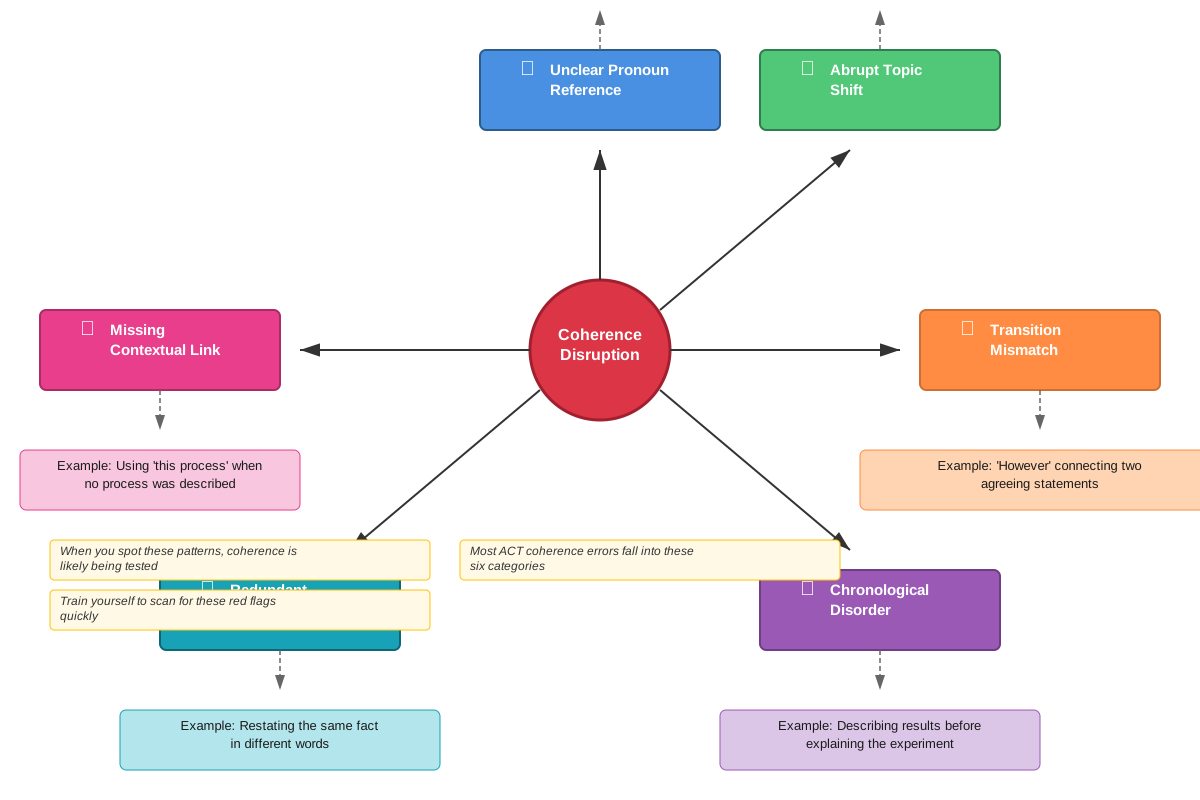
- Redundant information disrupts coherence by repeating ideas without adding value, making deletion the correct choice.
- Questions asking "Should the writer add this sentence?" require evaluation of both relevance and coherence—the sentence must fit the topic AND connect logically to surrounding text.
- Paragraph ordering questions are rare but high-value—they test understanding of passage-level organizational patterns.
- The phrase "for the sake of logic and coherence" explicitly signals that the question tests logical flow rather than grammar or style.
- Sentences with vague pronouns or unclear references indicate placement problems—the sentence likely belongs where the antecedent is clearer.
- Contrast transitions (however, nevertheless) require actual opposing ideas, not just different ideas.
- Addition transitions (furthermore, moreover) require ideas that support or extend the previous point, not introduce new topics.
Quick check — test yourself on Coherence so far.
Try Flashcards →Common Misconceptions
Misconception: Coherence is the same as grammatical correctness.
Correction: Coherence concerns logical flow and connection between ideas, while grammar concerns sentence-level correctness. A passage can be grammatically perfect but incoherent if ideas don't connect logically, and vice versa.
Misconception: The most interesting or dramatic sentence placement is correct.
Correction: The ACT rewards logical flow, not dramatic effect. The correct placement creates the clearest, most natural progression of ideas, even if another placement might be more stylistically interesting.
Misconception: Any transition word that makes grammatical sense is acceptable.
Correction: Transition words must accurately reflect the logical relationship between ideas. "However" is grammatically correct in many positions but logically correct only when introducing genuine contrast.
Misconception: Sentences should be added if they contain true or interesting information.
Correction: Sentences should be added only if they're relevant to the paragraph's main idea, support the passage's purpose, and connect logically to surrounding sentences. True but irrelevant information disrupts coherence.
Misconception: Longer, more complex transitions are more sophisticated and therefore better.
Correction: The best transition is the one that most accurately and clearly expresses the relationship between ideas. Simple transitions like "but" or "so" are often correct when they precisely convey the logical connection.
Misconception: Coherence questions always have obvious right answers.
Correction: Coherence questions require careful analysis of context and logical relationships. The difference between answer choices may be subtle, requiring students to evaluate how each option affects the passage's flow.
Misconception: Sentence placement questions can be answered by reading only the sentence in question.
Correction: Correct sentence placement requires reading the entire paragraph (and sometimes surrounding paragraphs) to understand context, identify connection clues, and evaluate logical flow.
Worked Examples
Example 1: Sentence Placement
Passage Context:
[1] The monarch butterfly's migration is one of nature's most remarkable phenomena. [2] These delicate insects travel up to 3,000 miles from Canada to Mexico each fall. [3] Scientists have discovered that monarchs use the sun's position to navigate during their journey. [4] The butterflies that make the return trip in spring are actually the grandchildren of those that flew south.
Question:
For the sake of logic and coherence, Sentence 4 should be placed:
A. where it is now
B. after Sentence 1
C. after Sentence 2
D. before Sentence 1
Solution Process:
Step 1: Analyze Sentence 4's content. It discusses "the return trip in spring" and mentions "grandchildren of those that flew south," indicating it deals with the completion of the migration cycle.
Step 2: Identify connection clues. The phrase "return trip" suggests this sentence discusses what happens after the southward journey. The reference to "those that flew south" requires that the southward migration has already been mentioned.
Step 3: Evaluate each placement:
- Option A (current position): After discussing navigation methods, jumping to the return trip feels abrupt. The passage hasn't fully established the southward journey before discussing the return.
- Option B (after Sentence 1): This would place the return trip discussion before readers know about the southward journey, creating confusion about what "return trip" means.
- Option C (after Sentence 2): Sentence 2 establishes the southward journey to Mexico. Placing Sentence 4 here would logically complete the migration cycle: south to Mexico, then return in spring. However, this interrupts the flow into Sentence 3's discussion of navigation.
- Option D (before Sentence 1): This would begin with the return trip before introducing the migration itself, violating logical sequencing.
Step 4: Consider the passage's organizational pattern. The passage introduces the migration (Sentence 1), describes the southward journey (Sentence 2), explains navigation (Sentence 3), and should conclude with the return journey (Sentence 4).
Answer: A (where it is now). While Option C might seem logical, the current placement allows the passage to fully develop the southward journey and navigation before addressing the return trip, creating the most coherent overall flow. The sentence serves as a concluding detail that completes the migration cycle after all other aspects have been explained.
Example 2: Transition Selection
Passage Context:
The local library planned to extend its hours to accommodate working families. _____, the city council rejected the proposal due to budget constraints. Library supporters argued that the extended hours would increase community engagement and literacy rates.
Question:
Which choice provides the most logical transition?
F. Furthermore,
G. For example,
H. However,
J. Similarly,
Solution Process:
Step 1: Identify the logical relationship between sentences. The first sentence describes a plan (extending library hours). The second sentence describes the plan's rejection. These are opposing outcomes—a plan versus its failure.
Step 2: Evaluate each transition:
- Option F (Furthermore): This transition adds supporting information or continues in the same direction. It would suggest the council's rejection somehow supports or extends the library's plan, which is illogical.
- Option G (For example): This transition introduces a specific instance of a general statement. The council's rejection isn't an example of the library's plan; it's a response to it.
- Option H (However): This transition signals contrast or opposition. It accurately reflects that the council's rejection opposes or contradicts the library's plan.
- Option J (Similarly): This transition indicates likeness or parallel situations. The rejection doesn't parallel the plan; it opposes it.
Step 3: Verify the logical relationship. The passage presents a contrast: the library wanted to extend hours (positive action), but the council rejected this (negative outcome). This requires a contrast transition.
Answer: H (However). This transition accurately signals the opposing relationship between the library's plan and the council's rejection, maintaining coherence by explicitly showing readers that the second sentence contradicts expectations set by the first.
Exam Strategy
Approaching Coherence Questions
When encountering coherence questions on the ACT, follow this systematic approach:
- Identify the question type: Recognize whether the question asks about sentence placement, transitions, additions/deletions, or paragraph ordering
- Read broadly: Don't focus only on the immediate sentence—read the entire paragraph and sometimes surrounding paragraphs
- Look for explicit clues: Identify pronouns, demonstrative adjectives, time markers, and logical connectors
- Test each option: For placement questions, mentally insert the sentence in each location and evaluate flow
- Trust logical flow over style: Choose the answer that creates the clearest logical progression, not the most interesting arrangement
Trigger Words and Phrases
Watch for these phrases that signal coherence questions:
- "For the sake of logic and coherence"
- "The most logical placement"
- "Which choice provides the most logical transition?"
- "Should the writer add this sentence here?"
- "Should the writer delete this sentence?"
- "The best placement for this sentence would be..."
- "Which sequence of paragraphs is most logical?"
Process of Elimination Tips
For sentence placement questions:
- Eliminate options where pronouns lack clear antecedents
- Eliminate placements that disrupt chronological order in narrative passages
- Eliminate positions that separate examples from the general statements they illustrate
- Eliminate placements that create topic shifts within paragraphs
For transition questions:
- Eliminate transitions that contradict the logical relationship (e.g., "however" when ideas agree)
- Eliminate transitions that are too weak or too strong for the relationship
- Eliminate transitions that introduce relationships not present in the text
- Keep the simplest transition that accurately conveys the relationship
For addition/deletion questions:
- Eliminate "yes" options if the sentence is off-topic or redundant
- Eliminate "no" options if the sentence provides essential information or improves flow
- Evaluate the reasoning provided in answer choices—incorrect reasoning indicates an incorrect answer
- Consider whether the sentence matches the paragraph's level of detail and focus
Time Allocation
Coherence questions typically require more time than grammar questions because they demand broader context analysis. Allocate approximately:
- 45-60 seconds for sentence placement questions (requires reading full paragraph)
- 30-45 seconds for transition questions (requires reading surrounding sentences)
- 45-60 seconds for addition/deletion questions (requires evaluating relevance and reasoning)
- 60-90 seconds for paragraph ordering questions (rare but complex)
If a coherence question seems time-consuming, mark it and return after completing faster grammar questions. However, don't skip these questions entirely—they're too common and valuable to ignore.
Memory Techniques
The PLACE Method for Sentence Placement
Pronouns - Check that pronouns have clear antecedents
Logical flow - Ensure ideas progress naturally
Antecedents - Verify references to previous information
Chronology - Confirm time sequence makes sense
Evaluate all options - Test each placement before deciding
The RAFT Strategy for Transitions
Relationship - Identify the logical relationship between ideas
Accuracy - Ensure the transition accurately reflects that relationship
Fit - Verify the transition fits grammatically and stylistically
Test - Read the sentence with the transition to confirm smooth flow
Transition Categories Mnemonic: "ACE-T"
Addition - furthermore, moreover, additionally (ideas agree/extend)
Contrast - however, nevertheless, yet (ideas oppose)
Example - for instance, specifically (general to specific)
Time - meanwhile, subsequently, finally (temporal sequence)
Coherence Question Recognition: "LOGIC"
Location questions - "Where should this sentence be placed?"
Ordering questions - "Which sequence of paragraphs..."
Guidance questions - "Which transition..."
Inclusion questions - "Should the writer add..."
Cutting questions - "Should the writer delete..."
Summary
Coherence represents the logical flow and clear connection of ideas within a passage, tested extensively on the ACT English section through questions about sentence placement, transitions, and the addition or deletion of information. Mastering coherence requires understanding three levels: sentence-level connections between consecutive sentences, paragraph-level unity around a single main idea, and passage-level organization that supports the writer's overall purpose. The key to answering coherence questions correctly lies in reading broadly for context, identifying explicit connection clues like pronouns and time markers, and selecting options that create the smoothest logical flow rather than the most dramatic or interesting arrangement. Transition words must accurately reflect the logical relationship between ideas—addition, contrast, cause-effect, example, or time—and cannot be selected based solely on grammatical correctness. Sentence placement questions require testing each option by mentally inserting the sentence and evaluating how well it connects to surrounding text, while addition and deletion questions demand assessment of both relevance and logical fit. Success on coherence questions directly translates to higher scores on the ACT English section, as these questions account for a significant portion of the Rhetorical Skills category and reward students who can think about passages as unified wholes rather than collections of isolated sentences.
Key Takeaways
- Coherence questions test logical flow and connection between ideas, not grammar or style, and account for 15-20% of ACT English questions
- Read entire paragraphs for context rather than focusing only on the sentence in question—coherence requires understanding how ideas connect across multiple sentences
- Pronouns, demonstrative adjectives, and time markers are crucial clues for determining correct sentence placement and identifying logical connections
- Transition words must accurately reflect the logical relationship between ideas—"however" requires contrast, "therefore" requires cause-effect, and "furthermore" requires addition
- The correct answer creates the smoothest logical flow, even if other options might be grammatically correct or stylistically interesting
- Addition and deletion questions require evaluating both relevance and coherence—information must be on-topic AND connect logically to surrounding sentences
- Systematic approaches like PLACE and RAFT help students analyze coherence questions methodically and avoid common mistakes
Related Topics
Organization and Structure: Building on coherence skills, this topic explores how entire passages are organized using patterns like chronological order, cause-effect, comparison-contrast, and order of importance. Mastering coherence provides the foundation for understanding these larger organizational frameworks.
Transitions and Connective Phrases: This topic deepens knowledge of the specific words and phrases that create coherence, including subordinating conjunctions, conjunctive adverbs, and transitional expressions. Strong coherence skills make advanced transition work more intuitive.
Relevance and Purpose: These topics extend coherence principles by examining whether information serves the writer's goal and audience. Understanding coherence helps students evaluate whether content belongs in a passage at all.
Paragraph Development: This topic applies coherence principles to crafting effective paragraphs with clear topic sentences, relevant supporting details, and logical progression. Coherence skills directly transfer to evaluating paragraph quality.
Rhetorical Strategy: Advanced questions about writer's choices and effectiveness build on coherence understanding, as logical flow is essential for persuasive and engaging writing.
Practice CTA
Now that you've mastered the core concepts of coherence, it's time to apply your knowledge! Work through the practice questions to test your ability to identify coherence issues, select appropriate transitions, and determine correct sentence placement. The flashcards will help you memorize key transition categories and coherence strategies. Remember, coherence questions reward careful analysis and systematic thinking—skills that improve with deliberate practice. Each question you work through strengthens your ability to see logical connections and evaluate flow, bringing you closer to your target ACT score. You've built a strong foundation; now reinforce it through active practice!
Sign up free to keep reading
Create a free AnvayaPrep account to finish this ACT guide on Coherence — plus flashcards and practice questions.