Overview
Sentence variety is a critical component of effective writing on the ACT Writing test, referring to the strategic use of different sentence structures, lengths, and types to create engaging, sophisticated prose. While many students focus exclusively on grammar rules and punctuation, the ACT also evaluates a writer's ability to craft varied, rhythmic sentences that maintain reader interest and clearly convey complex ideas. Mastering ACT sentence variety means understanding when to use simple sentences for emphasis, complex sentences for nuance, compound sentences for balance, and compound-complex sentences for sophisticated argumentation.
On the ACT Writing test, sentence variety appears in two distinct contexts: the multiple-choice English section and the optional essay portion. In the English section, questions may ask students to revise passages by combining sentences, breaking apart run-ons, or selecting alternatives that improve flow and readability. These questions test whether students can recognize monotonous writing patterns and apply appropriate revision strategies. The essay portion rewards writers who naturally incorporate varied sentence structures, as the scoring rubric explicitly values "varied sentence structure" as a component of Language Use and Conventions.
Understanding sentence variety connects directly to broader writing concepts including rhetorical effectiveness, style, and audience awareness. A writer who varies sentence structure demonstrates control over language and creates prose that feels professional and polished. This skill intersects with parallelism, subordination, coordination, and transitions—all essential elements of the Essay Organization and Style unit. Students who master sentence variety gain a significant competitive advantage, as this skill elevates writing from merely correct to genuinely compelling.
Learning Objectives
- [ ] Identify when Sentence variety is being tested in ACT English passages and essay prompts
- [ ] Explain the core rule or strategy behind Sentence variety and its impact on writing quality
- [ ] Apply Sentence variety to ACT-style questions accurately and efficiently
- [ ] Distinguish between the four main sentence types and their appropriate uses
- [ ] Recognize monotonous sentence patterns in passages and select effective revisions
- [ ] Construct essays that naturally incorporate varied sentence structures
- [ ] Evaluate answer choices based on their contribution to overall passage rhythm and flow
Prerequisites
- Basic sentence structure: Understanding subjects, predicates, independent clauses, and dependent clauses is essential for recognizing how sentences can be combined or separated
- Coordination and subordination: Knowledge of coordinating conjunctions (FANBOYS) and subordinating conjunctions enables effective sentence combining
- Punctuation rules: Proper use of commas, semicolons, and periods determines whether sentence combinations are grammatically correct
- Rhetorical skills: Understanding purpose, audience, and tone helps determine which sentence structures best serve the writer's goals
Why This Topic Matters
In professional and academic writing, sentence variety distinguishes competent writers from exceptional ones. Readers naturally respond to rhythmic variation in prose; monotonous sentence patterns create a choppy, elementary feel that undermines even strong ideas. College professors, employers, and publication editors all value writers who can modulate sentence structure to emphasize key points, establish relationships between ideas, and maintain reader engagement across extended texts.
On the ACT, sentence variety appears with significant frequency. Approximately 8-12% of English section questions test rhetorical skills related to sentence structure, including combining sentences, revising for variety, and improving flow. These questions typically appear as "Which choice best accomplishes the writer's goal?" or "Which alternative provides the most effective transition?" The essay scoring rubric allocates substantial weight to Language Use and Conventions, where varied sentence structure directly impacts scores in the 4-6 range (out of 6).
Common manifestations in ACT passages include: consecutive short, choppy sentences that need combining; overly long, convoluted sentences requiring separation; repetitive sentence openings (e.g., five consecutive sentences beginning with "The"); and passages lacking transitional variety between ideas. The test frequently presents revision questions where all answer choices are grammatically correct, but only one provides appropriate variety that enhances readability and maintains the passage's established style.
Core Concepts
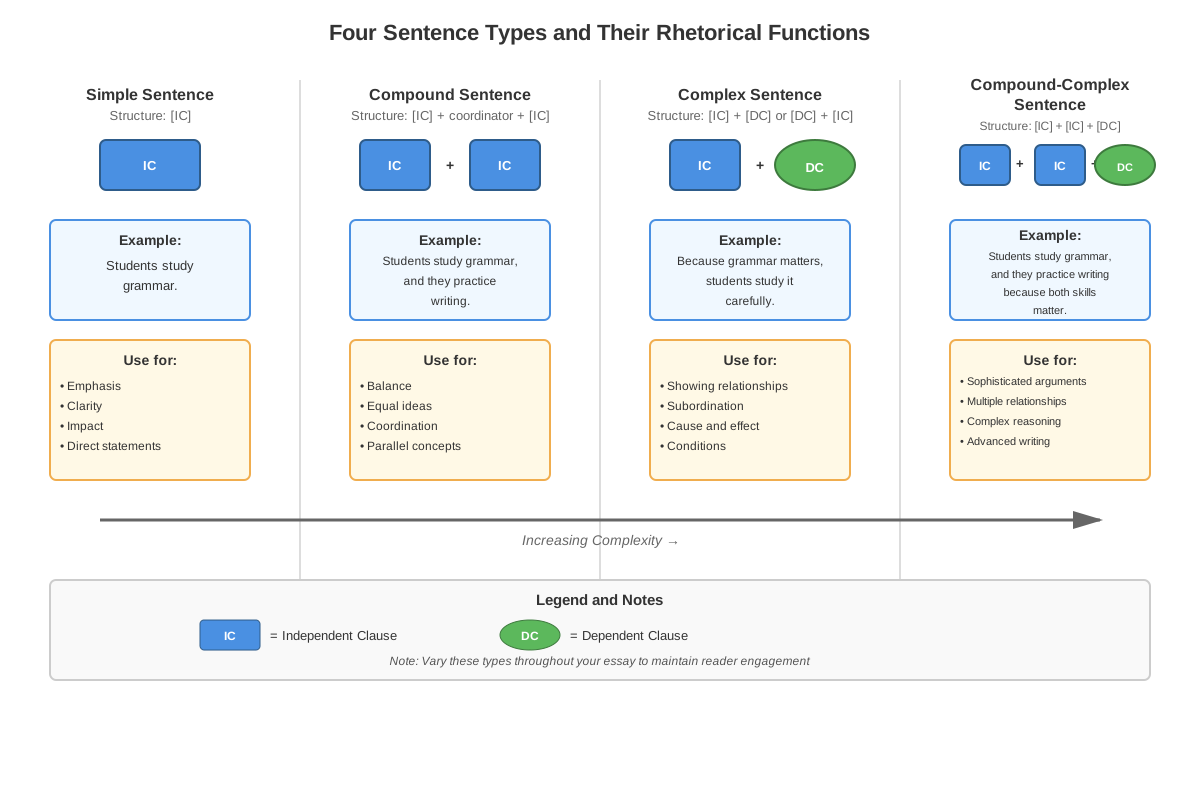
The Four Sentence Types
Understanding the fundamental sentence types provides the foundation for creating variety. Each type serves distinct rhetorical purposes and contributes differently to prose rhythm.
Simple sentences contain one independent clause with a subject and predicate. Despite their name, simple sentences can include compound subjects, compound verbs, and multiple modifiers. Example: "The researcher analyzed the data." These sentences create emphasis, clarity, and impact—particularly effective after longer, more complex constructions.
Compound sentences join two or more independent clauses using coordinating conjunctions (for, and, nor, but, or, yet, so) or semicolons. Example: "The researcher analyzed the data, and the assistant prepared the report." Compound sentences establish relationships of addition, contrast, or consequence between equally important ideas.
Complex sentences contain one independent clause and at least one dependent (subordinate) clause. Example: "After the researcher analyzed the data, the team met to discuss findings." Complex sentences show hierarchical relationships, indicating which information is primary and which is supporting or contextual.
Compound-complex sentences combine multiple independent clauses with at least one dependent clause. Example: "After the researcher analyzed the data, the team met to discuss findings, and they revised their hypothesis." These sophisticated structures handle multiple relationships simultaneously and demonstrate advanced writing skill.
Sentence Length Variation
Beyond structural type, sentence length significantly impacts rhythm and readability. Effective writers strategically alternate between short, medium, and long sentences to create a pleasing cadence.
Short sentences (5-10 words) provide punch and emphasis. They work exceptionally well for introducing topics, making bold claims, or creating dramatic effect. Example: "The results were clear." However, consecutive short sentences create a choppy, immature style that the ACT penalizes.
Medium sentences (11-20 words) form the backbone of most professional writing. They balance clarity with sophistication, conveying complete thoughts without overwhelming readers. Most ACT passages maintain a foundation of medium-length sentences punctuated by strategic variation.
Long sentences (21+ words) demonstrate control and sophistication when properly constructed. They allow writers to establish complex relationships, provide detailed explanations, and create flowing, elegant prose. However, excessively long sentences risk confusion and should be used judiciously.
| Sentence Length | Word Count | Primary Function | ACT Usage |
|---|---|---|---|
| Short | 5-10 | Emphasis, clarity, impact | Occasional, strategic |
| Medium | 11-20 | Standard communication | Frequent, foundational |
| Long | 21+ | Complexity, sophistication | Moderate, controlled |
Sentence Opening Variation
Monotonous sentence openings represent one of the most common weaknesses in student writing. The ACT frequently tests recognition of this problem and selection of appropriate revisions.
Subject-first openings represent the default pattern: "The scientist conducted experiments." While grammatically correct and often appropriate, consecutive subject-first sentences create monotony.
Prepositional phrase openings add variety and context: "In the laboratory, the scientist conducted experiments." These openings establish setting, time, or circumstance before introducing the main action.
Participial phrase openings create sophisticated, action-oriented sentences: "Conducting experiments, the scientist discovered unexpected results." These structures emphasize ongoing action and create dynamic prose.
Subordinate clause openings establish logical relationships: "Because previous methods failed, the scientist developed a new approach." These openings foreground causation, condition, or temporal relationships.
Transitional word/phrase openings guide readers through argument progression: "Furthermore, the scientist's methodology addressed previous limitations." These openings explicitly signal relationships between ideas.
Combining and Separating Sentences
ACT questions frequently present opportunities to combine choppy sentences or separate unwieldy ones. Understanding effective combination strategies is essential.
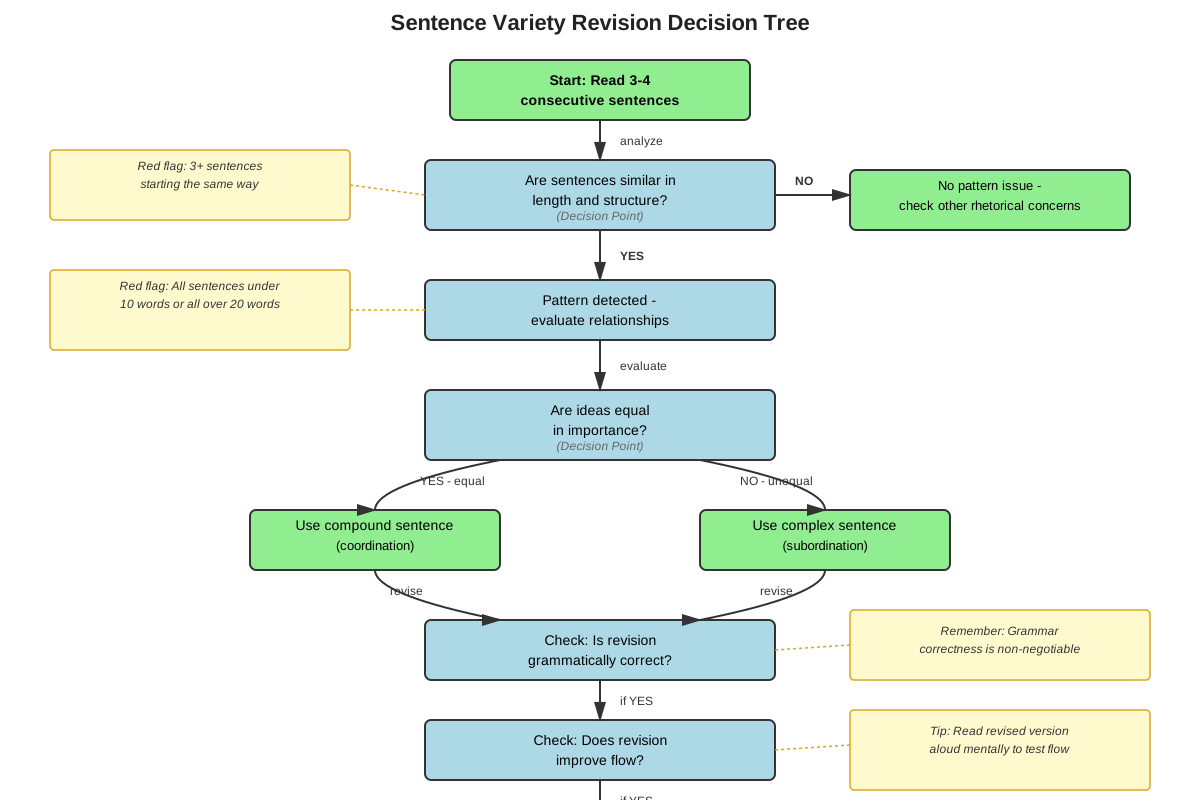
Coordination joins equal ideas using coordinating conjunctions or semicolons. Use coordination when ideas have similar importance and logical relationships of addition, contrast, or result. Example: "The experiment succeeded" + "The team celebrated" → "The experiment succeeded, and the team celebrated."
Subordination creates hierarchical relationships by converting one independent clause into a dependent clause. Use subordination when one idea provides context, cause, condition, or contrast for another. Example: "The experiment succeeded" + "The team had worked for months" → "After working for months, the team succeeded in their experiment."
Reduction eliminates redundancy by converting clauses into phrases or single words. Example: "The scientist was careful" + "The scientist checked all measurements" → "The careful scientist checked all measurements."
Appositives rename or explain nouns, allowing efficient combination. Example: "Dr. Chen led the project" + "Dr. Chen is a renowned physicist" → "Dr. Chen, a renowned physicist, led the project."
Rhetorical Effectiveness
Sentence variety serves rhetorical purposes beyond mere stylistic preference. The ACT evaluates whether sentence structure choices enhance communication effectiveness.
Emphasis through contrast: Following several long, complex sentences with a short, simple sentence creates dramatic emphasis. The ACT rewards recognition of when this technique enhances meaning.
Rhythm and pacing: Varied sentence lengths create natural reading rhythm. Passages with monotonous structure feel plodding regardless of content quality.
Clarity and comprehension: Appropriate sentence variety helps readers process information. Too many long, complex sentences overwhelm; too many short sentences fragment ideas unnecessarily.
Tone and sophistication: Sentence variety signals writing maturity. College-level writing naturally incorporates structural diversity, while elementary writing relies heavily on simple, repetitive patterns.
Concept Relationships
The concepts within sentence variety form an interconnected system where each element influences others. The four sentence types (simple, compound, complex, compound-complex) provide the structural foundation, which then combines with length variation to create rhythm and pacing. Opening variation builds upon both structural type and length, adding another dimension of diversity. These three elements—type, length, and opening—work together to achieve rhetorical effectiveness, the ultimate goal of sentence variety.
Sentence variety connects directly to prerequisite knowledge of coordination and subordination, as these grammatical tools enable effective sentence combining. Understanding clause structure (independent vs. dependent) determines which combination strategies are grammatically permissible. Punctuation rules govern how combined sentences are properly marked, ensuring that variety doesn't come at the expense of correctness.
The relationship map flows as follows: Basic sentence structure → enables recognition of → Sentence types → which combine with → Length variation → and → Opening variation → to achieve → Rhetorical effectiveness → which manifests as → Improved ACT scores. Additionally, Combining/separating strategies draw upon → Coordination and subordination → while respecting → Punctuation rules → to create → Grammatically correct variety.
Within the broader Essay Organization and Style unit, sentence variety intersects with transitions (both use varied openings), parallelism (maintains consistency within varied structures), and style (variety contributes to overall sophistication). Mastering sentence variety enhances performance on questions testing these related concepts.
Quick check — test yourself on Sentence variety so far.
Try Flashcards →High-Yield Facts
- ⭐ The ACT English section includes 8-12% of questions testing sentence structure and variety, making it a high-frequency topic
- ⭐ Consecutive sentences with identical openings (especially subject-first) signal a sentence variety problem that the ACT will test
- ⭐ When all answer choices are grammatically correct, select the option that best varies sentence structure from surrounding sentences
- ⭐ Short sentences (5-10 words) create emphasis and should follow longer sentences for maximum impact
- ⭐ The essay scoring rubric explicitly rewards "varied sentence structure" in the Language Use and Conventions domain
- Compound-complex sentences demonstrate the highest level of syntactic sophistication on the ACT
- Three or more consecutive simple sentences typically indicate a revision opportunity
- Subordination (complex sentences) is generally preferable to coordination (compound sentences) for showing cause-effect relationships
- Participial phrases and prepositional phrases provide the most common alternatives to subject-first openings
- Sentence variety questions often appear as "Which choice best maintains the style and tone of the passage?"
- Effective variety balances consistency (maintaining passage style) with diversity (avoiding monotony)
- The ACT penalizes both excessive monotony and jarring, inappropriate variation
- Reading passages aloud mentally helps identify monotonous rhythm patterns
- Professional writing typically maintains 60-70% medium-length sentences with strategic short and long sentences for variety
- Transitional words and phrases at sentence openings serve dual purposes: varying structure and clarifying relationships
Common Misconceptions
Misconception: Sentence variety means making every sentence different in structure and length.
Correction: Effective variety balances consistency with diversity. Passages need a stable foundation of medium-length sentences with strategic variation. Random, excessive variation creates choppy, disjointed prose that's harder to read than monotonous writing.
Misconception: Longer, more complex sentences are always better and demonstrate superior writing skill.
Correction: Sentence sophistication comes from appropriate variety, not length alone. Short, simple sentences serve crucial rhetorical purposes, especially for emphasis. The most effective writing alternates between sentence types based on content and purpose.
Misconception: Combining sentences always improves writing quality.
Correction: Combination improves writing only when it clarifies relationships or eliminates choppiness. Sometimes separating long, convoluted sentences into clearer, shorter ones better serves readability. The ACT tests judgment about when to combine and when to separate.
Misconception: Starting sentences with coordinating conjunctions (and, but, so) is grammatically incorrect.
Correction: Beginning sentences with coordinating conjunctions is grammatically acceptable and can effectively vary sentence openings. Professional writers regularly use this technique. However, overuse creates informal tone inappropriate for some ACT passages.
Misconception: Sentence variety only matters in the essay portion of the ACT Writing test.
Correction: Sentence variety appears extensively in the multiple-choice English section, where questions test recognition of monotonous patterns and selection of effective revisions. Both sections evaluate this skill, making it doubly important for overall Writing scores.
Misconception: All sentences in a paragraph should follow the same structural pattern for consistency.
Correction: While maintaining consistent tone and style matters, structural repetition creates monotony. Consistency refers to voice, formality level, and perspective—not sentence structure. Varied structures within consistent style represents ideal writing.
Misconception: Using sophisticated vocabulary compensates for lack of sentence variety.
Correction: Vocabulary and sentence structure are separate evaluation criteria. Advanced word choice in monotonous sentence patterns still produces weak writing. The ACT evaluates both elements independently; neither substitutes for the other.
Worked Examples
Example 1: Identifying and Correcting Monotonous Patterns
Passage excerpt:
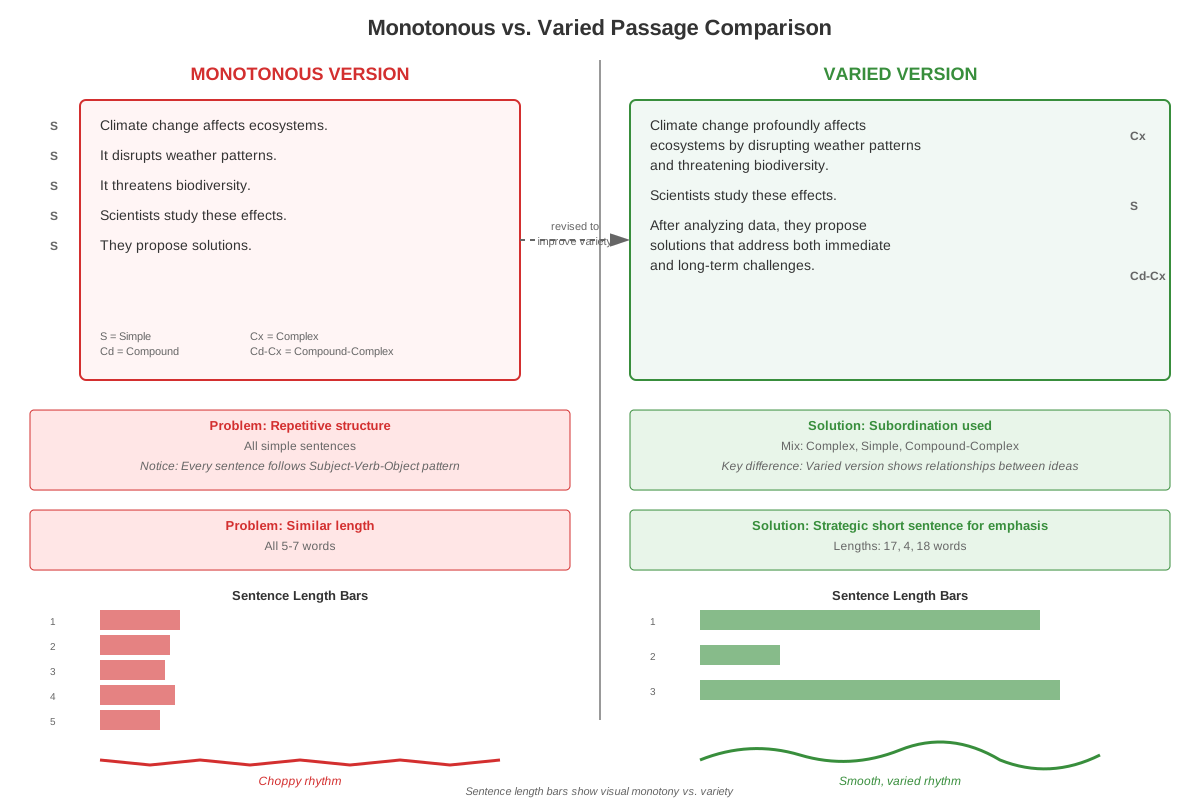
"The ancient Romans built extensive road networks. The Romans used these roads for military purposes. The roads also facilitated trade throughout the empire. The road system connected distant provinces. The system remained functional for centuries."
Analysis: This passage demonstrates classic sentence variety problems. All five sentences follow identical structure: subject-first, simple sentence, similar length (7-9 words). The repetitive pattern creates choppy, elementary-level prose despite sophisticated content.
Step 1: Identify the monotony. Note that every sentence begins with "The" followed by a noun subject, then a simple predicate. No variation in opening, type, or length exists.
Step 2: Determine logical relationships. Sentences 1-2 connect (roads and their purpose). Sentences 2-3 show contrast (military vs. trade purposes). Sentences 4-5 relate (system characteristics).
Step 3: Apply combination strategies using subordination and coordination:
Revised version:
"The ancient Romans built extensive road networks primarily for military purposes, though these roads also facilitated trade throughout the empire. Connecting distant provinces, the road system remained functional for centuries."
Improvements achieved:
- Reduced five choppy sentences to two flowing ones
- Varied sentence length (first: 20 words; second: 11 words)
- Introduced complex sentence structure with subordination ("though")
- Used participial phrase opening ("Connecting distant provinces")
- Maintained all original information while improving readability
- Created sophisticated, college-level prose rhythm
Example 2: ACT-Style Question
Passage context:
"Scientists have long studied the migration patterns of monarch butterflies. These insects travel thousands of miles annually. They move from North America to Mexico. The journey requires multiple generations to complete. [1]"
Question: Which of the following alternatives to the underlined portion would be LEAST acceptable?
[1] A. NO CHANGE
B. complete, a journey that
C. complete; this journey
D. complete this journey
Step 1: Recognize this as a sentence variety question. The phrase "LEAST acceptable" indicates all options may be grammatically correct, but one disrupts flow or variety.
Step 2: Analyze the current pattern. The passage contains four consecutive short, simple sentences with subject-first openings. This monotonous pattern needs correction, not continuation.
Step 3: Evaluate each option:
- Option A (NO CHANGE): Maintains the problematic pattern with a fifth short, simple sentence
- Option B: Creates a complex sentence by converting the clause into an appositive phrase, adding variety
- Option C: Combines sentences using a semicolon, creating a compound sentence with varied structure
- Option D: Combines sentences through subordination, creating a complex sentence
Step 4: Identify the LEAST acceptable option. Option A perpetuates monotony while B, C, and D all introduce variety through different combination strategies.
Answer: A (NO CHANGE) is LEAST acceptable because it continues the choppy, repetitive pattern rather than introducing needed variety.
Key takeaway: When passages show obvious monotony, the ACT rewards options that introduce structural variety, even when the original is grammatically correct.
Exam Strategy
Recognition Triggers
Watch for these signals that sentence variety is being tested:
- Consecutive short sentences in passages, especially three or more in a row
- Repetitive sentence openings, particularly when multiple sentences begin with the same word or structure
- Questions asking "Which choice best maintains the style of the passage?" or "Which alternative provides the most effective transition?"
- Answer choices that are all grammatically correct but differ in sentence structure or combination approach
- Underlined periods between sentences, suggesting potential combination or separation issues
- Phrases like "LEAST acceptable" or "would NOT be acceptable," indicating stylistic rather than grammatical evaluation
Approach Process
- Read surrounding context (2-3 sentences before and after) to identify patterns
- Identify the current structure: sentence type, length, and opening style
- Check for monotony: Do surrounding sentences follow identical or very similar patterns?
- Evaluate each answer choice for how it affects variety, not just grammatical correctness
- Select the option that introduces appropriate variety while maintaining passage tone and style
- Verify that your choice doesn't create new problems (awkward phrasing, unclear meaning, grammatical errors)
Process of Elimination
- Eliminate options that create grammatical errors (fragments, run-ons, comma splices)
- Eliminate choices that drastically change meaning or omit important information
- Eliminate alternatives that introduce inappropriate tone shifts (too formal/informal for context)
- Between remaining options, choose the one that best varies structure from surrounding sentences
- When stuck, read each option aloud mentally to hear which creates the best rhythm
Time Management
Sentence variety questions typically require 30-45 seconds each—slightly longer than pure grammar questions because they demand contextual analysis. Budget time accordingly:
- Quick scan (5 seconds): Identify question type and read surrounding sentences
- Analysis (15-20 seconds): Evaluate pattern and assess options
- Selection and verification (10-15 seconds): Choose answer and confirm it works
Don't rush these questions; they reward careful consideration of context and style. However, if genuinely stuck after 45 seconds, make your best guess and move forward. Spending excessive time on one question jeopardizes performance on others.
Memory Techniques
The VOLS Acronym
Remember the four dimensions of sentence variety with VOLS:
- Variety in sentence type (simple, compound, complex, compound-complex)
- Opening variation (subject-first, prepositional, participial, subordinate, transitional)
- Length diversity (short, medium, long)
- Sophistication through strategic combination
The "Three-Strike Rule"
When three consecutive sentences follow the same pattern (type, length, or opening), variety problems exist. Visualize a baseball umpire calling "Strike three!"—the passage is "out" and needs revision.
The Rhythm Test
Mentally "hear" sentence rhythm by tapping: short sentences = one tap, medium = two taps, long = three taps. Monotonous passages sound like "tap-tap-tap-tap-tap" (all the same). Varied passages sound like "tap-tap-tap-tap-tap-tap-tap" (mixed rhythm).
FANBOYS for Coordination
Remember coordinating conjunctions (used in compound sentences) with the classic acronym:
- For
- And
- Nor
- But
- Or
- Yet
- So
The "Emphasis Sandwich"
Visualize emphasis technique: Long sentence (top bun) + Short sentence (meat) + Long sentence (bottom bun). The short sentence in the middle gets maximum emphasis, like the best part of a sandwich.
Summary
Sentence variety represents a crucial ACT Writing skill that distinguishes competent from exceptional writers. Mastery requires understanding the four sentence types (simple, compound, complex, compound-complex) and strategically varying sentence length, opening style, and structure to create engaging, sophisticated prose. The ACT tests sentence variety both in multiple-choice English questions—where students must recognize monotonous patterns and select effective revisions—and in essay scoring, where varied structure directly impacts Language Use and Conventions scores. Effective variety balances consistency with diversity: maintaining stable passage tone while avoiding repetitive patterns that create choppy, elementary-level writing. Students must recognize that when answer choices are all grammatically correct, the ACT rewards options that introduce appropriate structural variety. Success requires reading contextually, identifying current patterns, and selecting revisions that enhance rhythm and readability while preserving meaning and tone. The key principle: variety serves rhetorical effectiveness, not mere stylistic preference.
Key Takeaways
- Sentence variety encompasses three dimensions: type (simple, compound, complex, compound-complex), length (short, medium, long), and opening style (subject-first, prepositional, participial, subordinate, transitional)
- The ACT tests sentence variety in 8-12% of English questions and explicitly rewards it in essay scoring rubrics
- Three or more consecutive sentences with identical structure signal a variety problem that requires revision
- When all answer choices are grammatically correct, select the option that best introduces variety while maintaining passage style
- Effective variety balances consistency (stable tone and voice) with diversity (avoiding monotonous patterns)
- Short sentences create emphasis and work best after longer sentences; compound-complex sentences demonstrate highest sophistication
- Recognition triggers include consecutive short sentences, repetitive openings, and questions about "style" or "effectiveness" rather than grammar
Related Topics
Transitions and Transitional Phrases: Mastering sentence variety enables more sophisticated use of transitions, as varied sentence openings naturally incorporate transitional elements. Understanding how transitions connect ideas helps determine which sentence structures best serve rhetorical purposes.
Parallelism: While sentence variety promotes structural diversity between sentences, parallelism maintains consistency within sentences and lists. These complementary skills work together to create writing that's both varied and coherent.
Rhetorical Skills and Style: Sentence variety forms one component of broader rhetorical effectiveness. Students who master variety are prepared to tackle questions about tone, audience awareness, and purpose—all essential for top ACT Writing scores.
Essay Development and Organization: The essay portion rewards varied sentence structure as part of overall writing quality. Mastering variety in the English section translates directly to higher essay scores in Language Use and Conventions.
Practice CTA
Now that you understand the principles and strategies behind sentence variety, it's time to apply this knowledge! Complete the practice questions to test your ability to recognize monotonous patterns and select effective revisions. Use the flashcards to reinforce key concepts like sentence types, combination strategies, and recognition triggers. Remember: sentence variety appears frequently on the ACT and directly impacts both your English section score and essay evaluation. Every practice question you complete builds the pattern recognition and strategic thinking skills that lead to test-day success. You've got this!
Sign up free to keep reading
Create a free AnvayaPrep account to finish this ACT guide on Sentence variety — plus flashcards and practice questions.