Overview
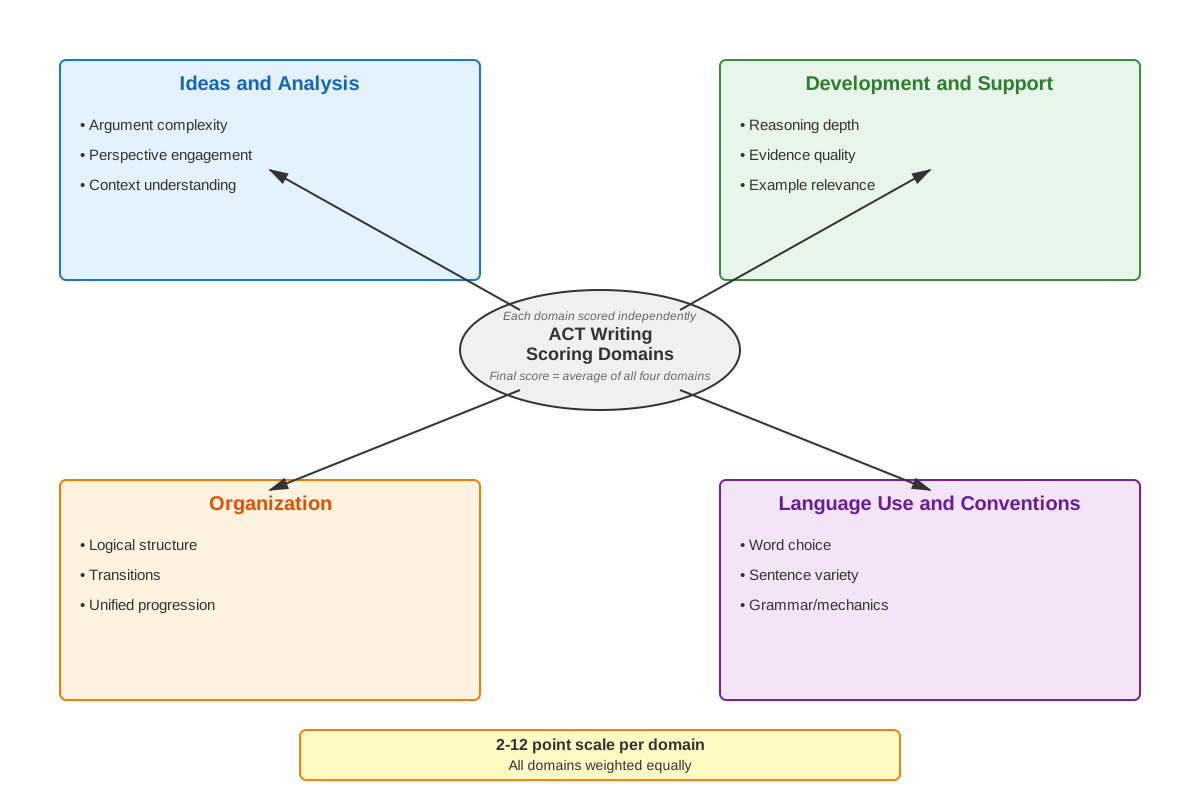
The ACT writing scoring domains represent the four distinct analytical lenses through which trained graders evaluate every ACT essay. Understanding these domains is absolutely critical for achieving a competitive score on the ACT Writing test, as each domain contributes equally to the final essay score. The four domains—Ideas and Analysis, Development and Support, Organization, and Language Use and Conventions—provide a comprehensive framework that assesses different dimensions of writing quality, from the sophistication of argumentation to the precision of language mechanics.
Mastering the ACT writing scoring domains is not merely about knowing what graders look for; it's about internalizing a strategic approach to essay construction that systematically addresses each evaluation criterion. Students who understand these domains can reverse-engineer high-scoring essays by ensuring their writing demonstrates strength across all four areas. This knowledge transforms the essay from an intimidating open-ended task into a manageable checklist of specific, achievable goals. Each domain operates on a 2-12 point scale, and scores are averaged to produce the final Writing score, making balanced performance across all domains essential rather than excelling in just one or two areas.
The scoring domains connect intimately with broader ACT Writing concepts, particularly essay structure, argument development, and rhetorical analysis. They provide the evaluative framework that determines how effectively a student has responded to the prompt's perspectives, developed their own argument, and communicated their ideas. Understanding these domains also illuminates why certain essay strategies prove more effective than others—strategies that might seem impressive in isolation may fail to address multiple domains simultaneously, resulting in unbalanced scores.
Learning Objectives
- [ ] Identify when ACT writing scoring domains is being tested
- [ ] Explain the core rule or strategy behind ACT writing scoring domains
- [ ] Apply ACT writing scoring domains to ACT-style questions accurately
- [ ] Distinguish between the four scoring domains and recognize which aspects of writing each domain evaluates
- [ ] Analyze sample essay excerpts and determine which domain(s) they address effectively or inadequately
- [ ] Construct essay plans that systematically address all four scoring domains with balanced attention
- [ ] Evaluate personal writing samples using the domain rubrics to identify specific areas for improvement
Prerequisites
- Basic essay structure knowledge: Understanding introduction, body paragraphs, and conclusion organization provides the foundation upon which domain-specific strategies are built
- Familiarity with argumentative writing: The ACT essay requires taking and defending a position, so students must understand claims, evidence, and reasoning
- Reading comprehension of perspective prompts: Students must be able to analyze the three provided perspectives before they can engage with them meaningfully in their essays
- Fundamental grammar and mechanics: While Language Use is one domain, basic sentence construction ability is assumed for addressing any domain effectively
Why This Topic Matters
The ACT writing scoring domains matter because they directly determine essay scores in a transparent, systematic way. Unlike subjective "holistic" grading where criteria remain vague, the ACT provides explicit domain descriptions that function as a roadmap to success. Students who understand these domains can self-assess their writing during the planning and revision phases, catching weaknesses before submission. This knowledge also reduces test anxiety by replacing uncertainty with concrete goals.
On the ACT, the Writing test appears as an optional 40-minute essay at the end of the exam. While optional, many competitive colleges require or strongly recommend the Writing score, making it effectively mandatory for college-bound students targeting selective institutions. The essay prompt presents an issue and three different perspectives on that issue, requiring students to analyze the perspectives, develop their own viewpoint, and explain relationships between their perspective and the given ones. Graders spend approximately 2-3 minutes per essay, making it essential that domain-specific strengths are immediately apparent.
The scoring domains appear in every single ACT essay evaluation. Two trained graders independently score each essay on each of the four domains using a 1-6 scale, and these scores are then combined and scaled to produce domain scores of 2-12. The four domain scores are averaged for the final Writing score. This means that weakness in even one domain can significantly impact the overall score, while balanced competence across all domains ensures a solid result. Understanding the domains allows strategic allocation of the 40-minute time limit—students can ensure they're investing effort in activities that directly improve scores rather than pursuing impressive-sounding but ultimately unrewarded writing choices.
Core Concepts
The Four ACT Writing Scoring Domains
The ACT evaluates essays through four distinct scoring domains, each assessing a different dimension of writing quality. These domains are Ideas and Analysis, Development and Support, Organization, and Language Use and Conventions. Each domain receives an independent score from 1-6 from two graders, which are then combined and scaled to produce domain scores ranging from 2-12. Understanding what each domain measures and how to address it is fundamental to ACT essay success.
Ideas and Analysis Domain
The Ideas and Analysis domain evaluates the quality of thinking demonstrated in the essay. This domain assesses how well the writer engages with the complexity of the issue, analyzes the perspectives provided in the prompt, and develops their own perspective with nuance and depth. High-scoring essays in this domain demonstrate sophisticated thinking that goes beyond surface-level observations.
Key components of Ideas and Analysis include:
- Perspective engagement: Effectively analyzing the strengths, weaknesses, and implications of the provided perspectives rather than merely summarizing them
- Argument complexity: Developing a thesis that acknowledges nuance, considers multiple dimensions of the issue, and avoids oversimplification
- Critical thinking: Examining underlying assumptions, exploring consequences, and considering context rather than making blanket statements
- Intellectual depth: Moving beyond obvious observations to generate insights that demonstrate genuine analytical thinking
A strong Ideas and Analysis performance might explore how two seemingly opposed perspectives actually share common ground, examine why reasonable people might disagree on the issue, or identify unstated assumptions underlying each perspective. Weak performance typically involves simply restating perspectives without analysis, taking an overly simplistic position, or failing to engage meaningfully with the complexity of the issue.
Development and Support Domain
The Development and Support domain measures how effectively the essay substantiates its claims through reasoning, examples, and elaboration. While Ideas and Analysis focuses on what you think, Development and Support evaluates how you justify and explain those ideas. This domain rewards essays that provide specific, relevant support and thoroughly explain the connections between evidence and claims.
Essential elements of Development and Support include:
- Reasoning quality: Providing logical explanations for why claims are valid rather than simply asserting them
- Example specificity: Using concrete, detailed examples rather than vague generalities
- Relevance: Ensuring all support directly connects to and advances the argument
- Elaboration depth: Explaining the significance of examples and reasoning rather than leaving connections implicit
- Sufficient quantity: Providing enough support that claims feel substantiated rather than underdeveloped
High-scoring essays in this domain might use hypothetical scenarios to illustrate consequences, draw on general knowledge about historical or contemporary issues, or develop extended reasoning chains that thoroughly justify positions. The examples need not be highly specific facts or statistics—thoughtful hypotheticals and logical reasoning are equally valuable. Weak performance typically involves making claims without explanation, using examples that don't clearly connect to the argument, or providing insufficient elaboration that leaves the reader unconvinced.
Organization Domain
The Organization domain assesses the essay's structural clarity and logical flow. This domain evaluates how effectively the essay guides readers through the argument, whether ideas are grouped logically, and how smoothly the writing transitions between points. Strong organization makes the essay easy to follow and enhances the persuasiveness of the argument.
Critical aspects of Organization include:
- Logical structure: Arranging ideas in a sequence that makes sense and builds the argument effectively
- Paragraph unity: Ensuring each paragraph focuses on a clear main idea that contributes to the overall argument
- Transitions: Using effective connections between sentences and paragraphs that clarify relationships between ideas
- Introduction and conclusion: Providing clear framing that establishes the argument's direction and synthesizes key points
- Coherence: Maintaining focus throughout the essay without digressions or confusing shifts
A well-organized essay might structure body paragraphs around different perspectives or different dimensions of the issue, use transitional phrases that signal relationships (contrast, causation, elaboration), and maintain a clear throughline from introduction to conclusion. Poor organization manifests as paragraphs that seem randomly ordered, abrupt shifts between ideas without transition, or structural choices that obscure rather than clarify the argument.
Language Use and Conventions Domain
The Language Use and Conventions domain evaluates the essay's command of written English, including word choice, sentence structure, grammar, and mechanics. This domain assesses both the sophistication of language use and the correctness of conventions. While minor errors are acceptable even in high-scoring essays, this domain rewards precise, varied, and stylistically effective writing.
Key components of Language Use and Conventions include:
- Word choice precision: Using vocabulary that conveys meaning accurately and appropriately
- Sentence variety: Employing different sentence structures and lengths to create engaging prose
- Grammar accuracy: Demonstrating control over standard English grammar rules
- Mechanics correctness: Proper use of punctuation, spelling, and capitalization
- Style appropriateness: Maintaining a formal, academic tone suitable for analytical writing
High-scoring essays in this domain feature varied sentence structures (simple, compound, complex), precise vocabulary that enhances meaning, and minimal errors that don't interfere with comprehension. They demonstrate stylistic maturity through techniques like subordination, parallel structure, and strategic word choice. Weak performance includes repetitive sentence patterns, imprecise or inappropriate vocabulary, frequent grammatical errors, or mechanical mistakes that distract from meaning.
Domain Scoring Scale
Each domain uses a 1-6 scoring scale applied by two independent graders, with scores then combined and scaled to 2-12:
| Score Level | Description | Characteristics |
|---|---|---|
| 6 (11-12) | Skillful | Demonstrates effective skill in responding to the task |
| 5 (9-10) | Well-developed | Shows well-developed skill with some minor weaknesses |
| 4 (7-8) | Adequate | Displays adequate skill with noticeable limitations |
| 3 (5-6) | Developing | Shows developing skill with significant weaknesses |
| 2 (3-4) | Weak | Demonstrates weak or inconsistent skill |
| 1 (2) | Inadequate | Shows little or no skill in responding to the task |
Understanding this scale helps students calibrate their goals—achieving consistent "adequate" performance across all domains yields a respectable score, while "well-developed" performance positions students competitively for selective colleges.
Concept Relationships
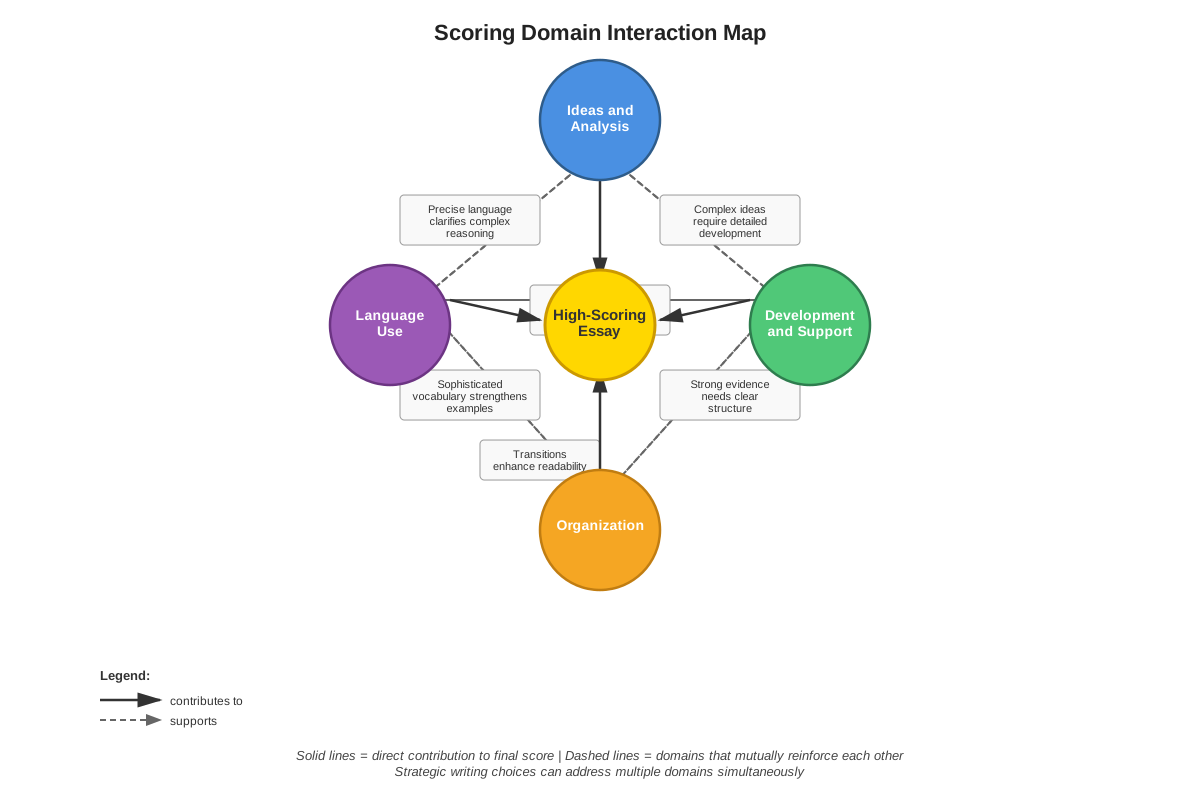
The four scoring domains interconnect in complex ways, with strength in one domain often supporting performance in others. Ideas and Analysis provides the intellectual foundation that the other domains build upon—without sophisticated ideas, there's nothing substantial to develop, organize, or express. Development and Support takes the ideas generated in the first domain and makes them convincing through reasoning and examples. Organization structures both the ideas and their support into a coherent, persuasive sequence that maximizes impact. Language Use and Conventions serves as the vehicle through which all other domains are communicated, with precise language enhancing clarity and grammatical control ensuring ideas are understood as intended.
The relationship flows: Ideas and Analysis → Development and Support → Organization → Language Use and Conventions, though in practice, these domains operate simultaneously during writing. A well-organized essay makes ideas clearer (Organization enhancing Ideas and Analysis), while sophisticated vocabulary can make reasoning more precise (Language Use enhancing Development and Support). Conversely, weaknesses cascade: poor organization can obscure strong ideas, while language errors can undermine otherwise solid reasoning.
These domains connect to prerequisite knowledge in predictable ways. Basic essay structure knowledge supports the Organization domain, argumentative writing skills underpin Ideas and Analysis and Development and Support, and grammar fundamentals enable Language Use and Conventions. The domains also relate to broader ACT Writing concepts: the requirement to analyze perspectives directly feeds into Ideas and Analysis, while the 40-minute time limit necessitates organizational efficiency.
Quick check — test yourself on ACT writing scoring domains so far.
Try Flashcards →High-Yield Facts
⭐ The ACT essay is scored on four equally weighted domains: Ideas and Analysis, Development and Support, Organization, and Language Use and Conventions
⭐ Each domain receives a score of 2-12, calculated by combining two graders' 1-6 scores and scaling the result
⭐ The final Writing score is the average of the four domain scores, making balanced performance across all domains essential
⭐ Ideas and Analysis evaluates the sophistication and depth of thinking, not just whether you have an opinion
⭐ Development and Support rewards specific reasoning and examples, not vague generalizations or unsupported claims
- Organization assesses logical structure and transitions, not just the presence of five paragraphs
- Language Use and Conventions evaluates both correctness and sophistication of language
- High-scoring essays must meaningfully engage with the provided perspectives, not just state agreement or disagreement
- Minor grammatical errors are acceptable in high-scoring essays if they don't impede understanding
- The domains are evaluated independently, so an essay can score differently across domains
- Graders spend approximately 2-3 minutes per essay, making immediately apparent strengths crucial
- Essays that excel in one domain but neglect others receive unbalanced scores that lower the overall result
- The scoring rubric is publicly available, allowing students to understand exactly what graders seek
- Development and Support values quality of reasoning over memorized facts or statistics
- Organization includes both macro-structure (overall essay arrangement) and micro-structure (paragraph coherence and transitions)
Common Misconceptions
Misconception: The essay score is holistic, so focusing on overall quality is sufficient → Correction: The essay receives four separate domain scores that are averaged, so targeted attention to each specific domain is necessary. An essay with brilliant ideas but poor organization will receive an unbalanced score that lowers the overall result.
Misconception: Ideas and Analysis means having a strong opinion on the issue → Correction: This domain evaluates the sophistication and nuance of thinking, not the strength of conviction. A high-scoring essay might acknowledge complexity and explore multiple dimensions rather than taking an extreme position.
Misconception: Development and Support requires specific facts, statistics, or historical examples → Correction: While specific examples can be effective, this domain primarily rewards logical reasoning and thoughtful hypotheticals. General knowledge and well-developed "what if" scenarios are equally valuable.
Misconception: Organization means following a five-paragraph format → Correction: While five paragraphs can work, this domain evaluates logical flow, coherence, and effective transitions rather than adherence to a specific template. A well-organized four-paragraph or six-paragraph essay can score just as highly.
Misconception: Language Use and Conventions requires perfect grammar with no errors → Correction: High-scoring essays can contain minor errors that don't interfere with meaning. This domain evaluates overall command of language, including vocabulary and sentence variety, not just error-free writing.
Misconception: All four domains must be addressed separately in the essay → Correction: The domains are evaluation criteria, not essay sections. Strong writing naturally addresses all domains simultaneously—a well-reasoned paragraph demonstrates Ideas and Analysis, Development and Support, Organization, and Language Use all at once.
Misconception: Longer essays automatically score higher → Correction: While extremely brief essays struggle to demonstrate domain competencies, length alone doesn't determine scores. A focused, well-developed essay of moderate length outscores a rambling, repetitive longer essay.
Worked Examples
Example 1: Analyzing an Essay Excerpt for Domain Performance
Prompt context: The issue concerns whether automation in the workplace primarily benefits or harms workers.
Essay excerpt:
"Automation helps companies but hurts workers. Many people lose their jobs when machines replace them. This is bad for the economy. Companies should think about workers before using automation. The first perspective says automation is good, but I disagree because jobs are important."
Domain Analysis:
Ideas and Analysis: This excerpt demonstrates weak performance (score 2-3 range). The thinking is simplistic and binary ("helps companies but hurts workers") without acknowledging nuance or complexity. The engagement with the perspective is superficial—merely stating disagreement without analyzing the perspective's reasoning or considering why someone might hold that view. There's no exploration of underlying assumptions or consideration of context.
Development and Support: This excerpt shows inadequate development (score 2 range). The claim that "many people lose their jobs" lacks specific reasoning or examples. The statement "this is bad for the economy" is asserted without explanation of why or how job loss affects the economy. No reasoning chain connects the claims, and there's no elaboration on the significance of the points raised.
Organization: The organization is developing but weak (score 3 range). Ideas are presented in a list-like fashion without clear connections. The transition between discussing job loss and addressing the perspective is abrupt. However, there is a basic logical sequence (claim, reason, conclusion), preventing this from being entirely inadequate.
Language Use and Conventions: This excerpt demonstrates adequate but limited language use (score 3-4 range). Sentences are grammatically correct but simplistic and repetitive in structure. Word choice is imprecise ("helps," "bad," "good") and lacks sophistication. There are no errors, but there's also no variety or stylistic maturity.
Improvement strategy: To raise domain scores, this excerpt needs: (1) more nuanced thinking that acknowledges complexity, (2) specific reasoning explaining how and why automation affects workers and the economy, (3) smoother transitions and clearer connections between ideas, and (4) more varied sentence structures and precise vocabulary.
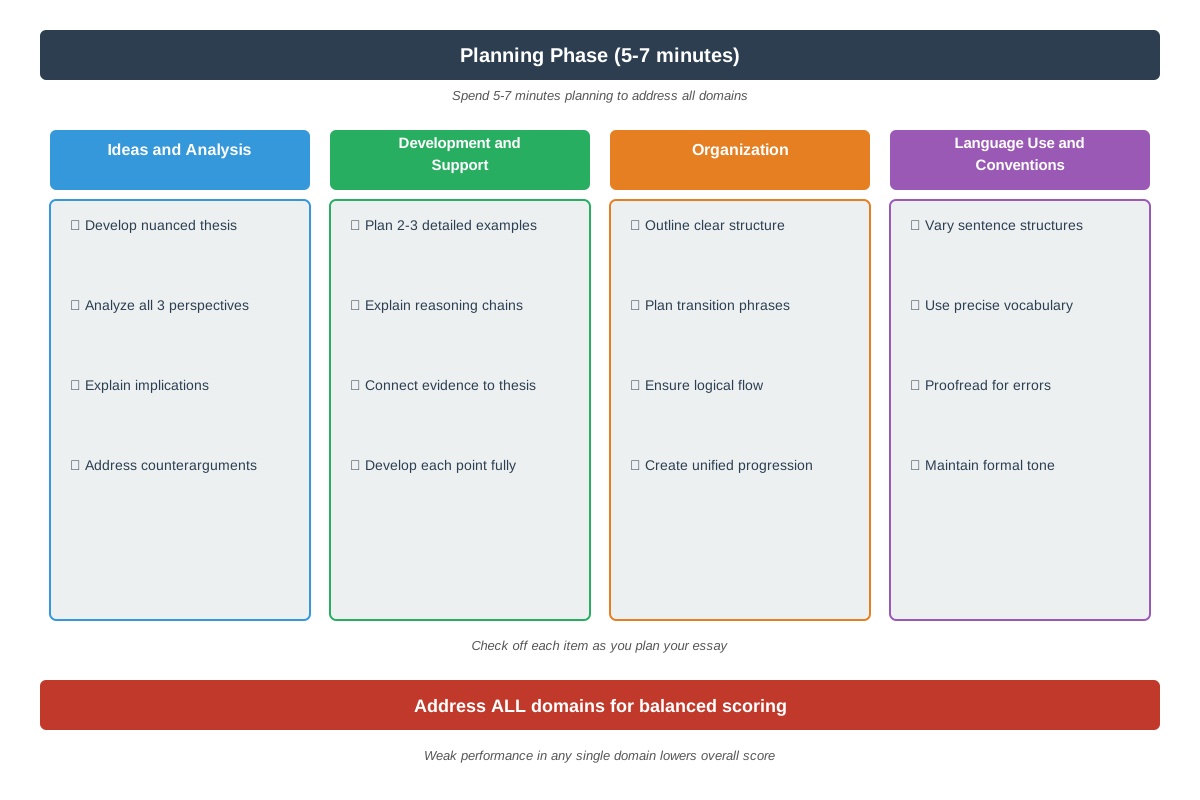
Example 2: Planning an Essay to Address All Domains
Prompt: Should high schools require students to complete community service for graduation?
Strategic planning process:
Step 1 - Ideas and Analysis planning: Develop a nuanced thesis that acknowledges complexity. Instead of simply "yes" or "no," consider: "While mandatory community service risks undermining the intrinsic motivation that makes service meaningful, carefully designed requirements that offer choice and reflection can cultivate civic engagement without the drawbacks of coercion." This thesis demonstrates sophisticated thinking by acknowledging a tension and proposing a conditional position.
Step 2 - Development and Support planning: For each main point, plan specific reasoning:
- Point about intrinsic motivation: Explain psychological research suggesting external requirements can reduce internal drive; develop hypothetical scenario of student who resents forced service versus one who volunteers freely
- Point about civic engagement benefits: Reason through how exposure to community needs can broaden perspectives; use example of student discovering interest in social issues through service
- Point about implementation design: Explain why choice matters (autonomy preservation) and how reflection activities (journals, discussions) can deepen learning
Step 3 - Organization planning: Structure logically:
- Introduction: Present issue, acknowledge perspectives, state nuanced thesis
- Body paragraph 1: Analyze perspective favoring requirements, then present concern about intrinsic motivation
- Body paragraph 2: Analyze perspective opposing requirements, then explain benefits of civic engagement
- Body paragraph 3: Synthesize by proposing well-designed requirements that address concerns
- Conclusion: Reinforce nuanced position and broader implications
Step 4 - Language Use planning: Consciously vary sentence structures and use precise vocabulary:
- Use subordinate clauses to show relationships: "While proponents argue..., this overlooks..."
- Employ precise terms: "intrinsic motivation," "civic engagement," "autonomy"
- Vary sentence openings and lengths for rhythm
This planning process ensures all four domains receive attention before writing begins, making efficient use of the 40-minute time limit and producing balanced domain performance.
Exam Strategy
When approaching the ACT Writing test with domain awareness, employ this systematic strategy:
During the 40-minute essay period:
- Minutes 0-8 (Planning): Read the prompt and perspectives carefully. Develop a thesis that demonstrates nuance (Ideas and Analysis). Outline main points with specific reasoning for each (Development and Support). Plan paragraph structure and transitions (Organization).
- Minutes 8-35 (Writing): Execute the plan while maintaining domain awareness. In each paragraph, ensure you're analyzing rather than summarizing (Ideas and Analysis), providing reasoning and examples (Development and Support), maintaining logical flow (Organization), and using varied, precise language (Language Use and Conventions).
- Minutes 35-40 (Revision): Quickly review for domain balance. Check: Does the essay demonstrate sophisticated thinking? Is each claim supported with reasoning? Do paragraphs flow logically? Are there distracting errors?
Trigger words and phrases to watch for in prompts:
- "Analyze and evaluate" → signals Ideas and Analysis emphasis
- "Develop your own perspective" → requires original thinking, not just agreeing with a provided perspective
- "Discuss the relationship between your perspective and at least one other" → demands comparative analysis
Process-of-elimination for self-assessment:
When reviewing your essay plan or draft, ask domain-specific questions:
- Ideas and Analysis: "Have I moved beyond obvious observations? Do I acknowledge complexity?"
- Development and Support: "Can I explain why for each claim? Are my examples specific?"
- Organization: "Does each paragraph have a clear purpose? Are transitions smooth?"
- Language Use: "Have I varied sentence structures? Is my vocabulary precise?"
If the answer to any question is "no," that domain needs attention before time expires.
Time allocation advice:
Resist the urge to begin writing immediately. The 8-minute planning investment pays dividends by ensuring domain balance and preventing mid-essay confusion. Similarly, preserve 5 minutes for revision—catching organizational gaps or adding a missing transition can meaningfully improve scores. The actual writing phase should be efficient execution of a solid plan, not exploratory drafting.
Exam Tip: Graders evaluate what's on the page, not your potential. Make domain strengths immediately visible through clear topic sentences (Organization), explicit reasoning (Development and Support), analytical language like "this suggests" or "the implication is" (Ideas and Analysis), and varied sentence structures (Language Use).
Memory Techniques
Mnemonic for the four domains: "I DO Love Writing"
- I = Ideas and Analysis
- D = Development and Support
- O = Organization
- L = Language Use and Conventions
Visualization strategy for Ideas and Analysis: Picture a diamond with multiple facets. High-scoring Ideas and Analysis examines the issue from multiple angles (facets) rather than viewing it from just one direction. When planning, visualize turning the diamond to see different perspectives.
Acronym for Development and Support: "REES"
- R = Reasoning (explain why)
- E = Examples (provide specific instances)
- E = Elaboration (explain significance)
- S = Sufficient (provide enough support)
Memory technique for Organization: Think of the essay as a guided tour. A good tour guide (well-organized essay) tells you where you're going (introduction), takes you through locations in a logical order (body paragraphs), points out how locations connect (transitions), and summarizes what you've seen (conclusion). A poor tour guide jumps randomly between locations without explanation.
Mnemonic for Language Use priorities: "VIP-C"
- V = Variety (sentence structures)
- I = Intelligent (word choice)
- P = Precise (vocabulary)
- C = Correct (grammar and mechanics)
Conceptual memory aid: Remember that domains build on each other like a house:
- Foundation = Ideas and Analysis (what you're building)
- Frame = Development and Support (what holds it up)
- Layout = Organization (how rooms connect)
- Finish = Language Use (how it looks and functions)
Summary
The ACT writing scoring domains provide the evaluative framework through which every essay is assessed, making understanding these domains essential for achieving competitive scores. The four domains—Ideas and Analysis, Development and Support, Organization, and Language Use and Conventions—each assess distinct dimensions of writing quality and contribute equally to the final score. Ideas and Analysis evaluates the sophistication and nuance of thinking, rewarding essays that engage deeply with complexity rather than taking simplistic positions. Development and Support measures how effectively claims are justified through reasoning and examples, requiring specific elaboration rather than vague assertions. Organization assesses structural clarity and logical flow, ensuring readers can easily follow the argument. Language Use and Conventions evaluates command of written English, including vocabulary precision, sentence variety, and grammatical correctness. Success on the ACT Writing test requires balanced attention to all four domains, as weakness in even one area significantly impacts the overall score. Strategic planning that addresses each domain systematically, combined with awareness of what graders seek, transforms the essay from an intimidating task into a manageable demonstration of specific, achievable competencies.
Key Takeaways
- The ACT essay receives four separate domain scores (Ideas and Analysis, Development and Support, Organization, Language Use and Conventions) that are averaged for the final Writing score
- Ideas and Analysis rewards sophisticated, nuanced thinking that acknowledges complexity rather than simplistic positions or strong opinions
- Development and Support values specific reasoning and elaboration over memorized facts, with logical explanation being more important than statistical evidence
- Organization encompasses both macro-structure (overall essay arrangement) and micro-structure (paragraph coherence and smooth transitions)
- Language Use and Conventions evaluates both correctness and sophistication, with sentence variety and precise vocabulary being as important as error-free writing
- Balanced performance across all four domains is essential, as excelling in one domain while neglecting others produces unbalanced scores that lower overall results
- Strategic planning that systematically addresses each domain before writing begins maximizes efficiency and ensures comprehensive coverage within the 40-minute time limit
Related Topics
ACT Essay Prompt Analysis: Understanding how to deconstruct the issue and three perspectives provided in each prompt, identifying key tensions and implications that enable sophisticated Ideas and Analysis. Mastering scoring domains provides the framework for knowing what to do with prompt analysis insights.
Thesis Development for ACT Essays: Learning to craft nuanced, sophisticated thesis statements that demonstrate the analytical thinking rewarded in the Ideas and Analysis domain while providing a clear roadmap for organization.
Evidence and Reasoning Strategies: Developing techniques for generating specific examples and logical reasoning chains that satisfy the Development and Support domain, including hypothetical scenarios and general knowledge application.
Transition Techniques and Essay Flow: Mastering the specific transitional phrases and structural strategies that create the coherent, logical progression rewarded in the Organization domain.
Advanced Sentence Construction: Building skills in sentence variety, subordination, and parallel structure that elevate performance in the Language Use and Conventions domain beyond basic correctness.
Practice CTA
Now that you understand the four ACT writing scoring domains and how they function as evaluation criteria, it's time to apply this knowledge through practice. Attempt the practice questions to test your ability to identify domain-specific strengths and weaknesses in sample essays, and use the flashcards to reinforce your understanding of what each domain evaluates. Remember: understanding the scoring domains transforms the ACT essay from a subjective writing task into a strategic demonstration of specific, measurable skills. Every practice essay is an opportunity to strengthen your performance across all four domains and build the balanced competence that produces competitive scores. Your investment in mastering these domains will pay dividends not only on test day but in developing analytical and communication skills valuable far beyond the ACT.
Sign up free to keep reading
Create a free AnvayaPrep account to finish this ACT guide on ACT writing scoring domains — plus flashcards and practice questions.