Overview
The ACT Writing test presents students with a complex issue and three distinct perspectives on that issue. Success on this exam hinges on the ability to accurately identify perspectives and understand what each viewpoint truly argues. This skill forms the foundation of the entire essay-writing process, as students must analyze these perspectives, compare them to their own position, and discuss the relationships between different viewpoints in a coherent, well-reasoned essay.
Identifying perspectives is not simply about reading three short paragraphs—it requires critical analysis to extract the core argument, underlying assumptions, and implications of each viewpoint. Many students struggle because they confuse surface-level details with the fundamental position being advocated. The ACT deliberately crafts perspectives that may seem similar at first glance but actually represent distinct philosophical approaches or practical solutions to the prompt's central issue. Misidentifying what a perspective actually argues leads to off-topic analysis, weak comparisons, and ultimately lower scores across all four scoring domains: Ideas and Analysis, Development and Support, Organization, and Language Use.
Within the broader context of ACT Writing, ACT identifying perspectives serves as the critical first step in the essay-writing process. Before students can develop their own thesis, they must accurately understand the intellectual landscape presented in the prompt. This topic connects directly to argument analysis, thesis development, and comparative reasoning—all essential skills for achieving scores in the upper ranges (8-12 on the 12-point scale). The ability to identify perspectives accurately enables students to write with precision, engage meaningfully with counterarguments, and demonstrate the sophisticated thinking that graders reward.
Learning Objectives
- [ ] Identify when Identifying perspectives is being tested
- [ ] Explain the core rule or strategy behind Identifying perspectives
- [ ] Apply Identifying perspectives to ACT-style questions accurately
- [ ] Distinguish between the main claim and supporting details within each perspective
- [ ] Recognize the underlying values and assumptions that drive each perspective
- [ ] Compare and contrast multiple perspectives to identify areas of agreement and disagreement
- [ ] Paraphrase perspectives accurately without distorting their intended meaning
Prerequisites
- Basic reading comprehension: Students must be able to extract main ideas from short passages, as each perspective is presented as a brief paragraph that requires careful reading.
- Understanding of argumentative structure: Recognizing claims, evidence, and reasoning helps students separate what a perspective asserts from why it makes that assertion.
- Familiarity with the ACT Writing prompt format: Knowing that the test always presents exactly three perspectives on a debatable issue allows students to approach the task systematically.
- Vocabulary for discussing arguments: Terms like "claim," "position," "viewpoint," and "stance" enable precise thinking about what perspectives actually say.
Why This Topic Matters
In real-world contexts, the ability to accurately identify and understand different perspectives is fundamental to critical thinking, productive debate, and informed decision-making. Whether analyzing political positions, evaluating business strategies, or navigating ethical dilemmas, success depends on first understanding what others actually believe before responding. This skill prevents strawman arguments, promotes intellectual honesty, and enables genuine dialogue across differences.
On the ACT Writing test, perspective identification appears in 100% of essay prompts—it is unavoidable and foundational. The test always presents three perspectives, and students must engage with all three in their essays to achieve high scores. According to ACT scoring guidelines, essays that demonstrate "a nuanced understanding of multiple perspectives" and "analyze the relationship between their own perspective and at least one other perspective" score significantly higher than those that merely summarize or ignore the given perspectives. Questions about perspective identification don't appear as multiple-choice items, but the skill is directly assessed through the essay itself, particularly in the Ideas and Analysis domain.
Common ways this topic manifests in ACT Writing prompts include perspectives that: advocate for different solutions to a problem (e.g., government regulation vs. market forces vs. individual responsibility); represent different value systems (e.g., prioritizing freedom vs. security vs. equality); propose different interpretations of a phenomenon (e.g., technology as liberating vs. isolating vs. neutral); or emphasize different stakeholders' interests (e.g., consumers vs. workers vs. business owners). The perspectives are deliberately designed to be distinct yet plausible, requiring careful analysis to avoid conflating them.
Core Concepts
What Perspectives Are on the ACT
Each ACT Writing prompt presents a contemporary issue followed by three perspectives—distinct viewpoints that take positions on the issue. These perspectives are not random opinions but carefully constructed arguments that represent different philosophical approaches, practical solutions, or value priorities. Each perspective typically consists of 2-4 sentences that state a position and provide brief reasoning or implications.
The perspectives serve multiple purposes: they provide intellectual starting points for student thinking, ensure all test-takers engage with the same basic arguments, and create a framework for comparative analysis. Understanding that perspectives are meant to be analyzed rather than simply agreed with or rejected is crucial. The ACT does not expect students to adopt any particular perspective; rather, it assesses how well students can understand, evaluate, and engage with multiple viewpoints.
The Anatomy of a Perspective
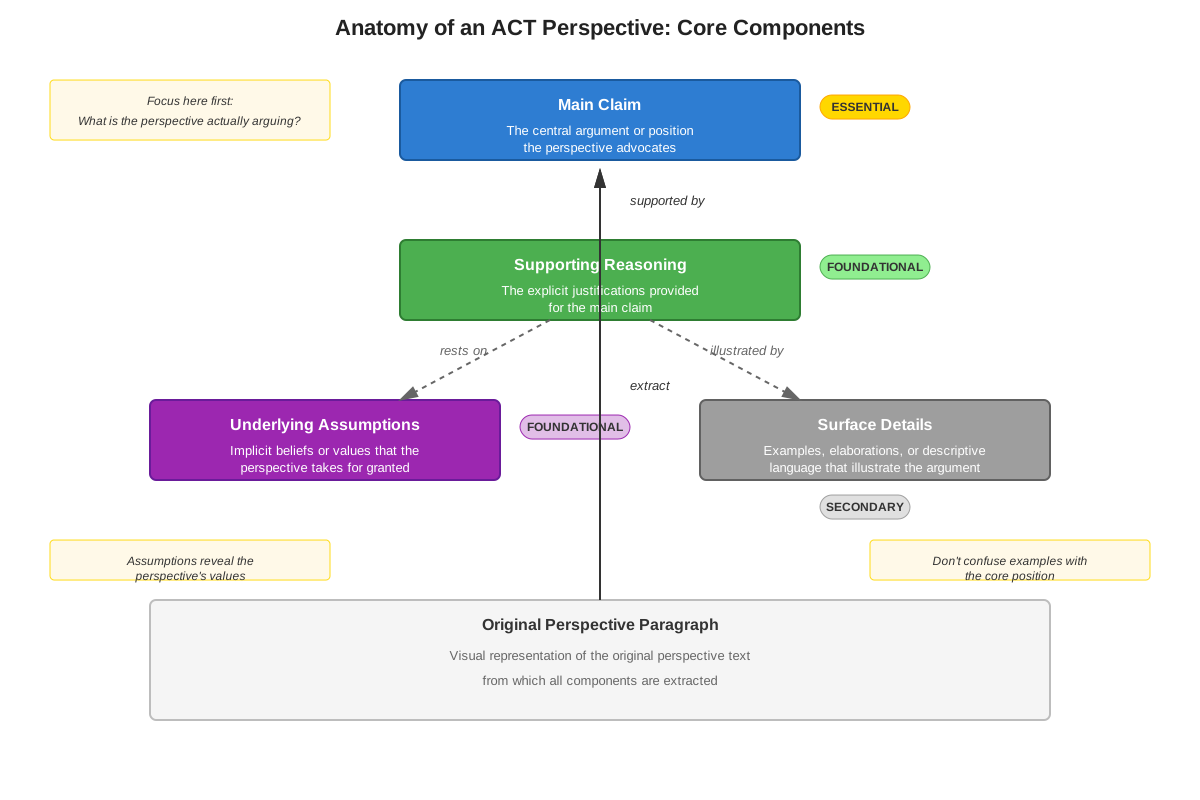
Each perspective contains several identifiable components that students must recognize:
The Core Claim: This is the fundamental position or assertion the perspective makes about the issue. It answers the question "What does this perspective believe should happen?" or "What stance does this perspective take?" The core claim is often stated explicitly in the first sentence but may require inference from the entire paragraph.
Supporting Reasoning: Most perspectives include brief justification for their position—why this viewpoint makes sense or what logic supports it. This reasoning might appeal to practical consequences, moral principles, historical precedent, or logical consistency.
Underlying Values: Every perspective rests on certain assumptions about what matters most. One perspective might prioritize individual freedom, another collective welfare, and a third economic efficiency. Identifying these underlying values helps students understand why perspectives differ and enables deeper analysis.
Implications: Some perspectives explicitly state what would follow from adopting their position, while others leave implications unstated. Recognizing both stated and unstated implications allows for richer engagement with the perspectives.
The Process of Identifying Perspectives
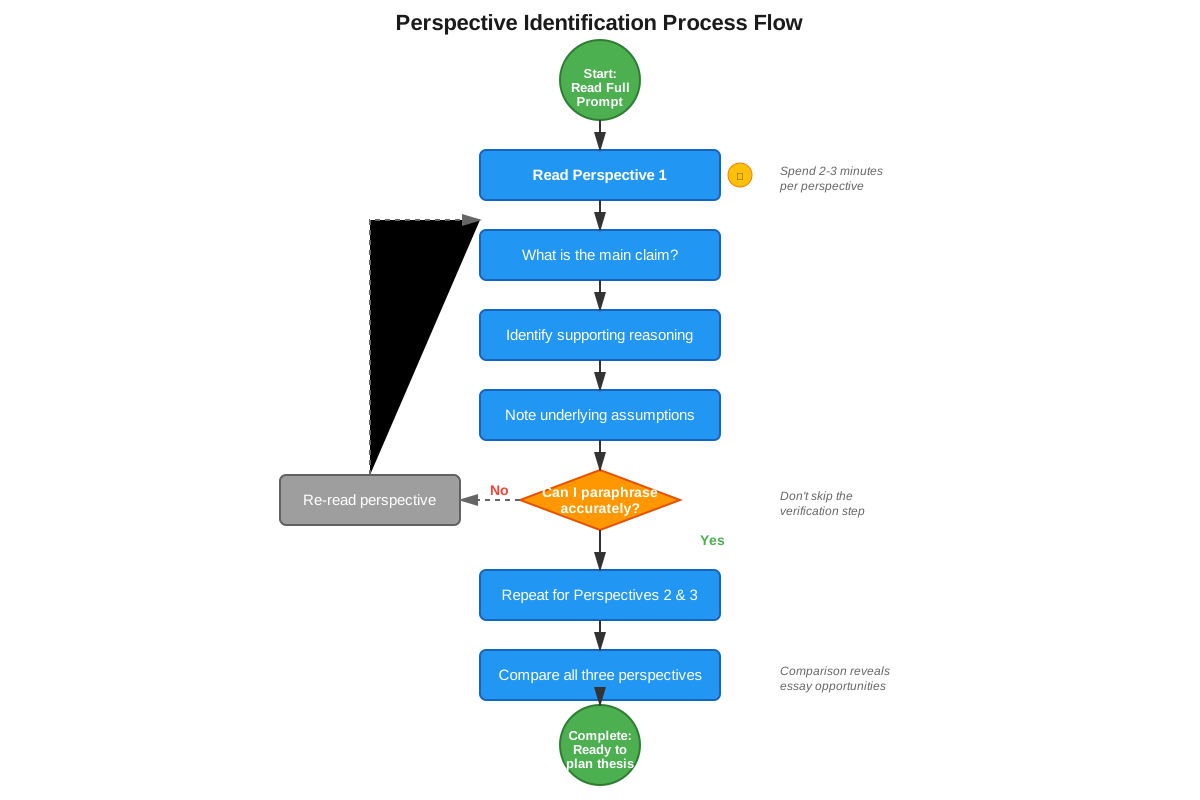
Accurate perspective identification follows a systematic approach:
- Read the entire prompt first: Understand the issue before examining individual perspectives. The introductory paragraph frames the debate and provides context essential for interpreting each viewpoint.
- Read each perspective twice: The first reading captures the general position; the second reading identifies specific claims, reasoning, and nuances.
- Identify the core claim in one sentence: Force yourself to articulate what each perspective fundamentally argues. If you cannot state it clearly, you have not yet identified it accurately.
- Note key words and phrases: Perspectives often contain signal words that reveal their stance—words like "should," "must," "only," "primarily," "instead," or "rather than" indicate the perspective's position relative to alternatives.
- Distinguish claims from reasons: Separate what the perspective asserts from why it makes that assertion. The "what" is the position; the "why" is the justification.
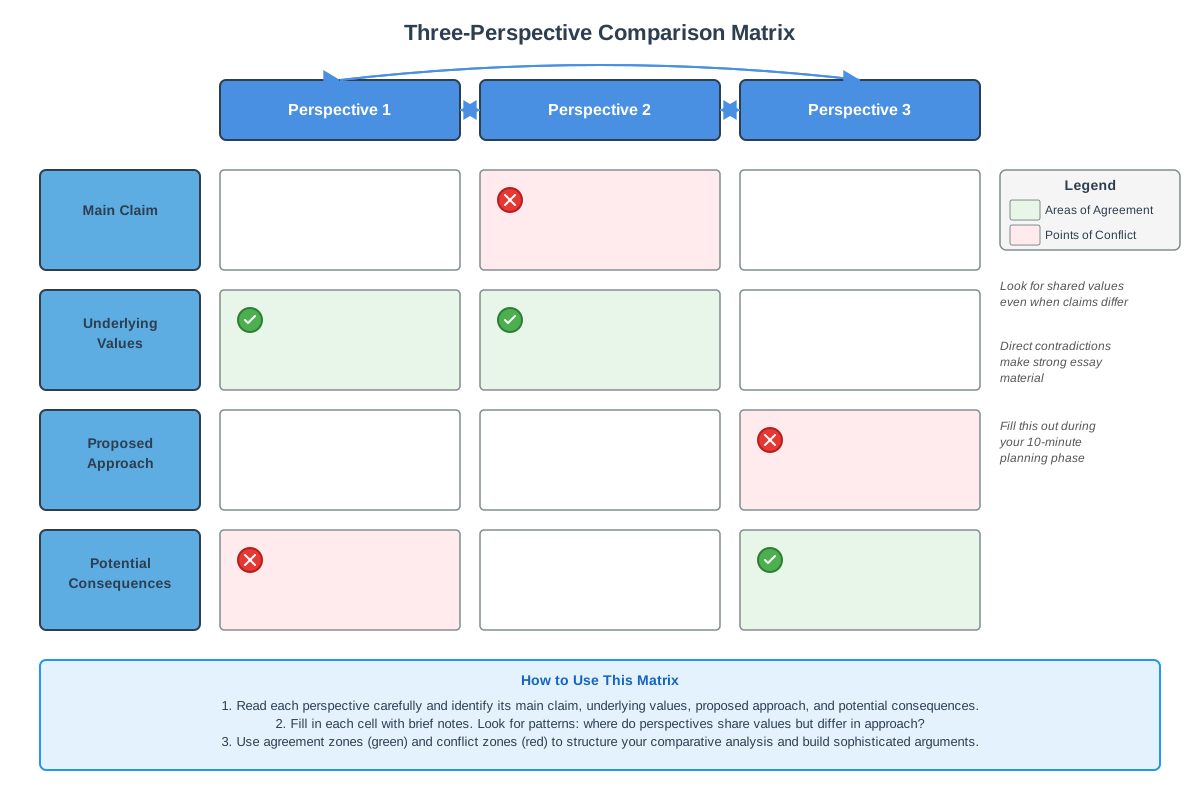
- Compare perspectives to each other: Understanding one perspective often becomes clearer when contrasted with the others. Ask: Where do they agree? Where do they fundamentally differ? What different assumptions drive them?
Common Perspective Patterns
ACT Writing prompts typically follow recognizable patterns in how perspectives relate to each other:
| Pattern Type | Description | Example Structure |
|---|---|---|
| Spectrum | Three perspectives represent different degrees along a continuum | Strongly for → Moderate/conditional → Strongly against |
| Stakeholder | Each perspective represents a different group's interests | Consumers → Workers → Business owners |
| Value-based | Perspectives prioritize different core values | Freedom → Security → Equality |
| Solution-focused | Different approaches to solving the same problem | Government action → Market forces → Individual responsibility |
| Interpretive | Different ways of understanding the same phenomenon | Positive view → Negative view → Neutral/complex view |
Recognizing these patterns helps students quickly grasp the intellectual landscape of the prompt and understand how perspectives relate to each other.
What Identifying Perspectives Is NOT
Many students make the mistake of thinking perspective identification means:
- Agreeing or disagreeing: Identification is about understanding, not evaluation. Students must accurately grasp what each perspective argues before deciding whether they agree with it.
- Summarizing every detail: Identification focuses on the core position, not every supporting point or example mentioned.
- Choosing one perspective as "correct": The ACT does not present one perspective as objectively right. All three are designed to be defensible positions.
- Ignoring perspectives you disagree with: High-scoring essays engage seriously with multiple perspectives, including those the student ultimately rejects.
Precision in Paraphrasing
Once perspectives are identified, students must paraphrase them accurately in their essays. This requires capturing the essential position without distorting it. Effective paraphrasing maintains the perspective's core claim while using different words, demonstrates understanding through accurate representation, and avoids oversimplification or exaggeration.
Poor paraphrasing often results from hasty reading, imposing one's own views onto the perspective, or focusing on minor details rather than the main argument. Students should practice restating perspectives in their own words and checking whether their paraphrase would be recognizable to someone who holds that viewpoint.
Concept Relationships
The process of identifying perspectives serves as the foundation for all subsequent essay-writing tasks. Once perspectives are accurately identified, students can develop their own thesis by positioning it relative to the given viewpoints—agreeing with one, synthesizing elements of multiple perspectives, or proposing an alternative position that addresses limitations in all three.
Accurate identification enables meaningful analysis. Students cannot effectively analyze strengths and weaknesses of perspectives they have misunderstood. Similarly, comparing perspectives requires first knowing what each actually argues. The relationship flows: Identification → Analysis → Comparison → Synthesis.
Within the skill itself, component abilities build on each other: Basic reading comprehension → Extracting core claims → Recognizing underlying values → Understanding implications → Comparing multiple viewpoints. Each level requires the previous one as a foundation.
The connection to prerequisite knowledge is direct: argumentative structure knowledge helps students separate claims from evidence within perspectives; reading comprehension enables extraction of main ideas; familiarity with the prompt format allows efficient navigation of the test structure.
Relationship Map:
Reading the prompt → Identifying each perspective's core claim → Recognizing underlying values and assumptions → Understanding implications → Comparing perspectives to each other → Positioning your own thesis → Analyzing relationships between perspectives → Developing your essay
High-Yield Facts
⭐ The ACT Writing test always presents exactly three perspectives on the given issue—no more, no fewer.
⭐ Each perspective represents a distinct, defensible position; none is presented as objectively correct or incorrect.
⭐ High-scoring essays (10-12) demonstrate "a nuanced understanding of multiple perspectives" according to official ACT scoring guidelines.
⭐ The core claim of a perspective is what it fundamentally argues should happen or what position it takes on the issue.
⭐ Perspectives often differ in their underlying values (what they prioritize) even when they seem superficially similar.
- Supporting details and examples within a perspective are less important than its core argumentative position.
- Perspectives may agree on some points while disagreeing on others; identifying both areas of overlap and divergence is valuable.
- Signal words like "should," "must," "only," "primarily," and "instead" often reveal a perspective's stance.
- Accurate paraphrasing of perspectives in your essay demonstrates understanding and earns higher scores in Ideas and Analysis.
- Misidentifying what a perspective argues leads to off-topic analysis that cannot earn high scores regardless of writing quality.
- The introductory paragraph of the prompt provides essential context for interpreting what each perspective means.
- Perspectives are deliberately designed to represent different approaches (solutions, values, or interpretations) rather than minor variations on the same idea.
Quick check — test yourself on Identifying perspectives so far.
Try Flashcards →Common Misconceptions
Misconception: All three perspectives are equally valid, so it doesn't matter which one you choose or how you interpret them.
Correction: While all perspectives are defensible, accurate identification of what each actually argues is essential. Misrepresenting a perspective leads to flawed analysis. The ACT assesses your ability to understand and engage with the given perspectives accurately, not just to pick one and ignore the others.
Misconception: You must agree with at least one of the three perspectives to write a successful essay.
Correction: High-scoring essays can agree with one perspective, synthesize multiple perspectives, or propose an alternative position that differs from all three. What matters is accurate understanding and meaningful engagement, not agreement.
Misconception: The longest or most detailed perspective is the most important one to discuss.
Correction: All three perspectives deserve equal attention in your analysis. The length or detail of a perspective does not indicate its importance or correctness. Balanced engagement with multiple perspectives earns higher scores.
Misconception: Identifying perspectives means copying their exact wording into your essay.
Correction: Effective essays paraphrase perspectives in the student's own words, demonstrating genuine understanding. Direct quotation is unnecessary and often suggests superficial engagement.
Misconception: If two perspectives seem similar, they can be treated as the same position.
Correction: The ACT deliberately creates perspectives that may seem similar but represent distinct positions. Careful analysis reveals important differences in emphasis, values, or implications. Conflating perspectives demonstrates weak analysis.
Misconception: The perspective that appears first is the one the ACT wants you to support.
Correction: The order of perspectives is arbitrary and does not indicate preference or correctness. Students should evaluate all three perspectives equally and develop their own reasoned position.
Misconception: You only need to discuss perspectives that support your thesis.
Correction: High-scoring essays engage with multiple perspectives, including those that differ from the student's position. Addressing counterarguments and alternative viewpoints demonstrates sophisticated thinking.
Worked Examples
Example 1: Technology and Human Connection Prompt
Prompt Issue: As technology enables more virtual interaction, debate continues about its impact on human relationships.
Perspective One: Technology enhances human connection by enabling communication across distances and creating communities based on shared interests rather than geographic proximity. People can maintain relationships that would otherwise fade and find support from others facing similar challenges worldwide.
Perspective Two: Virtual interaction is a poor substitute for face-to-face connection. Technology creates an illusion of closeness while actually isolating people from genuine human contact. The depth and quality of relationships suffer when mediated through screens.
Perspective Three: Technology is simply a tool—neither inherently beneficial nor harmful to relationships. What matters is how individuals choose to use it. Technology can supplement but should not replace in-person interaction.
Analysis Process:
Step 1 - Identify Core Claims:
- Perspective One: Technology improves human connection (positive view)
- Perspective Two: Technology harms genuine relationships (negative view)
- Perspective Three: Technology's impact depends on usage (neutral/conditional view)
Step 2 - Recognize Underlying Values:
- Perspective One values accessibility, inclusivity, and expanded possibilities for connection
- Perspective Two values authenticity, depth, and traditional forms of intimacy
- Perspective Three values individual agency and balanced approaches
Step 3 - Note Key Distinguishing Features:
- Perspective One emphasizes benefits (enabling, creating, maintaining)
- Perspective Two uses strong negative language (poor substitute, illusion, isolating)
- Perspective Three explicitly rejects both extreme positions (neither...nor, can supplement but should not replace)
Step 4 - Understand Implications:
- If Perspective One is correct, we should embrace and expand technological communication
- If Perspective Two is correct, we should limit technology use and prioritize face-to-face interaction
- If Perspective Three is correct, we should focus on teaching wise technology use rather than promoting or restricting it
Application to Essay: A student who accurately identifies these perspectives can now position their own thesis meaningfully. They might agree with Perspective Three while noting that Perspective One correctly identifies benefits and Perspective Two correctly identifies risks. Or they might argue that Perspective Two underestimates technology's positive potential while Perspective One overlooks legitimate concerns. The key is that accurate identification enables sophisticated engagement.
Example 2: Education and Standardized Testing Prompt
Prompt Issue: Schools rely heavily on standardized tests to measure student achievement and school effectiveness.
Perspective One: Standardized tests provide objective, comparable data essential for accountability. Without standardized measures, schools cannot be held responsible for student learning, and parents cannot make informed choices about education.
Perspective Two: Standardized tests narrow curriculum and teaching to what can be easily measured. True education involves creativity, critical thinking, and personal growth—qualities that tests cannot capture. Schools should be evaluated through multiple measures including student portfolios, teacher observations, and long-term outcomes.
Perspective Three: Standardized tests serve a legitimate but limited purpose. They effectively measure basic skills and knowledge but should constitute only one component of a comprehensive assessment system. Over-reliance on testing is problematic, but eliminating tests entirely would sacrifice valuable information.
Analysis Process:
Step 1 - Identify Core Claims:
- Perspective One: Standardized tests are essential and should be maintained (strong support)
- Perspective Two: Standardized tests are harmful and should be replaced with alternatives (strong opposition)
- Perspective Three: Standardized tests have value but should be balanced with other measures (moderate/nuanced position)
Step 2 - Recognize the Spectrum Pattern:
These perspectives represent a classic spectrum from strong support → moderate/conditional → strong opposition. Recognizing this pattern helps understand how they relate to each other.
Step 3 - Distinguish Claims from Reasoning:
- Perspective One claims tests are essential BECAUSE they provide objectivity and accountability
- Perspective Two claims tests are harmful BECAUSE they narrow education and miss important qualities
- Perspective Three claims tests have limited value BECAUSE they measure some things well but not others
Step 4 - Identify Areas of Disagreement:
- Whether objectivity (Perspective One's priority) outweighs the risk of narrowing curriculum (Perspective Two's concern)
- Whether tests can be part of a solution (Perspective Three) or are fundamentally problematic (Perspective Two)
- Whether alternatives to testing (Perspective Two's proposal) can provide the accountability Perspective One values
Application to Essay: A student might develop a thesis that synthesizes Perspectives Two and Three, arguing that while Perspective One correctly identifies the need for accountability, it fails to recognize how over-reliance on testing undermines educational quality. The student could propose a system that uses tests for basic skills assessment (acknowledging Perspective Three) while implementing the alternative measures Perspective Two advocates for higher-order thinking.
Exam Strategy
Approaching Perspective Identification Systematically
Time Allocation: Spend 5-7 minutes of your 40-minute essay time on careful reading and perspective identification. This investment pays dividends throughout the writing process by ensuring your essay stays on-topic and engages meaningfully with the prompt.
Reading Strategy:
- Read the introductory paragraph carefully to understand the issue's context
- Read all three perspectives once for general understanding
- Read each perspective a second time, underlining or mentally noting the core claim
- Jot brief notes (3-5 words) capturing each perspective's main position
- Identify the pattern (spectrum, stakeholder, value-based, etc.)
Trigger Words and Phrases
Watch for these signal words that reveal a perspective's stance:
Strong Position Indicators: "must," "should," "only," "essential," "necessary," "always," "never"
Comparative Language: "rather than," "instead of," "more important than," "better than"
Conditional Language: "if...then," "depends on," "can be...when," "may...but"
Value Language: "truly," "genuine," "authentic," "real," "meaningful"
Negative Framing: "illusion," "false," "merely," "poor substitute," "fails to"
Exam Tip: If a perspective uses conditional language ("can be beneficial when used wisely"), it likely represents a moderate or nuanced position rather than an extreme stance.
Process of Elimination for Perspective Analysis
When determining what a perspective actually argues:
Eliminate interpretations that:
- Focus on minor supporting details rather than the main claim
- Impose your own views onto the perspective
- Oversimplify a nuanced position or add nuance to a clear position
- Contradict explicit statements in the perspective
- Conflate two distinct perspectives
Confirm interpretations that:
- Can be stated in one clear sentence
- Align with the perspective's explicit language
- Distinguish this perspective from the other two
- Capture the underlying value or priority driving the position
Common Traps to Avoid
The Agreement Trap: Don't let your personal agreement or disagreement cloud your understanding of what a perspective actually says. Identify first, evaluate second.
The Detail Trap: Don't mistake supporting examples or secondary points for the core claim. Ask yourself: "What is this perspective's fundamental position?"
The Similarity Trap: Don't assume perspectives that seem similar are making the same argument. Look for subtle but important differences in emphasis, values, or implications.
The Complexity Trap: Don't add nuance or conditions that aren't present in the perspective. If a perspective takes a clear, strong stance, don't soften it in your interpretation.
Memory Techniques
The CLAIM Acronym for Perspective Analysis
Core position - What does this perspective fundamentally argue?
Language signals - What key words reveal its stance?
Assumptions - What values or beliefs underlie this position?
Implications - What would follow if this perspective were adopted?
Main distinction - How does this differ from the other two perspectives?
The Three-Column Visualization
Mentally organize perspectives into three columns:
[Perspective 1]  |  [Perspective 2]  |  [Perspective 3]
Core claim       |  Core claim       |  Core claim
Key value        |  Key value        |  Key value
Main emphasis    |  Main emphasis    |  Main emphasis
This visual organization helps you see the intellectual landscape at a glance and prevents conflation of perspectives.
The "One Sentence" Rule
For each perspective, practice stating its position in exactly one sentence beginning with "This perspective argues that..." If you cannot do this clearly, you have not yet identified the perspective accurately.
The Comparison Mnemonic: "SAV"
When comparing perspectives, remember SAV:
- Similarities - Where do perspectives overlap or agree?
- Assumptions - What different values drive their disagreement?
- Variations - What specific differences distinguish them?
Summary
Identifying perspectives accurately is the foundational skill for ACT Writing success. The test always presents three distinct viewpoints on a contemporary issue, and high-scoring essays demonstrate nuanced understanding of these perspectives through accurate paraphrasing, meaningful analysis, and sophisticated comparison. The process requires careful reading to extract each perspective's core claim—its fundamental position on the issue—while distinguishing this main argument from supporting details, reasoning, and examples. Students must recognize underlying values and assumptions that drive each perspective, understand stated and unstated implications, and identify how perspectives relate to each other through patterns like spectrums, stakeholder positions, or value-based disagreements. Common pitfalls include conflating similar-seeming perspectives, imposing personal views onto the given viewpoints, focusing on minor details rather than core claims, and failing to engage with all three perspectives meaningfully. Success requires systematic reading, precise paraphrasing, and recognition that perspectives are meant to be understood and analyzed rather than simply agreed with or rejected. This skill enables everything that follows in the essay-writing process: thesis development, comparative analysis, and sophisticated argumentation.
Key Takeaways
- The ACT Writing test always presents exactly three perspectives that represent distinct, defensible positions on the prompt's issue
- Accurate perspective identification requires extracting the core claim—what each perspective fundamentally argues—rather than focusing on supporting details
- High-scoring essays demonstrate nuanced understanding through accurate paraphrasing and meaningful engagement with multiple perspectives
- Perspectives differ in their underlying values, assumptions, and implications, not just their surface-level positions
- Common patterns include spectrum arrangements (strong support → moderate → strong opposition), stakeholder positions, and value-based disagreements
- Signal words like "should," "must," "only," "rather than," and conditional language reveal a perspective's stance
- Misidentifying perspectives leads to off-topic analysis that cannot earn high scores regardless of writing quality
Related Topics
Developing Your Own Thesis: Once perspectives are accurately identified, students must position their own argument relative to these viewpoints—agreeing with one, synthesizing multiple perspectives, or proposing an alternative. Mastering perspective identification enables more sophisticated thesis development.
Analyzing Perspective Strengths and Weaknesses: After identifying what perspectives argue, students must evaluate their logical soundness, practical implications, and underlying assumptions. This analytical skill builds directly on accurate identification.
Comparative Analysis of Perspectives: High-scoring essays compare perspectives to each other, identifying areas of agreement and disagreement. This requires first understanding what each perspective actually says.
Integrating Perspectives into Essay Organization: Effective essays weave discussion of perspectives throughout rather than simply summarizing them in the introduction. Understanding perspectives deeply enables this sophisticated integration.
Addressing Counterarguments: Engaging seriously with perspectives that differ from your thesis demonstrates intellectual maturity. Accurate identification is prerequisite to meaningful counterargument engagement.
Practice CTA
Now that you understand the strategies for identifying perspectives accurately, it's time to apply these skills to actual ACT-style prompts. The practice questions will present you with various prompt formats and perspective patterns, allowing you to refine your ability to extract core claims, recognize underlying values, and distinguish between similar-seeming viewpoints. The flashcards will reinforce key concepts like signal words, common patterns, and the components of perspective analysis. Remember: perspective identification is a skill that improves with deliberate practice. Each prompt you analyze strengthens your ability to read critically and understand complex arguments—skills that will serve you not just on test day, but throughout your academic career. Approach the practice with the same systematic process outlined in this guide, and you'll build the confidence and competence needed to excel on the ACT Writing test.
Sign up free to keep reading
Create a free AnvayaPrep account to finish this ACT guide on Identifying perspectives — plus flashcards and practice questions.