Overview
Understanding the task is the foundational skill that determines success on the ACT Writing test. Before a single word of the essay is written, students must demonstrate they can accurately interpret what the prompt is asking them to do. This critical first step involves carefully reading the issue presented, analyzing the three perspectives provided, and recognizing that the task requires both evaluating these perspectives and developing a personal position on the complex issue at hand.
The ACT Writing test presents students with a contemporary issue relevant to teenagers and young adults, accompanied by three distinct perspectives on that issue. Many students rush into writing without fully grasping what the prompt requires, leading to essays that may be well-written but fail to address the actual task. ACT understanding the task means recognizing that the essay must accomplish multiple objectives simultaneously: analyze the relationship between the given perspectives, evaluate the strengths and weaknesses of at least one perspective, and articulate and defend a personal viewpoint that may align with, challenge, or qualify the provided perspectives.
This topic serves as the gateway to all other aspects of ACT essay writing. Without proper task understanding, even sophisticated vocabulary, flawless grammar, and logical organization cannot compensate for an essay that misses the mark. Task understanding directly influences thesis development, evidence selection, perspective analysis, and overall essay structure. It is the lens through which every subsequent writing decision must be filtered, making it arguably the most important skill in the entire ACT Writing curriculum.
Learning Objectives
- [ ] Identify when Understanding the task is being tested
- [ ] Explain the core rule or strategy behind Understanding the task
- [ ] Apply Understanding the task to ACT-style questions accurately
- [ ] Distinguish between the issue, the perspectives, and the required response components
- [ ] Evaluate whether a sample thesis statement adequately addresses all task requirements
- [ ] Analyze a complete essay to determine if it fulfills the task demands
- [ ] Generate a task checklist from any ACT Writing prompt within 3 minutes
Prerequisites
- Basic reading comprehension skills: Students must be able to extract main ideas and supporting details from complex texts, as ACT prompts contain multiple layers of information that must be parsed accurately.
- Familiarity with argumentative essay structure: Understanding thesis statements, body paragraphs, and conclusions provides the framework within which task requirements must be fulfilled.
- Ability to distinguish fact from opinion: The ACT Writing test requires evaluating perspectives, which demands recognizing the difference between objective claims and subjective viewpoints.
Why This Topic Matters
In real-world contexts, understanding task requirements is essential for academic success, professional communication, and civic engagement. College assignments, workplace projects, and community initiatives all begin with interpreting what is being asked. The ability to analyze complex prompts, identify multiple components of a task, and respond comprehensively is a transferable skill that extends far beyond standardized testing.
On the ACT specifically, task understanding directly impacts the Ideas and Analysis domain score, which accounts for one-fourth of the total Writing score. According to ACT scoring rubrics, essays that fail to address the task—regardless of their other qualities—cannot score above a 2 out of 6 in this domain. Approximately 30-40% of students who score below the 50th percentile on ACT Writing do so primarily because they misunderstand or incompletely address the task requirements. The scoring rubric explicitly states that high-scoring essays must "critically engage with multiple perspectives" and "develop a precise thesis that establishes a thoughtful context for analysis."
This topic appears in every single ACT Writing test administration. The task is consistent across all prompts: students must analyze and evaluate perspectives on an issue while developing their own perspective. However, the specific issue changes, and students who don't understand the underlying task structure often get distracted by the content and forget the required analytical components. Common manifestations include essays that only present a personal opinion without engaging the given perspectives, essays that summarize perspectives without analysis, or essays that address only one or two perspectives while ignoring the third.
Core Concepts
The Three-Part Task Structure
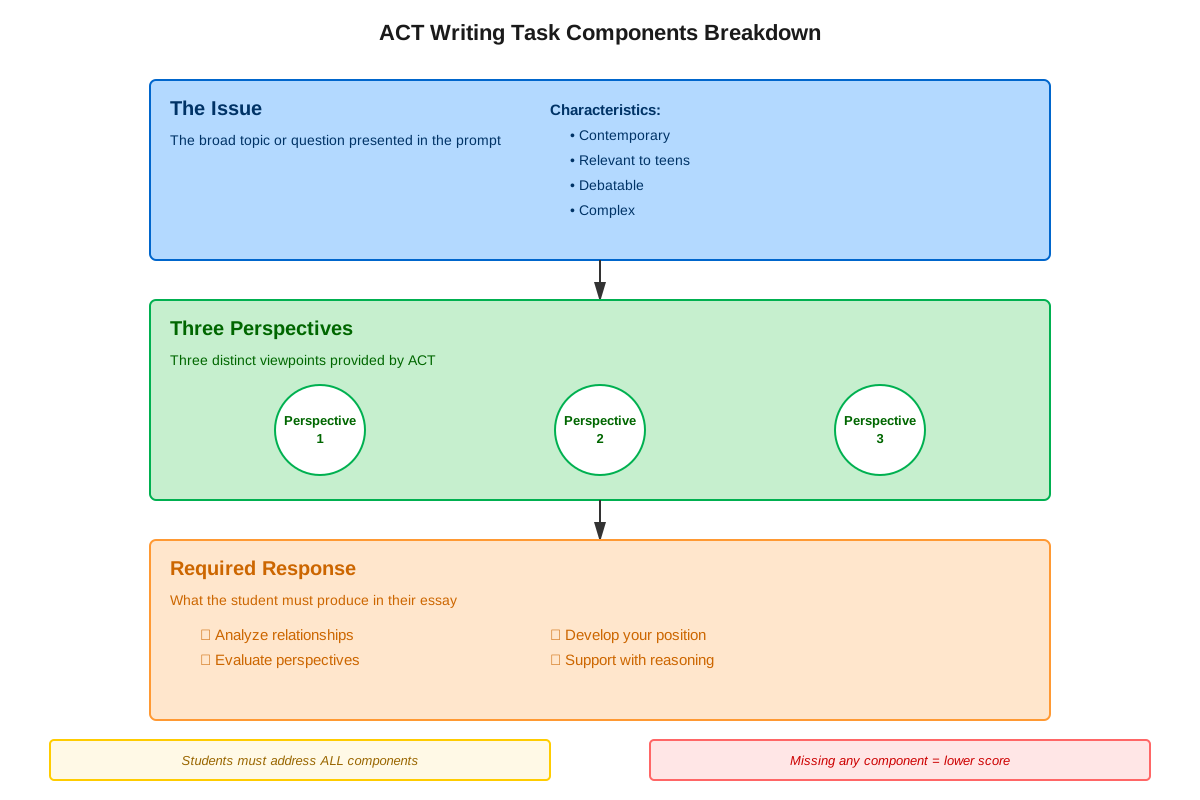
The ACT Writing prompt always contains three distinct elements that students must recognize and address. First, the issue is a broad, debatable topic relevant to contemporary society and student experience. Issues might include technology's role in education, the balance between individual freedom and collective responsibility, or the value of specialized versus broad-based learning. The issue is presented in a brief introductory paragraph that provides context.
Second, the three perspectives represent different viewpoints on the issue. These perspectives are deliberately designed to be distinct from one another—they may be complementary, contradictory, or address different aspects of the issue. Each perspective is presented in a separate box with 2-4 sentences. Critically, these perspectives are not necessarily correct, complete, or equally valid; they are simply starting points for analysis.
Third, the task instructions appear after the perspectives and explicitly state what the essay must accomplish. The standard ACT Writing task includes these components:
- Write a unified, coherent essay evaluating multiple perspectives
- State and develop your own perspective on the issue
- Explain the relationship between your perspective and those given
Decoding the Task Instructions
The task instructions use specific language that signals required components. The phrase "evaluate multiple perspectives" means students must do more than summarize—they must analyze strengths, weaknesses, implications, or limitations of at least some of the given perspectives. The word "multiple" indicates that addressing only one perspective is insufficient for a high score.
"State and develop your own perspective" requires two actions: clearly articulating a personal position (the thesis) and providing reasoning and evidence to support it. Development means going beyond assertion to explanation, using examples, logical reasoning, or hypothetical scenarios to demonstrate why the position is valid.
"Explain the relationship" is perhaps the most overlooked requirement. This demands explicit discussion of how the student's perspective connects to the given perspectives. Does it align with one perspective and challenge another? Does it synthesize elements from multiple perspectives? Does it introduce a new angle not captured by any given perspective? High-scoring essays make these relationships clear and explicit.
The Analytical Requirement
Understanding the task means recognizing that the ACT Writing test is fundamentally an analytical exercise, not merely an opinion piece. Students must demonstrate critical thinking by examining perspectives from multiple angles. This might include:
- Identifying assumptions underlying a perspective
- Considering contexts where a perspective is more or less applicable
- Recognizing potential consequences of adopting a particular viewpoint
- Acknowledging limitations or counterarguments to a perspective
- Comparing and contrasting different perspectives' approaches to the issue
The task does not ask students to prove which perspective is "correct" or to choose one perspective as their own. Instead, it asks them to think deeply about the issue by using the perspectives as analytical tools.
Task Fulfillment vs. Task Avoidance
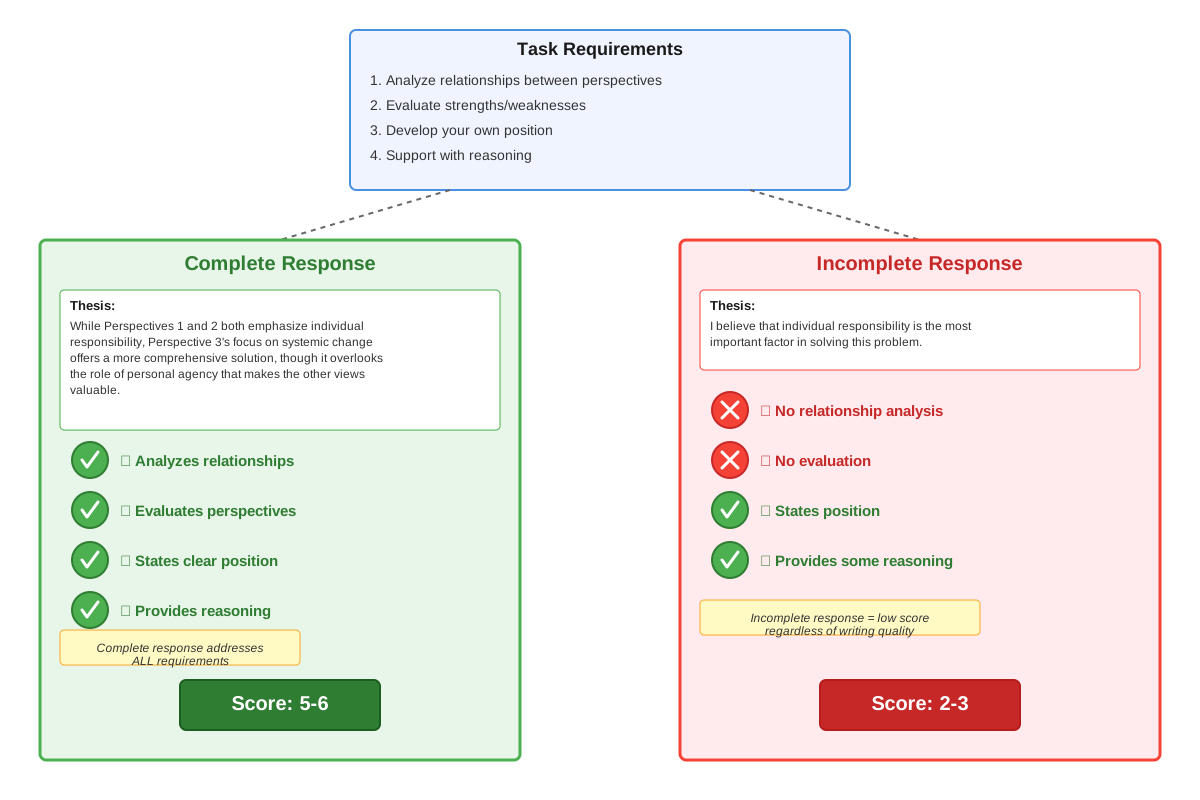
Task fulfillment occurs when an essay addresses all required components with sufficient depth. A task-fulfilling essay has a clear thesis that takes a position on the issue, discusses multiple given perspectives with analysis (not just summary), and explicitly connects the thesis to those perspectives.
Task avoidance happens when students write about the general topic without addressing the specific task requirements. Common forms include:
| Task Avoidance Pattern | What It Looks Like | Why It Fails |
|---|---|---|
| The Opinion Essay | States a position and supports it without mentioning given perspectives | Ignores the "evaluate multiple perspectives" requirement |
| The Summary Essay | Describes what each perspective says without analysis or personal position | Lacks both evaluation and original perspective development |
| The Single-Perspective Essay | Agrees with one perspective and ignores the others | Fails the "multiple perspectives" requirement |
| The Off-Topic Essay | Discusses the general issue without addressing the specific prompt framing | Doesn't respond to the actual task presented |
The Relationship Component
The most sophisticated aspect of task understanding involves the relationship component—explaining how one's own perspective connects to the given perspectives. This can take several forms:
- Alignment: "My perspective agrees with Perspective One because..."
- Qualification: "While Perspective Two raises valid concerns, it overlooks..."
- Synthesis: "By combining the emphasis on X from Perspective One with the caution about Y from Perspective Three..."
- Extension: "None of the given perspectives adequately addresses Z, which is central to my position..."
- Contrast: "Unlike Perspective Two, which assumes A, my perspective recognizes that B..."
High-scoring essays make these relationships explicit through clear transitional language and direct references to the perspectives throughout the essay, not just in a single paragraph.
Concept Relationships
The three-part task structure (issue, perspectives, instructions) forms a hierarchical relationship where the issue provides the broad context, the perspectives offer specific analytical entry points, and the instructions define the required response. Understanding the issue is necessary but insufficient; students must also understand how the perspectives frame that issue and what the instructions demand.
Task understanding directly enables thesis development—a student cannot craft an effective thesis without first understanding what the thesis must accomplish. The thesis, in turn, guides perspective analysis, as the student must select which aspects of each perspective to discuss based on how they relate to the thesis position.
The analytical requirement connects to the relationship component: analysis of perspectives naturally leads to identifying how one's own position compares, contrasts, or synthesizes those perspectives. This creates a feedback loop where deeper analysis of given perspectives clarifies one's own position, which in turn suggests further analytical angles on the perspectives.
Relationship Map:
Issue Understanding → Perspective Recognition → Task Instruction Decoding → Thesis Development → Perspective Analysis → Relationship Articulation → Complete Task Fulfillment
High-Yield Facts
⭐ The ACT Writing task always requires addressing multiple perspectives, not just one—essays that discuss only one perspective cannot score above a 3 in Ideas and Analysis.
⭐ Students must develop their own perspective in addition to evaluating given perspectives—summarizing the three perspectives without taking a position fails the task.
⭐ The task requires explaining relationships between perspectives—simply stating your position and separately discussing given perspectives without connecting them is insufficient.
⭐ "Evaluate" means analyze strengths, weaknesses, implications, or limitations—merely summarizing what each perspective says does not constitute evaluation.
⭐ The given perspectives are not necessarily correct or complete—students can and should critically examine them rather than treating them as authoritative.
- The issue is always debatable with multiple reasonable positions—there is no single "correct" answer the ACT expects.
- Task instructions use consistent language across all prompts—learning to decode one prompt's instructions helps with all future prompts.
- High-scoring essays make perspective relationships explicit through direct references and clear transitional language.
- The task does not require equal treatment of all three perspectives—discussing one in depth and two more briefly can fulfill the "multiple perspectives" requirement.
- Understanding the task should take 3-5 minutes of the 40-minute time limit—rushing this step leads to essays that miss key requirements.
- The perspectives are deliberately designed to represent different approaches—they may address different aspects of the issue rather than directly contradicting each other.
- Task fulfillment is assessed primarily in the Ideas and Analysis domain but affects all four scoring domains.
- Essays can disagree with all three given perspectives as long as they still analyze and discuss them.
- The relationship between your perspective and given perspectives should appear throughout the essay, not just in one paragraph.
- Misunderstanding the task is the single most common reason for low scores among students with strong writing skills.
Quick check — test yourself on Understanding the task so far.
Try Flashcards →Common Misconceptions
Misconception: The task is to choose which of the three perspectives is correct and defend that choice.
Correction: The task requires developing your own perspective (which may or may not align with a given perspective) and analyzing multiple given perspectives, not selecting one as "the answer."
Misconception: Discussing the general topic thoroughly is sufficient, even without addressing the specific perspectives provided.
Correction: The ACT Writing task specifically requires engagement with the given perspectives—writing a well-developed essay about the general issue without analyzing these perspectives fails to fulfill the task.
Misconception: "Multiple perspectives" means discussing at least two, so addressing two perspectives is sufficient.
Correction: While "multiple" technically means more than one, ACT scoring rubrics indicate that high-scoring essays typically engage with all three perspectives, even if one receives less extensive treatment.
Misconception: The relationship between your perspective and given perspectives only needs to be stated once, typically in the introduction or conclusion.
Correction: High-scoring essays weave perspective relationships throughout the essay, making connections explicit in multiple paragraphs as part of the ongoing analysis.
Misconception: "Evaluate" and "summarize" are essentially the same thing.
Correction: Evaluation requires critical analysis—examining implications, identifying limitations, considering contexts, or assessing validity—while summary merely restates what the perspective says without analytical commentary.
Misconception: You must agree with at least one of the given perspectives.
Correction: Students can disagree with all three perspectives as long as they still analyze them and explain why their own perspective differs or addresses aspects the given perspectives miss.
Misconception: The task changes significantly from prompt to prompt, requiring different approaches.
Correction: While the issue and perspectives change, the underlying task structure remains consistent—always requiring perspective evaluation, personal position development, and relationship articulation.
Worked Examples
Example 1: Analyzing Task Fulfillment
Prompt Summary: Issue about whether public libraries should prioritize physical books or digital resources. Perspective 1 argues for maintaining physical collections, Perspective 2 advocates for digital transition, Perspective 3 suggests a balanced approach.
Sample Thesis Statement: "Public libraries should prioritize digital resources because they are more cost-effective and accessible to modern users."
Analysis:
This thesis partially fulfills the task. It clearly states a personal perspective on the issue (✓), taking a definite position. However, it does not explicitly address the relationship to given perspectives (✗). A student with this thesis might write an entire essay defending digital resources without ever analyzing the given perspectives or explaining how this position relates to them.
Improved Thesis: "While Perspective 1's concern for preserving traditional reading experiences has merit, and Perspective 3's balanced approach seems pragmatic, libraries must prioritize digital resources as Perspective 2 suggests, because digital access addresses equity issues that neither physical-only nor balanced approaches adequately resolve."
Why This Works: This thesis states a clear position (✓), signals engagement with all three perspectives (✓), and begins establishing relationships by indicating agreement with one perspective while acknowledging considerations from the others (✓). The phrase "addresses equity issues that neither... adequately resolve" sets up analytical discussion of perspective limitations.
Example 2: Identifying Task Avoidance
Prompt Summary: Issue about whether high schools should require community service for graduation. Perspective 1 supports mandatory service, Perspective 2 opposes requirements, Perspective 3 suggests optional but incentivized service.
Sample Essay Opening:
"Community service is an important part of being a good citizen. When I volunteered at a food bank last summer, I learned valuable lessons about helping others. High schools should encourage students to volunteer because it builds character and helps the community. Many students today are too focused on their phones and need to learn about real-world problems..."
Task Fulfillment Analysis:
This opening demonstrates task avoidance. The student is writing about community service (the general issue) but has not addressed the specific task requirements:
- No mention of the three given perspectives (✗)
- No indication that the essay will evaluate multiple viewpoints (✗)
- Personal anecdote without connection to analytical task (✗)
- Vague position ("should encourage") that doesn't engage with the specific debate about requirements vs. optional vs. incentivized approaches (✗)
Improved Opening:
"The debate over mandatory community service requirements reveals fundamental tensions between educational autonomy and civic responsibility. While Perspective 1 correctly identifies the societal benefits of universal service participation, and Perspective 2 raises valid concerns about coercion undermining authentic volunteerism, Perspective 3's incentivized approach offers the most promising path forward. By examining the assumptions underlying each perspective, we can see that incentivized service preserves student choice while still promoting civic engagement more effectively than either mandatory requirements or purely optional programs."
Why This Works: This opening immediately signals task understanding by referencing the specific perspectives (✓), indicating that evaluation will occur ("by examining the assumptions") (✓), stating a clear position that relates to the perspectives (✓), and setting up analytical discussion rather than personal narrative (✓).
Exam Strategy
The First-Read Protocol
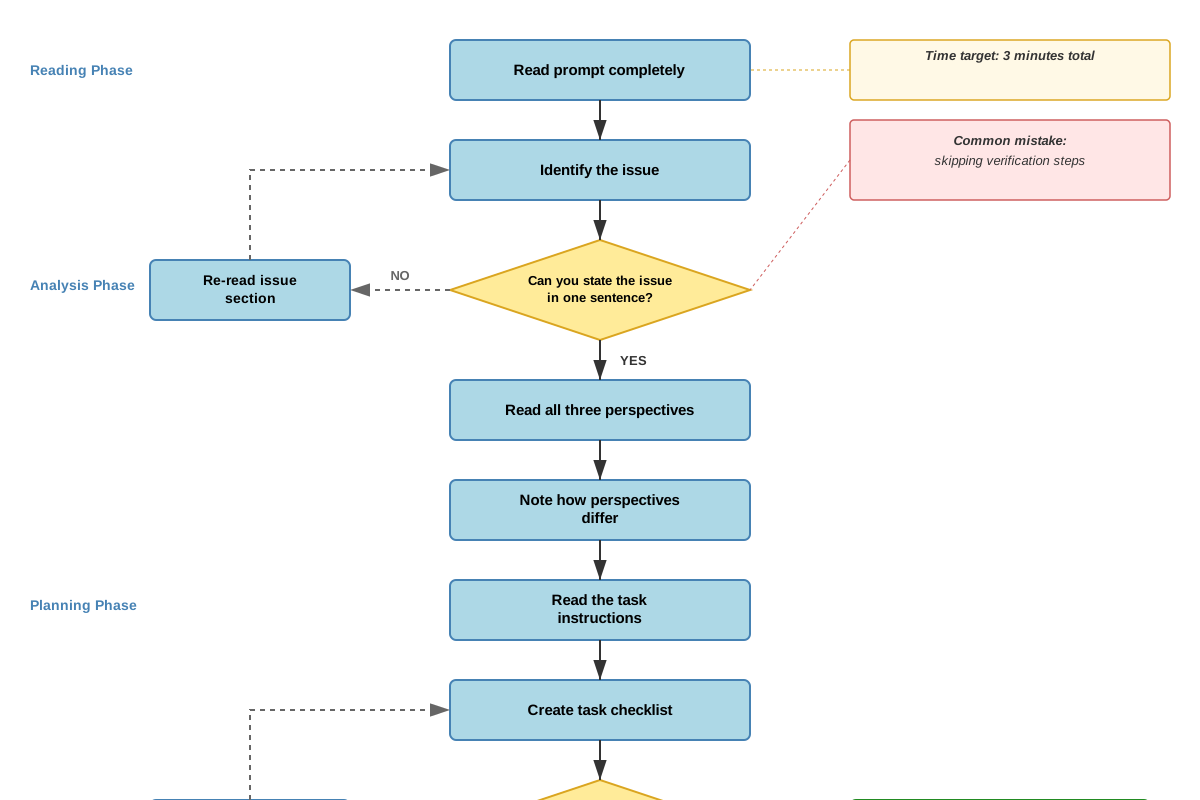
Spend the first 3-5 minutes of the 40-minute time limit on task understanding before writing anything. Use this protocol:
- Read the issue paragraph and identify the core question or tension
- Read each perspective and note in the margin what each emphasizes (e.g., "individual freedom," "collective benefit," "practical concerns")
- Read the task instructions and mentally check off each requirement
- Reread the perspectives now that you understand the task, looking for analytical angles
Trigger Words in Task Instructions
Watch for these key phrases that signal specific requirements:
- "Evaluate multiple perspectives" → You must analyze at least two perspectives with critical commentary, not just summary
- "State and develop your own perspective" → You need both a clear thesis and supporting reasoning
- "Explain the relationship" → You must explicitly connect your position to the given perspectives
- "Consider the following" (in the task instructions) → These are suggested analytical approaches, not required elements, but they can guide your thinking
The Task Checklist Method
Before beginning your essay, create a mental or written checklist:
- [ ] Do I have a clear thesis that takes a position on the issue?
- [ ] Have I identified at least two perspectives I will discuss?
- [ ] Do I know what analytical point I will make about each perspective?
- [ ] Can I explain how my position relates to each perspective I discuss?
If you cannot check all boxes, spend more time planning before writing.
Process of Elimination for Task Understanding
When evaluating whether you understand the task, eliminate these approaches:
- ❌ Writing only about personal experiences without connecting to perspectives
- ❌ Agreeing with one perspective and ignoring the others
- ❌ Summarizing all three perspectives without taking a position
- ❌ Discussing the general topic without addressing the specific perspectives provided
Time Allocation
- Minutes 1-5: Read prompt, understand task, identify analytical angles
- Minutes 6-10: Plan essay structure and perspective relationships
- Minutes 11-35: Write essay with task requirements in mind
- Minutes 36-40: Review to ensure all task components are addressed
Exam Tip: If you realize mid-essay that you haven't addressed a task requirement, it's better to add a paragraph that addresses it (even if it disrupts flow slightly) than to submit an essay with incomplete task fulfillment.
Memory Techniques
The EPR Acronym
Remember the three task components with EPR:
- Evaluate perspectives (analyze, don't just summarize)
- Position your own perspective (clear thesis with development)
- Relationship between your perspective and given perspectives (explicit connections)
The "Three-Three-One" Rule
- Three perspectives are given
- Three task requirements must be fulfilled (evaluate, position, relationship)
- One unified essay that integrates all components
Visualization Strategy
Picture the task as a conversation at a table:
- Three people (the perspectives) have already spoken
- You must listen to what they said (understand the perspectives)
- You must comment on their ideas (evaluate)
- You must contribute your own view (state your perspective)
- You must explain how your view relates to theirs (relationship)
This mental image reinforces that you're joining an ongoing discussion, not starting a new one.
The "STAR" Analysis Prompt
When reading each perspective, think STAR:
- Strengths: What's valid or valuable about this view?
- Tradeoffs: What does this perspective sacrifice or overlook?
- Assumptions: What must be true for this perspective to work?
- Relationship: How does this connect to my position?
Summary
Understanding the task is the foundational skill for ACT Writing success, requiring students to recognize that the essay must accomplish three distinct objectives: evaluating multiple given perspectives with critical analysis, developing and supporting a personal perspective on the issue, and explicitly explaining relationships between the personal perspective and given perspectives. The task structure remains consistent across all prompts—an issue, three perspectives, and specific instructions—but students must actively decode these components rather than rushing into writing. Task avoidance, such as writing only about personal opinions or summarizing perspectives without analysis, is the primary reason for low scores among otherwise capable writers. Successful task fulfillment requires spending 3-5 minutes carefully reading the prompt, identifying all requirements, and planning an essay that integrates perspective analysis throughout rather than treating it as a separate component. The ACT Writing test is fundamentally an analytical exercise that uses given perspectives as tools for critical thinking, not a simple opinion essay about a general topic.
Key Takeaways
- The ACT Writing task always requires three components: evaluating multiple perspectives, stating your own perspective, and explaining relationships between them
- "Evaluate" means analyze critically (strengths, weaknesses, implications, limitations), not merely summarize what perspectives say
- Task understanding must happen before writing begins—spending 3-5 minutes on careful prompt analysis prevents essays that miss key requirements
- The relationship between your perspective and given perspectives should be explicit and woven throughout the essay, not isolated to one paragraph
- Task avoidance (writing about the general topic without addressing specific perspectives) is the most common reason for low scores
- All three perspectives should be acknowledged, though they need not receive equal treatment
- Your perspective can agree with, disagree with, synthesize, or extend beyond the given perspectives—there is no "correct" answer
Related Topics
Thesis Development for ACT Writing: Once the task is understood, students must craft a thesis statement that addresses all task requirements while taking a clear, defensible position. This topic builds directly on task understanding by translating requirements into a concrete statement that guides the entire essay.
Perspective Analysis Techniques: After understanding that perspectives must be evaluated rather than summarized, students need specific strategies for analyzing perspectives critically—identifying assumptions, considering implications, and recognizing limitations. This topic deepens the analytical skills that task understanding introduces.
Essay Organization and Structure: Task understanding determines what content must appear in the essay, but organization determines how that content is arranged for maximum clarity and coherence. This topic addresses how to structure body paragraphs to integrate perspective analysis with personal position development.
Evidence and Reasoning in Argumentative Writing: Developing your own perspective (a task requirement) demands supporting that position with effective evidence and logical reasoning. This topic provides the tools for the "development" aspect of the task.
Practice CTA
Now that you understand the critical importance of task understanding and the specific requirements of the ACT Writing prompt, you're ready to apply these concepts to actual practice. Work through the practice questions to test your ability to identify task requirements, evaluate sample responses for task fulfillment, and plan essays that address all components. Use the flashcards to reinforce key concepts like the difference between evaluation and summary, the three-part task structure, and common task avoidance patterns. Remember: understanding the task is not just the first step—it's the foundation that determines whether everything else you write will earn the score you deserve. Every minute spent mastering this skill pays dividends across all four scoring domains of the ACT Writing test.
Sign up free to keep reading
Create a free AnvayaPrep account to finish this ACT guide on Understanding the task — plus flashcards and practice questions.