Overview
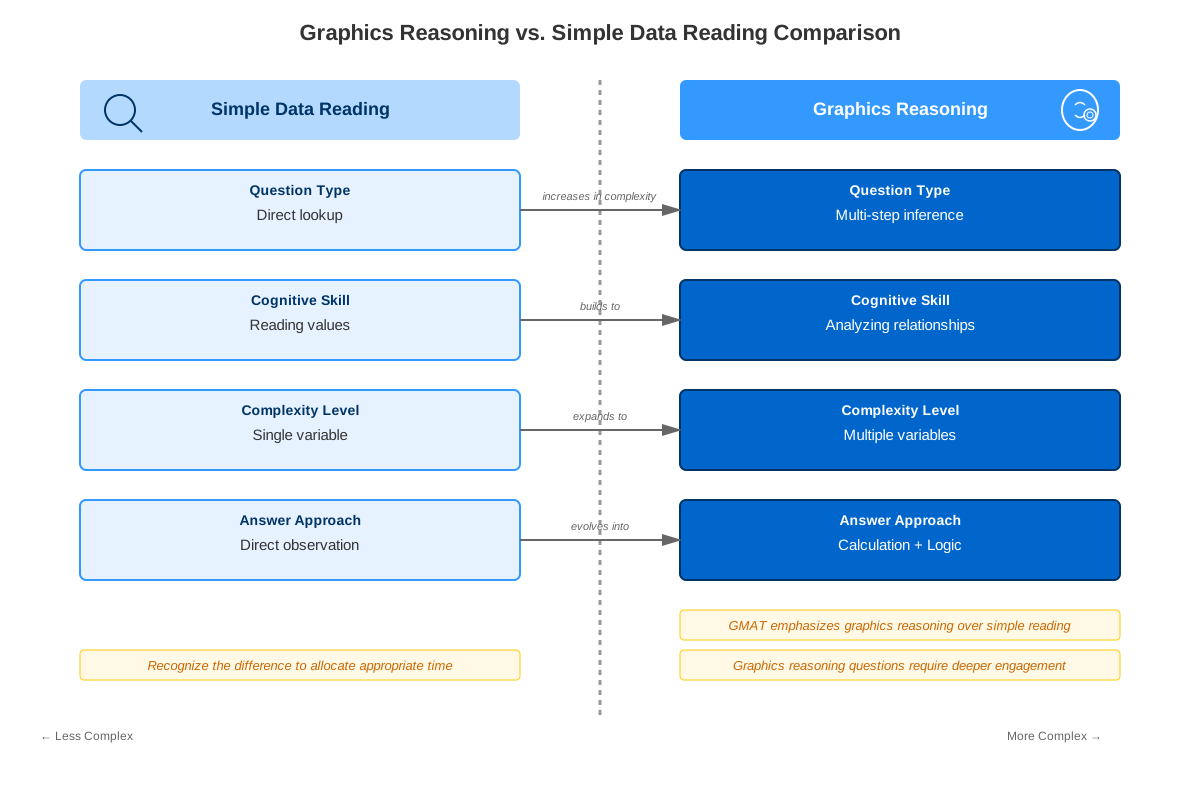
Graphics reasoning is a critical analytical skill tested in the GMAT Data Insights section that requires candidates to interpret, analyze, and draw logical conclusions from visual data representations. Unlike simple chart reading, GMAT graphics reasoning demands that test-takers synthesize information from complex graphs, identify patterns and trends, make comparisons across data sets, and apply mathematical or logical reasoning to reach accurate conclusions. This skill goes beyond surface-level data extraction—it requires understanding the relationships between variables, recognizing what changes in one element mean for others, and translating visual information into quantitative or qualitative insights.
The GMAT places substantial emphasis on graphics reasoning because it mirrors real-world business scenarios where executives must quickly interpret dashboards, financial reports, market research visualizations, and performance metrics to make informed decisions. Business school programs value this competency as it directly translates to case study analysis, data-driven strategy development, and evidence-based decision-making. Questions testing graphics reasoning typically present scatter plots, line graphs, bar charts, pie charts, Venn diagrams, or multi-axis visualizations alongside statements that must be evaluated for accuracy or completed with appropriate conclusions.
Within the broader Data Insights framework, graphics reasoning serves as a foundational skill that integrates with table analysis, two-part analysis, and multi-source reasoning questions. It bridges quantitative reasoning with critical thinking, requiring test-takers to apply mathematical concepts like percentages, ratios, rates of change, and proportional relationships while simultaneously exercising logical deduction. Mastering graphics reasoning enhances performance across multiple GMAT question types and strengthens the analytical toolkit necessary for success in graduate business education.
Learning Objectives
- [ ] Identify graphics reasoning questions and distinguish them from simple data extraction tasks
- [ ] Explain the principles underlying graphics reasoning and the types of analytical thinking required
- [ ] Apply graphics reasoning to GMAT questions by interpreting visual data and evaluating statements
- [ ] Analyze relationships between multiple variables presented in graphical formats
- [ ] Synthesize information from complex visualizations to draw valid conclusions
- [ ] Evaluate the accuracy of statements based on graphical evidence using logical reasoning
- [ ] Recognize common graph types and their appropriate analytical approaches
Prerequisites
- Basic graph literacy: Understanding how to read standard chart types (bar, line, pie, scatter plots) is essential as graphics reasoning builds upon fundamental interpretation skills
- Percentage and ratio calculations: Many graphics reasoning questions require computing percentage changes, proportions, and comparative ratios from visual data
- Rate and trend analysis: Recognizing increasing/decreasing patterns and calculating rates of change forms the basis for more complex reasoning tasks
- Logical reasoning fundamentals: The ability to evaluate statements for validity and identify necessary versus sufficient conditions supports conclusion-drawing from graphics
- Basic algebra: Translating visual relationships into mathematical expressions and solving for unknowns appears frequently in graphics reasoning contexts
Why This Topic Matters
Graphics reasoning represents one of the most practical skills tested on the GMAT, directly reflecting competencies that business professionals use daily. In corporate environments, leaders must interpret sales dashboards, analyze market trend visualizations, evaluate financial performance charts, and extract actionable insights from data presentations. The ability to quickly and accurately reason from graphical information distinguishes effective decision-makers from those who struggle with data-driven environments. Business schools specifically value this skill because case method teaching relies heavily on analyzing charts, graphs, and visual data representations to support strategic recommendations.
On the GMAT, graphics reasoning appears with high frequency throughout the Data Insights section, accounting for a significant portion of the Graphics Interpretation question type. Test-takers typically encounter 2-4 graphics interpretation questions per exam, each presenting a single visualization with two statements requiring completion from dropdown menus. These questions carry substantial weight in the Data Insights score and often serve as differentiators between good and excellent performances. The medium difficulty level means these questions are accessible to well-prepared candidates but challenging enough to separate those with superficial preparation from those with deep analytical skills.
Common manifestations include scatter plots showing correlations between business variables (advertising spend vs. revenue, price vs. demand), line graphs depicting trends over time (quarterly sales, market share evolution), multi-series bar charts comparing categories (regional performance, product line comparisons), and combination charts requiring synthesis across multiple data representations. Questions frequently test the ability to identify maximum/minimum values, calculate percentage changes, recognize inflection points, compare rates of change, and extrapolate trends—all skills that demand robust graphics reasoning capabilities.
Core Concepts
Understanding Graphics Reasoning
Graphics reasoning encompasses the cognitive processes required to extract meaning, identify patterns, draw inferences, and reach logical conclusions from visual data representations. Unlike passive chart reading, graphics reasoning is an active analytical process that involves questioning what the data shows, what it implies, what relationships exist between variables, and what conclusions can be validly drawn. This skill integrates visual perception, quantitative analysis, logical deduction, and critical thinking into a unified problem-solving approach.
The foundation of graphics reasoning rests on understanding that graphs are visual encodings of relationships between variables. Every element—axes, scales, data points, lines, bars, colors—carries meaning that must be decoded and interpreted. Effective graphics reasoning requires recognizing which visual elements are relevant to answering specific questions, ignoring distracting information, and focusing analytical attention on the relationships that matter for the task at hand.
Types of Analytical Reasoning in Graphics
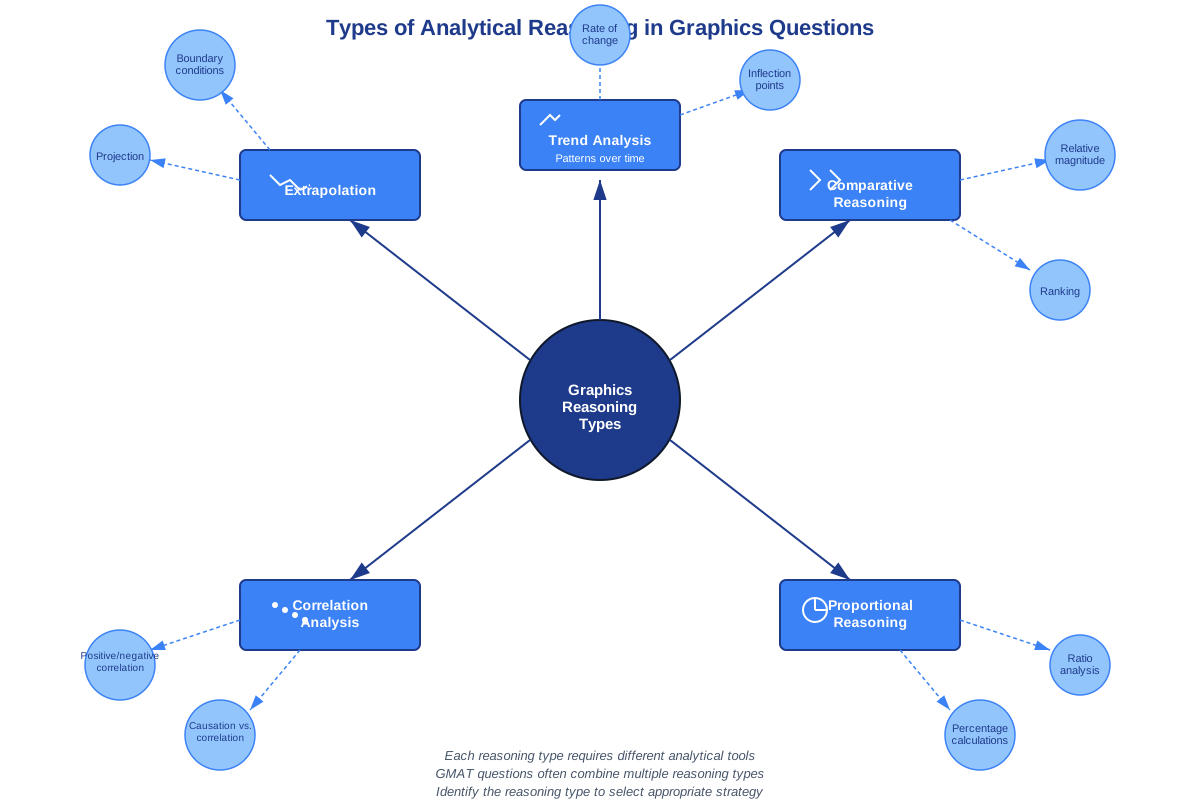
Graphics reasoning on the GMAT encompasses several distinct analytical approaches:
Comparative Analysis: Determining which category, time period, or data point is larger, smaller, or equal to another. This requires careful attention to scale, understanding relative magnitudes, and making accurate comparisons across different visual representations.
Trend Identification: Recognizing patterns of increase, decrease, stability, or cyclical variation over time or across categories. This involves distinguishing between absolute changes (raw differences) and relative changes (percentage or proportional differences).
Rate of Change Analysis: Calculating and comparing how quickly variables change, identifying acceleration or deceleration in trends, and recognizing where slopes steepen or flatten in line graphs.
Proportional Reasoning: Understanding part-to-whole relationships, calculating percentages, and recognizing how changes in one component affect overall totals or other components.
Correlation and Relationship Analysis: Identifying positive, negative, or no correlation between variables in scatter plots, understanding causation versus correlation, and recognizing strength of relationships.
Key Graph Types and Reasoning Approaches
| Graph Type | Primary Use | Key Reasoning Tasks | Common Pitfalls |
|---|---|---|---|
| Line Graph | Trends over time | Rate of change, inflection points, comparative trends | Confusing absolute vs. relative change |
| Bar Chart | Category comparison | Ranking, proportional differences, maximum/minimum | Misreading scale or axis labels |
| Scatter Plot | Variable relationships | Correlation strength, outliers, clustering | Assuming correlation implies causation |
| Pie Chart | Part-to-whole | Percentage composition, relative proportions | Difficulty comparing similar-sized segments |
| Multi-axis Chart | Multiple variables | Synthesizing relationships, comparing different units | Confusing which axis applies to which data |
The Graphics Reasoning Process
Effective graphics reasoning follows a systematic approach:
- Orientation: Identify the graph type, read all labels (title, axes, legend, units), and understand what variables are being represented
- Scale Analysis: Examine axis scales carefully, noting starting points (especially non-zero origins), intervals, and whether scales are linear or logarithmic
- Data Extraction: Locate specific values, data points, or ranges relevant to the question being asked
- Relationship Analysis: Determine how variables relate to each other—increases, decreases, proportions, correlations
- Calculation: Perform necessary mathematical operations (percentage change, ratios, differences) using extracted data
- Logical Evaluation: Assess whether statements or conclusions are supported by the graphical evidence
- Verification: Double-check calculations and ensure conclusions align with visual evidence
Critical Elements in Graphics Reasoning
Scale Sensitivity: The visual impression created by a graph can be manipulated through scale choices. A graph with a truncated y-axis (starting at 50 instead of 0) can make small differences appear dramatic. Graphics reasoning requires recognizing these scale effects and making judgments based on actual values rather than visual impressions alone.
Precision Limitations: Graphs present approximate visual representations. When exact values aren't labeled, estimates must be made carefully, and answer choices should reflect appropriate precision levels. Graphics reasoning includes knowing when approximation is sufficient and when exact calculation is required.
Multiple Data Series: Many GMAT graphics present multiple lines, bars, or data sets simultaneously. Graphics reasoning requires tracking which visual element corresponds to which variable, comparing across series, and synthesizing information from multiple sources within a single visualization.
Temporal and Sequential Relationships: Understanding how data changes across time or ordered categories requires recognizing sequential patterns, identifying turning points, and calculating period-over-period changes accurately.
Concept Relationships
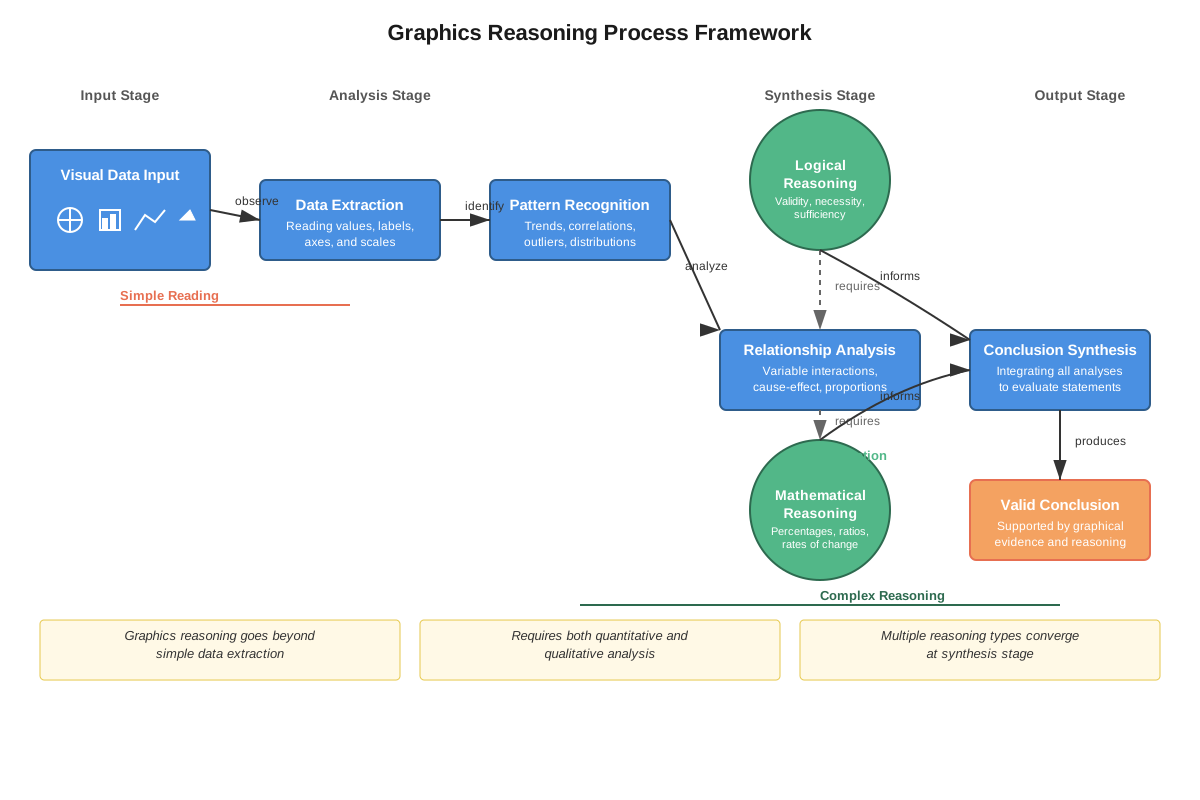
Graphics reasoning serves as the integrative skill that connects visual literacy with quantitative analysis and logical evaluation. The relationship flows as follows: Basic graph reading → Data extraction → Quantitative calculation → Logical reasoning → Conclusion validation. Each step builds upon the previous one, creating a hierarchical skill structure where deficiencies at lower levels impair performance at higher levels.
Within graphics reasoning itself, the core concepts interconnect systematically. Scale analysis informs data extraction accuracy, which enables precise quantitative calculations. These calculations feed into comparative analysis and trend identification, which together support relationship analysis. All these elements converge in the final step of logical evaluation, where conclusions are assessed against the totality of graphical evidence.
Graphics reasoning connects backward to prerequisite topics by applying percentage calculations, ratio analysis, and rate computations in visual contexts. It connects forward to more complex Data Insights question types like multi-source reasoning, where graphics must be synthesized with textual information and tables. The skill also supports two-part analysis questions where graphical information informs both parts of a compound question.
The relationship between graphics reasoning and other GMAT sections extends beyond Data Insights. The logical evaluation component connects to Critical Reasoning in the Verbal section, while the quantitative calculations link to Problem Solving in the Quantitative section. This cross-sectional integration makes graphics reasoning a high-leverage skill that improves overall GMAT performance.
High-Yield Facts
⭐ Graphics reasoning questions always require going beyond simple data reading to draw conclusions or make comparisons
⭐ Scale manipulation is the most common source of visual misinterpretation—always check axis starting points and intervals
⭐ Percentage change calculations appear in approximately 60% of graphics reasoning questions
⭐ When comparing rates of change, steeper slopes indicate faster change regardless of absolute values
⭐ Correlation in scatter plots does not establish causation—GMAT questions frequently test this distinction
- Line graph intersections indicate points where two variables have equal values
- In multi-series graphs, the legend is essential for correctly identifying which visual element represents which variable
- Pie charts showing percentages must total 100%; if they don't, the graph contains an error or represents a subset
- Bar chart comparisons require careful attention to whether axes start at zero or another value
- Scatter plot outliers are data points that deviate significantly from the general pattern and may indicate special cases
- When graphs show "millions" or "thousands" in axis labels, all values must be multiplied by that factor
- Trend reversals (inflection points) often signal important changes in underlying relationships
- Proportional reasoning errors occur when test-takers confuse absolute differences with percentage differences
- Multi-axis charts require identifying which y-axis corresponds to which data series
- Time-series graphs showing multiple years require calculating changes across the correct time intervals
Quick check — test yourself on Graphics reasoning so far.
Try Flashcards →Common Misconceptions
Misconception: A steeper line on a graph always means a larger value.
Correction: Steepness (slope) indicates rate of change, not absolute magnitude. A steep line shows rapid change, but the actual values depend on the y-axis position. A slowly rising line at high values represents larger quantities than a steeply rising line at low values.
Misconception: If two variables move together in a scatter plot, one causes the other.
Correction: Correlation indicates association, not causation. Both variables might be influenced by a third factor, or the relationship might be coincidental. Graphics reasoning requires distinguishing between correlation (observable relationship) and causation (one variable directly influencing another).
Misconception: Visual impressions from graphs are always accurate representations of the data.
Correction: Graph design choices (scale, axis starting points, aspect ratio) can create misleading visual impressions. Effective graphics reasoning requires reading actual values and performing calculations rather than relying on visual appearance alone.
Misconception: All data points on a graph are equally important for answering questions.
Correction: Graphics reasoning involves identifying which data points are relevant to the specific question being asked. Efficient test-takers focus on pertinent information and avoid getting distracted by irrelevant details in complex visualizations.
Misconception: Percentage changes can be calculated by simply subtracting percentages shown on a graph.
Correction: Percentage change must be calculated as (New Value - Old Value) / Old Value × 100%. If a graph shows market share declining from 40% to 30%, the percentage change is -25% (not -10%), because the calculation is (30-40)/40 × 100%.
Misconception: When a line graph shows a flattening trend, the variable has stopped changing.
Correction: A horizontal line indicates no change, but a flattening line still shows change, just at a decreasing rate. The variable continues to increase or decrease, but more slowly than before.
Worked Examples
Example 1: Multi-Series Line Graph Analysis
Question Setup: A line graph shows quarterly revenue (in millions) for three product lines—Alpha, Beta, and Gamma—over four quarters. Alpha starts at $8M in Q1, rises to $10M in Q2, $11M in Q3, and $12M in Q4. Beta starts at $12M in Q1, stays at $12M in Q2, drops to $10M in Q3, and rises to $11M in Q4. Gamma starts at $6M in Q1, rises to $8M in Q2, $10M in Q3, and $12M in Q4.
Statement to Evaluate: "The product line with the highest percentage growth from Q1 to Q4 is _______."
Solution Process:
Step 1 - Identify relevant data points: We need Q1 and Q4 values for all three product lines.
- Alpha: Q1 = $8M, Q4 = $12M
- Beta: Q1 = $12M, Q4 = $11M
- Gamma: Q1 = $6M, Q4 = $12M
Step 2 - Calculate percentage change for each product line using the formula: (Final - Initial) / Initial × 100%
Alpha: (12 - 8) / 8 × 100% = 4/8 × 100% = 50%
Beta: (11 - 12) / 12 × 100% = -1/12 × 100% ≈ -8.3%
Gamma: (12 - 6) / 6 × 100% = 6/6 × 100% = 100%
Step 3 - Compare results: Gamma shows 100% growth, Alpha shows 50% growth, and Beta shows negative growth.
Step 4 - Verify reasoning: Although Alpha and Gamma both reached $12M in Q4, Gamma started from a lower base ($6M vs. $8M), resulting in higher percentage growth. This demonstrates the importance of calculating percentage change rather than absolute change.
Answer: Gamma
Learning Objective Connection: This example applies graphics reasoning by requiring trend identification, data extraction, quantitative calculation, and comparative analysis—demonstrating that visual similarity (both reaching $12M) doesn't indicate equal percentage performance.
Example 2: Scatter Plot Correlation Analysis
Question Setup: A scatter plot shows 20 data points representing advertising expenditure (x-axis, in thousands) versus monthly sales (y-axis, in units) for a retail company. The points show a general upward trend from lower-left to upper-right, with most points clustered along an imaginary diagonal line. However, three points in the upper-left area show high sales despite low advertising expenditure.
Statement to Evaluate: "The data demonstrates that increasing advertising expenditure causes proportional increases in sales."
Solution Process:
Step 1 - Analyze the visual pattern: The general upward trend indicates positive correlation—as advertising increases, sales tend to increase.
Step 2 - Evaluate the strength and consistency: The presence of outliers (high sales with low advertising) indicates the relationship is not perfectly consistent. Some factors other than advertising must influence sales.
Step 3 - Distinguish correlation from causation: Even if the correlation were perfect, scatter plots show association, not causation. The relationship could be:
- Advertising causes sales increases
- Higher sales generate more budget for advertising (reverse causation)
- Both are influenced by seasonal factors (third variable)
- The relationship is coincidental
Step 4 - Assess "proportional" claim: Proportional relationship means doubling advertising would double sales. The scatter plot shows positive correlation but doesn't establish proportionality—the relationship could be linear but non-proportional, or even non-linear.
Step 5 - Evaluate the complete statement: The statement makes two claims—causation and proportionality—neither of which can be established from correlation alone.
Answer: False/Cannot be determined from the graph
Learning Objective Connection: This example demonstrates advanced graphics reasoning by requiring distinction between correlation and causation, recognition of outliers, and evaluation of the strength and nature of relationships—all critical skills for GMAT Data Insights questions.
Exam Strategy
When approaching graphics reasoning questions on the GMAT, implement a systematic process that maximizes accuracy while managing time effectively. Begin by investing 15-20 seconds in thorough graph orientation: read the title, examine all axis labels and units, study the legend, and identify the graph type. This upfront investment prevents costly errors from misinterpreting what the graph represents.
Trigger words and phrases that signal specific reasoning requirements include:
- "Approximately" or "closest to" → estimation is acceptable
- "Percentage change" or "percent increase/decrease" → requires calculation, not simple subtraction
- "Rate of change" or "rate of increase" → focus on slope or speed of change
- "Correlation" → look for patterns but don't assume causation
- "Compared to" or "relative to" → requires direct comparison between specific data points
- "Trend" → analyze overall pattern rather than individual fluctuations
- "Maximum" or "minimum" → identify extreme values carefully
Process-of-elimination strategies specific to graphics reasoning:
- Eliminate answers that contradict visual evidence: If a statement claims Product A always exceeded Product B, but the graph shows intersection points, eliminate immediately
- Eliminate answers requiring information not present: If the graph shows revenue but an answer choice discusses profit margins, it's likely incorrect unless profit can be derived from given information
- Eliminate answers with extreme language unsupported by data: Words like "always," "never," "only," or "exclusively" require absolute evidence from the graph
- Check calculation-based answers against reasonable estimates: If calculating 23% growth, answers showing 230% or 2.3% likely result from decimal errors
Time allocation for graphics reasoning questions should follow this pattern:
- 20 seconds: Graph orientation and comprehension
- 30 seconds: Reading and understanding the statement
- 60 seconds: Data extraction and calculation
- 20 seconds: Verification and answer selection
- Total: approximately 2 minutes per statement (4 minutes for typical two-statement questions)
If a calculation becomes complex or time-consuming, use estimation strategically. GMAT answer choices are typically spaced far enough apart that precise calculation isn't always necessary. For example, if calculating percentage change yields approximately 47%, and answer choices are 25%, 50%, 75%, and 100%, the 50% choice is clearly correct without computing to exact precision.
Priority hierarchy when multiple analytical approaches are possible:
- Direct reading from clearly labeled data points (fastest, most accurate)
- Simple calculations using clearly visible values
- Estimation from unlabeled points using grid lines
- Complex multi-step calculations (verify these are truly necessary)
Memory Techniques
SCALE mnemonic for systematic graph analysis:
- Start by reading all labels and titles
- Check axis starting points and intervals
- Analyze what variables are represented
- Locate relevant data points for the question
- Evaluate relationships and perform calculations
"PERCENT" acronym for percentage change calculations:
- Previous value is the denominator
- Ending value minus starting value
- Result divided by original
- Convert to percentage by multiplying by 100
- Evaluate whether change is increase or decrease
- Never subtract percentages directly
- Take care with negative changes
Visualization strategy for correlation patterns: Picture scatter plots as "clouds" of points. A tight diagonal cloud indicates strong correlation; a circular cloud indicates no correlation; an elliptical cloud indicates moderate correlation. The direction of the cloud (lower-left to upper-right vs. upper-left to lower-right) indicates positive vs. negative correlation.
"RATE-SLOPE" connection: Remember that rate of change corresponds to slope steepness. Steeper = faster change. Visualize skiing: steeper slopes mean faster descent. This physical metaphor helps quickly identify which variable is changing most rapidly in line graphs.
Axis-check habit: Develop an automatic habit of checking whether axes start at zero. Visualize a "warning flag" appearing whenever you see a non-zero starting point, triggering extra caution about visual impressions versus actual magnitudes.
Summary
Graphics reasoning represents a sophisticated analytical skill that integrates visual interpretation, quantitative calculation, and logical evaluation to extract meaningful insights from data visualizations. Success on GMAT graphics reasoning questions requires moving beyond surface-level chart reading to engage in deeper analysis of relationships, trends, rates of change, and proportional comparisons. The systematic approach involves careful graph orientation, precise data extraction, accurate calculation, and rigorous logical evaluation of statements against graphical evidence. Critical competencies include recognizing how scale choices affect visual impressions, distinguishing correlation from causation, calculating percentage changes correctly, comparing rates of change through slope analysis, and synthesizing information from complex multi-series visualizations. Common pitfalls include relying on visual impressions without checking actual values, confusing absolute and relative changes, assuming causation from correlation, and making calculation errors in percentage change formulas. Mastery requires practicing the systematic SCALE approach, developing automatic habits for checking axes and scales, and building fluency with the quantitative calculations that frequently appear in graphics contexts. The ability to efficiently and accurately reason from graphics directly impacts Data Insights performance and reflects practical business skills that extend far beyond the GMAT itself.
Key Takeaways
- Graphics reasoning requires active analysis and logical deduction, not passive chart reading—always question what the data implies beyond what it directly shows
- Scale awareness is critical: non-zero axis starting points, interval choices, and unit labels dramatically affect interpretation and must be checked systematically
- Percentage change calculations follow the formula (New - Old) / Old × 100% and represent the most frequently tested quantitative skill in graphics reasoning questions
- Correlation indicates association between variables but never establishes causation—GMAT questions specifically test the ability to maintain this distinction
- Effective graphics reasoning follows a systematic process: orientation → scale analysis → data extraction → calculation → logical evaluation → verification
- Rate of change corresponds to slope steepness in line graphs, enabling quick visual comparison of which variables are changing most rapidly
- Multi-series graphs require careful attention to legends and axis assignments to avoid confusing which visual element represents which variable
Related Topics
Table Analysis: Builds on graphics reasoning by applying similar analytical approaches to tabular data, requiring sorting, filtering, and logical evaluation of statements based on numerical information organized in rows and columns.
Multi-Source Reasoning: Integrates graphics reasoning with text interpretation and table analysis, requiring synthesis of information across multiple sources to answer complex questions—mastering graphics reasoning provides essential skills for this advanced question type.
Two-Part Analysis: Often incorporates graphical information as part of compound questions where both parts must be answered correctly, making graphics reasoning skills directly applicable to this challenging question format.
Quantitative Problem Solving: The calculation skills developed through graphics reasoning (percentages, ratios, rates) transfer directly to traditional problem-solving questions, creating synergies across GMAT sections.
Data Sufficiency with Graphics: Some data sufficiency questions present graphical information in the question stem or statements, requiring graphics reasoning to determine whether sufficient information exists to answer the question.
Practice CTA
Now that you've mastered the core concepts and strategies for graphics reasoning, it's time to solidify your skills through deliberate practice. Attempt the practice questions associated with this topic, focusing on applying the systematic SCALE approach and avoiding the common misconceptions identified in this guide. Use the flashcards to reinforce high-yield facts and calculation formulas until they become automatic. Remember that graphics reasoning is a skill that improves dramatically with focused practice—each question you work through builds pattern recognition and analytical fluency that will serve you throughout the Data Insights section. Your investment in mastering this high-frequency, high-impact topic will pay dividends not only on test day but throughout your business school career and professional life. Approach each practice question as an opportunity to refine your systematic approach and build confidence in your analytical capabilities.
Sign up free to keep reading
Create a free AnvayaPrep account to finish this GMAT guide on Graphics reasoning — plus flashcards and practice questions.