Overview
Missing values represent one of the most critical analytical challenges in GMAT Data Insights questions, particularly within Table Analysis problems. When examining datasets presented in tabular format, test-takers frequently encounter cells that contain no data, are marked with symbols like dashes or "N/A," or are conspicuously blank. Understanding how to identify, interpret, and work around these gaps in data is essential for accurate analysis and correct answer selection.
The GMAT tests GMAT missing values not merely as an exercise in spotting blank cells, but as a sophisticated assessment of analytical reasoning. Questions involving missing values require students to determine whether sufficient information exists to draw conclusions, to recognize when missing data prevents definitive answers, or to calculate ranges of possible values when complete data is unavailable. This skill mirrors real-world business scenarios where decision-makers must work with incomplete information—a competency highly valued in graduate business education.
Within the broader Data Insights section, missing values connect intimately with statistical reasoning, data sufficiency concepts, and logical inference. Mastery of this topic enables students to navigate complex multi-source reasoning questions, evaluate the completeness of datasets, and avoid the common trap of making unwarranted assumptions about absent information. The ability to distinguish between what can be determined from available data versus what remains uncertain due to missing values often separates high scorers from average performers on the GMAT.
Learning Objectives
- [ ] Identify missing values in tables, charts, and data presentations
- [ ] Explain the implications of missing values for data analysis and conclusion validity
- [ ] Apply missing values concepts to GMAT questions involving incomplete datasets
- [ ] Determine when missing values prevent definitive conclusions from being drawn
- [ ] Calculate ranges or bounds for aggregate statistics when data contains missing values
- [ ] Distinguish between different types of missing data representations (blank cells, symbols, explicit markers)
- [ ] Evaluate whether sufficient information exists to answer questions despite missing values
Prerequisites
- Basic statistical concepts (mean, median, sum, count): Understanding these measures is essential because missing values directly impact their calculation and interpretation
- Table reading and data interpretation: Students must be comfortable navigating tabular data structures before analyzing incomplete datasets
- Logical reasoning fundamentals: Determining what can or cannot be concluded from incomplete information requires sound logical inference skills
- Data sufficiency principles: The concept of whether available information is adequate to answer a question underlies all missing values analysis
Why This Topic Matters
Missing values appear in real-world business contexts constantly—incomplete sales records, partial survey responses, unavailable financial data from competitors, or gaps in market research. Business leaders must regularly make decisions with imperfect information, making this analytical skill directly relevant to MBA-level work. The GMAT tests this competency because it reflects the ambiguity and information gaps that characterize actual business environments.
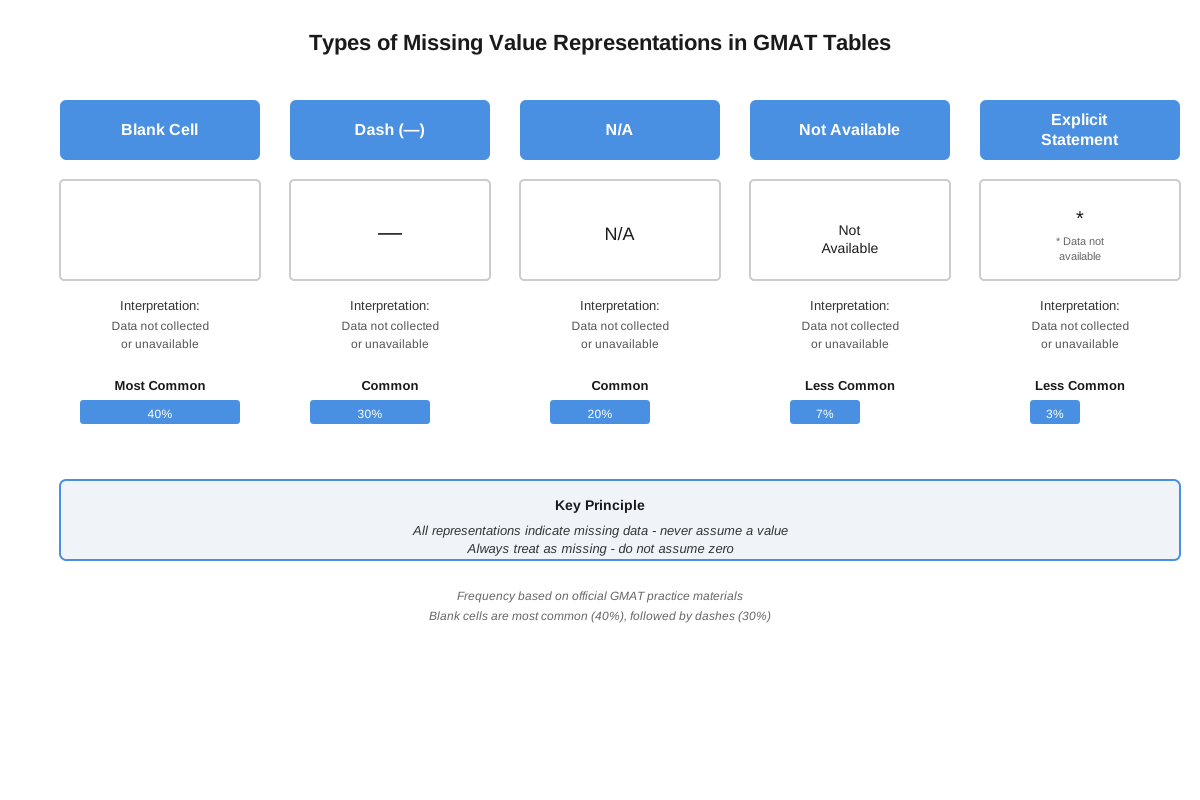
On the GMAT, missing values appear in approximately 15-20% of Data Insights questions, with particularly high frequency in Table Analysis and Multi-Source Reasoning question types. These questions typically present tables with 8-15 rows and 4-8 columns, where 10-30% of cells may contain missing data. The exam uses various representations: blank cells, dashes (—), "N/A," "Not Available," or explicit statements like "Data not collected."
Common question patterns include: determining whether a statement can be verified as true/false or whether it's indeterminate due to missing data; calculating minimum or maximum possible values for sums or averages; identifying which rows or categories have complete versus incomplete information; and evaluating whether sufficient data exists to rank items or make comparisons. The GMAT specifically designs these questions to penalize students who make assumptions about missing data or who fail to recognize when gaps in information prevent definitive conclusions.
Core Concepts
What Constitutes Missing Values
Missing values are data points that should theoretically exist within a dataset but are absent, unavailable, or not recorded. In GMAT Table Analysis questions, these appear as empty cells, explicit markers (dashes, "N/A," "—"), or are referenced in accompanying text. Understanding what qualifies as missing versus what is intentionally zero or inapplicable is crucial. A blank cell in a "Revenue" column represents missing data, while a zero might indicate no revenue was generated—these carry different analytical implications.
The GMAT distinguishes between several categories of missing information:
- Explicitly marked missing values: Cells containing symbols or text indicating unavailability
- Implicitly missing values: Blank cells in otherwise populated tables
- Partially missing values: Situations where some but not all components of a calculation are available
- Systematically missing values: Entire rows or columns absent due to data collection limitations
Impact on Statistical Calculations
When calculating aggregate statistics from datasets containing missing values, students must recognize that standard formulas may not apply directly. For the mean (average), missing values reduce the denominator—the count of available data points—rather than being treated as zeros. If a table shows five employees with salaries of $50K, $60K, $70K, missing, and $80K, the average of available salaries is $260K ÷ 4 = $65K, not $260K ÷ 5 = $52K.
For sums and totals, missing values create uncertainty ranges. If three values are 10, 20, and missing, the sum could be as low as 30 (if the missing value is 0 or negative) or potentially unlimited (if positive values are possible). GMAT questions often ask for minimum or maximum possible totals, requiring students to consider extreme scenarios for missing data.
Medians are particularly interesting with missing values. If the missing value's position in the ordered sequence cannot be determined, the median becomes indeterminate. However, if enough values are known to establish bounds, sometimes the median can still be calculated. For example, with values 5, 10, missing, 20, 25, the median is definitely 10 or higher, but the exact value depends on where the missing value falls.
Determining Sufficiency of Information
A critical skill tested through missing values is evaluating whether available data suffices to answer a question definitively. This connects directly to Data Sufficiency question logic. Students must ask: "Can I answer this question with certainty given the missing information, or does the gap prevent a definitive conclusion?"
Consider three scenarios:
- Sufficient despite missing values: "Is Company A's revenue greater than Company B's?" If A shows $5M and B shows $3M, with other companies' data missing, the question is answerable.
- Insufficient due to missing values: "What is the total revenue of all companies?" If any company's revenue is missing, the exact total cannot be determined.
- Partially determinable: "Is the average revenue above $2M?" If four of five companies show revenues of $3M, $4M, $5M, $6M, and one is missing, the average is definitely above $2M regardless of the missing value (even if it's $0, the average would be $3.6M).
Strategies for Working with Missing Values
When encountering missing values in GMAT questions, employ these systematic approaches:
Boundary analysis: Determine minimum and maximum possible values by considering extreme cases for missing data. If asked for the highest possible total, assume missing values are at their maximum reasonable level; for lowest possible total, assume minimum or zero values.
Sufficiency testing: Before attempting calculations, assess whether the question can be answered definitively. Read carefully to determine if the question asks for an exact value (which may be impossible with missing data) or a comparison/range (which may still be determinable).
Pattern recognition: Identify whether missing values follow patterns. Are they concentrated in specific rows, columns, or categories? Sometimes the pattern of missingness itself provides analytical insight.
Elimination reasoning: Use missing values to eliminate answer choices. If a statement claims an exact total but data is missing, that statement is likely "Cannot be determined" rather than true or false.
Types of Questions Involving Missing Values
The GMAT presents missing values through several question formats:
| Question Type | Description | Example Approach |
|---|---|---|
| True/False/Cannot Determine | Evaluate whether statements can be verified | Check if missing data affects the statement's verifiability |
| Range Calculations | Find minimum or maximum possible values | Consider extreme scenarios for missing values |
| Ranking/Ordering | Determine relative positions | Assess whether missing values could change rankings |
| Sufficiency Evaluation | Determine if enough information exists | Identify what's known versus unknown |
| Comparative Analysis | Compare categories or groups | Check if comparisons remain valid despite gaps |
Handling Different Missing Value Representations
The GMAT uses various conventions to indicate missing data, and recognizing these is the first step in analysis:
- Blank cells: Most common representation; requires careful visual scanning
- Dashes or hyphens (—): Explicit markers indicating unavailability
- "N/A" or "Not Available": Text-based indicators
- Footnotes or asterisks: References to explanatory notes about missing data
- Shaded or grayed cells: Visual indicators of missing information
Each representation carries the same analytical implication: the data point is absent and cannot be assumed to equal zero or any other specific value without explicit justification.
Concept Relationships
Missing values analysis builds directly on prerequisite knowledge of statistical calculations and table interpretation. The relationship flows as follows: Basic table reading → enables → Identifying missing values → requires → Statistical reasoning → leads to → Sufficiency evaluation → determines → Answer selection strategy.
Within the topic itself, concepts connect hierarchically. First, students must identify that values are missing (recognition). This identification then enables impact assessment—understanding how the missing data affects possible calculations or conclusions. Impact assessment leads to strategy selection—choosing between boundary analysis, sufficiency testing, or elimination reasoning. Finally, strategy application produces answer determination—selecting the correct response or recognizing indeterminacy.
Missing values connect to broader Data Insights concepts through several pathways. The topic shares logical structure with Data Sufficiency questions, where determining whether information is adequate parallels evaluating whether missing values prevent conclusions. It relates to Multi-Source Reasoning by requiring synthesis of complete and incomplete information from multiple sources. It connects to statistical analysis by complicating standard calculation procedures. Understanding missing values also enhances critical reasoning skills by forcing careful distinction between what is stated, what can be inferred, and what remains unknown.
Quick check — test yourself on Missing values so far.
Try Flashcards →High-Yield Facts
⭐ Missing values should never be assumed to equal zero unless explicitly stated—this is the most common error students make.
⭐ When calculating averages with missing values, exclude missing data points from both numerator and denominator—don't count them as zeros.
⭐ A single missing value can make an exact total or sum impossible to determine, but may not prevent comparison or ranking questions from being answerable.
⭐ Questions asking for "minimum possible" or "maximum possible" values are strong indicators that missing values are relevant to the solution.
⭐ If a question can be answered regardless of what value the missing data might have, then the missing value doesn't affect sufficiency—test extreme cases to verify.
- Blank cells, dashes, "N/A," and similar markers all indicate missing values and should be treated identically in analysis.
- Missing values in denominators (like missing quantities when calculating per-unit costs) create different analytical challenges than missing values in numerators.
- When multiple values are missing, the range of possible outcomes typically expands significantly compared to a single missing value.
- The GMAT often includes answer choices like "Cannot be determined" specifically for questions where missing values prevent definitive conclusions.
- Systematic patterns in missing data (all values missing for one category) may indicate that category should be excluded from analysis rather than treated as having unknown values.
- Questions may provide sufficient information to determine relationships (greater than, less than) even when exact values cannot be calculated due to missing data.
- Missing values in time-series data (sequential rows) may prevent trend analysis but still allow point-in-time comparisons.
Common Misconceptions
Misconception: Blank cells or dashes in a table should be treated as zeros when calculating sums or averages.
Correction: Missing values represent unknown data, not zero values. Treating them as zeros artificially deflates calculations and leads to incorrect conclusions. Only if explicitly stated should missing values be interpreted as zeros.
Misconception: If most data is available, missing values can be ignored or estimated based on patterns in the available data.
Correction: The GMAT never requires or permits estimation of missing values unless explicit information supports such estimation. Each missing value represents genuine uncertainty that must be acknowledged in analysis.
Misconception: Questions involving missing values are always unanswerable or result in "Cannot be determined" responses.
Correction: Many questions remain answerable despite missing values. Comparative questions, minimum/maximum calculations, and sufficiency evaluations often have definitive answers even with incomplete data. The key is determining whether the specific question asked depends on the missing information.
Misconception: Missing values only affect calculations directly involving those specific data points.
Correction: Missing values can have cascading effects. A missing value in one row might affect column totals, averages across categories, rankings, and comparative analyses. Students must consider both direct and indirect impacts.
Misconception: If a table shows "N/A" or "Not Available," it means the value is not applicable rather than missing.
Correction: In GMAT contexts, "N/A" and similar markers indicate missing data—information that should exist but is unavailable. "Not applicable" would be stated explicitly if that were the intended meaning. The distinction matters because truly non-applicable data can be excluded from analysis, while missing data creates uncertainty.
Worked Examples
Example 1: Determining Sufficiency with Missing Values
Problem: A table shows quarterly revenue for five companies. Company A: $2.5M, Company B: $3.1M, Company C: missing, Company D: $2.8M, Company E: $3.4M. Evaluate the following statements:
Statement 1: "The total revenue of all five companies exceeds $12 million."
Statement 2: "Company B has the highest revenue among all five companies."
Statement 3: "The average revenue of companies with available data is above $2.5 million."
Solution:
For Statement 1, we need to determine if the total definitely exceeds $12M. Available data sums to: $2.5M + $3.1M + $2.8M + $3.4M = $11.8M. Since Company C's revenue is missing, the total could be as low as $11.8M (if C had $0 revenue) or higher. For the total to definitely exceed $12M, Company C would need at least $0.2M. However, we cannot determine this from available information. Statement 1: Cannot be determined.
For Statement 2, Company B shows $3.1M, while Company E shows $3.4M. Company E has higher revenue than Company B among known values. Even if Company C's revenue were missing, Company E's $3.4M is already higher than B's $3.1M. Statement 2: False (Company B does not have the highest revenue; Company E does, and possibly Company C could be even higher).
For Statement 3, calculate the average of available data: ($2.5M + $3.1M + $2.8M + $3.4M) ÷ 4 = $11.8M ÷ 4 = $2.95M. This is indeed above $2.5M. The question specifically asks about "companies with available data," so Company C is excluded from this calculation. Statement 3: True.
Key Takeaway: This example demonstrates that missing values affect different types of questions differently. Exact totals become indeterminate, but comparisons among known values and calculations explicitly limited to available data remain answerable.
Example 2: Boundary Analysis with Multiple Missing Values
Problem: A table shows test scores for eight students. Five scores are visible: 72, 85, 88, 91, 94. Three scores are missing. The question asks: "What is the minimum possible average score for all eight students?"
Solution:
To find the minimum possible average, we need to minimize the total sum of all scores, which means assuming the missing values are as low as possible.
First, sum the known scores: 72 + 85 + 88 + 91 + 94 = 430
For the minimum average, we need to consider what the lowest possible scores could be. If the test has a minimum score (commonly 0 or some stated minimum), use that value. Assuming scores can be as low as 0:
Minimum total = 430 + 0 + 0 + 0 = 430
Minimum average = 430 ÷ 8 = 53.75
However, if the problem context suggests scores must be passing (say, minimum 60), then:
Minimum total = 430 + 60 + 60 + 60 = 610
Minimum average = 610 ÷ 8 = 76.25
Critical insight: The answer depends on constraints. GMAT questions will either specify constraints (minimum possible score) or expect you to recognize that without constraints, the theoretical minimum approaches the lowest value in the scoring system.
If the question instead asked for the maximum possible average:
Maximum total = 430 + 100 + 100 + 100 = 730 (assuming 100 is the maximum score)
Maximum average = 730 ÷ 8 = 91.25
Key Takeaway: Boundary analysis requires identifying constraints on missing values and applying extreme scenarios. Always check whether the problem specifies limits on possible values.
Exam Strategy
When approaching GMAT questions involving missing values, implement this systematic process:
Step 1: Visual Scan and Identification (15-20 seconds)
Quickly scan the entire table or dataset to identify all missing values. Note their locations—are they scattered randomly, concentrated in specific rows/columns, or following a pattern? Mark or mentally note each missing cell before reading the question.
Step 2: Question Analysis (10-15 seconds)
Read the question carefully to determine what it asks for:
- Exact values or calculations? (likely affected by missing data)
- Comparisons or rankings? (may be answerable despite gaps)
- Minimum/maximum possibilities? (requires boundary analysis)
- True/false/cannot determine? (test sufficiency)
Step 3: Sufficiency Assessment (20-30 seconds)
Before calculating anything, determine whether the question can be answered definitively with available data. Ask: "Does the missing information directly impact what I'm being asked?" If yes, consider whether bounds or comparisons might still work.
Step 4: Strategic Calculation (30-60 seconds)
If calculation is needed, choose the appropriate approach:
- For averages: exclude missing values from count
- For totals: determine if exact value is needed or if range suffices
- For comparisons: check if known values already establish the relationship
- For rankings: assess whether missing values could change the order
Exam Tip: Trigger phrases like "must be true," "could be true," "cannot be determined," "minimum possible," and "maximum possible" are strong indicators that missing values play a central role in the question.
Time Allocation: Spend no more than 2.5 minutes on any single Table Analysis question. If missing values make a question complex, don't get stuck trying to account for every possibility—use elimination to narrow choices quickly.
Process of Elimination:
- Eliminate answer choices that claim exact values when data is missing and no bounds are specified
- Eliminate choices that ignore missing values in calculations (treating them as zeros without justification)
- Keep "Cannot be determined" options when missing values directly affect the question's answer
- Eliminate comparative statements that could be reversed depending on missing values
Common Trigger Words:
- "Exactly," "precisely," "total" → likely problematic with missing values
- "At least," "at most," "minimum," "maximum" → boundary analysis needed
- "Among those shown," "for available data" → missing values can be excluded
- "All," "every," "complete" → missing values may prevent verification
Memory Techniques
Mnemonic for Missing Values Analysis: "SCAN"
- Spot the missing values first
- Check what the question asks for
- Assess sufficiency before calculating
- Never assume missing equals zero
Visualization Strategy: Picture missing values as "fog patches" on a map. You can see around them and sometimes navigate despite them, but you cannot see through them. This mental image helps remember that missing data creates uncertainty but doesn't always prevent reaching a destination (answer).
Acronym for Question Types: "BERT"
- Boundary questions (min/max)
- Exact value questions (often indeterminate)
- Ranking questions (may be answerable)
- True/false questions (test each carefully)
Memory Hook: "Missing values are like missing puzzle pieces—you can often see the picture without them, but you can't claim it's complete." This reminds students that partial analysis is often valid, but claiming completeness or exactness is not.
Summary
Missing values represent a sophisticated analytical challenge in GMAT Data Insights questions, requiring students to distinguish between what can be determined from available data and what remains uncertain due to information gaps. The core competency involves identifying missing data in various formats (blank cells, dashes, "N/A"), understanding how these gaps affect statistical calculations and logical conclusions, and determining whether sufficient information exists to answer questions definitively. Critical principles include never treating missing values as zeros without justification, excluding missing data points from both numerators and denominators when calculating averages, and recognizing that many questions remain answerable through comparative analysis, boundary calculations, or sufficiency reasoning even when exact values cannot be determined. Success requires systematic approaches: visually scanning for missing values before reading questions, assessing sufficiency before calculating, applying boundary analysis for minimum/maximum questions, and using elimination strategies that account for uncertainty. The GMAT specifically tests whether students can work effectively with incomplete information—a skill essential for real-world business decision-making and a frequent differentiator between high and average scores.
Key Takeaways
- Missing values should never be assumed to equal zero unless explicitly stated; they represent genuine uncertainty in the dataset
- When calculating averages with missing data, exclude missing values from both the sum and the count—don't treat them as zeros
- Many questions remain answerable despite missing values through comparative analysis, boundary calculations, or by focusing on available data only
- Questions asking for "minimum possible" or "maximum possible" values signal the need for boundary analysis considering extreme scenarios for missing data
- Systematic approach is essential: identify missing values first, assess what the question asks, determine sufficiency, then calculate strategically
- The presence of "Cannot be determined" as an answer choice often indicates that missing values play a critical role in the question
- Different question types are affected differently by missing values—exact calculations become indeterminate while comparisons among known values may remain valid
Related Topics
Data Sufficiency Questions: Mastering missing values provides direct preparation for Data Sufficiency problems, where determining whether information is adequate to answer questions is the central skill. The logical framework for evaluating sufficiency with missing values transfers directly to these question types.
Statistical Analysis in Data Insights: Understanding how missing values affect means, medians, ranges, and other statistical measures deepens overall statistical reasoning ability, essential for Graphics Interpretation and Two-Part Analysis questions.
Multi-Source Reasoning: Missing values frequently appear across multiple data sources in MSR questions, requiring synthesis of complete and incomplete information from tables, text, and graphics simultaneously.
Table Analysis Advanced Techniques: Building on missing values mastery, students can progress to more complex table analysis involving conditional sorting, multi-variable filtering, and integrated reasoning across large datasets.
Practice CTA
Now that you understand the principles and strategies for handling missing values in GMAT Data Insights questions, it's time to apply this knowledge through deliberate practice. Work through the practice questions associated with this topic, paying special attention to identifying missing values quickly, assessing sufficiency before calculating, and distinguishing between questions that remain answerable versus those that become indeterminate due to data gaps. Use the flashcards to reinforce key concepts and common question patterns. Remember: mastery comes from recognizing patterns across multiple problems, so approach each practice question as an opportunity to refine your systematic approach. Your ability to work confidently with incomplete data will serve you not only on test day but throughout your business career!
Sign up free to keep reading
Create a free AnvayaPrep account to finish this GMAT guide on Missing values — plus flashcards and practice questions.