Overview
Numeric interpretation is a fundamental skill within the GMAT Data Insights section, specifically tested through Table Analysis questions. This competency requires test-takers to extract, analyze, and manipulate numerical data presented in tabular format to answer complex questions accurately and efficiently. Unlike simple data reading, GMAT numeric interpretation demands that students understand relationships between numbers, perform mental calculations, recognize patterns, and draw meaningful conclusions from datasets that may contain dozens of rows and multiple columns of information.
Mastering numeric interpretation is essential for GMAT success because it appears in approximately 20-25% of Data Insights questions and serves as the foundation for more complex analytical tasks. The GMAT presents tables containing financial data, demographic statistics, scientific measurements, or business metrics, and expects candidates to sort, filter, and analyze this information under time pressure. Students must quickly identify relevant data points, understand what numerical relationships matter, and determine whether statements about the data are true or false based on accurate interpretation of the numbers presented.
Within the broader Data Insights framework, numeric interpretation connects directly to quantitative reasoning, data sufficiency, and multi-source reasoning. It bridges pure mathematical computation with critical thinking about data relationships. While other Data Insights topics may focus on graphical representations or integrated reasoning across multiple sources, numeric interpretation specifically develops the ability to work with structured numerical data in table format—a skill that underlies success across virtually all quantitative business and analytical contexts tested on the GMAT.
Learning Objectives
- [ ] Identify numeric interpretation tasks within GMAT Table Analysis questions
- [ ] Explain the principles and methods of numeric interpretation in data tables
- [ ] Apply numeric interpretation techniques to solve GMAT questions accurately and efficiently
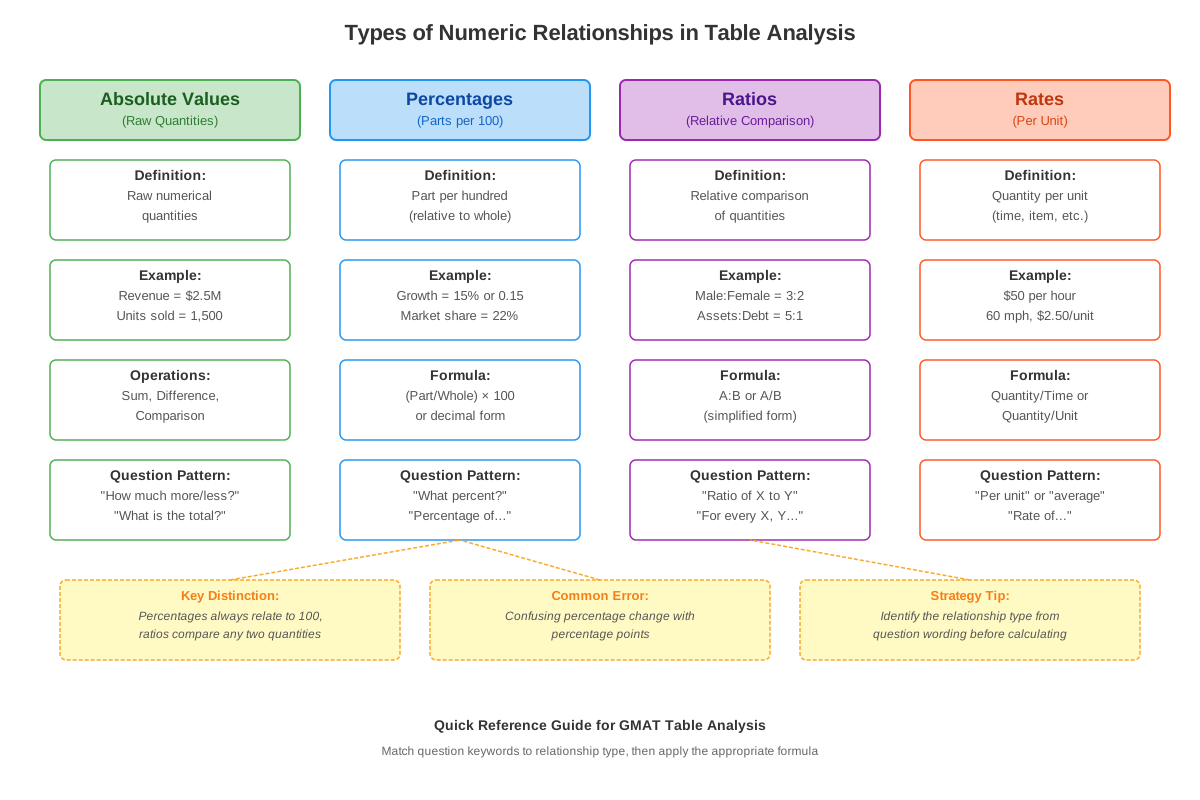
- [ ] Distinguish between absolute values, percentages, ratios, and rates within tabular data
- [ ] Execute multi-step calculations using data from multiple table columns or rows
- [ ] Evaluate the truth value of statements based on accurate numeric interpretation of table data
Prerequisites
- Basic arithmetic operations: Addition, subtraction, multiplication, and division form the computational foundation for all numeric interpretation tasks
- Percentage calculations: Understanding how to calculate percentages, percentage change, and percentage points is essential since tables frequently present or require percentage-based comparisons
- Ratio and proportion concepts: Many table analysis questions require comparing values as ratios or understanding proportional relationships between data points
- Basic statistical measures: Familiarity with mean, median, and range helps interpret summary statistics that may appear in or be derived from tables
- Algebraic manipulation: Simple equation solving and variable manipulation enable students to work backward from given information to find unknown values
Why This Topic Matters
Numeric interpretation skills extend far beyond standardized testing into real-world business, research, and analytical contexts. Professionals across industries—from financial analysts examining quarterly reports to marketing managers evaluating campaign performance metrics—must regularly extract insights from numerical tables. The ability to quickly identify relevant data, perform accurate calculations, and draw valid conclusions from structured datasets represents a core competency in data-driven decision-making environments.
On the GMAT specifically, numeric interpretation appears in approximately 3-5 questions per exam within the Data Insights section. Table Analysis questions constitute a significant portion of this section, and each Table Analysis question typically presents 3-4 statements that must be evaluated as true or false based on the provided table. This question format means that a single table may generate multiple scoring opportunities, making proficiency in numeric interpretation particularly high-yield for score improvement. The GMAT awards points for correctly evaluating all statements within a question, so partial credit is not available—accuracy in numeric interpretation directly impacts the score.
Common manifestations of numeric interpretation on the GMAT include: comparing values across different categories or time periods; calculating percentage changes or growth rates; identifying maximum, minimum, or median values; determining rankings; computing averages or totals; and evaluating whether specific numerical relationships hold true. Tables may contain 15-30 rows of data with 4-8 columns, requiring efficient scanning and sorting strategies. The exam interface allows students to sort tables by any column, a feature that becomes crucial for answering questions efficiently.
Core Concepts
Understanding Table Structure and Data Types
Tables present information in a structured format with rows representing individual records or observations and columns representing different variables or attributes. Each cell contains a data point that relates a specific row entity to a particular column attribute. Numeric interpretation begins with understanding what each column represents, what units are being used, and what type of numerical data is presented.
Data types in GMAT tables typically include:
- Absolute values: Raw numbers representing counts, measurements, or amounts (e.g., revenue in dollars, population in thousands)
- Percentages: Values expressed as parts per hundred, which may represent proportions, growth rates, or composition
- Ratios: Relationships between two quantities expressed as fractions or with colon notation
- Rates: Values that express change over time or per unit of another measure
Understanding whether a column shows absolute or relative values is critical. A common error involves treating percentages as absolute numbers or vice versa. For example, a 50% increase from a base of 100 yields 150, but a 50% increase from a base of 1,000 yields 1,500—the percentage is the same, but the absolute change differs dramatically.
Extracting Relevant Data Points
Efficient numeric interpretation requires quickly locating the specific data points needed to answer a question. GMAT tables often contain more information than necessary for any single statement, testing the ability to filter relevant from irrelevant data. The sorting functionality in the GMAT interface becomes a powerful tool: sorting by a particular column can immediately reveal maximum or minimum values, facilitate ranking comparisons, or group similar values together.
When extracting data, students must:
- Identify which row(s) contain the relevant entity or entities
- Identify which column(s) contain the needed attribute(s)
- Note the units and scale (thousands, millions, percentages, etc.)
- Record or mentally note the exact values for calculation
Performing Calculations and Comparisons
Once relevant data points are identified, numeric interpretation often requires mathematical operations. Common calculation types include:
Percentage Change Calculation:
Percentage Change = ((New Value - Old Value) / Old Value) × 100%Percentage Point Difference: The arithmetic difference between two percentages (e.g., 45% minus 30% equals 15 percentage points, not 15%)
Weighted Averages: When calculating averages from grouped data, weights must be considered
Ranking and Ordering: Determining which values are largest, smallest, or fall within a specific range
Compound Calculations: Multi-step problems requiring intermediate results (e.g., calculating total revenue by multiplying price per unit by quantity, then summing across multiple products)
Evaluating Statement Accuracy
GMAT Table Analysis questions present statements that must be evaluated as true or false based solely on the table data. This evaluation requires precise numeric interpretation—approximations that would be acceptable in some contexts may lead to incorrect answers. Students must:
- Verify that calculations are exact, not estimated
- Ensure comparisons use the correct values and units
- Check that statements about "all," "none," "always," or "never" are absolutely true
- Distinguish between correlation and causation (tables show relationships but not necessarily causal mechanisms)
- Recognize when insufficient information exists to confirm a statement
Recognizing Patterns and Relationships
Beyond individual calculations, numeric interpretation involves identifying patterns across multiple data points. These patterns might include:
- Trends: Consistent increases or decreases across time periods or categories
- Proportional relationships: When one variable changes, another changes by a consistent ratio
- Outliers: Values that deviate significantly from typical ranges
- Distributions: How values cluster or spread across a range
Recognizing these patterns enables more efficient problem-solving and helps verify whether calculated results are reasonable.
Concept Relationships
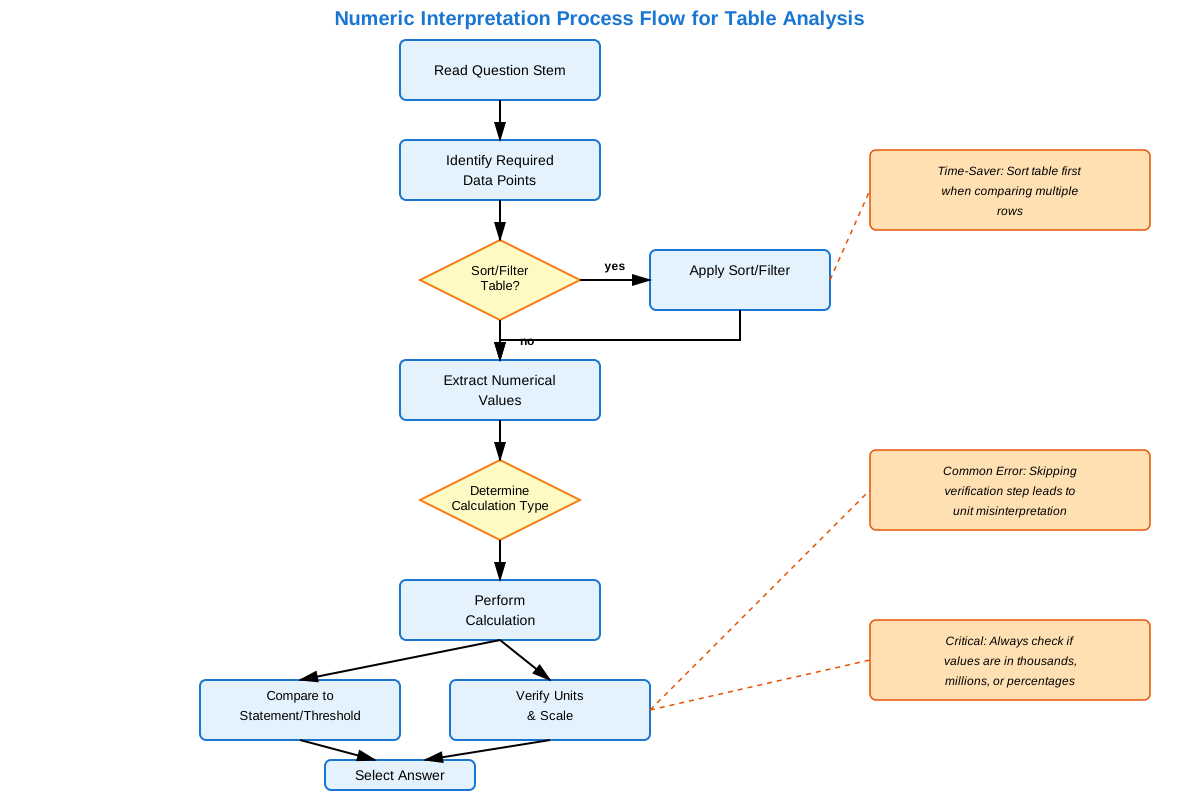
Numeric interpretation serves as the foundational skill that enables all other Table Analysis competencies. The relationship flow proceeds as follows:
Table Structure Understanding → Data Extraction → Calculation Execution → Statement Evaluation
Each step depends on the previous one: without understanding table structure, data extraction becomes haphazard; without accurate extraction, calculations use wrong inputs; without correct calculations, statement evaluation fails.
Numeric interpretation connects to prerequisite topics through direct application: basic arithmetic provides the computational tools; percentage concepts enable relative comparisons; ratio understanding facilitates proportional reasoning; and statistical measures allow summary analysis. These prerequisites feed directly into numeric interpretation tasks.
The relationship to broader Data Insights topics includes:
- Multi-Source Reasoning: Numeric interpretation skills transfer to analyzing numerical data across multiple exhibits
- Graphics Interpretation: Similar analytical thinking applies to extracting data from charts and graphs
- Two-Part Analysis: Numerical relationships identified in tables inform constraint-based problem solving
Within Table Analysis specifically, numeric interpretation enables sorting strategy optimization (knowing what to sort by requires understanding what numerical relationships matter) and time management (efficient interpretation reduces calculation time, allowing more time for complex reasoning).
High-Yield Facts
⭐ The GMAT Table Analysis interface allows sorting by any column—use this feature strategically to quickly identify maximum, minimum, or ranked values
⭐ Percentage change and percentage point difference are distinct concepts: a change from 20% to 30% is a 10 percentage point increase but a 50% relative increase
⭐ When comparing values across rows, always verify you're using the same units and scales (thousands vs. millions, percentages vs. decimals)
⭐ Statements containing absolute qualifiers like "all," "none," "always," or "never" require verification across every relevant data point—a single exception makes the statement false
⭐ Compound annual growth rate (CAGR) calculations appear frequently and require understanding exponential rather than linear growth
- Tables may contain calculated columns (like totals or averages) that can be verified against raw data to check for consistency
- When a question asks about "median" values, sorting the relevant column immediately reveals the middle value(s)
- Percentage composition questions (e.g., "What percentage of total revenue came from Product A?") require calculating both the part and the whole
- Ratio comparisons should be simplified to lowest terms when possible to facilitate easier comparison
- Time-series data in tables often tests understanding of cumulative vs. period-specific values
- Missing or incomplete data in tables is intentional—statements about those data points should be marked as "Cannot be determined" if that option exists
- Rounding instructions, when provided, must be followed precisely as they affect whether calculated values match statement claims
Quick check — test yourself on Numeric interpretation so far.
Try Flashcards →Common Misconceptions
Misconception: Percentage increases are symmetric with percentage decreases (e.g., a 50% increase followed by a 50% decrease returns to the original value).
Correction: Percentage changes are calculated on different bases. A 50% increase from 100 yields 150, but a 50% decrease from 150 yields 75, not 100. The original value would require a 33.3% decrease from 150.
Misconception: When comparing two percentages, the difference can be expressed as a percentage directly.
Correction: The difference between two percentages is expressed in percentage points. If Market Share increases from 25% to 30%, that's a 5 percentage point increase, but a 20% relative increase (5/25 = 0.20 = 20%).
Misconception: Sorting a table by one column automatically reveals the answer to questions about other columns.
Correction: Sorting helps identify extremes or rankings for the sorted column only. Questions involving relationships between multiple columns may require different sorting strategies or manual comparison of values across columns.
Misconception: Average (mean) and median are interchangeable terms.
Correction: Mean is the sum divided by count; median is the middle value when data is ordered. In skewed distributions, these can differ substantially. GMAT questions specify which measure is required.
Misconception: If a table shows data for 2020 and 2021, calculating change requires only subtraction.
Correction: The type of change matters. Absolute change uses subtraction, but percentage change requires dividing the absolute change by the base year value and multiplying by 100. Questions specify which type of change is relevant.
Misconception: All numbers in a table are equally important for answering questions.
Correction: GMAT tables intentionally include extraneous data. Efficient test-takers identify only the relevant rows and columns for each specific statement, avoiding unnecessary calculations.
Misconception: Approximation is acceptable for GMAT numeric interpretation questions.
Correction: While estimation helps verify reasonableness, final answers must be precise. A statement claiming a value is "greater than 45%" is false if the calculated value is 44.8%, even though it's "approximately 45%."
Worked Examples
Example 1: Multi-Step Percentage Calculation
Table Data (simplified):
| Company | 2021 Revenue ($M) | 2022 Revenue ($M) | 2023 Revenue ($M) |
|---|---|---|---|
| Alpha | 120 | 150 | 165 |
| Beta | 200 | 210 | 252 |
| Gamma | 180 | 198 | 207 |
Statement: "Beta's percentage revenue growth from 2021 to 2023 exceeded Alpha's percentage revenue growth over the same period."
Solution Process:
Step 1: Calculate Alpha's percentage growth from 2021 to 2023
- Initial value (2021): $120M
- Final value (2023): $165M
- Absolute change: $165M - $120M = $45M
- Percentage change: ($45M / $120M) × 100% = 37.5%
Step 2: Calculate Beta's percentage growth from 2021 to 2023
- Initial value (2021): $200M
- Final value (2023): $252M
- Absolute change: $252M - $200M = $52M
- Percentage change: ($52M / $200M) × 100% = 26%
Step 3: Compare the percentage growth rates
- Alpha: 37.5%
- Beta: 26%
- 26% is NOT greater than 37.5%
Conclusion: The statement is FALSE. Despite Beta having a larger absolute revenue increase ($52M vs. $45M), Alpha had a higher percentage growth rate because it started from a smaller base.
Learning Objective Connection: This example demonstrates applying numeric interpretation to distinguish between absolute and relative measures, a critical skill for GMAT Table Analysis questions.
Example 2: Ranking with Calculated Values
Table Data:
| Product | Units Sold | Price per Unit ($) | Marketing Spend ($) |
|---|---|---|---|
| Widget | 5,000 | 25 | 30,000 |
| Gadget | 3,500 | 40 | 28,000 |
| Tool | 4,200 | 30 | 35,000 |
| Device | 2,800 | 50 | 25,000 |
Statement: "When products are ranked by profit margin (defined as revenue minus marketing spend), Tool ranks second."
Solution Process:
Step 1: Calculate revenue for each product (Units Sold × Price per Unit)
- Widget: 5,000 × $25 = $125,000
- Gadget: 3,500 × $40 = $140,000
- Tool: 4,200 × $30 = $126,000
- Device: 2,800 × $50 = $140,000
Step 2: Calculate profit margin for each product (Revenue - Marketing Spend)
- Widget: $125,000 - $30,000 = $95,000
- Gadget: $140,000 - $28,000 = $112,000
- Tool: $126,000 - $35,000 = $91,000
- Device: $140,000 - $25,000 = $115,000
Step 3: Rank products by profit margin (highest to lowest)
- Device: $115,000
- Gadget: $112,000
- Widget: $95,000
- Tool: $91,000
Conclusion: The statement is FALSE. Tool ranks fourth (last), not second. Device ranks first, followed by Gadget.
Learning Objective Connection: This example illustrates applying numeric interpretation through multi-step calculations and ranking, demonstrating how GMAT questions test the ability to derive new metrics from table data.
Exam Strategy
Approach Framework:
- Read the statement first, then examine the table: Understanding what the question asks before diving into data prevents wasting time on irrelevant information
- Identify the specific rows and columns needed: Circle or mentally note which data points are relevant to the current statement
- Use the sort function strategically: If a statement asks about maximum, minimum, or ranking, sort by the relevant column immediately
- Perform calculations systematically: Write down intermediate steps for complex calculations to avoid mental arithmetic errors
- Verify units and scales: Before calculating, confirm whether values are in thousands, millions, percentages, or other units
Trigger Words and Phrases:
- "Greater than," "less than," "at least," "at most": These require precise calculations, not approximations
- "Percentage change" vs. "percentage point change": Signals which calculation method to use
- "Median," "average," "mean": Indicates specific statistical measures requiring different calculation approaches
- "Ranked by," "highest," "lowest": Suggests using the sort function
- "All," "none," "every," "always": Requires checking multiple data points; a single exception invalidates the statement
- "Approximately," "about," "roughly": Rare in GMAT numeric interpretation; when present, indicates acceptable rounding
Process-of-Elimination Tips:
- If a statement involves comparing two values and one is obviously much larger/smaller, quick estimation may suffice without precise calculation
- For statements about rankings, eliminate if you can identify even one item that clearly contradicts the claimed ranking
- When time is short, prioritize statements that require simple lookups over those requiring multi-step calculations
- If two statements seem contradictory, at least one must be false—use this logical relationship to guide verification efforts
Time Allocation:
- Budget approximately 2.5 minutes per Table Analysis question (which typically contains 3-4 statements)
- Spend 20-30 seconds initially understanding the table structure and column meanings
- Allocate 30-45 seconds per statement for evaluation
- If a calculation becomes too complex or time-consuming, make an educated guess and move forward rather than spending 2+ minutes on a single statement
Memory Techniques
PERCENT Mnemonic for percentage calculations:
- Part and whole must be identified
- Ensure same units before dividing
- Ratio comes first (part/whole)
- Convert to percentage (multiply by 100)
- Examine whether change or composition is asked
- New vs. old determines direction
- Total verification prevents errors
SORT Strategy for table analysis:
- Scan the statement to identify key variables
- Organize by sorting the relevant column
- Read the sorted values carefully
- Test the statement against the organized data
Visualization Strategy: Picture tables as spreadsheets where each cell is a specific intersection of row and column. When a question asks about relationships, visualize drawing lines connecting the relevant cells to see the pattern.
Unit Conversion Reminder: Create a mental "units checklist" before each calculation:
- Thousands (K) = × 1,000
- Millions (M) = × 1,000,000
- Percentages = ÷ 100 to convert to decimal
- Percentage points = direct subtraction of percentages
Acronym for Common Errors - CRUDE:
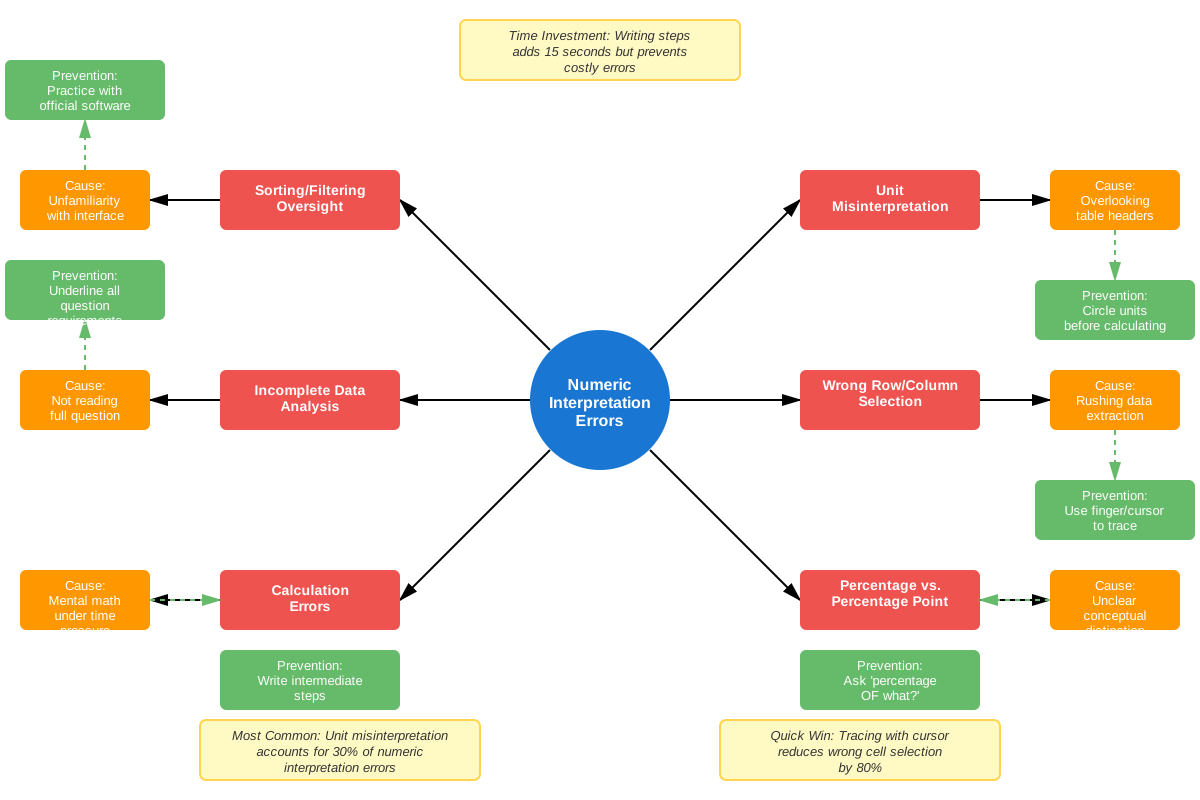
- Confusing percentage change with percentage points
- Rounding prematurely
- Using wrong base for percentage calculations
- Disregarding units and scales
- Estimating when precision is required
Summary
Numeric interpretation represents a critical competency within GMAT Data Insights, requiring test-takers to accurately extract, analyze, and manipulate numerical data from tables to evaluate statement accuracy. This skill encompasses understanding table structure and data types, efficiently locating relevant information, performing precise calculations including percentage changes and rankings, and evaluating whether statements are definitively true or false based on the data. Success requires distinguishing between absolute and relative measures, recognizing when to use the sorting function, and avoiding common pitfalls like confusing percentage change with percentage point differences or applying calculations to incorrect base values. The GMAT tests numeric interpretation through Table Analysis questions that present multi-column, multi-row datasets requiring both computational accuracy and strategic thinking about which data points matter for each specific statement. Mastery involves developing systematic approaches to data extraction, maintaining precision in calculations while managing time effectively, and recognizing patterns that enable efficient problem-solving across the diverse numerical scenarios presented in the exam.
Key Takeaways
- Numeric interpretation requires precision: GMAT Table Analysis questions demand exact calculations, not approximations, as statements are evaluated as definitively true or false
- Percentage change ≠ percentage point change: Understanding this distinction prevents one of the most common errors in table analysis questions
- Strategic sorting saves time: Use the GMAT interface's sort function to quickly identify maximum, minimum, and ranked values rather than manually scanning rows
- Units and scales matter critically: Always verify whether values are in thousands, millions, percentages, or other units before performing calculations
- Multi-step calculations require systematic approaches: Break complex problems into sequential steps, recording intermediate results to avoid mental arithmetic errors
- Statements with absolute qualifiers demand comprehensive verification: Words like "all," "always," or "none" require checking every relevant data point
- Efficient data extraction focuses on relevance: Identify only the specific rows and columns needed for each statement, ignoring extraneous table information
Related Topics
Graphics Interpretation: Builds on numeric interpretation skills by applying similar analytical thinking to bar charts, line graphs, and scatter plots. Mastering numeric interpretation in tables provides the foundation for extracting and comparing data from visual representations.
Multi-Source Reasoning: Extends numeric interpretation across multiple exhibits, requiring synthesis of numerical data from tables, text passages, and graphics. Success in table-based numeric interpretation directly transfers to analyzing numerical information embedded in complex, multi-source scenarios.
Data Sufficiency: While focused on determining whether sufficient information exists rather than calculating specific answers, data sufficiency questions often involve numerical relationships similar to those in table analysis, making numeric interpretation skills highly transferable.
Quantitative Reasoning: The computational skills developed through numeric interpretation—percentage calculations, ratio comparisons, and statistical measures—apply directly to standalone quantitative problems, creating synergy between Data Insights and Quantitative sections.
Practice CTA
Now that you've mastered the core concepts of numeric interpretation, it's time to solidify your understanding through deliberate practice. Attempt the practice questions associated with this topic, focusing on applying the systematic approaches and strategies outlined in this guide. Use the flashcards to reinforce high-yield facts and common calculation patterns until they become automatic. Remember that numeric interpretation is a skill that improves dramatically with focused practice—each table you analyze builds pattern recognition and calculation speed that will serve you throughout the GMAT Data Insights section. Approach practice with the same precision and strategic thinking you'll use on test day, and you'll develop the confidence and competence needed to excel on these high-value questions.
Sign up free to keep reading
Create a free AnvayaPrep account to finish this GMAT guide on Numeric interpretation — plus flashcards and practice questions.