Overview
Ranking data is a fundamental skill within the GMAT Data Insights section, specifically tested through Table Analysis questions. This topic requires test-takers to organize, sort, and interpret tabular information by ordering values from highest to lowest or vice versa. Unlike simple data reading, ranking demands that students mentally or systematically reorder information to identify relative positions, percentiles, medians, and comparative relationships among data points.
The ability to work with GMAT ranking data is essential because Table Analysis questions frequently present unsorted or partially sorted data that must be reorganized to answer questions accurately. Students must determine which values occupy specific positions (e.g., "Which product had the third-highest revenue?"), identify items within certain ranges (e.g., "How many countries had GDP growth rates above the median?"), or compare relative standings across multiple variables. These questions test both analytical reasoning and attention to detail under time pressure.
Within the broader Data Insights framework, ranking data connects directly to statistical concepts like median, quartiles, and percentiles, while also supporting skills in data comparison and pattern recognition. Mastery of ranking enables efficient navigation of complex tables and forms the foundation for more advanced analytical tasks such as multi-sort analysis and conditional filtering. This topic appears in approximately 15-20% of Data Insights questions and is considered high-yield because ranking skills transfer across multiple question types and difficulty levels.
Learning Objectives
- [ ] Identify ranking data in GMAT Table Analysis questions
- [ ] Explain the principles and methodology of ranking data systematically
- [ ] Apply ranking data techniques to solve GMAT questions efficiently
- [ ] Determine positional values (median, quartiles, specific ranks) within ranked datasets
- [ ] Compare multiple variables simultaneously using ranking strategies
- [ ] Recognize when ranking is necessary versus when it can be avoided to save time
Prerequisites
- Basic statistical measures (mean, median, mode): Understanding these concepts is essential because ranking often determines median values and percentile positions
- Table reading and data interpretation: Students must be able to extract values from rows and columns before they can rank them
- Numerical comparison skills: Ranking requires quick and accurate comparison of numbers, including decimals, percentages, and negative values
- Understanding of ascending and descending order: The foundation of all ranking operations
Why This Topic Matters
Real-World Applications
Ranking data is ubiquitous in business analytics, financial analysis, and strategic decision-making. Companies rank products by profitability, sales teams by performance, and markets by growth potential. Investment analysts rank stocks by various metrics, while operations managers rank suppliers by reliability and cost-effectiveness. The ability to quickly identify top performers, bottom quartiles, or median values drives resource allocation, strategic planning, and competitive analysis across industries.
GMAT Exam Significance
Table Analysis questions constitute a significant portion of the Data Insights section, and ranking appears in approximately 60-70% of these questions. The GMAT specifically tests ranking through questions that require:
- Positional identification: "Which city had the 4th highest population density?"
- Threshold analysis: "How many products exceeded the median profit margin?"
- Comparative ranking: "Did Company A rank higher in revenue than in market share?"
- Percentile determination: "What percentage of observations fell below the 75th percentile value?"
These questions typically appear with tables containing 10-20 rows of data across 4-8 columns, requiring students to mentally or systematically rank subsets of information. The difficulty increases when multiple sorts are needed or when ranking must be performed on calculated values rather than given data.
Core Concepts
Understanding Ranking Data
Ranking data refers to the process of ordering a dataset according to the values of a specific variable, arranging items from highest to lowest (descending order) or lowest to highest (ascending order). In GMAT contexts, ranking transforms unordered tabular information into an ordered sequence that reveals positional relationships, relative standings, and distributional characteristics.
The fundamental principle involves comparing each data point against all others within the same variable to establish its position. For example, if five companies have revenues of $45M, $67M, $23M, $89M, and $56M, ranking them in descending order produces: $89M (rank 1), $67M (rank 2), $56M (rank 3), $45M (rank 4), $23M (rank 5).
Types of Ranking Operations
Single-Variable Ranking
This involves ordering data based on one column or attribute. The GMAT presents tables where students must mentally reorder rows according to a specified variable. For instance, ranking countries by GDP growth rate requires comparing all growth rate values and determining their relative positions.
Key considerations:
- Identify the correct column for ranking
- Determine whether ascending or descending order is needed
- Account for tied values (multiple items with identical values)
- Track which row corresponds to which ranked position
Multi-Variable Ranking
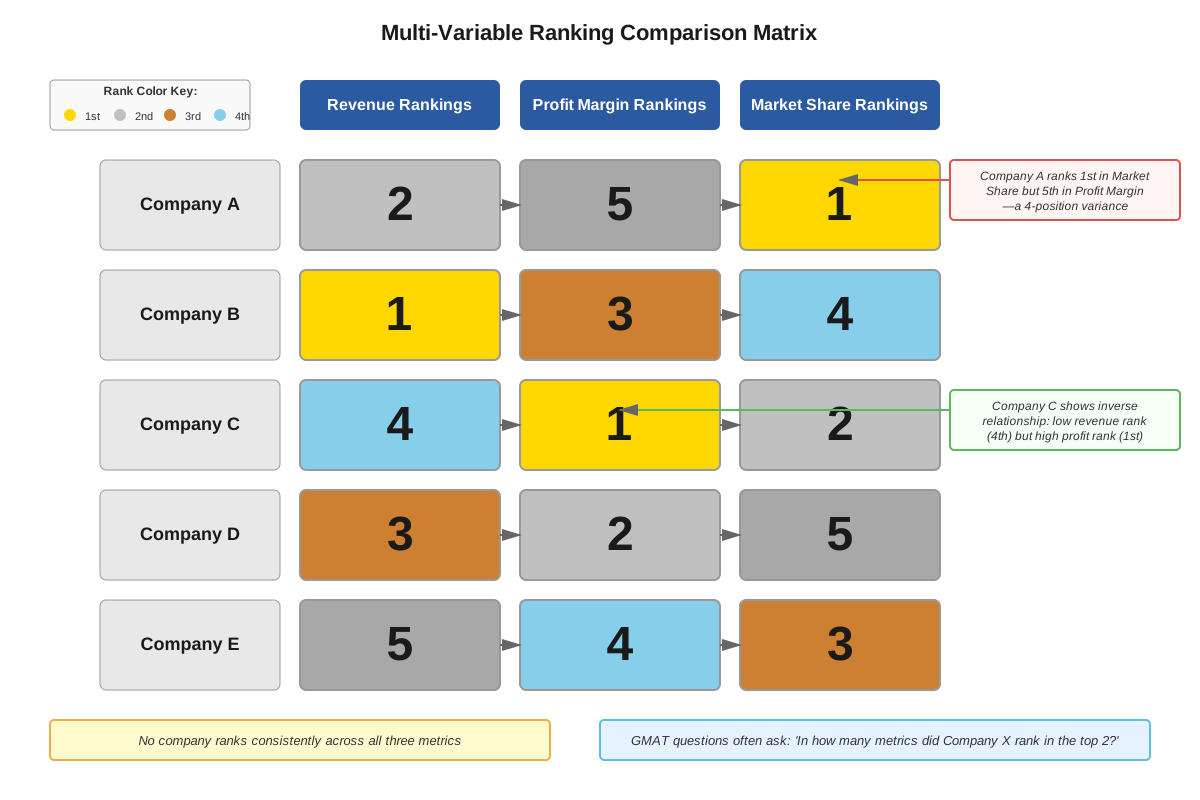
More complex questions require ranking the same entities across different variables. A company might rank 3rd in revenue but 7th in profit margin. These questions test whether students can maintain separate mental rankings or recognize that high performance in one metric doesn't guarantee high performance in another.
Conditional Ranking
Some questions require ranking only a subset of data that meets specific criteria. For example: "Among countries with populations exceeding 50 million, which had the highest literacy rate?" This requires filtering first, then ranking the filtered subset.
Positional Values and Ranking
Median Determination
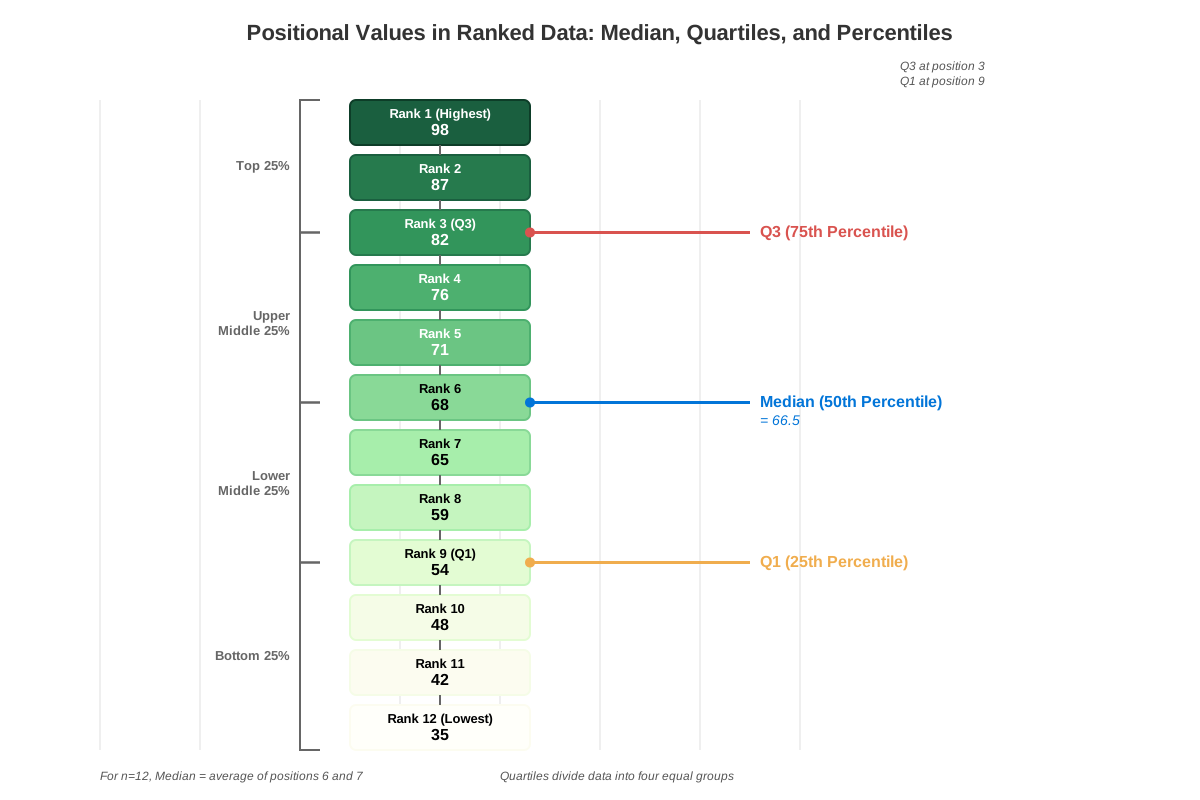
The median is the middle value in a ranked dataset. For an odd number of observations (n), the median is the value at position (n+1)/2. For an even number, it's the average of values at positions n/2 and (n/2)+1.
Example: In a ranked dataset of 9 values, the median is the 5th value. In a dataset of 10 values, the median is the average of the 5th and 6th values.
Quartiles and Percentiles
Ranking enables identification of:
- First quartile (Q1): The value at the 25th percentile (position ≈ 0.25n)
- Third quartile (Q3): The value at the 75th percentile (position ≈ 0.75n)
- Specific percentiles: Any position within the ranked distribution
Counting Above/Below Thresholds
Once data is ranked, determining how many values exceed or fall below a threshold becomes straightforward. If the median is the 8th value in a 15-item ranked list, then 7 values are above the median and 7 are below it.
Ranking with Ties
When multiple items share the same value, they occupy the same rank. The GMAT handles ties in two ways:
- Standard ranking: Items with identical values receive the same rank, and the next rank is skipped. If three items tie for 4th place, the next item is ranked 7th.
- Dense ranking: Items with identical values receive the same rank, but the next rank is consecutive. Three items tied for 4th are followed by the 5th-ranked item.
GMAT questions typically use context to clarify which method applies, or the distinction doesn't affect the answer.
Efficient Ranking Strategies
Mental Ranking for Small Datasets
For 5-7 items, mental ranking is often fastest:
- Scan for the obvious highest/lowest value
- Identify the second extreme
- Continue until the middle values are positioned
Systematic Comparison for Larger Datasets
For 10+ items:
- Divide the dataset into high, medium, and low groups
- Rank within each group
- Combine the groups
Partial Ranking
Many GMAT questions don't require complete ranking. If asked for the "3rd highest value," identify only the top three rather than ranking all items. This saves significant time.
Ranking Calculated Values
Some questions require ranking values that must be calculated from table data. For example, ranking companies by profit margin when the table provides revenue and profit separately requires:
- Calculate the metric for each row (profit ÷ revenue)
- Compare calculated values
- Determine rankings based on comparisons
This is more time-intensive and requires careful calculation accuracy.
Concept Relationships
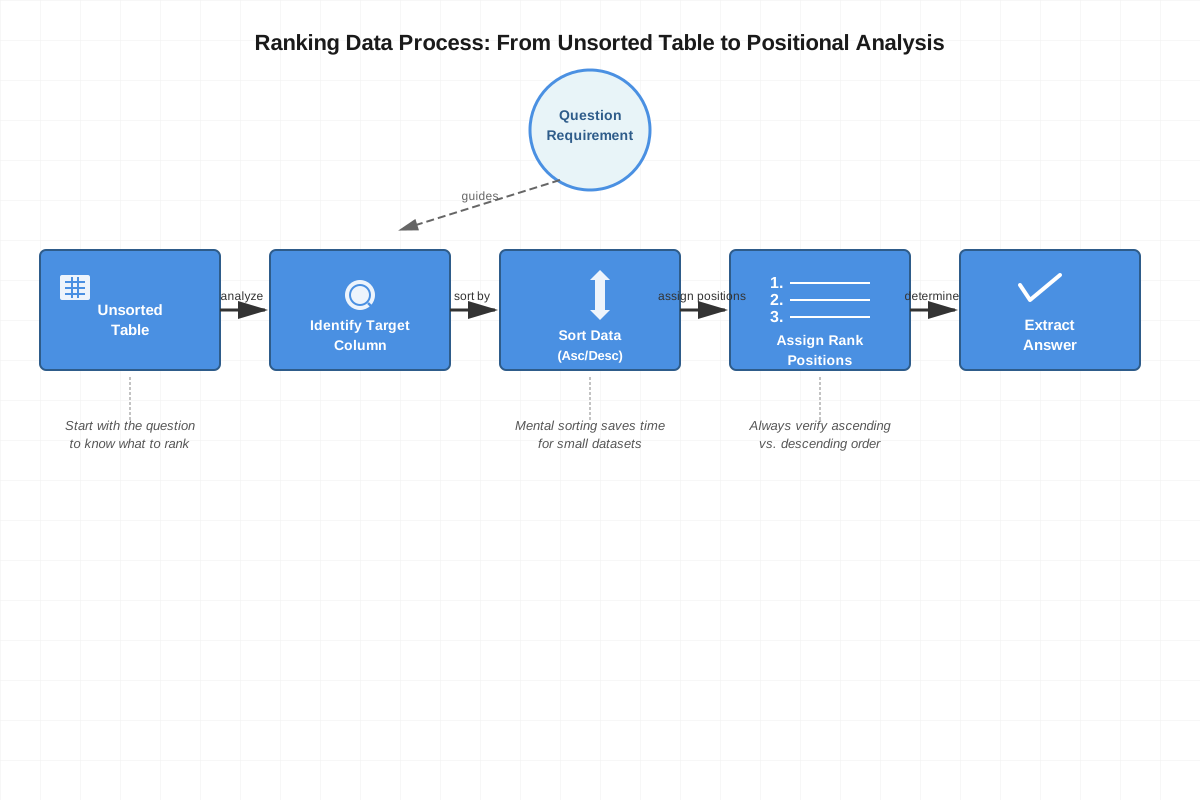
Ranking data serves as a bridge between raw data presentation and statistical analysis. The relationship flow operates as follows:
Raw Tabular Data → Ranking Process → Ordered Dataset → Statistical Measures (median, quartiles) → Comparative Analysis → Answer Determination
Within the topic itself, single-variable ranking forms the foundation for multi-variable ranking, which in turn enables comparative analysis across dimensions. Conditional ranking builds upon single-variable ranking by adding a filtering step before the ordering process.
Ranking connects to prerequisite knowledge of basic statistics because the median, by definition, requires ranked data. It also relates to percentile calculations, which are meaningless without an established order. Furthermore, ranking supports pattern recognition—once data is ordered, trends, outliers, and distributional characteristics become immediately visible.
The topic connects forward to more advanced Data Insights skills such as multi-sort table analysis (where tables can be dynamically sorted by different columns) and integrated reasoning tasks that combine ranking with graphical interpretation or two-part analysis questions.
Quick check — test yourself on Ranking data so far.
Try Flashcards →High-Yield Facts
⭐ The median of a ranked dataset with n items is located at position (n+1)/2 for odd n, and is the average of positions n/2 and (n/2)+1 for even n
⭐ GMAT Table Analysis questions often require ranking data that is not pre-sorted in the table presentation
⭐ Partial ranking (identifying only the top 3 or bottom 2 values) is faster than complete ranking when questions don't require full ordering
⭐ When ranking calculated values, accuracy in computation is critical—one calculation error can misrank multiple items
⭐ Tied values occupy the same rank; the next distinct value's rank depends on how many items share the previous rank
- Ranking in descending order means highest values receive lower rank numbers (1st, 2nd, 3rd)
- Questions asking "how many values exceed the median" require counting items above the middle position in the ranked list
- Multi-variable ranking questions test whether students recognize that high rank in one variable doesn't predict rank in another variable
- Conditional ranking requires filtering data before ranking, which can significantly reduce the number of items to order
- The interquartile range (Q3 - Q1) requires ranking to identify the 25th and 75th percentile values
Common Misconceptions
Misconception: The median is always one of the values in the dataset → Correction: For datasets with an even number of values, the median is the average of the two middle values and may not appear in the original data. For example, in the ranked set {2, 5, 8, 11}, the median is 6.5.
Misconception: Ranking must always be done from highest to lowest → Correction: Ranking can be ascending (lowest to highest) or descending (highest to lowest) depending on the question's requirements. "Lowest cost" questions require ascending order, while "highest revenue" questions require descending order.
Misconception: If a company ranks 3rd in revenue and 5th in profit, it must rank 4th in something else → Correction: Rankings across different variables are independent. There's no mathematical relationship between a company's rank in one metric and its rank in another unless the metrics are directly correlated.
Misconception: The value at position 5 in a 10-item list is always the median → Correction: In a 10-item ranked list, the median is the average of the 5th and 6th values, not simply the 5th value. Only in odd-numbered datasets does a single position represent the median.
Misconception: Ranking negative numbers follows different rules than ranking positive numbers → Correction: Ranking follows the same comparison logic regardless of sign. When ranking in descending order, -2 ranks higher than -5 because -2 is greater than -5. Students often reverse this relationship incorrectly.
Misconception: All items in a ranked list must have different ranks → Correction: Multiple items can share the same rank when they have identical values. Three companies with $50M revenue all rank equally, and the ranking system must account for this tie.
Worked Examples
Example 1: Single-Variable Ranking with Median Determination
Question: The table below shows quarterly sales (in thousands) for seven regional offices. What is the median quarterly sales figure?
| Office | Q1 Sales |
|---|---|
| North | 145 |
| South | 167 |
| East | 134 |
| West | 189 |
| Central | 156 |
| Metro | 145 |
| Coastal | 178 |
Solution:
Step 1: Identify that we need to rank the Q1 Sales column to find the median.
Step 2: Rank the seven values in ascending order:
- 134 (East) - Position 1
- 145 (North) - Position 2
- 145 (Metro) - Position 2 (tied)
- 156 (Central) - Position 4
- 167 (South) - Position 5
- 178 (Coastal) - Position 6
- 189 (West) - Position 7
Step 3: For 7 values (odd number), the median is at position (7+1)/2 = 4th position.
Step 4: The 4th value in the ranked list is 156.
Answer: The median quarterly sales figure is 156 thousand.
Key Learning Points: This example demonstrates single-variable ranking and median calculation. Notice that tied values (145 appears twice) don't affect the median position calculation. The question required complete mental ranking of all seven values.
Example 2: Multi-Variable Ranking with Comparative Analysis
Question: The table shows five companies' performance metrics. True or False: Company C ranks higher in Profit Margin than in Revenue Growth.
| Company | Revenue Growth (%) | Profit Margin (%) |
|---|---|---|
| A | 12.5 | 8.3 |
| B | 8.7 | 11.2 |
| C | 15.3 | 9.8 |
| D | 10.2 | 12.5 |
| E | 9.1 | 7.6 |
Solution:
Step 1: Rank companies by Revenue Growth (descending):
- C (15.3%)
- A (12.5%)
- D (10.2%)
- E (9.1%)
- B (8.7%)
Company C ranks 1st in Revenue Growth.
Step 2: Rank companies by Profit Margin (descending):
- D (12.5%)
- B (11.2%)
- C (9.8%)
- A (8.3%)
- E (7.6%)
Company C ranks 3rd in Profit Margin.
Step 3: Compare rankings: C ranks 1st in Revenue Growth but 3rd in Profit Margin.
Answer: False. Company C ranks lower (3rd) in Profit Margin than in Revenue Growth (1st).
Key Learning Points: This example illustrates multi-variable ranking where the same entities must be ranked across different metrics. The question tests understanding that high performance in one area doesn't guarantee high performance in another. Students must maintain separate mental rankings for each variable.
Exam Strategy
Approaching Ranking Questions
When encountering a Table Analysis question that requires ranking:
- Identify the ranking requirement: Look for trigger words like "highest," "lowest," "median," "top three," or "exceeds"
- Determine if full or partial ranking is needed: Don't waste time ranking all 15 items if the question only asks for the top 3
- Choose your ranking method: Mental ranking for small datasets (≤7 items), systematic grouping for larger sets
- Track your work: Use scratch paper to note positions if mental ranking becomes difficult
Trigger Words and Phrases
Watch for these question stems that signal ranking requirements:
- "Which [item] had the highest/lowest [metric]?"
- "How many [items] exceeded the median?"
- "What is the median value of [metric]?"
- "Which [item] ranked third in [metric]?"
- "How many [items] were above/below [threshold]?"
- "Did [item] rank higher in [metric A] than in [metric B]?"
Process of Elimination Tips
For True/False statements about rankings:
- Eliminate statements that require complete ranking when partial ranking reveals the answer: If asked whether Item X is in the top 3, and you can identify 3 items clearly higher than X, mark False without ranking everything
- Check extreme values first: Questions about highest/lowest can often be answered by identifying obvious extremes
- Use approximation for calculated rankings: If ranking profit margins calculated from revenue and profit, rough estimates may be sufficient to determine relative order
Time Allocation
- Simple single-variable ranking (5-7 items): 30-45 seconds
- Complex single-variable ranking (10-15 items): 60-90 seconds
- Multi-variable ranking: 90-120 seconds
- Ranking with calculations: 120-180 seconds
Exam Tip: If a ranking question is taking more than 2 minutes, you may be over-ranking. Reassess whether the question requires complete ordering or just identification of specific positions.
Memory Techniques
Median Position Mnemonic
"ODD-ADD, EVEN-BETWEEN"
- ODD-ADD: For odd n, add 1 to n, then divide by 2 to find median position
- EVEN-BETWEEN: For even n, the median is between (and averages) the two middle positions
Ranking Direction Reminder
"HIGH-LOW-1-GO" (Descending order)
- HIGH values get LOW rank numbers (1, 2, 3...)
- Rank 1 is the GO-to for "highest" questions
"LOW-HIGH-1-SHY" (Ascending order)
- LOW values get HIGH rank numbers... wait, that's wrong!
- Actually: LOW values get rank 1 when you're SHY about big numbers
Quartile Visualization
Imagine a ranked dataset as a horizontal line divided into four equal sections:
[Q1 - 25%][Q2 - 50%][Q3 - 75%][Q4 - 100%]- Q1 marks the end of the first quarter (25th percentile)
- Q2 is the median (50th percentile)
- Q3 marks the end of the third quarter (75th percentile)
Partial Ranking Strategy: "TOP-STOP"
When looking for the "3rd highest" value:
- TOP: Identify the top values only
- STOP: Stop ranking once you've found the required position
Summary
Ranking data is a critical skill for GMAT Data Insights Table Analysis questions, requiring test-takers to mentally or systematically order tabular information to identify positional values, compare relative standings, and determine statistical measures like medians and quartiles. The core process involves comparing values within a variable to establish ascending or descending order, then using that order to answer questions about specific positions, thresholds, or comparative rankings across multiple variables. Efficient ranking strategies include partial ranking when full ordering isn't necessary, mental ranking for small datasets, and systematic grouping for larger tables. Success requires recognizing when ranking is needed, choosing the appropriate method, and executing accurately under time pressure. The topic connects directly to statistical concepts and forms the foundation for more complex data analysis tasks throughout the Data Insights section.
Key Takeaways
- Ranking data means ordering values from highest to lowest (descending) or lowest to highest (ascending) to reveal positional relationships
- The median requires ranking and is located at position (n+1)/2 for odd n, or averaged between positions n/2 and (n/2)+1 for even n
- Partial ranking (identifying only top 3 or bottom 2 values) saves time when complete ordering isn't required
- Multi-variable ranking questions test whether students recognize that rankings are independent across different metrics
- Trigger words like "highest," "median," "exceeded," and "ranked" signal that ranking operations are necessary
- Tied values occupy the same rank, affecting the rank numbers of subsequent items
- Efficient ranking strategies vary by dataset size: mental ranking for ≤7 items, systematic grouping for larger sets
Related Topics
Percentile Calculations: Building on ranking skills, percentile analysis requires determining what percentage of values fall above or below specific thresholds in ranked datasets. Mastering ranking enables quick percentile identification.
Multi-Sort Table Analysis: Advanced Table Analysis questions allow dynamic sorting by different columns. Understanding ranking principles makes these interactive sorting features intuitive and enables rapid data exploration.
Statistical Measures (Quartiles, IQR): The interquartile range and quartile calculations depend entirely on ranked data. Proficiency in ranking directly enables these more advanced statistical analyses.
Data Sufficiency with Statistics: Some Data Sufficiency questions ask whether provided information is sufficient to determine rankings or medians. Ranking knowledge helps evaluate what information is necessary.
Practice CTA
Now that you've mastered the concepts of ranking data, it's time to solidify your understanding through practice. Attempt the practice questions associated with this topic to apply these strategies under exam-like conditions. Focus on identifying when partial ranking is sufficient, practicing mental ranking for speed, and accurately handling multi-variable comparisons. The flashcards will help reinforce the high-yield facts and formulas you'll need for quick recall on test day. Remember: ranking skills improve dramatically with deliberate practice—each question you work through builds the pattern recognition and speed essential for GMAT success!
Sign up free to keep reading
Create a free AnvayaPrep account to finish this GMAT guide on Ranking data — plus flashcards and practice questions.