Overview
Table reasoning is a critical analytical skill tested extensively in the GMAT Data Insights section, requiring test-takers to extract, interpret, and manipulate information presented in tabular format. This competency goes beyond simple data reading; it demands the ability to sort information mentally or visually, identify patterns across rows and columns, compare values, and draw logical conclusions based on multiple data points simultaneously. On the GMAT, GMAT table reasoning questions present candidates with complex tables containing numerical data, percentages, ratios, or categorical information, followed by a series of statements that must be evaluated as true, false, or cannot be determined based on the available data.
The importance of table reasoning within the Data Insights section cannot be overstated. These questions assess a candidate's ability to work efficiently with structured data—a skill fundamental to business school coursework and professional business environments. Table Analysis questions typically present 8-12 rows of data across 4-6 columns, with sortable functionality that mirrors real-world spreadsheet applications. Test-takers must quickly identify relevant information, perform calculations, recognize relationships between variables, and make accurate determinations under time pressure.
Table reasoning serves as a foundational skill that integrates with other Data Insights question types, including Multi-Source Reasoning and Graphics Interpretation. The analytical processes developed through mastering table reasoning—systematic data scanning, mental organization, comparative analysis, and logical deduction—transfer directly to these related question formats. Furthermore, the quantitative and logical reasoning skills honed through table analysis strengthen performance across the entire GMAT, including Quantitative Reasoning and even Critical Reasoning questions that present data-driven arguments.
Learning Objectives
- [ ] Identify Table reasoning questions and their characteristic features on the GMAT
- [ ] Explain Table reasoning principles and the cognitive processes involved in analyzing tabular data
- [ ] Apply Table reasoning to GMAT questions efficiently and accurately
- [ ] Systematically evaluate multiple statements against complex data tables within time constraints
- [ ] Utilize sorting functionality strategically to reveal patterns and relationships in data
- [ ] Distinguish between statements that can be definitively proven versus those requiring assumptions beyond the given data
Prerequisites
- Basic arithmetic operations: Essential for performing calculations with table values, including addition, subtraction, multiplication, division, and percentage calculations
- Understanding of percentages, ratios, and proportions: Required to interpret comparative data and make relative assessments across table entries
- Logical reasoning fundamentals: Necessary to evaluate the truth value of statements and recognize when insufficient information exists
- Reading comprehension skills: Critical for understanding column headers, row labels, and the context provided in table descriptions
- Basic statistical concepts: Helpful for understanding measures like averages, medians, and ranges that may need to be calculated from table data
Why This Topic Matters
Table reasoning represents one of the most practical skills tested on the GMAT, directly mirroring the data analysis tasks business professionals encounter daily. In corporate environments, executives regularly review sales reports, financial statements, market research data, and operational metrics—all presented in tabular formats. The ability to quickly extract insights, identify trends, compare performance across categories, and make data-driven decisions is fundamental to business success. Business schools value this competency because case studies, financial modeling, and quantitative coursework all require sophisticated table analysis skills.
From an exam perspective, Table Analysis questions constitute approximately 20-25% of the Data Insights section, making them high-frequency question types. Each Table Analysis question typically presents three statements that must be evaluated, effectively creating three mini-questions within a single prompt. This format means that mastering table reasoning significantly impacts overall Data Insights performance. The GMAT presents these questions in an interactive format where columns can be sorted in ascending or descending order, adding a strategic dimension to the problem-solving process.
Common manifestations of table reasoning on the GMAT include: comparative analysis questions requiring identification of maximum or minimum values across categories; percentage change calculations between time periods; ranking tasks based on multiple criteria; questions testing understanding of relationships between variables; and statements requiring synthesis of information from multiple rows or columns. The tables may present financial data (revenues, costs, profits), demographic information (population statistics, survey results), operational metrics (production volumes, efficiency rates), or market data (prices, market shares, growth rates).
Core Concepts
Understanding Table Structure and Components
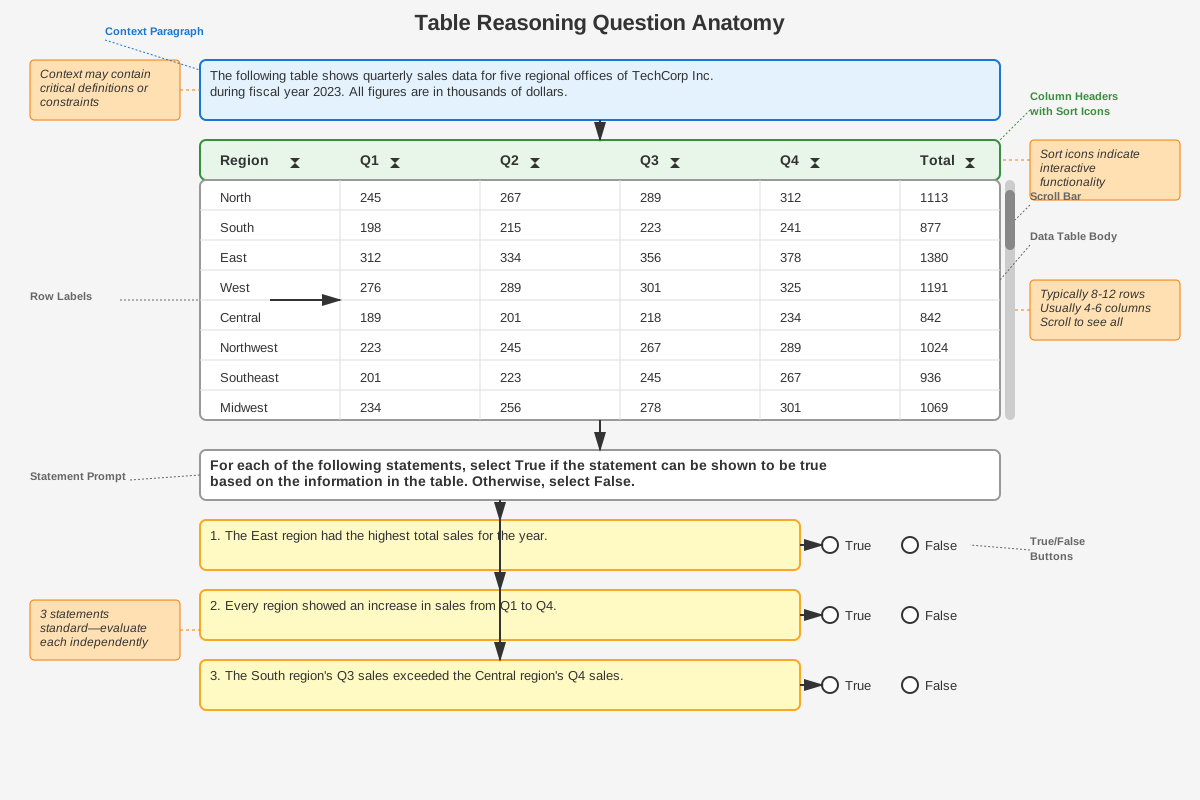
A GMAT table consists of several key structural elements that must be understood before analysis can begin. The table title provides context about what data is being presented and often includes critical information about units, time periods, or geographic scope. Column headers identify the variables or categories represented in each vertical section, while row labels identify the entities, time periods, or categories for each horizontal entry. The data cells contain the actual values—numerical, categorical, or mixed—that form the basis for analysis.
The interactive nature of GMAT tables allows sorting by any column in either ascending or descending order. This functionality is not merely a convenience; it is a strategic tool that can dramatically reduce problem-solving time. Sorting reveals patterns such as highest and lowest values, clusters of similar data, or sequential relationships that might be obscured in the default presentation order. Understanding when and how to sort is a critical component of efficient table reasoning.
Systematic Data Extraction Process
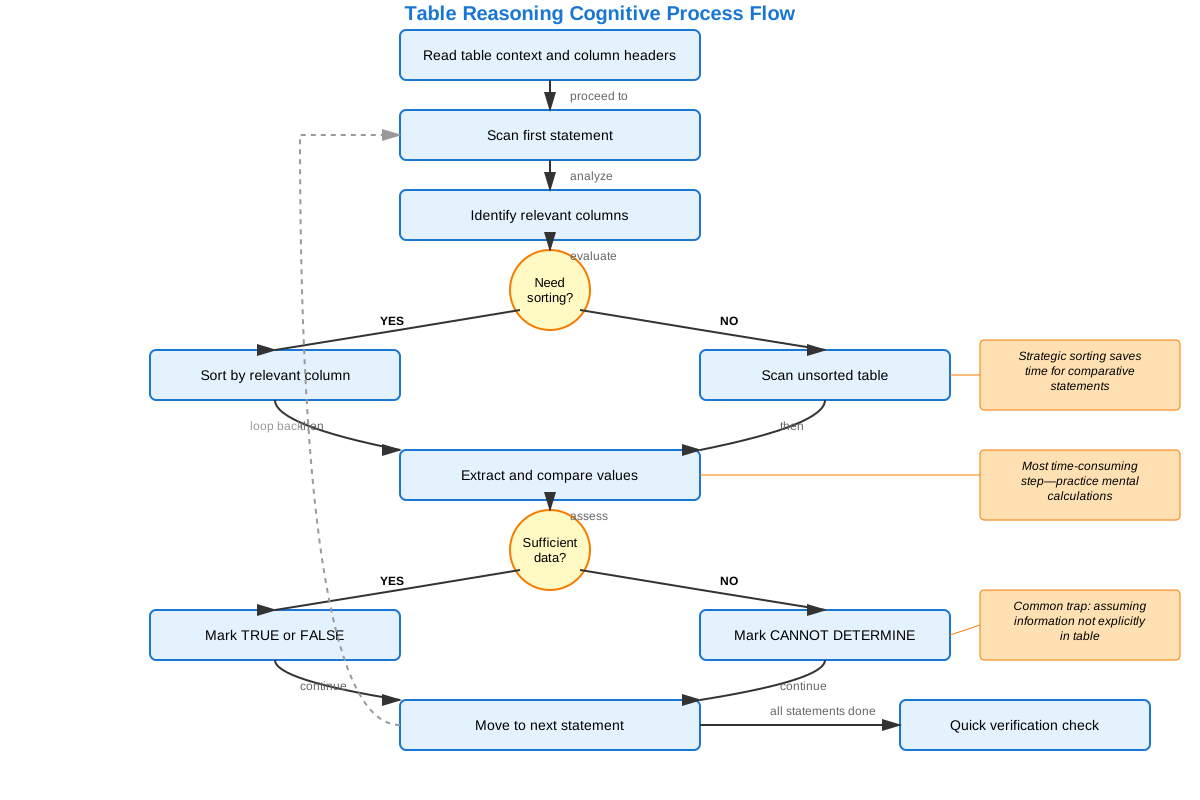
Effective table reasoning follows a systematic approach rather than random data scanning. The process begins with orientation: reading the table title, understanding what each column represents, noting units of measurement, and identifying the scope of the data. Next comes statement analysis: carefully reading each statement to identify exactly what information is required and what type of comparison or calculation is needed. The third step is strategic sorting: determining whether sorting by a particular column would make the required information more accessible. Fourth is data location: identifying the specific cells relevant to the statement. Finally comes verification: performing necessary calculations and confirming that the statement is definitively true, false, or cannot be determined.
This systematic approach prevents common errors such as misreading column headers, using data from incorrect rows, or making assumptions beyond what the table explicitly shows. The discipline of following a consistent process becomes especially valuable under exam time pressure when the temptation to rush increases.
Types of Table Reasoning Tasks
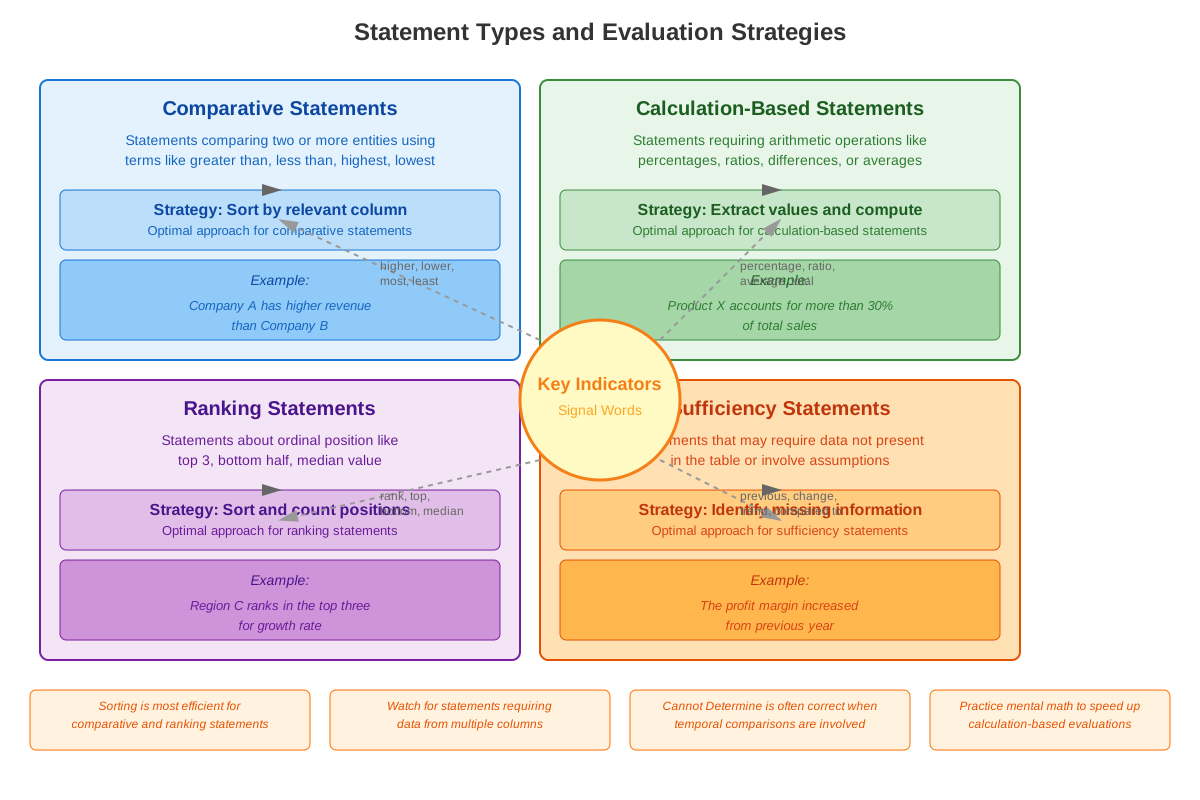
GMAT table reasoning questions can be categorized into several distinct task types, each requiring specific analytical approaches:
Direct lookup tasks require finding a specific value in the table and comparing it to a threshold or another value. These are the most straightforward questions but still require careful attention to ensure the correct row and column intersection is identified.
Calculation-based tasks require performing arithmetic operations on table values. Common calculations include finding sums, differences, products, quotients, percentage changes, averages, or ratios. These questions test both data extraction and computational accuracy.
Ranking and comparison tasks require identifying which entity has the highest or lowest value for a particular variable, or comparing multiple entities across one or more dimensions. Strategic sorting is particularly valuable for these questions.
Relationship identification tasks require recognizing patterns, correlations, or relationships between variables. For example, determining whether entities with higher values in one column consistently have higher or lower values in another column.
Synthesis tasks require combining information from multiple rows or columns to reach a conclusion. These are often the most complex questions, requiring multiple steps of analysis and calculation.
Evaluating Statement Truth Values
A distinctive feature of GMAT Table Analysis questions is the three-option response format for each statement: True, False, or Cannot be determined (though the actual interface uses Yes/No for whether the statement can be inferred). Understanding when each response is appropriate is crucial:
A statement is True (or can be inferred) only when the table data definitively supports it. All necessary information must be present, and any required calculations must lead unambiguously to the stated conclusion.
A statement is False (or cannot be inferred) when the table data directly contradicts it OR when insufficient information exists to verify it. This is a critical distinction: on the GMAT, statements that cannot be verified due to missing information are treated the same as false statements in terms of inference.
The key principle is that no assumptions beyond the given data are permitted. If a statement requires information about entities not in the table, time periods not covered, or variables not measured, it cannot be confirmed as true regardless of how plausible it might seem.
Strategic Sorting Techniques
The sorting functionality in GMAT table questions is a powerful tool that must be used strategically. Sorting by different columns reveals different patterns and relationships in the data:
Sorting by the dependent variable (the column mentioned in the statement) immediately reveals maximum and minimum values, making comparison tasks straightforward. For example, if a statement asks about the company with the highest revenue, sorting the revenue column in descending order places the answer in the first row.
Sorting by categorical variables can group similar entities together, making it easier to compare subsets of the data or identify patterns within categories.
Multiple sorts may be necessary for complex statements. After evaluating one statement, re-sorting by a different column may be optimal for the next statement. Efficient test-takers develop a sense for when re-sorting saves time versus when it's faster to scan the current arrangement.
However, sorting also has costs: it takes time, and it changes the visual arrangement that may have been mentally mapped. The decision to sort should be deliberate, based on whether it genuinely simplifies the required analysis.
Handling Missing or Incomplete Data
GMAT tables sometimes include cells with missing data, indicated by dashes, "N/A," or blank spaces. These gaps are intentional and test the ability to recognize when conclusions cannot be drawn. When a statement requires information from a cell with missing data, the statement cannot be confirmed as true, regardless of what other data suggests. This tests the discipline to avoid making assumptions or extrapolations beyond the explicit data provided.
Concept Relationships
The concepts within table reasoning form an interconnected analytical framework. Understanding table structure serves as the foundation, enabling all subsequent analysis. This structural knowledge directly supports the systematic data extraction process, which provides the procedural framework for approaching any table question. The extraction process, in turn, must be adapted based on the type of reasoning task presented—whether direct lookup, calculation, ranking, relationship identification, or synthesis.
Strategic sorting techniques enhance the efficiency of the extraction process, particularly for ranking and comparison tasks, creating a bidirectional relationship where task type informs sorting strategy, and sorting capability influences how tasks are approached. Both the extraction process and sorting techniques feed into evaluating statement truth values, which represents the ultimate goal of table reasoning: making accurate determinations about what can and cannot be concluded from the data.
Handling missing or incomplete data intersects with all other concepts, serving as a constraint that must be considered during extraction, calculation, and evaluation. It particularly impacts truth value evaluation, as missing data often determines that statements cannot be confirmed.
The relationship map flows as follows:
Table Structure Understanding → Systematic Data Extraction → Task Type Identification → Strategic Sorting Application → Statement Truth Evaluation, with Missing Data Handling as a parallel consideration throughout the entire process.
These table reasoning concepts also connect to broader Data Insights skills. The systematic approach developed here transfers to Multi-Source Reasoning questions, where information must be extracted from multiple sources. The calculation skills apply to Graphics Interpretation questions. The logical evaluation of statements connects to Two-Part Analysis questions. Thus, table reasoning serves as a cornerstone skill that supports performance across the entire Data Insights section.
High-Yield Facts
⭐ Table Analysis questions present three statements that must each be evaluated independently; the truth value of one statement does not affect the others
⭐ Sorting a column in ascending or descending order immediately reveals maximum and minimum values, making comparison tasks significantly faster
⭐ Statements cannot be confirmed as true if they require information not present in the table, even if the conclusion seems logical or probable
⭐ Percentage change calculations require identifying both the original value and the new value, then applying the formula: (New - Original) / Original × 100%
⭐ When a statement uses absolute terms like "always," "never," "all," or "none," a single counterexample in the table is sufficient to prove it false
- Column headers and row labels must be read carefully, as similar-sounding categories or easily confused labels are common trap elements
- Units of measurement (thousands, millions, percentages vs. decimals) are critical; misreading units is a frequent source of errors
- Calculations should be performed with the actual table values, not rounded approximations, unless the question explicitly permits estimation
- When multiple calculations are required, performing them in a logical sequence can reveal shortcuts or allow elimination of unnecessary steps
- The default sort order of a table may be alphabetical, chronological, or arbitrary; never assume it's sorted by any particular column without verification
- Statements asking about "more than half" or "majority" require calculating or comparing against 50% of the relevant total
- Time-based comparisons (year-over-year changes, growth rates) require careful attention to which time periods are being compared
- Ratio and proportion questions often require finding a common basis for comparison when direct values differ in scale
- Missing data (indicated by dashes or blank cells) means calculations involving those cells cannot be completed, making related statements unverifiable
- The most efficient approach often involves reading all three statements first to determine if a single sort order will facilitate multiple evaluations
Quick check — test yourself on Table reasoning so far.
Try Flashcards →Common Misconceptions
Misconception: Sorting the table is always necessary and should be done immediately upon seeing the question.
Correction: Sorting is a strategic tool that should be used selectively. For simple direct lookup questions or when statements reference different columns, sorting may waste time. Evaluate what each statement requires before deciding whether to sort.
Misconception: If a statement seems logically reasonable based on general knowledge or trends visible in the data, it can be marked as true.
Correction: Statements can only be confirmed as true if the table data explicitly and definitively supports them. Real-world knowledge, logical inferences beyond the data, or apparent trends that aren't specifically verified must not influence the answer.
Misconception: When calculating percentages or ratios, it doesn't matter which value is used as the base or denominator.
Correction: The choice of base is critical and must match what the statement specifies. "X is 20% more than Y" is fundamentally different from "Y is 20% less than X." The statement's wording determines which value serves as the reference point (100%).
Misconception: If most of the data supports a statement but one or two exceptions exist, the statement can still be considered true.
Correction: Unless the statement explicitly uses qualifying language like "most," "generally," or "typically," it must be true for all relevant cases in the table. A single counterexample makes an absolute statement false.
Misconception: Missing data can be estimated or interpolated based on patterns in other rows or columns.
Correction: Missing data means exactly that—the information is not available. No assumptions, estimates, or interpolations are permitted. Any statement requiring missing data cannot be confirmed as true.
Misconception: Complex calculations must be performed with complete precision, including all decimal places.
Correction: While accuracy is important, GMAT table questions are designed so that the truth value of statements can typically be determined without excessive calculation. If a calculation seems prohibitively complex, look for a simpler comparison or estimation approach that still definitively answers the question.
Misconception: The three statements in a Table Analysis question are related and should be evaluated together as a set.
Correction: Each statement is independent and must be evaluated solely on its own merits. The truth value of one statement provides no information about the others. Treat each as a separate question.
Worked Examples
Example 1: Sales Performance Analysis
Table: Regional Sales Data for TechCorp (in thousands of dollars)
| Region | Q1 Sales | Q2 Sales | Q3 Sales | Q4 Sales | Annual Target |
|---|---|---|---|---|---|
| North | 450 | 520 | 490 | 580 | 2000 |
| South | 380 | 410 | 440 | 470 | 1600 |
| East | 520 | 490 | 510 | 530 | 2100 |
| West | 410 | 450 | 480 | 510 | 1800 |
| Central | 340 | 360 | 380 | 400 | 1500 |
Statement 1: The North region exceeded its annual target.
Analysis: This requires calculating the total annual sales for the North region and comparing it to the target.
- North annual sales = 450 + 520 + 490 + 580 = 2,040 thousand dollars
- Annual target = 2,000 thousand dollars
- 2,040 > 2,000, so the North region did exceed its target
- Answer: TRUE
Statement 2: The region with the highest Q1 sales also had the highest Q4 sales.
Analysis: This requires identifying two pieces of information and comparing them.
- Sorting by Q1 Sales (descending) shows East had the highest Q1 sales at 520
- Sorting by Q4 Sales (descending) shows North had the highest Q4 sales at 580
- East (highest Q1) ≠ North (highest Q4)
- Answer: FALSE
Statement 3: More than half of the regions showed consistent sales growth across all four quarters.
Analysis: This requires examining each region's quarterly progression.
- North: 450 → 520 (↑) → 490 (↓) → 580 (↑) — NOT consistent growth
- South: 380 → 410 (↑) → 440 (↑) → 470 (↑) — consistent growth ✓
- East: 520 → 490 (↓) → 510 (↑) → 530 (↑) — NOT consistent growth
- West: 410 → 450 (↑) → 480 (↑) → 510 (↑) — consistent growth ✓
- Central: 340 → 360 (↑) → 380 (↑) → 400 (↑) — consistent growth ✓
- Three out of five regions (60%) showed consistent growth
- More than half (50%) did show consistent growth
- Answer: TRUE
Key Learning Points: This example demonstrates the need for different analytical approaches for each statement—calculation for Statement 1, strategic sorting for Statement 2, and systematic row-by-row analysis for Statement 3. It also shows how "more than half" requires calculating the actual proportion.
Example 2: University Enrollment Data
Table: Student Enrollment by Major and Year
| Major | 2020 | 2021 | 2022 | Avg Class Size | Faculty Count |
|---|---|---|---|---|---|
| Business | 1,240 | 1,310 | 1,380 | 35 | 42 |
| Engineering | 980 | 1,020 | 1,090 | 28 | 38 |
| Liberal Arts | 1,450 | 1,420 | 1,390 | 32 | 51 |
| Sciences | 870 | 910 | 950 | 25 | 35 |
| Education | 620 | 580 | — | 22 | 28 |
Statement 1: The percentage increase in Engineering enrollment from 2020 to 2022 was greater than the percentage increase in Sciences enrollment over the same period.
Analysis: This requires calculating percentage change for both majors.
- Engineering: (1,090 - 980) / 980 × 100% = 110/980 × 100% = 11.22%
- Sciences: (950 - 870) / 870 × 100% = 80/870 × 100% = 9.20%
- 11.22% > 9.20%
- Answer: TRUE
Statement 2: In 2022, Liberal Arts had the lowest student-to-faculty ratio among all majors.
Analysis: This requires calculating the ratio for each major in 2022.
- Business: 1,380 / 42 = 32.86
- Engineering: 1,090 / 38 = 28.68
- Liberal Arts: 1,390 / 51 = 27.25
- Sciences: 950 / 35 = 27.14
- Education: Cannot calculate (2022 enrollment data missing)
- Among calculable majors, Sciences has the lowest ratio (27.14), not Liberal Arts (27.25)
- Even if we could calculate Education's ratio, Liberal Arts demonstrably does not have the lowest
- Answer: FALSE
Statement 3: Education was the only major that experienced declining enrollment between 2020 and 2021.
Analysis: This requires checking enrollment changes for all majors.
- Business: 1,240 → 1,310 (increase)
- Engineering: 980 → 1,020 (increase)
- Liberal Arts: 1,450 → 1,420 (decrease) ✗
- Sciences: 870 → 910 (increase)
- Education: 620 → 580 (decrease) ✗
- Both Liberal Arts and Education experienced declining enrollment
- Education was NOT the only major with declining enrollment
- Answer: FALSE
Key Learning Points: This example illustrates the importance of precise calculations for percentage changes (Statement 1), the need to calculate values for all relevant entities before making comparative claims (Statement 2), and how absolute terms like "only" require verification across all cases (Statement 3). It also demonstrates how missing data affects but doesn't prevent evaluation of statements.
Exam Strategy
When approaching GMAT Table Analysis questions, begin by investing 15-20 seconds in orientation: read the table title carefully, scan all column headers to understand what variables are present, note the units of measurement, and check for any footnotes or special notations. This upfront investment prevents errors caused by misunderstanding the data structure.
Trigger words that signal specific analytical approaches include:
- "Highest," "lowest," "maximum," "minimum" → Consider sorting by the relevant column
- "Percentage change," "percent increase/decrease" → Identify original and new values, apply percentage change formula
- "More than half," "majority," "most" → Calculate or compare against 50% threshold
- "Always," "never," "all," "none" → Look for even a single counterexample to disprove
- "Average," "mean" → Sum values and divide by count
- "Ratio," "proportion" → Set up fraction with correct numerator and denominator based on statement wording
Process-of-elimination strategies specific to table reasoning include:
- For statements with absolute language, scan quickly for obvious counterexamples before performing detailed calculations
- When statements involve missing data, immediately recognize that they likely cannot be confirmed as true
- If a statement requires complex calculations but seems designed to be false, look for a quick way to disprove it rather than calculating precisely
- When multiple statements reference the same column, sort by that column once and evaluate all relevant statements before re-sorting
Time allocation is critical for Table Analysis questions. With three statements per question and typically 2-3 Table Analysis questions in a Data Insights section, allocate approximately 2.5-3 minutes per complete question (all three statements). This breaks down to roughly 45-60 seconds per statement, including any necessary sorting or calculations. If a statement requires extensive calculation, consider whether there's a simpler comparison or estimation approach that still definitively answers the question. The GMAT rarely requires tedious arithmetic; if calculations seem prohibitively complex, you may be missing a shortcut.
Develop a consistent evaluation sequence: read all three statements first to identify if a single sort order benefits multiple statements, then evaluate in the order that minimizes re-sorting. However, don't spend excessive time optimizing this sequence—the time saved by perfect optimization is often less than the time spent planning it.
Memory Techniques
SORTED - A mnemonic for the systematic table analysis process:
- Scan the structure (title, headers, units)
- Orient to what each statement asks
- Recognize the task type (lookup, calculation, ranking, etc.)
- Tactically sort if beneficial
- Extract relevant data carefully
- Determine truth value based solely on table data
The "Three Cs" of Statement Evaluation:
- Confirm: Can the statement be definitively proven true with the given data?
- Contradict: Does the data directly contradict the statement?
- Cannot determine: Is information missing or insufficient?
Visualization strategy for percentage change: Picture a number line with the original value at the center. The change amount is the distance moved, and the original value is the "ruler" you measure against. This prevents confusion about which value serves as the base.
The "All or Nothing" rule: When statements use absolute terms (all, none, always, never), visualize a single counterexample breaking the absolute claim. This mental image helps quickly identify when such statements are false.
Acronym for common calculation errors - RUDE:
- Rounding too early (maintain precision until final answer)
- Units misread (thousands vs. millions, percentages vs. decimals)
- Denominator confusion (wrong base for percentages/ratios)
- Extraneous assumptions (going beyond given data)
Summary
Table reasoning is a fundamental GMAT Data Insights skill that requires systematic extraction, analysis, and evaluation of information presented in tabular format. Success depends on understanding table structure, following a disciplined analytical process, and accurately determining what can and cannot be concluded from the given data. The interactive sorting functionality provides a strategic tool that, when used judiciously, significantly enhances efficiency for comparison and ranking tasks. Each statement in a Table Analysis question must be evaluated independently based solely on explicit table data, without assumptions or extrapolations. Common task types include direct lookups, calculations (especially percentage changes and ratios), rankings, relationship identification, and synthesis of information across multiple rows or columns. The key to mastering table reasoning lies in developing a systematic approach that balances speed with accuracy, recognizing when to sort versus scan, performing calculations efficiently, and maintaining strict discipline about what the data does and does not support. With practice, these skills become automatic, enabling confident and rapid evaluation of even complex tables under exam time pressure.
Key Takeaways
- Table Analysis questions require evaluating three independent statements using only the explicit data provided in the table, without assumptions or external knowledge
- Strategic sorting by relevant columns immediately reveals maximum/minimum values and patterns, but should be used selectively based on statement requirements
- Percentage change calculations must use the correct base value as specified in the statement: (New - Original) / Original × 100%
- Statements with absolute terms (always, never, all, none) can be proven false with a single counterexample, while statements with qualifiers (most, generally) require broader verification
- Missing data in table cells means any statement requiring that information cannot be confirmed as true, regardless of patterns in other data
- Systematic orientation to table structure (title, headers, units, scope) prevents common errors and should be completed before analyzing statements
- Time efficiency comes from reading all statements first to optimize sorting strategy, then evaluating in an order that minimizes re-sorting and redundant calculations
Related Topics
Multi-Source Reasoning: Builds on table reasoning by requiring synthesis of information from multiple sources (tables, text, graphics), demanding the same systematic extraction skills but with added complexity of integrating diverse data formats.
Graphics Interpretation: Applies similar analytical thinking to visual data presentations (graphs, charts, plots), requiring extraction of quantitative information and relationship identification from graphical rather than tabular formats.
Two-Part Analysis: Utilizes logical evaluation skills developed through table reasoning, requiring simultaneous consideration of constraints and relationships, though typically without tabular data presentation.
Quantitative Problem Solving: The calculation skills honed through table reasoning—percentage changes, ratios, proportions—transfer directly to standalone quantitative problems, strengthening overall mathematical performance.
Data Sufficiency: The discipline of determining what can and cannot be concluded from given information, central to table reasoning, is the core skill tested in Data Sufficiency questions.
Practice CTA
Now that you've mastered the concepts and strategies of table reasoning, it's time to put your knowledge into action! Attempt the practice questions to reinforce these skills under exam-like conditions, and use the flashcards to cement high-yield facts in your memory. Remember, table reasoning is one of the highest-yield topics in Data Insights—every minute you invest in practice directly translates to points on test day. Approach each practice question systematically, applying the SORTED framework, and review not just what you got wrong, but why. Your ability to analyze tables efficiently and accurately will serve you throughout business school and your professional career. You've got this!
Sign up free to keep reading
Create a free AnvayaPrep account to finish this GMAT guide on Table reasoning — plus flashcards and practice questions.