Overview
Trend analysis is a critical analytical skill tested extensively in the GMAT Data Insights section, particularly within Table Analysis questions. This technique involves examining data patterns over time or across categories to identify consistent directions of change, rates of growth or decline, and meaningful relationships between variables. On the GMAT, trend analysis requires students to quickly interpret complex tables containing multiple rows and columns of numerical data, then make accurate determinations about how values increase, decrease, remain stable, or fluctuate across different dimensions.
The importance of GMAT trend analysis cannot be overstated—it appears in approximately 30-40% of Table Analysis questions and frequently combines with other Data Insights skills such as ratio analysis, percentage calculations, and comparative reasoning. Mastering trend analysis enables test-takers to efficiently navigate dense data presentations and answer questions about growth rates, sequential patterns, comparative performance across categories, and predictive relationships. Unlike simple data reading, trend analysis demands higher-order thinking: recognizing patterns, understanding causation versus correlation, and making inferences based on directional changes in data.
Within the broader Data Insights framework, trend analysis serves as a foundational skill that connects to virtually every other analytical competency. It builds upon basic table reading and numerical literacy while supporting more advanced tasks like multi-source reasoning and graphics interpretation. Students who excel at trend analysis can quickly eliminate incorrect answer choices, validate statements about data relationships, and identify which variables demonstrate meaningful patterns versus random fluctuations—all essential capabilities for achieving a competitive GMAT score.
Learning Objectives
- [ ] Identify trend analysis questions and data patterns in GMAT Table Analysis problems
- [ ] Explain the components and methodology of trend analysis including directional changes, rates of change, and pattern recognition
- [ ] Apply trend analysis techniques to GMAT questions involving time-series data, categorical comparisons, and multi-variable relationships
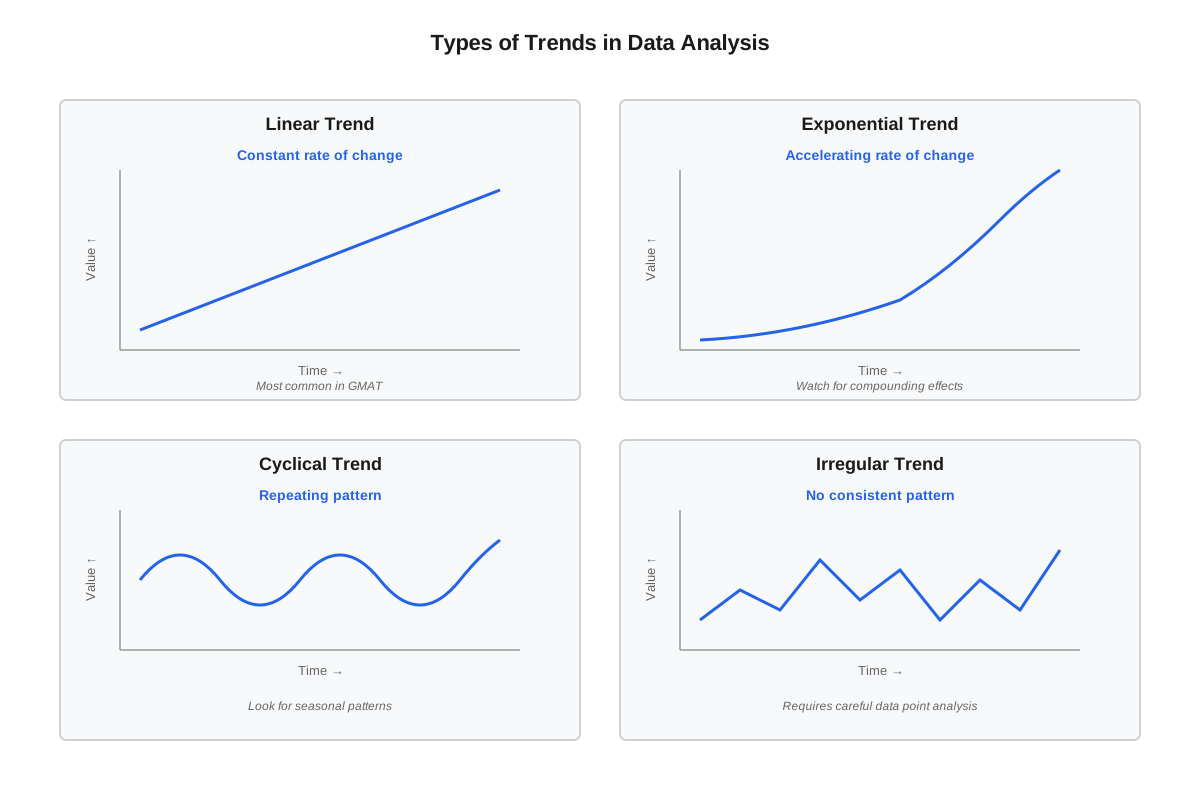
- [ ] Distinguish between different types of trends (linear, exponential, cyclical, and irregular)
- [ ] Calculate and compare rates of change across multiple data series
- [ ] Synthesize trend information from multiple columns or rows to answer complex inference questions
- [ ] Evaluate the strength and consistency of trends to determine their reliability for prediction
Prerequisites
- Basic arithmetic operations: Essential for calculating differences, percentages, and rates of change when analyzing trends
- Percentage calculations: Required to determine percentage increases/decreases and compare relative changes across data series
- Table reading comprehension: Necessary foundation for locating relevant data points and understanding table structure before analyzing trends
- Comparative reasoning: Enables evaluation of whether one trend is stronger, faster, or more consistent than another
- Basic understanding of time-series data: Helps recognize how sequential data points relate to one another chronologically
Why This Topic Matters
Trend analysis represents one of the most practical and widely applicable analytical skills tested on the GMAT. In business contexts, executives constantly examine sales trends, market share evolution, cost trajectories, and performance metrics over time to make strategic decisions. Investment analysts study stock price trends, revenue growth patterns, and industry cycles. Operations managers track production efficiency trends, defect rates, and supply chain metrics. The GMAT tests trend analysis because it directly measures a candidate's ability to extract actionable insights from complex business data—a core competency for success in graduate management programs and professional careers.
From an exam perspective, trend analysis appears in approximately 8-12 questions per GMAT administration, making it one of the highest-yield topics within Data Insights. These questions typically present sortable tables with 15-25 rows and 4-8 columns of data, asking test-takers to evaluate three statements as True, False, or Cannot Be Determined based on the data. Trend analysis questions specifically focus on statements like "Revenue increased consistently from 2018 to 2022," "Company X showed the fastest growth rate," or "The ratio of expenses to revenue declined over the period." Time pressure intensifies the challenge—students must analyze trends accurately within 2.5 minutes per question while managing the cognitive load of sorting tables and tracking multiple variables.
Common manifestations of trend analysis in GMAT passages include: year-over-year financial performance comparisons, market share evolution across competitors, demographic shifts over decades, product sales trajectories across regions, efficiency metrics tracked quarterly, and comparative growth rates between business units. Questions may ask about absolute changes (did values increase?), relative changes (which increased fastest?), consistency (did the trend hold throughout?), or inflection points (when did the direction change?). Mastering these question types significantly improves overall Data Insights performance and builds confidence for tackling the section's most challenging problems.
Core Concepts
Understanding Trend Analysis Fundamentals
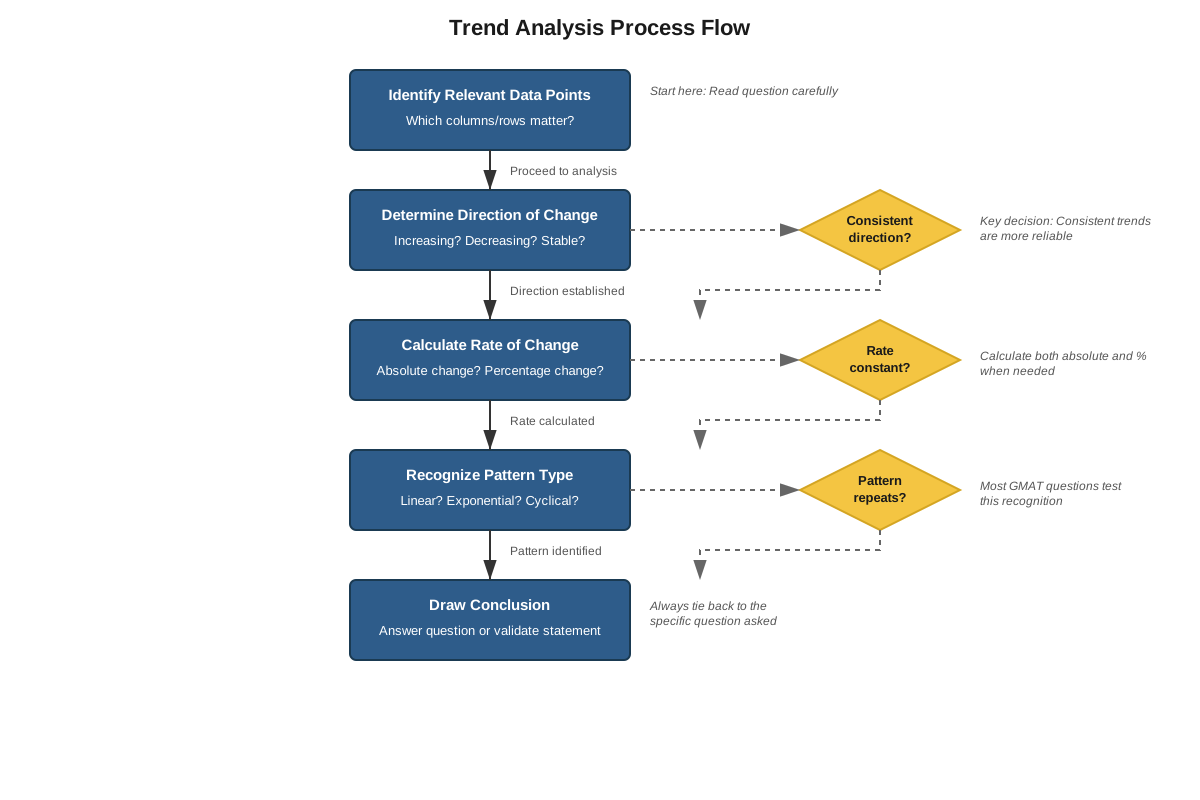
Trend analysis is the systematic examination of data points collected over time or across categories to identify patterns, directions, and rates of change. At its core, trend analysis answers three fundamental questions: (1) What direction is the data moving? (2) How fast is it changing? (3) How consistent is the pattern? On the GMAT, this analytical process must be executed rapidly and accurately, often requiring students to sort tables by different columns to reveal hidden patterns.
The foundation of trend analysis rests on recognizing directional change—whether values are increasing, decreasing, or remaining stable. However, GMAT questions rarely ask simple directional questions. Instead, they test nuanced understanding: Did the increase occur consistently across all time periods? Did one category increase faster than another? Did the trend reverse at any point? These subtleties distinguish correct answers from attractive distractors.
Types of Trends
Understanding different trend patterns enables faster pattern recognition and more accurate analysis:
| Trend Type | Characteristics | GMAT Example |
|---|---|---|
| Linear | Consistent absolute change per period | Revenue increases by $5M each year |
| Exponential | Consistent percentage change per period | Market share grows by 10% annually |
| Cyclical | Regular patterns of increase and decrease | Seasonal sales fluctuations |
| Irregular | Inconsistent changes without clear pattern | Volatile stock prices with no trend |
| Stepped | Periods of stability followed by sudden changes | Prices stable then jump after policy change |
The GMAT most frequently tests linear and exponential trends, as these require careful calculation to distinguish. A company growing revenue from $100M to $110M to $120M shows a linear trend (+$10M per year), while growth from $100M to $110M to $121M shows an exponential trend (+10% per year). Recognizing which type of trend exists determines the correct analytical approach.
Calculating Rate of Change
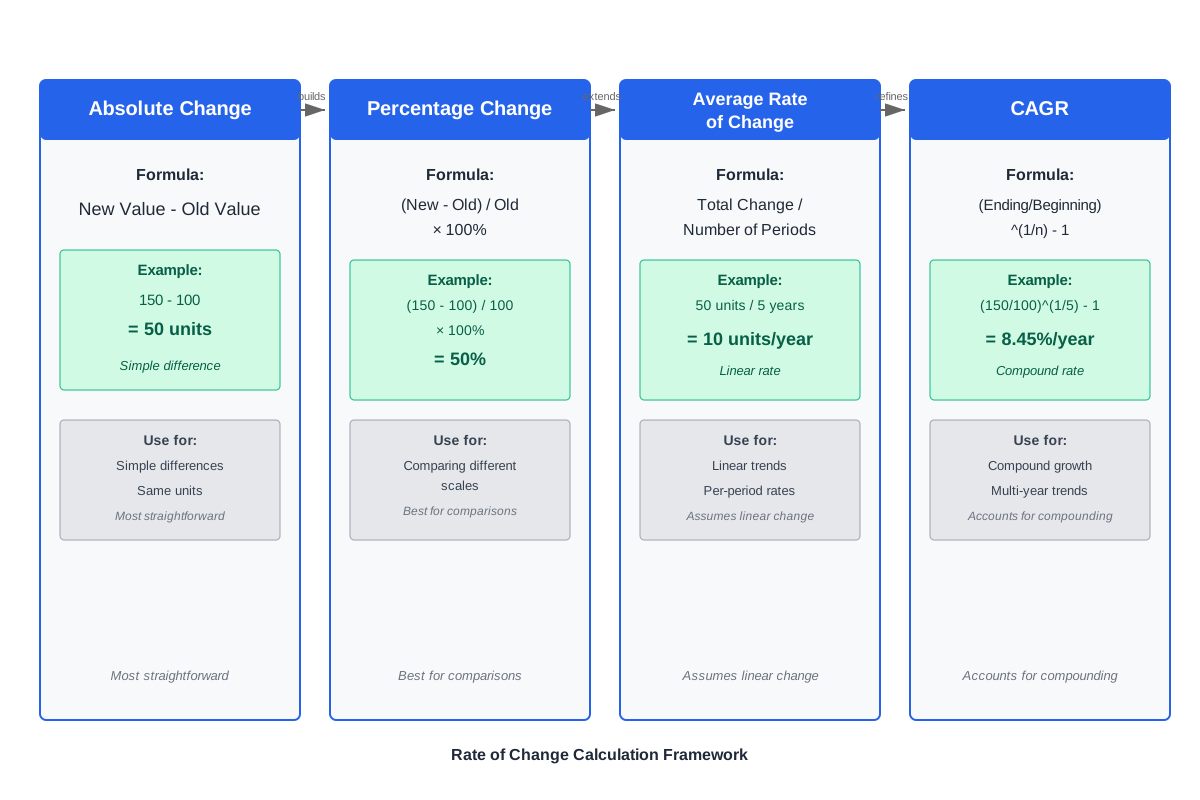
Rate of change quantifies how quickly a trend progresses and enables comparison between different data series. The GMAT tests two primary rate calculations:
Absolute Rate of Change: The arithmetic difference between consecutive data points
Absolute Rate = (Value at Time 2) - (Value at Time 1)Relative Rate of Change: The percentage change between consecutive data points
Relative Rate = [(Value at Time 2 - Value at Time 1) / Value at Time 1] × 100%Consider this scenario: Company A's revenue grows from $50M to $60M (absolute change: +$10M, relative change: +20%), while Company B's revenue grows from $200M to $210M (absolute change: +$10M, relative change: +5%). A GMAT question might ask "Which company experienced faster revenue growth?" The answer depends on whether "faster" refers to absolute or relative terms—a common source of confusion that trend analysis mastery resolves.
Identifying Consistent Trends
Consistency represents a critical dimension of trend analysis frequently tested on the GMAT. A trend is consistent when the direction of change remains the same across all measured periods. For example, if sales figures are 100, 120, 135, 150, 180, the trend is consistently upward. However, if figures are 100, 120, 115, 150, 140, the trend is inconsistent—it increases, decreases, increases, then decreases again.
GMAT questions often include statements like "Metric X increased consistently from 2018 to 2023." To evaluate such statements, students must:
- Sort the table chronologically if not already ordered
- Compare each consecutive pair of values
- Verify that every comparison shows the same directional change
- Confirm no reversals or flat periods exist (unless the statement allows for them)
A single reversal makes a "consistent increase" statement false, even if the overall trend from first to last value is upward. This distinction separates high-scoring test-takers from those who make hasty judgments.
Comparative Trend Analysis
Many GMAT questions require comparing trends across multiple categories, companies, regions, or products. This comparative trend analysis demands tracking multiple data series simultaneously and determining which exhibits the strongest, fastest, or most consistent pattern.
Key comparison dimensions include:
- Magnitude: Which trend shows the largest absolute change?
- Speed: Which trend shows the highest rate of change?
- Consistency: Which trend maintains its direction most reliably?
- Duration: Which trend persists longest before reversing?
- Volatility: Which trend shows the least fluctuation?
Effective comparative analysis often requires calculating rates of change for each series, then ranking them. The GMAT may present data where one series has the largest absolute change but another has the highest percentage change, testing whether students understand the question's specific requirement.
Inflection Points and Trend Reversals
An inflection point marks where a trend changes direction—from increasing to decreasing, or vice versa. Identifying these points is crucial for answering questions about when changes occurred or whether trends held throughout a period.
For example, if quarterly profits are $10M, $12M, $15M, $13M, $11M, an inflection point occurs after Q3 when the upward trend reverses to downward. GMAT questions might ask: "In which quarter did profitability begin to decline?" or "Did profitability increase throughout the year?" (False, because of the reversal).
Recognizing inflection points requires systematic comparison of consecutive values and noting where the direction of change shifts. Missing a single inflection point can lead to incorrect answers on otherwise straightforward questions.
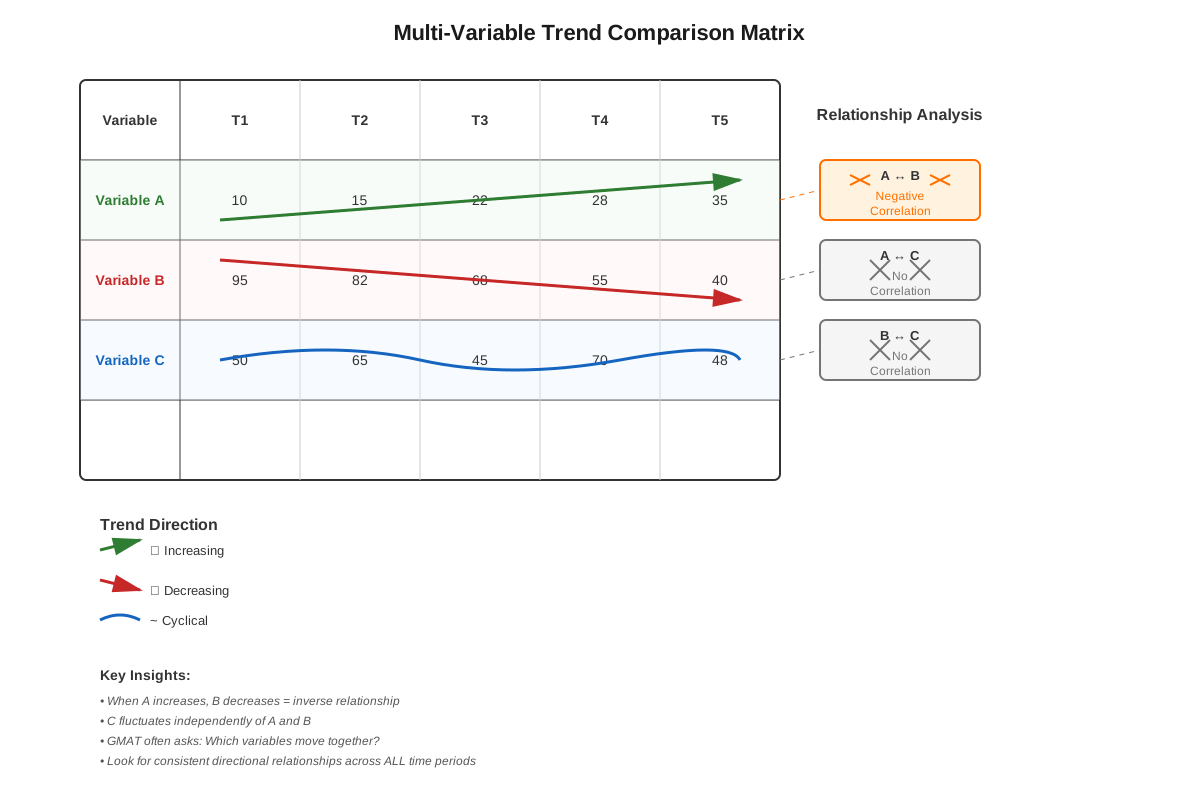
Multi-Variable Trend Analysis
Advanced GMAT questions combine trend analysis across multiple related variables, testing whether students can synthesize information from different columns. For instance, a table might show both revenue and expenses over time, and questions might ask about the trend in profit margin (which requires calculating profit from revenue minus expenses, then determining margin trends).
This multi-variable approach requires:
- Identifying which columns contain relevant data
- Performing necessary calculations (ratios, differences, percentages)
- Analyzing the trend in the calculated values
- Drawing conclusions about relationships between variables
Questions might ask: "Did the ratio of marketing expenses to total revenue increase consistently?" This requires calculating the ratio for each time period, then analyzing whether those ratios show a consistent upward trend—a two-step process that combines calculation with trend identification.
Concept Relationships
Trend analysis serves as a central hub connecting multiple Data Insights competencies. At the foundational level, table reading skills enable locating relevant data points, which then feed into trend analysis to identify patterns. This pattern recognition supports comparative reasoning, allowing students to determine which trends are stronger or more significant.
The relationship flows as follows: Basic Data Reading → Trend Identification → Rate Calculation → Comparative Analysis → Inference and Prediction. Each step builds upon the previous, creating a hierarchical skill structure where mastery of earlier components enables success with more complex tasks.
Trend analysis also connects laterally to other Data Insights topics. Ratio analysis often combines with trend analysis when questions ask about trends in ratios (e.g., "Did the debt-to-equity ratio decline consistently?"). Percentage calculations support trend analysis by enabling relative rate comparisons. Statistical reasoning extends trend analysis by adding concepts like average rates of change and trend strength measures.
Within trend analysis itself, concepts interconnect tightly. Understanding directional change is prerequisite to calculating rates of change, which in turn enables comparative trend analysis. Recognizing consistency depends on identifying inflection points, and both inform judgments about trend reliability. This internal web of relationships means that weakness in one area (e.g., rate calculations) undermines performance across all trend analysis questions.
Quick check — test yourself on Trend analysis so far.
Try Flashcards →High-Yield Facts
⭐ A trend is only "consistent" if the direction of change is the same between every consecutive pair of data points—a single reversal makes it inconsistent
⭐ Absolute change and relative (percentage) change can lead to opposite conclusions about which trend is "faster" or "larger"
⭐ When comparing growth rates, always verify whether the question asks for absolute or relative comparison
⭐ An overall increase from first to last value does NOT guarantee a consistent upward trend—intermediate values may decrease
⭐ Sorting the table by different columns often reveals trends that are invisible in the default view
- Linear trends show constant absolute change per period, while exponential trends show constant percentage change per period
- Inflection points mark where trends reverse direction and are critical for determining whether a trend held "throughout" a period
- Multi-year or multi-period trends require comparing each consecutive pair, not just first and last values
- The steepness of a trend refers to its rate of change—steeper means faster change
- Cyclical patterns may appear as inconsistent trends unless the question specifically asks about cyclical behavior
- When a question asks if a trend "accelerated," it's asking whether the rate of change itself increased over time
- Zero change (flat trend) is neither increasing nor decreasing—statements about "always increasing" are false if any period shows zero change
- Negative values can still show upward trends if they become less negative (e.g., -10 to -5 is an increase)
- Percentage changes are not symmetric: a 50% decrease requires a 100% increase to return to the original value
- The longest consistent trend in a dataset may not be the overall trend from start to finish
Common Misconceptions
Misconception: If the first value is lower than the last value, the trend increased consistently throughout the period.
Correction: A consistent increase requires that every single consecutive comparison shows an increase. The overall direction can be upward while intermediate values fluctuate, creating an inconsistent trend. Always check each consecutive pair individually.
Misconception: The series with the largest absolute change always has the fastest growth rate.
Correction: Growth rate typically refers to relative (percentage) change, not absolute change. A small company growing from $10M to $20M has a 100% growth rate, while a large company growing from $1B to $1.1B has only a 10% growth rate despite the $100M absolute increase being much larger.
Misconception: Trend analysis only applies to time-series data arranged chronologically.
Correction: GMAT trend analysis also applies to categorical data arranged by any ordinal variable (size, rank, age group, etc.). For example, analyzing how customer satisfaction changes across age groups from youngest to oldest is trend analysis, even though it's not time-based.
Misconception: If most periods show an increase, the trend can be described as "generally increasing" or "mostly increasing."
Correction: GMAT questions use precise language. "Increased consistently" means every period increased. "Generally increased" is not GMAT terminology. If even one period shows a decrease, statements about consistent increase are false—there's no partial credit for "mostly" correct trends.
Misconception: Calculating the average rate of change (total change divided by number of periods) is sufficient to describe a trend.
Correction: Average rate of change obscures important information about consistency and inflection points. A trend might have a positive average rate while actually decreasing in most periods if one large increase skews the average. GMAT questions test understanding of period-by-period changes, not just overall averages.
Misconception: When comparing two trends, the one that ends at a higher value grew faster.
Correction: Growth rate depends on the starting point and the rate of change, not the ending value. A company starting at $1B and growing to $1.1B grew more slowly (10%) than a company starting at $100M and growing to $150M (50%), even though the first company's ending value is much higher.
Worked Examples
Example 1: Identifying Consistent Trends
Question: The table below shows annual revenue (in millions) for five companies from 2019 to 2023. Evaluate the statement: "Company C's revenue increased consistently from 2019 to 2023."
| Company | 2019 | 2020 | 2021 | 2022 | 2023 |
|---|---|---|---|---|---|
| A | 45 | 48 | 52 | 55 | 60 |
| B | 120 | 125 | 123 | 128 | 135 |
| C | 78 | 82 | 89 | 95 | 103 |
| D | 200 | 210 | 215 | 215 | 220 |
| E | 95 | 88 | 92 | 98 | 105 |
Solution Process:
Step 1: Locate Company C's data: 78, 82, 89, 95, 103
Step 2: Compare each consecutive pair to determine direction of change:
- 2019 to 2020: 78 → 82 (increase of 4)
- 2020 to 2021: 82 → 89 (increase of 7)
- 2021 to 2022: 89 → 95 (increase of 6)
- 2022 to 2023: 95 → 103 (increase of 8)
Step 3: Evaluate consistency: All four consecutive comparisons show increases with no decreases or flat periods.
Step 4: Verify the overall pattern: The revenue moves from 78 to 103 with increases in every single year.
Answer: TRUE. Company C's revenue increased consistently from 2019 to 2023 because every year-over-year comparison shows an increase.
Key Learning Points: This example demonstrates the systematic approach required for consistency questions. Notice that we must check every consecutive pair—not just compare first and last values. Also observe that Company D shows an overall increase (200 to 220) but has a flat period (2021 to 2022 both at 215), so a statement about Company D's "consistent increase" would be FALSE despite the overall upward movement.
Example 2: Comparative Rate Analysis
Question: Using the same table, evaluate the statement: "Company A experienced faster revenue growth than Company E from 2019 to 2023."
Solution Process:
Step 1: Identify the ambiguity—"faster growth" could mean absolute change or relative (percentage) change. GMAT typically means relative unless specified otherwise.
Step 2: Calculate absolute change for both companies:
- Company A: 60 - 45 = 15 million
- Company E: 105 - 95 = 10 million
Step 3: Calculate relative (percentage) change for both companies:
- Company A: (60 - 45) / 45 × 100% = 15/45 × 100% = 33.3%
- Company E: (105 - 95) / 95 × 100% = 10/95 × 100% = 10.5%
Step 4: Compare the results:
- Absolute change: Company A (+15M) > Company E (+10M)
- Relative change: Company A (+33.3%) > Company E (+10.5%)
Step 5: Determine the answer: In both absolute and relative terms, Company A grew faster.
Answer: TRUE. Company A experienced faster revenue growth than Company E, showing both a larger absolute increase ($15M vs. $10M) and a higher percentage increase (33.3% vs. 10.5%).
Key Learning Points: This example illustrates the importance of calculating both absolute and relative changes when comparing growth rates. In this case, both measures agree, making the answer clear. However, be prepared for questions where absolute and relative measures conflict—in those cases, "growth rate" typically refers to percentage change unless the question specifies "absolute growth" or "dollar growth." The example also reinforces that growth rate calculations require the starting value as the denominator, not the ending value or an average.
Exam Strategy
When approaching GMAT trend analysis questions, implement this systematic process to maximize accuracy and efficiency:
Initial Assessment (15-20 seconds):
- Read all three statements before sorting the table
- Identify which columns are relevant to each statement
- Note whether statements ask about consistency, comparison, or specific time periods
- Flag statements that require calculations versus simple observation
Strategic Sorting:
- Sort by the primary variable mentioned in the first statement you'll evaluate
- For time-based trends, ensure chronological ordering
- For comparative questions, sort by the metric being compared to see rankings clearly
- Remember that re-sorting takes time—try to answer multiple statements per sort when possible
Trigger Words and Phrases:
- "Consistently": Requires checking every consecutive pair with zero exceptions
- "Throughout the period": Similar to consistently—no reversals allowed
- "Fastest/slowest growth": Calculate percentage changes, not just absolute differences
- "Always": A single exception makes the statement false
- "Increased/decreased": Verify direction; zero change is neither increase nor decrease
- "Each year/quarter/period": Must check every single interval individually
- "Overall": May allow for intermediate fluctuations as long as first-to-last comparison holds
Process of Elimination Tips:
- Start with statements that can be evaluated through simple observation rather than complex calculations
- If a statement about "consistent increase" can be disproven by finding one decrease, scan for that decrease first
- For comparative statements, eliminate options by checking extreme cases (highest and lowest values)
- When time is short, statements with absolute terms ("always," "never," "consistently") are often easier to disprove than prove
Time Allocation:
- Spend 30-40 seconds reading and understanding the table structure
- Allocate 40-50 seconds per statement evaluation
- Reserve 20-30 seconds for verification of uncertain answers
- If a statement requires extensive calculation, consider marking it for review and moving to easier statements first
Common Traps to Avoid:
- Don't assume overall direction equals consistent trend
- Don't confuse absolute change with rate of change
- Don't evaluate trends based on visual scanning alone—verify with actual comparisons
- Don't forget to check whether negative numbers are involved (trends in negative values can be counterintuitive)
Memory Techniques
TREND Acronym for Systematic Analysis:
- Time order: Ensure data is properly sequenced
- Rate calculation: Determine if absolute or relative change is needed
- Every pair: Check each consecutive comparison for consistency
- Negatives noted: Watch for negative values that affect trend interpretation
- Direction verified: Confirm increase, decrease, or stability for each period
The "Staircase Visualization":
For consistency questions, visualize the data points as steps on a staircase. A consistent upward trend means every step goes up—no steps go down or stay flat. If you can "walk up" the entire staircase without ever stepping down or staying level, the trend is consistently increasing. This mental image helps quickly identify inconsistencies.
"First-Last Trap" Reminder:
Remember the phrase: "First to last is not the past." This reminds you that comparing only the first and last values ignores everything that happened in between. The journey matters, not just the destination.
Percentage Change Formula Mnemonic:
"New minus Old, divided by Old, times 100 for the fold"
This helps recall that percentage change = (New - Old) / Old × 100%
Absolute vs. Relative Decision Tree:
When a question asks about "growth" or "change" without specifying:
- If it says "rate," "percentage," or "faster" → think relative (percentage)
- If it says "amount," "dollars," or "units" → think absolute
- If ambiguous → calculate both and see which makes the statement true/false
Summary
Trend analysis is an essential GMAT Data Insights skill that requires systematic examination of data patterns to identify directions of change, rates of growth or decline, and consistency across time periods or categories. Success demands understanding the critical distinction between absolute and relative change, recognizing that overall direction from first to last value does not guarantee consistency throughout all intermediate periods, and applying precise analytical methods to compare trends across multiple data series. The GMAT tests trend analysis through Table Analysis questions that present sortable data tables and ask students to evaluate statements about consistent increases or decreases, comparative growth rates, inflection points, and multi-variable relationships. Mastery requires both conceptual understanding—knowing what constitutes a consistent trend, how to calculate rates of change, and when trends can be meaningfully compared—and procedural fluency—efficiently sorting tables, systematically checking consecutive pairs, and accurately performing calculations under time pressure. High-performing test-takers approach these questions methodically, avoiding common traps like the first-last fallacy and absolute-relative confusion, while leveraging strategic sorting and trigger word recognition to maximize accuracy and speed.
Key Takeaways
- Consistent trends require the same directional change between every consecutive pair of values—a single reversal or flat period breaks consistency
- Growth rate questions typically refer to percentage (relative) change unless explicitly stated otherwise; absolute and relative measures can yield opposite conclusions
- Always verify trends by checking each consecutive comparison individually rather than relying on overall first-to-last value changes
- Strategic table sorting reveals hidden patterns and enables efficient evaluation of multiple statements
- Trigger words like "consistently," "throughout," "always," and "fastest" signal specific analytical requirements and potential traps
- Multi-variable trend analysis requires calculating derived values (ratios, differences, margins) before analyzing their trends
- Time management is critical—prioritize statements that can be evaluated through observation before those requiring extensive calculation
Related Topics
Ratio and Proportion Analysis: Builds on trend analysis by examining how relationships between variables change over time, enabling questions about whether ratios increased, decreased, or remained stable across periods.
Graphics Interpretation: Extends trend analysis skills to line graphs, bar charts, and scatter plots, where visual pattern recognition complements the numerical analysis practiced in table-based questions.
Multi-Source Reasoning: Combines trend analysis with information synthesis from multiple tables, graphs, and text passages, requiring integration of trends across different data sources.
Statistical Measures: Deepens trend analysis by introducing concepts like average rate of change, standard deviation of changes, and correlation between trending variables.
Percentage Applications: Provides the computational foundation for calculating relative rates of change and comparing percentage-based trends across categories.
Mastering trend analysis creates a strong foundation for these advanced topics while significantly improving performance on Table Analysis questions, which constitute a substantial portion of the Data Insights section.
Practice CTA
Now that you've mastered the concepts, strategies, and common pitfalls of trend analysis, it's time to put your knowledge into action. Work through the practice questions designed specifically for this topic, focusing on applying the systematic TREND approach and avoiding the misconceptions we've identified. Use the flashcards to reinforce high-yield facts and trigger words until recognizing trend analysis patterns becomes second nature. Remember: trend analysis is one of the highest-yield topics on the GMAT Data Insights section—every minute you invest in practice directly translates to points on test day. Challenge yourself to improve both accuracy and speed, and track which types of trend questions require additional review. You've built the foundation; now build the confidence through deliberate practice!
Sign up free to keep reading
Create a free AnvayaPrep account to finish this GMAT guide on Trend analysis — plus flashcards and practice questions.