Overview
Logical consistency is a foundational reasoning skill tested extensively in the GMAT Data Insights section, particularly within Two-Part Analysis questions. At its core, logical consistency requires test-takers to evaluate whether multiple statements, conditions, or conclusions can simultaneously be true without creating contradictions. This skill demands that students identify relationships between variables, constraints, and outcomes, then determine which combinations satisfy all given conditions. Unlike simple calculation problems, GMAT logical consistency questions assess the ability to hold multiple pieces of information in working memory while systematically testing scenarios for internal coherence.
The GMAT uses logical consistency questions to evaluate analytical reasoning—a critical skill for business school success. These questions often present complex scenarios involving scheduling conflicts, resource allocation, conditional statements, or numerical relationships where students must select two answers that work together harmoniously. The challenge lies not just in understanding each constraint individually, but in recognizing how constraints interact and limit possible solutions. A logically consistent answer set satisfies every stated condition without exception, while an inconsistent set violates at least one requirement.
Within the broader Data Insights framework, logical consistency serves as a bridge between quantitative reasoning and critical reasoning. It requires the mathematical precision of Quantitative Reasoning combined with the analytical rigor of Verbal Reasoning. Students who master logical consistency develop stronger problem-solving frameworks applicable to Multi-Source Reasoning, Table Analysis, and Graphics Interpretation questions. This topic represents approximately 15-20% of Two-Part Analysis questions and frequently appears in medium-to-hard difficulty ranges, making it a high-value target for score improvement.
Learning Objectives
- [ ] Identify logical consistency in GMAT Two-Part Analysis questions
- [ ] Explain the principles and requirements of logical consistency
- [ ] Apply logical consistency to GMAT questions systematically
- [ ] Distinguish between logically consistent and inconsistent answer combinations
- [ ] Evaluate multiple constraints simultaneously to determine valid solutions
- [ ] Construct systematic approaches to test answer combinations efficiently
- [ ] Recognize common logical consistency patterns in business and mathematical contexts
Prerequisites
- Basic algebraic manipulation: Essential for setting up equations and inequalities that represent constraints in logical consistency problems
- Understanding of conditional statements: Necessary to interpret "if-then" relationships and logical dependencies between variables
- Ability to work with systems of equations: Required when multiple numerical constraints must be satisfied simultaneously
- Familiarity with Two-Part Analysis format: Important for understanding how to select two separate answers that must work together
Why This Topic Matters
Logical consistency appears in real-world business scenarios constantly. Managers must ensure project timelines don't conflict, budgets allocate resources without exceeding totals, and strategic decisions align with company policies. Investment analysts verify that financial projections remain internally consistent across different assumptions. Operations managers coordinate schedules where multiple constraints—employee availability, equipment capacity, delivery deadlines—must all be satisfied simultaneously. The GMAT tests logical consistency because business school graduates will face these exact challenges in their careers.
On the GMAT, logical consistency questions appear in approximately 2-3 questions per exam within the Data Insights section. These questions carry significant weight because they test multiple skills simultaneously: reading comprehension, quantitative reasoning, and analytical thinking. According to GMAC data, logical consistency questions have a discrimination index above 0.65, meaning they effectively separate high scorers from average performers. Students who master this topic typically see score improvements of 20-30 points in the Data Insights section.
Common manifestations include: scenarios with multiple people, tasks, and time constraints where two selections must create a feasible schedule; business problems where two decisions must jointly satisfy budget, profit, and resource limitations; mathematical relationships where two values must simultaneously satisfy multiple equations or inequalities; and conditional logic chains where selecting one option triggers requirements that the second selection must fulfill. The GMAT frequently embeds logical consistency within realistic business contexts—marketing campaigns, supply chain decisions, hiring scenarios, or financial planning—requiring students to extract mathematical relationships from verbal descriptions.
Core Concepts
Definition of Logical Consistency
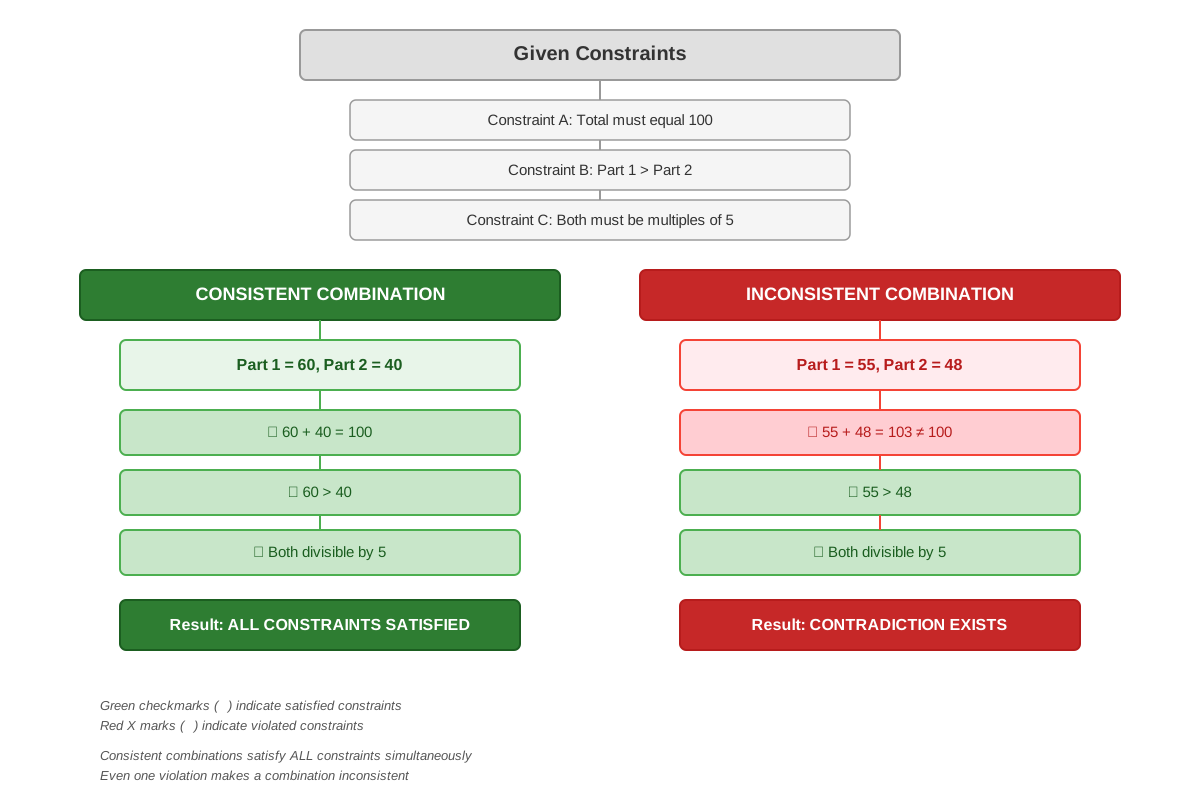
Logical consistency refers to a state where all statements, conditions, or constraints within a problem can be simultaneously true without creating any contradictions. In GMAT Two-Part Analysis questions, this means selecting two answers that, when considered together, satisfy every requirement stated in the problem. A logically consistent solution set creates no conflicts—every constraint is honored, every condition is met, and no statement contradicts another.
The opposite—logical inconsistency—occurs when selected answers create at least one violation. For example, if a problem states "the total budget is $100,000" and requires selecting a marketing expense and an operations expense, choosing $60,000 for marketing and $50,000 for operations creates inconsistency because their sum ($110,000) exceeds the constraint. Even if each selection individually seems reasonable, their combination violates the stated condition.
Types of Constraints in Logical Consistency Problems
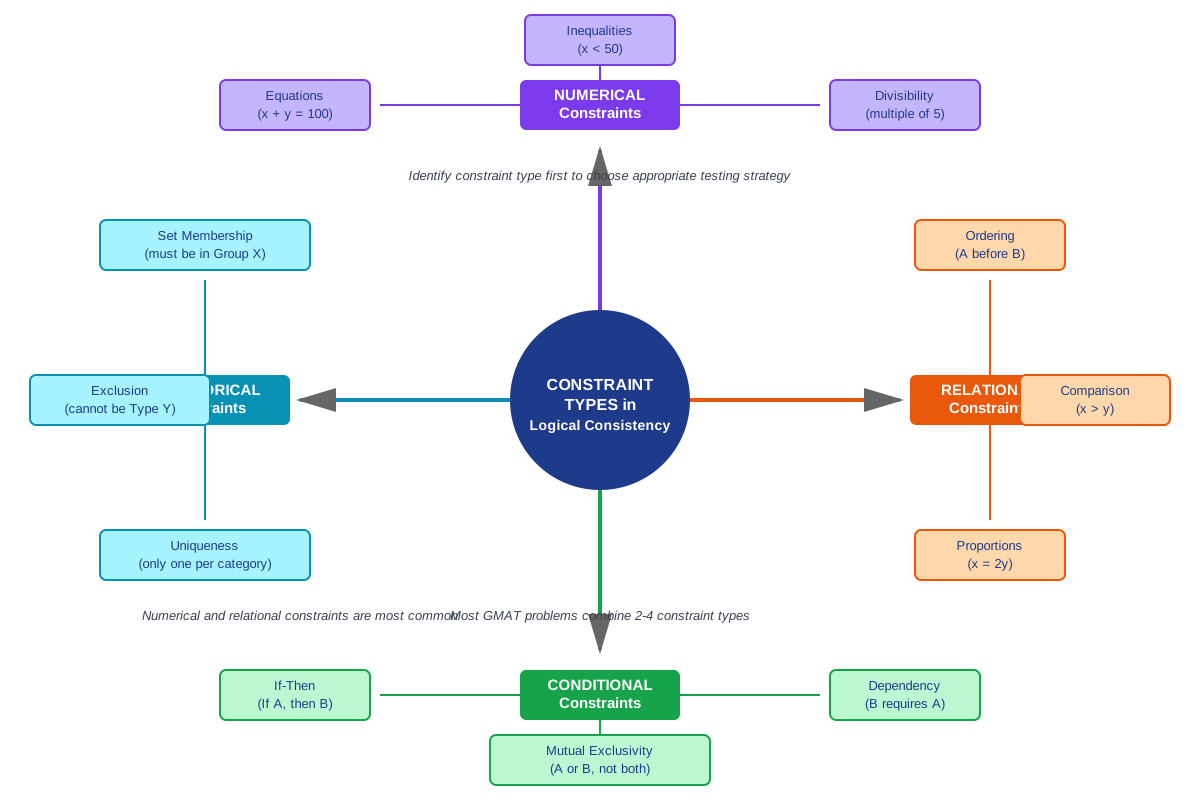
GMAT logical consistency questions typically involve three categories of constraints:
Numerical Constraints: These involve mathematical relationships such as equations, inequalities, sums, differences, ratios, or percentages. For example: "The combined experience of two employees must be at least 15 years" or "Department A's budget must be 20% more than Department B's budget." These constraints require arithmetic verification.
Conditional Constraints: These establish dependencies using "if-then" logic. For example: "If Project X is selected, then Project Y cannot be selected" or "The manager can attend the meeting only if the report is completed by Tuesday." These constraints create logical chains that limit valid combinations.
Categorical Constraints: These involve classifications, groupings, or mutually exclusive categories. For example: "One selection must be from the morning shift and one from the evening shift" or "Choose one fixed cost and one variable cost." These constraints ensure diversity or separation in the answer set.
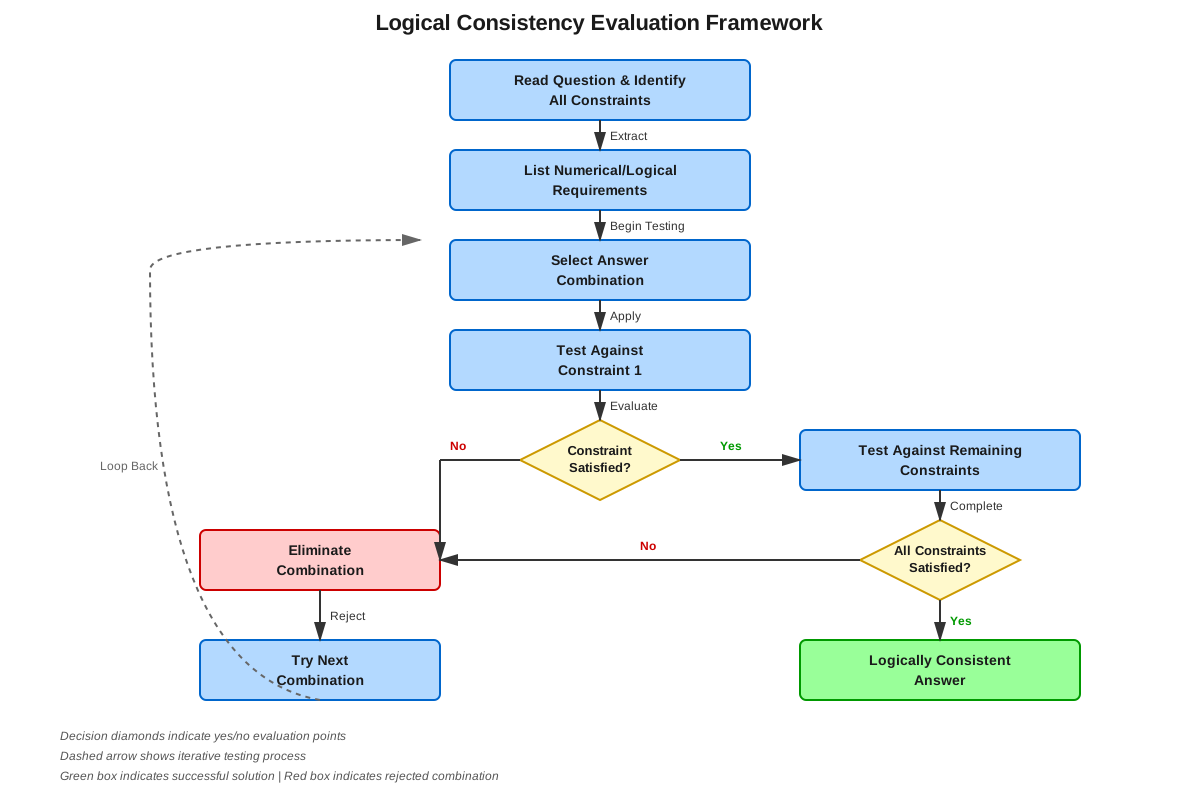
The Systematic Testing Approach
Solving logical consistency problems efficiently requires a structured methodology:
- Extract all constraints: Read the problem carefully and list every stated requirement, condition, or limitation
- Identify constraint types: Classify each constraint as numerical, conditional, or categorical
- Determine dependencies: Note which constraints interact or create chains of requirements
- Test systematically: Rather than random guessing, test answer combinations methodically
- Eliminate violations: As soon as a combination violates any constraint, eliminate it immediately
- Verify completely: Before finalizing, confirm the selected pair satisfies every single constraint
Common Logical Consistency Patterns
| Pattern Type | Description | Example Scenario |
|---|---|---|
| Sum/Total Constraints | Two selections must sum to a specific value or range | Selecting two investments that total exactly $500,000 |
| Ratio/Proportion Constraints | Two selections must maintain a specific relationship | Choosing staff numbers where managers are 1/5 of total employees |
| Sequencing Constraints | Two selections must follow temporal or ordering rules | Selecting two project phases where one must precede the other |
| Mutual Exclusivity | Two selections cannot both be from the same category | Choosing one internal candidate and one external candidate |
| Conditional Dependency | One selection triggers requirements for the other | If selecting Option A, the second choice must satisfy condition X |
Working with Multiple Constraints Simultaneously
The hallmark of challenging logical consistency questions is the presence of multiple, interacting constraints. Consider a scenario with three constraints: (1) Total cost ≤ $80,000, (2) Item A costs 30% more than Item B, and (3) Both items must be from different vendors. To solve this:
- First, establish the mathematical relationship: if Item B costs $x, then Item A costs $1.3x
- Second, apply the sum constraint: $x + $1.3x ≤ $80,000, which simplifies to $2.3x ≤ $80,000, so $x ≤ $34,783
- Third, when examining answer choices, verify the vendor constraint for any pair satisfying the numerical constraints
This layered approach—addressing constraints sequentially while maintaining awareness of all requirements—prevents overlooking critical conditions.
The Role of Contradiction Detection
A powerful technique in logical consistency problems involves actively seeking contradictions. Rather than trying to prove an answer combination works, attempt to disprove it. Ask: "Does this combination violate any constraint?" This negative testing approach often reveals problems faster than positive verification. For instance, if a problem states "at least one selection must be a senior employee," immediately eliminate any answer pair where both selections are junior employees. This contradiction-focused mindset accelerates problem-solving and reduces errors.
Concept Relationships
Logical consistency serves as the integrating principle that connects multiple analytical skills. At the foundation, basic algebraic manipulation enables the translation of verbal constraints into mathematical expressions. These expressions then feed into logical consistency evaluation, where students determine whether proposed solutions satisfy all conditions simultaneously. This evaluation process relies heavily on conditional reasoning, particularly when constraints create if-then chains that limit valid combinations.
The relationship flows as follows: Problem Statement → Constraint Extraction → Mathematical Translation → Systematic Testing → Logical Consistency Verification → Answer Selection. Each stage depends on the previous one, and weakness in any stage compromises the entire solution process.
Within Two-Part Analysis questions specifically, logical consistency connects to answer interdependence—the recognition that the two selected answers are not independent choices but must function as a coordinated pair. This interdependence distinguishes Two-Part Analysis from standard multiple-choice questions and requires a different cognitive approach.
Logical consistency also relates to constraint satisfaction problems from computer science and operations research, where multiple conditions must be simultaneously satisfied. Students familiar with optimization concepts will recognize parallels to feasible regions in linear programming, where solutions must fall within boundaries defined by multiple inequalities.
High-Yield Facts
⭐ Logical consistency requires that ALL constraints be satisfied simultaneously—violating even one constraint makes an answer combination invalid
⭐ In Two-Part Analysis questions, the two selected answers must work together as a pair, not independently
⭐ Numerical constraints typically involve sums, differences, ratios, or inequalities that can be tested arithmetically
⭐ Conditional constraints create logical chains where selecting one option triggers requirements for the other selection
⭐ Systematic elimination of inconsistent pairs is faster than trying to identify the correct pair directly
- Categorical constraints often require that selections come from different groups or satisfy diversity requirements
- Multiple constraints typically interact, meaning satisfying one constraint may limit options for satisfying others
- The GMAT frequently disguises mathematical constraints within verbal descriptions requiring careful extraction
- Time-based constraints often involve sequencing, duration, or scheduling conflicts that must be resolved
- Budget and resource constraints usually require that allocations sum to a specific total without exceeding it
- Percentage-based constraints require careful attention to whether percentages apply to the same or different base values
- Mutually exclusive conditions mean that certain combinations are automatically invalid regardless of numerical values
- The correct answer pair will satisfy every constraint without exception—partial satisfaction is insufficient
Quick check — test yourself on Logical consistency so far.
Try Flashcards →Common Misconceptions
Misconception: Each answer in a Two-Part Analysis question can be evaluated independently without considering the other selection. → Correction: The defining characteristic of logical consistency questions is that the two answers must work together as a coordinated pair. Each selection constrains or enables the other, and both must be evaluated jointly against all stated conditions.
Misconception: If an answer choice satisfies most constraints, it's probably correct even if it violates one minor condition. → Correction: Logical consistency is binary—either all constraints are satisfied (consistent) or at least one is violated (inconsistent). There is no partial credit for "mostly consistent" answers. A single violation invalidates the entire answer combination.
Misconception: Testing every possible answer combination is the most reliable approach. → Correction: While theoretically comprehensive, testing all combinations is time-inefficient. Strategic elimination based on constraint violations allows students to narrow possibilities quickly. For example, if six options exist for each selection, that's 36 possible pairs—but identifying that certain options violate categorical constraints can eliminate entire rows or columns of possibilities.
Misconception: Numerical constraints are always more important than conditional or categorical constraints. → Correction: All constraint types carry equal weight. A combination that satisfies all numerical requirements but violates a conditional constraint (e.g., "if A then not B") is just as wrong as one that fails arithmetic tests. The GMAT intentionally creates problems where different constraint types interact.
Misconception: The first answer combination that satisfies all visible constraints must be correct. → Correction: Some constraints are subtle or embedded within problem text. Students must extract all constraints before testing combinations. Additionally, the GMAT may present answer choices in an order designed to make incorrect but plausible combinations appear early, testing whether students verify comprehensively.
Misconception: Logical consistency questions always involve complex mathematics. → Correction: Many logical consistency questions involve simple arithmetic or no calculation at all, instead testing pure logical reasoning about categories, sequences, or conditional relationships. The complexity lies in managing multiple constraints simultaneously, not necessarily in computational difficulty.
Worked Examples
Example 1: Budget Allocation with Multiple Constraints
Problem: A company has $150,000 to allocate between two departments. The Operations department requires at least $60,000. The Marketing department's allocation must be at least 40% of the Operations department's allocation. Additionally, the Marketing department cannot receive more than $50,000. Select one allocation for Operations and one for Marketing that together satisfy all constraints.
| Operations | Marketing |
|---|---|
| $60,000 | $30,000 |
| $70,000 | $40,000 |
| $80,000 | $50,000 |
| $90,000 | $50,000 |
| $100,000 | $50,000 |
Solution Process:
Step 1 - Extract Constraints:
- Total budget: Operations + Marketing = $150,000
- Operations ≥ $60,000
- Marketing ≥ 0.40 × Operations
- Marketing ≤ $50,000
Step 2 - Test Systematically:
Testing Operations = $60,000, Marketing = $30,000:
- Sum: $60,000 + $30,000 = $90,000 ≠ $150,000 ✗ (violates total budget)
Testing Operations = $70,000, Marketing = $40,000:
- Sum: $70,000 + $40,000 = $110,000 ≠ $150,000 ✗ (violates total budget)
Testing Operations = $80,000, Marketing = $50,000:
- Sum: $80,000 + $50,000 = $130,000 ≠ $150,000 ✗ (violates total budget)
Testing Operations = $90,000, Marketing = $50,000:
- Sum: $90,000 + $50,000 = $140,000 ≠ $150,000 ✗ (violates total budget)
Testing Operations = $100,000, Marketing = $50,000:
- Sum: $100,000 + $50,000 = $150,000 ✓
- Operations ≥ $60,000: $100,000 ≥ $60,000 ✓
- Marketing ≥ 0.40 × Operations: $50,000 ≥ 0.40 × $100,000 = $40,000 ✓
- Marketing ≤ $50,000: $50,000 ≤ $50,000 ✓
Answer: Operations = $100,000, Marketing = $50,000
Key Insight: This problem demonstrates how multiple numerical constraints interact. The Marketing ceiling of $50,000 combined with the total budget constraint forces Operations to be exactly $100,000. The 40% minimum requirement is satisfied but not binding in the final solution.
Example 2: Conditional Logic with Scheduling
Problem: A manager must schedule two meetings: one in the morning (9 AM or 11 AM) and one in the afternoon (2 PM or 4 PM). The following conditions apply: (1) If the morning meeting is at 9 AM, the afternoon meeting must be at 4 PM to allow preparation time. (2) The 2 PM slot is only available if the morning meeting is at 11 AM. (3) At least one meeting must be at an even-numbered hour. Select one morning time and one afternoon time that satisfy all conditions.
| Morning | Afternoon |
|---|---|
| 9 AM | 2 PM |
| 9 AM | 4 PM |
| 11 AM | 2 PM |
| 11 AM | 4 PM |
Solution Process:
Step 1 - Extract Constraints:
- Conditional 1: If Morning = 9 AM, then Afternoon = 4 PM
- Conditional 2: If Afternoon = 2 PM, then Morning = 11 AM (contrapositive: If Morning ≠ 11 AM, then Afternoon ≠ 2 PM)
- Categorical: At least one meeting at an even hour (2 PM or 4 PM)
Step 2 - Test Each Combination:
Testing Morning = 9 AM, Afternoon = 2 PM:
- Conditional 1: 9 AM requires 4 PM, but we selected 2 PM ✗ (violates Conditional 1)
Testing Morning = 9 AM, Afternoon = 4 PM:
- Conditional 1: 9 AM requires 4 PM ✓
- Conditional 2: 2 PM not selected, so no constraint ✓
- Categorical: 4 PM is even ✓
- This combination works!
Testing Morning = 11 AM, Afternoon = 2 PM:
- Conditional 1: Not triggered (morning ≠ 9 AM) ✓
- Conditional 2: 2 PM requires 11 AM ✓
- Categorical: 2 PM is even ✓
- This combination also works!
Testing Morning = 11 AM, Afternoon = 4 PM:
- Conditional 1: Not triggered ✓
- Conditional 2: 2 PM not selected, so no constraint ✓
- Categorical: 4 PM is even ✓
- This combination also works!
Answer: Multiple valid combinations exist: (9 AM, 4 PM), (11 AM, 2 PM), or (11 AM, 4 PM). The question would specify which to select based on additional context or ask for a specific pairing.
Key Insight: This problem illustrates how conditional constraints create logical chains. The contrapositive of Conditional 2 eliminates the (9 AM, 2 PM) combination. Understanding logical equivalences accelerates solution identification.
Exam Strategy
Approach Framework: Begin every logical consistency question by creating a constraint checklist. Physically write down or mentally enumerate every stated requirement before examining answer choices. This prevents overlooking subtle conditions embedded in problem text. The GMAT intentionally buries critical constraints within lengthy descriptions to test careful reading.
Trigger Words to Watch: Pay special attention to phrases like "must be," "cannot exceed," "at least," "no more than," "if...then," "only if," "requires that," "provided that," and "both...and." These signal constraints that will determine logical consistency. Also watch for negative constructions like "neither...nor" and "cannot both be" which establish mutual exclusivity.
Elimination Strategy: Rather than seeking the correct answer directly, systematically eliminate inconsistent combinations. Start with the most restrictive constraint—the one that eliminates the most possibilities. For example, if a categorical constraint requires selections from different groups, immediately eliminate all same-group pairs. This reduces the solution space dramatically before testing numerical constraints.
Time Management: Allocate 2-2.5 minutes for logical consistency questions. Spend the first 30-45 seconds extracting and organizing constraints. Use the next 60-90 seconds testing combinations systematically. Reserve the final 30 seconds for verification. If testing all combinations would exceed time limits, focus on eliminating obviously inconsistent pairs first, then test remaining candidates.
Process of Elimination Tips:
- Eliminate answer choices that violate categorical constraints first (fastest to check)
- Next, eliminate choices violating conditional constraints (requires logical reasoning but no calculation)
- Finally, test remaining choices against numerical constraints (most time-consuming)
- If two answer choices for one selection both create inconsistencies with all options for the other selection, that answer choice cannot be part of the solution
Common Traps: The GMAT often includes answer combinations that satisfy most constraints but violate one subtle condition. These "almost correct" answers test thoroughness. Additionally, watch for answer choices that would be correct individually but create inconsistency when paired. The test exploits the tendency to evaluate options in isolation rather than as coordinated pairs.
Memory Techniques
SCAN Mnemonic for Constraint Types:
- Sums and numerical relationships
- Conditional if-then statements
- All-or-none categorical requirements
- Negative restrictions (cannot, must not)
The "Traffic Light" Visualization: Imagine each constraint as a traffic light. Green means the answer combination satisfies that constraint, red means violation. A logically consistent answer must show all green lights—even one red light invalidates the combination. This visual metaphor helps maintain awareness that all constraints must be satisfied.
The "Chain Link" Technique for Conditional Constraints: Visualize conditional statements as chain links. "If A then B" creates a link A→B. "If B then C" extends the chain to A→B→C. When evaluating answers, trace the chain to ensure no link breaks. A broken chain indicates logical inconsistency.
The "Budget Envelope" Method: For problems involving resource allocation, visualize a physical envelope containing the total budget. Each selection removes money from the envelope. If selections exceed the envelope's contents, inconsistency is immediately apparent. This concrete visualization prevents arithmetic errors in sum constraints.
Summary
Logical consistency represents a critical analytical skill tested throughout GMAT Data Insights, requiring students to identify answer combinations that simultaneously satisfy all stated constraints without creating contradictions. Success demands systematic extraction of numerical, conditional, and categorical constraints, followed by methodical testing of answer pairs against every requirement. The key insight is that logical consistency is binary—either all constraints are satisfied or the combination is invalid. Students must resist the temptation to evaluate answer choices independently, instead recognizing that Two-Part Analysis questions require coordinated pairs where each selection constrains the other. Efficient problem-solving involves strategic elimination of inconsistent combinations, starting with the most restrictive constraints and progressing to more complex numerical relationships. The GMAT tests this skill because it mirrors real business scenarios where multiple competing requirements must be balanced simultaneously—budget limitations, scheduling conflicts, resource constraints, and policy requirements all demand logically consistent solutions. Mastery requires practice in constraint extraction, systematic testing, and comprehensive verification before finalizing answers.
Key Takeaways
- Logical consistency requires satisfying ALL constraints simultaneously—partial satisfaction is insufficient and violating even one condition invalidates an answer combination
- Extract and categorize all constraints (numerical, conditional, categorical) before testing answer combinations to ensure comprehensive evaluation
- Two-Part Analysis answers must work as coordinated pairs, not independent selections—each choice constrains and enables the other
- Systematic elimination of inconsistent combinations is more time-efficient than random testing, especially when starting with the most restrictive constraints
- Conditional constraints create logical chains that must be traced completely—understanding contrapositives and logical equivalences accelerates solution identification
- The GMAT embeds constraints within verbal descriptions requiring careful reading—trigger words like "must," "cannot," "if...then," and "at least" signal critical conditions
- Verification is essential—before finalizing answers, confirm that the selected pair satisfies every single stated requirement without exception
Related Topics
Multi-Source Reasoning: Builds on logical consistency by requiring students to synthesize information from multiple sources (text, tables, graphics) and identify consistent conclusions across all sources. Mastering logical consistency provides the foundation for evaluating whether statements align with complex, multi-format data presentations.
Table Analysis: Extends logical consistency to data interpretation, where students must identify rows or entries that satisfy multiple filtering criteria simultaneously. The constraint-satisfaction skills developed in logical consistency transfer directly to complex table filtering tasks.
Integrated Reasoning - Graphics Interpretation: Applies logical consistency principles to visual data, requiring students to identify values or relationships that satisfy conditions represented graphically. Understanding how multiple constraints interact prepares students for interpreting multi-variable graphs.
Critical Reasoning - Assumption Questions: Shares the logical framework of identifying what must be true for conclusions to hold. The conditional reasoning skills developed in logical consistency enhance the ability to identify necessary assumptions in argument structures.
Practice CTA
Now that you've mastered the principles of logical consistency, it's time to cement your understanding through deliberate practice. Attempt the practice questions designed specifically for this topic, focusing on applying the systematic constraint-extraction and testing methodology outlined in this guide. Use the flashcards to reinforce high-yield facts and common patterns. Remember: logical consistency is a skill that improves dramatically with practice—each problem you solve strengthens your ability to manage multiple constraints simultaneously and identify valid answer combinations efficiently. Your investment in mastering this topic will pay dividends not only on test day but throughout your business school career and beyond!
Sign up free to keep reading
Create a free AnvayaPrep account to finish this GMAT guide on Logical consistency — plus flashcards and practice questions.