Overview
Distance rate time problems form one of the most frequently tested quantitative concepts on the GMAT, appearing in approximately 10-15% of all Quantitative Reasoning questions. These problems involve the fundamental relationship between how far something travels (distance), how fast it moves (rate or speed), and how long it takes (time). Mastering this topic is essential not only because of its high frequency on the exam but also because it serves as a foundation for more complex problem-solving scenarios involving relative motion, work rates, and optimization.
The beauty of GMAT distance rate time questions lies in their versatility. The exam presents these problems in various disguises: two trains moving toward each other, a cyclist traveling with and against the wind, a car making a round trip at different speeds, or even abstract scenarios involving rates of work completion. Understanding the core relationship—that distance equals rate multiplied by time (D = R × T)—provides the key to unlocking all these variations. However, the GMAT rarely tests this formula in isolation; instead, questions typically require setting up equations, working with multiple moving objects, or analyzing scenarios where rates or times change mid-journey.
Within the broader Quantitative Reasoning framework, distance rate time problems connect directly to algebraic equation-solving, ratio and proportion concepts, and unit conversion skills. They also frequently integrate with percentage calculations (such as speed increases or decreases) and average rate problems. The ability to translate word problems into mathematical equations—a critical GMAT skill—is particularly important for this topic, as most questions present scenarios in narrative form that must be converted into workable mathematical relationships.
Learning Objectives
- [ ] Identify Distance rate time relationships in GMAT problem scenarios
- [ ] Explain Distance rate time formulas and their variations
- [ ] Apply Distance rate time concepts to GMAT questions involving single and multiple objects
- [ ] Construct and solve equations for relative motion problems (objects moving toward or away from each other)
- [ ] Calculate average rates for trips with varying speeds across different segments
- [ ] Analyze round-trip scenarios where different rates apply to each direction
- [ ] Solve complex multi-step problems involving changing rates or interrupted journeys
Prerequisites
- Basic algebra and equation manipulation: Essential for isolating variables and solving for unknown quantities in distance-rate-time equations
- Unit awareness and conversion: Necessary for working with different time units (hours, minutes, seconds) and distance units (miles, kilometers, meters)
- Ratio and proportion understanding: Helps in comparing rates and setting up equivalent relationships
- Fraction and decimal operations: Required for calculations involving fractional speeds or time periods
- Word problem translation skills: Critical for converting narrative scenarios into mathematical expressions
Why This Topic Matters
Distance rate time problems appear in real-world contexts constantly: calculating travel times for commutes, determining fuel efficiency, planning project timelines, or optimizing delivery routes. The logical reasoning developed through these problems extends far beyond mathematics into strategic planning and resource allocation—skills highly valued in business school and management careers.
On the GMAT specifically, distance rate time questions appear in both Problem Solving and Data Sufficiency formats, with approximately 2-3 questions per exam. These questions typically fall into the medium-to-hard difficulty range, making them significant score differentiators. The GMAT favors questions that combine distance rate time with other concepts: you might encounter a problem involving percentages (a car increases speed by 20%), ratios (two trains travel at speeds in a 3:4 ratio), or averages (finding average speed for a multi-segment journey).
Common question formats include: relative motion problems where two objects move toward or away from each other; round-trip scenarios with different speeds in each direction; catch-up problems where a faster object pursues a slower one; average rate calculations for journeys with multiple segments; and time-to-meet problems involving objects starting at different times. Recognizing these patterns quickly allows for efficient problem-solving under time pressure.
Core Concepts
The Fundamental Formula
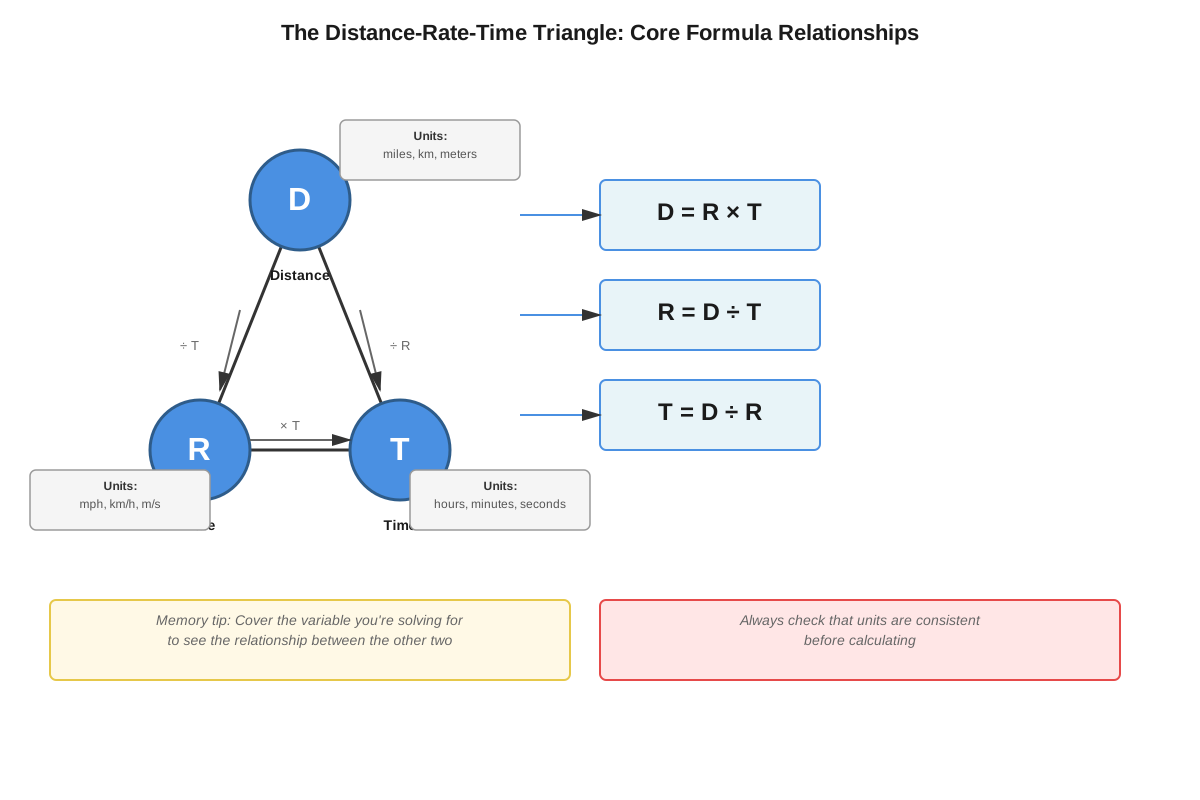
The cornerstone of all distance rate time problems is the relationship:
Distance = Rate × Time
D = R × T
This formula can be algebraically rearranged into three equivalent forms:
- D = R × T (distance equals rate times time)
- R = D / T (rate equals distance divided by time)
- T = D / R (time equals distance divided by rate)
Understanding when to use each form is crucial. If a problem asks "how fast," solve for rate; if it asks "how long," solve for time; if it asks "how far," solve for distance.
Units and Consistency
A critical aspect often tested on the GMAT involves unit consistency. All three variables must use compatible units. Common combinations include:
| Distance | Rate | Time |
|---|---|---|
| miles | miles per hour (mph) | hours |
| kilometers | kilometers per hour (km/h) | hours |
| meters | meters per second (m/s) | seconds |
| feet | feet per minute (ft/min) | minutes |
The GMAT frequently presents problems with mixed units—for example, giving a rate in miles per hour but asking for time in minutes. Converting units correctly is essential: remember that 1 hour = 60 minutes, so to convert hours to minutes, multiply by 60.
Relative Motion: Objects Moving Toward Each Other
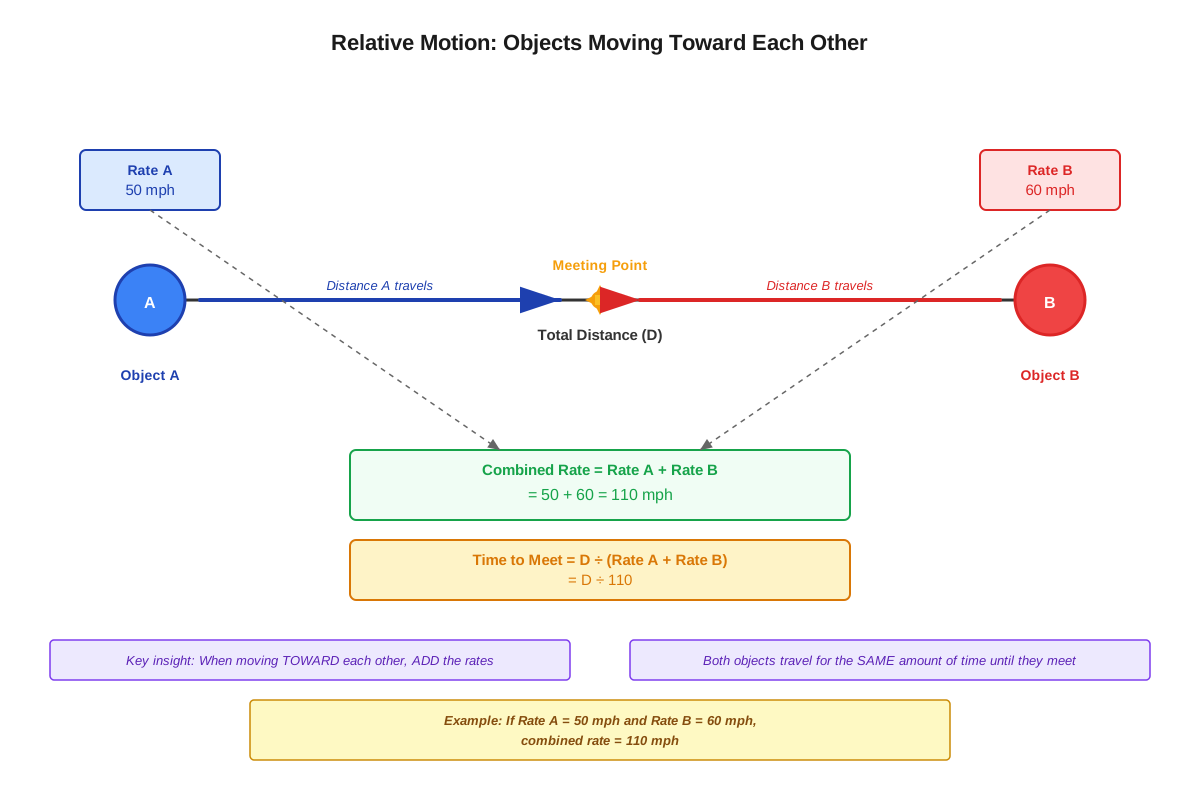
When two objects move toward each other, their rates effectively add together. If Train A travels at 60 mph and Train B travels at 40 mph toward each other, they close the distance between them at a combined rate of 100 mph.
The formula becomes:
Distance = (Rate₁ + Rate₂) × TimeThis concept applies when objects start at opposite ends of a distance and move toward a meeting point. The time until they meet equals the total distance divided by their combined rate.
Relative Motion: Objects Moving in the Same Direction
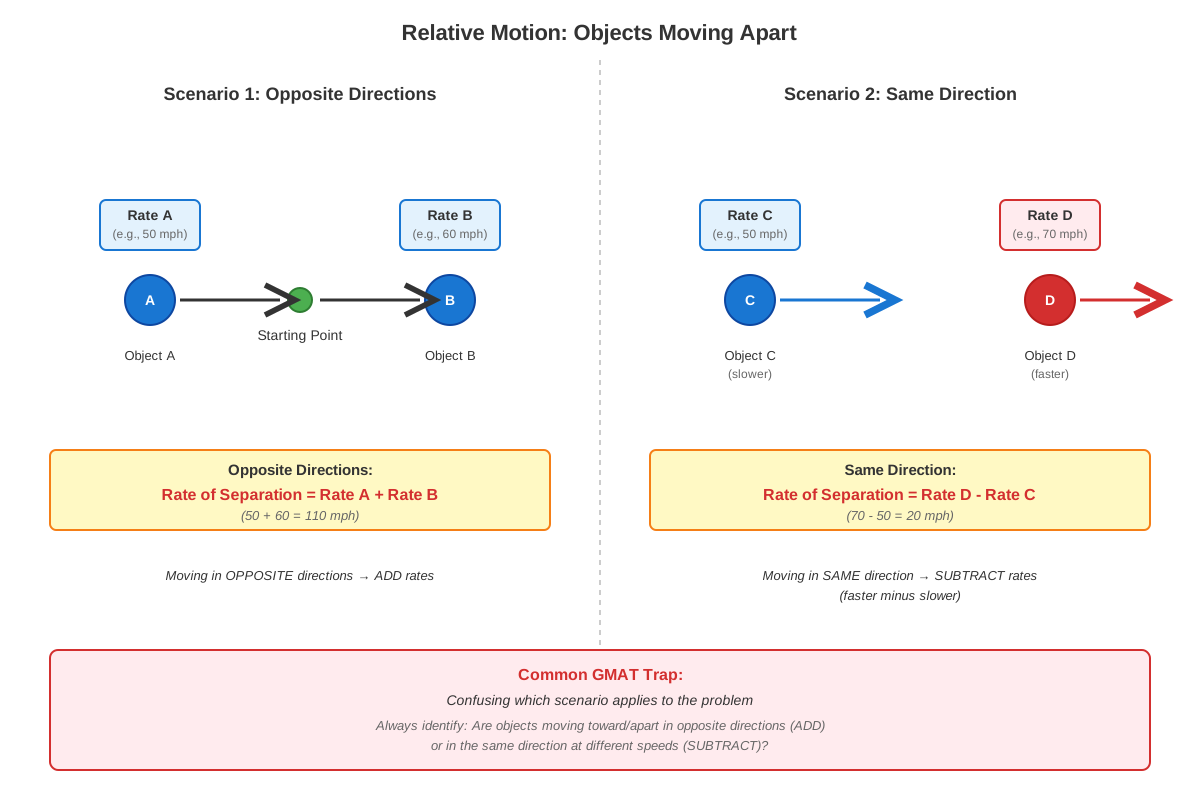
When two objects move in the same direction, their rates subtract. If a faster car traveling at 70 mph pursues a slower car traveling at 50 mph, the faster car closes the gap at a relative rate of 20 mph.
The formula becomes:
Distance = (Rate₁ - Rate₂) × TimeThis scenario commonly appears in "catch-up" problems where one object has a head start and another must overtake it.
Average Rate for Multi-Segment Journeys
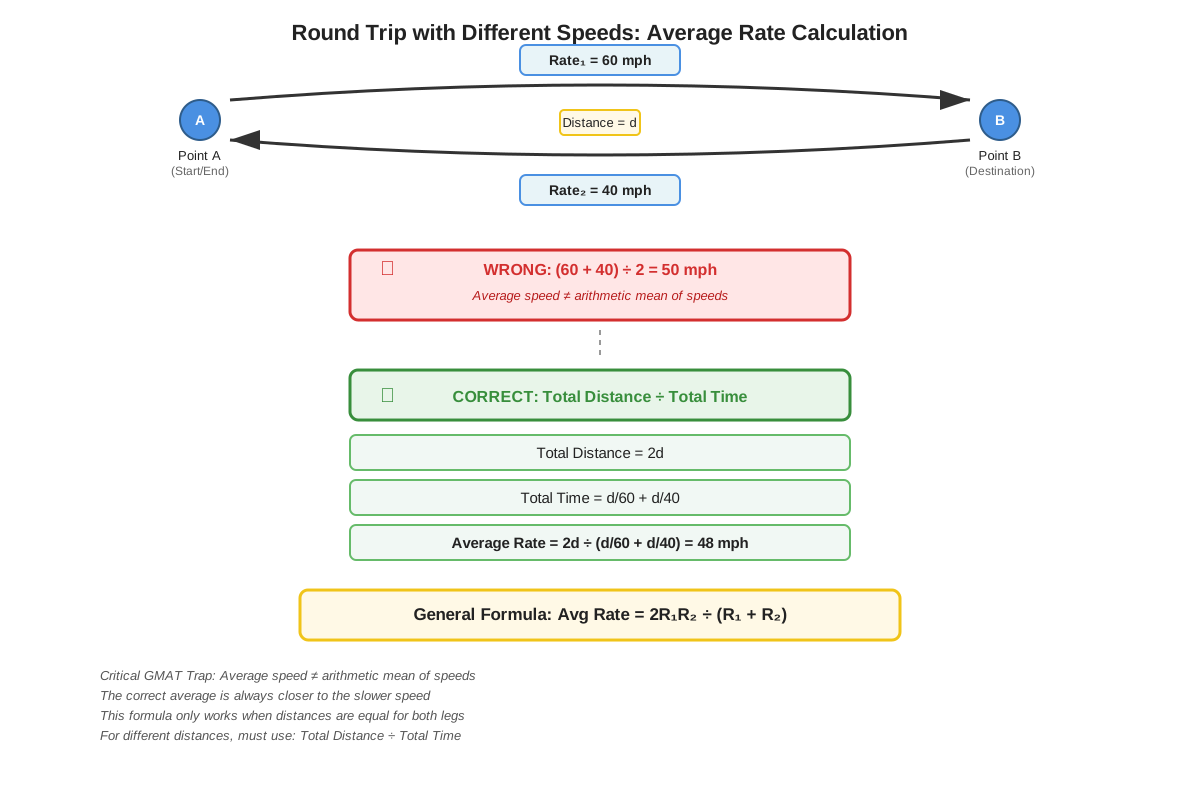
A frequent GMAT trap involves calculating average rate (or average speed). The average rate is NOT simply the arithmetic mean of the two rates. Instead:
Average Rate = Total Distance / Total TimeFor a round trip where the distance each way is the same but rates differ, you must calculate the time for each segment separately, sum them, then divide total distance by total time. This consistently yields a result closer to the slower speed, which surprises many test-takers.
Round-Trip Problems with Different Rates
When an object travels to a destination at one rate and returns at a different rate, set up the problem by:
- Defining the one-way distance as a variable (often d)
- Calculating time for the outbound journey: T₁ = d / R₁
- Calculating time for the return journey: T₂ = d / R₂
- Using the relationship that total distance = 2d and total time = T₁ + T₂
The average rate formula then becomes:
Average Rate = 2d / (d/R₁ + d/R₂) = 2R₁R₂ / (R₁ + R₂)This is the harmonic mean of the two rates, a high-yield concept for the GMAT.
Problems with Head Starts
Some problems involve one object starting before another. The key is to calculate how far the first object travels during its head start, then treat the remaining problem as a standard relative motion scenario. If Object A travels for 2 hours at 30 mph before Object B starts pursuing at 50 mph, Object A has a 60-mile head start. Object B closes this gap at a relative rate of 20 mph, taking 3 hours to catch up.
Concept Relationships
The distance rate time formula serves as the foundation, from which all other concepts branch. The fundamental formula (D = R × T) → leads to → unit consistency requirements, as all three variables must align in their measurement systems.
The fundamental formula → also leads to → relative motion concepts, which modify the basic formula by combining or subtracting rates depending on direction of travel. Relative motion toward each other and relative motion in the same direction are parallel concepts that apply the same principle (rate combination) in opposite ways.
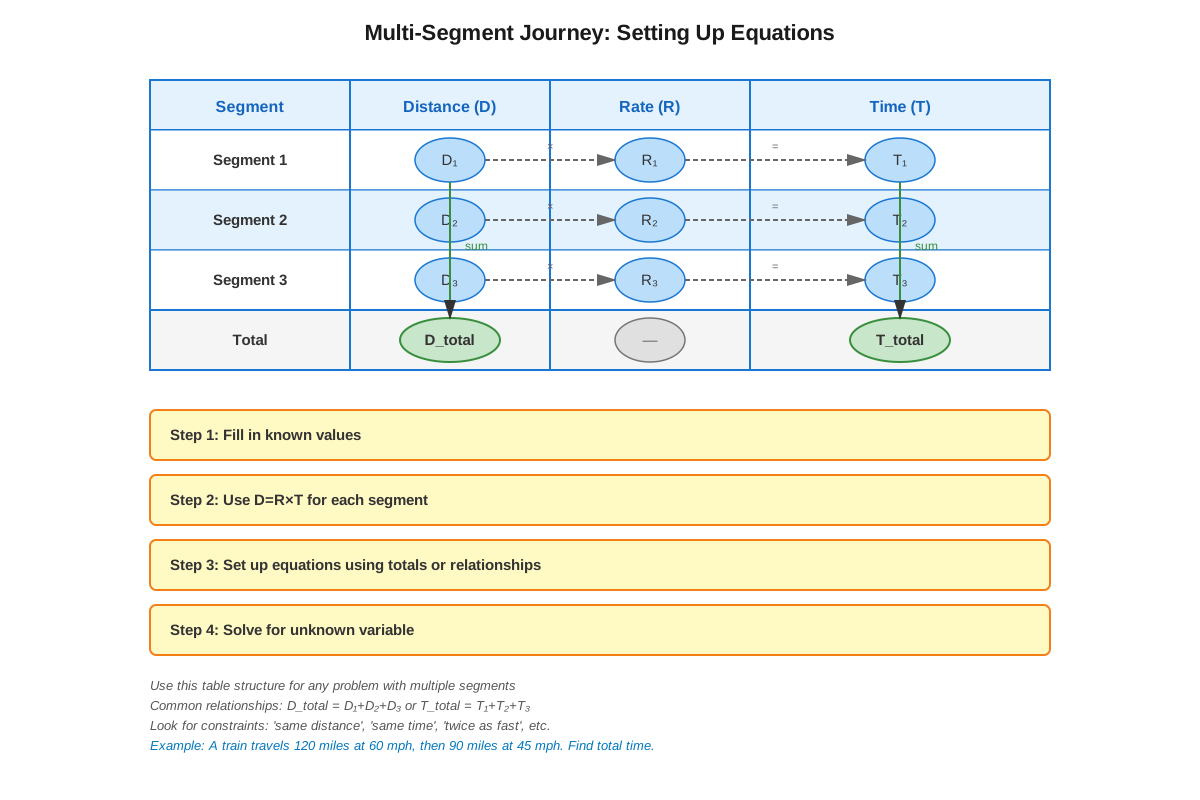
Multi-segment journey problems → build upon → the fundamental formula by requiring multiple applications of D = R × T for different portions of a trip, then combining results. This directly connects to average rate calculations, which require understanding that average rate equals total distance divided by total time, not the average of individual rates.
Round-trip problems → represent a specific application of → multi-segment journeys where the distance is the same in both directions but rates differ. These problems connect to the harmonic mean concept, which provides an efficient formula for calculating average rate in symmetric round trips.
Head start problems → combine → basic distance calculations with relative motion concepts, requiring students to first determine the initial separation, then apply relative rate formulas.
All these concepts connect back to prerequisite knowledge: algebraic manipulation enables solving for unknown variables, unit conversion ensures consistency, and word problem translation allows students to identify which concept applies to each scenario.
High-Yield Facts
⭐ The fundamental relationship is D = R × T, which can be rearranged to R = D/T or T = D/R depending on what you're solving for
⭐ When two objects move toward each other, add their rates; when moving in the same direction, subtract their rates
⭐ Average rate for a journey equals total distance divided by total time, NOT the average of the individual rates
⭐ For a round trip with equal distances at rates R₁ and R₂, the average rate is 2R₁R₂/(R₁ + R₂), which is the harmonic mean
⭐ Always check that units are consistent: if rate is in mph and time is in minutes, convert one to match the other
- When an object travels the same distance at two different speeds, the average speed is always closer to the slower speed
- In catch-up problems, the time to catch up equals the head start distance divided by the relative rate (difference in speeds)
- If distance is constant and rate increases by a factor of x, time decreases by a factor of x (inverse relationship)
- Converting hours to minutes requires multiplying by 60; converting minutes to hours requires dividing by 60
- The GMAT often provides rate in one form (like "60 miles in 90 minutes") requiring you to standardize it to a per-hour or per-minute rate
- Distance problems frequently combine with ratio concepts: if two rates are in ratio 3:4, you can express them as 3x and 4x
- For Data Sufficiency questions, knowing any two of the three variables (D, R, T) is sufficient to determine the third
Quick check — test yourself on Distance rate time so far.
Try Flashcards →Common Misconceptions
Misconception: Average speed for a round trip is the arithmetic mean of the two speeds → Correction: Average speed must be calculated as total distance divided by total time. For a round trip at 60 mph one way and 40 mph returning, the average is NOT 50 mph but rather 48 mph (using the harmonic mean formula). The average is always closer to the slower speed because more time is spent traveling at the slower rate.
Misconception: When two objects move toward each other, you should subtract their rates → Correction: When objects move toward each other, their rates ADD because they're collectively closing the distance between them faster. Subtraction applies only when objects move in the same direction, representing how quickly the faster object gains on the slower one.
Misconception: If a car travels 60 miles in 90 minutes, its rate is 60/90 = 0.67 mph → Correction: Rate must be expressed in consistent units. Since rate is typically miles per hour, convert 90 minutes to 1.5 hours, giving a rate of 60/1.5 = 40 mph. Alternatively, express as miles per minute: 60/90 = 2/3 mile per minute.
Misconception: In a head start problem, the faster object catches up when it has traveled the same distance as the slower object → Correction: The faster object catches up when it has traveled the head start distance MORE than the slower object has traveled since the pursuit began. If the slower object had a 30-mile head start and has traveled 45 miles since being pursued, the faster object must have traveled 75 miles total to catch up.
Misconception: Doubling your speed doubles your distance in the same time → Correction: This is actually TRUE and represents the direct proportionality between rate and distance when time is constant. However, the misconception often involves thinking that doubling speed also doubles time, which is false—doubling speed actually halves the time for the same distance.
Misconception: You can solve any distance-rate-time problem with just the D = R × T formula → Correction: While D = R × T is fundamental, complex GMAT problems require setting up systems of equations, understanding relative motion, or applying the average rate formula. Simply plugging numbers into D = R × T without understanding the problem structure leads to errors.
Worked Examples
Example 1: Relative Motion Problem
Problem: Two trains are 450 miles apart and traveling toward each other on parallel tracks. Train A travels at 60 mph, and Train B travels at 75 mph. If they start at the same time, how long will it take until they meet?
Solution:
Step 1: Identify the problem type. This is a relative motion problem with objects moving toward each other.
Step 2: Recognize that when moving toward each other, rates add:
Combined rate = 60 mph + 75 mph = 135 mph
Step 3: Apply the distance formula, solving for time:
D = R × T
450 = 135 × T
T = 450/135
T = 10/3 hours
T = 3 hours and 20 minutes (or 3.33 hours)
Step 4: Verify the answer makes sense. In 3.33 hours, Train A travels 60 × 3.33 = 200 miles, and Train B travels 75 × 3.33 = 250 miles. Together: 200 + 250 = 450 miles ✓
Connection to Learning Objectives: This problem demonstrates the application of distance rate time concepts to relative motion scenarios, specifically identifying when to add rates (objects moving toward each other).
Example 2: Average Rate for Round Trip
Problem: Sarah drives from City A to City B at an average speed of 40 mph. She returns from City B to City A along the same route at an average speed of 60 mph. What is her average speed for the entire round trip?
Solution:
Step 1: Recognize this is a round-trip problem where average rate ≠ arithmetic mean. The trap answer would be (40 + 60)/2 = 50 mph.
Step 2: Let the one-way distance = d miles.
Step 3: Calculate time for each segment:
Time to City B: T₁ = d/40 hours
Time returning: T₂ = d/60 hours
Step 4: Calculate total distance and total time:
Total distance = 2d miles
Total time = d/40 + d/60 hours
Step 5: Find a common denominator for the time calculation:
Total time = 3d/120 + 2d/120 = 5d/120 = d/24 hours
Step 6: Apply the average rate formula:
Average rate = Total distance / Total time
Average rate = 2d / (d/24)
Average rate = 2d × 24/d
Average rate = 48 mph
Alternative approach using harmonic mean formula:
Average rate = 2R₁R₂/(R₁ + R₂) = 2(40)(60)/(40 + 60) = 4800/100 = 48 mph
Step 7: Note that 48 mph is closer to the slower speed (40 mph) than the faster speed (60 mph), which confirms the principle that more time is spent at the slower rate.
Connection to Learning Objectives: This problem demonstrates why average rate must be calculated using total distance divided by total time, and shows the application of the harmonic mean formula for symmetric round trips.
Exam Strategy
When approaching GMAT distance rate time questions, begin by identifying the problem type: single object, relative motion (toward or away), round trip, or multi-segment journey. This classification immediately suggests which formula variation to apply.
Trigger words and phrases to watch for include:
- "Toward each other" or "approaching" → add rates
- "Same direction" or "catch up" → subtract rates
- "Average speed" or "average rate" → use total distance/total time, not arithmetic mean
- "Returns along the same route" → round-trip problem requiring harmonic mean
- "Starts 2 hours earlier" → head start problem requiring initial distance calculation
For Data Sufficiency questions, remember that knowing any two of the three variables (distance, rate, time) is sufficient to determine the third. However, be cautious with average rate problems: knowing the two individual rates for a round trip IS sufficient to determine average rate, but you need the actual distances if the segments aren't equal.
Process-of-elimination tips:
- Eliminate answer choices that violate unit consistency (e.g., if the question asks for time in hours, eliminate answers in minutes unless you convert)
- For average rate problems, immediately eliminate the arithmetic mean of the two rates—it's almost always a trap answer
- If two objects are moving toward each other, eliminate any answer that uses subtracted rates
- Check extreme cases: if one rate is much slower than another in a round trip, the average should be much closer to the slower rate
Time allocation: Spend 15-20 seconds identifying the problem type and setting up your equation structure. Don't rush into calculations—GMAT distance problems reward careful setup over computational speed. If a problem seems to require extensive calculation, look for a shortcut or formula (like the harmonic mean for round trips). Budget 2-2.5 minutes total for medium difficulty distance rate time problems.
Setup strategy: For complex problems, create a table with columns for Distance, Rate, and Time, with a row for each segment or object. This visual organization prevents errors and makes relationships clearer. Label your variables clearly (d₁, d₂, r₁, r₂, t₁, t₂) to avoid confusion.
Memory Techniques
DRT Triangle: Visualize a triangle with D at the top, R and T at the bottom corners. Cover the variable you're solving for, and the remaining two show the operation: cover D and you see R × T; cover R and you see D/T; cover T and you see D/R.
"TOWARD = ADD, AWAY = SUBTRACT": For relative motion, remember that objects moving toward each other ADD rates (they're working together to close distance), while objects moving in the same direction SUBTRACT rates (measuring the gap-closing rate).
"Harmonic Mean for Home and Back": The alliteration helps remember that round-trip average rates use the harmonic mean formula: 2R₁R₂/(R₁ + R₂). The word "harmonic" contains "harm," reminding you that simply averaging the rates would "harm" your score.
"Slow Time Dominates": For round trips, remember that average speed is closer to the slower speed because you spend more TIME at the slower rate. The word "dominates" emphasizes that the slower speed has greater influence.
Unit Conversion Rhyme: "Sixty minutes make an hour, multiply or divide with power" — multiply by 60 to convert hours to minutes, divide by 60 to convert minutes to hours.
"Two Known, Third Shown": For Data Sufficiency, remember that any two of Distance, Rate, and Time being known means the third can be calculated (sufficient).
Summary
Distance rate time problems represent a high-yield GMAT topic that tests both mathematical skills and logical reasoning. The fundamental relationship D = R × T serves as the foundation, but success requires understanding its variations: relative motion problems where rates combine (adding when moving toward each other, subtracting when moving in the same direction), average rate calculations that require total distance divided by total time rather than arithmetic means, and round-trip scenarios where the harmonic mean formula provides an efficient solution. Unit consistency is critical—all three variables must use compatible measurements, requiring frequent conversions between hours and minutes. The GMAT tests these concepts through word problems that demand careful translation into mathematical equations, often combining distance rate time with other quantitative topics like ratios, percentages, or algebra. Mastering this topic requires recognizing problem patterns quickly, setting up equations systematically, and avoiding common traps like using arithmetic means for average rates or applying the wrong relative motion formula.
Key Takeaways
- The fundamental formula D = R × T can be rearranged to solve for any variable, but all three must use consistent units
- Relative motion toward each other requires adding rates; same-direction motion requires subtracting rates
- Average rate always equals total distance divided by total time, never the arithmetic mean of individual rates
- For round trips with equal distances at different speeds, use the harmonic mean formula: 2R₁R₂/(R₁ + R₂)
- Identify problem type first (single object, relative motion, round trip, multi-segment) to determine the appropriate approach
- In Data Sufficiency questions, any two of the three variables (D, R, T) being known makes the third determinable
- Set up complex problems using tables or systematic variable labeling to prevent errors and clarify relationships
Related Topics
Work Rate Problems: These apply the same D = R × T framework but with "work completed" replacing distance and "rate of work" replacing speed. Mastering distance rate time provides direct preparation for work rate questions, which appear with similar frequency on the GMAT.
Ratio and Proportion: Many distance rate time problems incorporate ratios (two trains travel at speeds in a 3:5 ratio), making ratio fluency essential for advanced problems. Understanding proportional relationships enhances problem-solving efficiency.
Percentage Applications: Speed increases or decreases are often expressed as percentages (a car travels 25% faster on the return trip), requiring integration of percentage calculations with distance rate time formulas.
Algebraic Word Problems: Distance rate time questions exemplify the broader skill of translating narrative scenarios into mathematical equations, a competency that applies across all GMAT Quantitative Reasoning word problems.
Average Calculations: Understanding why average rate differs from arithmetic mean of rates connects to broader concepts about weighted averages and harmonic means, which appear in various GMAT contexts.
Practice CTA
Now that you've mastered the core concepts of distance rate time problems, it's time to solidify your understanding through practice. Attempt the practice questions associated with this topic, focusing on identifying problem types quickly and setting up equations systematically before calculating. Use the flashcards to reinforce formulas and key concepts until they become automatic. Remember, the GMAT rewards pattern recognition and efficient problem-solving—each practice problem you complete builds the mental frameworks that will save you valuable time on test day. Approach each question strategically, and don't hesitate to review this guide when you encounter concepts that need reinforcement. Your investment in mastering this high-yield topic will pay dividends across multiple questions on exam day!
Sign up free to keep reading
Create a free AnvayaPrep account to finish this GMAT guide on Distance rate time — plus flashcards and practice questions.